As I made my way from the grassy parking lot to the chateau, I wondered why I had only heard of Stránov that year, in 2025. After all, Stránov had been open to the public since 2004, even though reconstruction was in progress back then. The chateau looked impressive and romantic with a Neo-Renaissance appearance thanks to a 19th century transformation.
I walked into the café/box office to buy my ticket. The room was quaint with dark paneling. Then I walked into the courtyard dotted with white tables and chairs, and I gazed at the elegant Neo-Renaissance arcades. A distinctive sandstone fountain also caught my attention. From the courtyard I could see a narrow garden area below. People were seated at the white chairs and small tables in the garden. The plant species and flowers were colorful and enthralling.
The guide explained that a Gothic castle had been built on the site in the 15th century, replacing a fortress. Indeed, a Gothic tower still was a dominant feature of the chateau. It was even possible to climb it and take in the views. At the end of the 16th century, the castle got a Renaissance makeover and became a chateau for residential living. During the 18th century, more reconstruction was carried out – this time the chateau turned into a Baroque gem. The garden was also created during this period. The following century Stránov was made into the Neo-Renaissance structure that it is today.
However, the most important time in the chateau’s history began in 1917, when Josef Šimonek, a senator and entrepreneur with the Škoda auto manufacturer, purchased it. He had been so successful and well-respected in the business world that a noble title had been bestowed upon him.
During the First Republic, when Czechoslovakia was a democratic country under the guidance of President Tomáš Garrigue Masaryk, Šimonek, his wife Božena and their two sons, Jaromír and Jiří, made the chateau their home. Black-and-white photographs of the family dotted the rooms as did a group photograph of a joyous acting ensemble that had shot a film there long ago. I saw artifacts from the sons’ childhood – a sled made in 1929 and well-worn miniature toy cars. A children’s theater stage with figures of a skeleton, king and queen caught my attention. The decoration on it was exquisitely hand-painted. The father even created a small zoo for the children.
Although Šimonek retired from Škoda Auto in 1918, he remained a senator in Parliament until he died in 1934. His son František resided there with his family until the Communists forced them to flee in 1950. František’s mother, Božena, left with her husband’s urn in a basket, never to return. She found shelter in a parish house without running water. She lived there until her death in 1976. I saw the suitcases members of the family had carried when they had to leave their home.
Once nationalized, the chateau became an orphanage. The Šimonek family didn’t get the chateau back until 2003. Before the arrival of the Communists in 1950, there had been 750 pieces of furnishings and objects. Returned to the family in the early 2000s were only 35 of those. Stránov was open it to the public during 2004 even though reconstruction was taking place.
Photo of acting ensemble that shot a film at the chateau many decades ago
Another relative also named Jaromír Šimonek, born in 1945, had called the nearby chateau Lobeč home for five years before being forced out with his family by the Communists in 1950. Growing up, he had his hopes set on studying about machines in Mladá Boleslav, a nearby town. However, the Communists did not permit him to study for his desired profession. He did, though, wind up learning how to repair agricultural machines and took a serious interest in mechanics. Later, he followed in his family’s footsteps and went to work at Škoda Auto. Eventually, he became the mayor of Lobeč. He died in 2021.
The interior of the chateau harkened back to the First Republic. The current owner had furnishings made to look like they had been created during that era, my favorite period of Czechoslovak history. There were a few original furnishings that had been preserved for use in the orphanage.
The interior was cozy with an atmosphere that made me want to open a good book and relax there. In one room with wine red-upholstered chairs and a table with a tea service, I could imagine having a cup of Earl Grey on a wintry evening while discussing the Čapeks’ latest play. I could imagine people seated in armchairs or at tables there, talking animatedly about what was new with Masaryk’s politics, Karel Čapek’s books and Josef Čapek’s artwork. While some of the paintings on the wall were for sale, others harkened back to past eras. The dining room chairs looked elegant with the family coat-of-arms decorating the backs. A beautiful piano also was on display.
In the large space used for weddings, I saw red upholstered chairs with tables complementing the red and gold striped curtains that gave the place an elegant look. I wanted to fall into the quaint wine red leather couch. I noticed the beautiful Bohemian crystal chandelier. On the wall a painting caught my eye. The tranquil landscape featured a calm river with homes dotting the embankment.
The chateau included a toy museum with old objects donated by a private collector. I saw early 20th century dolls of girls in folk costumes and once much loved teddy bears of various sizes. Children’s baby carriages and dolls of various sizes graced the exhibition room. A rocking horse was also on display. I loved the miniature furniture, such as a cabinet filled with plates and tea cups. I also peered in one hallway at original folk costumes, exquisitely made.
I came away from the tour with a warm feeling for my favorite period in Czechoslovak history. I imagined raucous boys playing with miniature cars in the rooms as their father told them to keep the noise down while he read Lidové noviny. The furnishings had brought the chateau to life, giving it a distinct family atmosphere.
Tracy A. Burns is a writer, proofreader and editor in Prague.
Original armchairs made for Josef Šimonek during the First Republic
Whenever I come across a Cubist sculpture by Otto Gutfreund in a Czech gallery or museum, I take some time to appreciate the personal feelings that come to mind as I study the masterful figures. While I was perusing the impressive collection of Gutfreund’s works in Prague’s Kampa Museum, I was reminded that this was not the only style he employed in his career. As I studied the creations by Gutfreund there, I mused over the legendary sculpture’s career and the tragedy that befell him.
Lovers (Embracing Figures), 1913-14, bronze
Born in Dvůr Králové nad Labem in Bohemia during 1889, Gutfreund studied drawing and porcelain painting in Prague before turning to sculpture. In Paris his mentor was Antoine Bourdelle. Gutfreund was greatly influenced by the works of Auguste Rodin, whom he knew personally. While in Paris, he also became fascinated with Gothic art and nature. His travels then took him to England, Belgium and the Netherlands. He became immersed in the Cubist style after 1910 as he simplified natural forms into geometric shapes and showed objects and figures from multiple perspectives.
Cellist (Cello Player), 1912-13, bronze.
He made a name for himself as a Cubist guru with his first sculpture in this style, “Anxiety,” of 1911-12. Gutfreund joined the Group of Creative Artists around this time. This emotional and expressive work is my favorite as it stresses the sheer angst and fear that can be debilitating and personally destructive. It reminds me of the anxiety shown in works by Egon Schiele and the German Expressionists of the 1920s. I also see similarities to the emotion-immersed sculptures of František Bílek, a Czech Art Nouveau and Symbolist artist.
Cubist bust, 1913-14, bronze
Some of Gutfreund’s most renowned early Cubist works include his renditions of Don Quixote and Hamlet. Then, becoming more and more inspired by Picasso, he moved to Paris, where he met that artist as well as Apollinaire, to name a few.
World War I brought many changes to Gutfreund’s life. He became a soldier for the Foreign Legion in France and took part in the Battle of the Somme. He wound up in prison during 1916 and wasn’t released until three years later.
Viki, 1912-13, bronze
Two months after being freed, he moved back to Prague and was lauded as a sculptor of the social civilism style, which emphasized the everyday and was very realistic, nothing like the expressive Cubist movement in which he had participated before the war.
In the early 1920s, he received some big commissions. At this time, he created the monument to 19th century writer Božena Němcová in Ratibořice. The sculptural grouping showed off characters in Němcová’s stellar novel, The Grandmother, a 19th century Czech classic.
Industry, Study (sculpture on the right), 1923.
From 1922 to 1923, Gutfreund decorated the Legiobanka Building in Prague with a relief called “The Legions’ Return,” cooperating with renowned Czech architect Josef Gočár. In 1924 he designed a life-size statue of the first president of Czechoslovakia, Tomáš Garrigue Masaryk in Hradec Králové. I greatly admired likenesses of the first Czechoslovak president. Gutfreund held art shows, adding to his résumé of artistic mastery. During 1926 he became a professor of sculpture at Prague’s College of Decorative Arts, and Americans had the chance to admire his works in a New York City exhibition.
Fighters (A Fight, Wrestlers), 1924, bronze.
Unfortunately, his life was short-lived. On June 2, 1927, he drowned in the Vltava River in Prague. He accomplished so much in such a short time. If he had lived, there is no telling how much he could have influenced the Czechoslovak and world art scene. Gutfreund is buried in Prague.
At the Museum Kampa visitors can see a collection of both his Cubist and realistic sculptures as Otto Gutfreund lives on through his incredible art. It is worth traveling to Ratibořice to see the stunning chateau and park dedicated to Němcová and 19th century country life as well as the impressive statuary grouping by Gutfreund. Admirers of sculpture and architecture are sure to be amazed by Prague’s Legiobanka Building in the center of the city.
Tracy A. Burns is a writer, proofreader and editor in Prague.
Statuary grouping from Němcová’s book The Grandmother, by Otto Gutfreund, in Ratibořice
Early in 2023, I went to an exhibition of sculpture by late Croatian sculptor, architect and writer Ivan Meštrović. The art gallery at Prague’s main library hosted the intriguing show. I was familiar with the artist’s name: I had admired his villa, the Ivan Meštrović Gallery, in Split on my last trip to Croatia some years ago. It contained 86 sculptures made with various materials, showing off his dramatic, dynamic and expressive style that was both poetic and poignant. Drawings and reliefs were displayed, too. The bronze statue-dotted garden was delightful. One of my favorite things about traveling was being introduced to the works of various artists. I was enamored with Meštrović’s creations, and his unique, powerful style was forever embedded in my memory.
During Meštrović’s illustrious career that spanned six decades, he had been influenced by a number of styles ranging from Art Nouveau, Symbolism, Impressionism, Art Deco, Neoclassicism and Late Realism. Classicism played a major role in shaping his artistic style, too. Auguste Rodin’s naturalist style, which he had meticulously studied, greatly inspired him. During his extensive travels, Meštrović also saw Michelangelo’s creations, which affected his own work. poignant.
Meštrović’s subjects were diverse as well. He took on religious themes, created portrait busts, made sculptural monuments and delved into studies of figures. A firm believer in promoting Yugoslav national identity, he also presented folk themes and national myths. He fervently advocated for pan-Slavism, and some of his works represented historical events in Slav history.
The sculptor’s career took off when he exhibited his works in Vienna during 1905 as part of the Secession Group. While living in Paris for two years, he received recognition from all over the world and was very prolific. Then he spent four years in Rome, where he was lauded for his design of the Serbian Pavilion at Rome’s1911 International Exhibition. During World War I, he traveled extensively and spoke out against the Habsburg monarchy that controlled his homeland.
He returned to his homeland after the war ended and achieved much success while living in Zagreb. He even created many sculptures for King Alexander I of the Kingdom of Serbs, Croats and Slovenes. He continued to travel, even having an exhibition at the Brooklyn Museum in New York during the 1920s.
During World War II, Meštrović’s life was far from rosy. In 1941, he spent three-and-a-half months in prison. The following year his first wife died, and many of her Jewish relatives perished during the war. Thanks to the Vatican, Meštrović was let out of prison and took off to Venice and then back to Rome. He even met Pope Pius XII.
After World War II, he refused to return to Yugoslavia because the Communists were in control. He wound up in the USA during 1946, when he took a position as a professor at Syracuse University. His works were displayed at the Metropolitan Museum of New York the following year, and he was the first Croatian to do so. He continued to achieve great success and much recognition in the USA and even received the American Academy of Arts and Letters’ Gold Medal in the field of sculpture during1953. American President Dwight D. Eisenhower was so impressed with Meštrović that he gave him US citizenship. Meštrović took a job at the University of Notre Dame in Indiana soon after that. He designed monuments at Notre Dame, and his sculpture is featured in the university’s art museum.
He died in Indiana during 1962 at the age of 79 and was buried in his hometown of Otavice, though the Communists in control of Yugoslavia created many difficulties. His sculptures can be seen all over the world: in Serbia and Romania as well as in the United States, including Louisiana, Indiana, New York and Illinois.
This exhibition focused on Meštrović’s Czechoslovak connection as he had developed an affinity for Czech culture. He befriended the first democratic President of Czechoslovakia, Tomáš Garrigue Masaryk. They both had taken an anti-Habsburg stance during World War I. Also, Meštrović and Masaryk had lived in exile during the first World War. They both admired Slav history. While Meštrović wanted a united Yugoslavia of Croats, Serbs and Slovenes, Masaryk tried to forge a united Czechoslovakia of Czechs and Slovaks. Meštrović sculpted two busts of Masaryk in 1923 as well as busts of his wife Charlotte and his daughter Alice. He created these busts at the Czechoslovak President’s summer residence, Lány Chateau. I recalled spending some sunny afternoons in the park of the chateau in Lány as well as paying my respects at the Masaryk family graves.
Masaryk was by no means the only Czech Meštrović knew. For example, Meštrović was friends with Czech sculptor Bohumil Kafka and even created a portrait bust of Kafka during 1908.
Meštrović’s work was first unveiled in Prague during 1903, when the Habsburgs ruled the Czech lands. His work was included in an exhibition featuring Croatian artists at the Mánes Association in Prague. Mestrovic had another exhibition in Prague during 1933. President Masaryk was so impressed with Meštrović that he presented the Croatian sculptor with the Order of the White Lion award during 1926.
I was enthralled with the Czech connection between Meštrović and artists in Czechoslovakia. Tomáš Garrigue Masaryk was one of my heroes, and I was very interested in life during the First Republic, when Masaryk was president. I felt strong emotions when viewing Meštrović’s powerful works. I also thought back to my introduction to Meštrović’s creations in Split. What a discovery! I was glad to be reacquainted with Meštrović’s sculptures. Seeing his renditions in person was a profound experience.
Tracy A. Burns is a writer, proofreader and editor in Prague.
I visited Prague’s National Technical Museum for the first time in 2023, even though I have been living in Prague for more than 25 years. I am not a big technology fan and didn’t think I would be very interested in the exhibits.
I couldn’t have been more wrong. The museum includes sections on astronomy; chemistry; sugar and chocolate; transportation; printing; household items; photography; the measurement of time; architecture, civil engineering and design; metallurgy and mining, for instance. A TV studio used by Czech television from 1997 to 2011 allows visitors to sit behind a news desk and see how the TV technology works. A mock mine from the 1950s makes up another exposition. In this post I will concentrate on my two favorite parts – transportation and architecture, civil engineering and design.
Television studio in National Technical Museum
The history of the museum itself is intriguing. Vojtěch Náprstek, a Czech patriot and world-traveler, established the Czech Industrial Museum in 1862. While many exhibits from this museum are now in the Náprstek Museum, some pieces in the collection found their way to the National Technical Museum, which was founded in 1908. Two years later, the museum opened in Prague’s Schwarzenberg Palace near the Castle. After Czechoslovakia was founded in 1918, it moved to the Letná district of Prague, where it is situated today. Construction took place from 1938 to 1941, but, during the Nazi Occupation, the building was used as the ministry of the postal service. After World War II, the museum was located on Letná again, though it was not allocated the entire building. In 1951, new expositions were created, such as transportation, mining, astronomy and photography.
Wicker seat for passengers from Czechoslovak Aria BH-25 airliner, 1920
After the Velvet Revolution that had brought democracy to Czechoslovakia, the museum was able to utilize the entire building. However, there were difficult times ahead. During the 2002 floods, the museum’s depository in the Karlín district was heavily damaged, and some of the artifacts were ruined. Reconstruction started in 2003. In 2011, five expositions were opened. Still, construction wasn’t totally finished until 2013.
Masaryk’s presidential car
Zigmund and Hazelka’s car in which they traveled throughout Africa and South America
The main hall housing the transportation section is vast and overwhelming. Automobiles, a train dining car, planes, a boat, motorcycles and bicycles all make up the breathtaking exhibition. I liked the Tatra 80 car from 1935, the automobile of the first president of democratic Czechoslovakia, Tomáš Garrigue Masaryk, because I was interested in the First Republic era from 1918 to 1938. I also was excited to see the Tatra 87 car of world travelers Jiří Hanzelka and Miroslav Zigmund. They traveled around Africa and South America in that car from 1947 to 1950 and did more than 700 reports for radio broadcasts about their trips. The two had been the dynamic duo of travel: They visited more than 100 countries. They also made films, mostly documentaries, and wrote books together.
The dining car of Habsburg Emperor Franz Joseph I and later of President Masaryk
I was enamored by the dining car of Habsburg Emperor Franz Joseph I, which in 1923 became part of Masaryk’s presidential train. When President Edvard Beneš returned to his homeland from exile after the war in 1945, this dining car was part of his train. The dining car was put out of commission in 1959.
A sailing boat called Nike was on display, too. Czech Richard Kankolski had sailed around the world in it during 1972, and, at that time, it earned the distinction of being the second smallest boat to sail around the world.
British Spitfire
Three planes that saw action in World War I also are displayed, including an American one. Dating from 1911, the plane manned by the first Czech pilot Jan Kašpar is part of the exhibition. I was drawn to the British Spitfire that members of a Czechoslovak squadron of the RAF had flown during World War II.
Germans drove this kind of motorcycle when they occupied Czechoslovakia in 1939.
I was very interested in the various bicycles and motorcycles, too, even though I vow never to ride either of them. A bamboo-made Slavia bike hails from 1905. The BMW R11 from 1932 caught my undivided attention because the Germans had driven these motorcycles when they occupied Czechoslovakia on March 15, 1939. I tried to imagine seeing so many of these motorcycles at Prague Castle with the flag of the Third Reich fluttering from the flagpole. The very thought was chilling.
Milan Špinka’s bike
The first series-manufactured motorcycle in the world
I also saw the Jawa 500 – 891 from 1973. While the Soviet Union had excelled on ice speedway competitions, this is the motorcycle on which Czech Milan Špinka defeated the USSR in the world championships of 1974. Another motorcycle that interested me was the Hildebrand & Wolfmuller from 1894. It was the first series-manufactured motorcycle in the world. The one on display is the first motorcycle manufactured for the Austro-Hungarian Empire.
Indian brand, 1915, manufactured in America
Czechoslovak observation balloon, 1934
The architectural part of the museum covers the developments in the Czech lands from the second half of the 19th century to the present. Styles of historicism, secession, cubism, constructivism, functionalism and socialist realism as well as modern works are all represented. I loved the architectural models, especially those of villas in Prague, the Czech Pavilion at Expo 58 in Brussels and the Czechoslovak exhibition pavilion at the World Arts and Technology Exhibition in Paris during 1936. I loved to take walks through the villa-dotted sections of Prague’s Baba, Ořechovka and Hanspaulka quarters. In this museum, I saw models of famous villas in the Hodkovičky, Podolí and Troja districts of Prague, for instance.
Czechoslovak World Arts and Technology pavilion, Paris, 1936
Director Martin Frič’s villa in Hodkovičky, 1934-35
Top: Stýblo’s villa in Podolí quarter of Prague, 1935-36, Bottom: Villa of film director Věra Chytilová in Troja quarter of Prague, 1970-75
I liked the model of the column with lantern in front of Our Lady of the Snows Church in Prague because it was unique, Cubist in style. I also took notice of the Cubist Petrof BB upright piano. The model of the television transmitter and hotel on Ještěd Hill in Liberec brought back memories of the magnificent views from the observation point at the restaurant and hotel. Some models showed off designs by masterful Czech architect Jan Kotěra, including the East Bohemia Museum in Hradec Králové, which had extremely impressed me about a month previously, and the reconstruction of Saint George’s Church in Doubravka near Pilsen in west Bohemia. The museum in Hradec Králové was constructed from 1906 to 1913 while the church hails from 1899. Architectural plans and photography rounded out the exposition.
Ještěd Hill Hotel and Restaurant
Cubist column in front of church – top photo, Cubist piano – bottom photo
I was glad I had finally visited this museum that offers valuable insights into the technical world. The main hall with various exhibits of transportation was amazing, and my interest in architecture compelled me to take a close look at the exhibits in that section. Overall, it was a day well spent.
Tracy A. Burns is a writer, proofreader and editor in Prague.
Bust of first President of Czechoslovakia, Tomáš Garrigue Masaryk from TGM Museum in Lány
This past year my travel was once again marred by the dangers of the pandemic, and I didn’t want to take any unnecessary risks. I took day trips in the Czech Republic during the summer months, when the chateaus and castles were open. While I did not wander far from Prague, these trips did provide me with a fresh perspective of the world around me and of my own life. I tended to spend most of my time at home as a sort of recluse, and these trips offered me a chance to appreciate the world around me. Fears of getting coronavirus despite being vaccinated prevented me from gathering with friends in cafes. When I went on these trips, I traveled with a good friend, and that also helped keep me sane. We always went by car, which was much easier and much more comfortable than going by public transportation.
Tomáš Garrigue MasarykCzech soldiers during World War I
Our first trip in late May was to Lány, where the presidential summer residence was located along with its stunning park. I also visited an intriguing museum dedicated to the founder of Czechoslovakia and its first president, Tomáš Garrigue Masaryk. I had named my cat Šarlota after the first First Lady of Czechoslovakia, American Charlotte Garrigue Masaryk. (Šarlota is Charlotte in Czech.) I also paid my respects to the Masaryk family at the cemetery nearby.
Furnishings from the First Republic periodPanels explaining architecture and construction during the First Republic
The museum highlights, for example, Masaryk’s time as head of the government-in-exile in London and his trip to the USA to convince US President Woodrow Wilson to support Czechoslovakia becoming a country of its own. Masaryk abdicated due to poor health after 17 years in office. His many accomplishments and problems during his tenure are well-explained in these exhibits. One section shows off the role of the Czechoslovak legions fighting in Russia as part of the French army during World War I. Intriguing information about society and sport during the First Republic are on display, too.
The Masaryk graves in Lány
Then we went to the cemetery, where simple slabs mark the graves of Tomáš, his wife Charlotte (who died in 1923), son Jan and daughter Alice. I admired the modest yet eloquent gravestones in a quiet part of this cemetery. I recalled watching a film about Tomáš’ son Jan, a prominent politician whom the Communists pushed out a bathroom window to his death. I had visited the scene of the crime in the Ministry of Foreign Affairs palace some years ago, when an employee showed me around. I recalled that Tomáš, the first president of Czechoslovakia, had died at Lány chateau, where we were headed next.
Lány ChateauThe park at Lány
Only the park was open to the public. I had fallen in love with this park during my first visit back in the summer of 1991, less than two years after the Velvet Revolution had toppled Communism in Czechoslovakia. Lány Chateau has served as the summer residence of Czechoslovak and Czech presidents since the state purchased it in 1921. From the late 17th century until 1921 it was the property of the Furstenberg family. In earlier days it had even been owned by Holy Roman Emperor Rudolf II. Masterful Slovenian architect Josip Plečník had decorated the park during Masaryk’s tenure. A symbolic, spectacular fountain, two ponds, three small bridges, a cottage with fairy-tale decoration, beehives and Neo-Gothic Riding Stables all mesmerized me along with a greenhouse. Walking down the main chestnut-lined path, I saw better the beauty of the world around me as well as the beauty inside me. I tried to imagine Masaryk riding one of his beloved horses in the park or seated on a bench talking with prominent Czech writer Karel Čapek, one of my favorite authors.
Červená Lhota ChateauInterior of Červená Lhota Chateau
We made the trip to the fairy-tale bright red chateau Červená Lhota, which used to be surrounded by water. Alas, there is no water around it now. I recalled my first visit, when I was entranced by the reflection of the cheerful-looking structure in the pond. I also recalled my first attempted trip to the chateau, more than 15 years earlier, when I mistakenly traveled to another village with the same name in an entirely different part of the country. I also recalled the four friends I had made the first time I was successful at traveling to the chateau, walking the 10 kilometers from the train station while talking about life with my friendly companions.
Interior of Červená Lhota Chateau
The chateau got the name Červená Lhota – červená means red in Czech – during 1597, when it was painted that color. Legend claims that the devil had kidnapped a lady at the chateau, and she had died. After her murder, a spot of blood could be seen under a window of the then white façade. Another legend says that her blood had covered the chateau exterior, and the red color was permanent. Perhaps the family best associated with the chateau is the Schonburg-Hartenstein clan, who owned it from 1835 for 110 years. Indeed, the interior took its appearance from the start of the 20th century, when this family was in residence. We saw mostly authentic furnishings, which is always a treat. The painted ceilings, superb artwork, elaborate clocks, beautiful tiled stoves, intarsia-decorated furniture and graphics collection all held my undivided attention.
Jemniště Chateau
Another week we traveled about an hour from Prague to Jemniště Chateau, a Baroque gem completed about 1725, though most of it burned down in 1754 and had to be rebuilt. Leading Czech Baroque painter Václav Vavřinec Reiner and legendary Baroque sculptor Matyáš Bernard Braun did some of the reconstruction. The Sternberg family took possession of the chateau in 1898, but it was confiscated by the Nazis in 1943 and then nationalized by the Communists in 1951. After the Velvet Revolution, the Sternbergs did get the chateau back, and some members of the family live there today.
Park of Jemniště ChateauJemniště Chateau from the park
The Main Hall was astounding with four portraits of Habsburg rulers on the walls, ceiling frescoes with mythological themes and a superb rendition of three allegories of the four seasons. In other spaces, I loved the Dutch Baroque furniture with colored woods. Saint Joseph’s Chapel featured remarkable frescoes.
Český Šternberk Castle in the distanceView from Český Šternberk Castle
Another trip took us to Český Sternberk Castle, which is, in my opinion, the most impressive of the three medieval castles in Central Bohemia, outdoing Karlštejn and Křivoklát. The exterior is imposing Gothic with a steep climb to the entrance gate. The interior spaces are decorated in various historical styles from Renaissance to Rococo. The castle dates back to the mid-thirteenth century, when Zdeslav of Divišov changed his name to Sternberg, the family that owns the castle today. When the Communists took the castle away from then owner Jiří Sternberg in 1949, he and his family still resided there, allowed to use only two small rooms. Jiří even gave tours of the castle. At long last, in 1992, the current owner got the property back.
Interior of Český Šternberk CastleKnights’ Hall
The Knights’ Hall dated from around 1500 and features ornate 17th century stucco adornment. Life-size portraits on the walls showed generals from the Thirty Years’ War and King George of Poděbrady. Two 250-kilogram Czech crystal chandeliers amaze. This was the first but certainly not the last room where the eight-pointed Sternberg star had a prominent presence. The Yellow Salon featured its Empire wall painting of idyllic country scenes. The Dining Room showed off marvelous paintings. Dutch Baroque furniture with a floral motif graced another room. On the tour, we saw many renditions of battles – Sternberg owns 545 paintings of the battles during the Thirty Years’ War. Paintings by Filip Sternberg also are on display.
Karlštejn Castle from the picturesque main street
It was stupid of me to book a tour of Karlštejn Castle for a Friday afternoon. Traffic was hell, but there was nowhere to turn back. It was scorching hot. We walked up the steep road to the castle, gasping for air and needing a few short water breaks. Astounding Gothic Karlštejn Castle loomed above us. Its history was legendary. The castle was constructed for Holy Roman Emperor Charles IV in 1348, and the crown jewels of the Holy Roman Empire had been stored there until 1420. Throughout the centuries, the castle would never be totally conquered. Even a seven-month siege by the Hussites in the 15th century was successfully warded off. I had been to Karlštejn many times but not for some years. The Church of the Assumption of the Virgin Mary showed off beautiful 14th century frescoes. The walls of the small Chapel of Saint Catherine were decorated with exquisite frescoes and semi-precious stones.
Entrance gate at Karlštejn Castle
Gothic frescoes are by no means in short supply on the tour that included the chapel. On one ceiling about 40 angels played various medieval instruments. The Chapel of the Holy Cross, the highlight of the tour, dazzled with its ornate decoration. Designed by Charles IV, the space featured semi-precious stones and 129 paintings of saints, popes, knights, emperors, martyrs, kings plus the Apostles and others. The legendary Master Theodoric, Charles IV’s court painter, created the impressive works. The gold ceiling was adorned with thousands of stars made from Venetian glass.
Blatná Chateau
Unlike Červená Lhota, Blatná in south Bohemia was surrounded by water, adding a romantic flair to the already impressive structure. It was first mentioned in writing during the 13th century. Renovation during the 15th century was carried out in part by famous architect Benedikt Ried, who was responsible for designing part of Prague Castle. The highlight for me was the Green Chamber with its exquisite Renaissance art. The Sternbergs feature in the story of this chateau as well. They took control of the structure in 1541 and added a Renaissance palace. During 1798 Baron Karel Hildprandt bought it and held onto it until the chateau was nationalized in 1948. The family was able to live there, albeit in two small rooms, despite the takeover. In 1952 they were forced out, though. When the Emperor of Ethiopia paid a visit to Czechoslovakia in 1959, he asked that the Hildprandt family be allowed to emigrate to his country. They got permission and resided in Ethiopia until the Soviet coup in the 1970s. During 1992, the family returned to the chateau and made their home at Blatná.
The chapel includes Gothic vaulting and thin, high Gothic windows. The cheerful yellow color of the Baroque Salon reminded me of the yellow kitchen in my parents’ home – a kitchen I would never see again. I loved the intarsia furniture in this space. An English clock’s decoration showed the four seasons. I also was captivated by an Oriental jewel chest with hidden drawers. I recalled my visit to the extensive ruins of Rabí Castle when I saw that structure rendered in an impressive artwork. The Painting Gallery featured a rendition of a vast landscape on a wall and a superb chandelier made of Czech glass. A map in a hallway amazed. It hailed from the 17th century and was one of only two copies in existence. I saw Prague’s Charles Bridge before the statues had been built on it.
Park at Blatná Chateau
In the Hunting Salon some furniture was made from deer antlers. Archduke Franz Ferdinand d’Este visited occasionally to go on hunting trips with the Hildprandt owner. In the Dining Room, I was drawn to the red-and-black chairs and the daiquiri green tiled stove. The 19th century Neo-Gothic furniture was impressive. Japanese plates decorate a wall of another space with a Neo-Renaissance tiled stove and chandelier in Empire style. I noticed some Egyptian features of the Empire furniture. In other spaces an exotic landscape graced a tapestry and four paintings of Italian towns decorated a wall. A huge black Empire style tiled stove stood out in one space. In the Study of Jaroslav Rožmítl, I saw paintings of Adam and Eve plus renditions of saints George, Wenceslas and Catherine. There was an intriguing room with artifacts from Ethiopia that I had seen on previous tours, but for some reason, we did not visit that space this time. My friend and I were disappointed.
Děčín Chateau gate
We also went north to Baroque – Classicist Děčín Chateau, which had served as barracks for the Austro-Hungarian army, the Germans and the Soviets for many decades. The last Soviet soldier had departed in 1991. Its history dates back to the end of the 10th century. Děčín became a castle in the second half of the 13th century, though later it was burned down. In the 16th century the Knights from Bunau transformed it into a Renaissance chateau. The historical landmark gets its current appearance from the Thun-Hohenstein period. That family owned it from 1628 to 1932 and had nurtured a friendship with Franz Ferdinand d’Este. In fact, after Ferdinand d’Este and his wife Sophia were assassinated in Sarajevo during 1914, his children spent time at Děčín. Emperor Franz Joseph and his wife Sissy also stayed at the chateau three weeks after their wedding during the 19th century. A 270-meter steep street gave access to the chateau. Blind arcades adorned seven-meter high walls flanking the street. There was an exquisite Rose Garden, too. A gloriette and statues of mythological gods added to the splendor of this section as did a sala terrena.
View from the chateau
The interior was vast and impressive. The library, which at one time was situated in the biggest hall, had held 90,000 books, but due to financial problems, the Thuns had to sell them. Since no one wanted to buy the entire collection, the Thun clan sold the books by the pound. Only 4,500 volumes of the previous collection have been returned. This huge space currently looked like a ballroom with splendid crystal chandeliers.
Rose GardenStatue in Rose Garden
The exquisite Blue Room included two blue-painted walls with rich decoration, only uncovered during a 2001 restoration. A classical landscape showed people, boats, trees and temples. A large painting of the Thun family tree weighed 150 kilograms. Another room was decorated with floral motifs on blue walls. A wooden bed was made for women who slept half-seated as to not upset their elaborate hair styles. Also, people slept half-seated because they were worried they would die if they lay down on beds. A room showed off the paintings of Děčín by Karl Graff. The Chapel of Saint George was very impressive, too.
The house where my family lived for almost 50 years
In September, my last trip of the year, I spent two weeks in Virginia visiting my parents and four friends. I was constantly worried I would get covid as cases were on the rise. I tended to spend most of the time in my parents’ apartment for this reason. I wanted to go into DC to museums, but I chose to take precautions against covid and stay with my parents. It was the first time I had seen them in two years. That May they had moved from the townhouse where I had lived since the age of three. I missed the red, white and blue rug in my old room, the mahogany piano in the living room and most of all the sunny yellow kitchen where I had talked through so many problems over tea and muffins or scones. I felt as if I had not had the chance to say goodbye to the previous abode, and that rankled me. The thought of a stranger using my childhood home upset me. I liked the apartment, but my heart was back in the townhouse. Still, nothing could compare to the moment I stepped out of the taxi and saw my mother with her hands out, ready for a hug, for the first time in two years. That was one of the best moments of my life.
Šarlota on her cat treeŠarlotka on her Prague castleŠarlotka napping with her toys when she was 11
Yet, during that summer I had experienced one of the worst moments of my life, too. My 11-year-old black cat Šarlota suddenly lost the use of her back legs and had to be rushed to the emergency vet. She had heart problems and stayed overnight in the hospital. The next morning, I was on the balcony, trying to read but unable to concentrate, when the vet called. He said there was no hope. She had to be put to sleep. I was at the vets in an hour or less and spent about 20 minutes talking to Šarlota and petting her, explaining that she was going to meet Bohumil soon in Heaven.
I was crushed. After four horrible years, Šarlota had found me, and she had been so happy living by my side. She had been such a good cat, always thankful and appreciative of her rosy life. It was cruel for her to die after only six years with me, I thought. I spoke to her calmly and thanked her profusely for being my best friend. I will always treasure those 20 minutes. Her death was so sudden that her death still greatly pains me. Every day I almost burst into tears because she is not here.
Olinka
Four days after she died, I adopted a four-year old black cat I named Olinka Havlová Burnsová after Václav Havel’s wife, the first First Lady of the Czech Republic. Olinka’s history was tinged with sadness as well. About two weeks before I got her from a cat shelter, Olinka’s human, with whom she had a wonderful life, had been murdered at her home by a drug addict. For several days Olinka and her brothers and sisters had been alone in the house with the corpse. When the police came, they all ran away. Olinka was the first to come back to her previous territory, returning the next evening. The cat shelter where I knew the owner had caught her, and she had spent a few weeks there.
Olinka on Christmas Eve, 2021Olinka resting while I read on the couch
The moment I saw a photo of her on the cat shelter’s Facebook page, I wanted to adopt her. When I got her, she was dealing with the death of her first mother, and I was dealing with the death of Šarlota. Now she is happy again, loves playing with all her toys, eating soft food and napping in one of her many beds. She also loves knocking everything off tables, so I have to be careful. Pens, notes and cases for glasses are sprinkled on the carpets of my flat. So far she has destroyed one alarm clock and one lampshade. She was just playing.
I wanted Christmas to be special for Olinka so I filled two stockings with toys. She was very happy during her first Christmas without her first mother, brothers and sisters. I am always astounded at how friendly she is. If a stranger comes in, she will go to him or her and demand petting. The only person she is not sure about is the cleaning lady who moves her toys in order to vacuum.
I so badly want to go back to Italy next year, to travel a little outside the Czech Republic, to wander through museums I have never visited before, to contemplate life in cathedrals, gaze up at the dome and be overcome with awe. I want to walk down picturesque streets for the first time, discovering something new at each corner. I plan on visiting my parents again, too. I hope the situation will be better in the USA whenever I do fly there again.
Tracy A. Burns is a writer and proofreader in Prague.
This was my third or fourth trip to Lány, a town about 35 kilometers west of Prague near the Křivoklat forest. I loved going to Lány to pay tribute to the first Czechoslovak president, Tomáš Garrigue Masaryk and his family. I came by car this time, accompanied by a friend. First, I went to the TGM Museum, which told the story of Masaryk’s life and career. Then we went to the cemetery where Tomáš Masaryk and three members of his family are buried. After that, we strolled through one of my favorite chateau parks, part of the president’s summer residence. Masaryk had spent a lot of time in that majestic park and had died in the chateau.
Czechoslovak soldiers during World War I, from TGM Museum, Lány
First, the museum: I had been there once before and loved refamiliarizing myself with the history of the First Republic. If I could go back to any time in the past, I would travel to 1920s Czechoslovakia. The country was new, off to a fresh start as a democracy.
Besides exhibits relating specifically to Masaryk, the museum is home to period furnishings and paintings of his family members. There is a section devoted to the first World War, when he set up legions fighting in Russia as part of the French army, doing battle against the Habsburgs. First, we saw photos of Masaryk in a special exhibition. Then we went into the main part of the museum.
A philosopher, scholar and politician, Masaryk founded Czechoslovak democracy. He believed that small nations played a significant role in Europe and in the world. He also touted individual responsibility and religion as a source of morality. Masaryk came from humble beginnings. His father had been a Slovak carter, later a steward, while his German-Moravian mother had worked as a cook. At a German high school in Brno, Masaryk saw for himself the fraught tension between high-class Germans and oppressed, lower-class Czechs. He later concentrated on philosophy at the University of Vienna. While he was studying in a year-long program in Leipzig – a city I had loved visiting several years ago -, he met an American from Brooklyn, Charlotte Garrigue, and they were married in the USA during 1878. (I named my late cat the Czech version of Charlotte, Šarlota, after the first First Lady of Czechoslovakia. My cat died suddenly in July of 2021 at the age of 11.) Tomáš took his wife’s last name as his middle name. They had five children, and their son Jan later became a prominent politician whom Communists pushed out a bathroom window, killing him.
Tomáš Masaryk was a university professor and a writer. He penned books about the deplorable conditions in Russia after visiting that country and in another grappled with the causes of suicide. His writings centered on politics as well.
A wall of the museum took up the theme of the scandals that had scarred the public opinion of Masaryk. He proved that epic poems, which supposedly dated from the Middle Ages and appealed to Czech nationalists, were forgeries. These nationalists branded Masaryk a traitor. Then, a Jewish man named Leopold Hilsner was sentenced to death for ritual murder. Masaryk insisted that the trial had been anti-Semitic. Hilsner was given life imprisonment instead of the death penalty. Not all Czechs approved of Masaryk’s participation in this case, and the Masaryk family experienced anti-Semitic attacks.
An exhibit showing advertisements during the First Czechoslovak Republic
A section of the museum described Masaryk’s role during World War I. While Masaryk had fought for reforms with Austro-Hungary before the war, during World War I he became convinced that Czechs and Slovaks needed independence rather than autonomy. Masaryk was head of the government-in-exile in London. During a trip to the USA, he convinced President Woodrow Wilson that Czechoslovak independence was vital. Czechoslovakia was created October 28, 1918.
Pictures of the Masaryk family in the TGM Museum
Then there were the many exhibits about his presidency. Masaryk abdicated during his fourth term in office due to health reasons, after 17 years as head of state. During his presidency, the country was a democracy with all citizens equal, and minorities had rights to maintain their national identities. Freedom of the press and universal suffrage were other features. However, the country was not without its problems. German-Czech tensions and Slovak calls for separatism were two of the issues that caused him great concern.
Furnishings from the First Republic, TGM Museum, Lány
After his reelection in 1920, the country flourished, especially economically. However, personal tragedy hit the Masaryk family. His wife died in 1923. Three years into his third term, in 1930, he turned 80, and ideologies of Communism, Fascism and Nazism had infiltrated the democratic country. During 1934, he was elected for a fourth term, yet his time in office was riddled with health problems. He resigned in 1935 and died at Lány on September 14 that year.
Statue of TGM in front of the museum
After admiring a statue of Masaryk outside the museum, we went to the cemetery, where simple slabs marked the graves of Masaryk and his wife Charlotte, son Jan and daughter Alice. The small grassy area was roped off. It was a modest yet eloquent commemoration to lives that had upheld democratic values even during troubled times.
I reflected on Masaryk lying in state at Lány. About 60,000 citizens came to pay their respects. When his wife died in 1923, thousands of Czechs paid homage to her by going to Lány chateau as well.
Modest graves of Tomáš G. Masaryk and three members of his family
I thought about Tomáš Masaryk’s funeral in Prague. Black flags had fluttered from downtown buildings. Busts and pictures of Masaryk had dotted the town and covered the front pages of numerous newspapers. Black banners reading “TGM” had adorned Saint Vitus Cathedral and buildings on Wenceslas Square. Thousands of soldiers and legionnaires had marched in his funeral procession September 21 as 146 military standards appeared. Draped with the Czechoslovak flag, his coffin was carried on a gun carriage through the city. On its last leg to Lány, the coffin had traveled by train, placed in a car covered in wreaths and flowers.
The headstones of the graves of Tomáš Garrigue Masaryk and his wife Charlotte
I remembered seeing that gun carriage at a temporary exhibition in a Prague gallery a few years earlier. I recalled watching Václav Havel’s coffin travel by me while I waited on an Old Town Street in December of 2011. I was huddled in my LL Bean winter coat on that dark, dismal morning as the coffin made its way toward Prague Castle. My hero was dead; my heart broken; my mood solemn. I thought that it was the same way I would have felt if I had seen Masaryk’s funeral procession.
From the cemetery we made our way to a restaurant on a square, where I ate fried chicken steak and ice cream on that sunny May afternoon of 2021. We ate outside to be safer from coronavirus infection.
The next and last stop was much more upbeat – Lány Chateau, the summer residence of Czechoslovak and Czech presidents since 1921. While the residence was not open to the public (with several exceptions), the beautiful park was. I first set foot in this park during the summer of 1991, when I was a tourist seeing Prague and its environs for the first time.
That trip during the summer of 1991 was magical – walking through the Old Jewish Cemetery, gawking at Old Town Square with its superb architecture, making my way to Prague Castle via the Charles Bridge, where Russian soldiers sold their uniforms and fur hats. On the way, I walked up Nerudova Street, where, in a photography store, I found some prints of President George H.W. Bush with Václav Havel during that historic visit in 1990. There were also discounted posters of Gorbachev, but I wasn’t interested in buying one. Saint Vitus Cathedral had amazed me. On Golden Lane, a place in legends dating back to Rudolf II’s era, I got my picture taken with a man I had met on the train from Berlin to Prague. We were smitten with each other. Yet, we would part our separate ways a few days later, never contacting each other again. Life somehow had gotten in the way. I visited Karlštejn Castle, Konopiště Chateau, Hluboká Chateau, Kutná Hora and so many other places during that trip. Prague had felt like my true home, and the park in Lány was so special in my heart.
By this time, I knew the history of the chateau well. There was a structure here before 1392, when it was first mentioned in writing. Late in the 16th century, that edifice became a Renaissance keep. Rudolf II acquired the property in 1589 and did much hunting on the grounds at the game reserve. During the Thirty Years’ War, Swedish troops had occupied the residence. After Rudolf II acquired it, the residence was state-owned for 100 years. In 1685 Arnošt Josef Wallensteain bought it. When his daughter got married, the chateau and surrounding land became the property of the Furstenberg family and stayed in their possession until the state bought it in 1921. Then the chateau was modernized. Masaryk had the balcony built. During Ludvík Svoboda’s presidential term, the game reserve had been open to Western tourists, but later it was closed off again. Many other renovations had taken place throughout the decades. The chateau had been in poor condition after Gustav Husák’s tenure, when the Communist regime was toppled in 1989. Under Václav Havel and Olga Havlová – after whom I had named one of my cats – the chateau had been totally reconstructed into a beautiful work of art and architecture.
Near the park we perused the obelisk that Slovenian architect Josip Plečník had erected during Masaryk’s era to commemorate fallen soldiers during World War I. In the park I felt at home, so comfortable as if I was meant to be there, basking in the sun near the greenhouse or taking in the many landmarks. This was one of the few chateau parks that made me see not only the beauty around me but also the beauty inside me. The other park that gave me this feeling was at the chateau in Opočno in north Bohemia.
I loved the two ponds. One landmark that impressed me was a lion-headed fountain made by Plečník, who had superbly decorated parts of Prague Castle, too. With five Dorian colums and five lions’ heads, the fountain symbolizes the five lands of Czechoslovakia. Water from the five heads flows into a sixth head that spouts the water into the pond, symbolizing the unity of newly-formed Czechoslovakia.
Across the Masaryk stream I saw three bridges constructed in a simple design by Plečník. I remember visiting Plečník’s studio when I was in Ljubljana. Communist president Klement Gottwald had contributed to the park as well. He had a small cottage with fairy-tale elements built for his grandson. There were also beehives from Masaryk’s era, again designed by Plečník. The Furstenbergs, who had owned the land with chateau for several centuries, were responsible for setting up the greenhouse. Three benches celebrated more recent events. One commemorated the Višegrad Four conference hosted in Lány in 2006, when Václav Klaus was the Czech president. Another was donated by Livia Klausová, a former First Lady, in 2012. The third was donated by current President Miloš Zeman. The Riding Stables were built in Neo-Gothic style during 1861.
We walked along the main chestnut-lined path and took in the various perspectives of the yellow, Baroque chateau. I knew something about the interior, even though it was not possible to go inside. The Blue Dining Room was decorated in Third Rococo from the beginning of the 20th century. The bright yellow wallpaper in the Yellow Salon harkened back to Husák’s era. After the Velvet Revolution, five Renaissance painting of Habsburg archdukes as children had been installed. There was a beautiful marble fireplace surrounded by superb woodcarving in the library. Masaryk’s Salon includes, thanks to the Furstenbergs, furniture made from black pearwood.
During Masaryk’s tenure, there was a movie theatre at the chateau where locals could watch the latest talkies. The films of Vlasta Burian, a comic actor whose work I knew well, often were projected there. This was where the Lány Agreement promoting cooperation between Austria and Czechoslovakia had been signed in December of 1921. So many presidents and dignitaries had graced the halls of that chateau.
I tried to imagine Masaryk riding his horses through the park. At Lány Masaryk had written many of his books and had met with legendary Czech author Karel Čapek to put together the nonfiction work Conversations with TGM. During the Nazi Protectorate, Emil Hácha had called the chateau home. I tried to imagine the Protectorate flag fluttering from the tower during the second World War. I recalled that Gottwald had tried to do away with all the monuments at Lány that were associated with Masaryk. There had been an assassination attempt on President Antonín Zápotecky in 1953, as a bomb went off under his car. One of the town’s inhabitants was killed in the blast. During Havel’s presidency, I used to love to listen to his Conversations from Lány radio broadcast.
The chateau and park made me think about Masaryk’s era and Havel’s 13 years as president of Czechoslovakia and of the Czech Republic. After spending some time enjoying the sights in the park, it was time to go back to Prague. It was our first trip of the 2021 chateau and castle season, and it would always be one of the best ever.
Tracy A. Burns is a writer, proofreader and editor in Prague.
My late cat Šarlota, named after Charlotte Garrigue Masaryk
A long-term temporary exhibition, the First Republic art exhibition in Prague’s Trade Fair Palace showcases mostly Czechoslovak paintings and sculpture from 1918 to 1938, when Czechoslovakia was a democratic state under the guidance of President Tomáš Garrigue Masaryk. Czechoslovakia was founded in 1918, and Masaryk, who had been living in exile, was welcomed back into the Czech lands with much celebration and fanfare. The Munich Agreement, signed in September of 1938, proved a dark and dismal event in Czechoslovakia’s history, as the country ceded its German-minority Sudetenland to Hitler’s Third Reich. On March 15, 1939, the Nazis would march into Prague, and Hitler would set up the Protectorate of Bohemia and Moravia, starting a horrific chapter in Czech and Central European history.
Josef Čapek
Myslbek
The exhibition examines the flourishing of art in the various cultural centers of Czechoslovakia, first and foremost in Prague but also in Brno, the capital of Moravia. In Slovakia the cultural hubs were located in Bratislava and eastern Košice. Zarkarpattia was a section of Czechoslovakia from 1920 to 1938, and its city of Užhorod was the setting of some intriguing exhibitions. The exhibition not only features Czech art but also Czech-German production and Slovak artistic endeavors.
Antonín Slavíček, House in Kameničky, 1904
Adolf Hoffmeister, Bridge, 1922
Bohumil Kubišta, Quarry in Braník, 1910-11
Some of the Czech and Slovak artists whose works shine in the exhibition are Antonin Slavíček, Max Švabinský, Josef Čapek, Václav Špála, Jan Zrzavý, Jan Preisler, Ľudovít Fulla, Martin Benka, Bohumil Kubišta and Josef Šíma as well as Toyen and Jindřich Štyrský. The German and Austrian artists represented include August Bromse, Max Pechstein and Oskar Kokoschka, a favorite of mine.
Sculpture by Auguste Rodin, Paul Cezanne, House in Aix, 1885-87
French art from the 19th and 20th century is also on display as the Mánes Association in Prague held an important exhibition of French art at the Municipal House during 1923. The dynamic renditions of Monet, Matisse, Renoir, Van Gogh, Seurat, Gauguin, Rodin, Rousseau and others are in the limelight, too. The paintings of Georges Braque and Pablo Picasso explore Cubist tendencies.
Vincent Van Gogh, Green Wheat Field, 1889
Henri Rousseau, Self-Portrait – Me. Portrait – Landscape, 1890
Paul Cezanne
Georges Seurat, Harbor in Honfleur, 1886
I was particularly impressed by the works of a Czech artistic group called the Obstinates, established at the Municipal House. It included artists who spent World War I in Prague. I liked to eat chicken with potatoes at the Art Nouveau Municipal House, and I sometimes would imagine what it had been like for those artists to discuss their ideas and theories of art there. Three of my favorite Czech painters belonged to this group of avant-garde art that had traits of Cubism and Expressionism: Josef Čapek, Špála and Zrzavý. The Municipal House at that time was one of the most prominent exhibition spaces. It still houses art exhibitions and nowadays also includes a concert hall.
On right: Jan Zrzavý, Lady in the Loge, 1918
I also tried to imagine the avant-garde Devětsil group having its first exhibition during 1922 at the Union of Fine Arts in the Rudolfinum, now the main concert house for the Czech Philharmonic. I have attended many concerts there, even seeing my favorite violinist Joshua Bell on its stage twice. I wondered what it had been like to see the works of Karel Teige, Adolf Hoffmeister and Štyrský in that majestic building during 1922 and 1923.
Jindřich Štyrský, The Puppeteer, 1921
My favorite painting in the exhibition was called “Woman with a Cat” by František Zdeněk Eberl. I am a cat fanatic, and the woman in the painting is holding her cat on her shoulder so lovingly. You can sense that the cat is an important part of her family just as my Šarlota Garrigue Masaryková Burnsová is for me. (My cat is named after President Masaryk’s wife, the First Republic’s First Lady of Czechoslovakia.)
František Zdeněk Eberl, Woman with a Cat, around 1929
The exhibition also highlighted the importance of the Mánes Association of Fine Artists, which had been established by Prague students in 1887. It had many functions, organizing exhibitions and lectures as well as editing magazines, for instance.
Karl Schmidt-Rottluff, Village Square, 1920
Václav Špála
V
Vincenc Beneš, Behind the Mill in Písek, 1928
There were African art relics in the exhibition as well. I thought of Josef Čapek, who had been greatly influenced by African art. The exhibition informed museumgoers that Emil Filla’s paintings had been on display with African art at the Mánes in 1935. Filla had a strong interest in non-European art and was an avid supporter of the surrealist trends in Czechoslovakia.
Another significant exhibition space during that era was the Dr. Feigl Gallery. Hugo Feigl made quite a name for himself as a private gallery owner. The exhibitions he put together did not only display Czech art but also highlighted Czech-German, Jewish and artists from around the world. He did not only organize exhibitions at his own gallery. One art show that interested me was Feigl’s exhibition of German and Austrian artists who had come to Prague as refugees, fleeing Hitler as the dictator amassed more and more power. Oskar Kokoschka, one of my favorite painters, was a refugee who had made his home in Prague. I loved his view of the Charles Bridge and his view of Prague on display. They captured the magical spell of Prague using avant-garde techniques.
Oskar Kokoschka, Prague – View from Kramář’s Villa, 1934-35
Oskar Kokoschka, Prague – Charles Bridge, 1934
August Bromse, Descent from the Cross, before 1922
In 1937, Feigl even organized a daring exhibition of German Expressionist works from a German collection of which the Nazis were by no means fans. This exhibition encouraged people to protest against an exhibition in Munich, one that glorified the Nazi regime with its display of Nazi-approved art.
Václav Špála, By the River – Vltava near Červená, 1927, sculpture by Otto Gutfreund
I was also enthralled by the exhibitions that had taken place in Brno, Zlín and Bratislava. I had poignant memories of all three places. I had helped out at the first international theatre festival organized by the Theatre on a String in Brno many years ago. People in Brno had been so friendly, and my Czech really improved thanks to my time spent there. I had also visited some villas in Brno and knew the city’s sights well.
Max Švabinský, In the Land of Peace, 1922
Otto Gutfreund, Business, 1923
I had spent several days of one vacation in Zlín, where I had toured the fascinating Báťa shoe museum, which probably featured every kind of shoe imaginable. More than a decade ago, I had visited Bratislava once a month to help take care of my favorite Slovak writer’s grave. I had also visited the Slovak National Theatre, learning Slovak in part thanks to its performances. I loved the Slovak language and felt at peace hearing people around me speak it. I also felt this way when I heard Czech. I especially liked the works of Slovak painter Ľudovít Fulla. His use of bright colors, in his work “Balloons” for example, gave his paintings a dynamism and vitality that was unforgettable.
On right: Ľudovít Fulla, Balloons, 1930
Košice and Užhorod were featured as artistic centers, too. I had spent a lot of time in Košice during my travels to Slovakia as some of my ancestors had been from that region, and I had also used Košice as a starting point to visit other places in east Slovakia, such as Humenné and the Vihorlat. I had never been to Užhorod, which Czechoslovakia had begun to modernize during the early days of the country’s existence. I was surprised that architect Josef Gočár had designed some functionalist buildings there. I often walked by some of Gočár’s architectural achievements in the Baba quarter of functionalist individual family homes.
Anton Jaszusch, Landscape, 1920-24
Pablo Picasso, Still Life with a Goblet, 1922
The exhibition also informed me that between 1933 and 1938, about 10,000 refugees from Germany and Austria had officially made their way to Czechoslovakia while the number of unofficial refugees was about the same. Many significant artists came to Czechoslovakia to flee Hitler’s hold on Germany and Austria.
Caricature of Hitler, John Heartfield, Adolf the Superman: Swallows Gold and Spouts Junk, 1932
I was surprised to discover that as early as 1934 an exhibition of caricatures and humor protested Hitler’s ascent to power. It took place at the Mánes Association of Fine Artists. The caricatures were not limited to Hitler and even included some of the “good guys.” For instance, artists also poked fun at Masaryk. I was very moved by Josef Čapek’s versions of the painting “Fire,” showing a person unable to escape the dancing flames, artworks providing a stark warning about the danger of Hitler’s ideology and reign. The caricature of Hitler was chilling. Hitler’s head was perched atop a chest x-ray. His spine was made up of coins. His heart was shaped like a swastika.
A sculpture commenting on the Munich Agreement of 1938
Josef Čapek, Fire, 1938
The exhibition ended with those works commenting Hitler’s control of the region, specifically on the Munich Agreement of 1938. While those paintings and the sculpture profoundly affected me, I preferred to concentrate on the avant-garde creations that had been featured in an artistically flourishing democratic Czechoslovakia, when artists boldly experimented with their artistic visions, during an era that I had always wanted to visit if I could go back in time. I would have loved to experience the atmosphere of the country when democracy was fresh, the state new and full of promise. Little did anyone know at its inception that the First Republic would not last long and that such a chilling chapter would follow.
Tracy A. Burns is a writer, proofreader and editor in Prague.
View from Baba with St. Vitus’ Cathedral in the background
I like to take walks through the functionalist Baba colony in Prague’s sixth district, an area made up of 33 individual family homes constructed during the early 1930s in what was then the democratic First Republic. Pavel Janák, who worked for many years as the main architect of Prague Castle, was in charge of creating the housing development, and he had help from several other notable personalities in his field. The houses, whose designs were influenced by the Bauhaus style, were built for historians, writers, translators, publishers, sociologists, university professors, doctors and public officials who worked in ministries, to name a few.
Many of the homes have been built into steep, sloping terrain on what was once farmland. It never ceases to fascinate me how the functionalist designs can complement the natural setting, using the location as a lively architectural element. The architects worked with the natural elements rather than against them. I also noted that there was a clear division between house and garden. In fact, in many cases, the gardens are not directly accessible from the buildings. I would have loved to have stood on some of those terraces and balconies; I am sure they offer stunning views, but I could only see the houses from street level.
Typical for functionalism, the exteriors boasted no frills, and no experimental materials were used. Most houses were constructed of concrete and/or iron, for instance. The flooring often consisted of xylolite or linoleum. Many of the houses had central heating. While I could not go inside as they are all privately owned, I read that the interior walls in many of these abodes were white. Still, many of the interiors boasted unique features.
Sputnik playground equipment, once in Stromovka Park
The Home of the Palička family is notable for the placement of its terrace on the ground floor instead of on the roof. In the garden of this house, there is a unique piece of equipment from a playground, a colorfully dotted, plastic contraption called Sputnik. It used to be in Stromovka Park during the 1960s. When the equipment was deemed unsafe for children, it was removed from the park. Now it serves as a relic of times past, displayed prominently in the tranquil garden.
Cyril Bouda from Artmuseum.cz
Illustration by Cyril Bouda for a children’s book
Installed in the House of Cyril Bouda, a prominent illustrator, painter and professor, was a studio with unique features. The living room was connected with the studio by a sliding wall. From the two-floor studio, there was an exterior staircase leading to the garden. Janák designed the House of Karel Dovolil, which features a steel staircase connecting the garden to the terrace. Janák’s creation for Václav Linda and Pavla Lindová featured a stepped terrace above the garage. The House of Jan Bělehrádek and Marie Bělehrádková boasts four sections on four levels. The entrance is underground, on the second level. Looking at the façade, it is evident that the architect used the terrain as a contrasting element. The walls of the house are smooth, in stark contrast to the rather rough, sloping ground.
Josef Gočár from Brněnský architektonický manuál
Josef Gočár, who was responsible for four houses, designed the House of Julius Glucklich, which boasted an intriguing interior that looked like one continuous space. The hall and dining room were only separated by a sliding wall, a characteristic I also mentioned in another example. The House of Marie Mojžíšová and Stanislav Mojžíš, designed by Gočár, featured a Raumplan design, a design created by famous Czech-Austrian architect Adolf Loos. The Raumplan structure meant that each room was on a different level. The House of Václav Maule and Jarmila Mauleová, another masterfully built edifice by Gočár, features bedrooms situated on a raised ground floor while the living room is located on a higher level, perched on corbels. I would love to see the splendid views from that living room!
Pavel Janák from Brněnský architektonický manuál
What to me is even more interesting than the architecture of the homes are the stories of the lives of their occupants. Admittedly, I am not the biggest fan of functionalist architecture, but I would have loved to have been a fly on the wall in some of these houses.
The Munch couple had a house with both an exterior and interior staircase. Náďa Munková had served as personal secretary to Alice Masaryková, a daughter of the first Czechoslovak president, Tomáš Garrigue Masaryk. I wonder what it was like to work with Alice and how often she saw or spoke with Alice’s father, one of the heroes of the Czech nation. I often wonder what it would be like to live during Czechoslovakia’s First Republic, which was short-lived, only lasting from 1918 to 1938. I would have loved to have met both Alice Masaryková and President Masaryk. Náďa and her husband František emigrated to the USA in 1939, the year the Nazis took over Bohemia and Moravia. František studied and worked at Harvard and Columbia for a time.
Václav Řezáč
Vaclav Řezáč, whose house was built by František Kerhart during 1932 and 1933, made a name for himself as a writer who became successful in the 1930s by penning books for children. His best work, The Almanach of the Czech Book, was published during World War II, when the Nazis had control. He also began writing psychological novels during that era and received many accolades. His novel Black Light also became a film in which legendary Czech actor Josef Abrham played the lead role. I most admired Abrham for his role as the pickpocket pretending to work as a waiter in Run Waiter, Run!, the first screenplay that Zdeněk Svěrák wrote. Řezáč worked as an editor for the daily Lidové noviny from 1940 to 1945 and then took up screenwriting. A lot of his screenplays were made into films, some even under the Nazi Protectorate. For many years, he was the director of the state publishing house, Československý spisovatel.
After the Communists took control in 1948, Řezáč took a strong social realist stance in his writings, promoting totalitarian ideology. I wondered if he had believed in Communism or had been pressured into becoming a mouthpiece for the regime. Maybe both? Every day I was grateful that I had not had to endure living under Communism. I had heard enough stories from my friends who grew up during totality. Hearing those tales, I felt as if Communism was something that was almost tangible, while growing up during the Cold War in the USA I had considered it to be something gray and murky, something that existed far away, in a place I would never go.
Cyril Bouda, who had lived in the area, was such a significant artist in the Czech lands during the First Republic that he nabbed many awards. From 1946 to 1972, he was a professor at Charles University. One of his students was Jaroslav Weigel, who I have seen act many times on the stage of the Žižkov Jára Cimrman Theatre, one of my favorite places in the world. Weigel also worked as a painter, graphic artist and screenwriter. I had always thought of him as an actor before reading about his life. I hadn’t realized he was a man of so many talents.
Miloň Čepelka as Mrs. Žilová and Jaroslav Weigel as Mr. Žila in the Jára Cimrman Theatre’s first play, Akt
Bouda was known mostly for his graphic art and illustrations in books. He often illustrated fairy tales and legends as well as humorous and historical books. Bouda also designed some Czechoslovak stamps and a stained glass window in Saint Vitus’ Cathedral. He created a tapestry of the capital city for the Hotel Intercontinental in 1958. He was dubbed a National Artist in 1976, when the rigid normalization era of Communism was in full play. A year later, he signed the anti-Charter that opposed Charter 77, a document calling for human rights. I wondered if he had been pressured to sign the anti-Charter or if he really was against Charter 77, which was created by dissidents, including Václav Havel. I know many artists signed the anti-Charter under pressure from the regime. They must feel very guilty now for having signed it back then. I imagine it is a part of their past of which they are ashamed. But, during Communist times, things were not always black-and-white. Then again, life is full of grey areas, no matter what era you live in.
Antonie Suková and Václav Suk had a house in Baba, too, designed by Hana Kučerová – Záveská, whose architectural signature appears on two homes. It stood out as the largest house in the area, and the design had been in part influenced by Corbusier. Suk was arrested by the Communists at the end of the 1950s, an especially dark decade for Czechoslovakia. He passed away while behind bars. Unfortunately, his story is not unique.
The amazing athlete Jan Zadák had a house with folding wooden blinds, which were characteristic for functionalist creations in the early-to-mid 1930s. He competed in nine sports, but for fun played another 21 as well. I would love to have his stamina and to have been that fit. As a child, I had played baseball with boys and ice hockey with boys and girls. Some of my favorite afternoons involved taking part in a hockey practice followed by a baseball practice, being able to participate in two sports during one day. Zadák was especially known as a soccer goalie who became a referee when he retired. He played for Kolín and then for Sparta Praha, a famous team in the Czech lands. Even though he was so fit, he died at the early age of 66 in 1954.
The occupants of the house with the stepped terrace garden, Václav Linda and Pavla Lindová, did not have easy lives, even though their home was architecturally impressive. Still, luck had been on their side in the end. Pavla was Jewish but was not ushered away to a concentration camp because her husband was not Jewish. The couple’s son, however, had to toil in a work camp during the Second World War. In 1968, during a more liberal time of Communism, the family emigrated to the United States.
Stanislav Mojžíš served as director of the National Theatre when his house was built by Gočár during 1935 and 1936. The living room was very lavish with its fireplace and three big windows. He worked as director from 1932 to 1939, the year the Nazis marched into Prague. He also penned poems, historical plays, feuilletons and essays. He often used the name Stanislav Lom instead of his birth surname.
Jan Bělehrádek’s work centered on medicine and biology. While living in Prague, he taught at Charles University. During the 1930s, as a resident of Baba, he aided anti-Fascist endeavors and even chaired the underground Czech organization, We Remain Loyal. I wondered if he had been paranoid every day that the Nazis would come to his door and take him away forever. When it seemed that the Nazis would harm his family, he scarpered off to a sanatorium on the pretense of having tuberculosis, though his illness was purely fabricated. His ruse was not successful in the end, though. In 1945, the Nazis deported him to the Czech work camp Terezín. He was lucky. He came back alive. During the Second democratic Republic of Czechoslovakia, he served as rector of Charles University. Bělehradek fled to Paris after the Communists took control in the late forties. However, his family was not able to escape with him. Finally, in 1951, he was reunited with his family abroad. He wound up working for UNESCO and settling in London.
Karel Kytlica, the occupant of a house accented by terraces and a garden with a pergola, was a hero to many during World War II. Employed by the Ministry of Education and fluent in German, Karel was able to keep many of his employees safe and out of work camps. Karel was no fan of Communism, either. He refused to join the Party in 1948. He wound up training dogs after retiring as an invalid.
Václav Maule played significant roles as a translator, writer and publisher during the First Republic. He was incarcerated in Terezín but escaped at the end of the war. His freedom was short-lived, however. Three weeks later, he died of typhus.
Janák had built a house for himself in Baba, too. I sometimes visited Janák’s grave in the cemetery of the Church of St. Matthew in Hanspaulka, a part of Prague’s sixth district next to Baba This prominent architect of Czech modernism style had put his John Hancock on the city of Prague. In the capital city, he not only reconstructed buildings at Prague Castle but also designed two bridges, villas in the Střešovice district, a Cubist kiosk in a park, the Adria Palace, the Škoda Palace and the Juliš Hotel. He carried out reconstruction on Černín Palace, the home of the Ministry of Foreign Affairs, and Old Town Hall. He was also interested in art and founded the Artěl movement of handicrafts. He designed many objects and much furniture in this style. It was after 1925 that he changed from a decorative style and took up functionalism and urbanism. He also designed pavilions at the Jubilee Exhibition of 1908 and the pavilion for Czechoslovakia at an exhibition in Rio de Janeiro during 1922.
View from Baba
While Janák’s works dotted Prague, Gočár made a name for himself in Hradec Králové and Pardubice. He was known for his creations in Cubist style before taking up functionalism and urbanism. He studied under the tutelage of well-known Czech architect Jan Kotěra. Gočár served as a professor of the Academy of Decorative Arts in Prague until 1939 and for a time also was the school’s rector. In Prague he is best known for designing the Rondocubist Legio Bank and the Cubist House of the Black Madonna, which had housed a museum of Cubism for many years. The café there was Cubist, too, a real architectural gem. Gočár also designed gravestones.
View from Baba
Baba is not only architecture; it is people, the people who spent their everyday lives in the functionalist development, those who had experienced joy and hardship. I loved the stories those houses could tell. It was as if I could almost hear them whispering to me as I perused the exteriors. Walking through Baba is one of my favorite activities on a pleasant day. Now maybe you can understand why.
Tracy A. Burns is a writer, proofreader and editor in Prague.
I was introduced to Prague’s National Museum during July of 1991, when, for the first time, I saw objects and attire from World War II on exhibit there. I couldn’t believe that I was actually looking at real Nazi uniforms and authentic items from the horrific era of the Protectorate of Bohemia and Moravia, a period I had only read about in books while growing up in the USA. The exhibition made me even more aware of what a nightmarish time of oppression and terror it had been. I had never felt so close to history before that trip to Prague. It was an unforgettable experience for me, as were many moments during that first foray to one of the lands of my ancestors. By the time I moved to Prague in September of that year, the exhibition was gone. I occasionally visited the museum after that, but nothing there would influence me that strongly.
Fast forward to late October of 2018, when the National Museum reopened after seven years of reconstruction. The once grimy façade of the Neo-Renaissance gem now looked squeaky clean. Inside the most significant scientific and cultural institution in Bohemia was an exhibition about Czechs and Slovaks during the 100 years of existence since Czechoslovakia was formed in 1918. Right now, though, I am going to write about what I saw in the building itself as I savored the beauty of the sculpture, painting and architecture of the interior.
First, it is necessary to have some background about the museum in order to appreciate it fully. The year 2018 marks the 200th anniversary of its founding, as Kašpar Maria Šternberg and other prominent Czechs established the institution in 1818. During the 19th century, the museum became a symbol for Czech nationalism. At the time, Czechs were experiencing an era of Germanization with the Habsburg rulers at the helm. The Journal of the Bohemian Museum published there in Czech had a profound influence on Czech literature.
The current building was erected from 1885 to 1891 thanks to architect Josef Schulz. The edifice survived World War II but not without damage. The items normally housed in the museum had been transferred to another location, fortunately. Still, that wouldn’t be the last time the National Museum became a victim of historical events. When the Warsaw Pact armies invaded Prague in August of 1968, the Soviets shot at the museum, riddling it with bullet holes. The Russians also destroyed some sculptures, for instance. During 1969, university student Jan Palach set fire to himself as a protest against the rigid normalization period in front of the museum. He would succumb to his injuries in the hospital. The National Museum was also damaged during the construction of the Prague Metro in 1972. Six years later a large highway around the museum would prove a detriment.
The museum has served as a backdrop for many demonstrations and events throughout Czech history. I recalled the museum looming in the background as I walked around the State of Saint Wenceslas in December of 2011, observing all the candles and tributes to former dissident-turned-president Václav Havel shortly after his death. I had set a rose in front of the statue. Thinking back, I missed those days when Havel had been in the Castle.
The exterior of the National Museum that dominates Wenceslas Square is noteworthy. Sandstone statues, stucco and exquisite reliefs all add to its elegance and distinction. Allegorical statues are situated above a fountain, for example. The building consists of a large central tower with a dome and a lantern. There are four domes. A pantheon is located beneath the main dome. The exterior staircase is grandiose, too. In front of the museum, there is a splendid view of Wenceslas Square.
The moment I stepped inside the museum I was again entranced with its elegance. The entrance hall consisted of a monumental staircase fit for royalty with a coffered ceiling and 20 tall columns of red Swedish granite. Above are two floors with decorated arcades and beautiful floors. Upstairs I saw portraits of rulers of Bohemia and four paintings of significant castles in Bohemia – Prague Castle, Karlštejn, Zvíkov and Křivoklát. I loved spending my spring and summer weekends castle-hopping. I remember the many strolls I took to Prague Castle across the Charles Bridge many early mornings when I first moved to Prague and resided in the center. The chapel at Karlštejn Castle was one of the most beautiful sights in a castle interior. I also spent time admiring the 12 depictions of historical places in Bohemia, such as that of Český Krumlov, the most picturesque town in the country after Prague with its castle boasting three tours and Baroque theatre as well as extensive castle garden. Bronze busts rounded out the decoration.
The pantheon is perhaps my favorite section of the museum because it celebrates Czech history and culture, two subjects dear to my heart. The paintings, statues and busts serve as poignant reminders of the nation’s cultural accomplishments and historical contributions. Even the door of the pantheon is magnificent with its rich woodcarving. In the pantheon I found statues of Czech historical figures who have made me excited about the nation’s history – František Palacký, a 19th century historian, politician and writer dubbed The Father of the Nation. His seven-volume History of the Czech Nation in Bohemia and Moravia remains a significant source of information for modern day historians. He also was a major participant in the Czech National Revival.
Jan Amos Comenius’s likeness was there, too. He was a religious and educational reformer who authored textbooks, encyclopedias and dictionaries as well as one of the most important works of Czech literature, The Labyrinth of the World and Paradise of the Heart. The statue of Antonín Dvořák made me think of his New World Symphony, which I saw the Czech Philharmonic perform in an awe-inspiring concert. Karel Čapek’s statue brought to mind my graduate studies that in part focused on his plethora of works of various genres. The paintings in the chamber are also extraordinary. One of the lunettes that celebrates Czech history in the pantheon shows the founding of Prague University, now Charles University, in 1348 with Emperor Charles IV playing the central role.
The statue of first Czechoslovak President Tomáš Garrigue Masaryk has an intriguing history. It was removed during World War II and slated to be melted, but somehow survived a tenure in a junkyard and was reinstalled after the war. During the Stalinist 1950s, the government wasn’t exactly enthralled with Masaryk, so his statue was placed in the depository. When the liberal reforms of the 1968 Prague Spring were in full swing, the statue of Masaryk was reinstated in the pantheon. Throughout the 1970s and 1980s, Masaryk’s likeness remained there, even though the Communists did not put him in a favorable light. If I could live in another time period, I would choose the 1920s of Czechoslovakia, when the country was freshly on a democratic path with Tomáš Garrigue Masaryk leading the way.
Once again, the building cast a magical spell on me as I felt overwhelmed by the painting and sculptural decoration. Both the exterior and interior were filled with a sense of grandeur and splendor that made me reluctant to leave.
Tracy A. Burns is a writer, proofreader and editor in Prague.
Back in college, on a whim I took a classical music course, and soon I was hooked. Beethoven’s Pastoral Symphony and Dvořák’s New World Symphony enthralled me, but I became a fan of many other composers as well – Rachmaninoff, Vaughan Williams, Smetana, Charles Ives, Aaron Copland, Martinů, Mozart, Chopin, Bartók. Even the dissonance of Arnold Schoenberg captured my undivided attention. During my university years, I would take the bus from Smith College to Springfield, Massachusetts in order to attend Springfield Symphony concerts once a month.
In Prague I would sometimes admire the statue of Dvořák in front of the Rudolfinum, and, occasionally, I would visit the art gallery in the building to see intriguing contemporary exhibitions. However, for some reason, I did not go into the concert hall of the Rudolfinum for a long time. I assumed all the concerts would be too expensive, and everything would sell out immediately.
Then, a few years ago, in the midst of a classical music craving, I went to a piano recital in the Dvořák Hall of the Rudolfinum. I just had to go back. Again. And again. I went as often as I could, both to concerts in the large Dvořák Hall auditorium and to chamber concerts in the Suk Hall. Dvořák Hall, one of the oldest in Europe, has the capacity of 1,148 places with 1,104 seats. Standing room is big enough for 40 concertgoers, and there are four places designated for the wheelchair-disabled.
The following year I purchased season tickets to three cycles. Attending concerts not only allows me to hear worldwide acclaimed musicians but also to relieve stress and get my mind off any worries or concerns for a few hours.
Although I studied piano for fun in college, my favorite instrument is the violin. In Prague, I discovered the masterful interpretations of Czech violinists Josef Suk, Jiří Vodička and Josef Špaček. The violin enchants me, all the more because it is an instrument I know I could never even hold properly let alone play.
I did not know that there were tours of the Rudolfinum until I wrote to the box office and asked. I recommend all tourists interested in Czechoslovak history to take the tour, which is available in English. The story of the Rudolfinum is not only the story of Czech and Czechoslovak music but also the tale of Czech and Czechoslovak history. The Rudolfinum is not merely another music venue in Prague. It is a remarkable Neo-Renaissance building in which Czechoslovak history has been played out.
The Rudolfinum opened its doors February 7, 1885. It was designed by architect Josef Zítek and his student Josef Schulz and named after Crown Prince Rudolf of the Habsburg clan. The Crown Prince was present at the inaugural performance. The Czech Philharmonic played here for the first time on January 4, 1896, in a concert that Dvořák himself conducted. The Czech Philharmonic has called the building home since 1946.
However, the Rudolfinum has not only been a captivating venue for concerts. From 1919 to 1939, the seat of Czech Parliament was here. In Dvořák Hall during 1920, 1924 and 1934, Tomáš Garrigue Masaryk was elected President of Czechoslovakia. Sometimes, waiting for a concert to start, I try to imagine the atmosphere of those elections playing out in the very same hall where I am seated.
Because I like to know something about the history of the orchestra I am seeing perform, I looked up information about the various conductors of the Czech Philharmonic.
After Czechoslovakia was founded in 1918, Václav Talich became the main conductor and would serve in that capacity until 1941. His tenure lasted almost 1,000 concerts. Thanks to Talich, the Czech Philharmonic received worldwide acclaim. He first conducted with the Czech Philharmonic in 1917 at age 34.
Talich’s personal history is colorful. He was put in jail after World War II, accused of collaborating with the Nazis, but there was no proof to support the charge. After the Communist coup in 1948, he found himself immersed in troubles again. The Communists forbid him from conducting in any public place until 1954.
From 1942 to 1948, Raphael Kubelík worked as the main Czech conductor with the Philharmonic, but he also was known for his accomplishments as a composer and as a violinist. He was an expert on pieces created by Czech and other Slavic composers. He also was known for his interpretations of compositions by Gustav Mahler and Béla Bartók. He emigrated after the 1948 Communist coup, when the Communists took over the Czechoslovak government.
Karel Ančerl’s biography is fraught with tragedy. He was making a name for himself as a conductor when World War II changed everything. The Nazis forced him to work as a forester, and then incarcerated him. During 1942, he was transported to Terezín, where even the depressing atmosphere of a concentration camp could not stop him from continuing musical endeavors. Two years later, Ančerl was sent to Auschwitz. He was the only member of his family to survive the war. Ančerl took over the Czech Philharmonic in 1948. He would stay for 20 seasons, until he emigrated after Russian tanks invaded Czechoslavkia, crushing the liberal reforms of the Prague Spring in 1968.
For the past few seasons, I had watched Jiří Bělohlávek at the helm of the Czech Philharmonic. His interpretations of music received praise throughout the world. He worked with the Prague Philharmonic from 1994 to 2005 and then conducted with the BBC Symphony Orchestra from 2006 to 2012. He first held the post of main conductor with the Czech Philharmonic from 1990 to 1992. He rejoined the Czech Philharmonic again in 2012. His interpretation of the third and fourth symphonies of Bohuslav Martinů earned him a nomination for a Grammy in 2005. In April of 2012, he received the medal of the British Imperial Order. Unfortunately, he died May 31, 2017. I am honored that I was able to attend so many of his concerts.
The tour of the Rudolfinum takes music enthusiasts onto the stage of the Dvořák Hall where one can appreciate the rich decoration on the balustrades and painted ceiling with elegant chandelier. I loved the bright blue color in the superb ceiling painting. On the balcony, there is an intimate reception room for special guests. On the roof I saw many statues as well as beehives. (The National Theatre also makes its own honey, by the way.) I admired the superb views of Prague Castle.
On the first floor, I took note of the busts of various Czech musicians and conductors. I took a photo of the bust of Karel Šejna, who was a double bassist with the Czech Philharmonic who served as main conductor in 1950. That year he led the Czech Philharmonic in concerts in England as well as East and West Germany. He was known for his interpretations of the music of Hector Berlioz, Richard Strauss and Gustav Mahler.
The Conductor’s Room
I was also entranced with the black-and-white photos of Czechs who made great contributions to musical history. Some of the photos were even autographed. I especially liked the Conductor’s Room. The blues and reds of the carpet appealed to me as did the various styles of furniture. I could imagine one of the former conductors playing a Mozart melody on the Petrov piano, deep in thought. The photos of musicians on the walls gave me the feeling the space was imbued with historical resonance.
Seeing the building from a tourist’s perspective was enlightening. Still, I am most content as a concertgoer in elegant Dvořák Hall, listening to musicians warm up their instruments, anticipating the concert soon to come.
Tracy A. Burns is a writer, proofreader and editor in Prague.

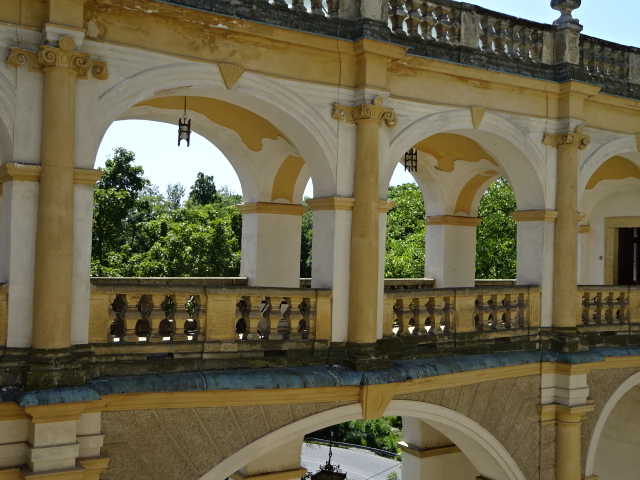

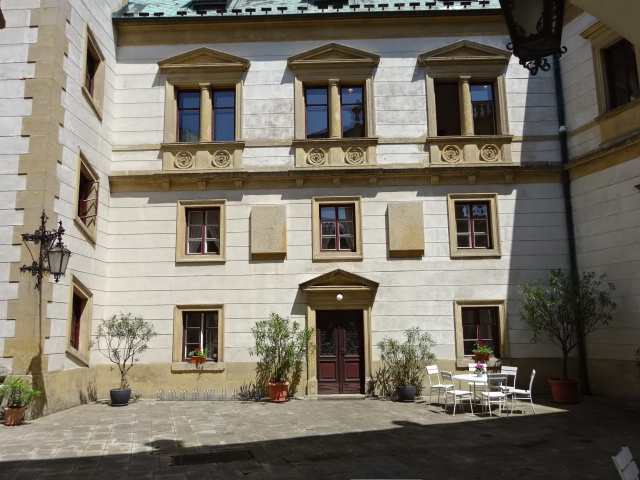
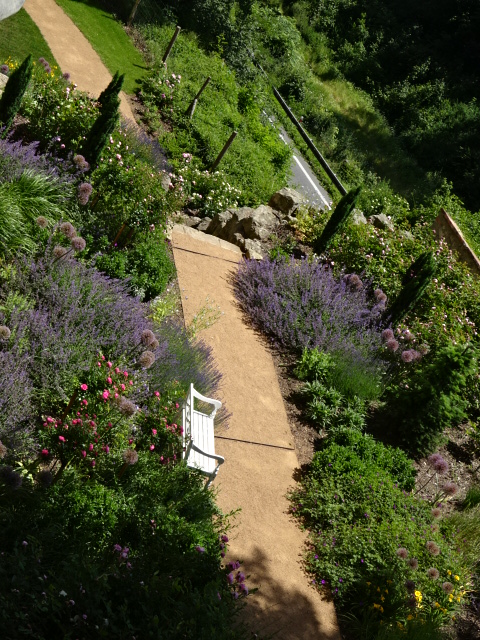

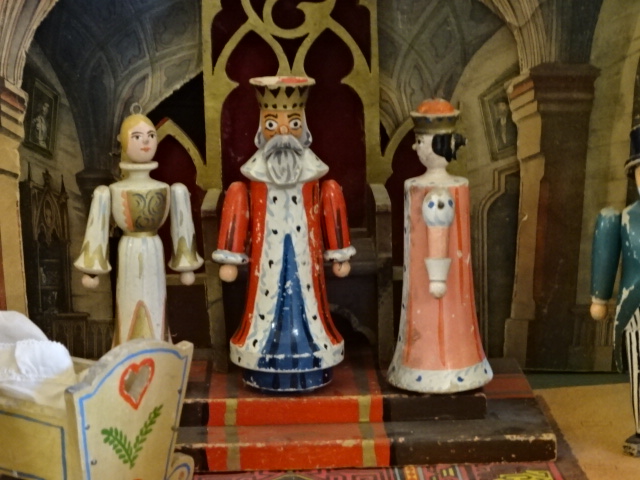

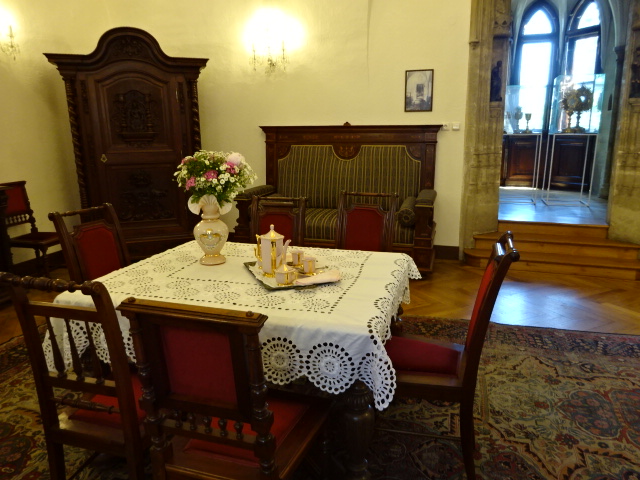
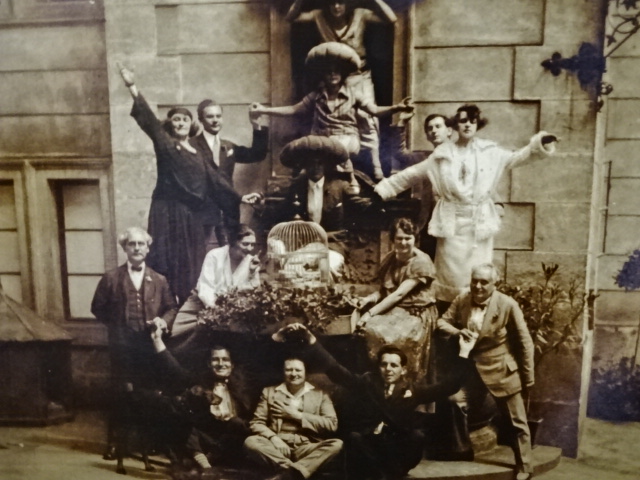
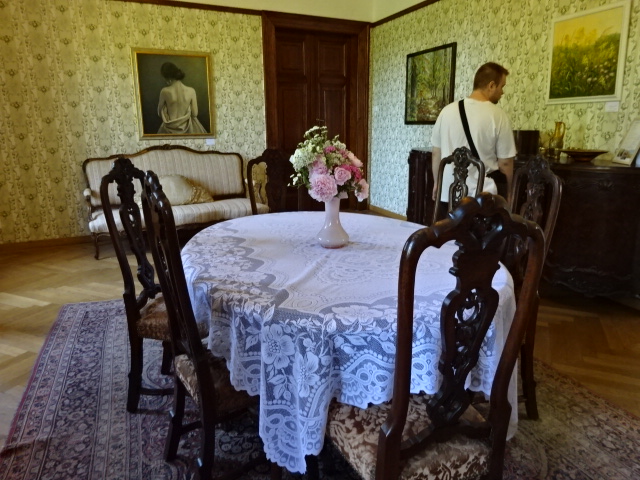
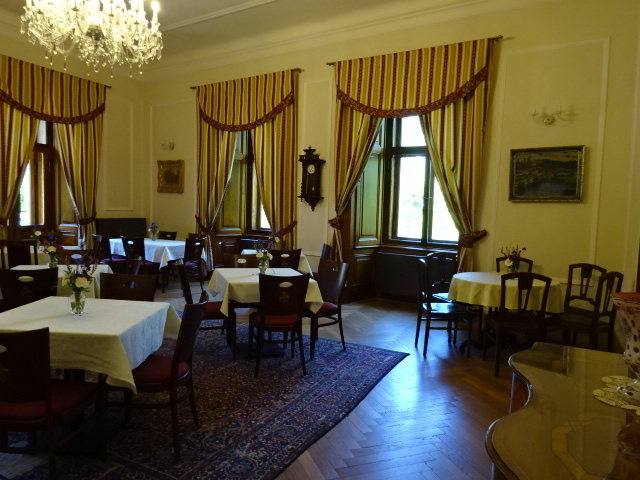

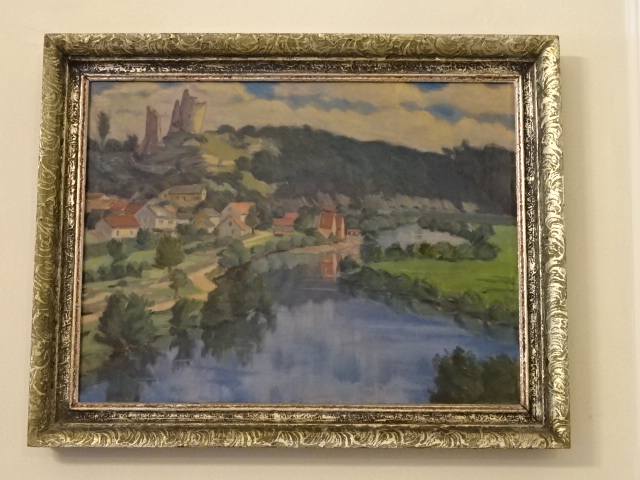
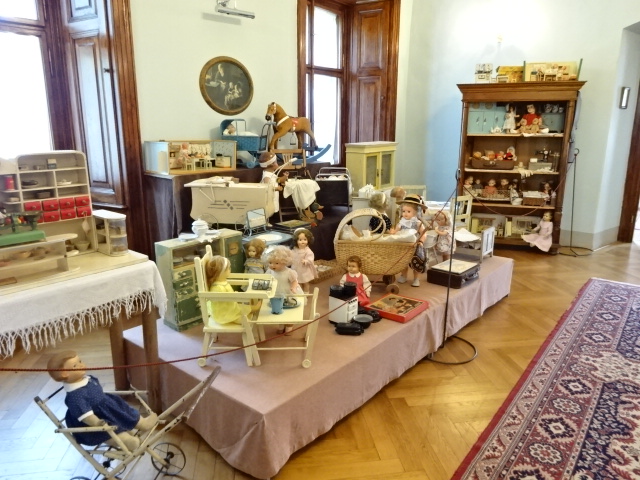
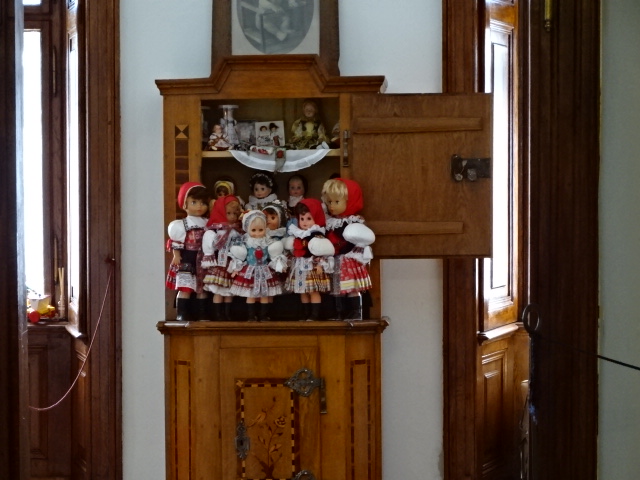


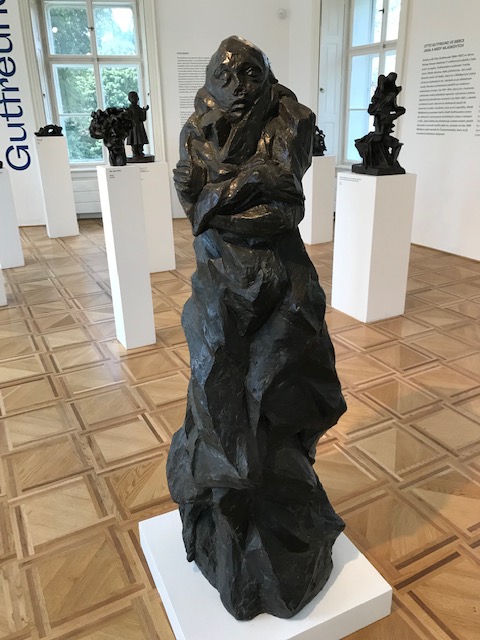

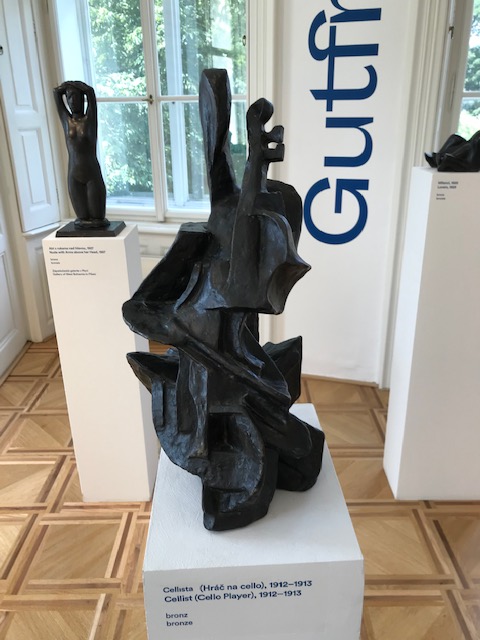

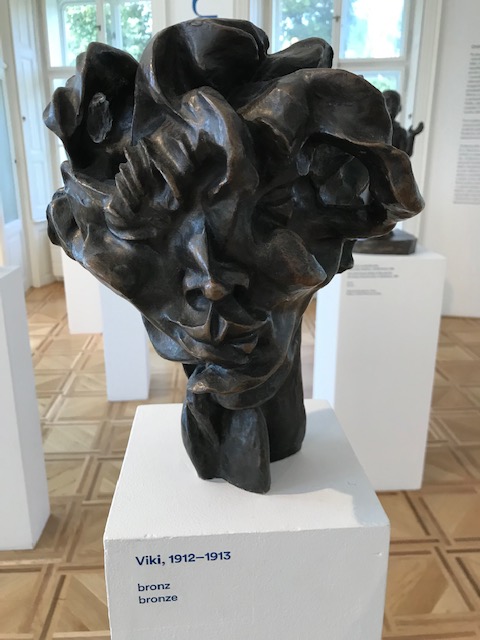

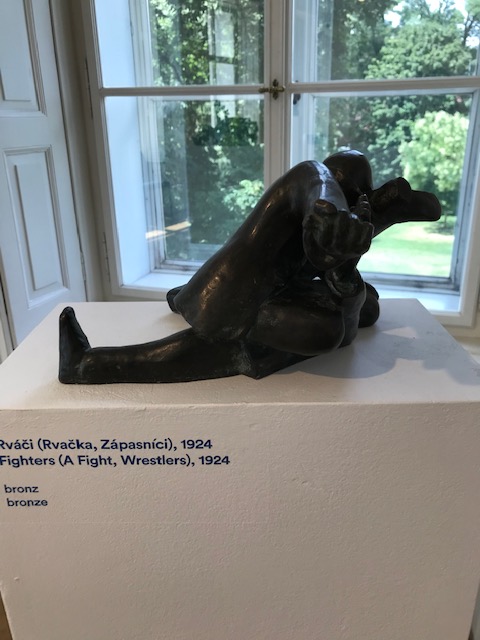
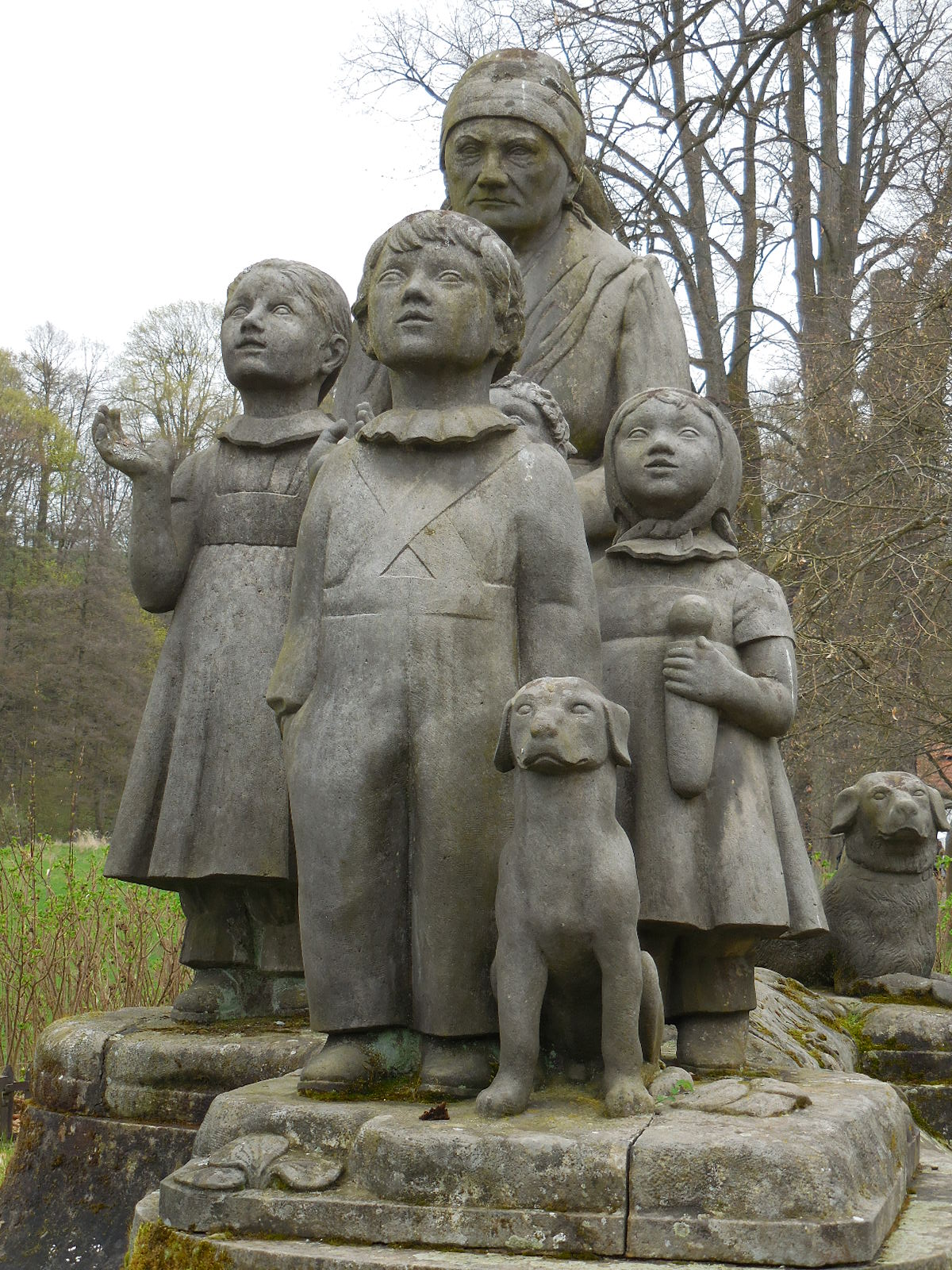


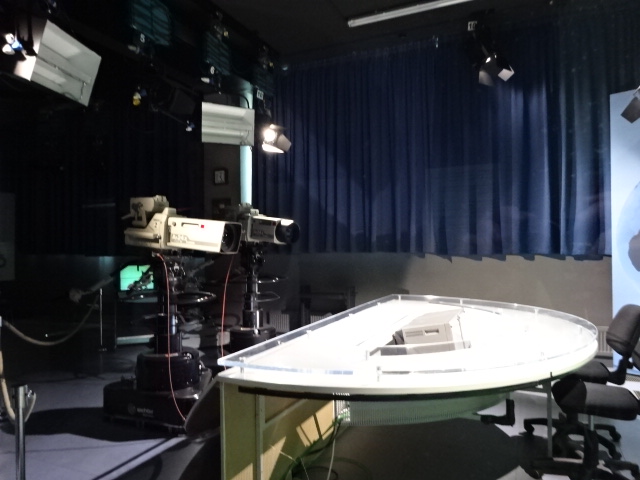


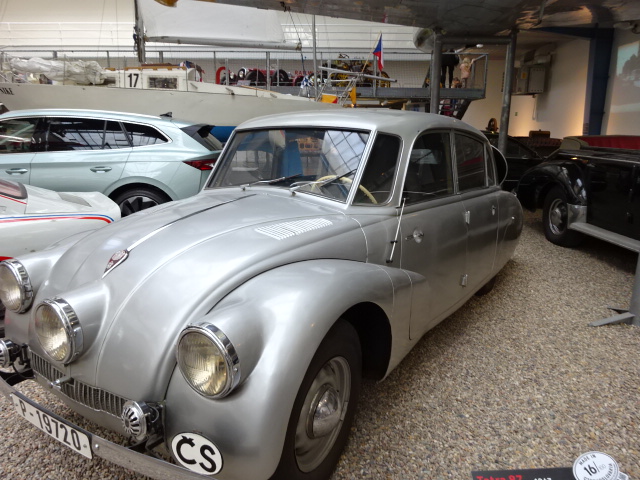


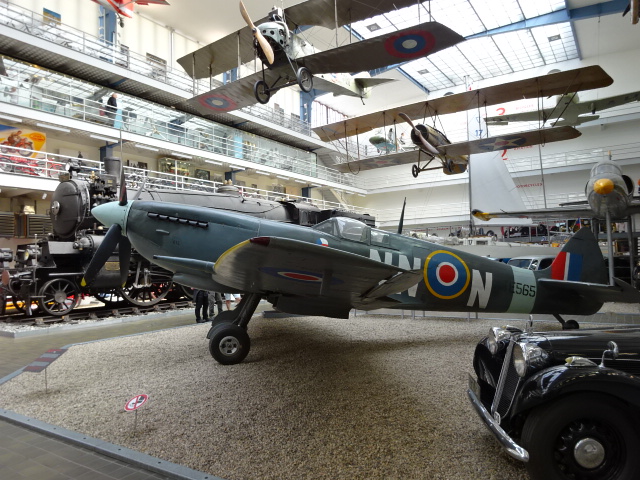


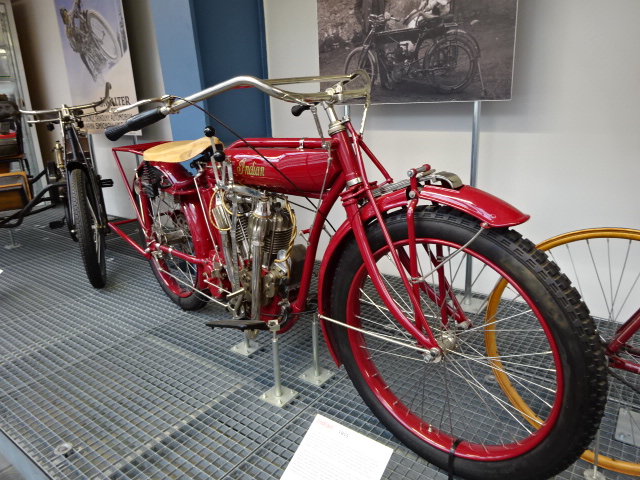
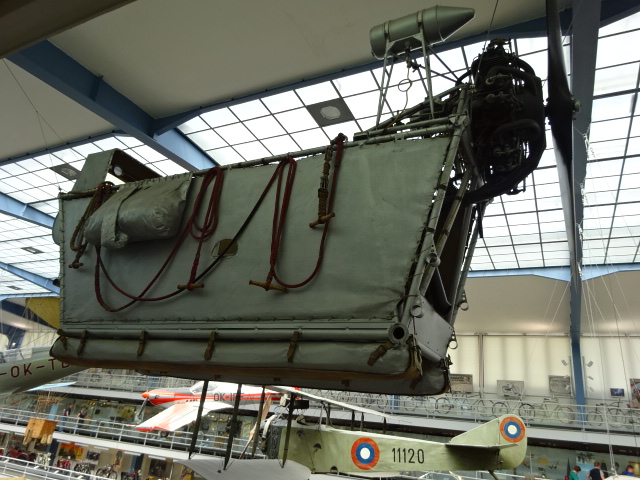
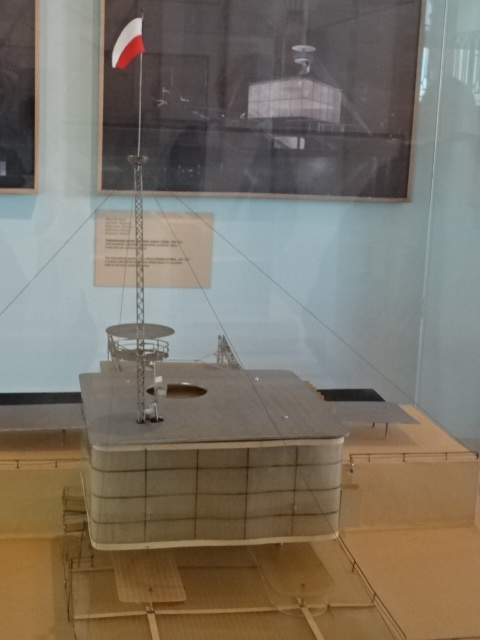
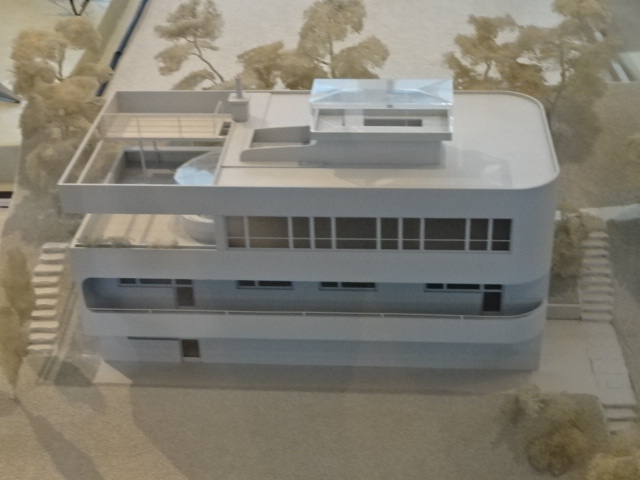

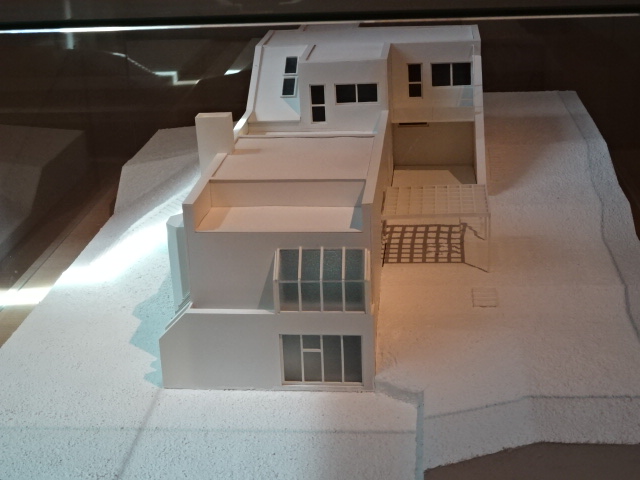
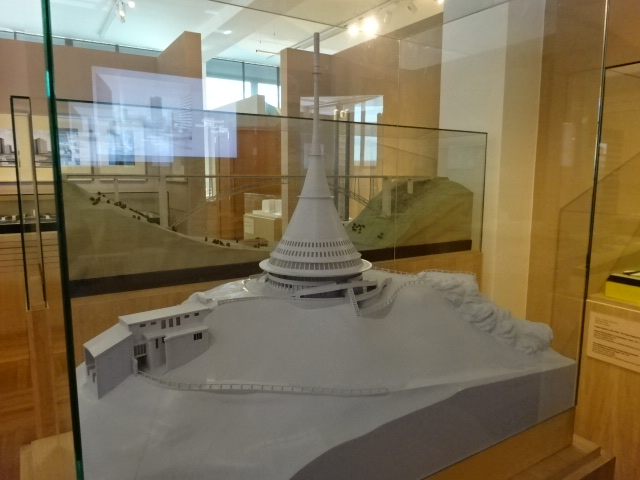
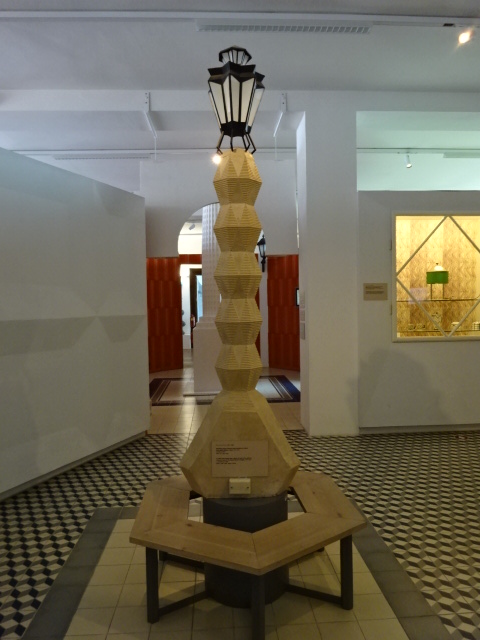
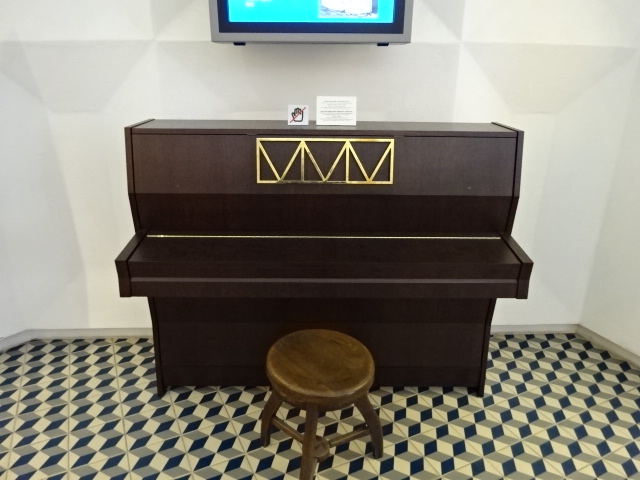
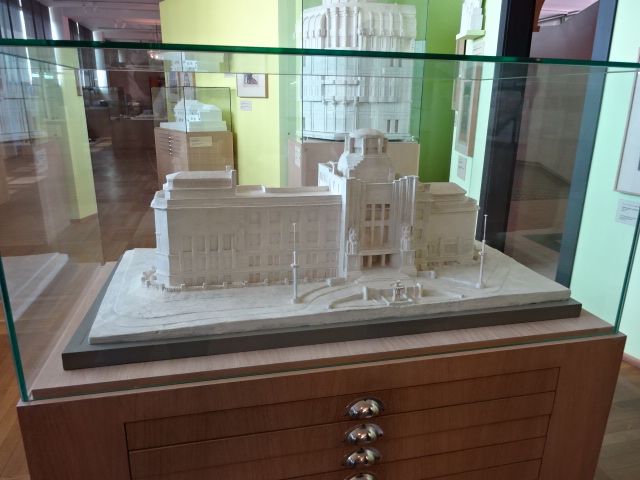




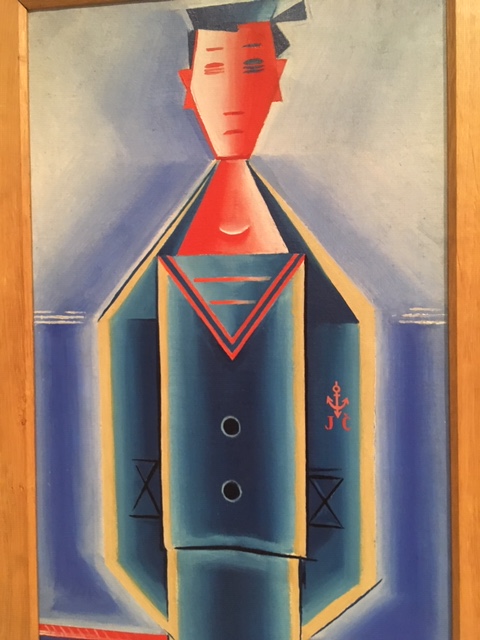


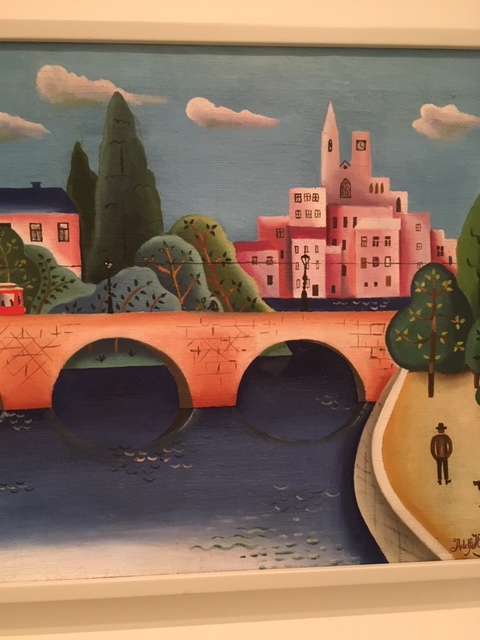


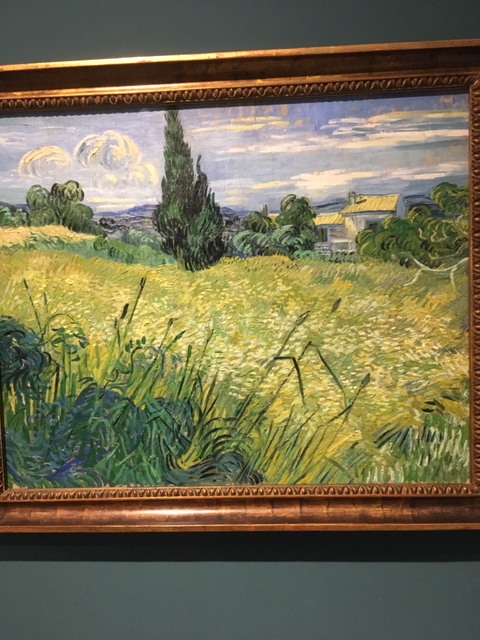

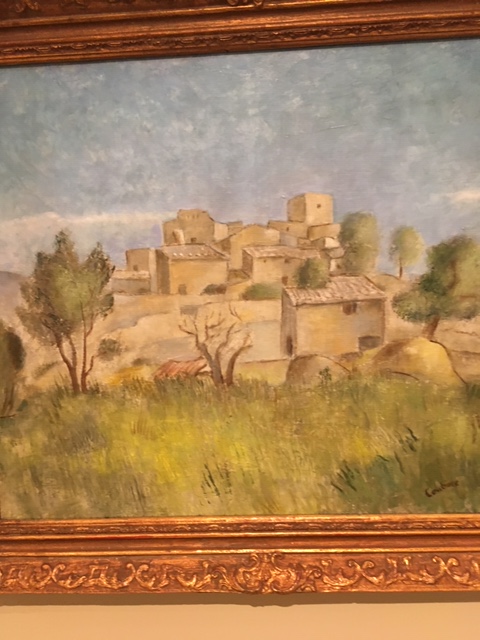


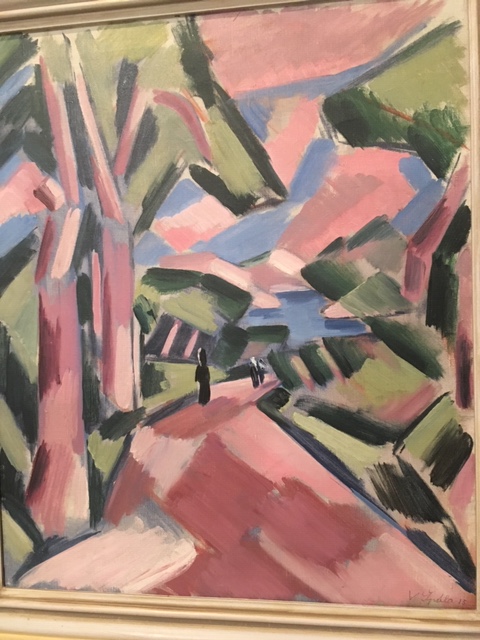


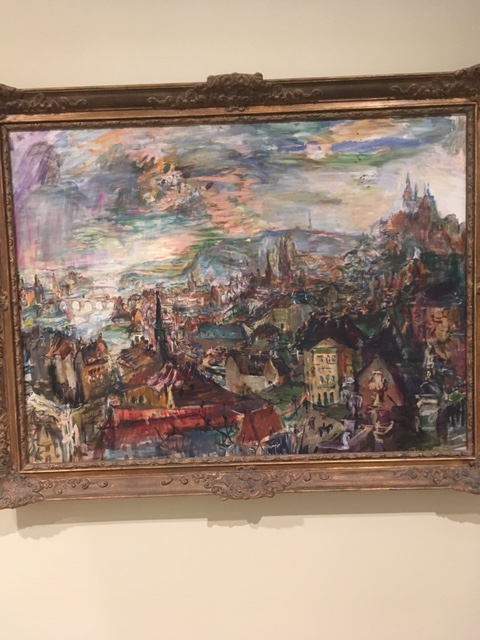
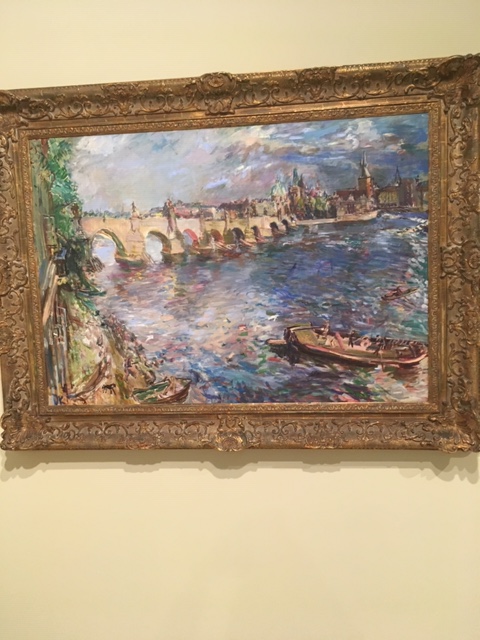


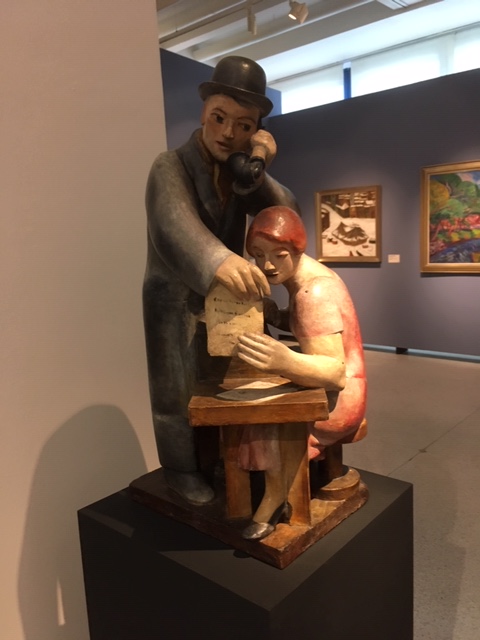
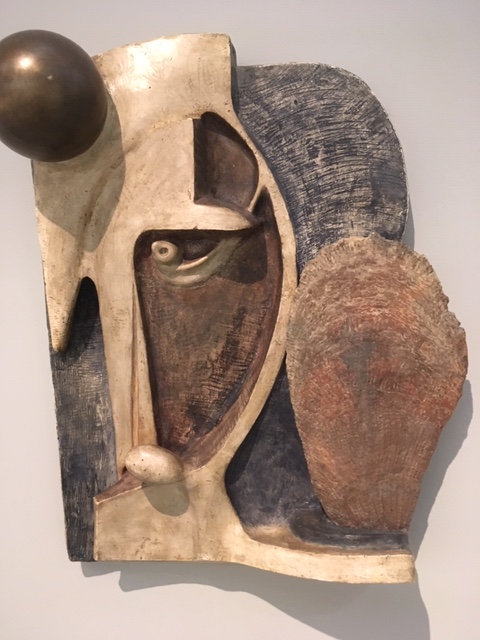


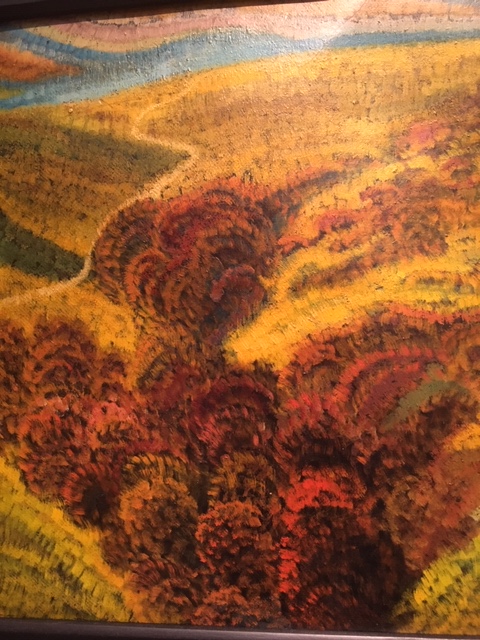


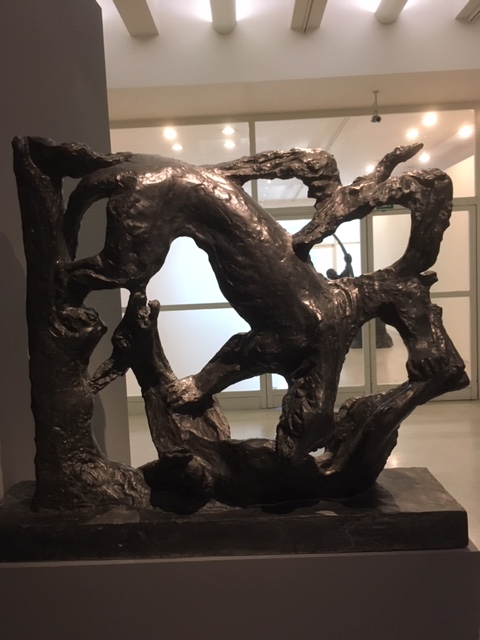


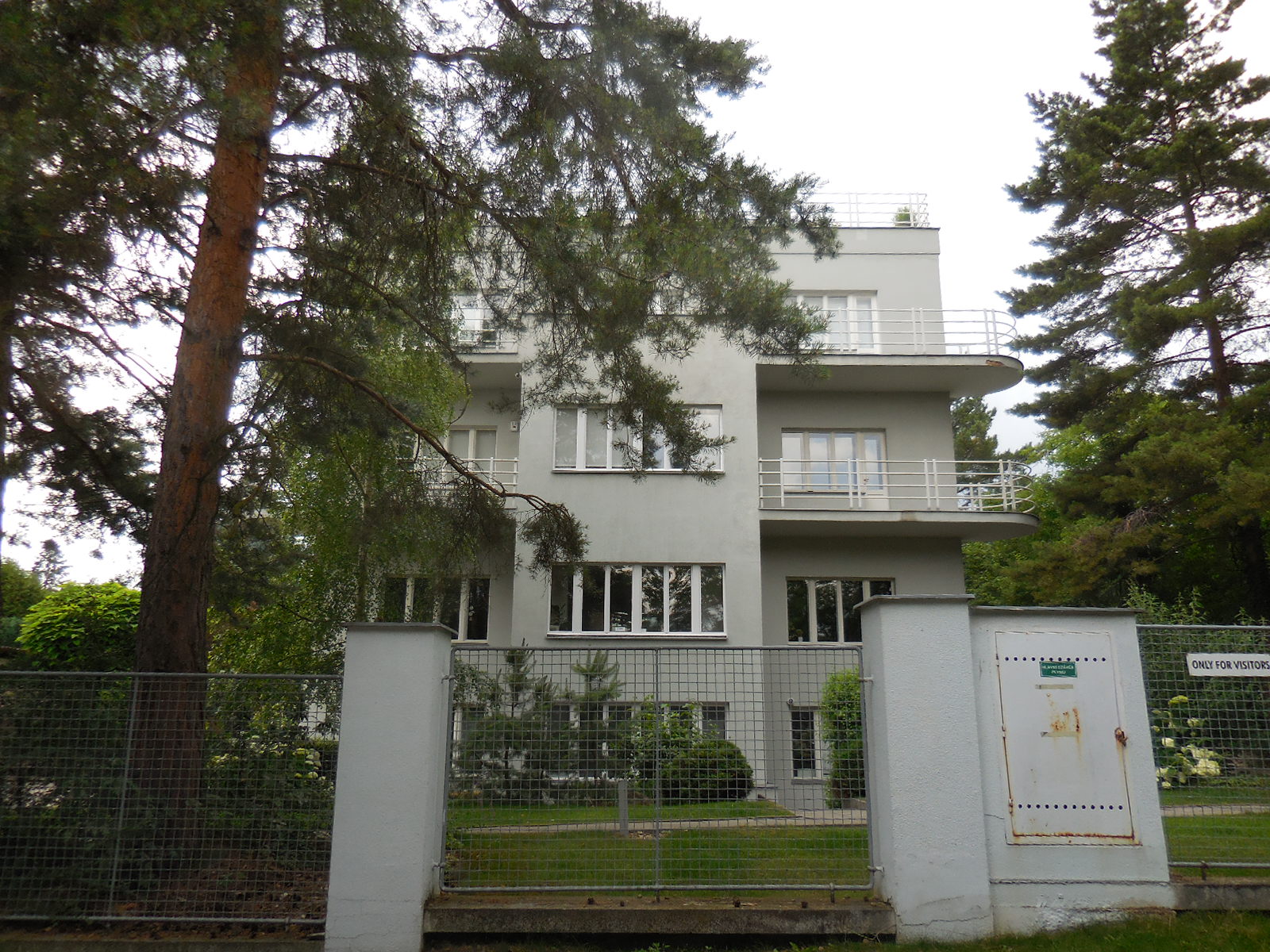


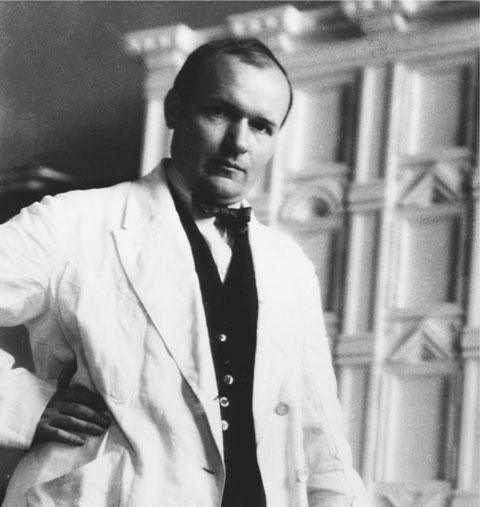
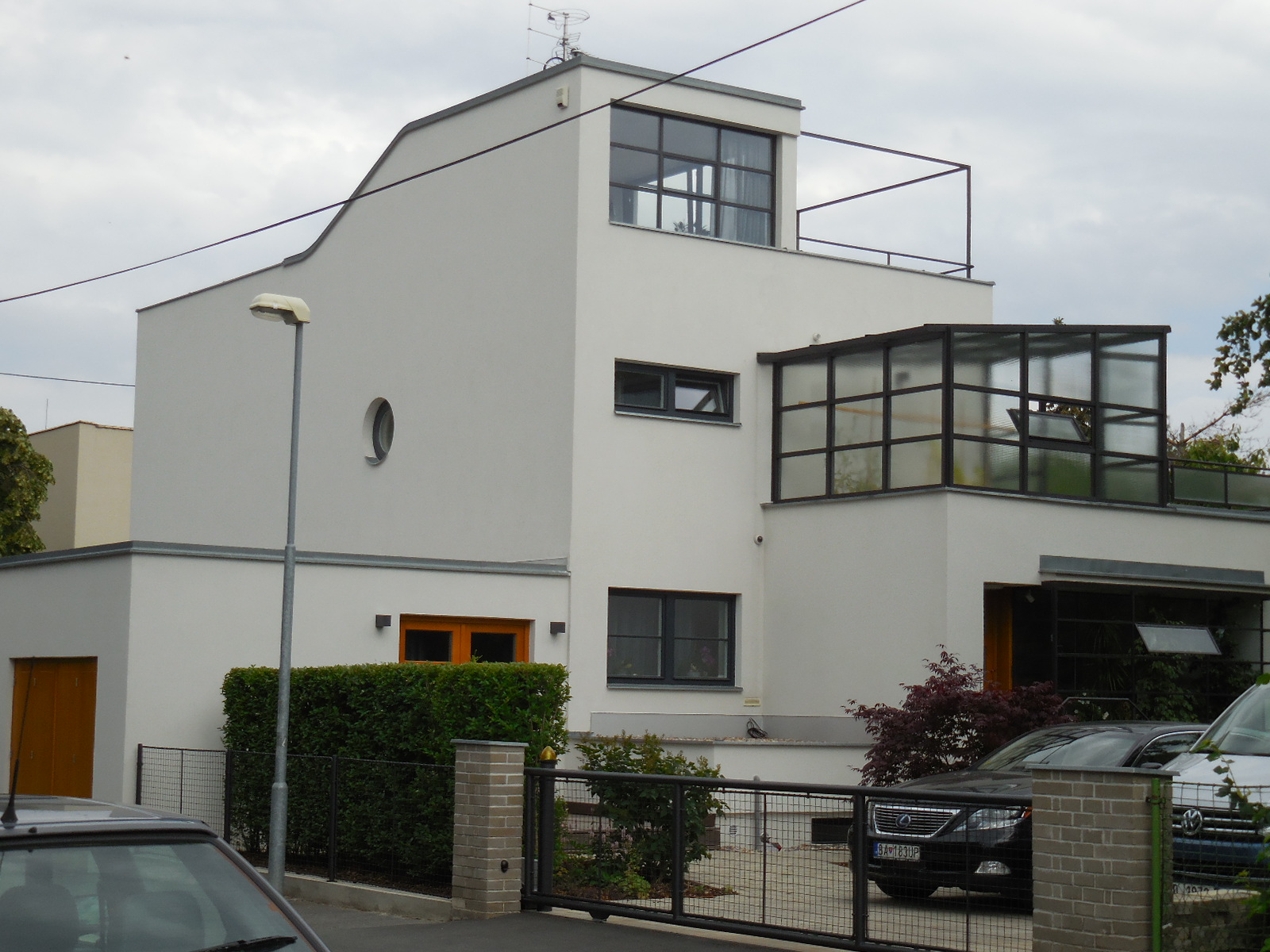
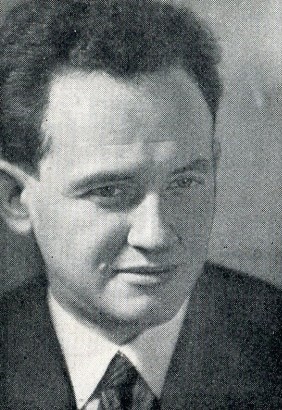
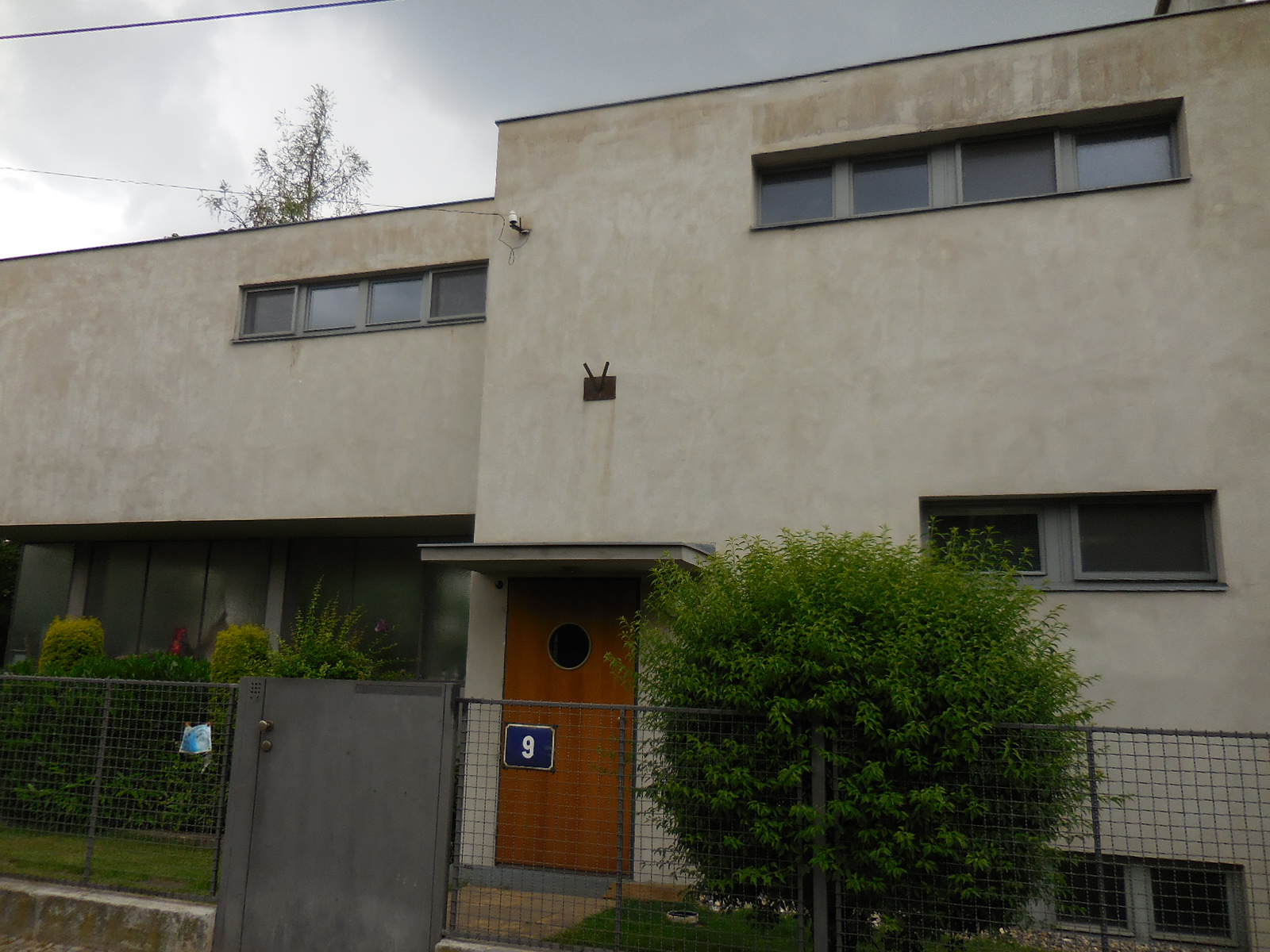


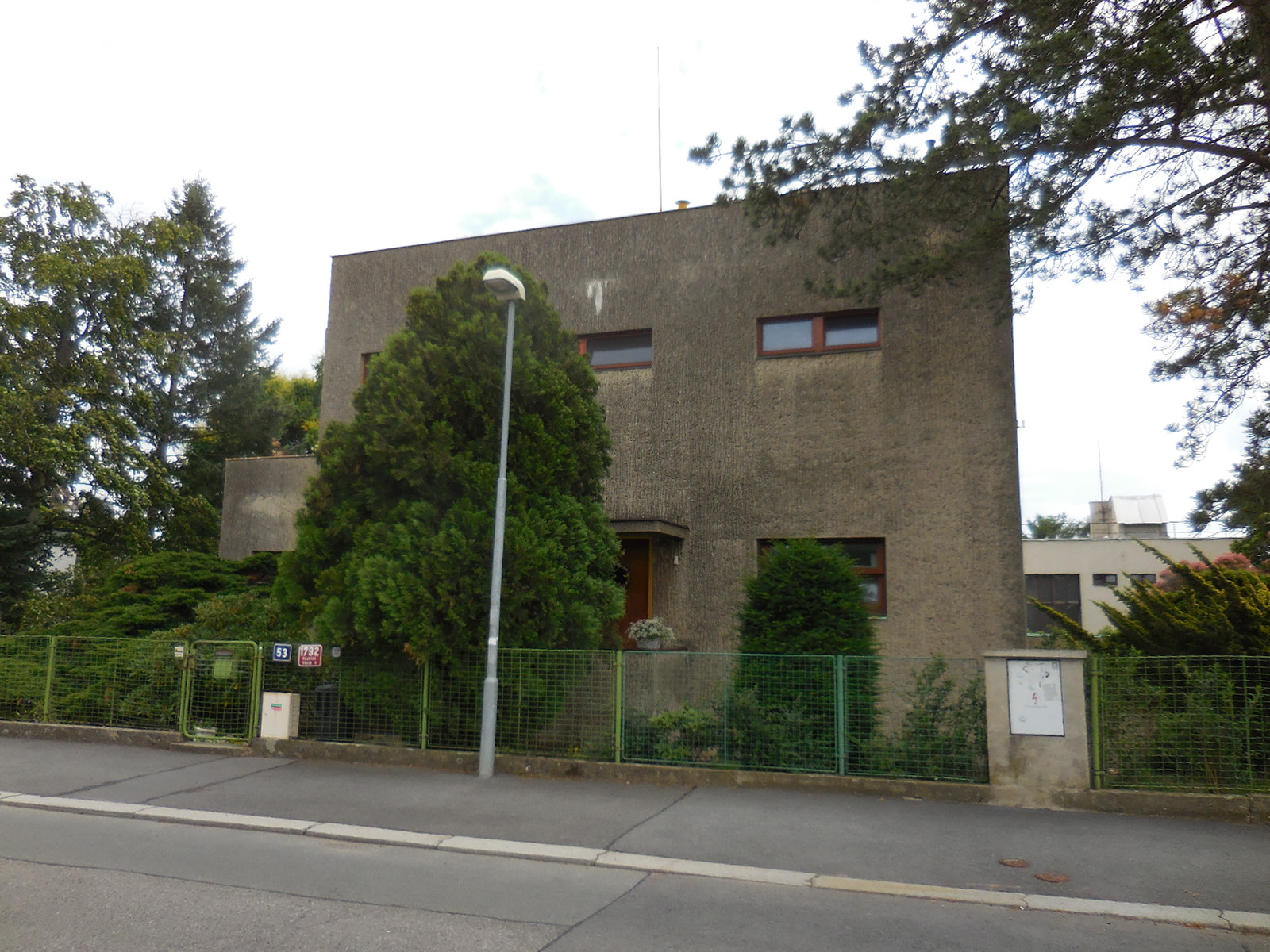
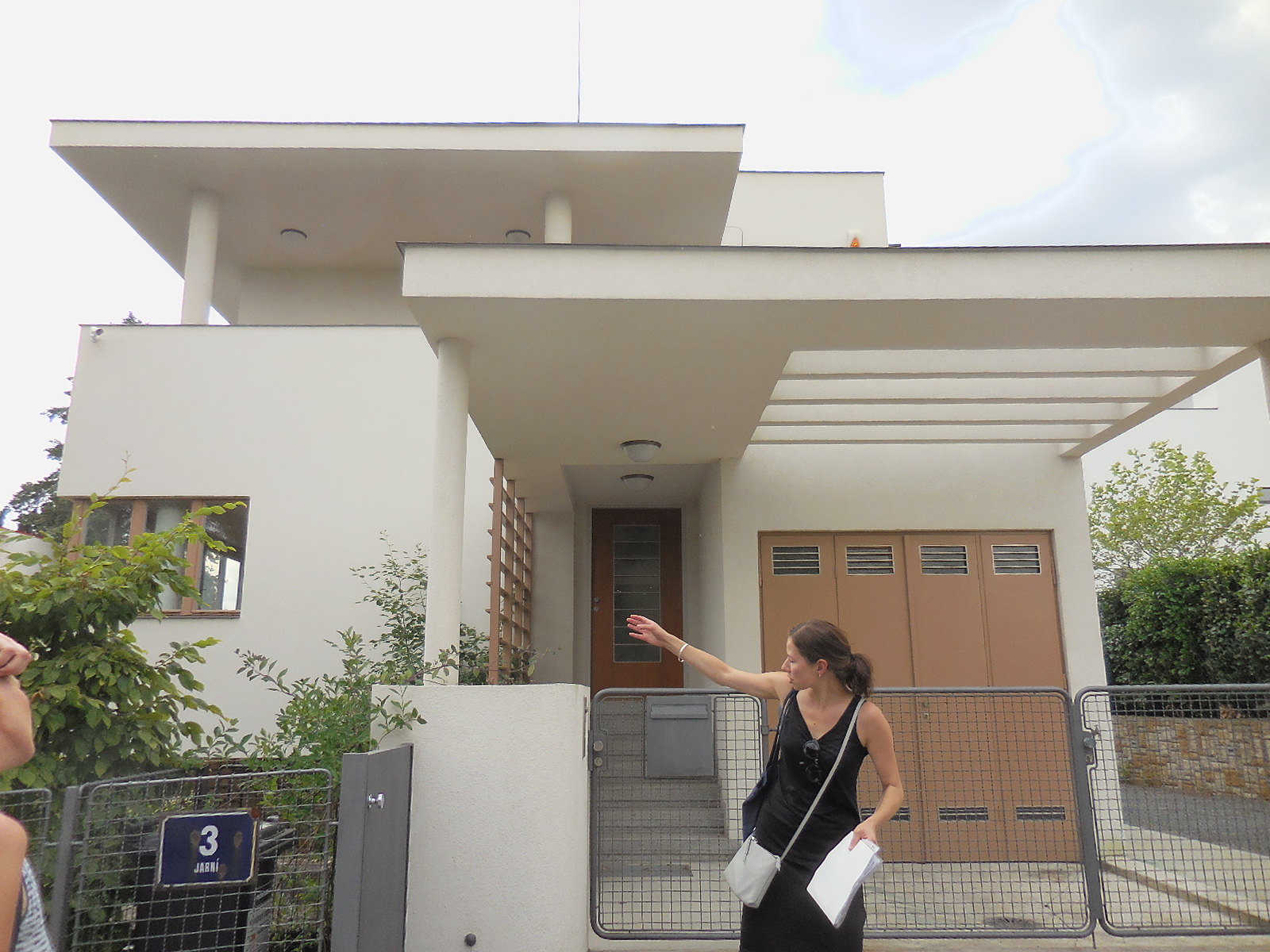
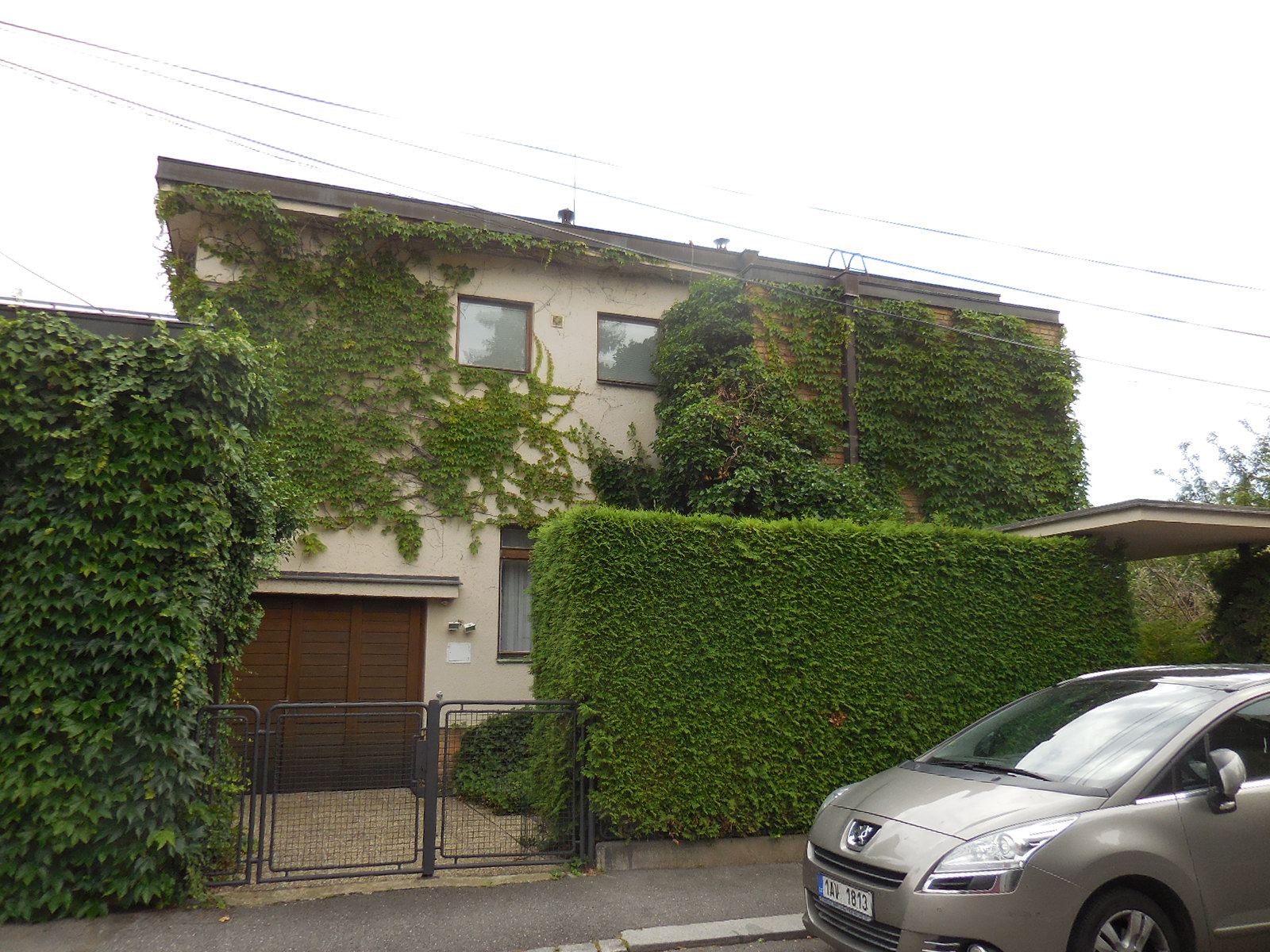


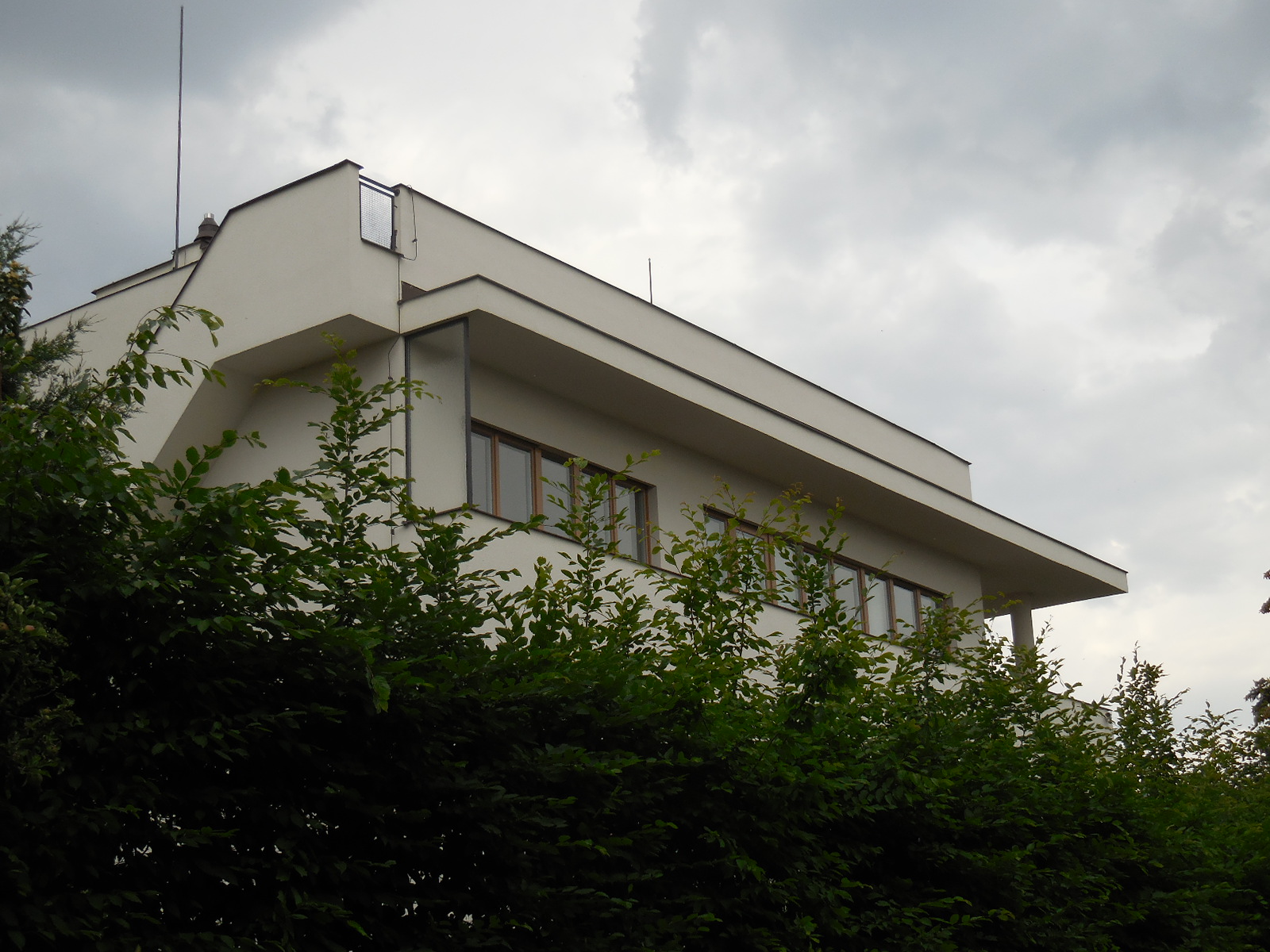


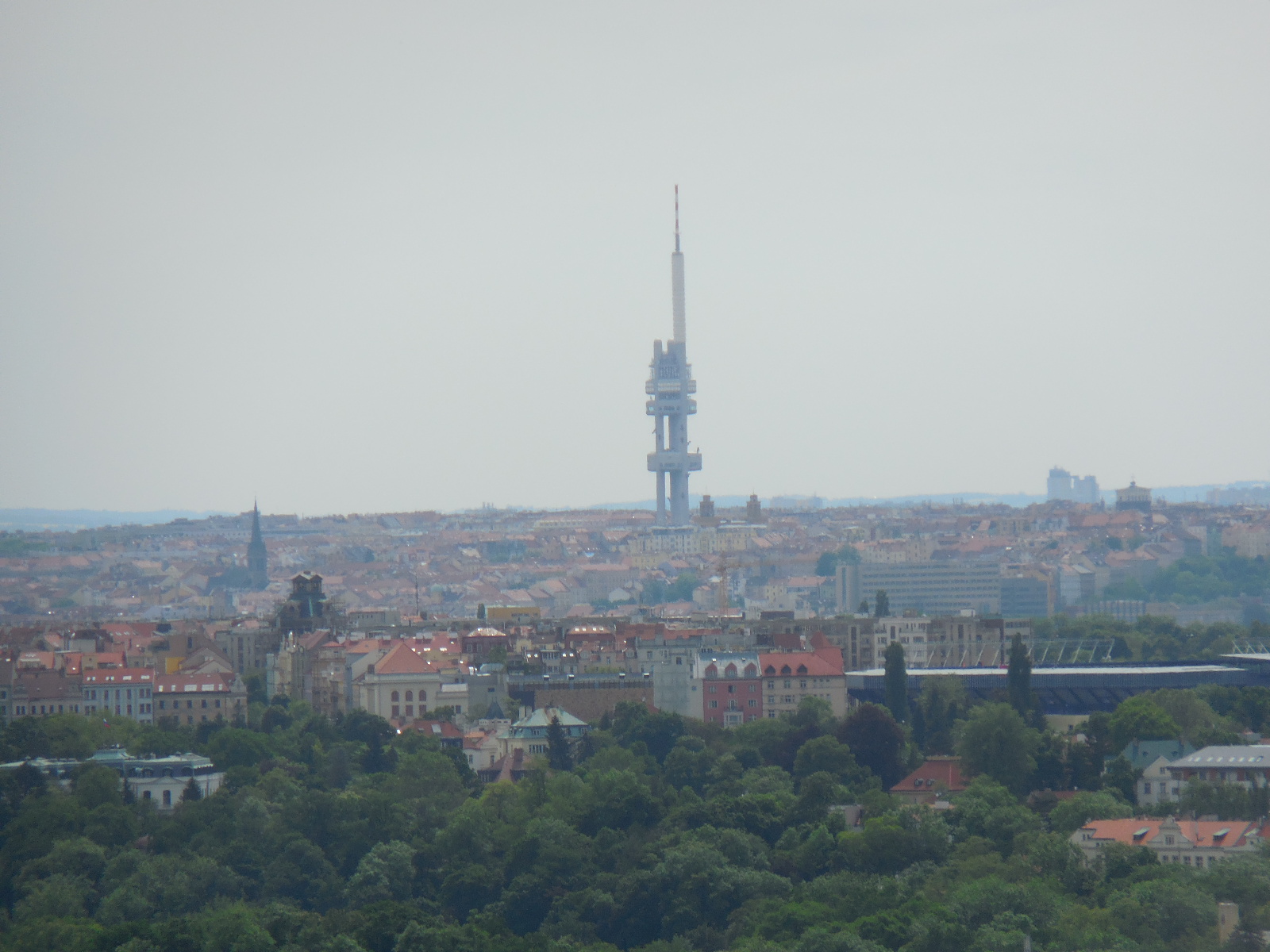
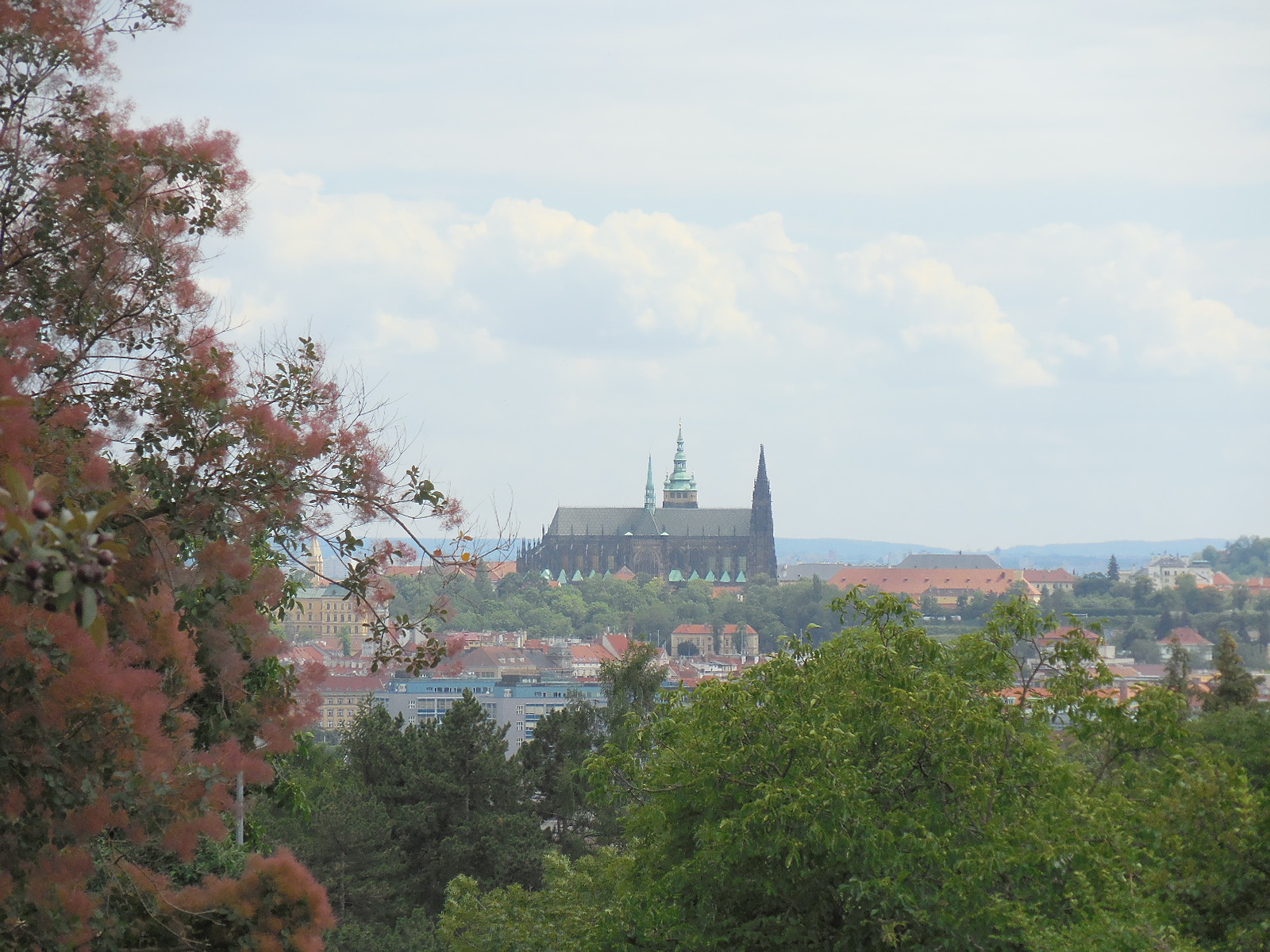
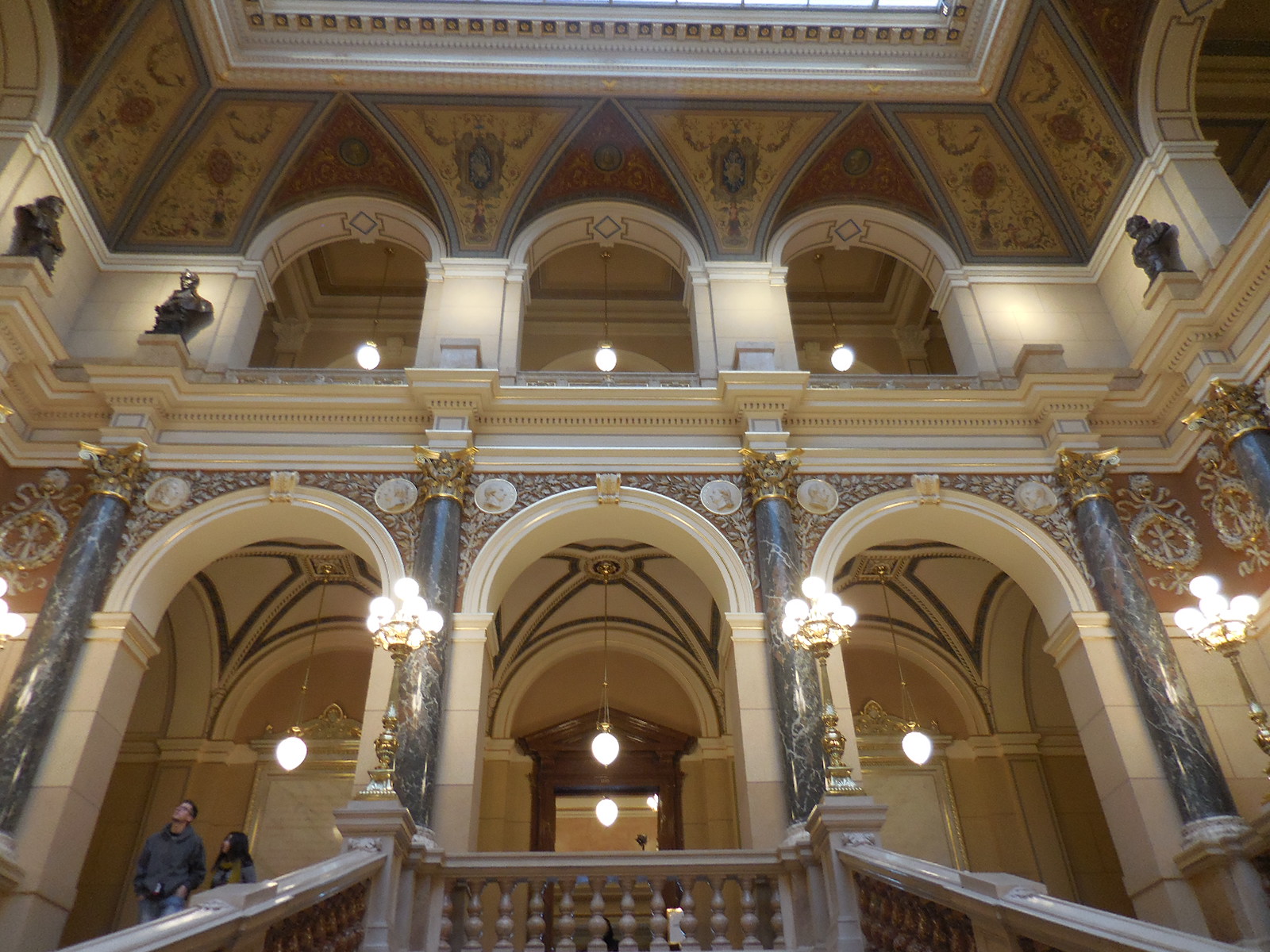



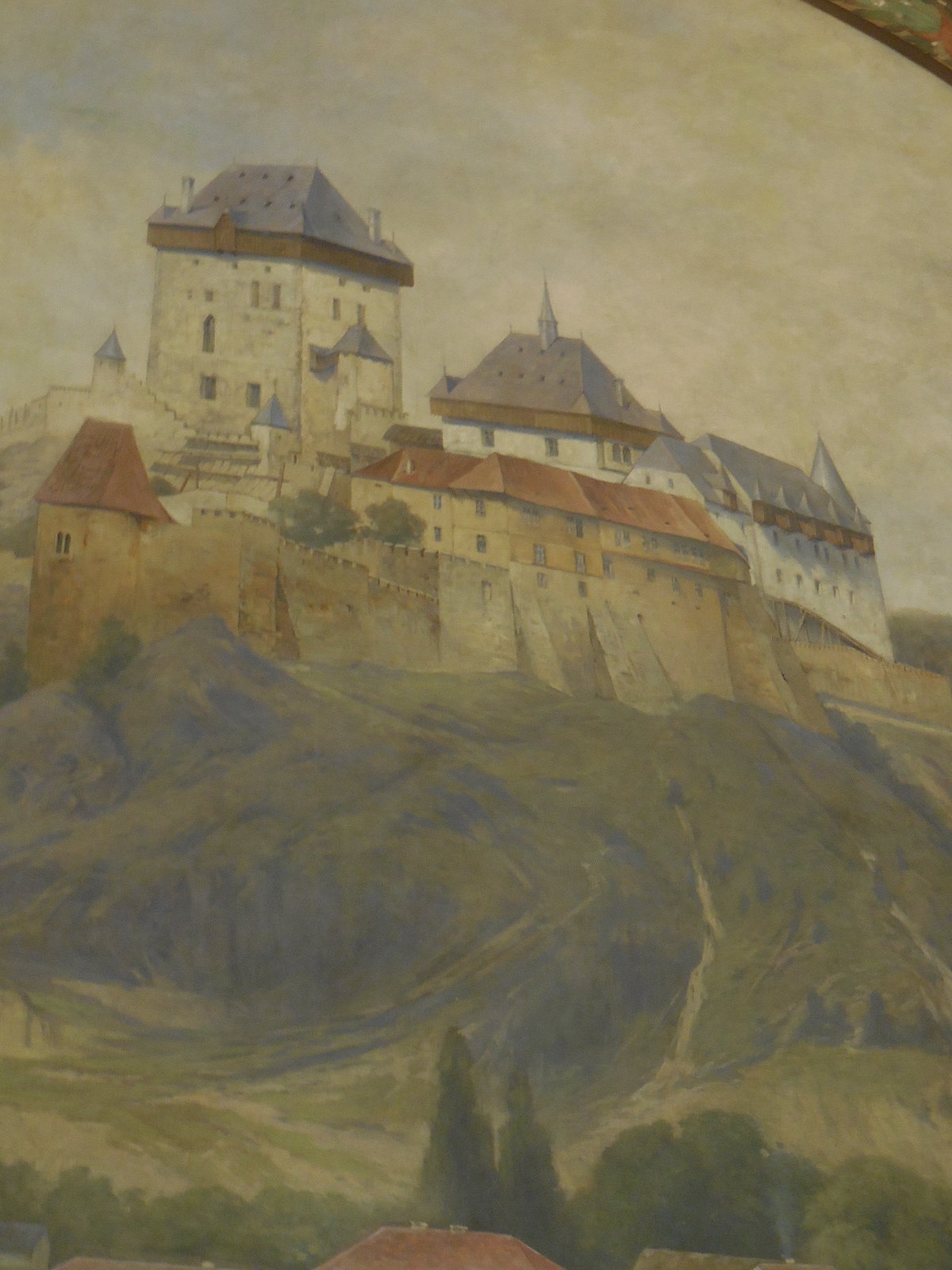

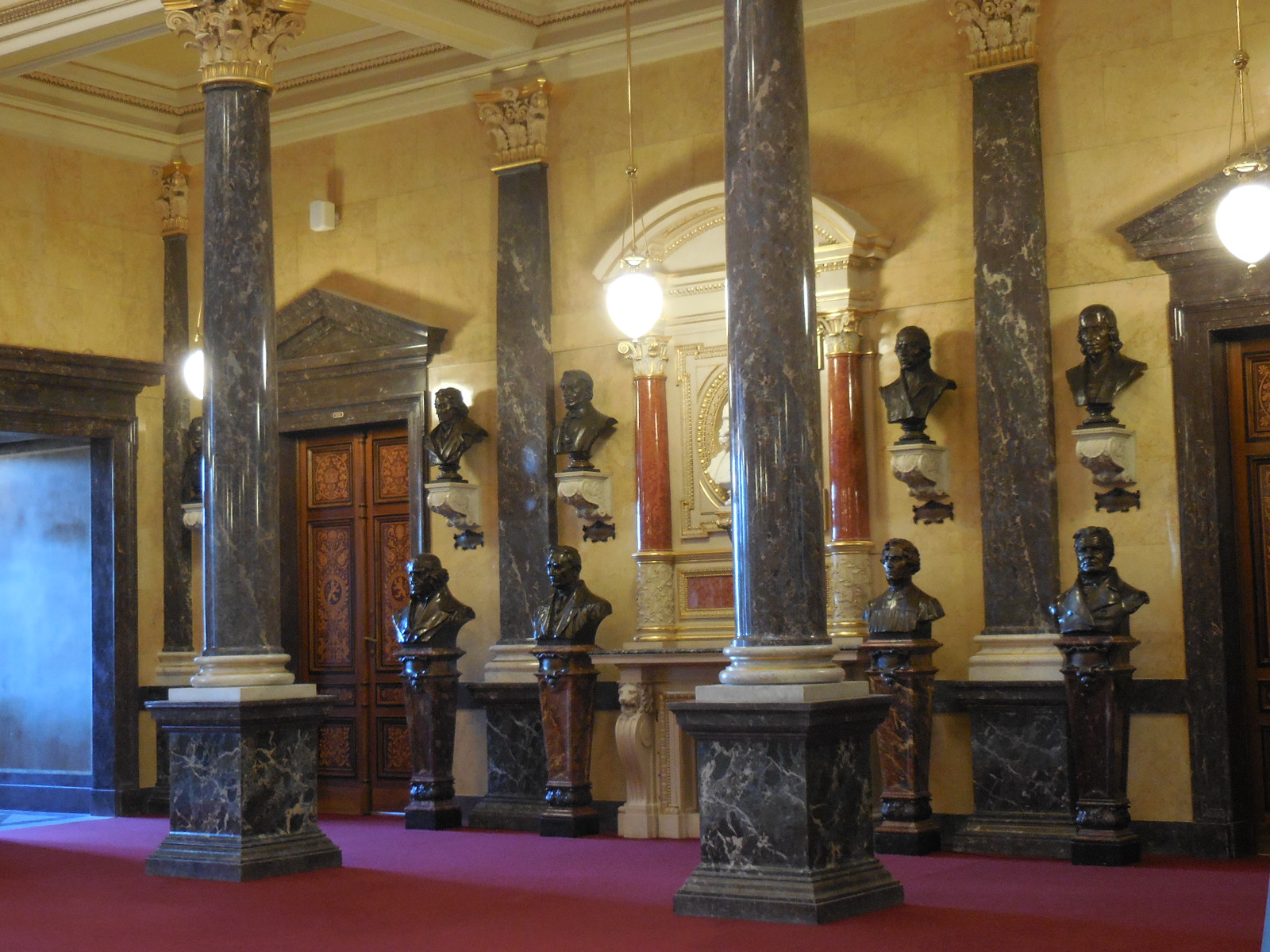


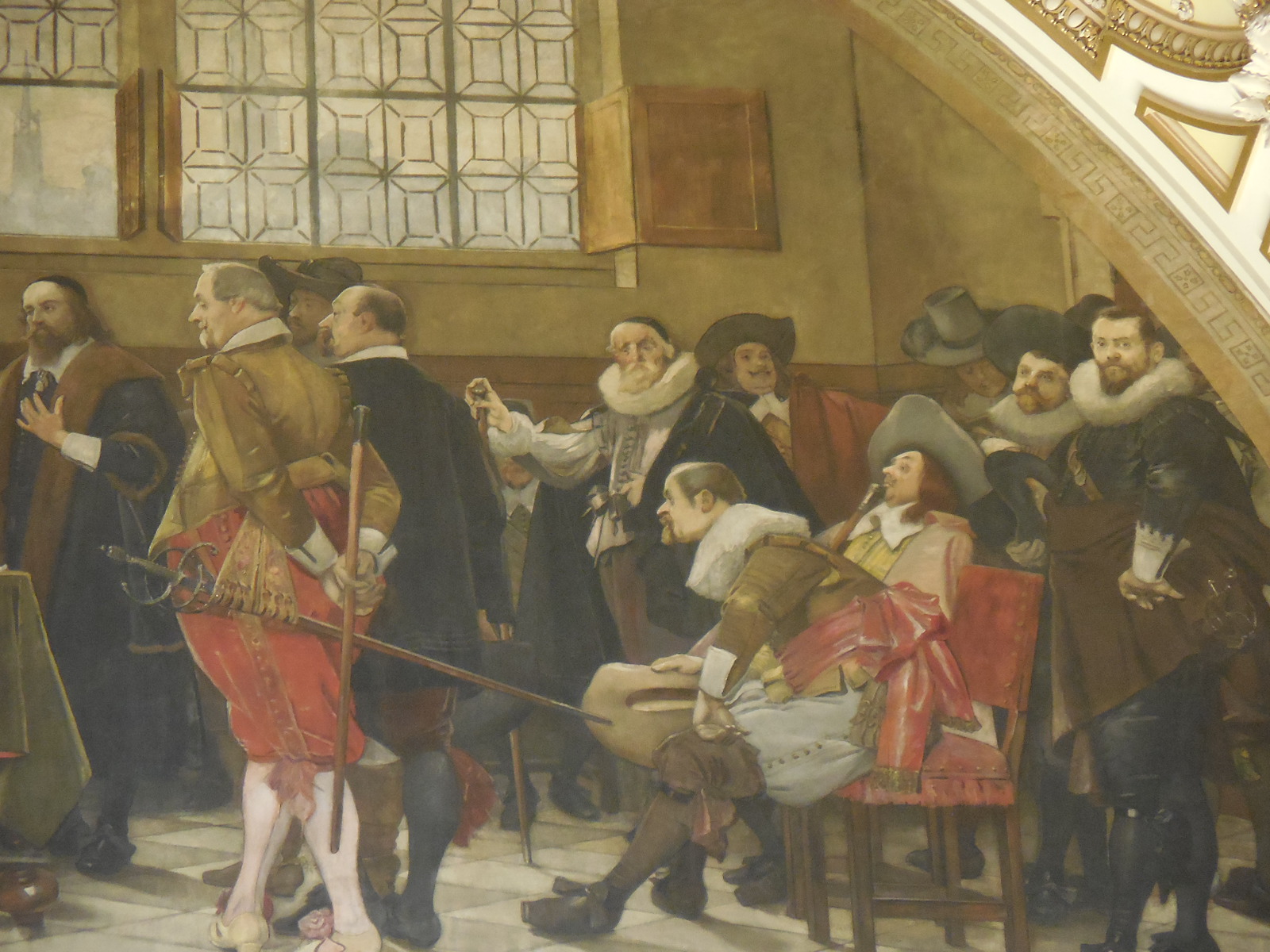


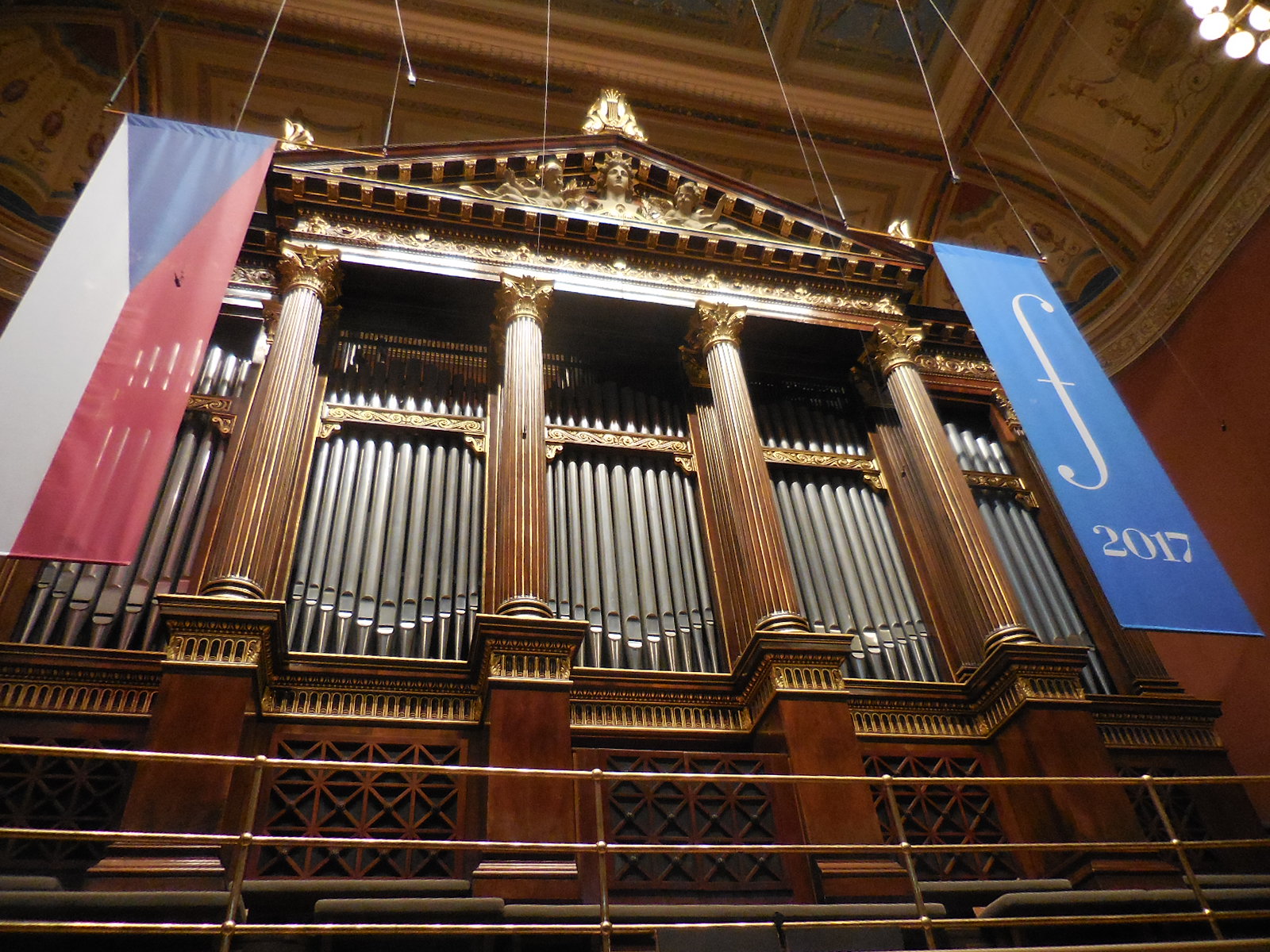



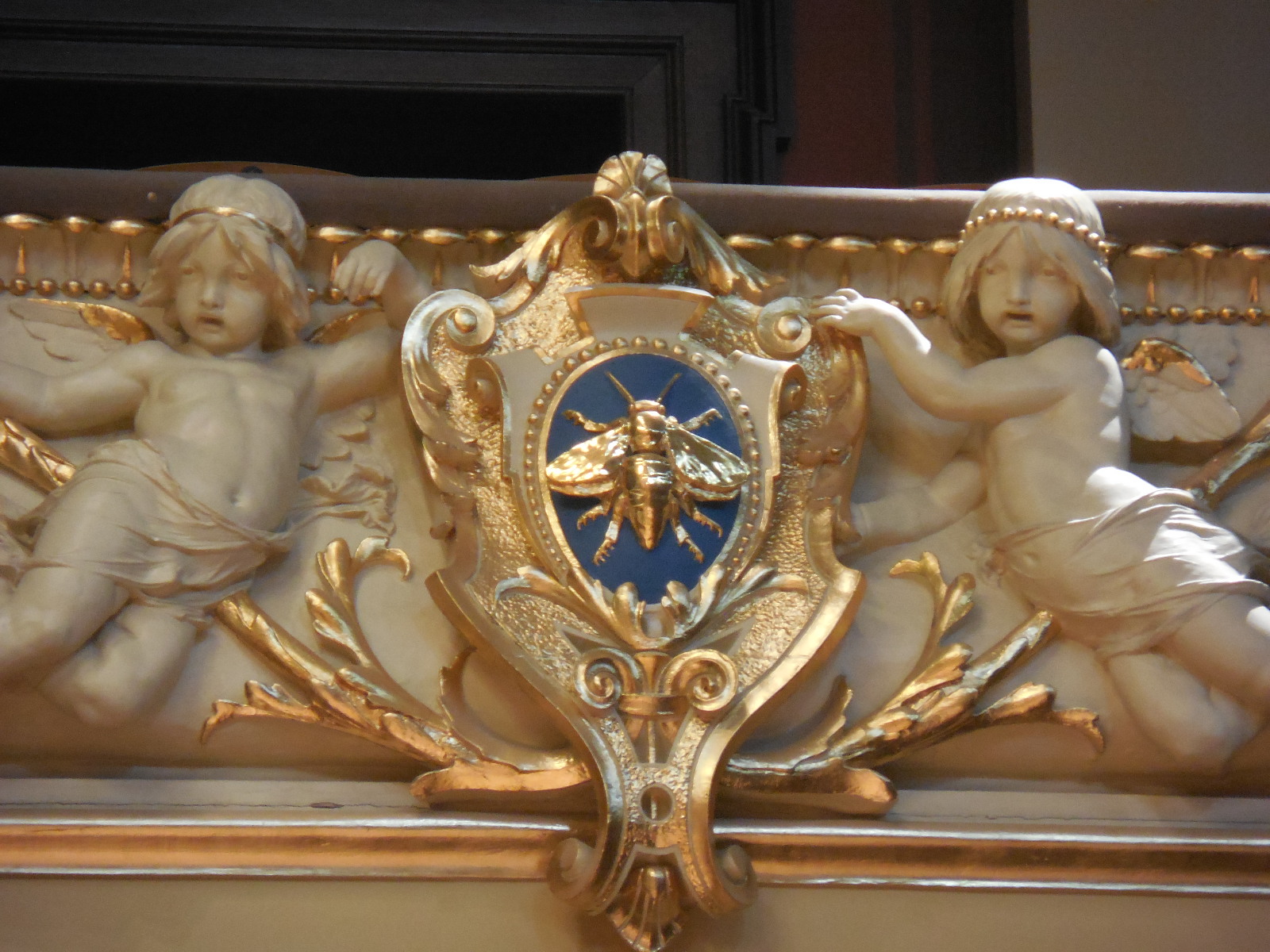
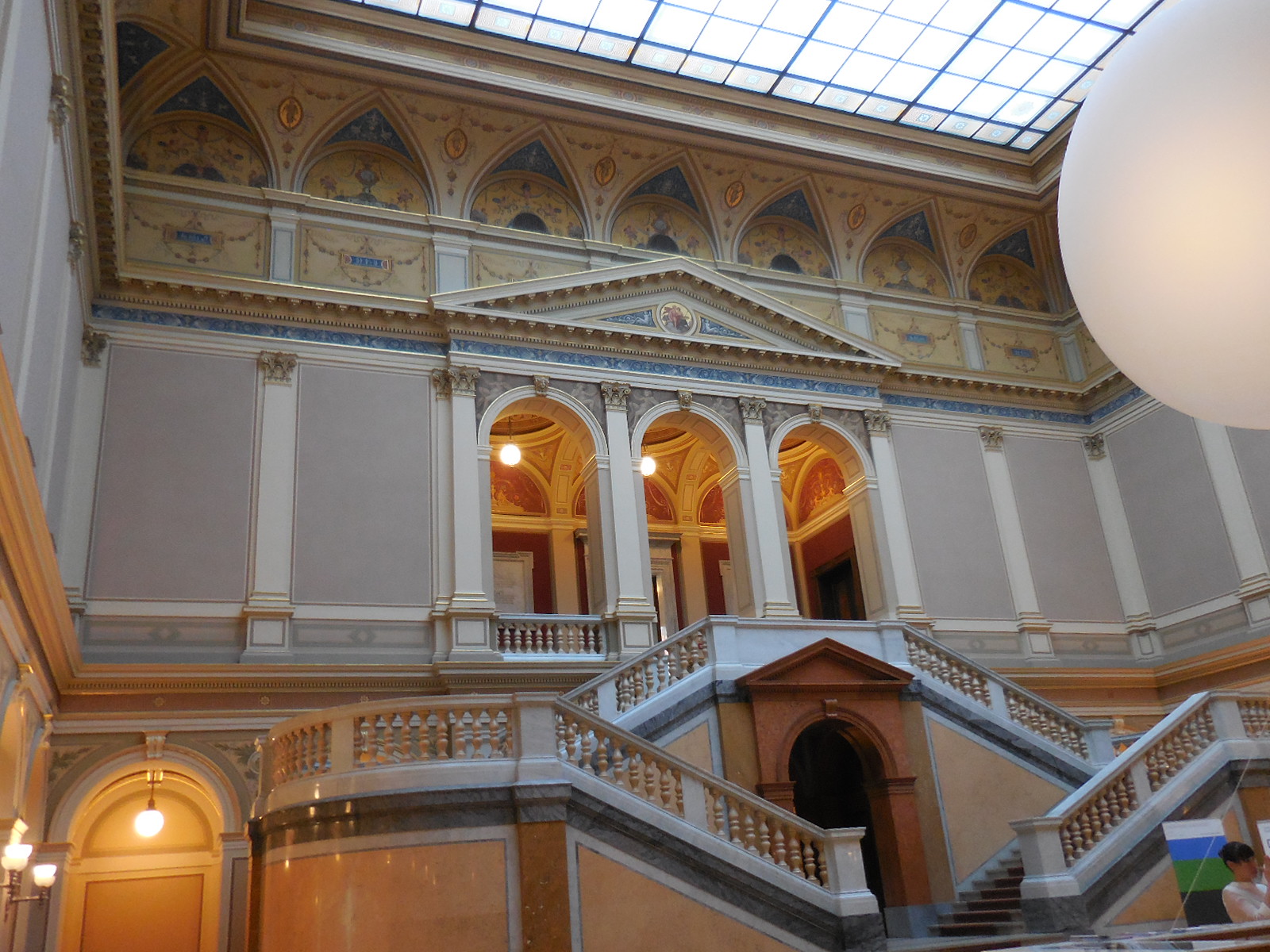


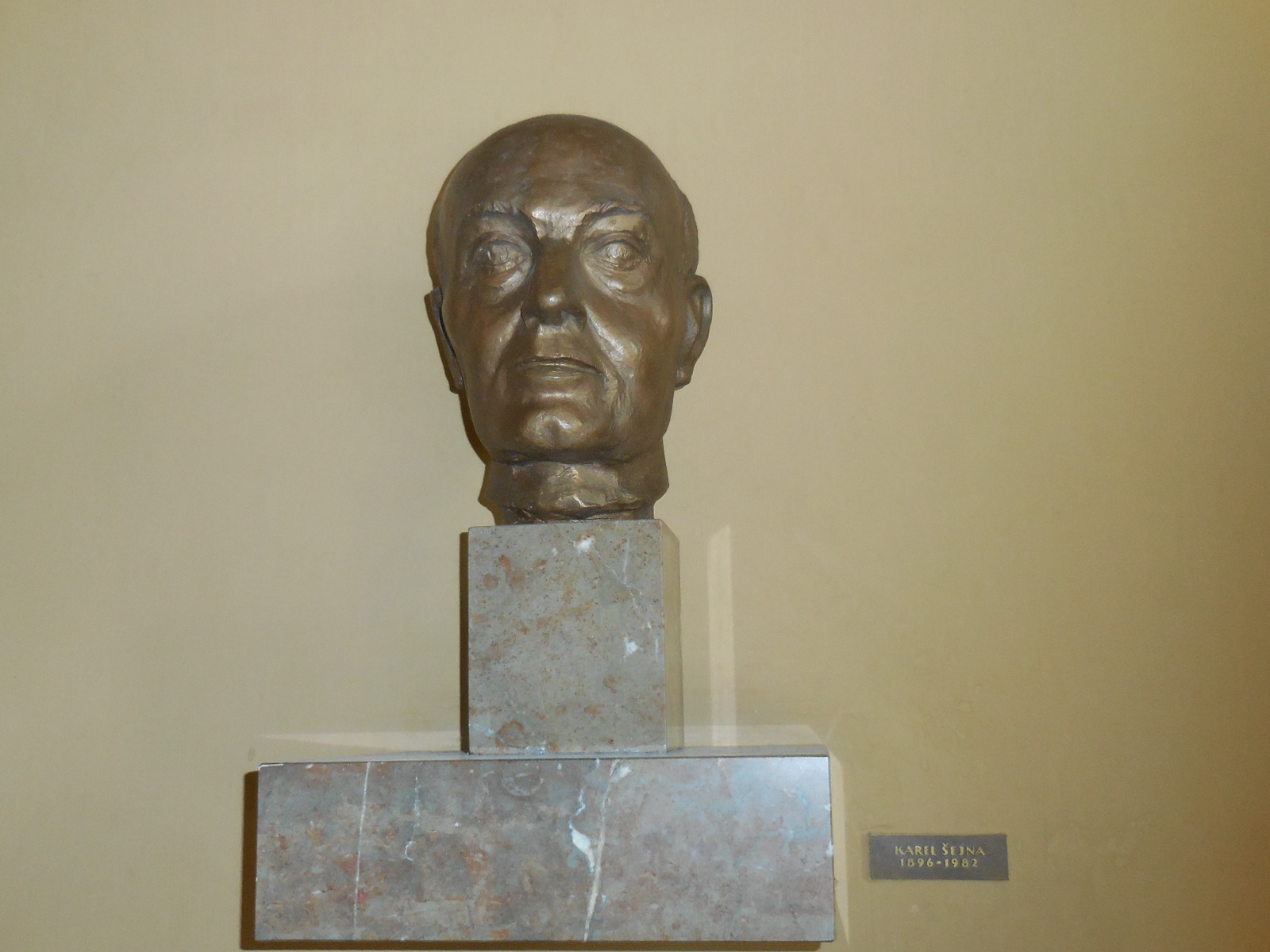

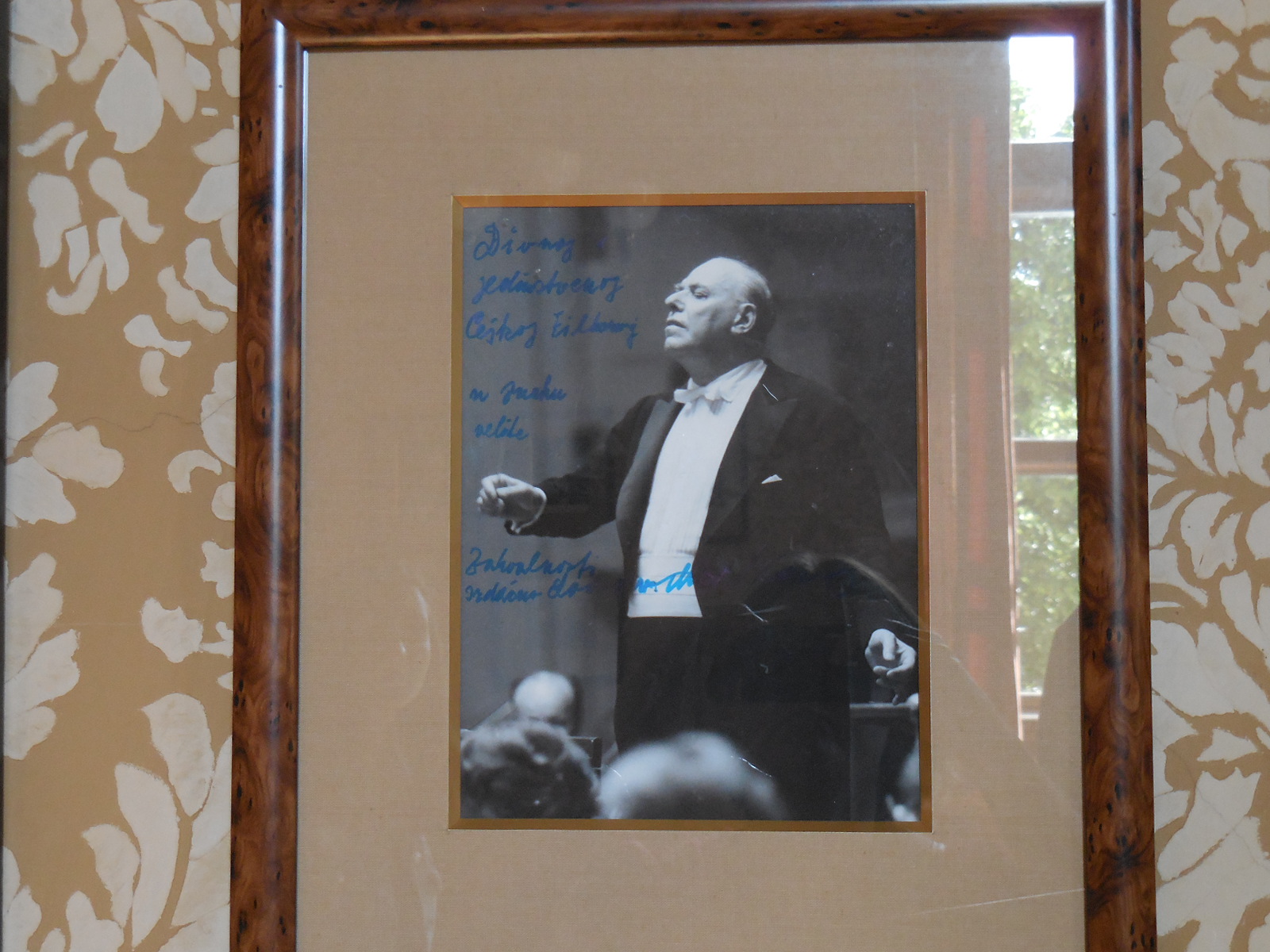

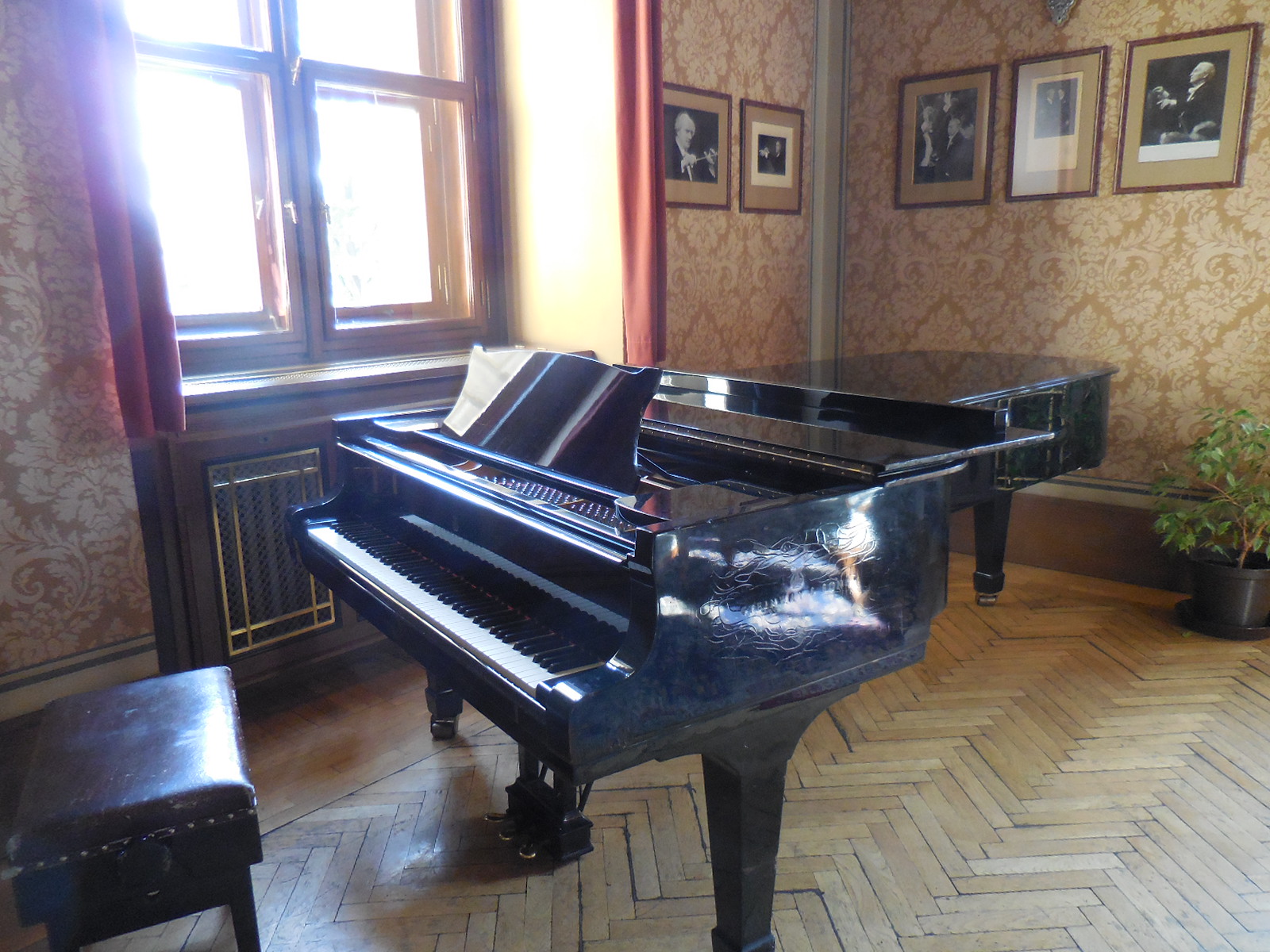


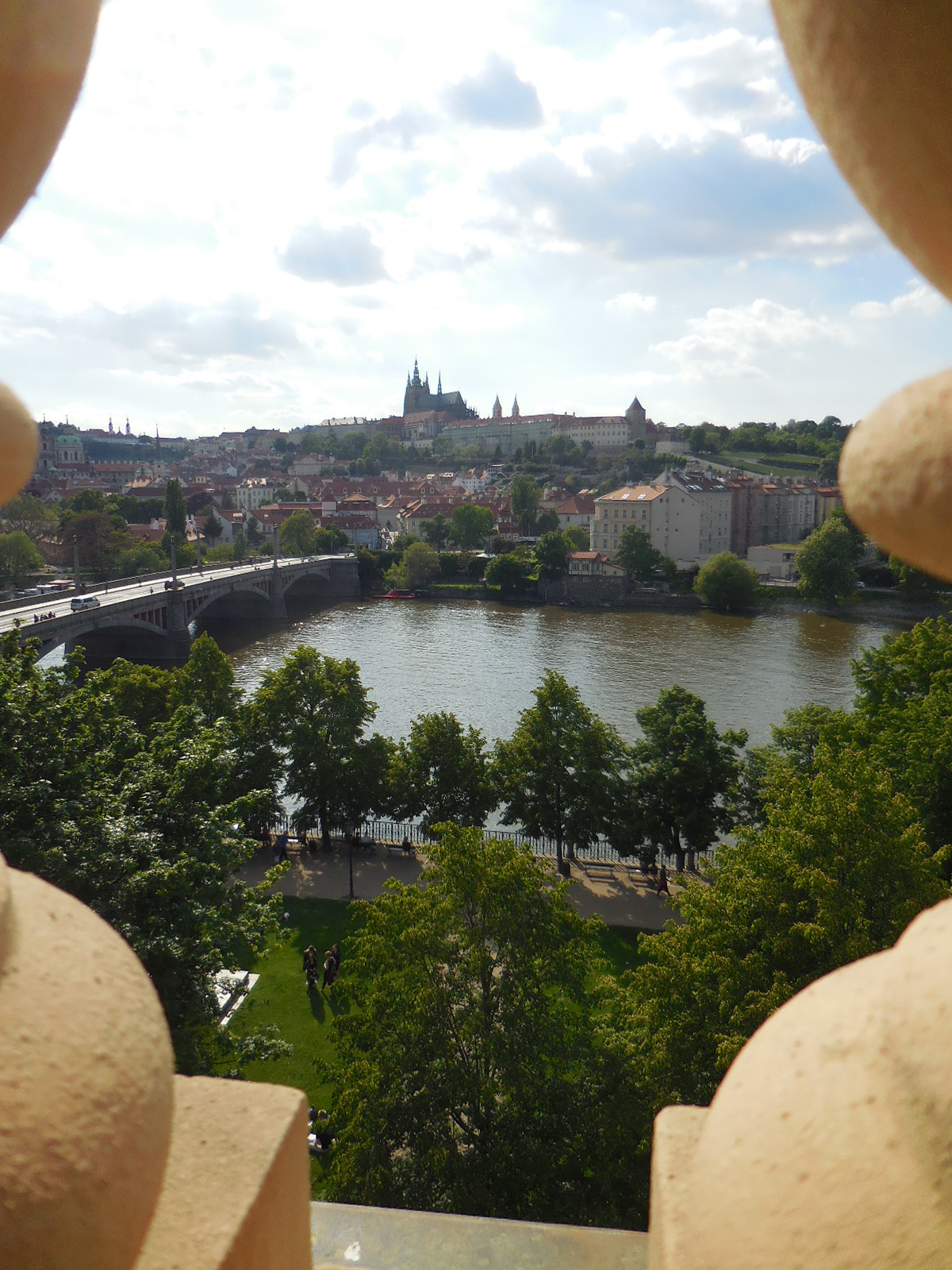
 Tracy's Travels