As I made my way from the grassy parking lot to the chateau, I wondered why I had only heard of Stránov that year, in 2025. After all, Stránov had been open to the public since 2004, even though reconstruction was in progress back then. The chateau looked impressive and romantic with a Neo-Renaissance appearance thanks to a 19th century transformation.
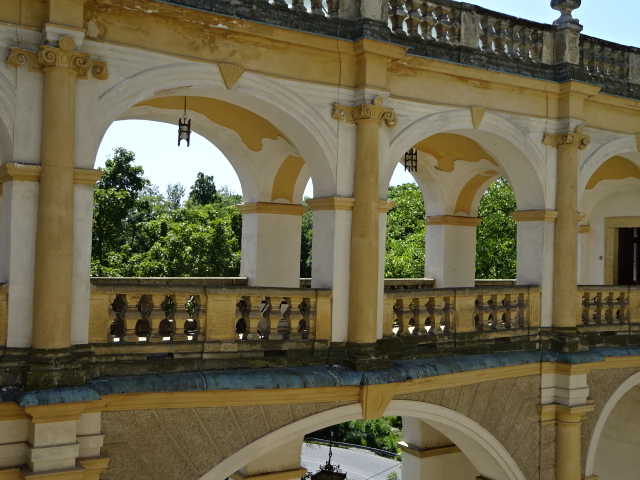
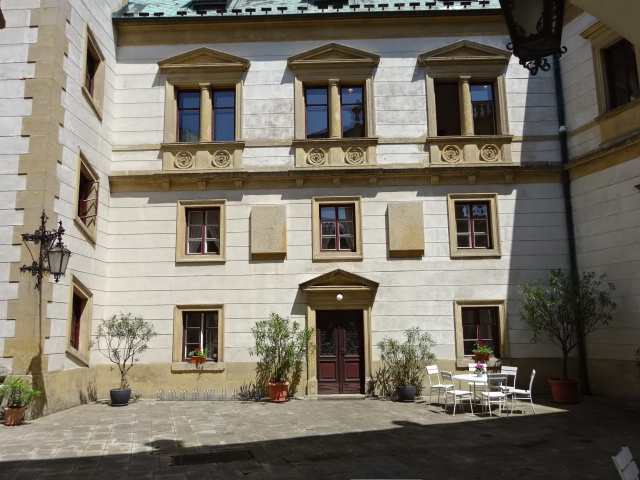
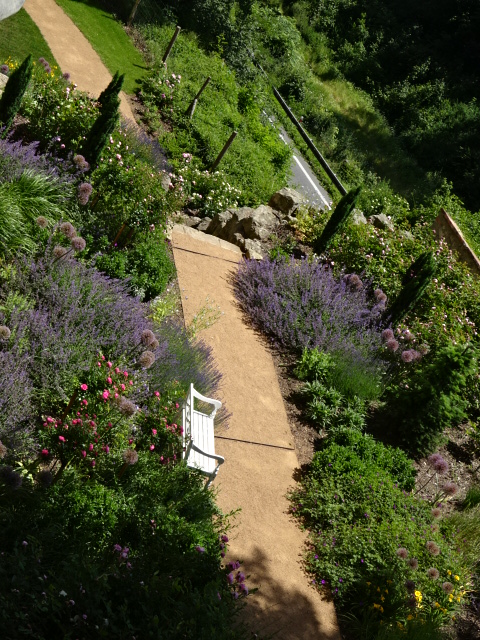
I walked into the café/box office to buy my ticket. The room was quaint with dark paneling. Then I walked into the courtyard dotted with white tables and chairs, and I gazed at the elegant Neo-Renaissance arcades. A distinctive sandstone fountain also caught my attention. From the courtyard I could see a narrow garden area below. People were seated at the white chairs and small tables in the garden. The plant species and flowers were colorful and enthralling.
The guide explained that a Gothic castle had been built on the site in the 15th century, replacing a fortress. Indeed, a Gothic tower still was a dominant feature of the chateau. It was even possible to climb it and take in the views. At the end of the 16th century, the castle got a Renaissance makeover and became a chateau for residential living. During the 18th century, more reconstruction was carried out – this time the chateau turned into a Baroque gem. The garden was also created during this period. The following century Stránov was made into the Neo-Renaissance structure that it is today.
However, the most important time in the chateau’s history began in 1917, when Josef Šimonek, a senator and entrepreneur with the Škoda auto manufacturer, purchased it. He had been so successful and well-respected in the business world that a noble title had been bestowed upon him.
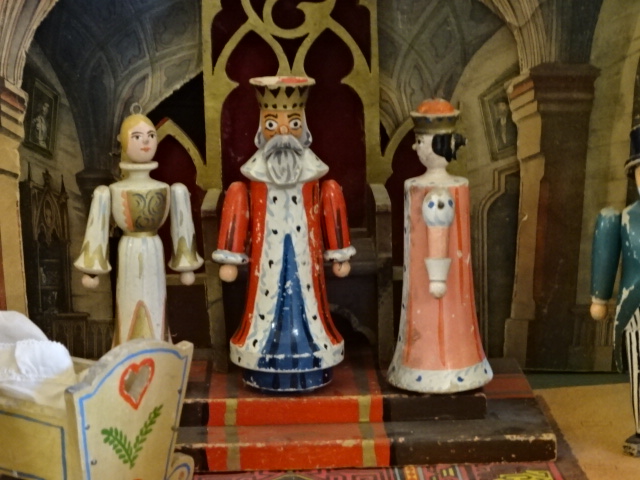
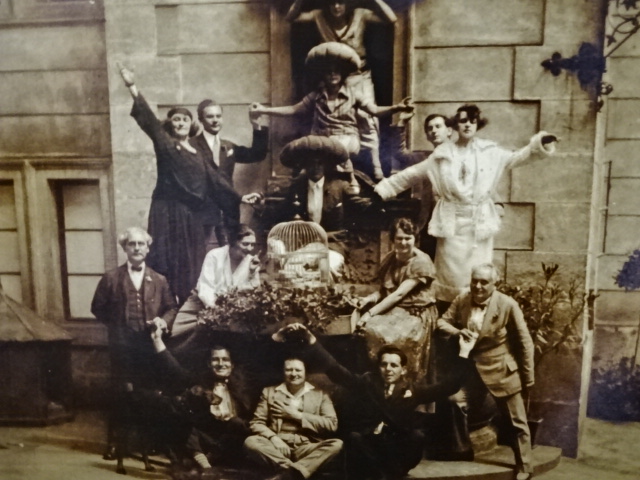
During the First Republic, when Czechoslovakia was a democratic country under the guidance of President Tomáš Garrigue Masaryk, Šimonek, his wife Božena and their two sons, Jaromír and Jiří, made the chateau their home. Black-and-white photographs of the family dotted the rooms as did a group photograph of a joyous acting ensemble that had shot a film there long ago. I saw artifacts from the sons’ childhood – a sled made in 1929 and well-worn miniature toy cars. A children’s theater stage with figures of a skeleton, king and queen caught my attention. The decoration on it was exquisitely hand-painted. The father even created a small zoo for the children.
Although Šimonek retired from Škoda Auto in 1918, he remained a senator in Parliament until he died in 1934. His son František resided there with his family until the Communists forced them to flee in 1950. František’s mother, Božena, left with her husband’s urn in a basket, never to return. She found shelter in a parish house without running water. She lived there until her death in 1976. I saw the suitcases members of the family had carried when they had to leave their home.
Once nationalized, the chateau became an orphanage. The Šimonek family didn’t get the chateau back until 2003. Before the arrival of the Communists in 1950, there had been 750 pieces of furnishings and objects. Returned to the family in the early 2000s were only 35 of those. Stránov was open it to the public during 2004 even though reconstruction was taking place.
Photo of acting ensemble that shot a film at the chateau many decades ago
Another relative also named Jaromír Šimonek, born in 1945, had called the nearby chateau Lobeč home for five years before being forced out with his family by the Communists in 1950. Growing up, he had his hopes set on studying about machines in Mladá Boleslav, a nearby town. However, the Communists did not permit him to study for his desired profession. He did, though, wind up learning how to repair agricultural machines and took a serious interest in mechanics. Later, he followed in his family’s footsteps and went to work at Škoda Auto. Eventually, he became the mayor of Lobeč. He died in 2021.
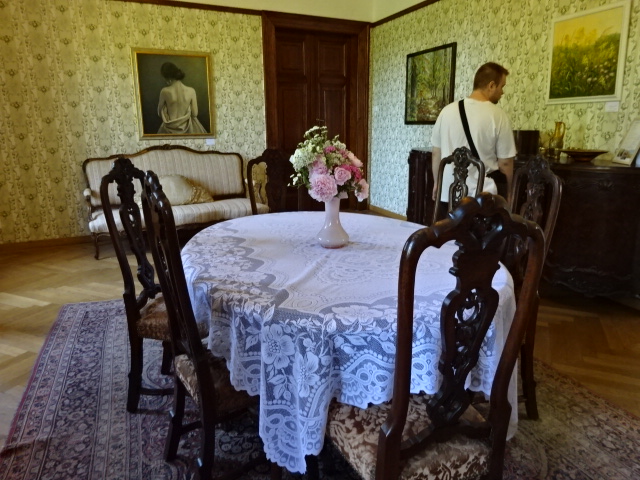
The interior of the chateau harkened back to the First Republic. The current owner had furnishings made to look like they had been created during that era, my favorite period of Czechoslovak history. There were a few original furnishings that had been preserved for use in the orphanage.
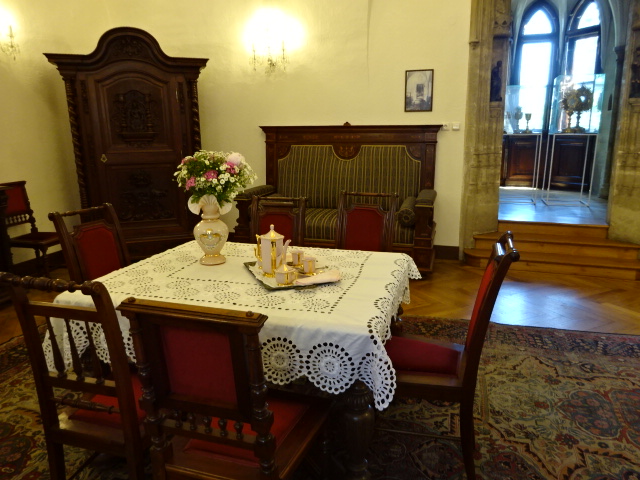
The interior was cozy with an atmosphere that made me want to open a good book and relax there. In one room with wine red-upholstered chairs and a table with a tea service, I could imagine having a cup of Earl Grey on a wintry evening while discussing the Čapeks’ latest play. I could imagine people seated in armchairs or at tables there, talking animatedly about what was new with Masaryk’s politics, Karel Čapek’s books and Josef Čapek’s artwork. While some of the paintings on the wall were for sale, others harkened back to past eras. The dining room chairs looked elegant with the family coat-of-arms decorating the backs. A beautiful piano also was on display.
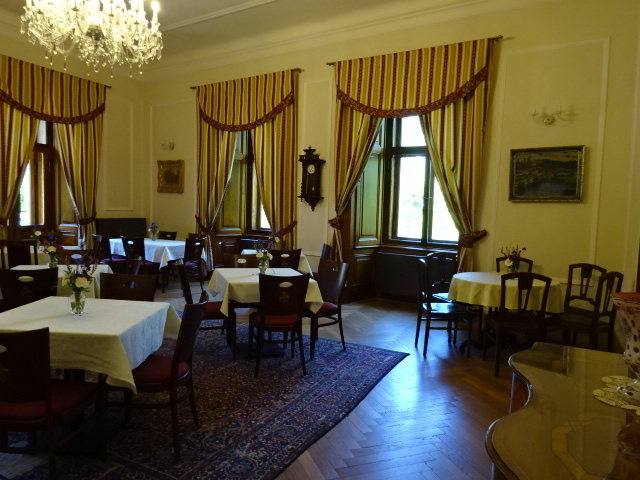
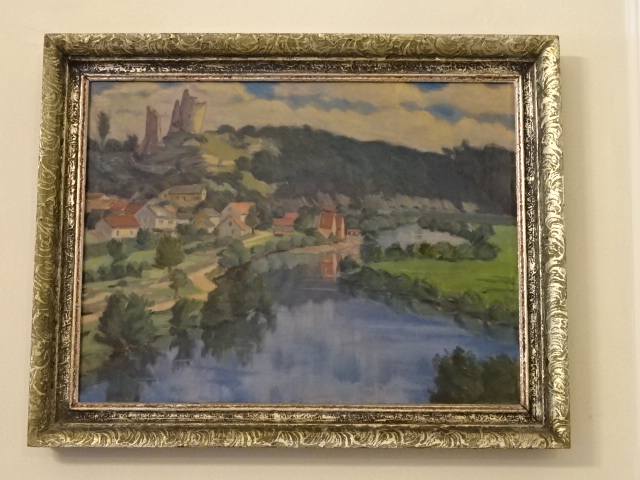
In the large space used for weddings, I saw red upholstered chairs with tables complementing the red and gold striped curtains that gave the place an elegant look. I wanted to fall into the quaint wine red leather couch. I noticed the beautiful Bohemian crystal chandelier. On the wall a painting caught my eye. The tranquil landscape featured a calm river with homes dotting the embankment.
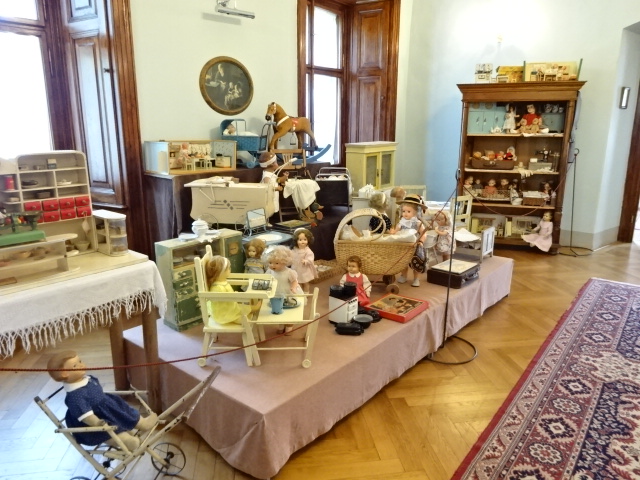
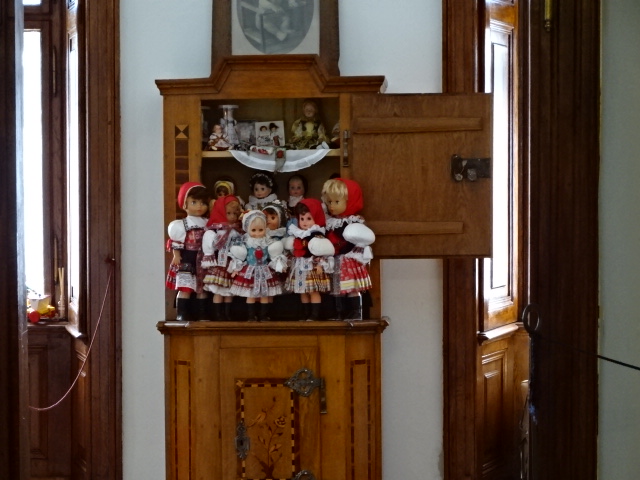
The chateau included a toy museum with old objects donated by a private collector. I saw early 20th century dolls of girls in folk costumes and once much loved teddy bears of various sizes. Children’s baby carriages and dolls of various sizes graced the exhibition room. A rocking horse was also on display. I loved the miniature furniture, such as a cabinet filled with plates and tea cups. I also peered in one hallway at original folk costumes, exquisitely made.
I came away from the tour with a warm feeling for my favorite period in Czechoslovak history. I imagined raucous boys playing with miniature cars in the rooms as their father told them to keep the noise down while he read Lidové noviny. The furnishings had brought the chateau to life, giving it a distinct family atmosphere.
Tracy A. Burns is a writer, proofreader and editor in Prague.
Original armchairs made for Josef Šimonek during the First Republic
It is very easy to get to Pilsen from Prague – only a one-hour bus journey, courtesy of the Student Agency bus company. From the bus station I took a tram three stops to Republic Square. The synagogue was within walking distance. I was curious about the second largest synagogue in the world and the third largest in the world with a capacity of 2,500 people.
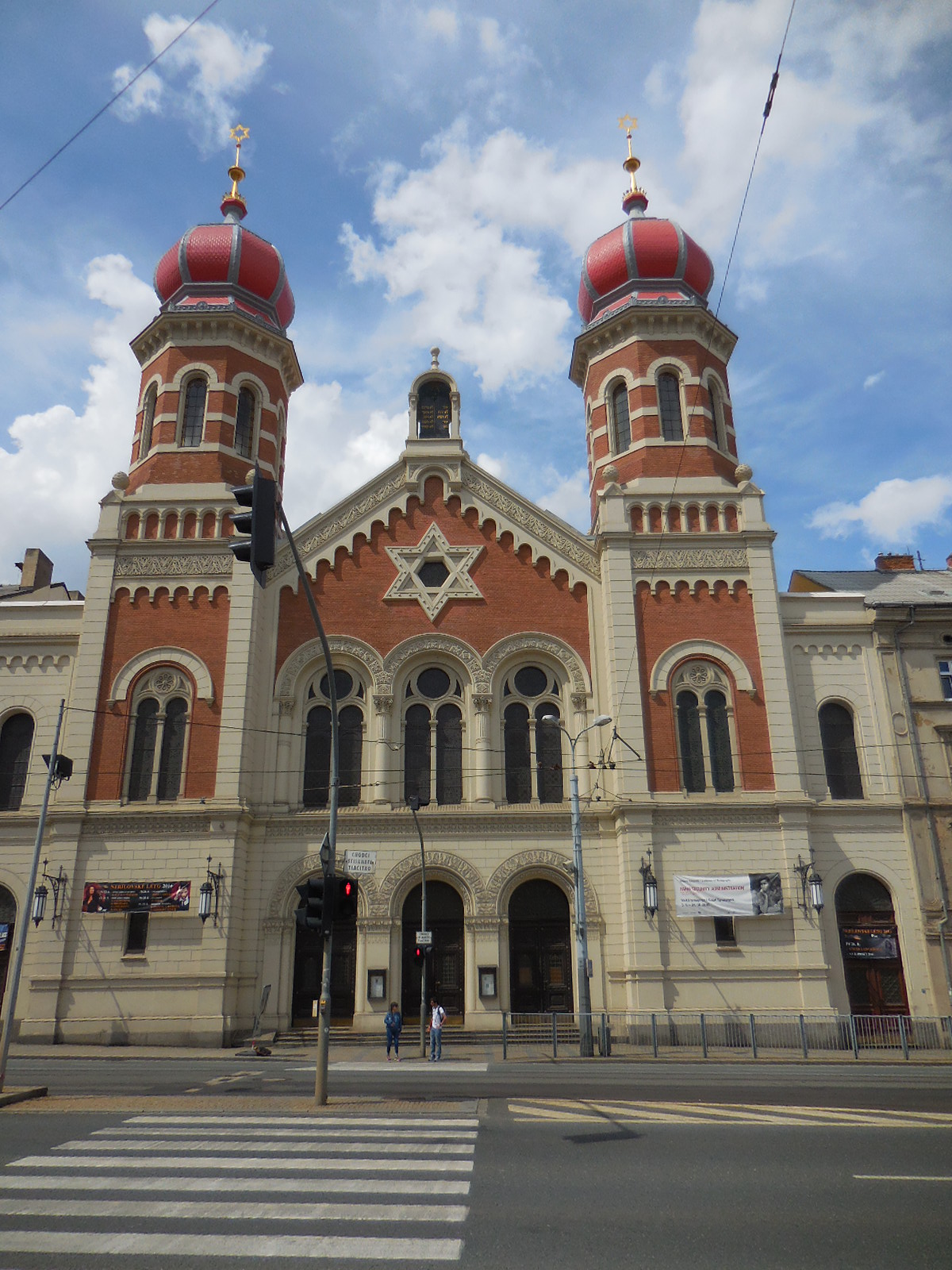
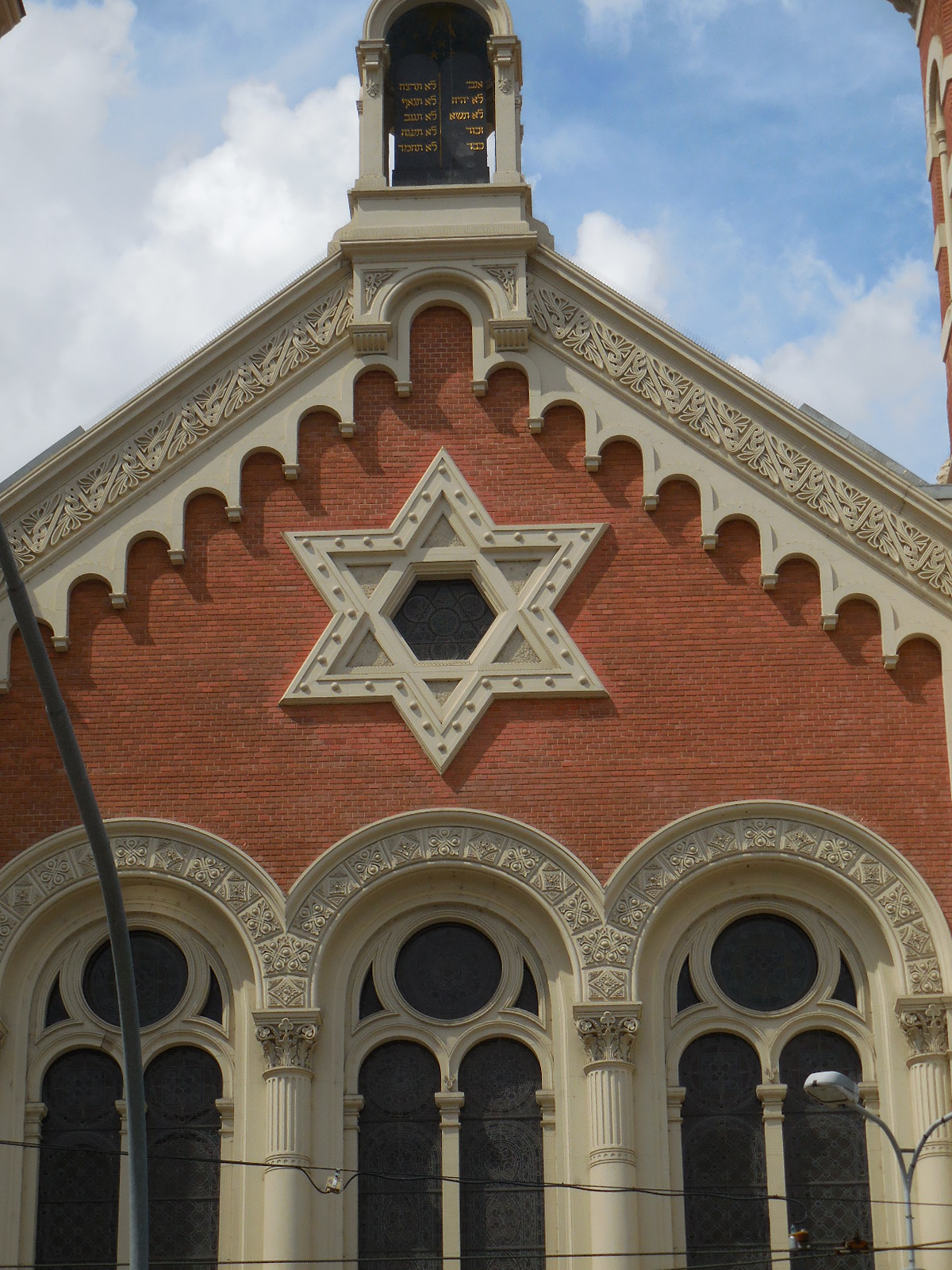
I was very impressed by the façade and two towers. Under the gabled roof of the structure of capping brick and stone blocks is a large Star of David. The two towers flanking the middle portion of the building have imperial domes and a belfry as well as a crown and the Star of David. The onion-shaped domes reminded me of some of the churches I had seen in Saint Petersburg, Russia.
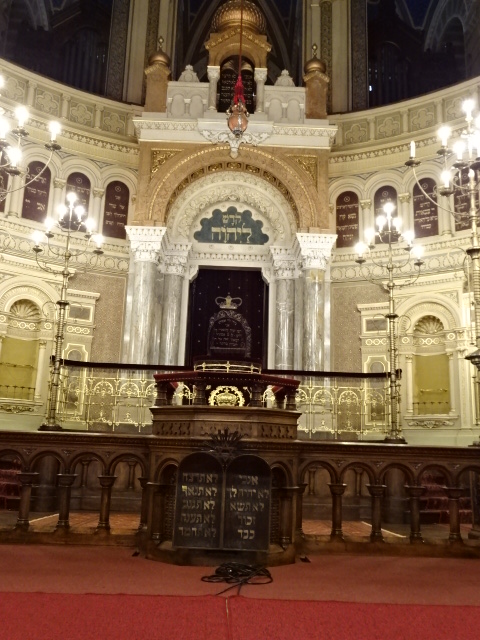
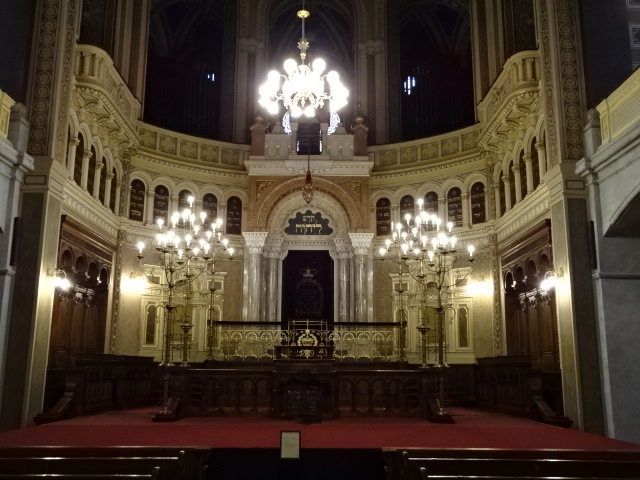
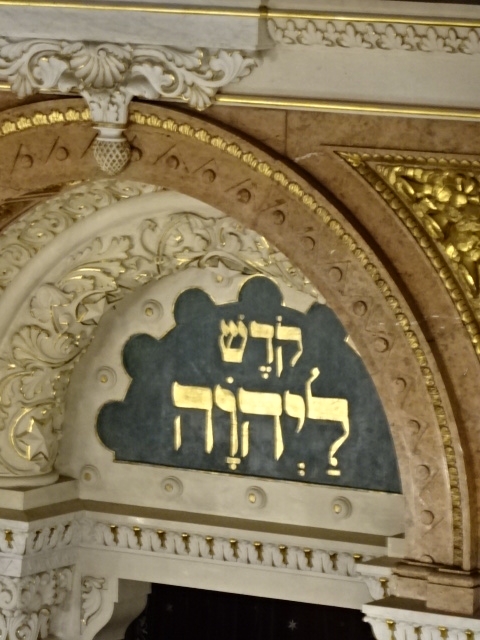
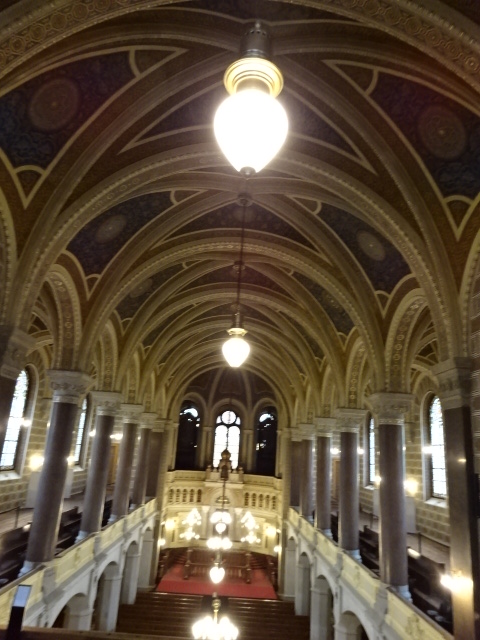
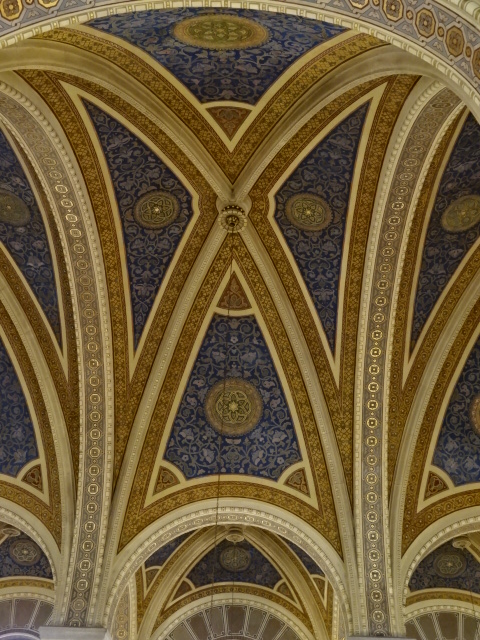
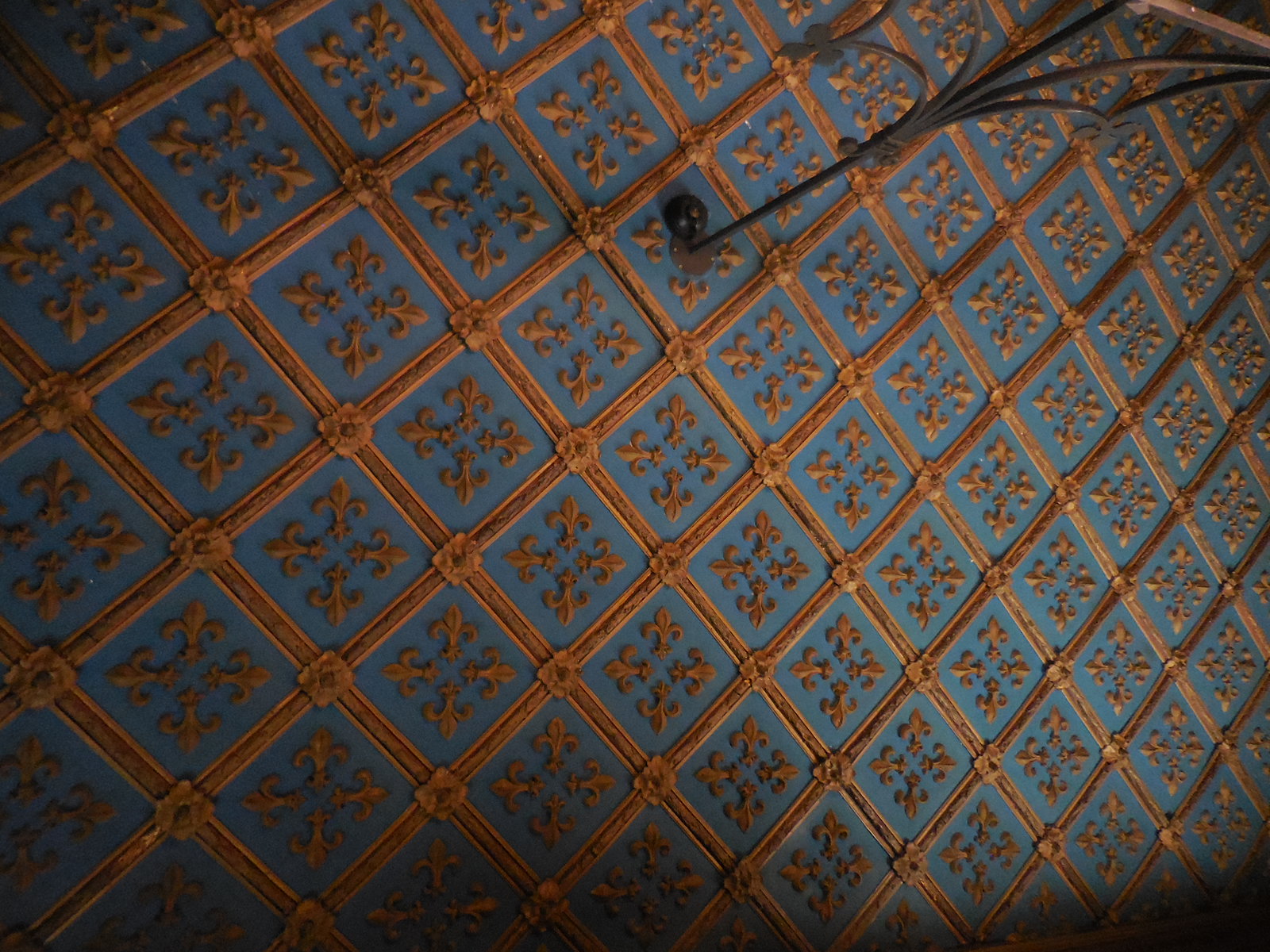
I gaped as I perused the spellbinding features. Built in 1892, the synagogue combines an Oriental interior with elements of Neo-Renaissance, found mostly in the corridors. The carved rostrum of the three-aisled ground floor has a simple, yet dignified design. Two stairways lead up to the platform with the rostrum. One of the things I admired most was the vaulted ceiling decoration of blue with gold painting with plant motifs. The use of gold for decoration throughout the synagogue was very pleasing to the eye. The staircase had a metal, golden balustrade. The vestibule included beautiful stucco decoration with gold as well. I also noticed the stucco décor with motifs such as David’s Star on the balustrade. I saw the organ, dating from 1890. I remembered reading that there had been a big choir here until World War II.
What entranced me the most, though, was not the exquisite vaulted ceiling, but the three stained glass windows above the cornice in the western side of the synagogue. Dating from 1893, the three windows show a design of circles and oblong shapes, geometric figures in bright colors. They seemed to glisten in the dim lighting. I walked to the upper gallery, where I could have touched them if I had wanted to. Instead, I just stood there, fascinated at their beauty.
I sat down in the balcony, where women had sat for generations because they were not allowed to sit with the men, and I pondered over the history of Jews in Pilsen. It all began in the 13th century when Jews first came to this city, and King Přemysl Otakar II allowed them religious freedom. At the start of the 15th century, most Jews bartered in spices, pepper and ginger, and two synagogues existed here during that time period. Yet during the reign of King Vladislav II, in 1504, Jews were expelled from Pilsen, and they didn’t return until 1584. Other hardships occurred.
Then things got better. Jews obtained more freedom during 1848-49, when the ghetto that had been created due to the reforms of Holy Roman Emperor and ruler of the Habsburg Empire Joseph II was destroyed. (Emperor Joseph II had been a devout Catholic and an enthusiast for Germanization.) Jews no longer had to pay special taxes. Then, finally in 1867, a constitution was passed, stating political and religious equality, allowing Jews to move house as they pleased and to own property. They were even offered state citizenship. It is no wonder, then, that many Jews headed for this city in the 1860s. The Jewish community of Pilsen thrived during the 19th and beginning of the 20th century, and Jews ran significant businesses in the city.
After World War II, the synagogue was returned to the Jewish community, but the last regular service took place in 1973 as the building became more and more dilapidated. Finally, it was closed down. Reconstruction occurred from 1995-97, and it reopened to the public on February 11, 1998. A service was held here once again, after 26 years, on September 20, 1998, celebrating the Jewish New Year. The first wedding in 61 years was held at this synagogue on June 6, 1999. There was extensive renovation during the 21st century, too.
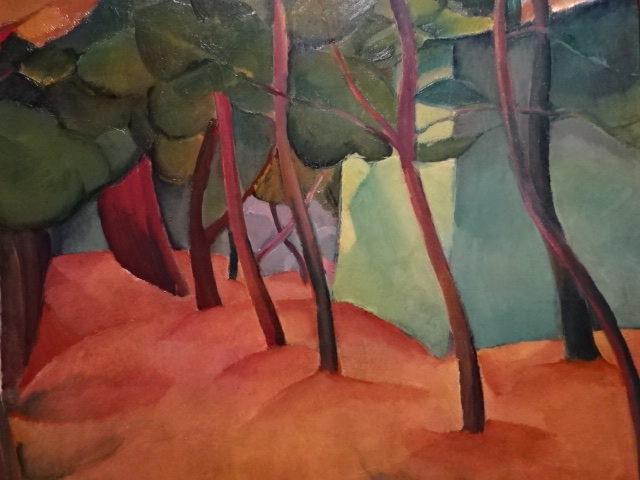
Before heading back to Prague, I took advantage of the beautiful, sunny weather and sat outside at a café on the main square. I also visited an art exhibition called Through the eyes of Franz Kafka, focusing on art in the Czech lands during the time period Kafka was in Prague. There I gazed at Kafka’s drawings, paintings by Czech artist Bohumil Kubišta and sculpture by Czech master František Bílek. I also saw some Japanese art that was popular during that era. I ate lunch in U Salzmannů, the oldest pub in the city and my favorite restaurant in Pilsen. The Czech food at that establishment is top-notch. I also stayed at the restaurant’s pension upstairs for several nights many years ago, during a theatre festival. I was very pleased with the accommodation. Since I only rarely drink alcohol, though, I did not try the legendary Pilsner Urquell beer brewed in this city.
Tracy A. Burns is a writer, proofreader and editor in Prague.
My favorite restaurant in Pilsen – U Salzmannů
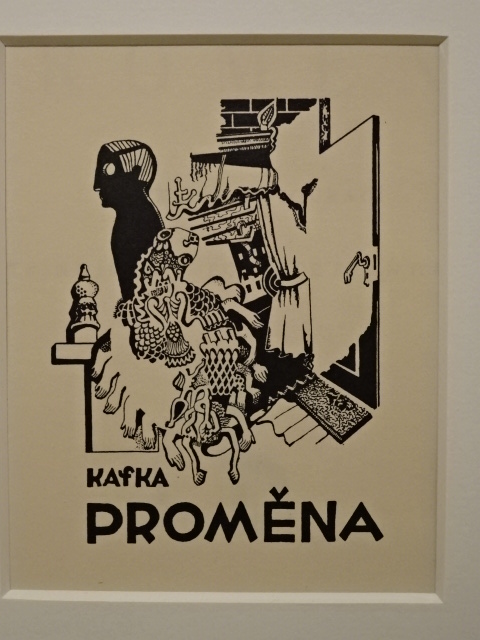
From Pilsen art gallery exhibition Through the Eyes of Franz Kafka
From Pilsen art gallery exhibition Through the Eyes of Franz Kafka
From Pilsen art gallery exhibition Through the Eyes of Franz Kafka
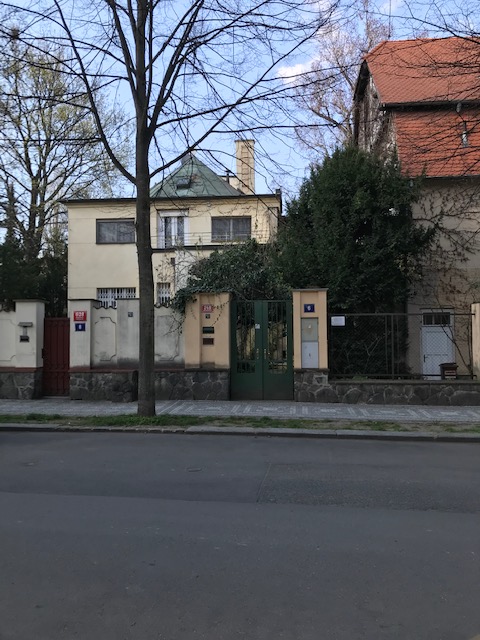
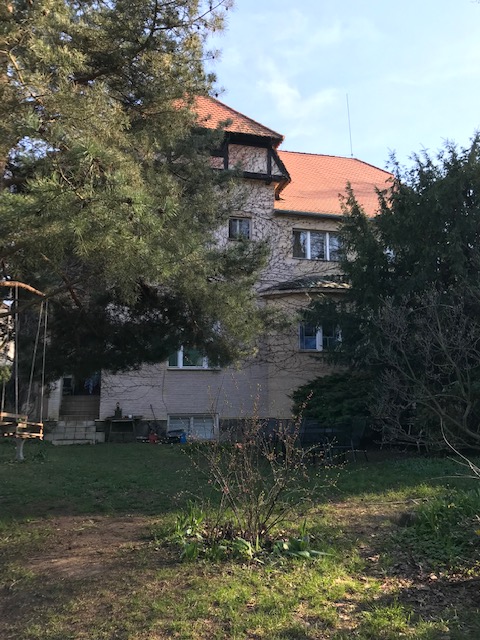
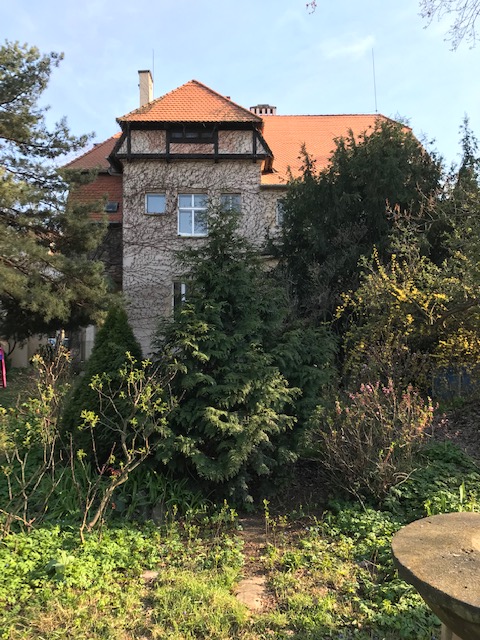
I had waited months for the tour of Stanislav Sucharda’s second villa. The first time I had had to cancel due to illness. I had seen the exterior of the Sucharda Villa on Slavíčkova Street for the first time on a tour of Bubeneč in Prague’s sixth district. Constructed for sculptor, designer and medallist Stanislav Sucharda from 1904 to 1907 by architect Jan Kotěra, the villa is shaped like a cube and features a mansard roof, polygonal bay windows and half-timbered gables. To say I was impressed is an understatement.
The studio of the Sucharda Villa, now a separate building
A large studio building, influenced by Cubism, stood next to what was Sucharda’s second villa. A knight figure is featured on its steep roof. This had once been Sucharda’s atelier but now was owned by the government for administrative purposes. Sucharda had needed a large studio after he won the competition for the colossal monument to František Palacký, the founder of Czech historiography as well as a prominent politician. Palacký’s nickname was the Father of the Nation.
Jan Kotěra – Photo from Kralovehradecký architektonický manual
Kotěra received accolades not only as an architect but also as a theoretician of architecture, a furniture designer and a painter. He designed all the interior furnishings for this villa. I was familiar with Kotěra’s National Building in Prostějov, Moravia. The two-winged, L-shaped building in Prostějov was clearly divided into sections for a hall, restaurant and cafes. Kotěra had also designed half of the complex for the Law Faculty of what is now Charles University, which I had often passed on foot or on the tram.
Decoration on Sucharda’s first villa
As I have already pointed out, this was Sucharda’s second villa in Bubeneč. The first one is also on Slavíčkova Street. It is a neo-Renaissance structure that he and his family had inhabited for 10 years. An exquisite painting of the bishop Božetěch is featured on the exterior of this villa. Stanislav sold this building to his brother Vojtěch, who had made a name for himself as an artist, too.
Mašek’s Villa on Slavíčková Street
Indeed, Slavíčkova Street is dotted with villas built for artists, including architect Jan Koula and painter Karel Vítězslav Mašek. The prominent villas on this street were built from 1895 to 1907. On Mašek’s villa there is floral decoration with a painting of the Virgin Mary with Child. Both the Koula and Mašek villas feature motifs of white pigeons. The painting on one side of Koula’s villa is outstanding.
Koula’s Villa on Slavíčkova Street
Back to Stanislav Sucharda: Family members have taken up artistic professions for at least 250 years. Stanislav was brought up in Nová Paka, where his father, Antonín Sucharda, had created and restored sculptures. The five children helped out in their father’s workshop and would continue to pursue artistic careers.
Stanislav Sucharda
Stanislav attended the School of Decorative Arts in Prague, where he studied under the greatest Czech sculptor of the 19th and 20th century, Josef Václav Myslbek. Every Praguer knows Myslbek’s equestrian statue of Saint Wenceslas at the top of Wenceslas Square. I vividly remember the statue being decorated with votive candles and pictures of Václav Havel shortly after the former president and former dissident died in 2011. The sight had made an unforgettable impression of me and filled me with an immense feeling of loss. Many demonstrations have taken place around the statue, too, even under Communism.
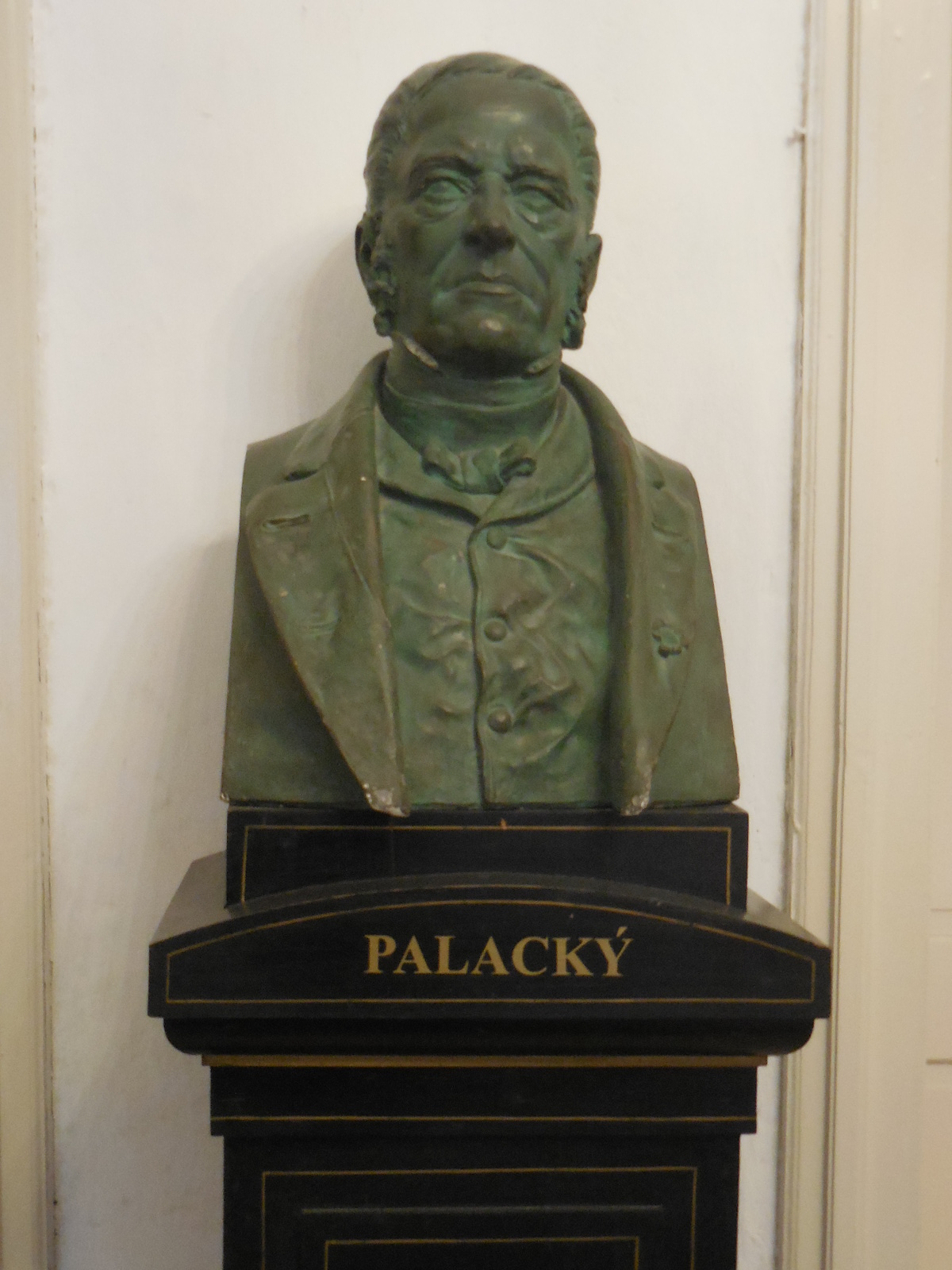
Bust of František Palacký from Maleč Chateau, where Palacky had resided.
Myslbek had been very influenced by the Czech National Revival that promoted Czech culture and the Czech language. I was familiar with Myslbek’s sculptural portrait of František Palacký, who had supported the Czech National Revival, on Palacký’s former home in the street named after him.
Postcard of Sucharda’s Prague and Vltava (1902) printed by Museum of Stanislav Sucharda
It is not surprising that Sucharda’s early creations were greatly influenced by Myslbek’s realism. Sucharda became known for his creations of Czech historical figures and the Slavonic themes in his work, which are two of the reasons his works appeal to me. I love Czech history and studied it in graduate school. After a Prague exhibition of Auguste Rodin’s sculpture in 1902, however, Sucharda’s style became more vibrant and underwent some changes.
Postcard of Sucharda’s Liliana (1909), printed by Museum of Stanislav Sucharda
Sucharda is best known for his sculptural grouping of the monument to Palacký on Palacký Square in Prague’s second district. Many years ago, Palacký’s statue had greeted me every time I took the Metro at the square or rode by on a tram. I had become very interested in Palacký’s work during graduate studies in Czech history, and I found that having a monument dedicated to him near my apartment was refreshing and soothing. The bronze statues of the monument brought to mind the revitalization of Czech history and culture during the Czech National Revival.
Palacký monument on Palacký Square in Prague
The monument also made me think of the Czech nation finally gaining independence after World War I with the creation of Czechoslovakia, even though Palacký had not been alive to see that. I thought of the Czech nation breaking free from the Germanization of the Austro-Hungarian Empire whenever I passed by that sculptural grouping.
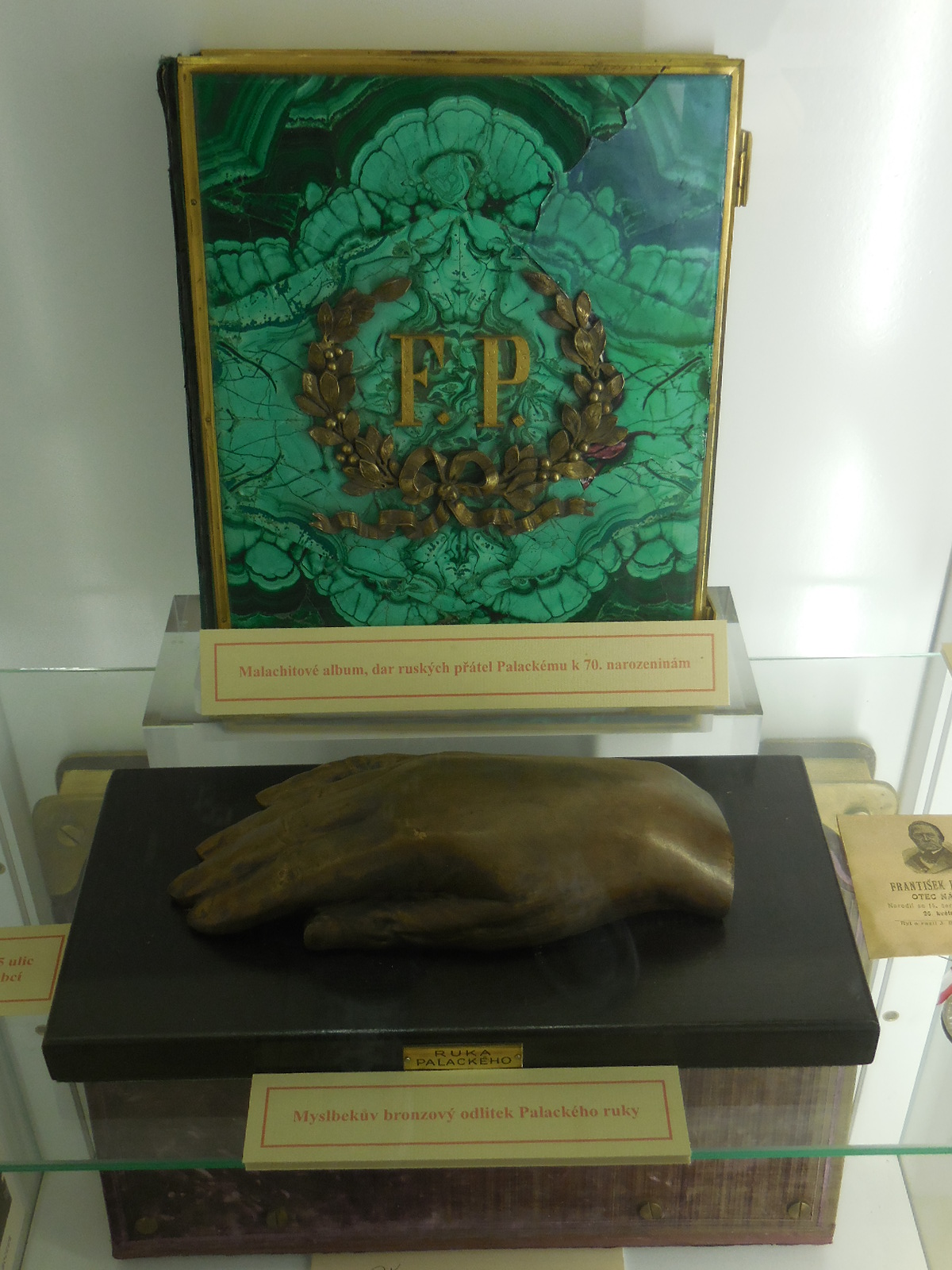
A cast of Palacký’s hand by Myslbek
In the same district as his villa, Sucharda had created a monument to composer Karel Bendl. He also built monuments to Czech historical figures Jan Amos Komenský (Comenius in English) and martyr Jan Hus, for instance. Other designs include sculpture for the study of the mayor of Prague from 1907 to 1909.
Sucharda also authored many reliefs, medals and plaques, and his medal designs were highly praised. His medal works even received international recognition. Stanislav became professor of the first Department of Medal Design of the Academy of Fine Arts in Prague after spending two decades as a professor at the School of Decorative Arts. He had also served for seven years as the chairperson of the Mánes Union of Fine Arts, which organized many influential exhibitions in Prague and was an important promoter of modern art.
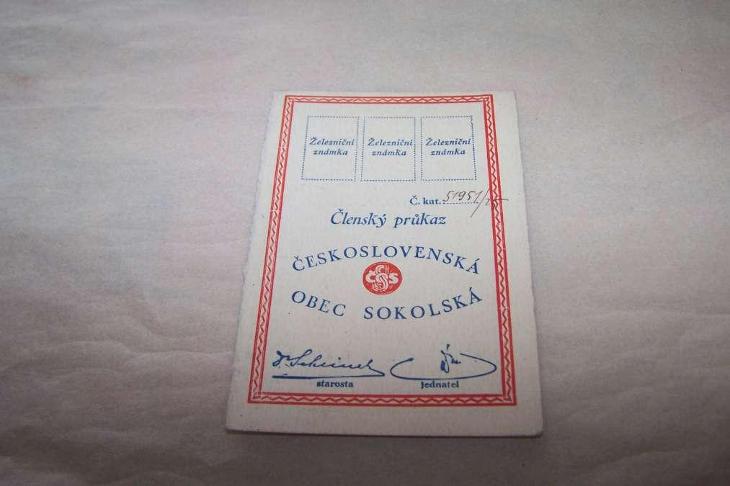
Sokol membership card from 1912. Photo from aukro.cz
For Sucharda there was more to life than artistry. He was an avid member of the legendary Sokol physical education organization, even working as an instructor there. His entire family was involved with this prominent Czech organization.
Then fate intervened. Stanislav served in the military during World War I and did battle on the eastern front. Wounded in the war, he died after returning to the Czech lands in 1916, a year after being chosen to head the medal design department of the Academy of Fine Arts. I thought it was such a shame that he did not get to see the establishment of independent Czechoslovakia with Tomáš Garrigue Masaryk at the helm.
Sucharda’s Second Villa as seen from the garden
The tour of the two-story villa was very impressive as Sucharda’s granddaughter told the group about her father’s work, the pieces of art in the building and the history of the villa. A professional guide was insightful, too. The interior consisted of an English style hall with stained glass decoration on high windows and sculptures, reliefs and paintings. The British architecture of the hall reminded me a bit of Staircase Hall in the Moravian villa of Slovak architect Dušan Jurkovič, who had been inspired by the English Arts and Crafts movement.
Jurkovič’s Villa in Moravia
We saw works by Edvard Munch and Rodin as well as many Czech creations. Small statues and other artworks decorated the top of an elegant decorative fireplace. Behind plush red seating shaped in a semi-circle was a beautiful stained glass window. I especially liked a large relief by Sucharda in the entrance hall and a life-size statue.
In the narrow hallway there was a fountain with sculptural decoration that employed religious motifs. We also saw the dining room with its paintings, statues, busts and ceramics. Works by Stanislav’s daughter were very impressive. The woodcarving of Kotěra furnishings was masterful. A small conservatory was adjoined to the dining room. Intriguing artifacts decorated the piano, and outstanding paintings decorated the walls. I especially liked a rendition of the Roman Forum by Cyril Bouda. It brought to mind my passion for Italy and the time I had showed my parents the Roman Forum
The garden had an intimate feel. I could imagine sitting there, reading a good book and relaxing on a sunny day.
The Muller Villa in Prague
Visiting villas in Prague was one of my favorite pastimes. I recalled touring the František Bílek Villa, the Muller Villa, the Winternitz Villa and the Rothmayer Villa in the capital city. I had also toured several intriguing villas in Brno and the Bauer Villa in central Bohemia. I would definitely recommend touring these villas. I was glad I was able to get to know Stanislav Sucharda better via his villa and the art within it. I developed a much stronger appreciation of Sucharda’s contribution to modern art. The tour was even more impressive than I had imagined it would be.
Tracy A. Burns is a writer, proofreader and editor in Prague.
This museum of Renaissance and neo-Renaissance decorated apartments in a palace is one of my favorite sights in Milan. It is big enough to include many treasures but yet small enough to have an intimate feel. Because the exhibition focuses on the Renaissance and neo-Renaissance, I didn’t feel overwhelmed as I often do when displays include many styles from numerous eras.
The history of the museum is enthralling. In the second half of the 19th century, Fausto and Giuseppe Bagatti Valsecchi furnished their palace located from via Gesu to via Santo Spirito in Milan with works of Renaissance and Neo-Renaissance art – tapestries, paintings, sculpture and weapons, for example. The furniture hails from Italy, Britain, Japan, France, Germany and Spain. Even though the apartments were transformed into a museum during 1974, the public wasn’t able to view them until 1994.
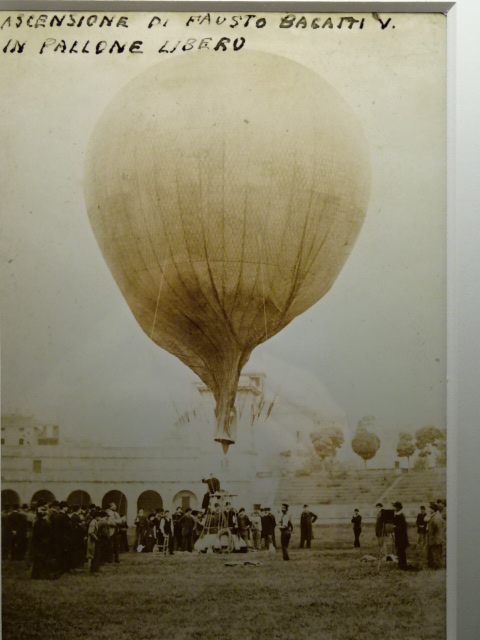
Giuseppe lived in his apartment with his wife. His five children lived on another floor with their nanny. Fausto had his own apartment on the same floor as Giuseppe. While they managed various charities and traveled, they also had some intriguing hobbies. Fausto enjoyed riding in hot-air balloons and Giuseppe was one of the first to ride a velocipede. They used their Renaissance-furnished apartments for daily activities rather than treating the spaces as a museum. Even though it was decorated to look like the Renaissance, the brothers had installed modern amenities, including hot and cold water and electricity. In fact, this palace made a name for itself as one of the first private homes in the world to install electricity.
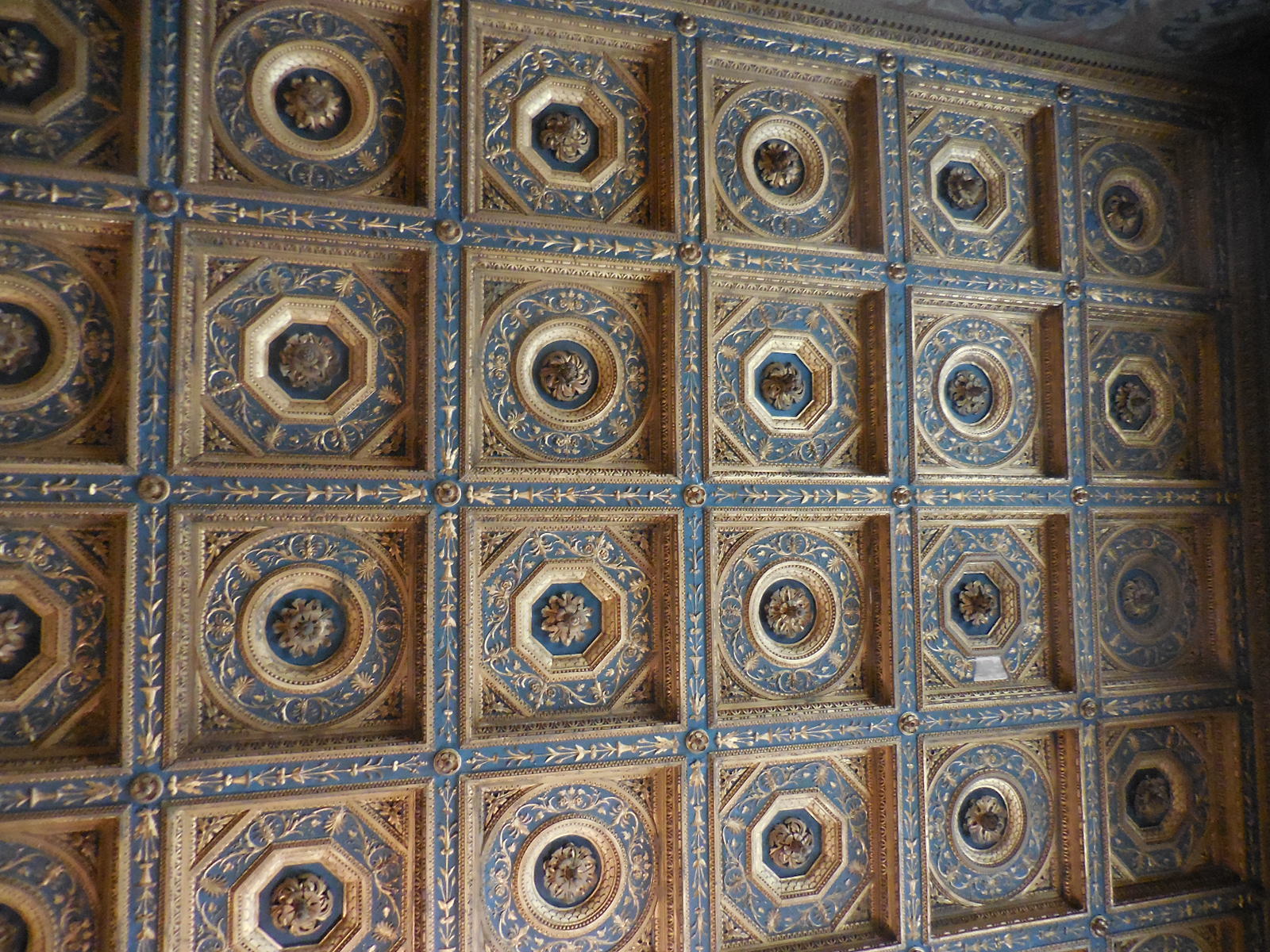
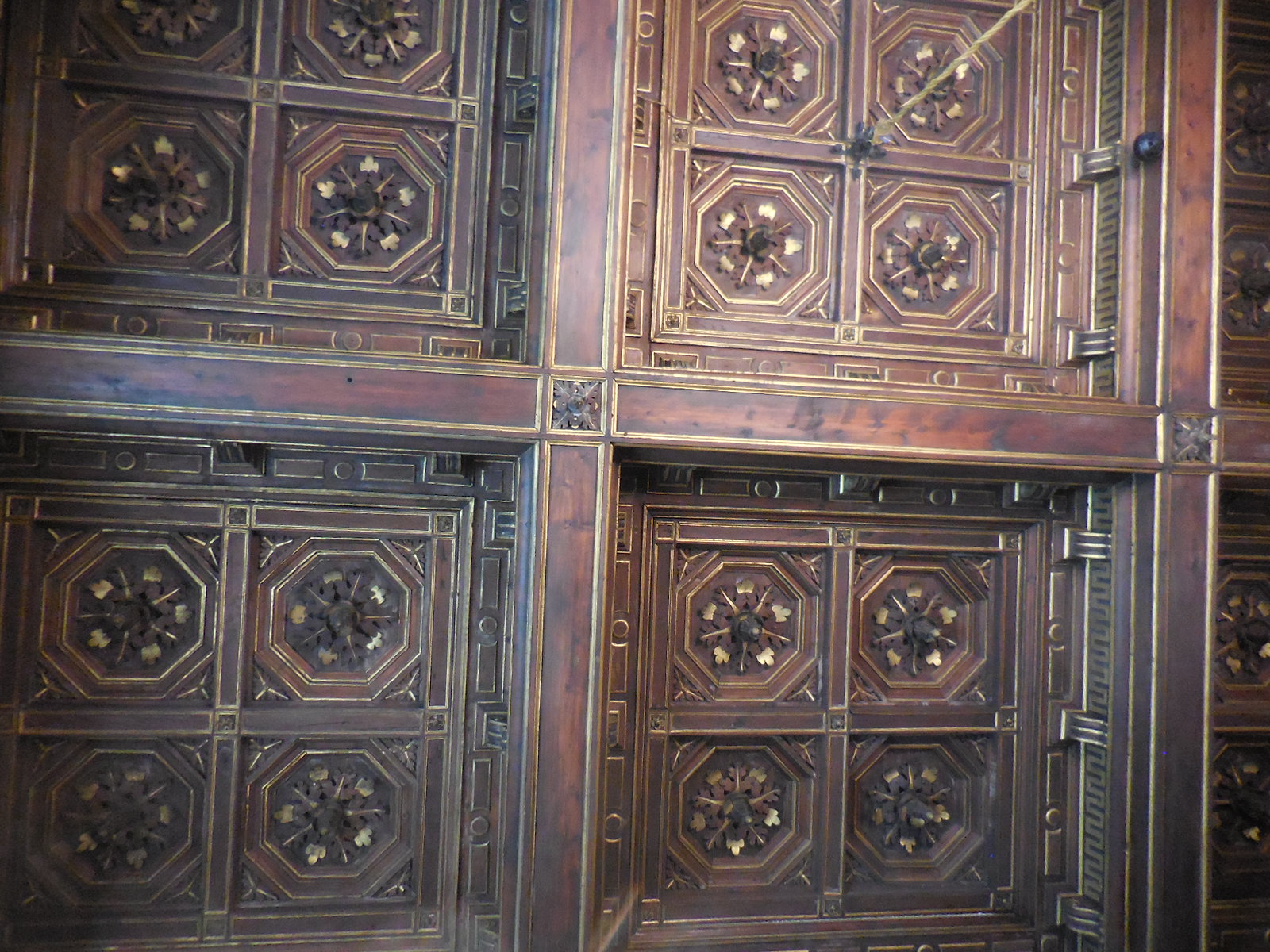
I especially liked the coffered ceilings and Latin inscriptions throughout the flats. Throughout the palace I saw the distinguished family crests of lily and eagle. The Neo-Renaissance frames used to display Renaissance art were appealing, fusing the old with the new or newer.
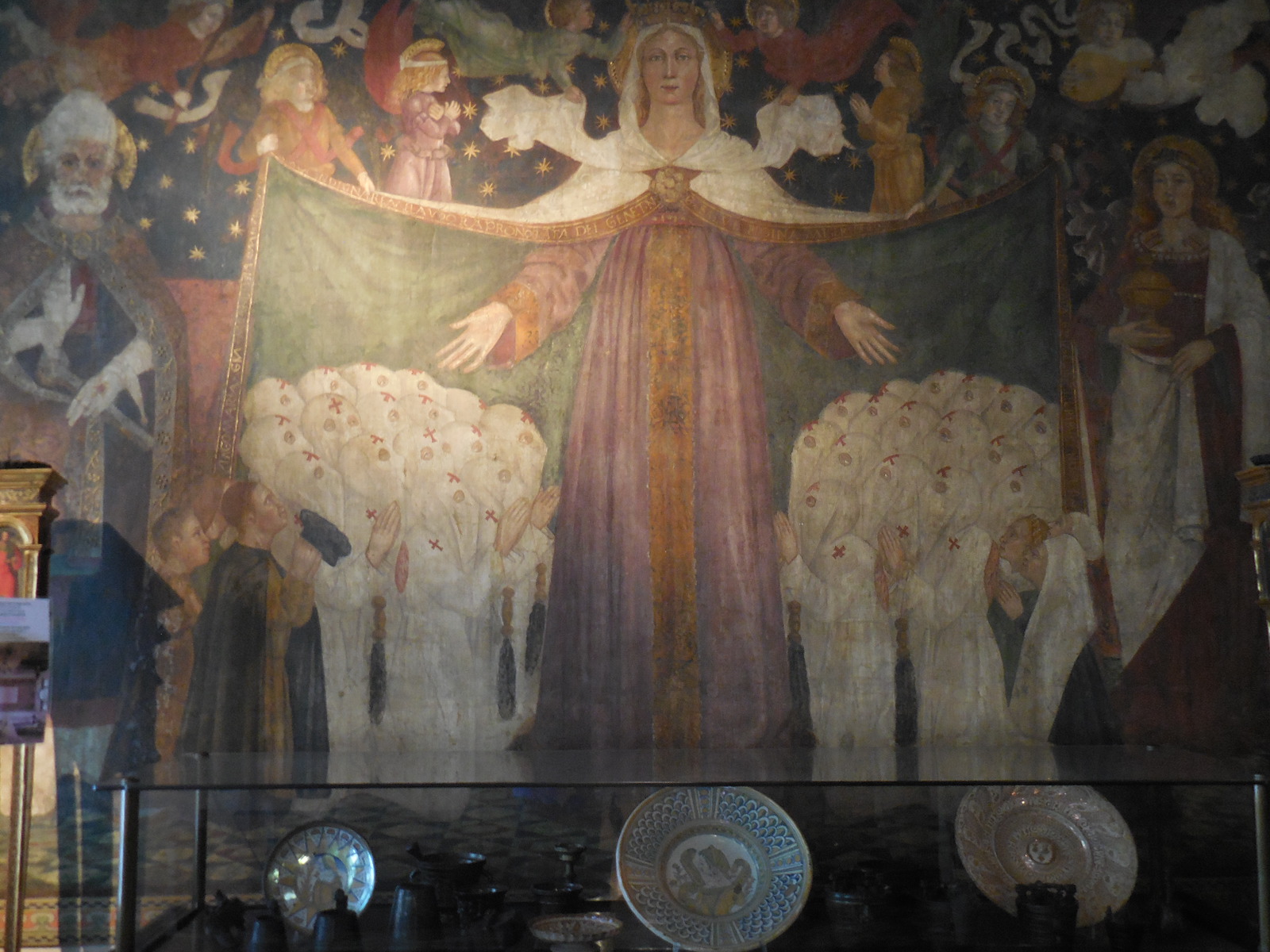
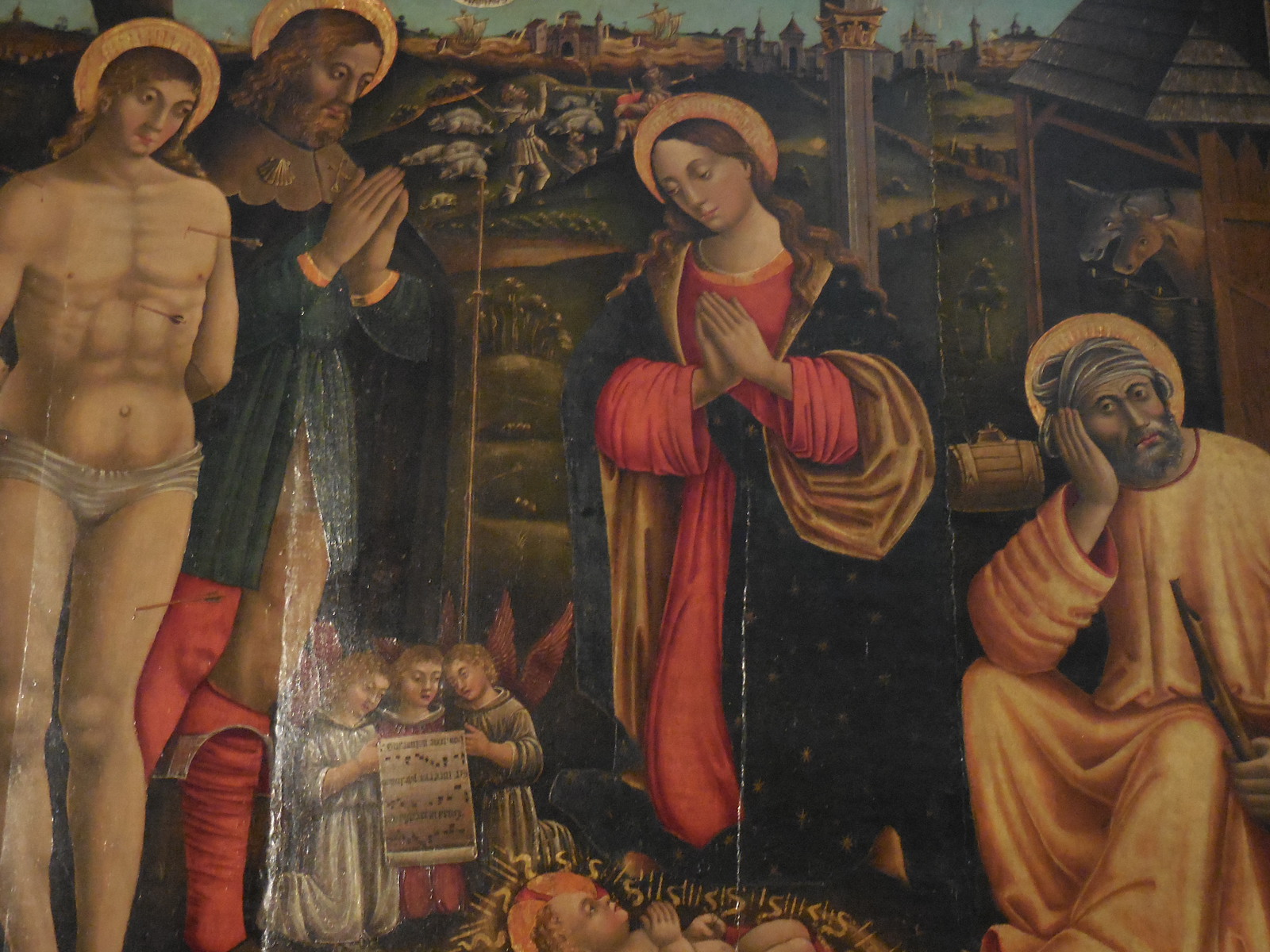
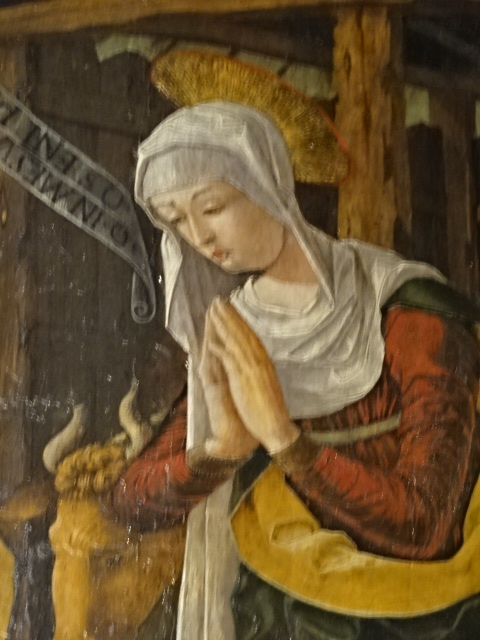
Many spaces captured my attention, including the Fresco Room, where15th century frescoes make a fascinating appearance. The Bevilacqua Room showed off the Madonna and Child by the artist after which the space is named. I took a good look at this innovative work from the 15th century. It was made of glass stones, silver thread, velvet and gold. A coffered ceiling and gold-and-red silk wall coverings added to the elegance of the space.
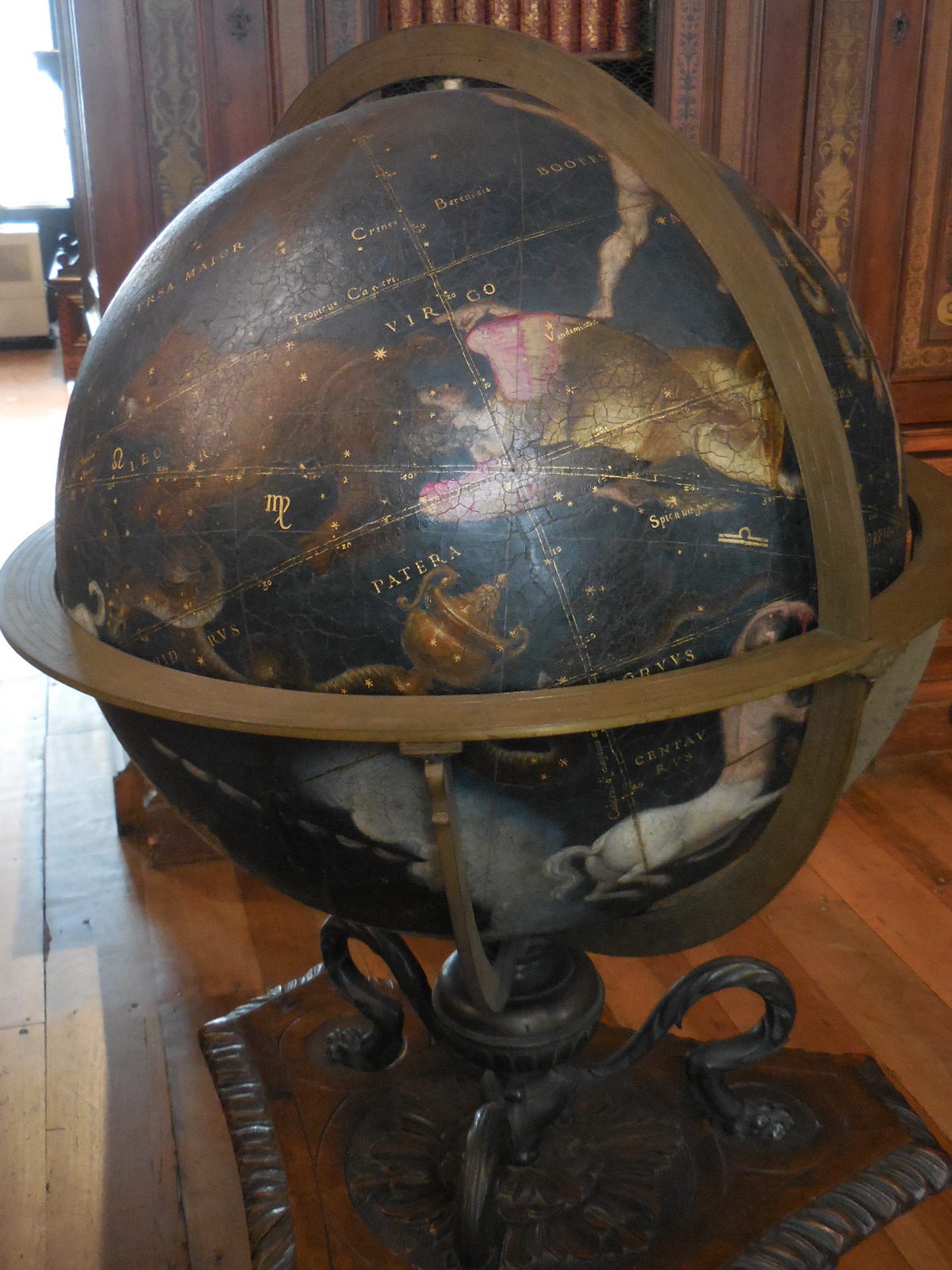
I have always loved libraries, and this library was no exception. On the 16th century terrestrial globe in the library, North America is labeled as “Unknown Territory.”
The largest room was the Grand Salon with a coffered ceiling adorned with pine cone images. Family crests made an appearance as did Latin inscriptions. The frieze featured a theme from Greek mythology and included 16th century frescoes. The red-and-gold décor gave the room a special sense of grandeur. The six stained glass windows were exquisite.
The living room of Giuseppe and Carolina included 16th century decorated paneling, red furniture with velvet upholstery and a piano. The Red Room, which served as the couple’s bedroom, showed off a coffered ceiling and 15th and 16th century paintings as well as a canopied bed with red covering. A door in this room leads to the children’s floor, so the children never had to walk through the Renaissance-decorated apartments.
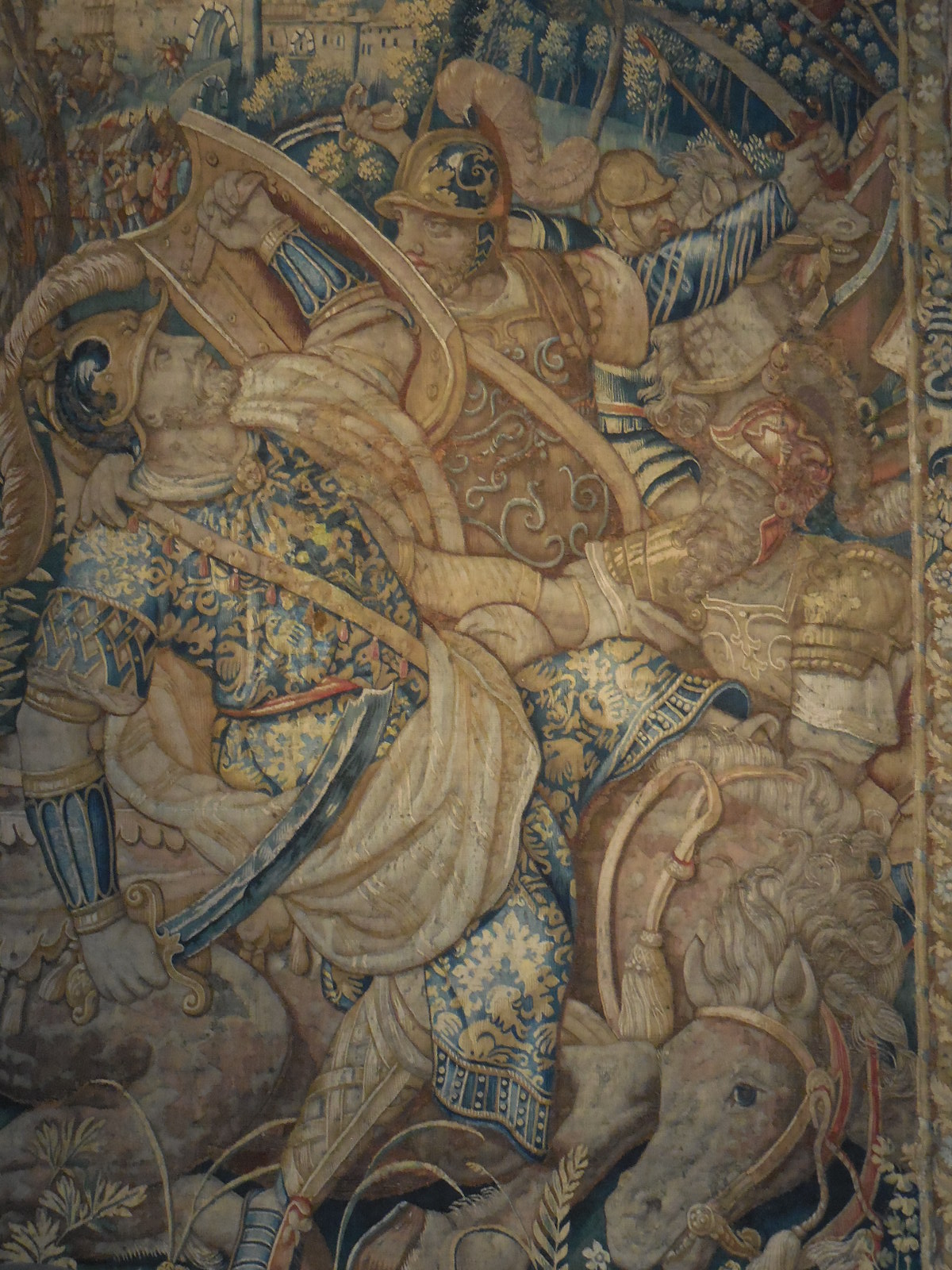
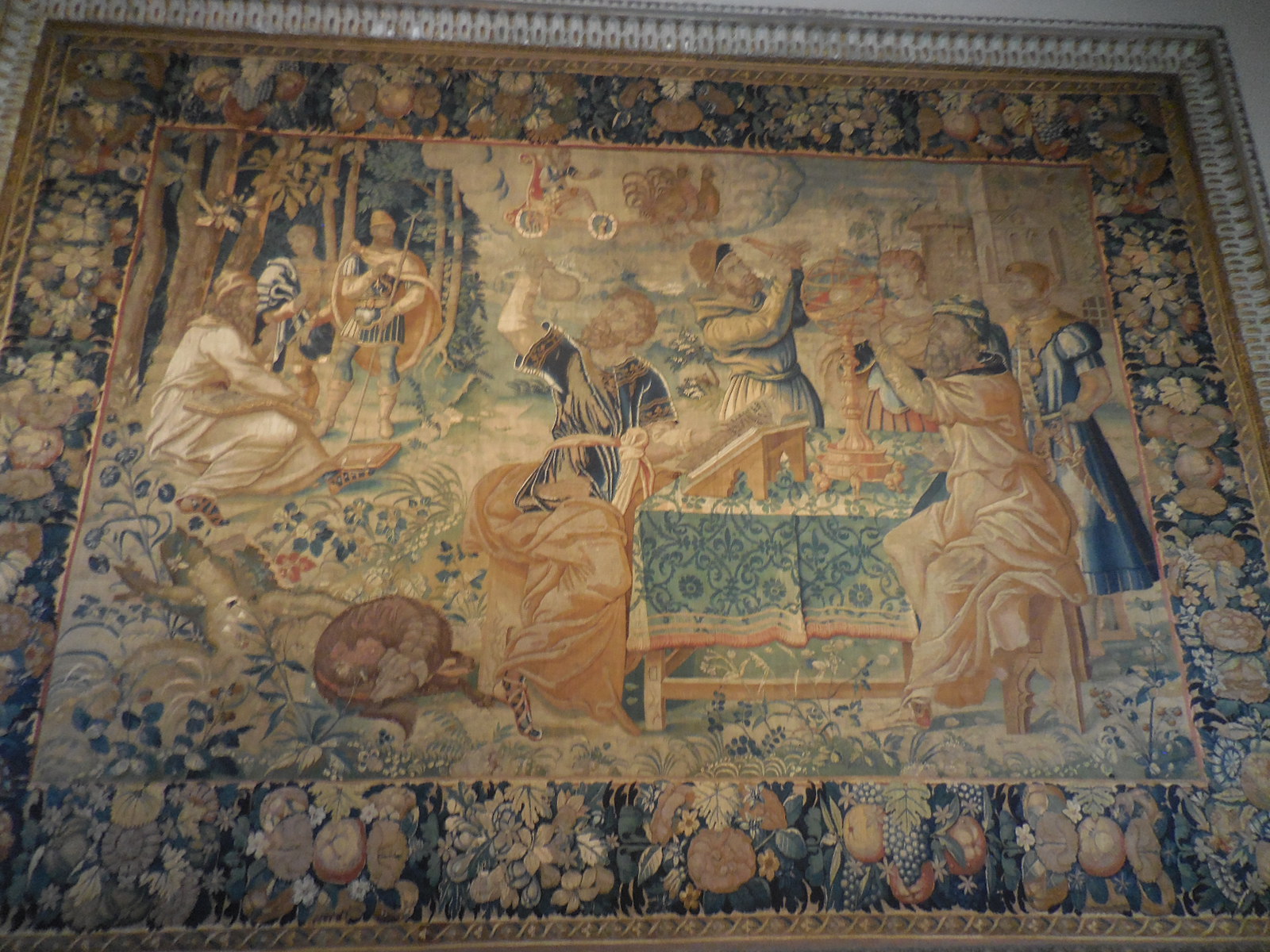
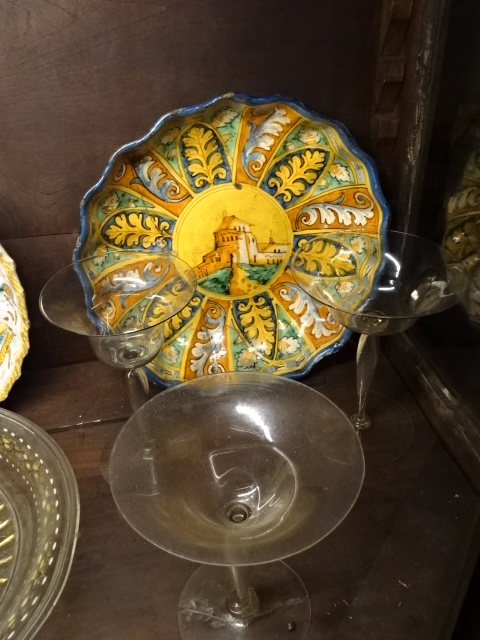
The Dining Room was elegant, too. The wall coverings showed the story of Persian king Cyrus. The majolica plates showed scenes from Alexander the Great’s life.
The bed in Fausto’s Bedroom was adorned with head and foot boards sporting 16th century reliefs. The decorated Neo-Renaissance coffered ceiling was another highlight. A 15th century altarpiece also enthralled. I noticed a clock and a lamp shaped like skulls, too.
I noticed the 16th century ceiling decorated with the two family crests and a Latin inscription in Giuseppe’s Bedroom, called “the Green Room.” The headboard showed off a Pieta scene.
The armory was a long and narrow room with helmets, armor, swords and shields. While I am not especially interested in weaponry, it was impressive.
I liked the Bagatti Valsecchi Room where visitors can open drawers and see photos of the two brothers and some of their personal belongings. One photo that captivated me showed the palace after a section was bombed during the second world war. On another photograph, I saw Giuseppe on a velocipede.
After my visit, I decide that this was my favorite museum in Milan because there was so much to appreciate and yet the flats had an intimacy that larger museums lack. The apartments brought the Renaissance to life with its artifacts. The photos of the two brothers made the apartments feel even more intimate. I was given the chance of having a glimpse of their lives, of getting to know them. That the flat was used for daily life and hadn’t been a museum when the brothers were alive made it all the more appealing. The painted coffered ceilings, the elegant beds with canopies and the 15th and 16th century paintings and frescoes throughout made great impressions on me.
I finally left, knowing someday I would be back because this was a museum I could go back to again and again, greatly enriching my life with each visit.
Tracy A. Burns is a writer, proofreader and editor in Prague.
Bust of first President of Czechoslovakia, Tomáš Garrigue Masaryk from TGM Museum in Lány
This past year my travel was once again marred by the dangers of the pandemic, and I didn’t want to take any unnecessary risks. I took day trips in the Czech Republic during the summer months, when the chateaus and castles were open. While I did not wander far from Prague, these trips did provide me with a fresh perspective of the world around me and of my own life. I tended to spend most of my time at home as a sort of recluse, and these trips offered me a chance to appreciate the world around me. Fears of getting coronavirus despite being vaccinated prevented me from gathering with friends in cafes. When I went on these trips, I traveled with a good friend, and that also helped keep me sane. We always went by car, which was much easier and much more comfortable than going by public transportation.
Tomáš Garrigue MasarykCzech soldiers during World War I
Our first trip in late May was to Lány, where the presidential summer residence was located along with its stunning park. I also visited an intriguing museum dedicated to the founder of Czechoslovakia and its first president, Tomáš Garrigue Masaryk. I had named my cat Šarlota after the first First Lady of Czechoslovakia, American Charlotte Garrigue Masaryk. (Šarlota is Charlotte in Czech.) I also paid my respects to the Masaryk family at the cemetery nearby.
Furnishings from the First Republic periodPanels explaining architecture and construction during the First Republic
The museum highlights, for example, Masaryk’s time as head of the government-in-exile in London and his trip to the USA to convince US President Woodrow Wilson to support Czechoslovakia becoming a country of its own. Masaryk abdicated due to poor health after 17 years in office. His many accomplishments and problems during his tenure are well-explained in these exhibits. One section shows off the role of the Czechoslovak legions fighting in Russia as part of the French army during World War I. Intriguing information about society and sport during the First Republic are on display, too.
The Masaryk graves in Lány
Then we went to the cemetery, where simple slabs mark the graves of Tomáš, his wife Charlotte (who died in 1923), son Jan and daughter Alice. I admired the modest yet eloquent gravestones in a quiet part of this cemetery. I recalled watching a film about Tomáš’ son Jan, a prominent politician whom the Communists pushed out a bathroom window to his death. I had visited the scene of the crime in the Ministry of Foreign Affairs palace some years ago, when an employee showed me around. I recalled that Tomáš, the first president of Czechoslovakia, had died at Lány chateau, where we were headed next.
Lány ChateauThe park at Lány
Only the park was open to the public. I had fallen in love with this park during my first visit back in the summer of 1991, less than two years after the Velvet Revolution had toppled Communism in Czechoslovakia. Lány Chateau has served as the summer residence of Czechoslovak and Czech presidents since the state purchased it in 1921. From the late 17th century until 1921 it was the property of the Furstenberg family. In earlier days it had even been owned by Holy Roman Emperor Rudolf II. Masterful Slovenian architect Josip Plečník had decorated the park during Masaryk’s tenure. A symbolic, spectacular fountain, two ponds, three small bridges, a cottage with fairy-tale decoration, beehives and Neo-Gothic Riding Stables all mesmerized me along with a greenhouse. Walking down the main chestnut-lined path, I saw better the beauty of the world around me as well as the beauty inside me. I tried to imagine Masaryk riding one of his beloved horses in the park or seated on a bench talking with prominent Czech writer Karel Čapek, one of my favorite authors.
Červená Lhota ChateauInterior of Červená Lhota Chateau
We made the trip to the fairy-tale bright red chateau Červená Lhota, which used to be surrounded by water. Alas, there is no water around it now. I recalled my first visit, when I was entranced by the reflection of the cheerful-looking structure in the pond. I also recalled my first attempted trip to the chateau, more than 15 years earlier, when I mistakenly traveled to another village with the same name in an entirely different part of the country. I also recalled the four friends I had made the first time I was successful at traveling to the chateau, walking the 10 kilometers from the train station while talking about life with my friendly companions.
Interior of Červená Lhota Chateau
The chateau got the name Červená Lhota – červená means red in Czech – during 1597, when it was painted that color. Legend claims that the devil had kidnapped a lady at the chateau, and she had died. After her murder, a spot of blood could be seen under a window of the then white façade. Another legend says that her blood had covered the chateau exterior, and the red color was permanent. Perhaps the family best associated with the chateau is the Schonburg-Hartenstein clan, who owned it from 1835 for 110 years. Indeed, the interior took its appearance from the start of the 20th century, when this family was in residence. We saw mostly authentic furnishings, which is always a treat. The painted ceilings, superb artwork, elaborate clocks, beautiful tiled stoves, intarsia-decorated furniture and graphics collection all held my undivided attention.
Jemniště Chateau
Another week we traveled about an hour from Prague to Jemniště Chateau, a Baroque gem completed about 1725, though most of it burned down in 1754 and had to be rebuilt. Leading Czech Baroque painter Václav Vavřinec Reiner and legendary Baroque sculptor Matyáš Bernard Braun did some of the reconstruction. The Sternberg family took possession of the chateau in 1898, but it was confiscated by the Nazis in 1943 and then nationalized by the Communists in 1951. After the Velvet Revolution, the Sternbergs did get the chateau back, and some members of the family live there today.
Park of Jemniště ChateauJemniště Chateau from the park
The Main Hall was astounding with four portraits of Habsburg rulers on the walls, ceiling frescoes with mythological themes and a superb rendition of three allegories of the four seasons. In other spaces, I loved the Dutch Baroque furniture with colored woods. Saint Joseph’s Chapel featured remarkable frescoes.
Český Šternberk Castle in the distanceView from Český Šternberk Castle
Another trip took us to Český Sternberk Castle, which is, in my opinion, the most impressive of the three medieval castles in Central Bohemia, outdoing Karlštejn and Křivoklát. The exterior is imposing Gothic with a steep climb to the entrance gate. The interior spaces are decorated in various historical styles from Renaissance to Rococo. The castle dates back to the mid-thirteenth century, when Zdeslav of Divišov changed his name to Sternberg, the family that owns the castle today. When the Communists took the castle away from then owner Jiří Sternberg in 1949, he and his family still resided there, allowed to use only two small rooms. Jiří even gave tours of the castle. At long last, in 1992, the current owner got the property back.
Interior of Český Šternberk CastleKnights’ Hall
The Knights’ Hall dated from around 1500 and features ornate 17th century stucco adornment. Life-size portraits on the walls showed generals from the Thirty Years’ War and King George of Poděbrady. Two 250-kilogram Czech crystal chandeliers amaze. This was the first but certainly not the last room where the eight-pointed Sternberg star had a prominent presence. The Yellow Salon featured its Empire wall painting of idyllic country scenes. The Dining Room showed off marvelous paintings. Dutch Baroque furniture with a floral motif graced another room. On the tour, we saw many renditions of battles – Sternberg owns 545 paintings of the battles during the Thirty Years’ War. Paintings by Filip Sternberg also are on display.
Karlštejn Castle from the picturesque main street
It was stupid of me to book a tour of Karlštejn Castle for a Friday afternoon. Traffic was hell, but there was nowhere to turn back. It was scorching hot. We walked up the steep road to the castle, gasping for air and needing a few short water breaks. Astounding Gothic Karlštejn Castle loomed above us. Its history was legendary. The castle was constructed for Holy Roman Emperor Charles IV in 1348, and the crown jewels of the Holy Roman Empire had been stored there until 1420. Throughout the centuries, the castle would never be totally conquered. Even a seven-month siege by the Hussites in the 15th century was successfully warded off. I had been to Karlštejn many times but not for some years. The Church of the Assumption of the Virgin Mary showed off beautiful 14th century frescoes. The walls of the small Chapel of Saint Catherine were decorated with exquisite frescoes and semi-precious stones.
Entrance gate at Karlštejn Castle
Gothic frescoes are by no means in short supply on the tour that included the chapel. On one ceiling about 40 angels played various medieval instruments. The Chapel of the Holy Cross, the highlight of the tour, dazzled with its ornate decoration. Designed by Charles IV, the space featured semi-precious stones and 129 paintings of saints, popes, knights, emperors, martyrs, kings plus the Apostles and others. The legendary Master Theodoric, Charles IV’s court painter, created the impressive works. The gold ceiling was adorned with thousands of stars made from Venetian glass.
Blatná Chateau
Unlike Červená Lhota, Blatná in south Bohemia was surrounded by water, adding a romantic flair to the already impressive structure. It was first mentioned in writing during the 13th century. Renovation during the 15th century was carried out in part by famous architect Benedikt Ried, who was responsible for designing part of Prague Castle. The highlight for me was the Green Chamber with its exquisite Renaissance art. The Sternbergs feature in the story of this chateau as well. They took control of the structure in 1541 and added a Renaissance palace. During 1798 Baron Karel Hildprandt bought it and held onto it until the chateau was nationalized in 1948. The family was able to live there, albeit in two small rooms, despite the takeover. In 1952 they were forced out, though. When the Emperor of Ethiopia paid a visit to Czechoslovakia in 1959, he asked that the Hildprandt family be allowed to emigrate to his country. They got permission and resided in Ethiopia until the Soviet coup in the 1970s. During 1992, the family returned to the chateau and made their home at Blatná.
The chapel includes Gothic vaulting and thin, high Gothic windows. The cheerful yellow color of the Baroque Salon reminded me of the yellow kitchen in my parents’ home – a kitchen I would never see again. I loved the intarsia furniture in this space. An English clock’s decoration showed the four seasons. I also was captivated by an Oriental jewel chest with hidden drawers. I recalled my visit to the extensive ruins of Rabí Castle when I saw that structure rendered in an impressive artwork. The Painting Gallery featured a rendition of a vast landscape on a wall and a superb chandelier made of Czech glass. A map in a hallway amazed. It hailed from the 17th century and was one of only two copies in existence. I saw Prague’s Charles Bridge before the statues had been built on it.
Park at Blatná Chateau
In the Hunting Salon some furniture was made from deer antlers. Archduke Franz Ferdinand d’Este visited occasionally to go on hunting trips with the Hildprandt owner. In the Dining Room, I was drawn to the red-and-black chairs and the daiquiri green tiled stove. The 19th century Neo-Gothic furniture was impressive. Japanese plates decorate a wall of another space with a Neo-Renaissance tiled stove and chandelier in Empire style. I noticed some Egyptian features of the Empire furniture. In other spaces an exotic landscape graced a tapestry and four paintings of Italian towns decorated a wall. A huge black Empire style tiled stove stood out in one space. In the Study of Jaroslav Rožmítl, I saw paintings of Adam and Eve plus renditions of saints George, Wenceslas and Catherine. There was an intriguing room with artifacts from Ethiopia that I had seen on previous tours, but for some reason, we did not visit that space this time. My friend and I were disappointed.
Děčín Chateau gate
We also went north to Baroque – Classicist Děčín Chateau, which had served as barracks for the Austro-Hungarian army, the Germans and the Soviets for many decades. The last Soviet soldier had departed in 1991. Its history dates back to the end of the 10th century. Děčín became a castle in the second half of the 13th century, though later it was burned down. In the 16th century the Knights from Bunau transformed it into a Renaissance chateau. The historical landmark gets its current appearance from the Thun-Hohenstein period. That family owned it from 1628 to 1932 and had nurtured a friendship with Franz Ferdinand d’Este. In fact, after Ferdinand d’Este and his wife Sophia were assassinated in Sarajevo during 1914, his children spent time at Děčín. Emperor Franz Joseph and his wife Sissy also stayed at the chateau three weeks after their wedding during the 19th century. A 270-meter steep street gave access to the chateau. Blind arcades adorned seven-meter high walls flanking the street. There was an exquisite Rose Garden, too. A gloriette and statues of mythological gods added to the splendor of this section as did a sala terrena.
View from the chateau
The interior was vast and impressive. The library, which at one time was situated in the biggest hall, had held 90,000 books, but due to financial problems, the Thuns had to sell them. Since no one wanted to buy the entire collection, the Thun clan sold the books by the pound. Only 4,500 volumes of the previous collection have been returned. This huge space currently looked like a ballroom with splendid crystal chandeliers.
Rose GardenStatue in Rose Garden
The exquisite Blue Room included two blue-painted walls with rich decoration, only uncovered during a 2001 restoration. A classical landscape showed people, boats, trees and temples. A large painting of the Thun family tree weighed 150 kilograms. Another room was decorated with floral motifs on blue walls. A wooden bed was made for women who slept half-seated as to not upset their elaborate hair styles. Also, people slept half-seated because they were worried they would die if they lay down on beds. A room showed off the paintings of Děčín by Karl Graff. The Chapel of Saint George was very impressive, too.
The house where my family lived for almost 50 years
In September, my last trip of the year, I spent two weeks in Virginia visiting my parents and four friends. I was constantly worried I would get covid as cases were on the rise. I tended to spend most of the time in my parents’ apartment for this reason. I wanted to go into DC to museums, but I chose to take precautions against covid and stay with my parents. It was the first time I had seen them in two years. That May they had moved from the townhouse where I had lived since the age of three. I missed the red, white and blue rug in my old room, the mahogany piano in the living room and most of all the sunny yellow kitchen where I had talked through so many problems over tea and muffins or scones. I felt as if I had not had the chance to say goodbye to the previous abode, and that rankled me. The thought of a stranger using my childhood home upset me. I liked the apartment, but my heart was back in the townhouse. Still, nothing could compare to the moment I stepped out of the taxi and saw my mother with her hands out, ready for a hug, for the first time in two years. That was one of the best moments of my life.
Šarlota on her cat treeŠarlotka on her Prague castleŠarlotka napping with her toys when she was 11
Yet, during that summer I had experienced one of the worst moments of my life, too. My 11-year-old black cat Šarlota suddenly lost the use of her back legs and had to be rushed to the emergency vet. She had heart problems and stayed overnight in the hospital. The next morning, I was on the balcony, trying to read but unable to concentrate, when the vet called. He said there was no hope. She had to be put to sleep. I was at the vets in an hour or less and spent about 20 minutes talking to Šarlota and petting her, explaining that she was going to meet Bohumil soon in Heaven.
I was crushed. After four horrible years, Šarlota had found me, and she had been so happy living by my side. She had been such a good cat, always thankful and appreciative of her rosy life. It was cruel for her to die after only six years with me, I thought. I spoke to her calmly and thanked her profusely for being my best friend. I will always treasure those 20 minutes. Her death was so sudden that her death still greatly pains me. Every day I almost burst into tears because she is not here.
Olinka
Four days after she died, I adopted a four-year old black cat I named Olinka Havlová Burnsová after Václav Havel’s wife, the first First Lady of the Czech Republic. Olinka’s history was tinged with sadness as well. About two weeks before I got her from a cat shelter, Olinka’s human, with whom she had a wonderful life, had been murdered at her home by a drug addict. For several days Olinka and her brothers and sisters had been alone in the house with the corpse. When the police came, they all ran away. Olinka was the first to come back to her previous territory, returning the next evening. The cat shelter where I knew the owner had caught her, and she had spent a few weeks there.
Olinka on Christmas Eve, 2021Olinka resting while I read on the couch
The moment I saw a photo of her on the cat shelter’s Facebook page, I wanted to adopt her. When I got her, she was dealing with the death of her first mother, and I was dealing with the death of Šarlota. Now she is happy again, loves playing with all her toys, eating soft food and napping in one of her many beds. She also loves knocking everything off tables, so I have to be careful. Pens, notes and cases for glasses are sprinkled on the carpets of my flat. So far she has destroyed one alarm clock and one lampshade. She was just playing.
I wanted Christmas to be special for Olinka so I filled two stockings with toys. She was very happy during her first Christmas without her first mother, brothers and sisters. I am always astounded at how friendly she is. If a stranger comes in, she will go to him or her and demand petting. The only person she is not sure about is the cleaning lady who moves her toys in order to vacuum.
I so badly want to go back to Italy next year, to travel a little outside the Czech Republic, to wander through museums I have never visited before, to contemplate life in cathedrals, gaze up at the dome and be overcome with awe. I want to walk down picturesque streets for the first time, discovering something new at each corner. I plan on visiting my parents again, too. I hope the situation will be better in the USA whenever I do fly there again.
Tracy A. Burns is a writer and proofreader in Prague.
From the moment I saw a picture of Neo-Renaissance Červená Lhota Chateau, I yearned to see it with my own eyes. Its cheerful red appearance cast a spell on me. Comprised of two stories, the pictured chateau dominated a rocky island surrounded by a pond. Červená Lhota looked as if it had jumped out of a fairy tale. How beautiful and romantic the reflection of the four-winged structure looked in the water! I read that a forest was situated nearby as was as a park with the Renaissance Chapel of the Holy Trinity.
There was only one problem: I had heard that the chateau was a 10-kilometer walk from the nearest public transportation, a train station. I was afraid I would get lost as I didn’t have a great sense of direction. I had no one to go with me and didn’t have access to a car. I wondered if I even could walk 10 kilometers. I loved playing sports, but 10 kilometers – was that even possible?
One afternoon I found myself at Prague’s main bus station, arriving home from a day trip. I decided to ask at a window if it was possible to travel to Červená Lhota by bus. I was in luck! It was! I got my bus ticket for the following Saturday. I would have to change buses at Jihlava, in Moravia. I hadn’t realized that the chateau was in Moravia, but I didn’t think any more about it.
I set off for Červená Lhota on a scorching summer day, enthusiastic, elated even, as I listened to the melodic singing of Slovak soft rock star Pavol Habera on my Walkman. I was sure nothing could destroy my ecstatic mood.
Two and a half hours later, I got off the bus at Jihlava and waited for another bus to take me – finally! – to Červená Lhota. Soon I would see that cheerful red façade that featured prominently on the craggy rocks! I would gaze at the sublime reflection of the chateau in the pond! It would be bliss! Before long, I walked to platform number 10, thinking that I could not have hoped for better weather and that nothing surely could go wrong.
Finally, the bus came, and on a sign behind the windshield I saw the words Červená Lhota. I was so close to my destination. It would not be long now.
The bus driver announced “Červená Lhota” when we came to a village. As I exited, I asked the driver, “How do I get to the chateau?”
The driver looked at me as if I was crazy.
“The chateau is near Jindřichův Hradec, in south Bohemia. This is another Červená Lhota.”
My face fell with disappointment.
The driver continued, “I’ll be stopping here again in an hour. Wait, and then you can go back with me to Jihlava.”
I thanked him, tempted to burst into tears. I sat on the bench at the bus stop, my mind reeling. How could I be so stupid? Hadn’t I read that the chateau was in south Bohemia? When I got my bus ticket, I had been so happy, so full of hope. Now I didn’t even know exactly where I was. Somewhere not too far from Jihlava in Moravia. I felt lost – in more ways than one. I didn’t like teaching with the agency full-time. I didn’t want to get up at five every morning and finish work at seven or nine at night. I wanted to do other things, to be able to sleep until seven am, at least several days a week. I didn’t like my housing situation. I felt like my life was just one disappointment after another, as if it was full of days spent in the wrong places. Is this all there was? Was this the only life I could live? I was in my early thirties. I wanted to make a change, but what? And how? I knew I didn’t want to move out of Prague. I felt that I was stuck at a crossroads.
No one else came to the bus stop during that hour. I was alone. It was quiet. I got myself together mentally, many thoughts going through my head. I had to persevere; I knew that. I had to move onward one small step at a time. During those 60 minutes of solitude, I decided that I wouldn’t let life get me down. The following Saturday I would take the train to Kardašovy Řečice, which was 10 kilometers from the right Červená Lhota. I was determined to see the chateau. I would walk the 10 kilometers alone. I could do it, I kept telling myself. When I saw the bus approaching, I breathed a sigh of relief.
From Jihlava I easily found a bus to Prague. When I got off in the capital city, I did not feel lost anymore. Instead, I was filled with purpose and determination.
The following Saturday I made it to Kardašovy Řečice in the morning. The weather was beautiful though very hot. I was so kanxious. What if I got lost in the middle of nowhere? Casting these thoughts aside, I started walking. Soon I came upon four adults in their twenties, two women and two men who had exited the same train.
“Is this the way to Červená Lhota?” I asked.
“Yeah. We’re going there, too. Come with us!”
We walked to Červená Lhota together, talking about their vacation in south Bohemia and their home in north Bohemia as well about Czech culture and literature. They recommended Zákupy Chateau near their hometown and Děčín Chateau, where I had been when it was still closed to the public in 1991. We talked about our respective travels, too. Our conversations were very pleasant, and I was glad to have met them. I had made four new friends.
I was tired when we arrived at the chateau. However, I totally forgot about my fatigue when I gazed upon that cheerful red façade and its reflection in the calm waters. The chateau was everything I imagined it to be. I almost pinched myself, not believing that the enchanting structure in front of me was real. I took photos on my disposable Kodak camera – I was saving to buy a digital one – while we waited for the tour. I also had a bite to eat in the chateau restaurant, sitting outside with a spectacular view of the red beauty.
The chateau rooms were small but intimate. However, the tour was crowded. Sometimes I had to almost push my way to the front of the large group so I could see because I was short. Still, I didn’t mind. I had reached my goal and met some nice people on the way. The furnishings and decorations were superb, in styles from Renaissance to Beidermeier. Each room had its own charm. I loved the intimate feel of the chateau. It really felt as if a family could live there rather than as a cold representative space.
We all left the chateau feeling elated and set off for the 10-kilometer walk to the train station. Could I trek another 10 kilometers? I needn’t have worried. A bus came and took us to the train station in a five-minute journey. As I stepped off this bus, I felt so different from the moment I had exited the bus in the village of Červená Lhota the previous weekend. This time I felt triumphant, victorious, full of energy despite my weary legs.
My four friends were catching a later train, so we parted at the station, promising to keep in touch. We said our goodbyes, and I started my journey back to Prague. I knew I had to come back here one day.
And, 18 years later, I would.
My second trip to the right Červená Lhota took place during August of 2021, when the situation with covid cases was not too horrible. A friend drove me there. I often visited castles and chateaus with her. She had visited the chateau decades ago but had never seen it surrounded by water. It was much easier than walking 10 kilometers, that was for sure, though I knew I could use the exercise. During the pandemic I had become lax about fitness.
The moment I saw the chateau I was flabbergasted because the pond had disappeared. My friend was so disappointed. The chateau still had me in a trance with its bewitching exterior, but the lack of water made it seem more steeped in reality than in a fairy-tale. Later, we would find out that the chateau would not have water around it for at least two more years. It was simply too expensive to maintain. A garden area was set up on one part of the dry land below the rocky terrain, but it still didn’t make up for the appearance of yesteryear.
It had been a long 18 years. I had stopped teaching full-time about 11 years ago, and I had moved twice. Now I was happy with my work as I was doing more writing and content with my accommodation. I was excited to be back. I hadn’t realized how much I had missed this chateau until I set my eyes on it again. It was scorching hot just like the first time I had visited. The guide told us that we had to wear masks. I was glad because when I was at Jemniště Chateau that rule had not been enforced. I was also pleased that only 20 people were allowed on the tour due to health concerns. I wouldn’t have to deal with a crowd like I had at Jemniště or Děčín chateaus, and there was less of a chance of catching covid during this visit.
I had refamiliarized myself with the chateau’s history before making the trip. The structure was first mentioned in writing during 1465 when it had been a Gothic fortress under the control of the sons of Ctibor of Zásmuk. During 1530 the knighted family of Káb from Rybňany became the owners. Jan Káb’s tombstone would be placed in the nearby chapel. Jan Káb’s two children had succumbed to the plague, so, after his death, his brothers took over. Then called Nová Lhota, the structure was transformed into Renaissance style from 1542 to 1555. A private chapel, now the Church of the Trinity, was built near the chateau in the 1550s. It would become known for its illusive fresco decoration that originated in the second half of the 16th century.
It got the name Červená Lhota (červená means red in Czech) during 1597, when it was painted the same color it is today. The chateau had changed owners again. Vilém Rút of Dírná had chosen this bright color for his residence. A legend claims that the devil had kidnapped a lady at the chateau, and she had been killed. After her murder, a spot of blood could be seen under a window of the then white façade. Another legend claimed that her blood had gushed over the chateau exterior, making it red, and the color could not be changed.
When the Catholics defeated the Protestants at White Mountain in November of 1620, the chateau was confiscated from the Rút family because they were Utraquists. It didn’t make a difference that they had not fought in the battle that would start the Thirty Years’ War.
During 1621 an Italian aristocrat named Antonio Bruccio took charge of Červená Lhota when the imperial army occupied it. After the war he made sure the chateau was not looted. The chapel was plundered, though, and Bruccio reconstructed it, so that the holy space could be reconsecrated in 1635. He founded a spa nearby, and it earned as much praise as the one in Karlovy Vary (Carlsbad), which has for centuries grabbed world-wide attention. Bruccio’s spa, alas, is no more. The stone bridge was built during his era, in 1622. He died in 1639, childless.
Vilém Slavata from Chlum and Košumberk purchased it after Bruccio passed, but he wouldn’t use the chateau as his main residence. I recalled that during the Third Defenestration of Prague, in 1618, he had been thrown out the window of the Castle. He didn’t die because he fell on a heap of dung. While looking after the chateau, he had some reconstruction completed. In 1641 the tower with distinguished portal was built. By 1678 the chateau sported a Baroque appearance. To this day the tower’s portal is decorated in Baroque style. Stuccowork seen in the chateau hails from this era.
Vilém Slavata from Epochaplus.cz
When the Slavata dynasty died out, the niece of the last of the Slavata clan was given possession of the chateau. Marie Theresa married into the Windischgratz family. Two owners in this clan accumulated a great debt due to their bad handling of finances. They wound up selling the chateau to barons, who started having construction work done. A fire damaged the chateau.
Two years after the fire, in 1776, Baron Ignác Stillfried bought the place. Karl Ditters von Dittersdorf, a composer and co-founder of the German opera, lived at the chateau from 1796 to 1799, when he died. Then the dukes of Schonburg-Hartenstein took control in 1835. They would own Červená Lhota for 110 years. During the second half of the 19th century, the chateau was given pseudo-Gothic features, inspired by Hluboká Chateau, one of my all-time favorites. From 1903 to 1913, the chateau got a Neo-Renaissance makeover, giving Červená Lhota the appearance it has today. The chapel was renovated at the beginning of the 20th century, too. In 1907 mass began to be held here again. (Services had been halted during the early 19th century.) After World War I, Johann, the then current owner who had been awarded Golden Fleece and Maltese Cross medals, lived there and added to the chateau’s splendor. When Johann died in 1937, he was buried in the chapel nearby.
Because the family was German, the chateau was handed over to the Czechoslovak state after the war. A children’s sanatorium was set up there in 1946, but its existence was short-lived. During 1949, Červená Lhota was open to the public. Some services, such as weddings, still take place in the former private chapel.
Soon it was time to tour the 16 rooms. So glad that we were in a small group, I was enamored of the interior, which once again felt like a home instead of mere representative spaces. The first floor showed off the life of the Schonburg-Hartenstein clan at the start of the 20th century. It was thrilling to see mostly original furnishings of various styles. Not many chateaus showed off authentic furnishings. At the beginning of our tour, we watched a flutist and pianist in period dress superbly play Renaissance music. The painted ceilings, elaborate clocks and stunning chandeliers all caught my undivided attention. Exquisite religious paintings and portraits, beautiful tiled stoves, furniture with intarsia, black-and-white graphics of various animals and fine porcelain also complemented the spaces. The intricate gilded headboard of a bed sported a hovering putti.
While we perused each room protected by our FFP2 masks, I recalled that Jan Káb’s two children had died of the plague, and I realized that, as the current coronavirus pandemic continued, I had learned how to live all over again. I had spent the first three weeks of the pandemic hiding in my apartment, tuned all day and night to CNN, only leaving to take out the trash. I had been that scared of catching the virus. I had kept my windows closed; my life closed off. Now I was doing things the best I could, being as cautious as I could, but still living rather than merely existing.
I thought back to those 60 minutes spent on that bench at the bus stop in another Červená Lhota, where I had mustered up the courage to face challenges and disappointments head-on, where I had become determined to make changes in my life, even if the changes meant sometimes taking small steps at a time. The tranquility of the hour that seemed to last for such a long time allowed me to get to grips with my present and helped guide me into the future.
Perhaps finding the village of Červená Lhota in Moravia had not been a mistake, but rather it had marked the beginning of a journey that had taken me here, for the second time, to this neo-Renaissance architectural wonder, visited during a pandemic that I had weathered the best I could, making changes along the way, directing my life story one day at a time as I came to new revelations about my journey and my destination. Perhaps it was only fitting that Červená Lhota would be the last chateau I would visit during the summer of 2021. After the tour, my friend and I promised to come back when the pond was restored. So, until then, I said my goodbyes to the place that has been close to my heart for several decades.
Tracy A. Burns is a writer, proofreader and editor in Prague.
I wrote about Velké Březno in an article for The Washington Post during 2005. A fellow castlegoer had enthusiastically recommended the chateau. Nestled in the Central Bohemian hills near Ustí nad Labem, Velké Březno is a hamlet with one of the smallest but most charming chateaus in the Czech lands. My second visit in 2009 was long overdue. From the moment I saw the Neo-Renaissance structure, which looked more like a large villa than a chateau, I was entranced. Because we had time before the tour, we spent some minutes on the beautiful terrace that overlooks the park.
First, a little background information. Velké Březno has been inhabited since the Mesolithic era, and the Slavs settled there in the 9th century. The oldest document mentioning the village dates from the second half of the 12th century.
While many people owned the chateau at various times, the most notable family to inhabit Velké Březno’s chateau is the Chotek clan. Not satisfied with the old castle in the town, Karl Chotek moved into Velké Březno with his wife and six sons in 1844. The chateau was built from 1842 to 1845 in Empire style. Karl had made a name for himself in Prague, where he promoted Czech national identity. Renowned Czech historian František Palacký had tutored him in the Czech language. (Later, Palacký taught Karl’s children.) Chotek had chipped in financially for the repairs of Karlštejn Castle near Prague. He was a key figure in setting up industrial exhibitions in Prague. He also helped the Prague public transport system in its early days. One interesting fact is that, during the 1820s, Karl initiated the tradition of Czechs sending New Year’s greeting cards.
Famous guests set foot in the chateau, too. A young Franz Joseph, who would later become emperor, visited in 1847. Composer Franz Liszt came to the chateau on three occasions. Sophie Chotek, who would be assassinated in Sarajevo along with her husband Franz Ferdinand d’Este, resided there in the late 19th century.
Karl’s son Anton took control of the chateau after Karl died, in 1868. Karl Maria, their son, dabbled in politics and took up many hobbies – traveling, photography and gardening, for instance. From 1885 to 1910, the chateau was reconstructed. The new Neo-Renaissance look featured a four-sided tower, chapel and attic. Major additions included balconies, balustrades, parapets, turrets and dormer windows. The interiors included wood paneling. The ground floor boasted of coffered ceilings. Tiled stoves also made appearances. Stables, stalls and a coach house were also built. During the 1890s, the chateau park was founded. In 1910, the chateau got electricity.
After the death of Karl Maria in 1926, his son Karl became the owner of Velké Březno. When the Sudeten lands, part of Czechoslovakia with a German majority, were annexed to the Third Reich, Karl took German citizenship and was able to keep the chateau during World War II. After the war, under the Beneš decrees, the chateau was nationalized as his property confiscated by the state because he had taken German citizenship. When Karl and his wife died during the same week in 1970, the Chotek line died out.
Then the chateau was used for various purposes. In the 1950s, it became a school focusing on politics. During the 1960s, the chateau was utilized as a remand home for children. In 1963 it became a cultural monument. Then the army made it into a storage facility. The chapel was demolished in 1965 because it was in such bad condition. The stables and coach house were sold. The chateau was in very dilapidated state. Reconstruction started at the end of the 1960s. Many of the original artifacts were returned. It was opened to the public in 1970.
During the tour, I especially liked the Meissen figures and Meissen mirror with porcelain from Berlin in one of the first rooms to be viewed. The low furniture and dark pink and wine red carpet gave the space a charming appearance. I loved the wood paneled floors. A blue-and-white English tiled stove also stood in the room.
The library was in a small but cozy room, containing 2,200 books on two floors. It dated from the second half of the 19th century. The lower level held magazines. I also saw a jewel cabinet made with intarsia.
In another space, I liked the Italian landscapes, as Italy is one of my favorite countries. At that point, I had visited Italy at least 12 times. The Smoking Salon featured a grandfather clock hailing from 1700. It was masterfully carved and richly decorated. I also saw a round table with intarsia, various stones used to make a mosaic with birds.
One unique oddity was a large silver candlestick presented to a Chotek owner from 78 nobles. The coats-of-arms of the nobles were featured on the lower part of the candlestick. It weighed 28 kilograms. The Japanese chairs were small but charming. A Japanese cabinet featured hidden drawers.
I saw a high ironing board that doubled as a bed for servants. I also liked the last owner’s bedroom adorned with many family photos. I found out that when the chateau was seized by the state, he was told he could only bring two suitcases with him.
In a boy’s room, there was a painting of Prague Castle. I remember my daily walks to the Castle from Old Town during 1991, as I crossed the Charles Bridge at 9 am, when the sellers were just readying to display their wares. An Edison phonograph and small piano also were in the room.
In the last room, the bathroom, we saw a toilet that was richly decorated with painting of brown leaves on the inside and outside. The top of the toilet was adorned with flowers and leaves. The sink was decorated with blue floral ornamentation. I had never seen a sink and toilet decorated in this way. It was certainly unique and intriguing.
View from the tower
We walked around the English park that included magnolias and rhododendrons as well as red, scarlet and English oak and five species of sycamore. Some of the trees were 160 years old. The 110-year old white rhododendrons in front of the chateau were striking.
View from the tower
We had a delightful lunch at the restaurant next to the chateau. In the restaurant an advertisement promoted the local beer as a brewery was in the town. I left Velké Březno Chateau very satisfied as the rooms, though modest in size, had exuded charm and elegance. The table with the mosaic of birds, the candlestick, the decorations on the toilet and sink, the grandfather clock from 1700 and the quaint two-storey library were all highlights that helped make this chateau a real delight.
Advertisement for beer from the local brewery
My dessert at the local restaurant, going off my diet for one day
Tracy A. Burns is a writer, proofreader and editor in Prague.
I was introduced to Prague’s National Museum during July of 1991, when, for the first time, I saw objects and attire from World War II on exhibit there. I couldn’t believe that I was actually looking at real Nazi uniforms and authentic items from the horrific era of the Protectorate of Bohemia and Moravia, a period I had only read about in books while growing up in the USA. The exhibition made me even more aware of what a nightmarish time of oppression and terror it had been. I had never felt so close to history before that trip to Prague. It was an unforgettable experience for me, as were many moments during that first foray to one of the lands of my ancestors. By the time I moved to Prague in September of that year, the exhibition was gone. I occasionally visited the museum after that, but nothing there would influence me that strongly.
Fast forward to late October of 2018, when the National Museum reopened after seven years of reconstruction. The once grimy façade of the Neo-Renaissance gem now looked squeaky clean. Inside the most significant scientific and cultural institution in Bohemia was an exhibition about Czechs and Slovaks during the 100 years of existence since Czechoslovakia was formed in 1918. Right now, though, I am going to write about what I saw in the building itself as I savored the beauty of the sculpture, painting and architecture of the interior.
First, it is necessary to have some background about the museum in order to appreciate it fully. The year 2018 marks the 200th anniversary of its founding, as Kašpar Maria Šternberg and other prominent Czechs established the institution in 1818. During the 19th century, the museum became a symbol for Czech nationalism. At the time, Czechs were experiencing an era of Germanization with the Habsburg rulers at the helm. The Journal of the Bohemian Museum published there in Czech had a profound influence on Czech literature.
The current building was erected from 1885 to 1891 thanks to architect Josef Schulz. The edifice survived World War II but not without damage. The items normally housed in the museum had been transferred to another location, fortunately. Still, that wouldn’t be the last time the National Museum became a victim of historical events. When the Warsaw Pact armies invaded Prague in August of 1968, the Soviets shot at the museum, riddling it with bullet holes. The Russians also destroyed some sculptures, for instance. During 1969, university student Jan Palach set fire to himself as a protest against the rigid normalization period in front of the museum. He would succumb to his injuries in the hospital. The National Museum was also damaged during the construction of the Prague Metro in 1972. Six years later a large highway around the museum would prove a detriment.
The museum has served as a backdrop for many demonstrations and events throughout Czech history. I recalled the museum looming in the background as I walked around the State of Saint Wenceslas in December of 2011, observing all the candles and tributes to former dissident-turned-president Václav Havel shortly after his death. I had set a rose in front of the statue. Thinking back, I missed those days when Havel had been in the Castle.
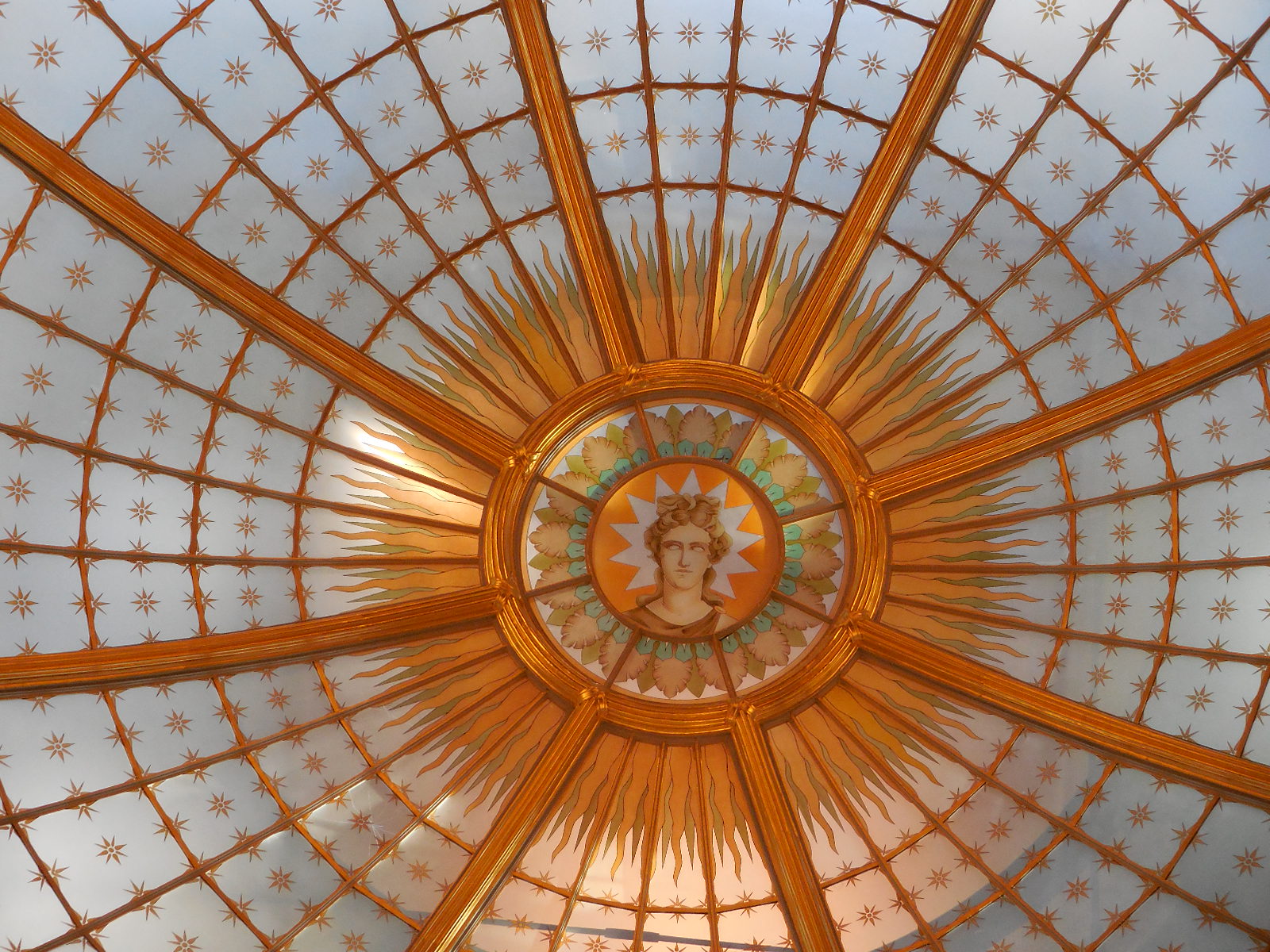
The exterior of the National Museum that dominates Wenceslas Square is noteworthy. Sandstone statues, stucco and exquisite reliefs all add to its elegance and distinction. Allegorical statues are situated above a fountain, for example. The building consists of a large central tower with a dome and a lantern. There are four domes. A pantheon is located beneath the main dome. The exterior staircase is grandiose, too. In front of the museum, there is a splendid view of Wenceslas Square.
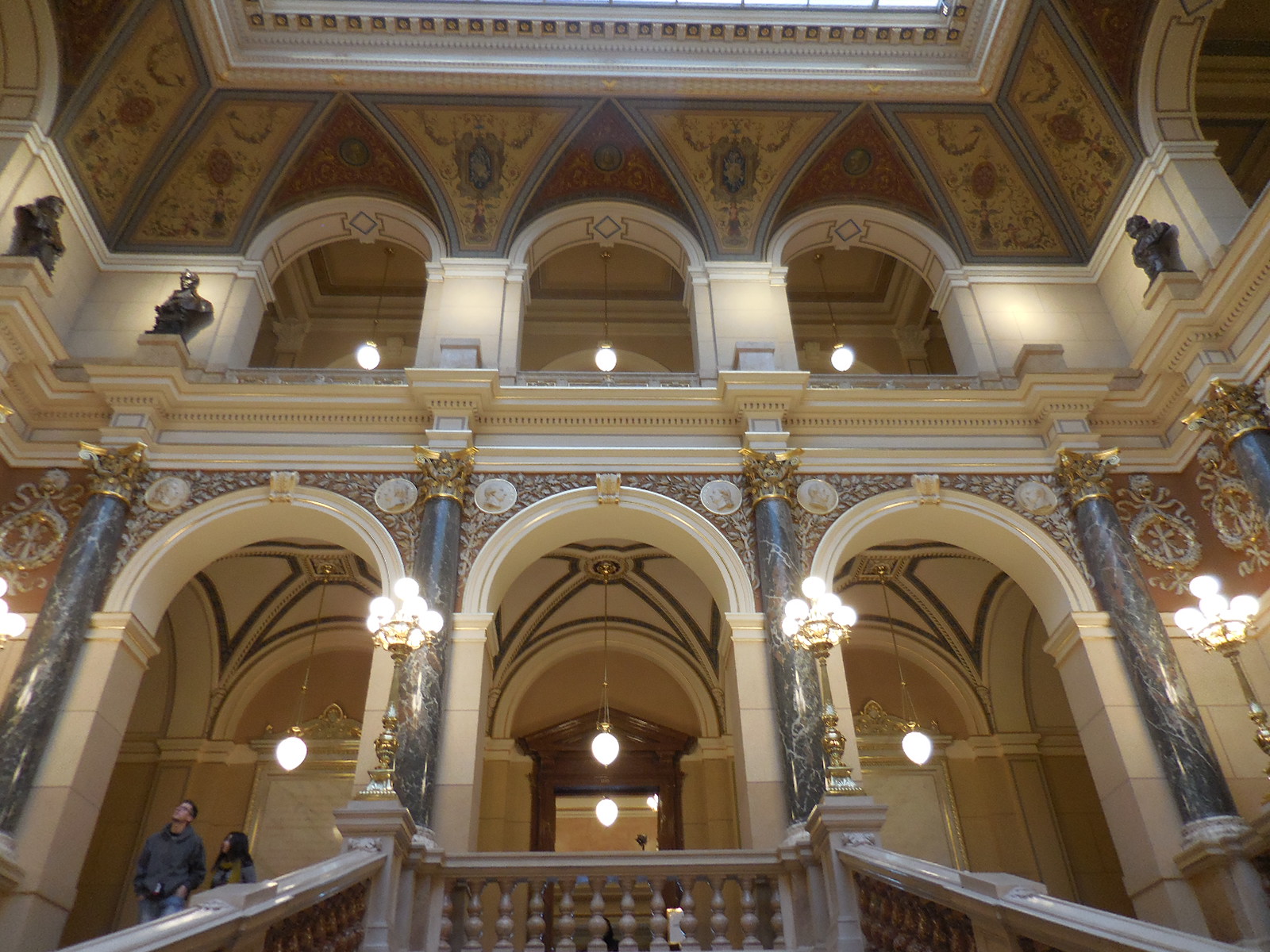
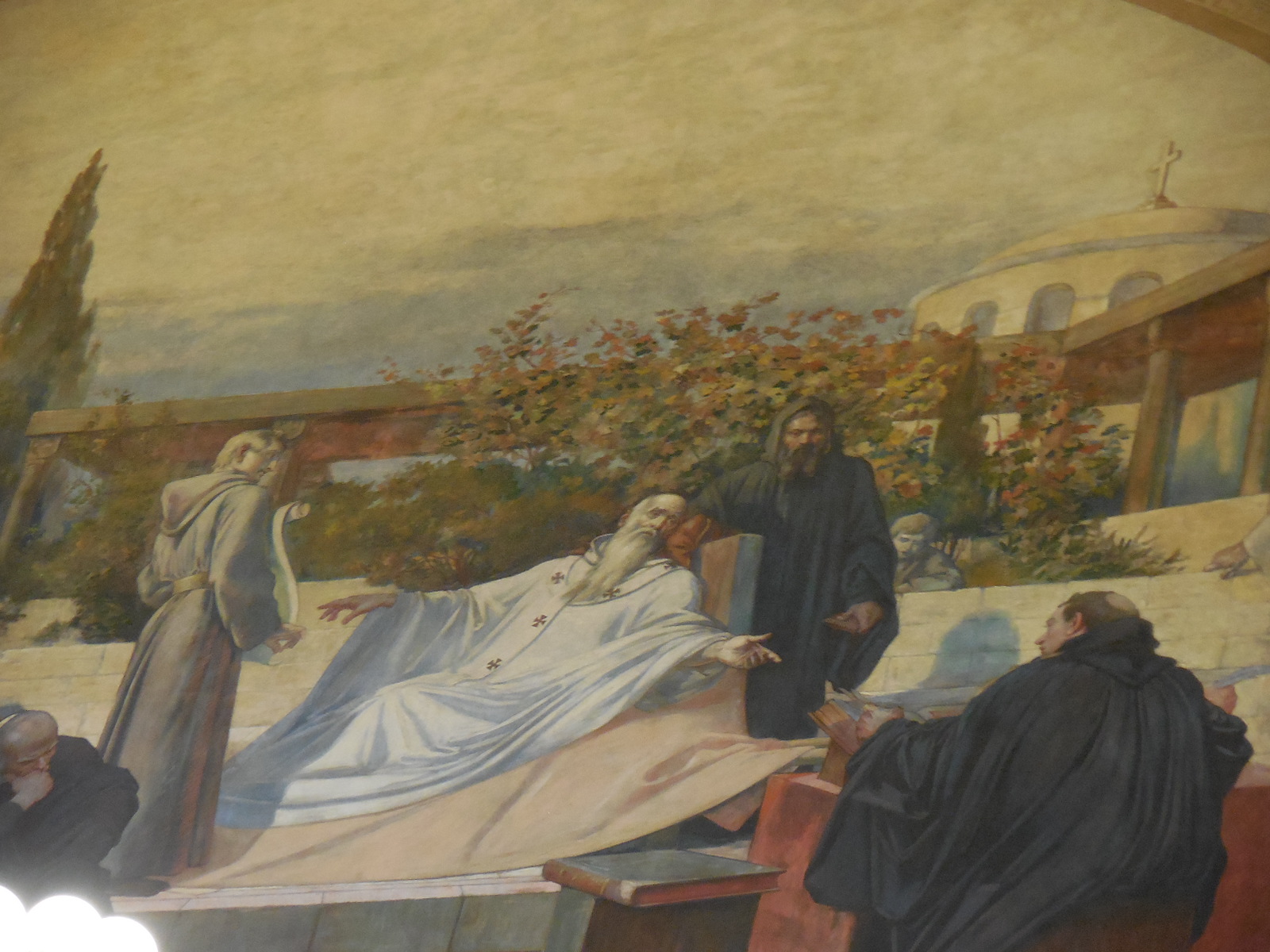
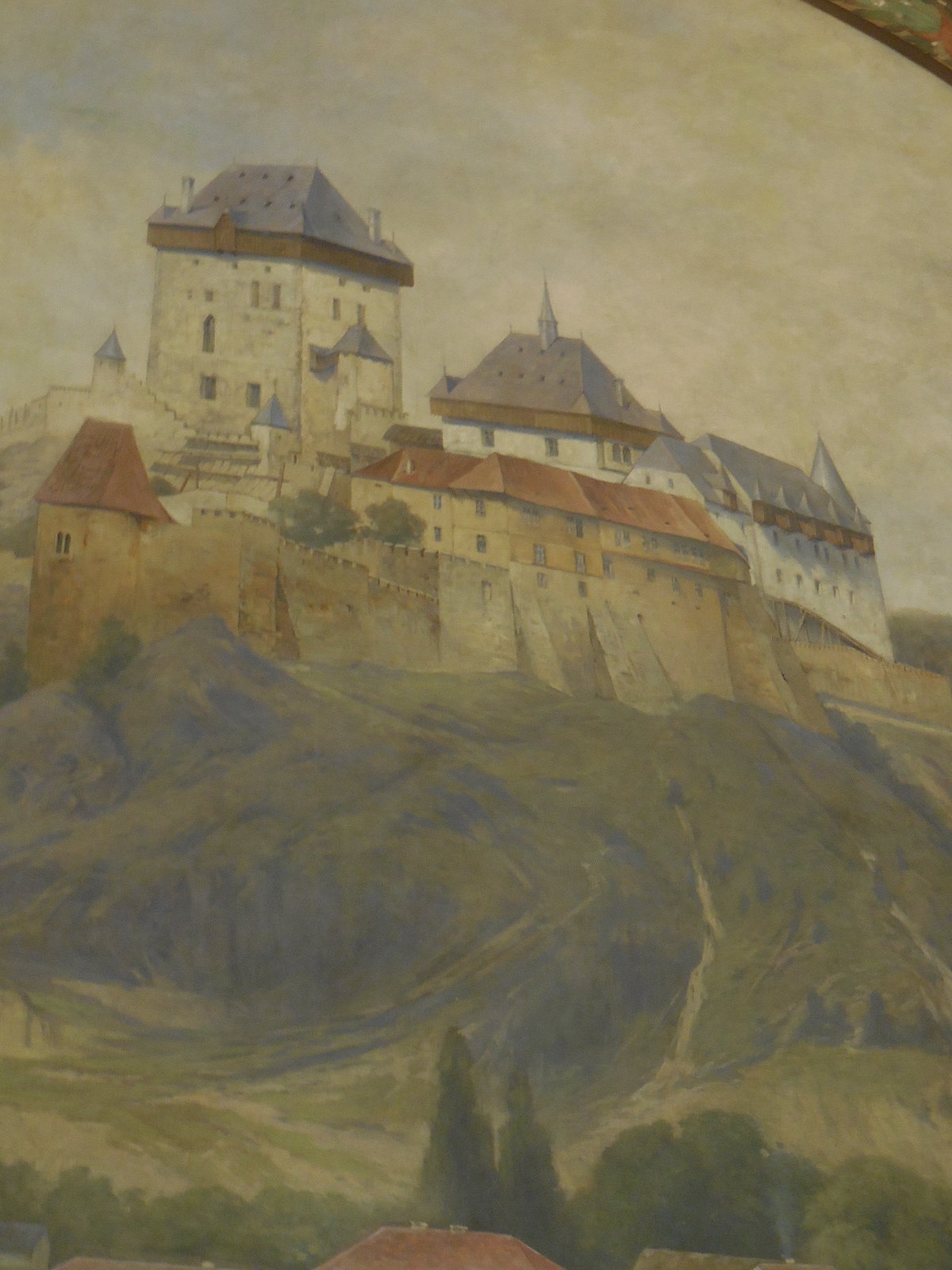
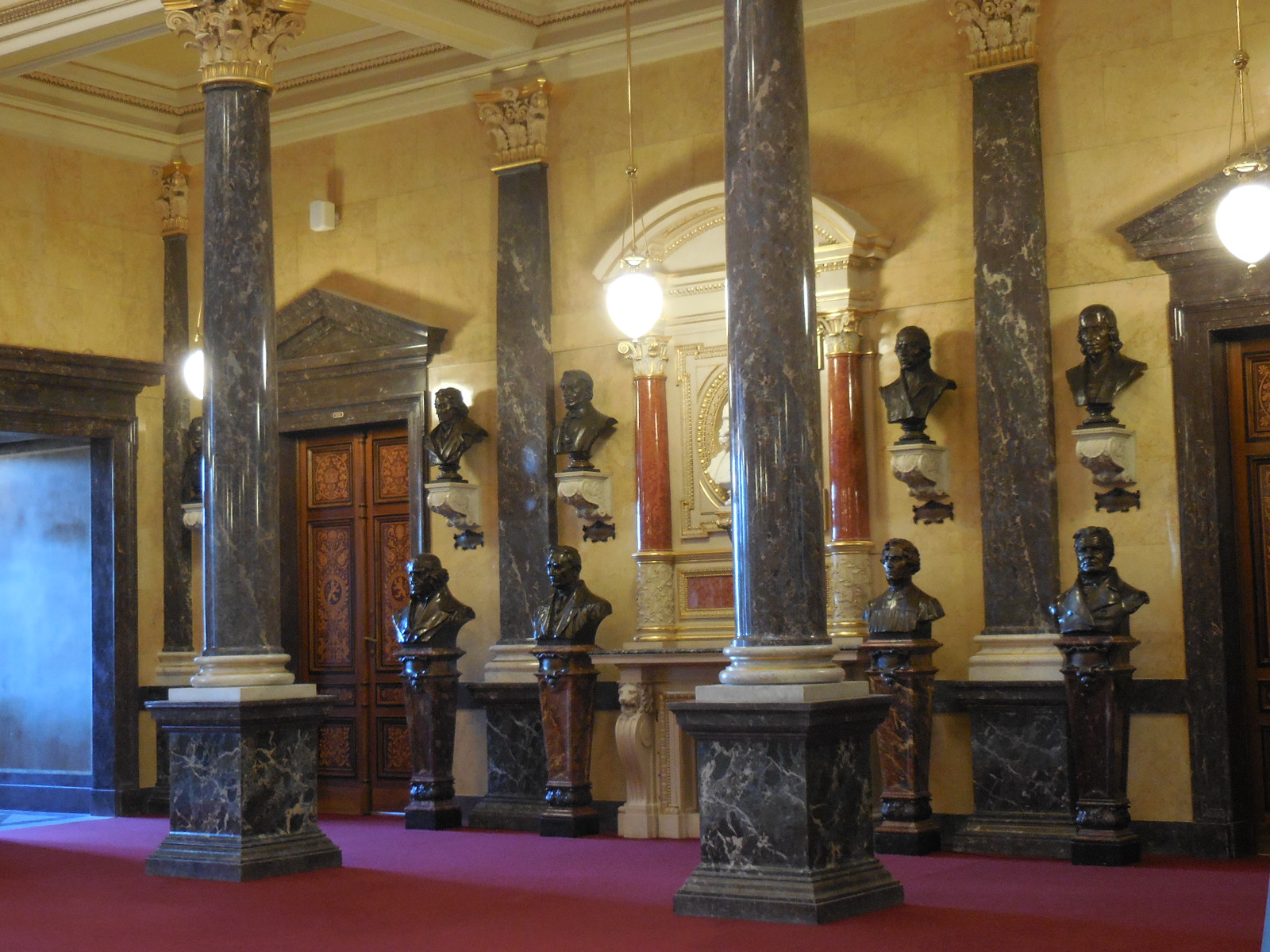
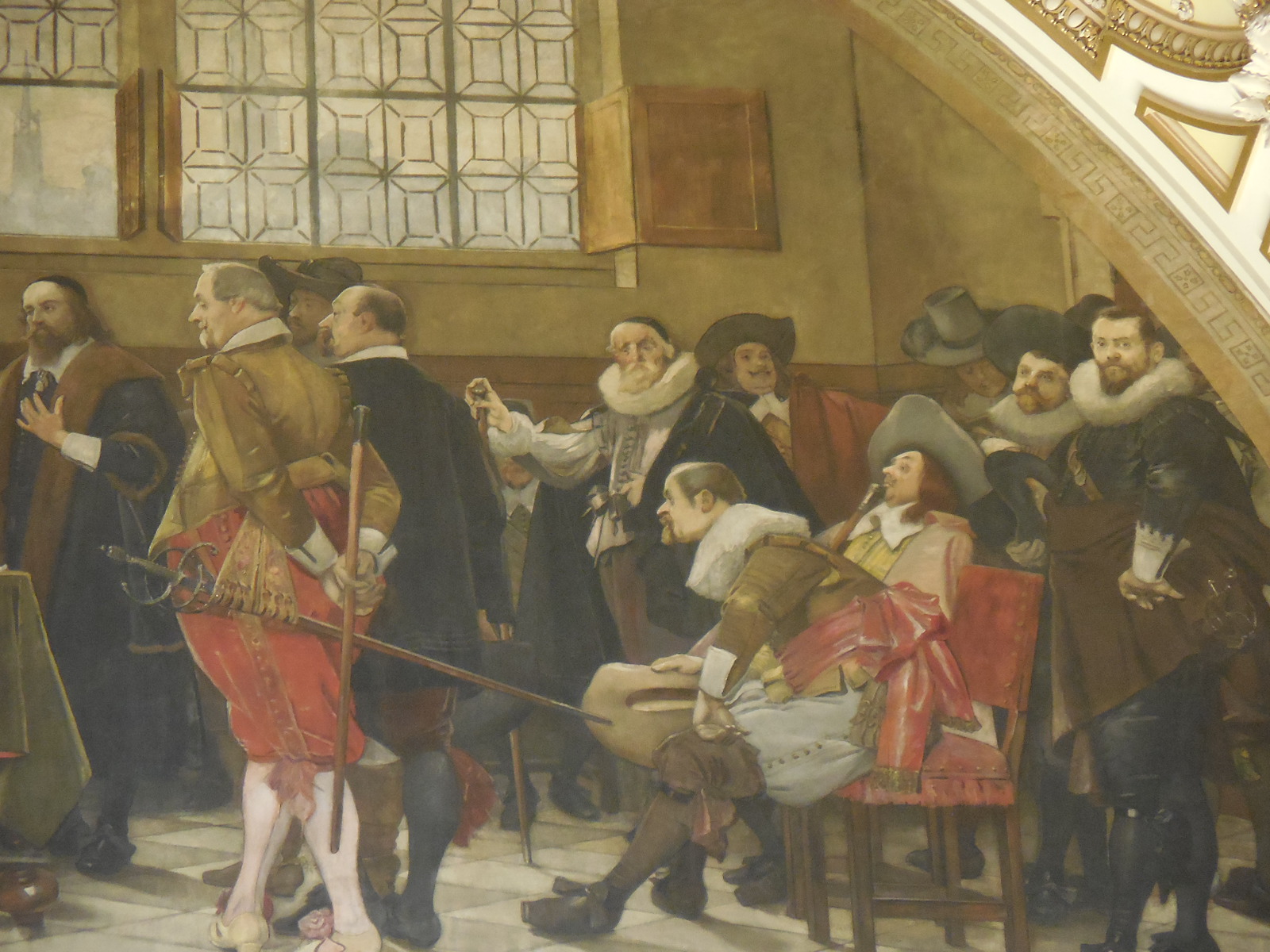
The moment I stepped inside the museum I was again entranced with its elegance. The entrance hall consisted of a monumental staircase fit for royalty with a coffered ceiling and 20 tall columns of red Swedish granite. Above are two floors with decorated arcades and beautiful floors. Upstairs I saw portraits of rulers of Bohemia and four paintings of significant castles in Bohemia – Prague Castle, Karlštejn, Zvíkov and Křivoklát. I loved spending my spring and summer weekends castle-hopping. I remember the many strolls I took to Prague Castle across the Charles Bridge many early mornings when I first moved to Prague and resided in the center. The chapel at Karlštejn Castle was one of the most beautiful sights in a castle interior. I also spent time admiring the 12 depictions of historical places in Bohemia, such as that of Český Krumlov, the most picturesque town in the country after Prague with its castle boasting three tours and Baroque theatre as well as extensive castle garden. Bronze busts rounded out the decoration.
The pantheon is perhaps my favorite section of the museum because it celebrates Czech history and culture, two subjects dear to my heart. The paintings, statues and busts serve as poignant reminders of the nation’s cultural accomplishments and historical contributions. Even the door of the pantheon is magnificent with its rich woodcarving. In the pantheon I found statues of Czech historical figures who have made me excited about the nation’s history – František Palacký, a 19th century historian, politician and writer dubbed The Father of the Nation. His seven-volume History of the Czech Nation in Bohemia and Moravia remains a significant source of information for modern day historians. He also was a major participant in the Czech National Revival.
Jan Amos Comenius’s likeness was there, too. He was a religious and educational reformer who authored textbooks, encyclopedias and dictionaries as well as one of the most important works of Czech literature, The Labyrinth of the World and Paradise of the Heart. The statue of Antonín Dvořák made me think of his New World Symphony, which I saw the Czech Philharmonic perform in an awe-inspiring concert. Karel Čapek’s statue brought to mind my graduate studies that in part focused on his plethora of works of various genres. The paintings in the chamber are also extraordinary. One of the lunettes that celebrates Czech history in the pantheon shows the founding of Prague University, now Charles University, in 1348 with Emperor Charles IV playing the central role.
The statue of first Czechoslovak President Tomáš Garrigue Masaryk has an intriguing history. It was removed during World War II and slated to be melted, but somehow survived a tenure in a junkyard and was reinstalled after the war. During the Stalinist 1950s, the government wasn’t exactly enthralled with Masaryk, so his statue was placed in the depository. When the liberal reforms of the 1968 Prague Spring were in full swing, the statue of Masaryk was reinstated in the pantheon. Throughout the 1970s and 1980s, Masaryk’s likeness remained there, even though the Communists did not put him in a favorable light. If I could live in another time period, I would choose the 1920s of Czechoslovakia, when the country was freshly on a democratic path with Tomáš Garrigue Masaryk leading the way.
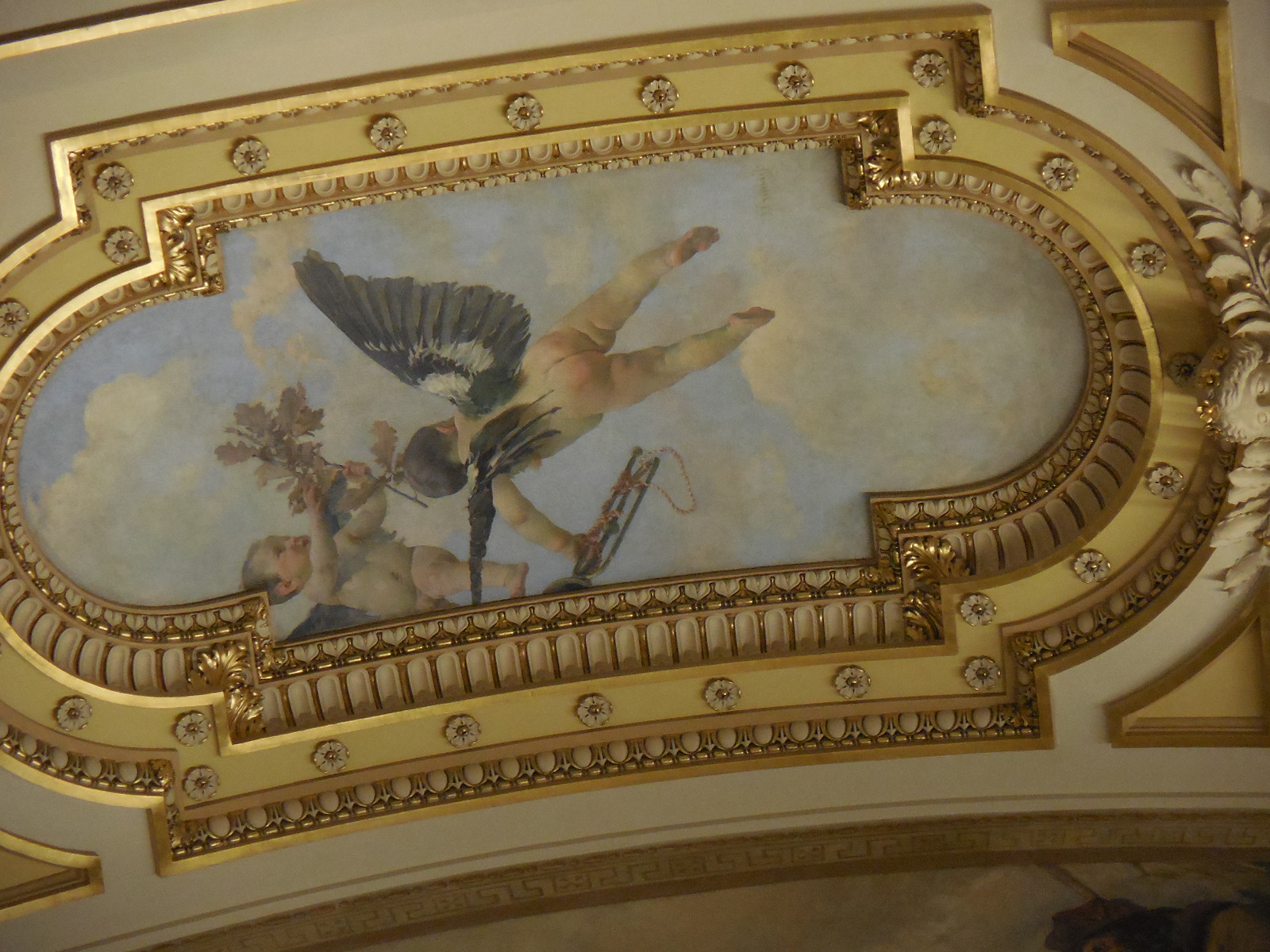
Once again, the building cast a magical spell on me as I felt overwhelmed by the painting and sculptural decoration. Both the exterior and interior were filled with a sense of grandeur and splendor that made me reluctant to leave.
Tracy A. Burns is a writer, proofreader and editor in Prague.











































 Tracy's Travels