Rabštejn nad Střelou Diary

Image

After visiting the chateau in Manětín not far from Plzeň in west Bohemia, I had to go by car to get to nearby Rabštejn nad Střelou, the smallest town in the Czech Republic and allegedly the smallest in Europe. As I entered the town, I noticed a pub on the right-hand side. I think every town in the Czech Republic has at least one pub. I had tried to visit the town the week before, but the only road to the town had been closed due to construction work.

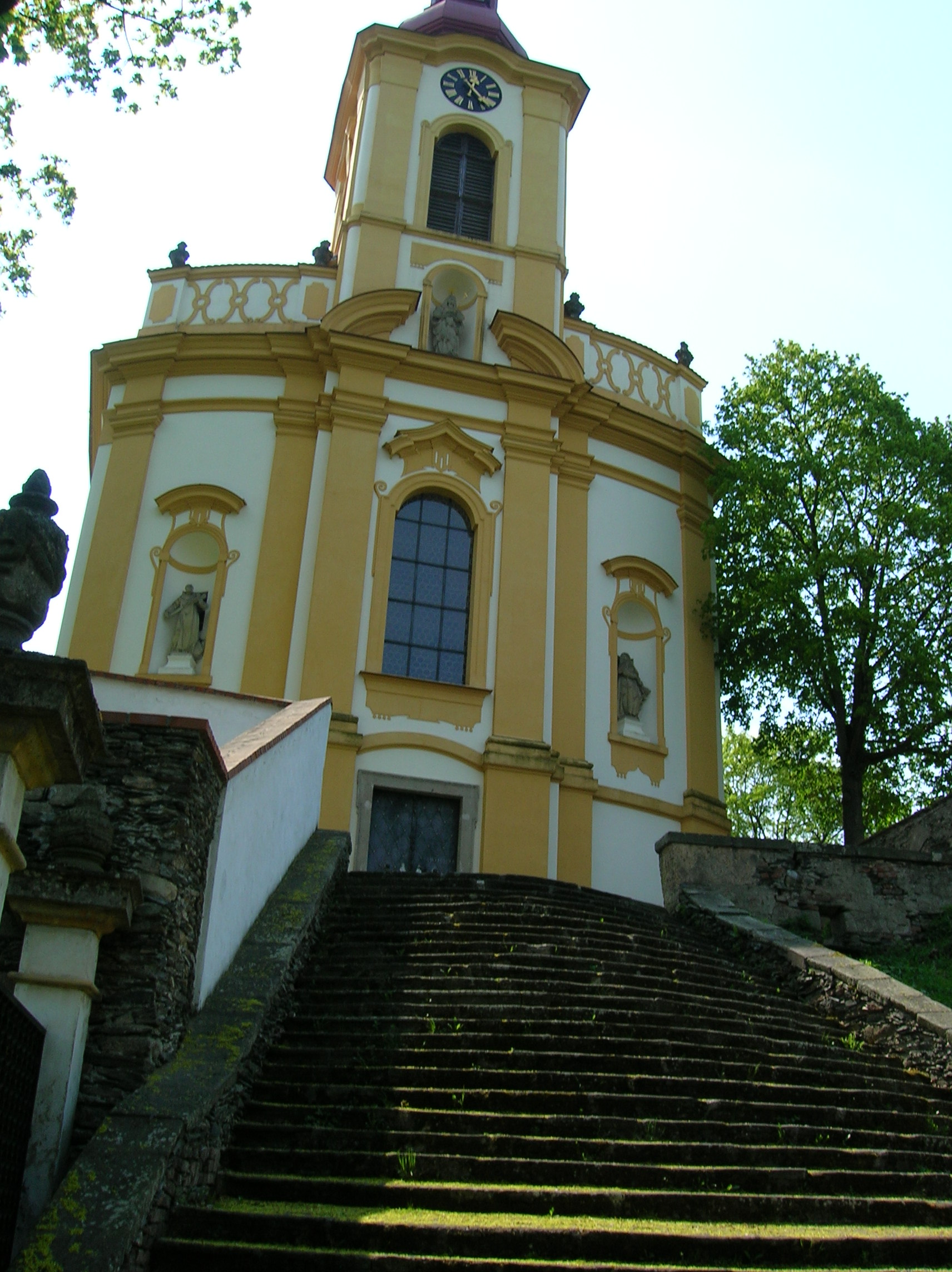
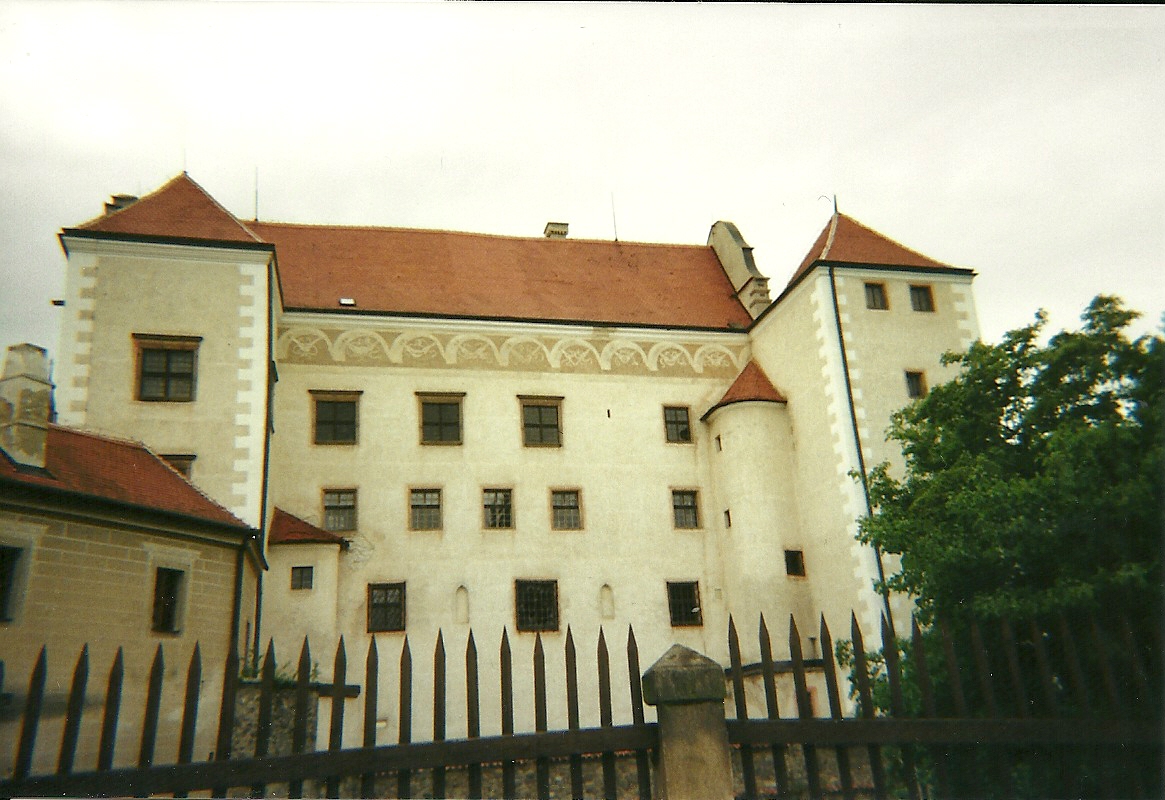
I expected to see four or five houses, maybe one church, but it was bigger than that. There was a yellow and white church on a hill and next to it a chateau behind a gate. A sign stated that it was private property. The façade was impressive and the lawn meticulously well-kept.  Situated next to the site of a former castle hailing from around 1260, the chateau was built in Baroque style in 1705. The castle originally had a high cylinder tower and walls around it but was severely damaged in the 16th century. Now some of the walls and the foundation of the tower are all that is left of the castle.

ImageThe road dipped down suddenly, and I came to the main square. About five men were struggling to put up a maypole as the May 1 holiday approached. Branches flaunted fluttering, colored ribbons. There was a decrepit building behind me and another one with an old, battered sign above the doorway in German. It read “LIEDFELDERHOF.” I wondered what it meant and if it hailed from World War II or even from the Austro-Hungarian Empire. Later I would find out that the word stood for “Sorrowfields’ Inn,” with “sorrowfields” probably being the surname of the innkeepers.

The sign in German attested to the influence that Germans had had on this town since settling in the region during the 12th century. Even the name of the town derived from the German words “rabe” for raven and “stein” for stone. The town was the property of Germans for many centuries. In 1631 military leader and politician Albrecht von Wallenstein became the owner. Wallenstein played a major role in the Thirty Years’ War, allying himself and his army with the Holy Roman Empire. Under the rule of the Habsburgs, he became supreme commander of the Habsburg armies. Wallenstein was assassinated in the west Bohemian town of Cheb after quarreling with Emperor Ferdinand and considering allying himself with the Protestants.

After World War II, when the Beneš’ decrees came into effect, most of the Germans were banished from the country, and Czechs came to live in the town. In 1930 Rabštejn had a population of 344. By 1950 it had dwindled to 77.

ImageI also wondered what the town had looked like in the Middle Ages. I was impressed that the history of this town could be traced all the way back to the 13th century. I had read that in medieval times two rows of houses surrounded an irregularly-shaped square. How had people lived long ago? I knew that in the past inhabitants had taken up making handicrafts, weaving, painting playing cards and glass as well as producing roof slate.

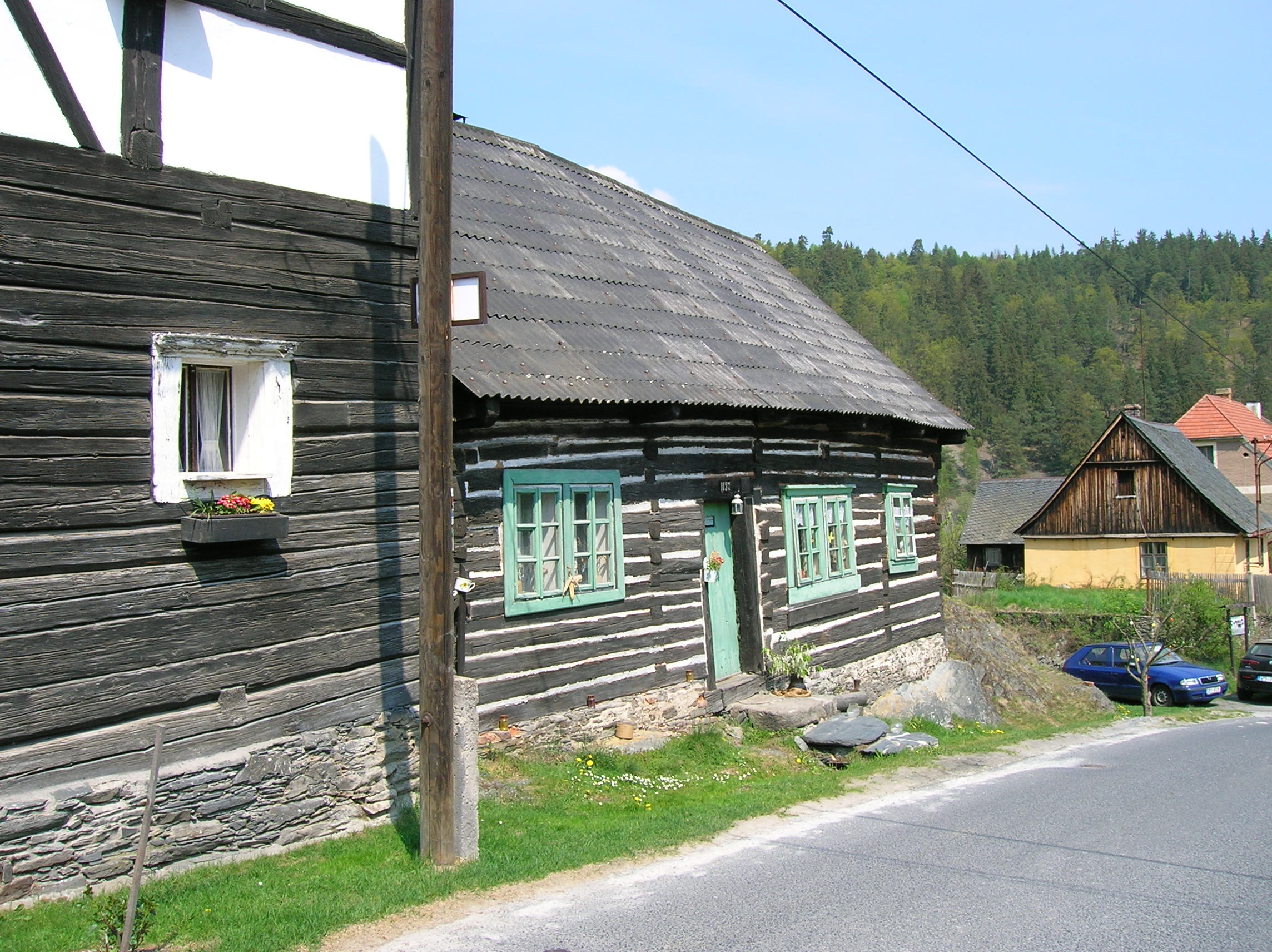
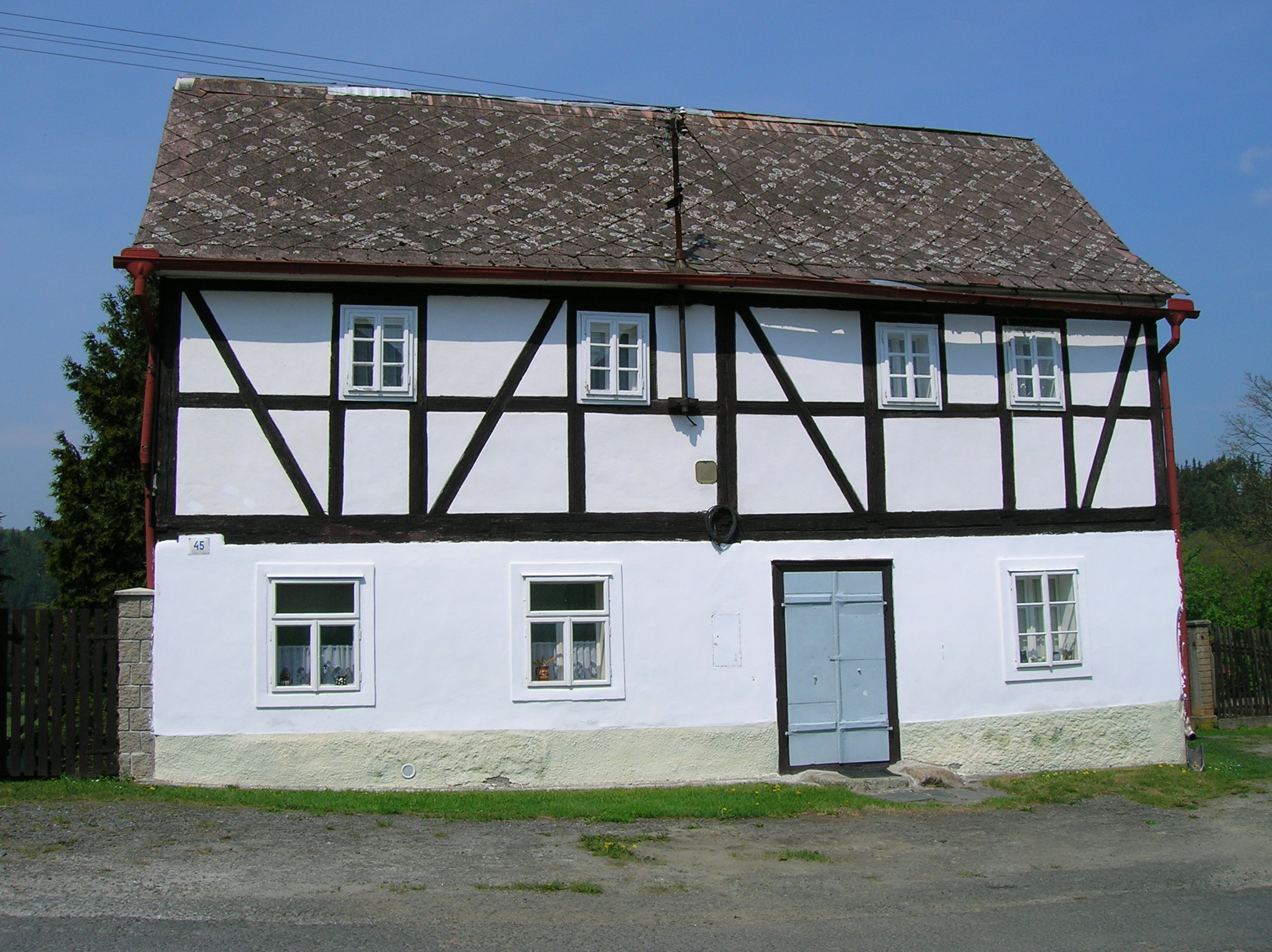
ImageFarther down were several timbered cabins, one painted black with green, another mostly white with black. They looked like they belonged to another century. It was strange when I saw a man open the door of one of these homes and go inside. It was as if a person from the 21st century was entering another time period.

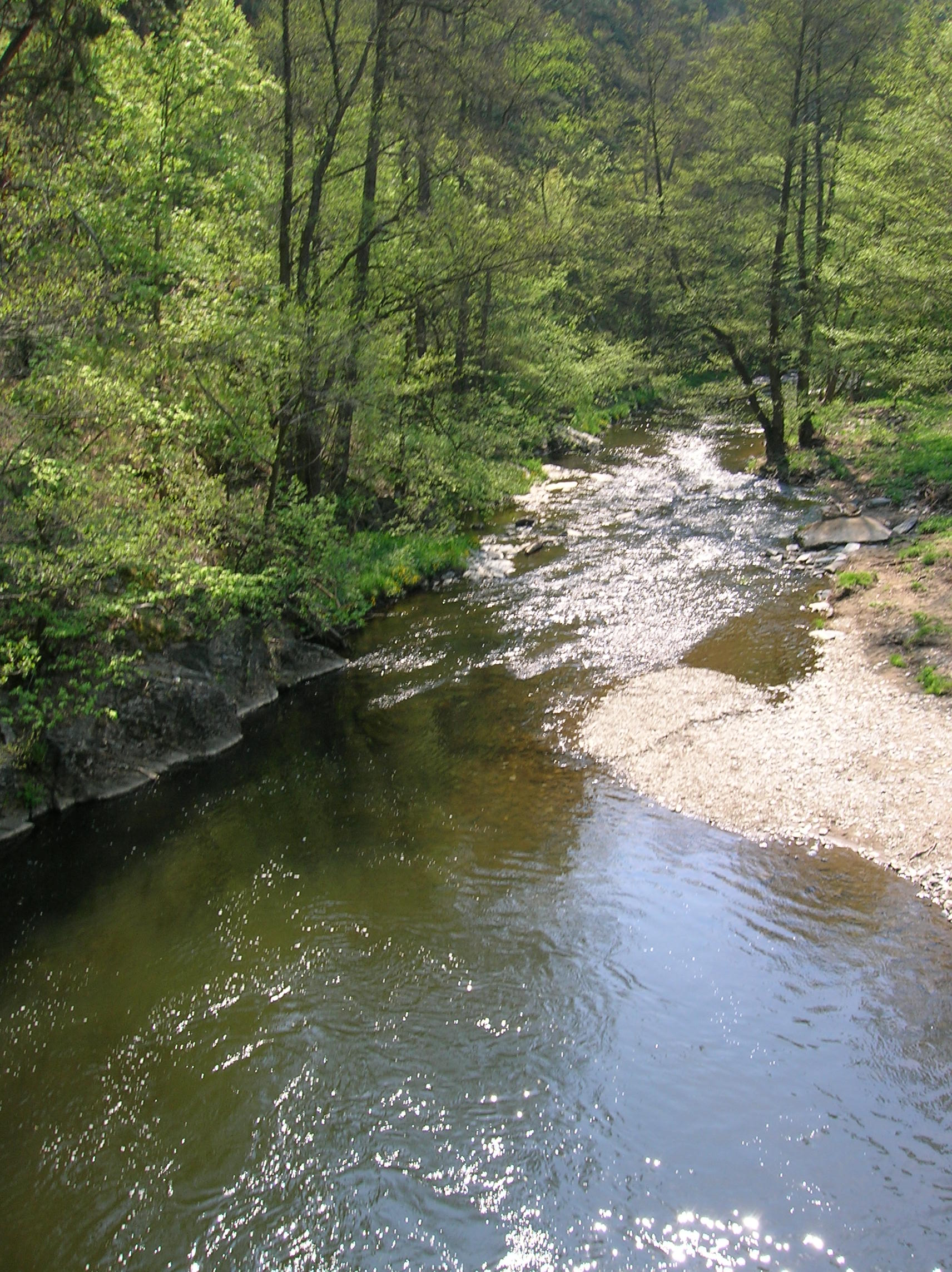
ImageAt the end of the town was a restaurant with picnic tables outside. Seven bikers were sitting there, drinking beer while engaged in animate conversations. There was an old stone bridge, dating most likely from 1335-1340. Under it flowed the Střela River. The body of water meandered through a forest, gurgling softly. A thick forest made up the background. It appeared as if this could be the backdrop for a landscape painting, as if I were looking at a canvas rather than real life. The forest was romantic, but it felt comforting and dangerous at the same time.

ImageI had read about a former brewery that only put out 700 hectoliters of beer during a year, but I did not see anything resembling a brewery. I did not see a former monastery, either, but there had been several in this town over the centuries. One dated back to the end of the 15th century but was destroyed in 1532. A new one was built in the 17th century, but it was abolished in 1787. There were several churches in the town during the 19th century, and legend has it that one of them was damaged in 1856. Workers had to dismantle the cross from the top of the church and reinstall it. While they were doing this, people celebrated below.  The workers drank some wine in the tower and threw a wine glass down. It fell but did not break.

 Image


Plasy Monastery Diary


Image

NOTE: I added photos of the interior from my third visit.

I have been to Plasy twice, both times changing trains in Plzeň (Pilsen). It is only 45 minutes from the home of pilsner beer. The exterior of the building did not impress me, but when I got inside, I was in for a treat.

First, a bit about the history of the monastery: Founded in the 12th century by Prince Vladislav II, Plasy was burned down by the Hussites, followers of the martyr and preacher Jan Hus, in 1421 during the Hussite Wars, which pitted radical Hussites against the more moderate ones teamed up with the Holy Roman Empire, Royalists, Hungary and The Pope. (The Radical Hussites lost, and Holy Roman Emperor Sigismund put on the Bohemian crown.) In the 18th century architects J.B. Mathey, Jan Blažej Santini-Aichel and Kilian Ignác Dientzenhofer (the younger of the two Dientzenhofers, who hailed from Bavaria but worked in Bohemia during the 18th century) gave it a High Baroque appearance.

Plasyint2

Things took a turn for the worst, though, when Holy Roman Emperor Joseph II closed down the monastery in 1785. Austro-Hungarian Empire chancellor, diplomat and politician Klement Václav Lothar Metternich bought it in the early 1800s, and his family tomb is located in the Church of Saint Václav (Wenceslas) across the street from the monastery, Plasy is also associated with one particular composer: famous Czech Bedřich Smetana spent a week here. He was not the only Czech personality to set foot in Plasy, though: Czech King Václav I (Wenceslas I) also stayed here on several occasions.

Plasyint6

At the beginning of the tour, I walked along the 61-meter long Cloister Hallway, boasting eight ceiling frescoes by Jakub Antonín Pink. One tripartite fresco depicted the Virgin Mary offering food to monks while another showed the Virgin Mary helping monks work in the fields. I noticed the modern art on the walls of the hallway: All the paintings shared the theme of Saint Jan Nepomucký (whom English speakers might better know as John Nepomuk). The works of modern art seemed out of place, though.

Plasyint7

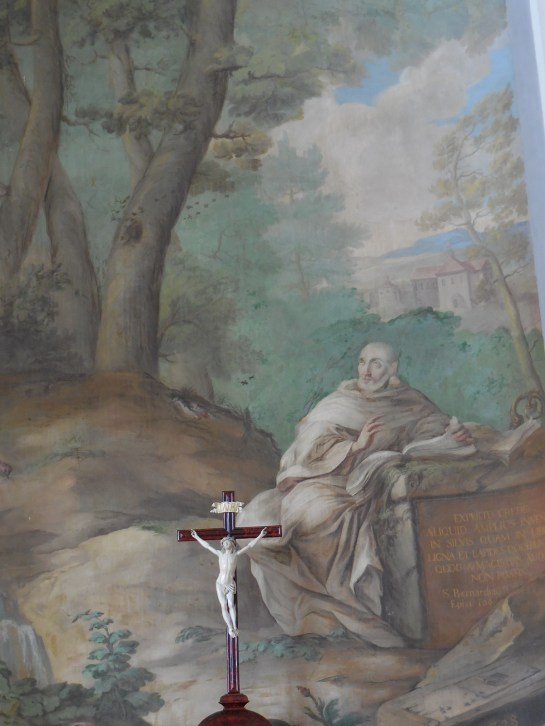
My group continued to the Chapel of Saint Bernard. Surprisingly, there was no furniture in this room. That was because Metternich sold all of it during his tenure there. Stunning, though, was the high wall painting of Saint Bernard, painted by premiere Czech Baroque artist Petr Brandl, whose works I greatly admired. Saint Bernard was leaning on a rock in a forest as angels flocked above. The ceiling fresco depicted Jesus Christ and the 14 disciples.

Plasyint8

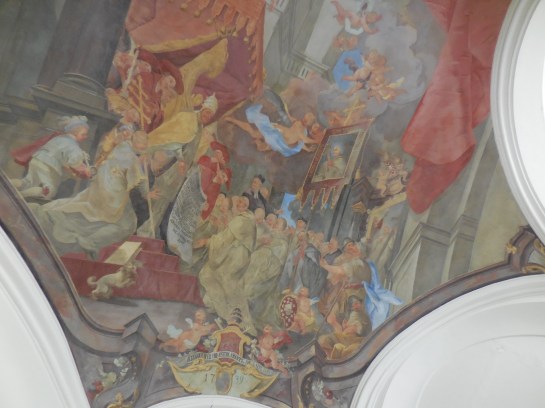
The Chapter Hall, measuring 27 meters in height, was designed by famous architect Kilian Ignác Dientzenhofer. This was where new monks used to be accepted, and where monks had cast their votes for new abbots. I glanced up at the ceiling and was impressed with what I saw – a fresco of the Virgin Mary and a gathering of monks. The tour guide told us to bang our fists on one of the wooden benches: The echo would last more than nine seconds, she claimed. She was right.

Plasyint9

One step into the first part of the library and I wondered where the books were: In the second part there were indeed three tall bookcases, though one was almost empty. There was a reason for this, the guide explained: Metternich had changed the library into a smoking room and theatre. The first section, the former smoking room, featured a ceiling fresco. What did it depict? Hard to tell. All the smoke that had lingered in the air had turned the fresco black. In the other area Metternich had installed a seating area and stage, but I saw a Secession bureau, the three tall bookcases and a ceiling fresco depicting an allegory concerning medicine, philosophy and theology.

The former circular Reading Room was intriguing, too. It was home to eight larger-than-life canvases by Pink. These 18th century Baroque paintings all dealt with themes about eating and drinking, taken from the Old Testament.

Plasyint3

When I walked into Winter Dining Room, I noticed that there were no tables or chairs. Instead, I saw an impressive sculptural grouping of Saint Luitgarda standing in the otherwise empty space. Created by legendary Czech sculptor Matyáš Bernard Braun, its original could be seen on Prague’s Charles Bridge. On the far right-hand side, I peeked into a small window of the monastery prison, where monks were sent if they came late for prayer, for instance.

Plasyint29

I also viewed two foundation water basins set there because the monastery was so close to the Střela River. These were part of the elaborate water pressure system designed by Czech architect Santini-Aichel, who, in order to give the monastery a firm foundation, constructed the convent on 5,100 oak piles and also created a system of connecting channels as a sort of defense against flooding. He specifically used oak wood because oak hardens in water. It fascinated me that Santini also came up with a unique hydrological system for the monastery.

Plasyint20

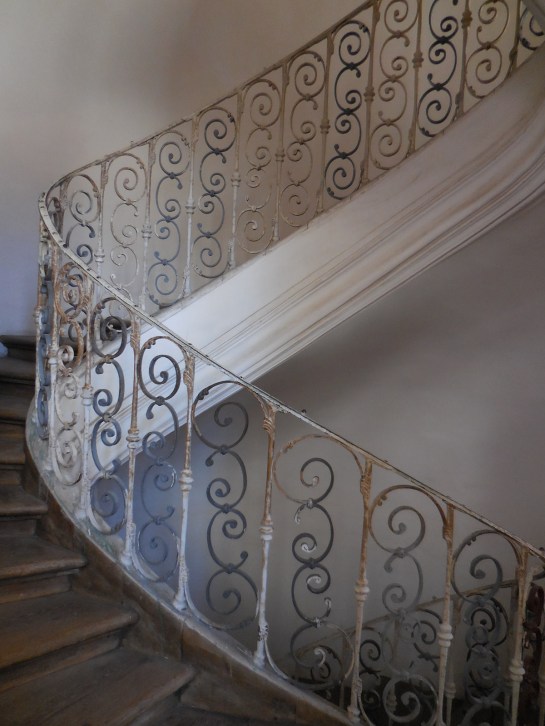
I didn’t miss the Baroque toilets, which were composed of circular holes in wooden benches. I looked down through the toilet seat and saw water below. On the way to the Hospital Wing, our group stopped at a self-supporting, winding staircase designed by Santini-Aichel, who I knew for his unique Baroque-Gothic style in a church at Sedlec, near Kutná Hora. I stretched my neck to glimpse the ceiling fresco of Archangel Michael fighting a dragon.

Then we moved to the Hospital Wing, where the pharmacy exhibitions were situated. First, I came across the Baroque pharmacy: I noticed the hand-made, exquisitely painted pictures on the drawers. My eyes were especially drawn to the drawer marked “opium.” It was the only one with a lock on it, the guide said.

Plasyint18

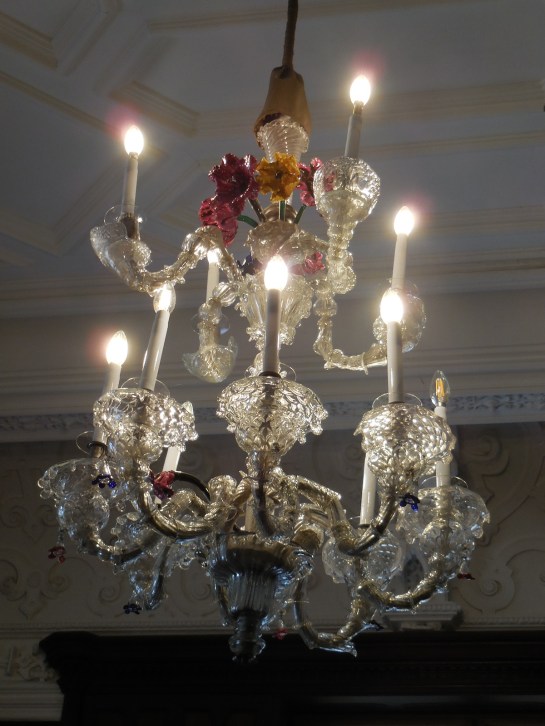
The Classicist pharmacy featured a white theme: wooden shelves were stocked with white jars, and the glass jars had white labels. All the labels on the drawers were white as well. Before reaching the Secession pharmacy, I stopped in the small hospital chapel. The Virgin Mary and 14 saintly helpers stared down at me from the ceiling. The Secession pharmacy flaunted many decorations of flowers and plants on the walls and cabinets. A chandelier impressed me, too. I liked the glass jars with white labels and the red and green fancy trim.

Plasyint15

Then our group left the main building of the monastery, crossed the street, passed the bust of Smetana in the small park and entered the Church of Saint Václav (Wenceslas), where Metternich’s family tomb was located. Originally a Gothic church, it had been reconstructed in Baroque style. Richard Metternich, Klement V. L. Metternich’s son, was the last of the family to be buried in the tomb, during 1938. Several abbots were also buried here.

After the remarkable tour I went to a restaurant nearby and had my usual, chicken with peaches and cheese. Then it was time to return to Prague, so I set off for the small train station. The numerous works of Baroque art had been stunning. Two paintings by master Karel Škréta, a creation by Esther I. Raab and six more canvases by Jan Kryštof Liška also helped to represent the rich Baroque art in the monastery. I better appreciated the differences among the three artistic styles by visiting the pharmacies. The Baroque ceiling and wall frescoes were unforgettable.Image

Karlovy Vary Diary

ImageI had not properly visited the west Bohemian spa town of Karlovy Vary, sometimes referred to as Carlsbad or Karlsbad, since 1991, when I was a tourist mesmerized by Czechoslovakia and the Czech language. True, I had changed buses and trains here many times – on the way to Bečov nad Teplou Chateau and Loket Castle, for instance, but I had never devoted an entire day to the town that boasted five impressive colonnades with 13 curative springs. So, I decided to travel by a comfortable Student Agency bus to see the city that Emperor and Bohemian King Charles IV founded during the mid-14th century, after one of his hunting dogs was burned by a hot spring.

From the Market bus stop it was only a short stroll to the center of town. I stopped at the main post office, erected at the turn of the 20th century, to stare at its incredible façade. It was dominated by large, allegorical sculptures. One stood for a telegraph while another represented the postal services. I also spotted sculptures depicting sea and rail transportation. The remarkable sculptures seemed to jump out at me, compelling me to gape in awe at the Renaissance style building’s ornamentation.

ImageNext I came to the hideous structure called the Hotel Thermal, a tall building made of steel and concrete. Its architecture reminded me of the stagnation of the totalitarian era, during which it was built. The building marred the cityscape. The hotel did not fit in with the majestic buildings and elegant colonnades but rather appeared as a permanent scar in the town. Just looking at it almost made me nauseous. Inside the monstrosity there was a hotel and sanatorium plus halls used for festivals. A big banner announced the Karlovy Vary International Film Festival that was going on during my visit, and a red carpet led into the hotel. I wanted to see the hotel’s outdoor pool that was carved into a rock above the building, but the receptionist said it was closed that day.
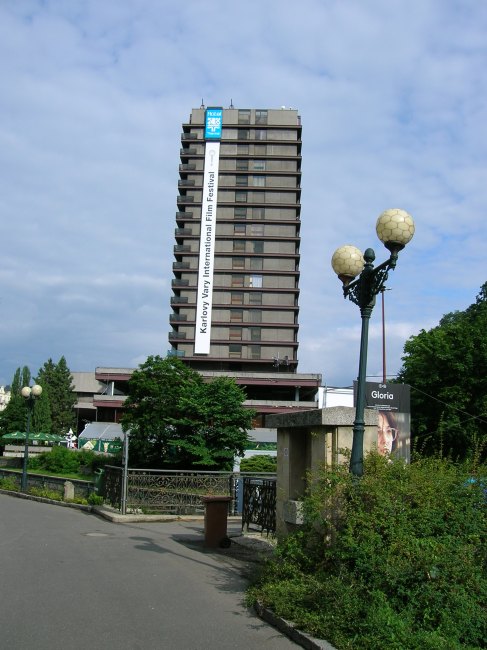
ImageI did not plan to come to Karlovy Vary during the International Film Festival. That just happened to be when I had time. Still, it was nice to see the town boasting such an electric atmosphere.

From there I went straight to the Hot Spring Colonnade, where I had an appointment to tour the underground area below what used to be a stunning, 19th century wrought-iron pavilion. That former structure was designed by the Viennese architectural duo of Ferdinand Fellner and Hermann Helmer, who were responsible for many buildings in the town. I walked by the other colonnades, but I decided to devote time to them after lunch.

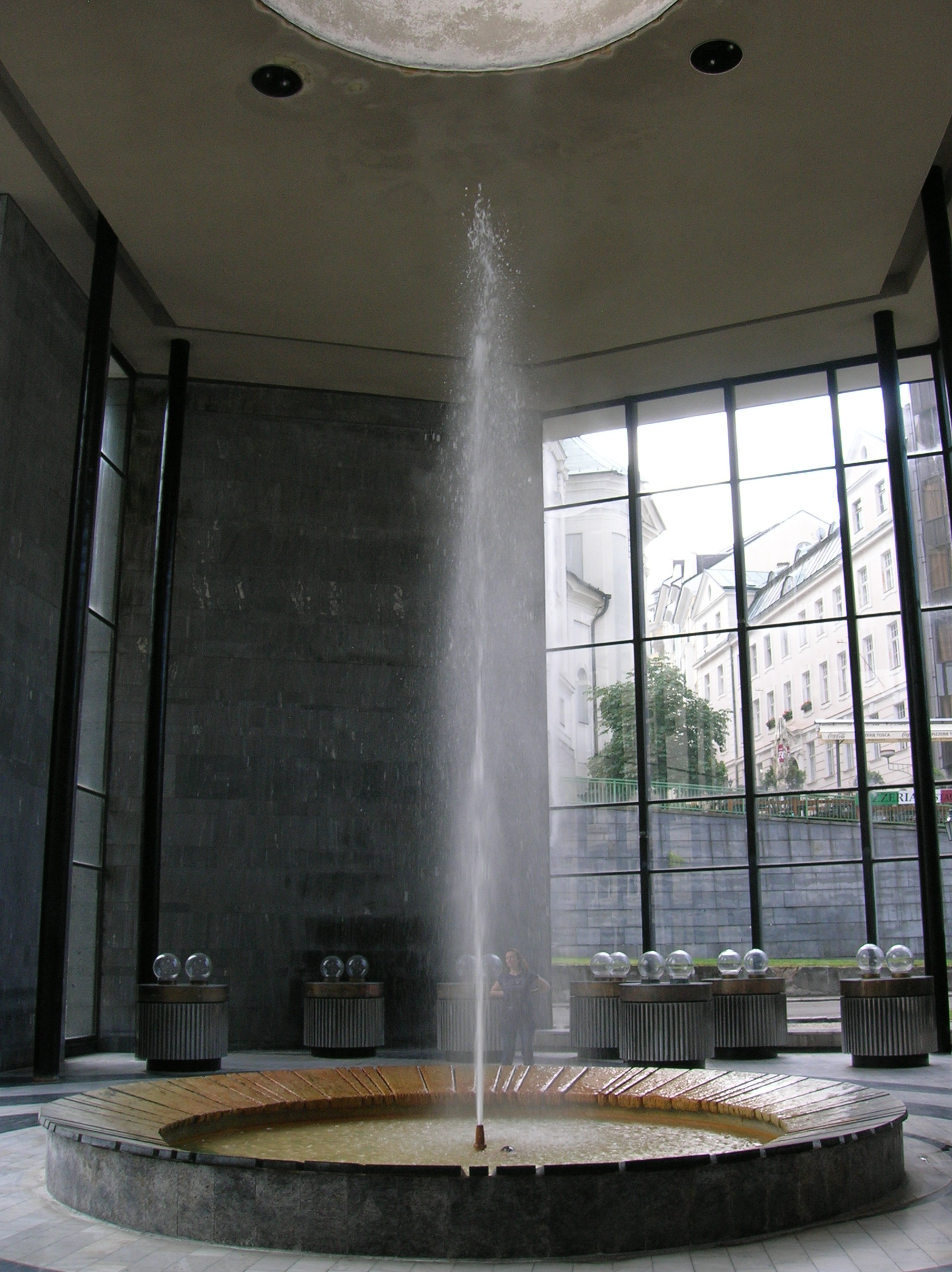
The Hot Spring Colonnade, made of glass and concrete, hailed from 1975, when it took on an appearance that was almost as hideous as the Hotel Thermal. Like the hotel it was an eyesore, not at all meshing with the romantic buildings surrounded by woods.  I tried to imagine it as it had been during the 19th century, when Fellner and Helmer had done their architectural magic. Then I went inside. A geyser gushed from the Hot Spring, sending 2,000 liters of water into the air per minute to a height of 12 meters.  I just stood there, not moving, entranced by the geyser’s movement. It was an incredible thing to see.
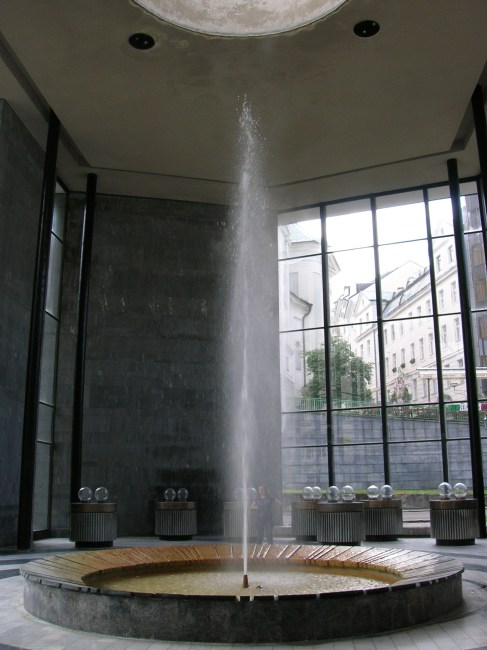
ImageThe underground tour gave me insights into the workings of the thermal springs. I learned that because the springs spewed out so many tons of minerals per day, there were small outbursts that could not be totally controlled. I saw an object created by the seeps. It looked like an abstract tower perched on a cliff. The guide also explained how souvenirs – such as pieces of porcelain or paper roses – were covered with mineral water.

Behind the Hot Spring Colonnade was the Baroque Church of Saint Mary Magdalene, but it was only possible to peek inside. I wish I could have seen the interior of this sacral building designed by prominent Baroque architect Kilian Ignác Dientzenhofer from 1732 to 1737.

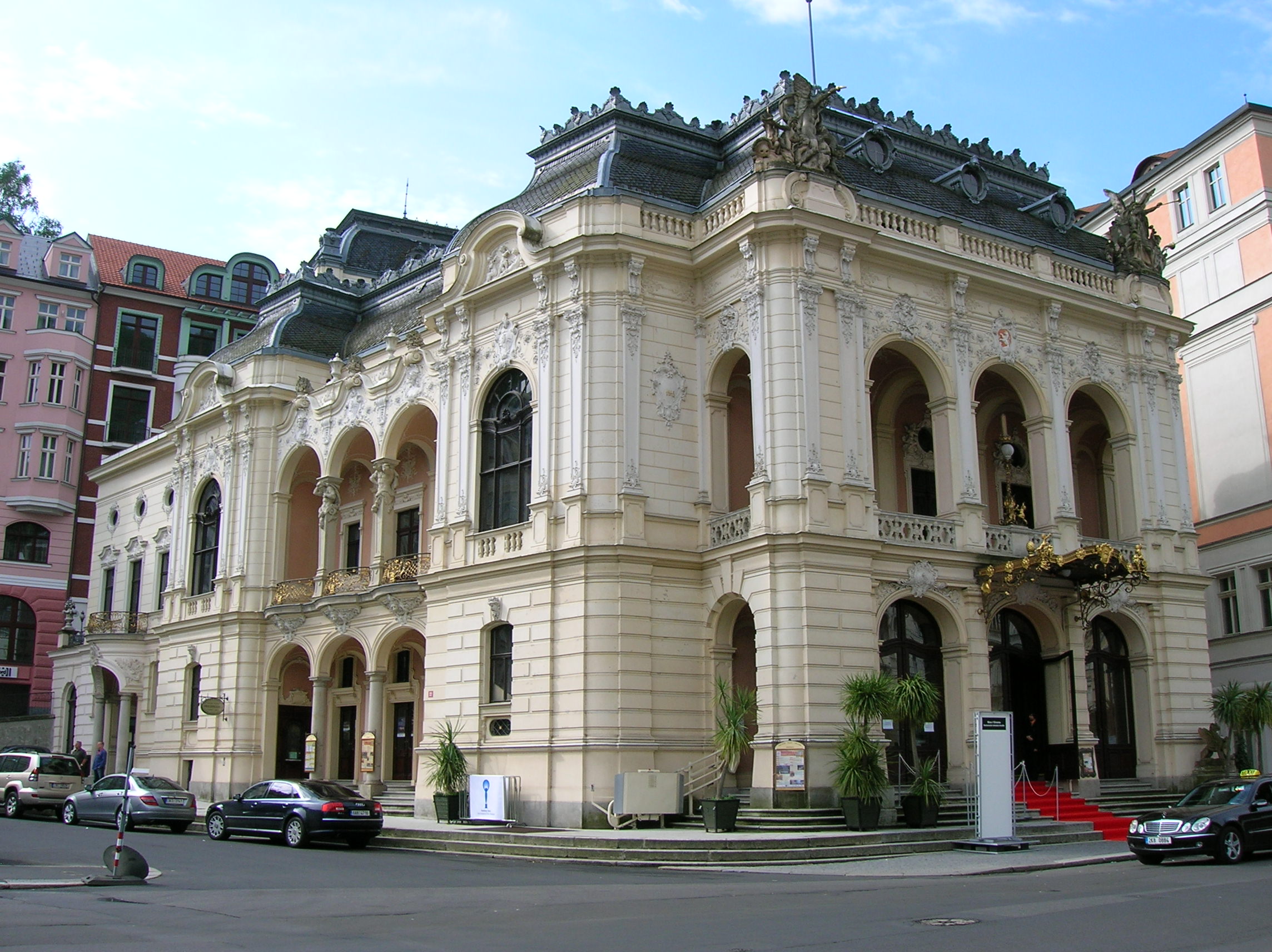
From there I headed to the town theatre, designed in Third Baroque style. It was the magnificent work of Fellner and Helmer, erected during the late 19th century.  I was impressed by the many sculptural creations on the exterior, especially the angel and cherubs making music on the parapet. One pudgy putti figure held a horn. The theatre was not open, but I did get to go into the foyer where stunning stucco work greeted me.

I wanted so badly to see the auditorium! I knew that Gustav Klimt, his brother Ernest and their friend Franz Matsche had created the ceiling fresco and the curtain, which showed an idyllic setting. Called “The apotheosis of the art of poetry,” the curtain scene was focused on a poet and beautiful women representing muses of the arts. Chubby cherubs also joined in. The entire curtain was rendered to resemble a banknote. I would have to come back to see it with my own eyes.

ImageDisappointed that I could not see these masterpieces, I decided it was time for rest and a snack. I sipped green tea and ate a croissant at the Café Elephant, which actually was adorned with a golden elephant. Later I would read that the building had been built as a late Classicist building with Italian Neo-Renaissance features during the 19th century. The foyer was lined with unique, straw tiles. It had the atmosphere of an elegant café where customers could peruse the paper for hours or scribble notes about philosophy in their diaries.

From my table outside, I peered at the charming buildings exuding an elegance that characterized the town, despite the Hotel Thermal and the Hot Spring Colonnade. A forest was set in a hilly background. I tried to imagine Johann Wolfgang Goethe, who spent 13 spa seasons here, strolling down the main street or Franz Kafka brooding in a café.  What had been Russian Czar Peter the Great’s impressions of Karlovy Vary when he had visited this popular spa resort? I knew that Frédéric Chopin and Ludwig van Beethoven had also graced the colonnades.

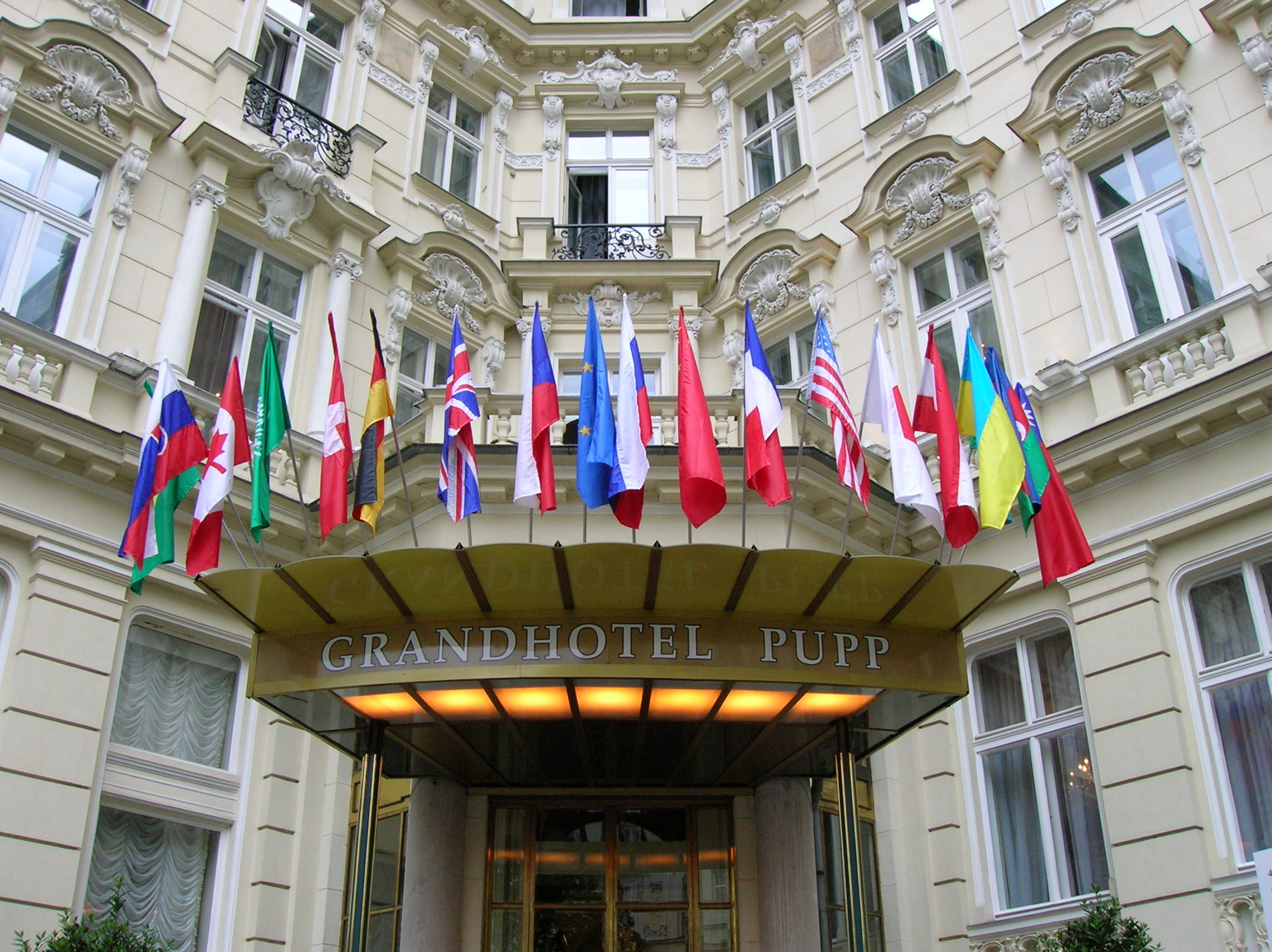
ImageThen it was time to explore the Grandhotel Pupp. The world famous hotel took its name from Johann Georg Pupp, a confectioner who, along with his wife, bought what were then individual buildings. During the 19th century the hotel prospered, and near the turn of the 20th century, Fellner and Helmer reconstructed the buildings into a single Neo-Baroque complex. Many notable figures had stayed there. English King Edward VII, Empress Maria Theresa and Karl Marx were just a few. Casino Royale and Last Holiday were two of the films shot here. I wanted to see the casino that had been featured in the James Bond thriller Casino Royale, but it was closed. Just by gazing at the exterior, I sensed the luxury and grandeur that were associated with this top-notch accommodation.

I went inside, but there was not much to see. I saw a dining room filled with late risers and people with the festival. At reception I asked if I could see a typical room, but there were no vacant rooms. I looked at a price list and discovered that one night in the presidential suite costs 40,000 Czech crowns. I gathered that I would never have enough money to be a guest here, but who knows? In the Neo-Baroque Festival Hall films were being shown, so that was off limits to me. The other lavish lounges were now offices. I would have to come back when the hotel was not full, I told myself.

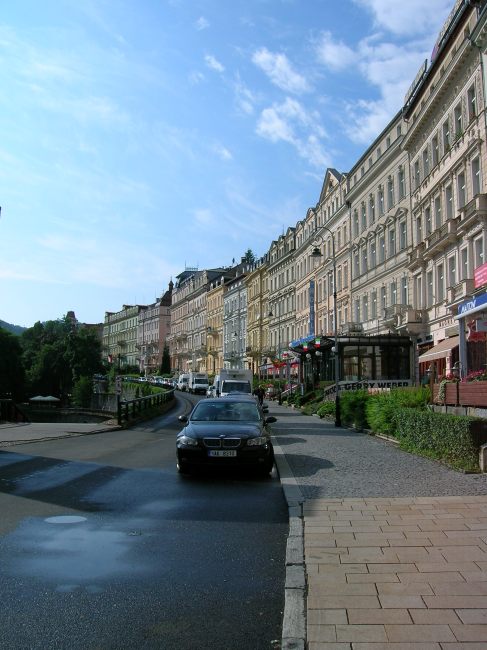
ImageNext I walked back up the main street and took a left onto an uphill road that took me to a tranquil, tree-dotted quarter. The atmosphere was so different from the hustle and bustle of the town’s center. The leafy, winding street led to the Russian Saint Peter and Paul Cathedral, its four blue domes and golden central dome dominating the horizon. I stared at the remarkable paintings of saints on the façade of this shrine built in the second half of the 19th century. The architecture had been influenced by 17th century churches in Russia.

The interior was breathtaking, too. I marveled at the impressive woodwork at the main altar. Icons were sprinkled in the sacral space, and I noticed altar crosses as well. It reminded me of those churches I had entered in Saint Petersburg, where I had spent a week absorbing art at the Hermitage and seeing the other major sights. I knew that Karlovy Vary had a large Russian population, and I had dreaded that I would have to resort to my very basic Russian to make myself understood. Luckily, all the people I had met in Karlovy Vary spoke Czech.

ImageLunch was the next priority. I found a quaint and almost empty restaurant in a cellar of a hotel on a leafy street.  While reflecting on what I had seen so far, I had tasty potato soup and delicious chicken. The prices were reasonable, too.

Then I explored the colonnades. First, I was off to the Market Colonnade, my favorite because the façade looked like a Swiss chalet with delicate, white, lace motifs. The light and airy appearance appealed to me. It had a sense of fragility as if the façade would break if someone touched it. The romantic colonnade was yet another masterpiece by Fellner and Helmer from the late 19th century. I also noticed the gabled roof and columned arcade sprinkled with wood décor. I spotted the relief portraying the founding of the town as Emperor Charles IV’s hunting dogs wandered upon the Hot Spring.

ImageThe Castle Colonnade was situated above the Market Colonnade, but the Upper Castle Colonnade seemed to be closed. The Lower Castle Colonnade was only accessible to guests of a spa there. The tower that once was part of a Gothic castle loomed above the main promenade.

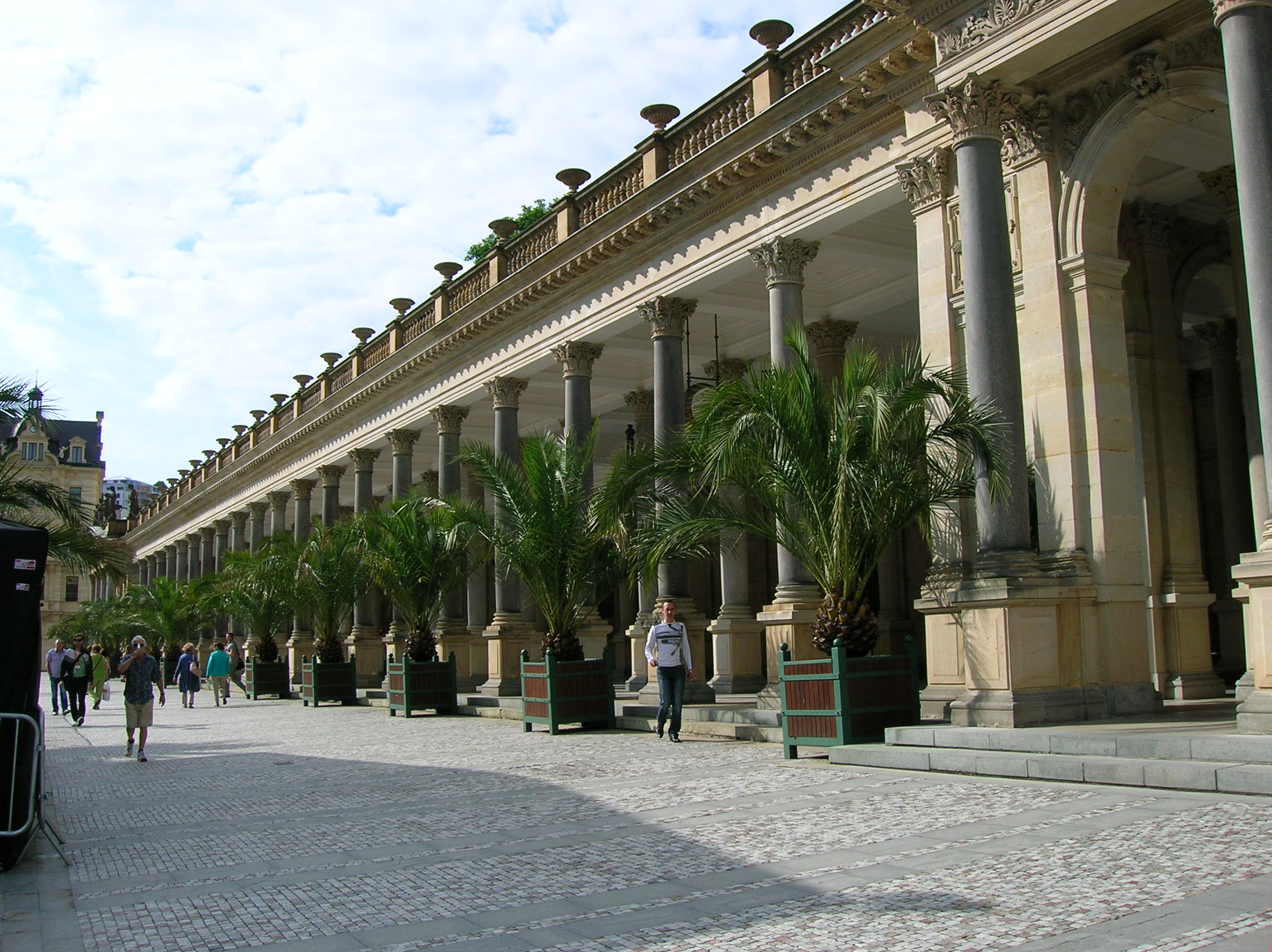
The Mill Colonnade, composed of a nave and two aisles, was next on the agenda. The pseudo-Renaissance style building was characterized by an elegance totally different from that of the Market Colonnade. The Mill Colonnade took me back to antiquity with its 24 elegant Corinthian columns on the roof. There were also 12 allegorical statues above the portico, each standing for a month of the year.  I admired the stone reliefs in the orchestra pit. They illustrated scenes from the town’s rich past.

ImageLast but not least I visited was the Park Colonnade, situated in a small park. I walked down the veranda and admired the wrought-iron ornamentation in Neo-Renaissance style. I liked the Snake Spring with its water spout shaped as a snake’s head. I also saw the nearby Liberty Pavilion, which also had a Swiss-style design, too.

I had time to pop into the Karlovy Vary Museum, where I saw Madonna statues, historical weapons and armor from the 17th century Thirty Years’ War. Blue and gray jugs flaunted grotesque reliefs forged in the 1600s. A Renaissance intarsia chest dated from 1600. There was also an admirable collection of clocks. A Meissen porcelain figure played a lute while another looked for inspiration with an easel and paintbrush. A bureau decorated with intarsia was adorned with a picture of the Karlovy Vary landscape. The 19th and 20th century colored and Moser glass designs intrigued me, too. I loved town museums because they often held an array of delights from archeological finds to present day objects. Their contents were always diverse and often held hidden treasures. Placards explained the history of the town, but I thought it was a shame that they were only in Czech. English-speaking tourists could not learn about the town’s history by visiting the museum.

ImageI decided to return to the Café Elephant for a snack before I made my way to the bus station. Sitting outside again, I watched passersby get their photos taken with people who I assumed were film stars, though I did not recognize them. One female tourist paused at a stand selling all sorts of porcelain drinking cups. She deliberated over whether to buy one shaped as a pink cat or one adorned with a picture of the town panorama. A thirty-something man licked an ice cream cone, chocolate on his chin.

I wanted to visit the Becher Museum, dedicated to the Czech herbal bitters Becherovka, which was made in Karlovy Vary. With a strong cinnamon-like flavor, it is considered therapeutic for digestive ailments and arthritis. I had read that the museum featured the original factory cellars and acquainted visitors with the beverage’s history and manufacturing. I did have a few minutes to admire the rustic, brick masonry of the façade, though.

Practically across the street from the museum was the bus station. Yes, Karlovy Vary had exceeded my expectations. I was most impressed by the diverse architecture. The Neo-Renaissance Mill Colonnade and the Neo-Baroque Grandhotel Pupp were only two examples of the architectural richness of the town. The renovated facades of many buildings on and near the main street also sported various architectural styles.

There were other sights I did not have time to visit. I would have loved to have ridden the funicular from Theatre Square to the Hotel Imperial. It dated from the early 20th century. There was an underground funicular, too. It took people to a lookout point where there were spectacular views of Karlovy Vary.

Next time. There would definitely be a next time.

 Image

Nové Město nad Metují Diary

ImageThe journey was easy. It only took two and a half hours on a direct bus from Prague to get to this small town in the foothills of the Eagle Mountains, not far from Poland. It was sunny, almost too hot. From the stop I had to walk straight for about 10 minutes and turn left onto the large, impressive main square on which buildings of various architectural styles were erected. I noticed the remains of chiaroscuro decoration on the facade. Because I had been here 10 years earlier, I knew the interior was truly a sight to behold.

First, a little history about the chateau itself: Built during 1501 in late Gothic style, the chateau underwent Renaissance renovation thanks to the Stubenberg family owners during the second half of the 16th century. More renovation work took place during 1651 to 1660, when early Baroque style made its way into the chateau.  A historical event took place here in June of 1812, as Russian Tsar Alexander I stayed at this chateau during his trip to meet with leaders of the Prussian and Austrian governments. (He wouldn’t be the only historical figure to spend the night in the chateau. During 1926 first democratic president of Czechoslovakia Tomáš Garrigue Masaryk slept here.)

The main square of the town

The main square of the town

But it wasn’t until the chateau was bought by the Bartoň family that perhaps the most significant renovations were carried out. Slovak architect Dušan Jurkovič and Czech architect Pavel Janák did many renovations in Art Nouveau, Art Deco and functionalist styles in this chateau also known for its collection of Czech and Slovak art from the 17th to 20th centuries. While Jurkovič concentrated on Art Nouveau, Janák took over the Art Deco and functionalist styles, his last renovations taking place from 1940-41. Jurkovič also was responsible for redesigning the two-tiered chateau gardens. Though the Bartoň family emigrated to Canada in 1949, they got the chateau back in 1992 and are its present owners.

The stunning facade of a building on the main square

The stunning facade of a building on the main square

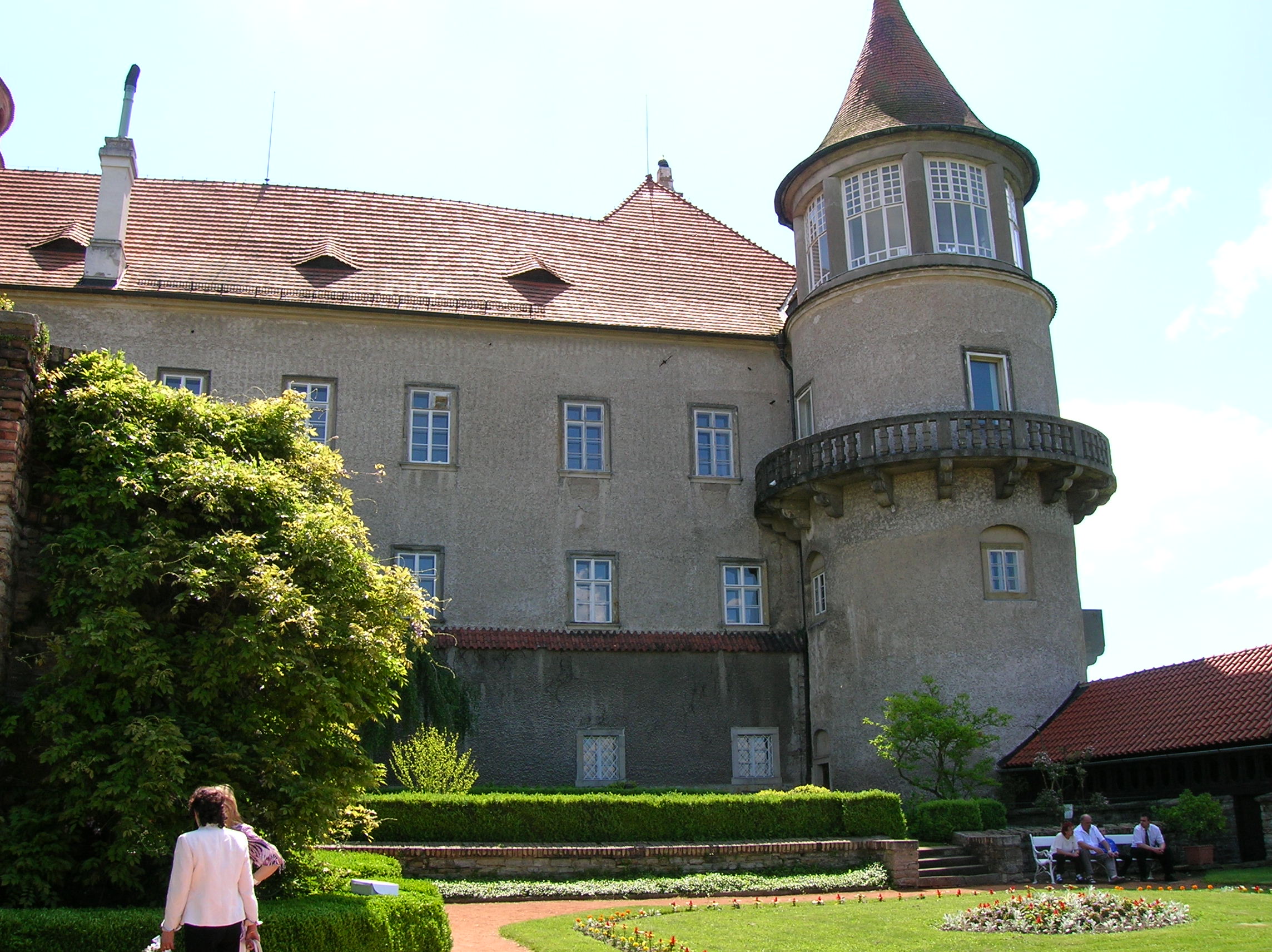
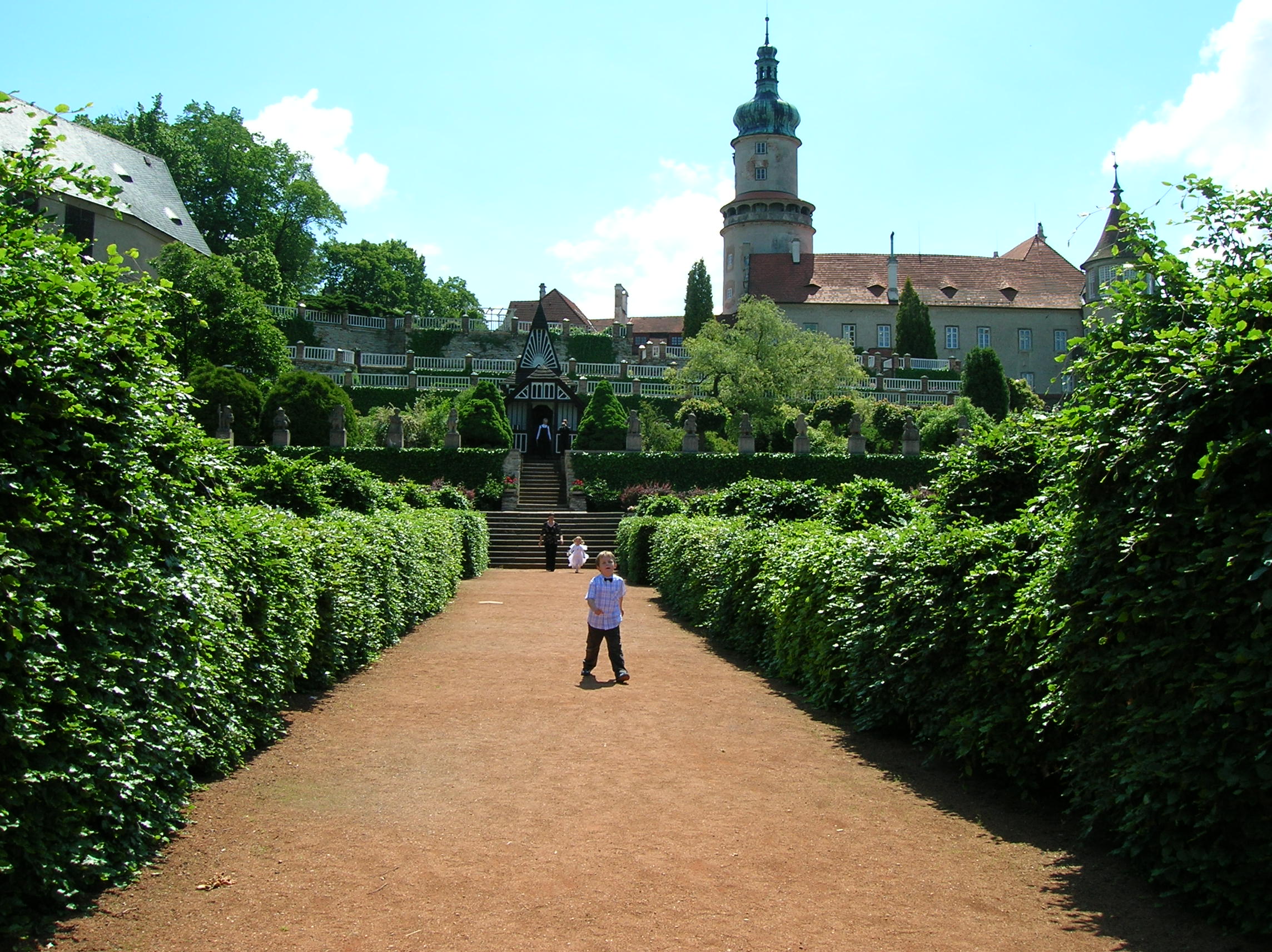
Before the tour I had time to visit the gardens and see Jurkovič’s outdoor masterpiece for myself. Terraces and flower beds punctuated the upper gardens while a quaint wooden bridge led me to the lower section. The sculptures of the stone dwarfs caught my attention immediately. They were the skilled work of famed Czech sculptor Matyáš Braun from the first third of the 18th century. I also noticed a statue of legendary Czech composer Bedřich Smetana and Baroque statues of the God Poseidon and the Goddess Demeter as well as two statues of bears. A Baroque fountain was situated in the garden, too. I felt like reading in the sun for a while here, but the tour was going to start soon and anyway, there was a wedding procession about to cross the wooden bridge and head in my direction. The gardens seemed to be the perfect place to bring a book and relax, occasionally glancing at the stone dwarfs and Baroque fountain.

ImageOne of the first places we visited on the tour was the Rising of the Holy Cross Chapel from the 17th century. The fresco on the ceiling and the white stucco decoration had me gaping in awe.  But more about that later. Then, in the hallway, I was overwhelmed by a 15th century Gothic altarpiece as we walked toward the Winter Garden. It was absolutely exquisite, depicting Saints Peter and Paul with an icon of Jesus Christ.

The Winter Garden was one of my two favorite rooms, designed in the decorative style by Jurkovič in 1910. Plants abounded, and there was lovely white wicker furniture as well as many ceramics in the space. The walls looked to be made of rock inlaid with a tree design in brown. I thought how much I would love to sip a cup of green Eilles tea at the white table, surrounded by so many thriving plants and intriguing ceramics.

NoveMestonadMpark4My other favorite was the Coffer Room, a Jurkovič masterpiece from 1913. The wine red carpet and dark brown leather and oak furniture contrasting with a light and airy ceiling made me feel comfortable. There was also leather wallpaper on the ceiling and a huge green and brown marble fireplace made of ceramic tiles. A brass chandelier decorated the room as well. An avid Czechoslovak history fan, I loved the portrait of former President Masaryk, set in a gold frame. The room, with all its couches and tables, appealed to me as a place I would like to come and read on a cold winter’s night, while sipping hot chocolate.  I somehow felt safe there, away from the worries of my life and the world.

We also entered a room full of Cubist furniture designed by Janák. A hundred coats-of-arms of Czech towns were painted on the walls. On the ceiling I noticed pictures of the towns of Náchod, Český Krumlov and the Black Tower in České Budějovice.

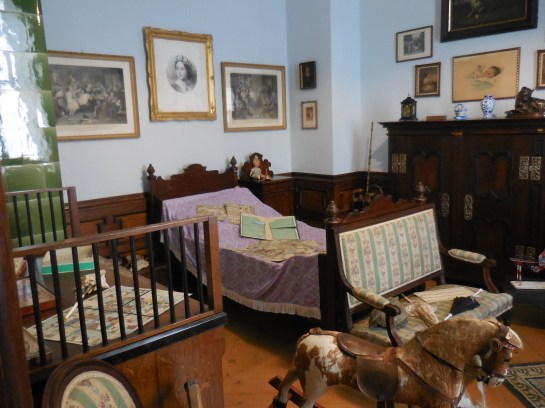
Some of the other rooms that particularly impressed me included: The Baroque bedroom, redesigned by Jurkovič in 1913. Swirling patterns decorated the arched ceiling, and there were three circular Renaissance frescoes on the wall above one bed.

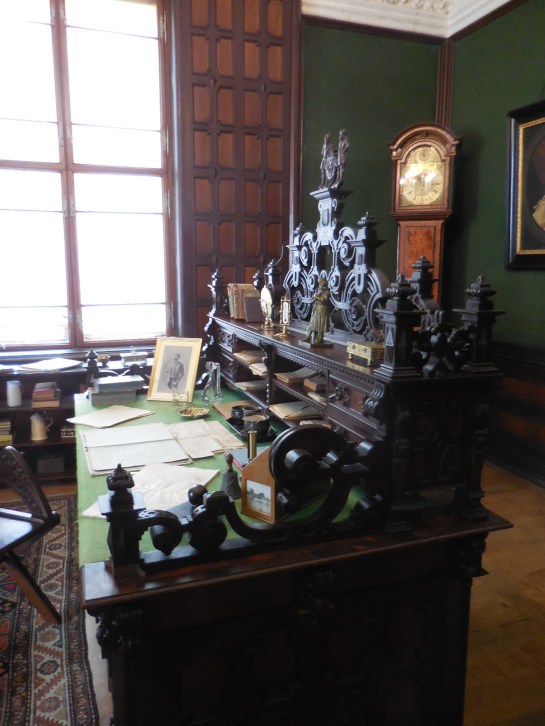
The Gentleman’s Study had an Art Deco interior forged by Janák in 1924. The central fresco was by František Kysela, who also painted many other frescoes in the chateau. Renaissance paintings hailing from the 16th century lined the walls. Textile art work and ceramics also punctuated the room. The space had a romantic flair, and I felt safe here. A sense of warmth exuded from the room. Dark wood mingled with a bright green color, with green upholstery on the dark wood chairs. The brown and white frescoes on the ceiling complemented the choice of furniture.

ImageWhat caught my attention in the Zodiac Room or Summer Dining Room was the exquisite handmade carpet. Inside an orange and light blue circle was another circle, this one in blue and orange, showing a proverb for each month. This Art Deco room, a 1923 creation by Janák, with brown wood furniture also boasted frescoes by Kysela.

I had a ticket for the long tour, so I followed the guide, a tall, bespectacled man in his forties, to the second floor, where the frescoes in the rooms all showed scenes from Greek and Roman mythology. In the Hall of Victors, which was really a Baroque dining room, I noticed the neo-Baroque interior and Flemish tapestry from the 16th and 17th centuries. Still lifes also decorated the walls which were a light yellow color. The frescoes sported sea blue and dark green. The white and blue porcelain was ravishing.

I cannot leave out the St. Hubert Room or the Hunters’ Room. This 17th century bedroom also boasts a ceiling fresco of Hypnos, the god of sleep. I was impressed with the vibrant colors of the fresco. Neo-Gothic and neo-Renaissance furniture from the 19th century contributed to the stunning look, too.

From the Oratory there was a fantastic view of the chapel. There were vibrant ceiling frescoes and white stucco decoration on the ceiling. The left-hand side of the altar was decorated with a painting of Saint Barbara, forged by the Baroque master Petr Brandl, one of my favorite Baroque painters. The black with gold columned altar was flanked by statues. The small size of the chapel gave it a sense of intimacy. What awed me in the Oriental Dining Room was its luxurious, long and sleek chandelier with the bottom shaped as a Chinese pagoda.

NoveMestonadMpark1Before the tour ended, the guide told us the legend of the Black Lady, who haunts the chateau. From 1624 to 1629 Marie Magdalena was one of the owners of the place, and she was called “Evil Manda” for a very good reason. She was exceptionally cruel to animals, and the townspeople were fed up with her. They rebelled in 1628. Soldiers put down the uprising, though, and proceeded to treat the rebels cruelly. Many men were killed in a gunpowder explosion in the tower, leaving many widows and orphans in the town. “Evil Manda” died in 1633, but she still walked the halls at night because she was looking for the two or three bodies of the farmers who were never found after the gunpowder explosion. She wanted them to be buried.  One could hear her footsteps at night, and sometimes paintings fell off the walls.

Then I left the chateau and went to a nicely decorated restaurant across the square. The restaurant was decorated in orange and yellow and had a cheerful appearance. It served good food as well, and I was able to eat my favorite food on my excursions – chicken with peaches and cheese plus a diet Coke.

Then it was time to get the bus back to Prague. When I made it to the stop about 20 minutes early, I was the only one there. Before long, about 10 people had joined me. We waited. And waited.  And waited. The elderly women standing next to me grumbled to themselves about how it did no good to complain in this country. A teenager with hair dyed pink read a book on the bench. Finally, the bus arrived – 45 minutes late. The bus driver did not offer an excuse or an apology. I was just glad the bus came.

Tracy A. Burns is a writer, proofreader and editor in Prague.

Image

Velké Losiny Chateau Diary

ImageDuring an Easter vacation in Olomouc, I decided to pay a visit to the chateau in Velké Losiny, which was a two-hour bus ride away. I was enthusiastic about seeing the chateau as I had recently read Václav Kaplický’s Witch Hammer, based on the witch trials that took place in northern Moravia from 1678 to 1692. In both the book and real life, Deacon Kryštof Alois Lautner tried to protect those branded as witches from a cruel fate, but even he wound up on the stake. I thought it was interesting that the witch trails in what is now the Czech Republic had been confined to two regions of northern Moravia, where there was a mostly German-speaking population.

It terrified me that people could believe such terrible superstitions and that because of those superstitions they could torture and kill fellow human beings. For 15 years, when the emperor’s inquisitor Jindřich František Boblig from Edelstadt occupied the chateau, more than 100 people from the regions were killed, 56 of them from Velké Losiny. The opportunity to see a place where such religious intolerance was carried out sent a chill up my spine. The very idea of people being burned as witches terrified me; yet I just had to see this place with my own eyes.

It made me sad that, although there are no longer witch trials, religious intolerance in such extreme forms still exists today. There were so many examples of religious intolerance in the modern world that it frightened and disgusted me.

As the bus took me north, I saw more and more snow on the ground, even though it was spring. I was the only person on the bus without skis.  Many were even standing in the aisle because all the seats were taken. When the bus came to Velké Losiny, it passed the white three-winged Renaissance chateau with beautiful arcades but didn’t even slow down at the stop. The driver evidently thought he only had skiers on board, and no one was waiting at that particular stop. I spoke up frantically that I needed to get off the bus, and a skier quickly told the driver. Finally, the bus let me off. About 15 skiers had to disembark from the bus in order for me to get out. Luckily, even though the driver hadn’t stopped where he was supposed to, I still wasn’t far away from the chateau.

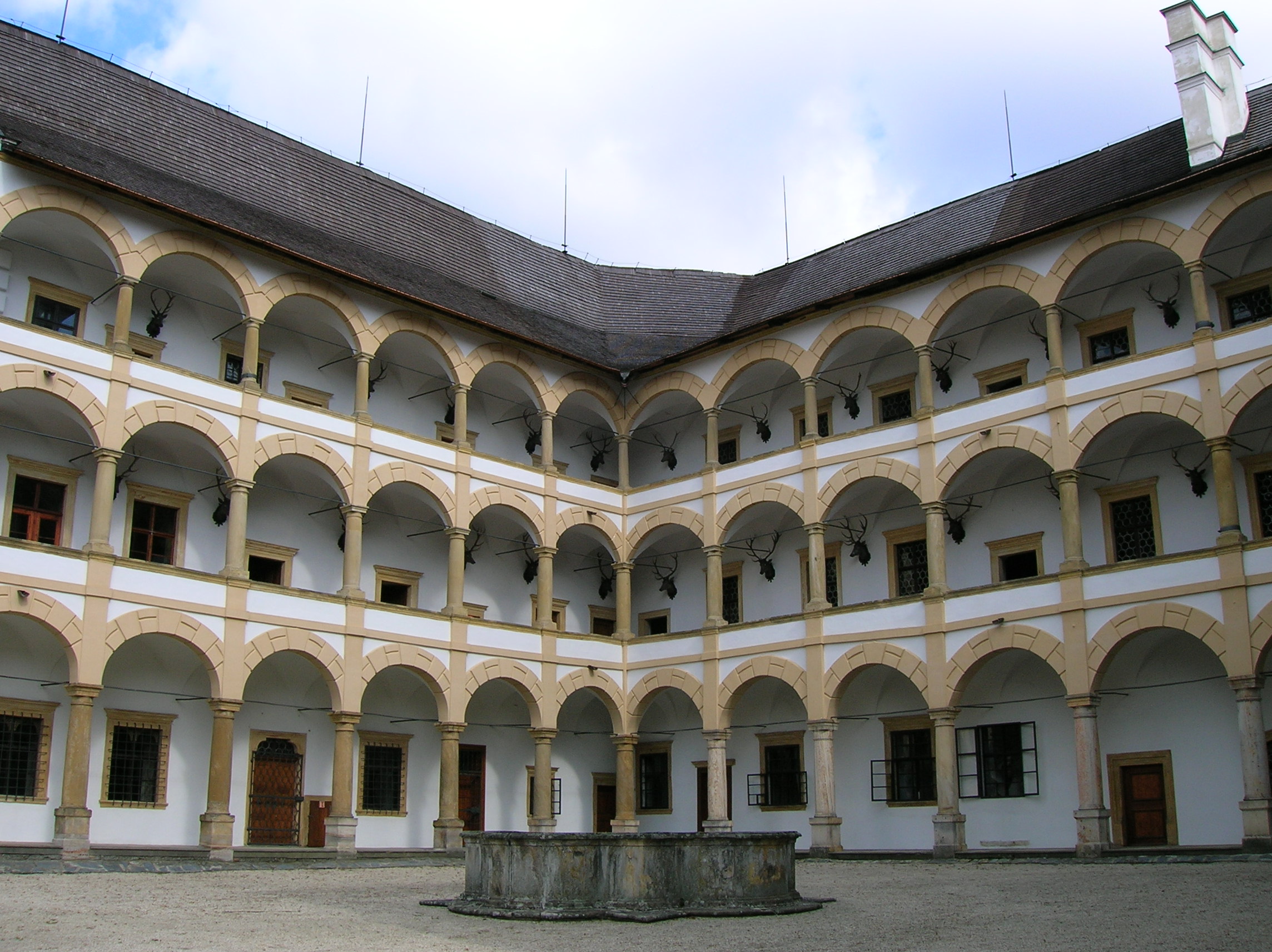
VelkeLosinycloseupWhen I approached the chateau, I noticed the exquisite sgraffito on one wall of the Renaissance wing from the 1680s and discovered that the chateau was really made of two parts: the Renaissance palace with arcaded courtyard and a Baroque two-storey building. The arcades in the courtyard gave the chateau a dignified look, I thought.  They dated from the 17th century, and the Baroque arcades were decorated with sculptures of dwarfs. It wasn’t until the tour that I realized the Renaissance windows were the oldest in Central Europe.

The guide explained that the Žerotín family had owned the chateau for more than 300 years, until 1802, and that Jan the Younger of Žerotín had built the Renaissance palace, a project that was finally finished in 1589. Also, this particular Žerotín, in 1596, founded the paper mill nearby, where paper was made by hand even today. It holds the distinction of being the only paper mill in Europe that makes paper by hand. During the Thirty Years’ War, the Žerotíns did not lose their property even though they did not convert to Catholicism. The Lichtenstein family took over the chateau from the Žerotíns in the 19th century because the Žerotíns were experiencing financial difficulties. The Žerotín portrait gallery in the chateau dates as far back as the 17th century, the guide pointed out.

Lake at Velke LosinyOn the tour, which consisted of only the guide and me, I stood on a parquet floor that was 400 years old. One 400-year old door was beautifully decorated with intarsia. In the Knights’ Hall I marveled at a majolica tiled stove, the third oldest in the Czech Republic, dating from 1585. The white, brown, blue and green colors intrigued me. The leather wallpaper also caught my attention. One of the two oldest leather wall coverings in the Czech Republic, it was decorated with floral ornament and a joint coat-of-arms of the Žerotín and Oppersdorf families. It dated from 1660. I especially liked the griffin with elaborate wings that stood for the Oppersdorfs. I looked up and thought I saw a panel ceiling, but it was only an illusion. The ceiling was, in fact, painted  in magnificent blue and gold colors. I also saw a Renaissance cupboard that was 400 years old, from the last quarter of the 16th century.

The guide informed me that above this space was a large room with a beamed ceiling where the witch craft trials took place in 1678, but the room was not open to the public. What a pity, I thought. That would be something to write home about! And to think I was standing in the room right below it!

In the library founded by Jan of Žerotín, the books ranged from the 15th to 19th century and were written in Latin, German and Czech, for example. They covered topics about horses, astrology and law, to name a few. In the center of the room, I saw a Renaissance reading pulpit made of ebony inlaid with ivory. I was especially intrigued with a leather wall covering that featured golden arabesques. Lions figured in some corners on the borders of the wallpaper.

In another room I saw the thrilling painting, “Night Festivity in Sienna,” which depicted firecrackers going off over a square. I liked the elements of fantasy in the picture that most likely dated from the 18th century.  I set my eyes on beautiful Baroque tapestries with motifs of a legend about Cupid and Psyche. They were woven around the middle of the 14th century. One tapestry illustrated a scene with Cupid and Psyche. A second tapestry showed Psyche and her two sisters. A third portrayed Mercury, Zeus and other gods at Cupid and Psyche’s wedding.  I saw even more tapestries in the chateau, and the guide proudly explained that this chateau had the second most tapestries in Moravia.

A set of four more tapestries decorated another room. The first showed Antony meeting Cleopatra; the second was titled, “A Torchlight Feast”; the third elaborated on the theme of Cleopatra’s and Antony’s love for each other; and the fourth, dating from 1560, dealt with Roman history as it portrayed the heroic young Roman Mucius Scaevola, who tried unsuccessfully to assassinate Etruscan king Lars Posenna. Because of his courage, he was not killed, though his right arm was badly burned. This particular tapestry dated from the second half of the 16th century.

In another room an early Baroque cabinet from Spain was inlaid with ivory. The drawers featured pictures made of tortoiseshell and ivory. I was enthralled by a small carved altar from Peru or Chile. It dated back to the 17th century, most likely. I saw even more leather wallpaper, this time from 1640, and a Baroque panel ceiling. I also took note of a Spanish bureau dating from the 17th century; it was called a vargueno. One particular painting fascinated me. It carried an inscription in an old form of the Czech language and showed a woman praying and Christ on the cross. Hailing from 1566, it was the funeral picture of Magdelene of Zástřizl, marked with the date of her death, the same year the painting was executed.

Then the guide and I came to a room where a copy of the official, thick book about the witch trials was displayed. She mentioned that among the 56 victims had been a Catholic priest. I imagined Boblig flipping through that fat volume, feeling pleased with himself, choosing which woman to torture next. Those thoughts both angered and terrified me. The atrocities of that period were too much for me to fathom.

In the two chapels, decorated by Jan Kryštof Handke and dating from the 1740s, I set my eyes on an astounding ceiling fresco featuring allegorical figures representing the four continents. A man with a parrot stood for America. Why Handke had chosen this particular symbol for America, I did not know.  Other figures included a kneeling woman with a crown to represent Europe, a man with a turban to denote Asia and a bowing black man as Africa.

The big chapel also featured a marble Rococo altar and a Renaissance altar of Madonna with child. The organ from 1723 still worked, the guide claimed. The fresco ceiling painting in the small chapel was the inspiration of Handke as well, and Baroque elements had been added to the late Renaissance altar. A copy of a Gothic statuette of Madonna of Altotting, from the Bavaria region of Germany, dated from the 14th century. Silk paintings also decorated the space.

The Empire Wing, where the Lichtensteins had lived, featured light wood Beidermeyer furniture. The porcelain was from Slavkov in the Czech Lands and from Vienna, Austria. The park, from 1802 in the English style, included eight sandstone sculptures of dwarves from the 1830s and a fountain decorated with a sculpture featuring fish and putti.

I left the chateau, astounded, unable to take in all I had seen, and set off for the paper mill nearby, where I went on a one-hour tour of the place. Founded in the 16th century, it was one of the oldest paper mills in Europe and was now the only existing one. Even the wife of a stationer who had worked here had been burned as a witch during Boblig’s reign. The handmade paper was made from cotton and flax. Some items in the museum included examples of Japanese handmade paper and a model of a paper crusher. I saw how paper was dried by hanging it on poles and learned about press compaction and the drainage of paper, among other things.

Then I found a restaurant in a hotel, ate a big meal of chicken, peaches and ham, wrote some postcards and soon left for the bus stop. This time, I hoped the bus would stop at the designated place.

It did.

Tracy A. Burns is a writer, proofreader and editor in Prague.

Arcades of Velke Losiny Chateau 2

Hrádek u Nechanic Chateau Diary

HradekuN2020ext3

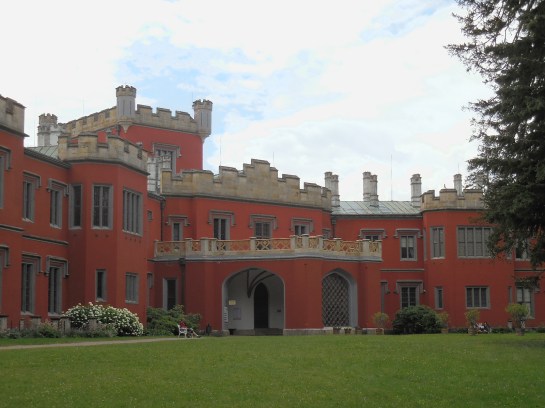
On a hot Friday morning in August, I went to one of my favorite chateaus, the small yet enchanting Hrádek u Nechanic, situated west of Hradec Králové, a major town in east Bohemia. Once again, I changed buses at Hradec Králové, a station I now felt I knew intimately. (Note: I would visit it again in July of 2020 and be just as amazed by its exterior and interior.)

HradekuN2020ext4

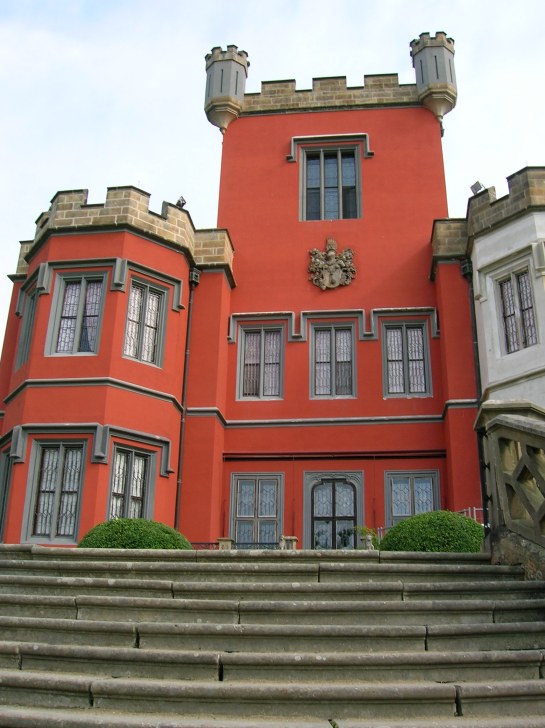
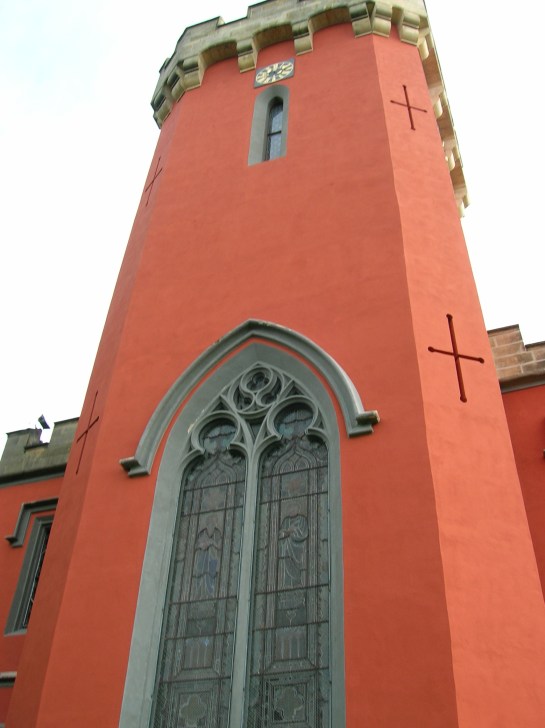
When I reached the chateau, I was struck by its cheerful, romantic, dark orange façade that made it look like it belonged in a fairy tale. After getting my ticket, I walked to the back of the chateau and noticed that this part of the park bordered on a golf course. What struck me most, though, was how the back side was not a playful orange but a mundane grey that was badly in need of a paint job. It even looked a bit dilapidated. A wire fence was set up in front of this side of the chateau. To the far left, though, I climbed a few stairs that led up to the chateau as another wing was painted that dynamic dark orange.

HrádekuN7

At the beginning of the tour, the guide pointed out the lantern lamps hanging on the walls. They harkened back to the 16th and 17th centuries and had been created in Venice. Hunting trophies also adorned the walls. Then the guide acquainted the group with the chateau’s history. While the village dated back to at least the 14th century, the chateau was young, a 19th century construction built in the Neo-Gothic style of English aristocratic homes reminiscent of the times when Queen Elizabeth I and King James I reigned during the 16th and 17th centuries.  Count František Arnošt Harrach of the prominent Harrach family was responsible for building this intimate chateau in 1839. A patron of the arts, he also supported the construction of the National Theatre in Prague.

HrádekuN4

From the July 3, 1866 battle of Hradec Králové during the Prussian-Austrian war to November of that year, the chateau served as a military hospital for the Prussians and was subsequently heavily damaged. Tents had been set up outside the chateau.  In 1884 František Arnošt’s son Jan Nepomuk Harrach took over. A distinguished Czech politician, he also was keen on the arts, giving his support to Czech artists such as Karel Jaromír Erben and Bedřich Smetana.

HradekuN2020ext11

When Jan died, the property was passed on to his brother Otto and then on to Otto’s son Jan, who lived there until 1945, when the Beneš decrees declared the property be handed over to the state. The controversial Beneš decrees declared Germans, Hungarians and collaborators living in the Czech lands and Slovakia would have to relinquish their Czechoslovak citizenship and property without compensation. Approximately three million ethnic Germans and Hungarians were expelled from the country from 1945 to 1947. The chateau was open to the public as early as 1953. It did not become a National Cultural Monument, though, until 2001.

HradekuNint1HradekuNint2

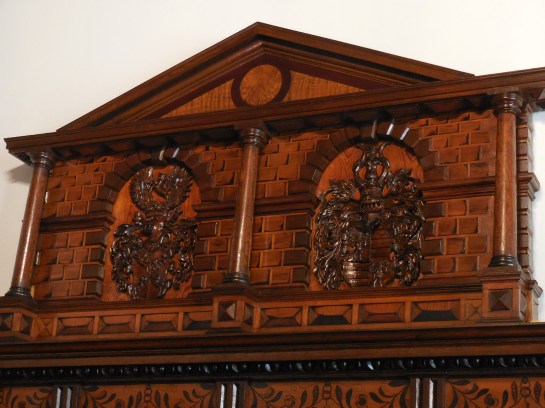
After putting large slippers over my shoes, I followed the group into the Knights’ Hall, a small room that happened to be the biggest in the chateau. I noticed that the floor had a black-and-white diamond pattern. Coats-of-arms decorated the space above the two doors and just below the ceiling. Portraits of Harrach family members dotted the walls. I noted the exquisitely carved backs of the chairs – there were nine of them. I remembered how this entire chateau had always enchanted me with superbly and ornately carved wooden furniture. That was one of the reasons I liked it so much. I found the dark wood appealing, and it made the small rooms feel cozy, perfect for a cup of hot ginger tea on a windy, wintry night. This is definitely a chateau I would not mind living in, if it were not so far from Prague. In the center of the room stood a stone table from the 16th century, decorated with writing and coats-of-arms. Looking up again, I spotted the Lobkowitz family’s coat-of-arms just below the ceiling near the door we had come through. It boasted two black eagles complemented with red and white colors.

HradekuNint55ceilingHradekuNint56HradekuNint57wallpaperHradekuNint60HradekuNint51

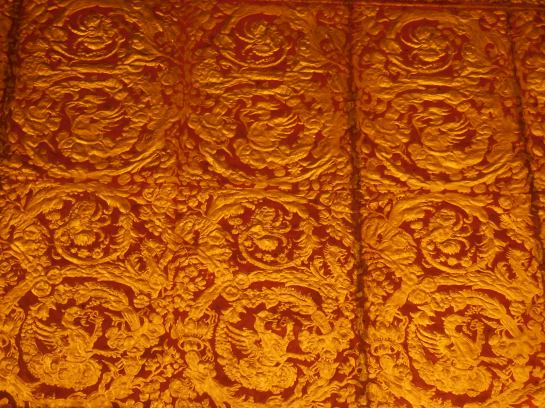
The Golden Hall next on the list was the most riveting space in the entire chateau. Its gold-plated leather wallpaper that featured golden swirls on a dark red background astounded me. The marble fireplace weighed 11 tons, and the tableware was 16th century, from Italy. What looked like a roll-up desk was revealed to be an upright piano. The guide lifted the lid to reveal a keyboard. Opening the two doors above the lid revealed the piano strings. But that was not the only object in that room that amazed me. A figure of a black eagle with a crown had a golden clock on its breast. It used to be able to wave its wings, too. This was the clock of Emperor Leopold I from the 17th century, the one a Russian tsar had given him. It is one of two in the world; the other graces the Hermitage Museum in Saint Petersburg.

HradekuNint63chandelierHradekuNint65

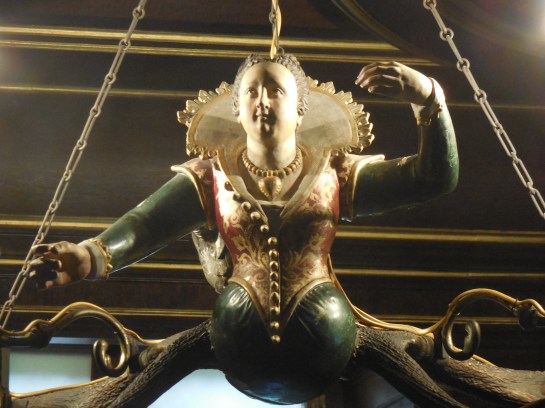
I was also entranced by the chandelier in the Breakfast Room. It featured a figure with a head and body. Its legs had been replaced by antlers that branched out to all sides. It reminded me of a creature from a fairy tale, one that was on the side of good rather than evil. Again, I admired the richly carved backs of the chairs.

HradekuNint72HradekuNint66HradekuNint68HradekuNint70

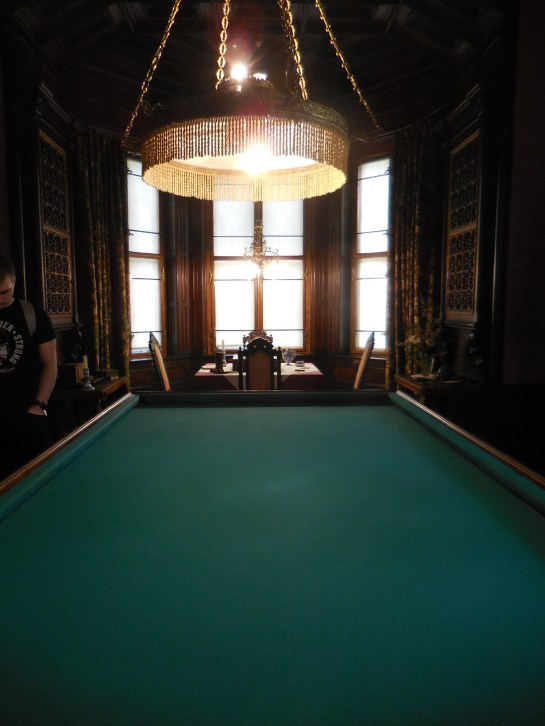
The Dining Room featured plates and ceramics situated on high shelves around the walls. They hailed from 16th and 17th century Italy and Germany. What looked like a brown and white water fountain once had been used to pour wine on tap. Predictably, in the Billiards’ Room there was a big pool table. Yet the holes had been covered over. A brown with gold décor grandfather clock hailed from 18th century Berlin. The dominant 16th century painting “Celebration in the Spa” by Dutch artist Lucas van Valckenborgh featured hills and a forest dotted with people. The picture was so detailed that if you looked closely, you could see a couple holding hands far in the background.

HradekuNint79libraryHradekuNint75libraryHradekuNint76libraryHradekuNint77chandelier

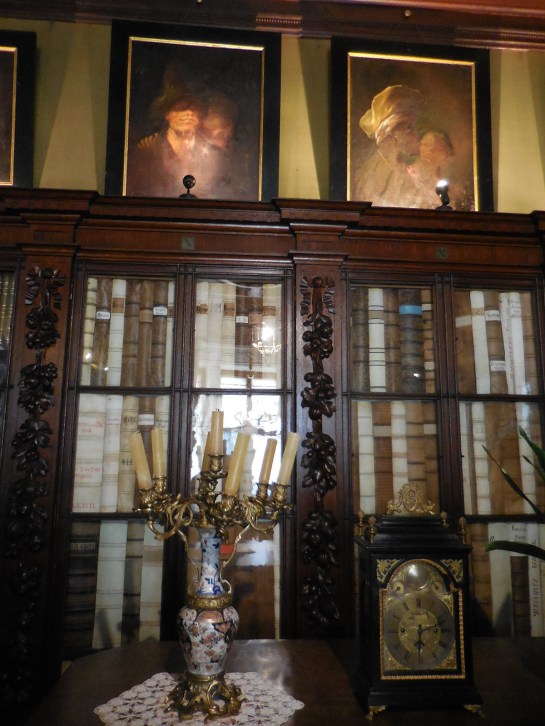
I marveled at the next room, the library, which housed an impressive collection of 19th century Czech and Slovak books. Usually chateau libraries held few, if any, books in Czech, and I had not heard of any carrying works in Slovak. The room was also home to many publications in English, French, Latin and Greek. There was even one book in Hungarian. But the books were not what caught my undivided attention in the library: The portraits hanging high on the walls did. There were 12 portraits of people’s faces, all with various diseases that resulted in deformities. I had to turn away when I saw the swollen warts on one man’s neck. Another had evil, demented eyes, his mouth open as if screeching in pain and anguish. The portraits also reflected the anti-Semitism and racism of those times by portraying an Arab, a Black man and a Jew. I was relieved that society no longer condoned such revolting prejudices. At the same time, I knew that society still had far to go in the anti-Semitism and racism departments. (When I visited in 2020, seeing the portrait of the Black man reminded me of the systemic racism in America and the murder of George Floyd as well as many others. Even though I was living in Prague, I had watched part of the protests and the moving funeral of Floyd on TV.)
HradekuNint9wallpaperHradekuNint10

Now on the first floor, we came to the Count’s Hall. The gold, blue and green leather wallpaper immediately caught my eye. The guide pointed out a faded pink armchair that was adjustable, able to move up and down. When the back of the chair was in the down position, it looked like a coffin. It so happened that František Arnošt died in that chair.

HradekuNint35HradekuNint36HradekuNint11


The Count’s Study featured a chandelier from Murano and a Renaissance desk. The guide showed our group what looked like a golden miniature telegraph but was really an alarm clock. Even the trash can was elaborate; it was made of carved wood.  How I would love to have a garbage can like that!

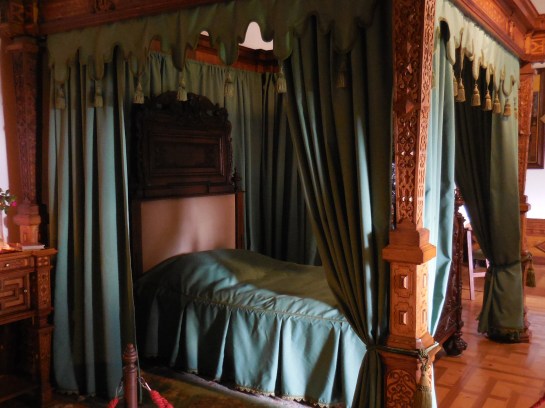
HradekuNint15ptngHradekuNint14chandelierHradekuNint16bed

We continued to a bedroom with an icon from the 15th century, the oldest object in the chateau. I liked its bright colors; it had a distinctive vibrancy.  The guide showed us a chandelier that was electric; electricity had been installed in the chateau in the early 20th century. It hung from a flexible band that could be pulled up and down.

HradekuNint18wallpaperHradekuNint20HradekuNint22

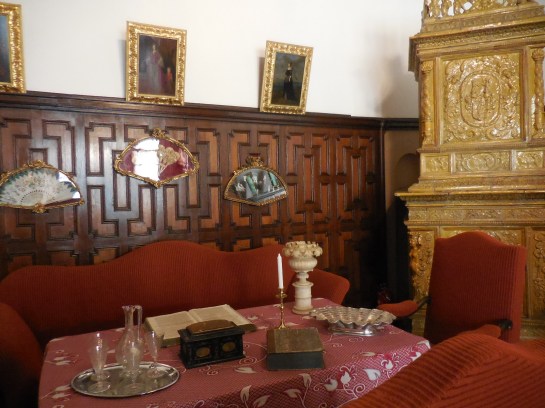
We walked through the guest rooms, where historical personalities such as Czech ethnographer and patron Vojta Náprstek had stayed. The exquisite carving on the doors also drew my attention.  On one wall I noticed the black-and-white engravings of an ancient city’s ruins – was it Rome? I saw a lovely, light blue bed frame with floral decoration in one of the rooms as well. Finally, we entered the Family Halls. Landscapes covered one wall. I noticed an impressively carved jewelry box with detailed wooden drawers. On the walls were black-and-white engravings of portraits of Habsburg generals. One of the earliest digital clocks was on display, too. It had a white square and a number in black on top of one other. The top number read two, the bottom one 59.

HradekuNint28HradekuNint31HradekuNint32HradekuNint25

Almost last but certainly not least was the Oriental Hall, which I don’t seem to have pictures of from my 2020 visit. I could hardly believe my eyes when I saw the ornate, detailed craftsmanship of the wooden furniture from China. I could not recall being more impressed by any other wooden furniture in all of the chateaus I had visited.

HradekuNint85chapelHradekuNint86chapelHradekuNint88chapel

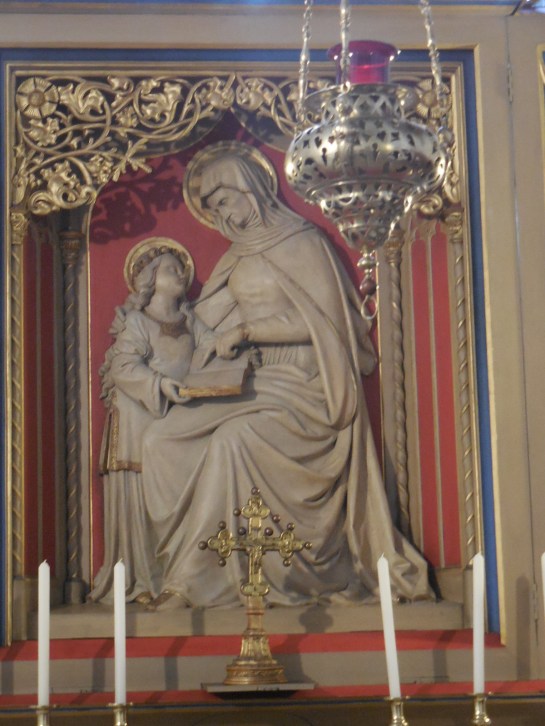
The chapel was dedicated to Saint Anna, who was depicted reading to a child in the altarpiece that consisted of lively, red, blue and tan colors. The stained glass windows were also a sight to behold. The men’s oratory was made of finely carved wood.

HradekuNint89chapelHradekuNint90chapel

The tour ended as a thunderstorm ensued. I wanted to take refuge in the cozy rooms of the chateau with dark wood lining. Yes, this chateau was still one of my favorites. I ventured outside and into the downpour, unable to get the images of all that exquisitely carved wooden furniture and lovely leather wallpaper out of my mind. (By the way, during my visit in 2020, it rained as well, but was an awe-inspiring trip nonetheless.)

Tracy A. Burns is a writer, proofreader and editor in Prague.

HradekuNint93chapelHradekuNint91chapel