Bečov nad Teplou Castle and Chateau Diary

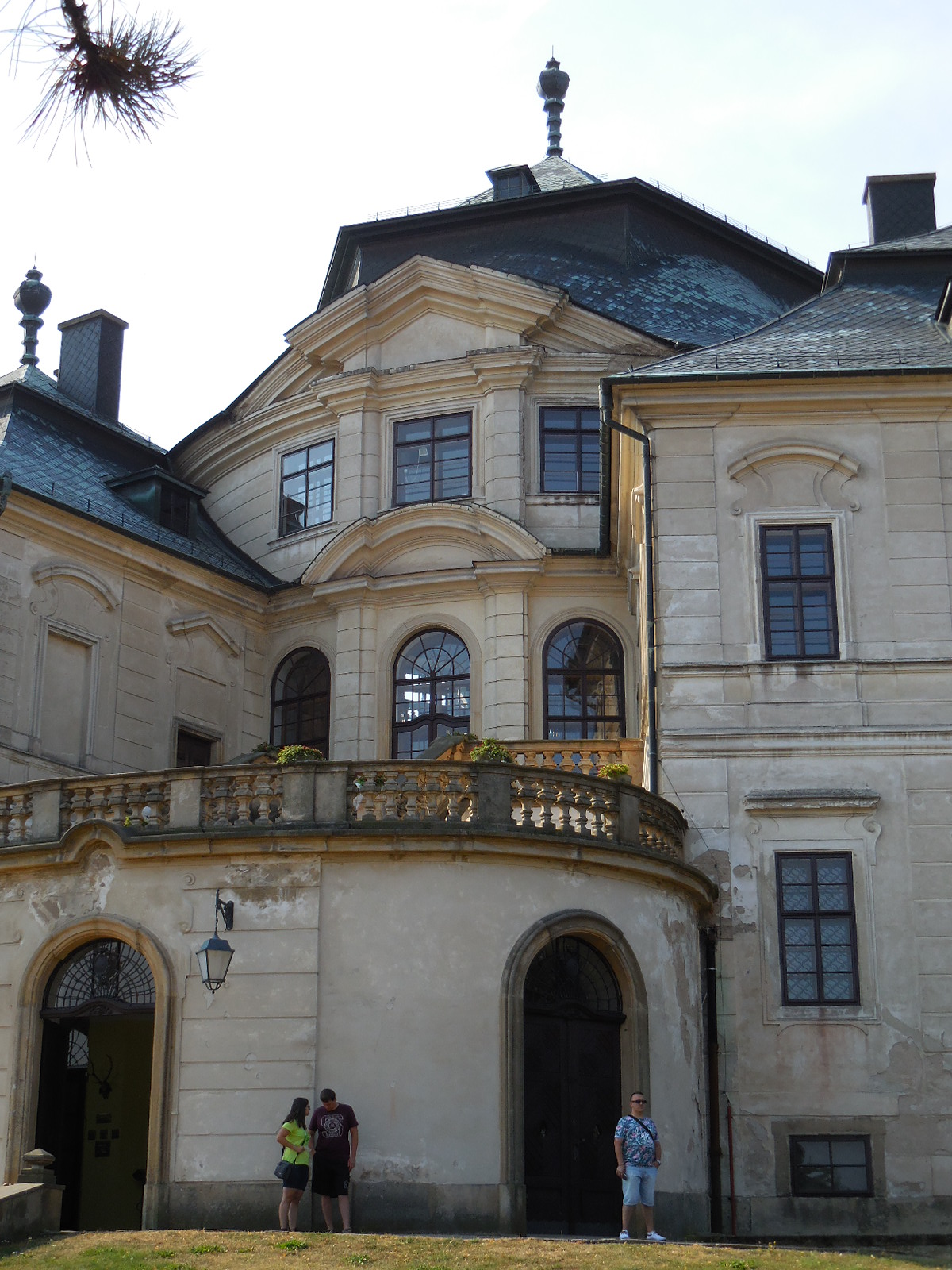
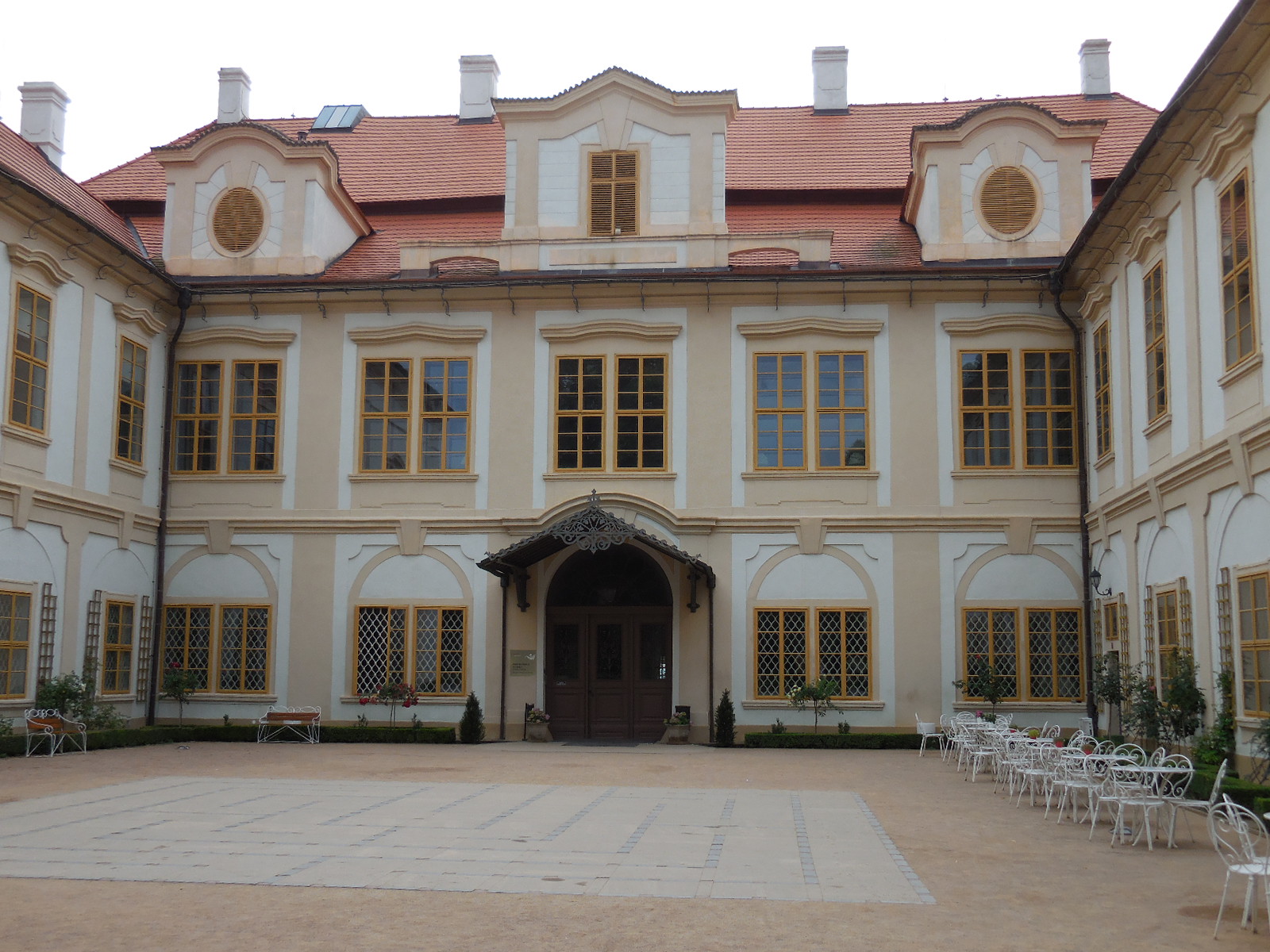
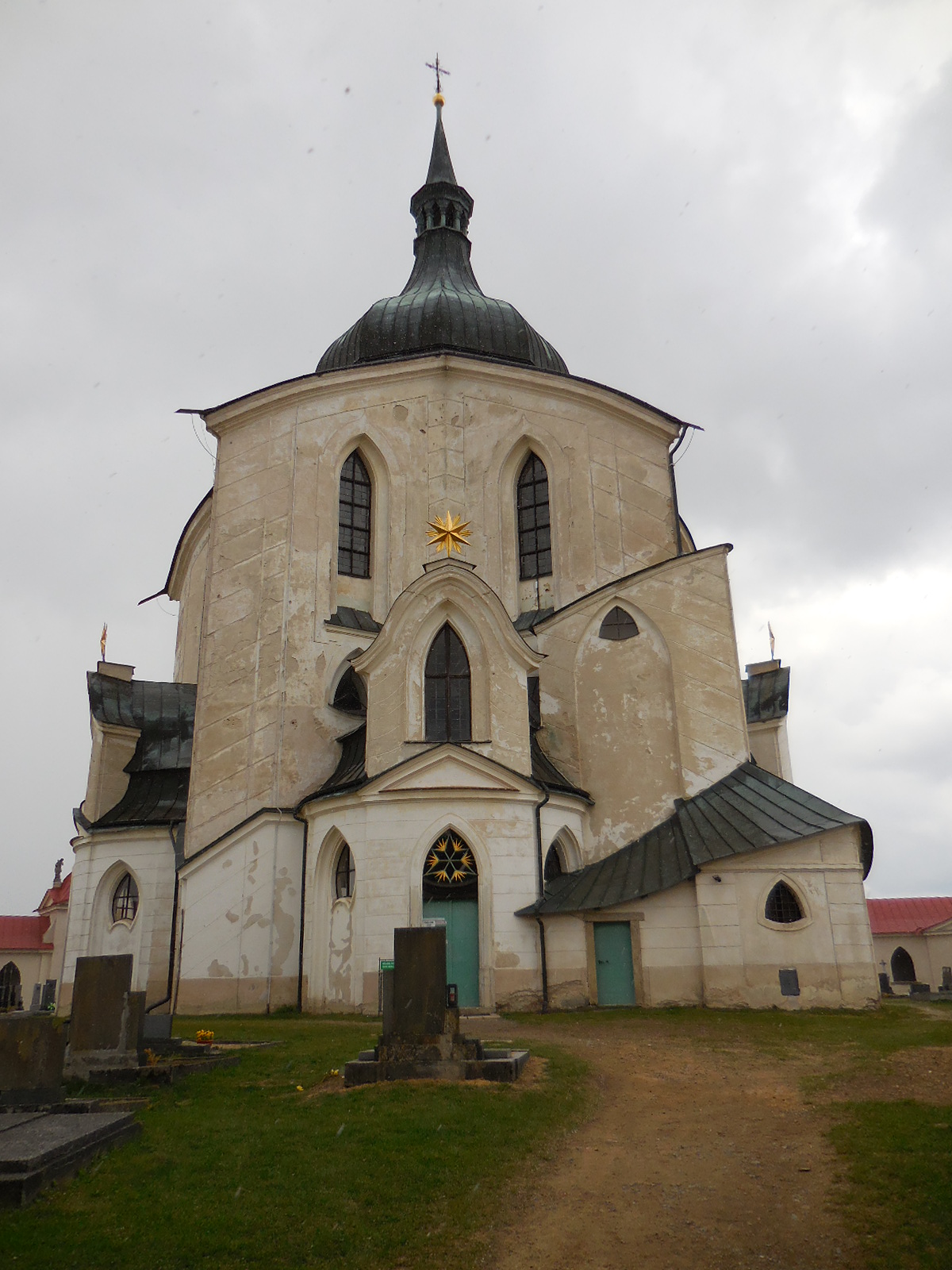
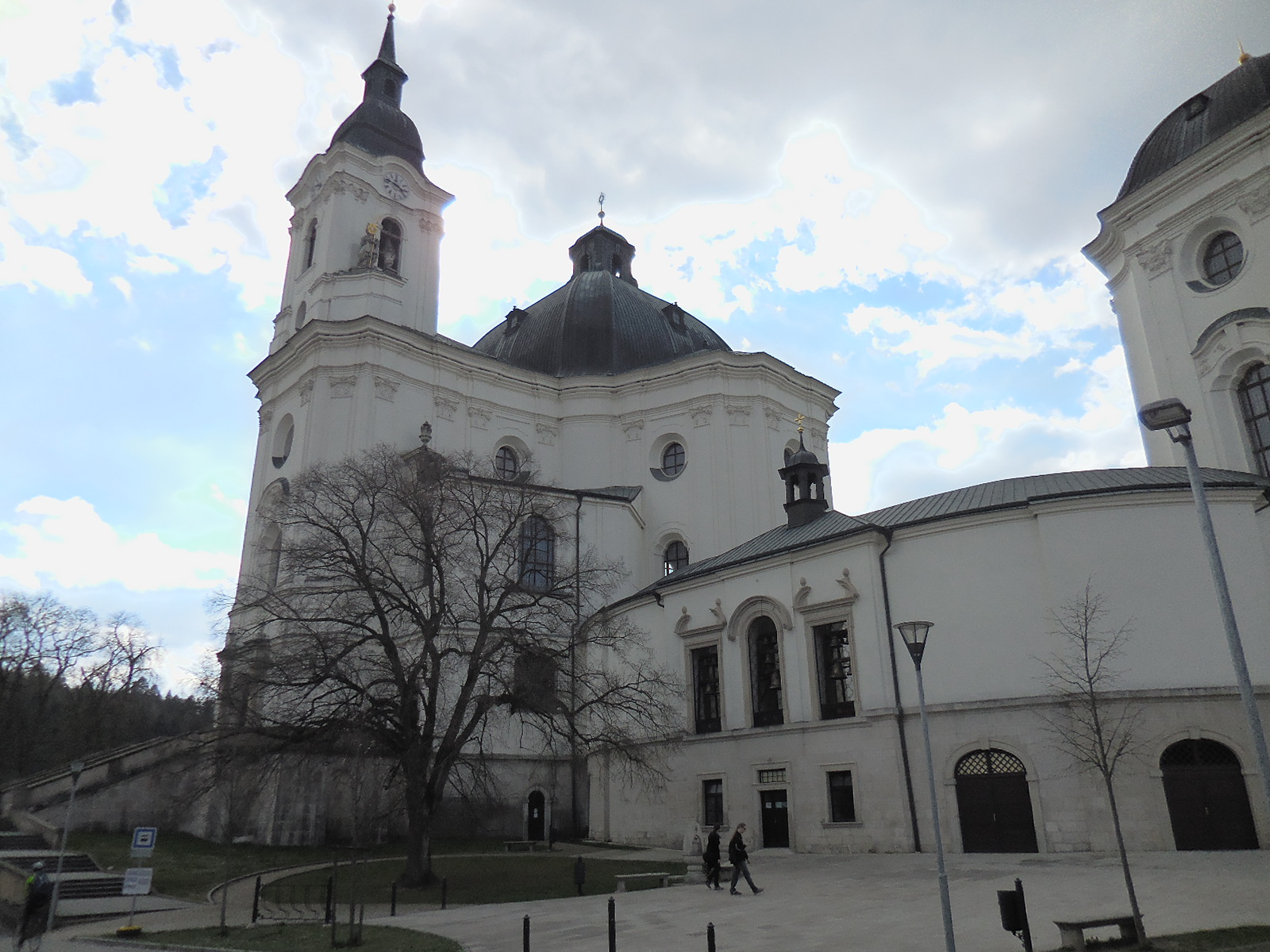
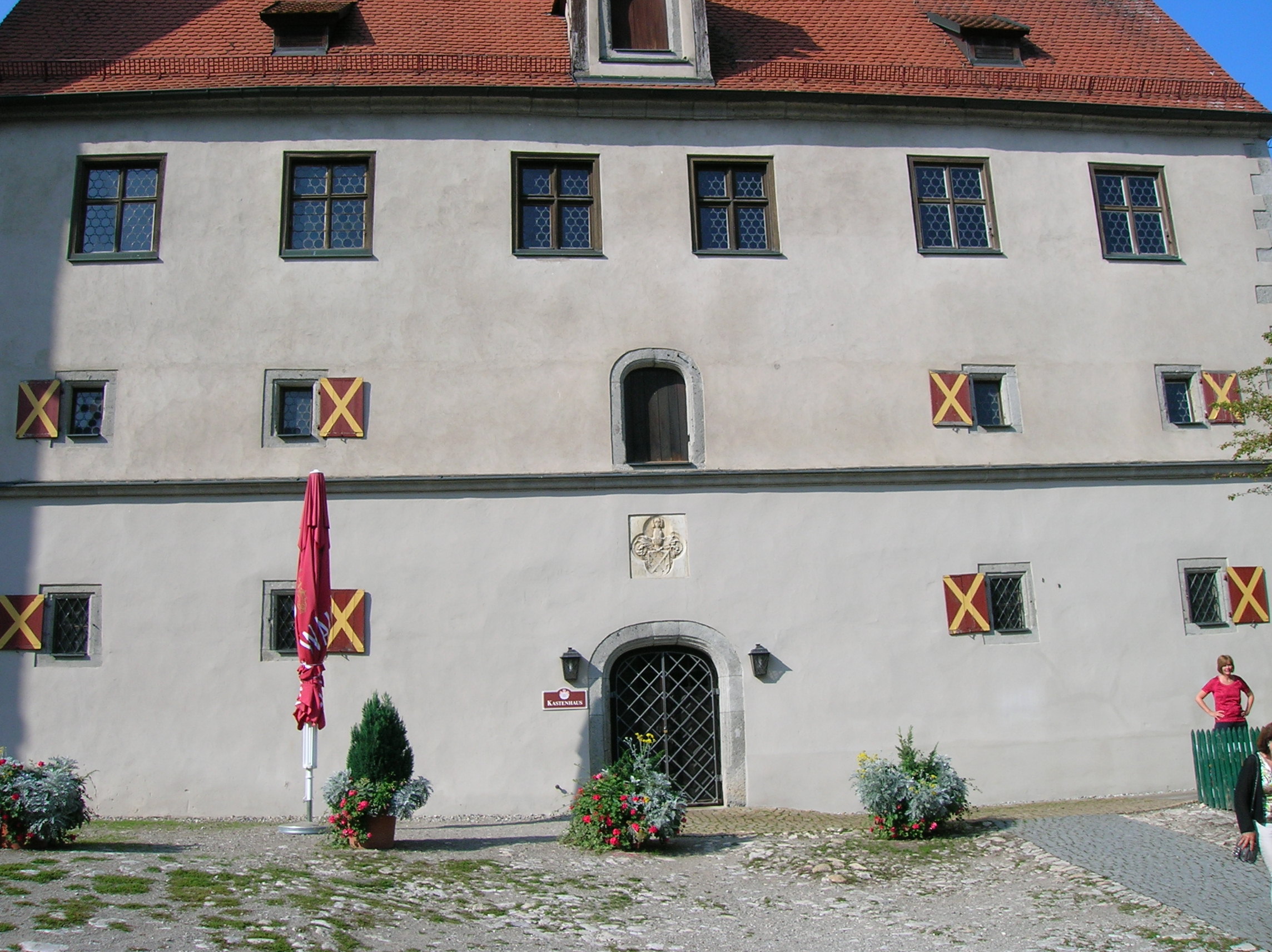
View of the chateau from the front gate

View of the chateau from the front gate


Part I

I waited and waited. The tram going to the Dejvická Metro station was late. I kept glancing at my watch. If it did not come soon, I would miss the 6:40 a.m. Saturday bus to Karlovy Vary. I had been looking forward to seeing the castle and chateau in Bečov nad Teplou again for some time. I had planned this trip so carefully. Where was the tram? There were always trams coming in the direction of the metro station. Why did I have to wait so long? Had there been an accident? Was there a problem with the tracks? My heart was racing. Where was the tram?

Some nerve-racking minutes later, the tram did come, and I made it the Student Agency bus just as the doors were about to close. During the two-hour trip to the famous Czech spa town, I fretted about whether or not I would make the train to Bečov nad Teplou. I only had 15 minutes to change, which should be enough if the bus was on time. Still, after the incident with the tram, I was worried….

It turned out that the bus dropped passengers off at the Karlovy Vary train and bus station at 8:30 a.m. rather than its 8:45 designated time. I had an entire half hour before the train departed. First, I waited in line at the only window for train tickets. There was a line of potential passengers, but no one appeared to be manning the window. After waiting an excruciatingly long 15 minutes, someone did come.
Becov4

The train was already on platform three. When I saw the Viamont train, I was surprised. It was new, clean and comfortable, not like those old red trains with uncomfortable seats that I had often taken to small towns for so many years. The stops were even announced and displayed electronically on a sign above the seats. I did not have to worry about getting off at the wrong stop – not this time anyway.

The train ride was scenic and relaxing. We traveled through woods and also past a golf course with ponds and a stream. I could see the Bečov nad Teplou chateau and castle on a high rock from the train stop in the valley. From there it was about a 15-minute walk through the small town with some narrow, steep side streets and a church on a hill. Passing a half-timbered house that seemed to belong in another century, I came to the picturesque square with its pensions, restaurants offering outdoor seating, antique store and souvenir shop.
On my way I noticed many Baroque or Classicist houses, which were in need of repair.

A view of the castle and chateau during the walk there from the train station

A view of the castle and chateau during the walk there from the train station


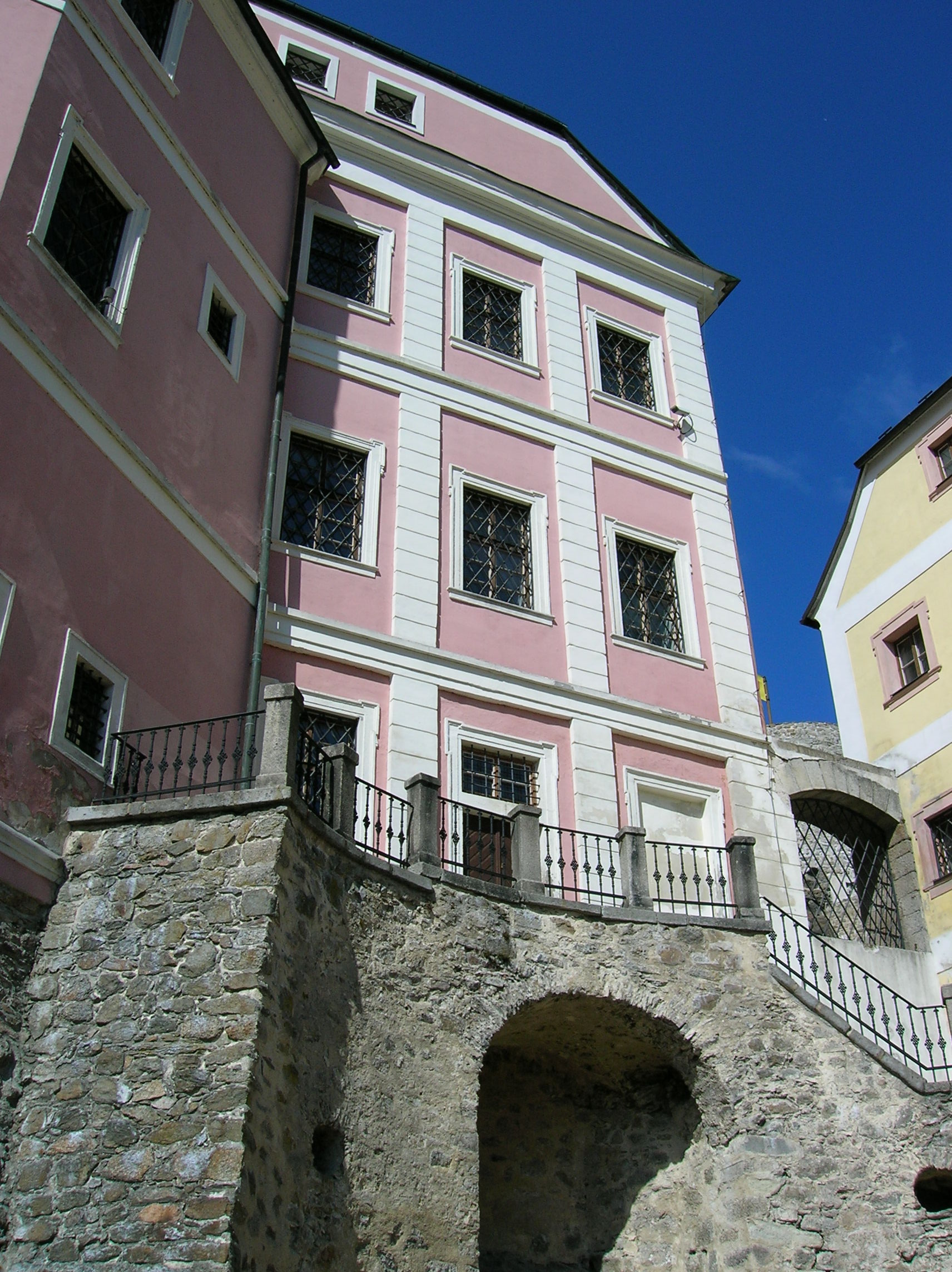
From the square I gazed at the pink Late Baroque chateau and headed directly to the box office. It was only 9:45 a.m. The chateau and castle opened at 10:00 a.m. Yet there was already a line of at least 10 people ahead of me, mostly seniors.

In the end there were about 20 people ready for the 10:00 a.m. tour, so they were split into two groups. One group started with the historic interiors, and the other group – my group – began with the Romanesque reliquary of St. Maurus, where fragments from the bodies of three saints – St. Maurus, St. John the Baptist, and St. Timothy– were kept. I had never been on this tour because the reliquary had opened to the public in May of 2002, and my first visit took place during March of that same year.

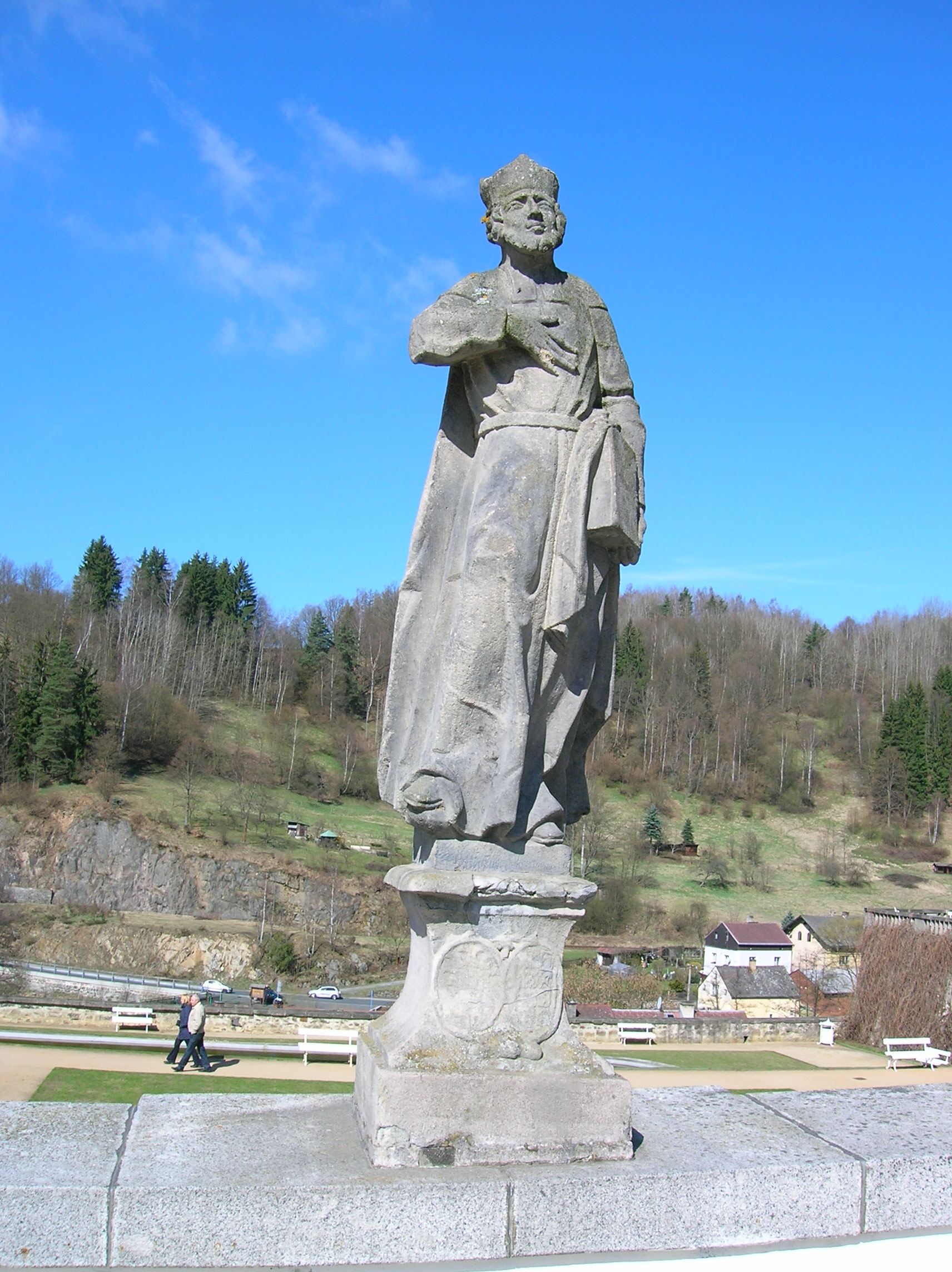
The small bridge featured two impressive statues.

The small bridge featured two impressive statues.


First, I crossed a small bridge decorated with the statues of John Nepomuk and the Jesuitical clergyman Jan de Gotto, both of which dated from 1753. I reached the front gate, framed in a 16th century Renaissance portal. Before going upstairs to the rooms dealing with the holy relic, we stood in a hallway decorated with portraits of soldiers riding horses off to battle. I noticed the plume on a soldier’s helmet and the castle in the lower left-hand side background of that portrait. The castle seemed so small and powerless against the mammoth soldier seated on a horse that seemed almost to bolt out of the canvas. I also was impressed by the elaborate saddle that the artist had rendered.

On the floor above the hallway, a display case in the first room dealing with the unique treasure featured a small Christ figure, a marquetry cross that appeared to be inlaid with gems and scapulars of the Beaufort-Spontin family. It also contained pictures of relics found in the richly decorated tomb box, such as small textile bags, bits of paper and small stones.

The chateau from the square

The chateau from the square


A map covered another wall. The guide pointed to Belgium and explained that the reliquary hailed from a Benedictine abbey in that state, from a city called Florennes. The reliquary dated from 1225 to 1230 and contained the remains of the three saints mentioned above; yet more recent DNA tests proved that there were the remains of five people in the chest, two of whom are men from the third century AD, according to the guide. He also explained that these sorts of shrines were important in society because people believed that they were the source of health-related miracles. He added that Saint Maurus was a sort of mystery man for scholars; it is only known that he was a saint and martyr in the first or third century AD, nothing more.
A look at the chateau

A look at the chateau


After surviving the French Revolution, the unique object was kept at St. Gengulf’s Church in Florennes. When Alfréd de Beaufort bought the reliquary in 1838 from a Belgian church council for 2,500 francs, it was in a decrepit state. He brought it to Bečov and had it repaired from 1847 to 1851. When his grandson had to flee in 1945 after the second world war because he had cooperated with the Nazis, he hid the reliquary in a backfill of a chapel in the castle here.

In the next room there was a reproduction of a partial mural from the castle chapel, which, along with the rest of the castle, was not open to the public. (Visitors were, however, allowed inside the chateau’s chapel.) The guide elaborated on the fascinating history of the treasure, which sounded like something out of a detective story.

The reliquary of Saint Maurus from www.svatymaur.cz

The reliquary of Saint Maurus from http://www.svatymaur.cz


The reliquary had remained hidden for 40 years. In 1984 an American named Danny Douglas wanted to buy an unspecified treasure hidden in the Czech lands during World War II and was willing to pay 250,000 USD for it. This was a financial offer that the Czechoslovak government could not afford to pass up. But the Czechs had to figure out which artifact he intended to purchase. During further talks with Douglas, the Czechs were informed that the object was oblong, the size of a conference table, hollow, made of metal and buried about 100 kilometers from Nuremberg, among other facts. Finally, they narrowed it down to the reliquary, which had to be buried somewhere in this chateau and castle.

A black-and-white video dated November 5, 1985 showed criminologists unearthing the chest in the chapel. I could not help but notice how dilapidated the façade of the building was, how different it looked from today. Of course, the Czechs would not allow the treasure to leave the country. In the end, the contract with Douglas was not signed.

The next room dealt with the restoration process. In display cases I saw tools and utensils used to fix the reliquary, such as chasers, a metal chiseller and engravers. The guide also mentioned that the statues on the exterior of the reliquary were made of silver tin and took 11 years to restore. Imagine that! Eleven years! When the criminologists found the treasure, it was damaged. The metal pieces were corroded, and parts of the figures and reliefs were no longer attached to the relic. Due to issues relating to property rights, restoration did not begin until mid-1993.

The guide also explained why the treasure with its fragile, small gilded silver statues took such a long time to restore. Restorers had to make miniature, detailed parts for the statues, hands and arms for example. The restoration of the 12 apostles and reliefs on the roof proved the most challenging. The young man conducting the tour mentioned that the restorers had to drill about 3,000 holes for nails to keep the object from getting damaged. Don’t overlook the fact that the chest included filigree with pieces of glass, precious stones and gems.

A closeup of the reliquary of Saint Maurus

A closeup of the reliquary of Saint Maurus from Wikimedia.org


Another display case featured the plaster casts for the circular reliefs on the chest, showing biblical scenes. In one Salome carried the head of St. John the Baptist. Another featured the dance of Salome. Plaster casts of saints were also displayed, including Saint Paul, Saint Jude Thaddeus and Saint Bartholomew. A large picture on one wall showed that the treasure was decorated with birds and mythological figures and inlaid with gems. No one knows how the gems were placed on the chest because not even a laser is capable of doing that kind of precise craftsmanship, and they certainly did not have microscopes back in Romanesque times.

In the fourth room I looked at the original oak box that had been found inside the chest. The restorers had to create a new wooden core for the object. The display cases along the walls showed various reliquaries. In one case I saw two gem-studded rings. I also gazed at a number of golden Baroque monstrances, so elaborate that they almost made me dizzy.

Another closeup of the reliquary of Saint Maurus from www.svatymaur.cz

Another closeup of the reliquary of Saint Maurus from http://www.svatymaur.cz


Then we finally came to the dark room containing the unique treasure. We only had five to seven minutes in the space. I noticed how Saint Maurus’ drapery seemed to flutter as he gripped a sword in one hand on the front of the chest. Christ was giving a blessing on the opposite side. On the roof were 12 large reliefs relating the life of Saint Maurus and of Saint John the Baptist. Small columns with floral decoration also decorated the chest. Apostles were shown with staffs; one gripped a cross. Saint John the Evangelist held a goblet. I noticed the precise curls in his hair as well as his flowing drapery. The detail in the saints’ facial expressions was also stunning.

Golden swirls and gems decorated the treasure as well. I noticed the precision of the inlaid gems and the precision with which the small hands of the apostles had to be made. My head was swimming. There was so much detailed decoration to take in at one time. I wanted to study the chest in small parts, truly appreciating the precision of the figures and reliefs. I knew I was staring at one of the most beautiful artifacts I would see in my life.

After a short time, we were ushered out of the dark room, and the first tour ended. In 10 minutes, it would be time for the tour of the interior rooms. I was enthralled by the first tour and excited about the second.

Another shot of the chateau

Another shot of the chateau


Part II

The tour of the historic interior rooms began, as did the last tour, in the hallway with the large wall paintings of soldiers on bolting horses. Then we went to a room displaying a model of the complex as it had looked in the 19th century, under the Beaufort family’s tenure. I admired the terraced gardens with pools and fountains. The guide pointed out the castle’s Chapel of the Visitation of the Blessed Virgin Mary in the tower, which was the oldest part of that building. (Only the chateau, not the castle, was open to the public.)

Donjon, taking its name from Early Gothic castles shaped like towers in southern France, had been a tower of four floors with toilets on every floor. The family had lived in this section of the castle. The Pluhovský Palace, still flaunting a Classicist style, was comprised of three houses. A watch-tower also had stood on the property, though it is only six meters high now, as it had been shortened and transformed into an observation terrace during the 19th century. The vibrant, pink Late Baroque chateau, built in the 18th century by the Kounic owners, was one dominating feature of the model.

The lovely and charming chateau

The lovely and charming chateau


The guide familiarized us with the history of the castle and chateau as I glanced occasionally at the portraits, maps and black-and-white landscapes on the walls. In the 14th century the village’s status was raised to that of a town. The castle remained the property of the Hrabišic of Osek clan until the beginning of the 15th century. From the 13th to the 16th centuries, the place prospered thanks to its gold, silver and tin mining. In fact, during the 16th century, Czech tin from the Bečov region was praised as the best in Europe. The manufacturing of pewter added to the town’s wealth.

But times changed as the Hussite army destroyed the castle during the Hussite wars that took place from 1419 to 1434 and pitted several factions of the armies of martyr Jan Hus’ followers against each other. The Holy Roman Empire, Hungary, The Pope and others joined forces with the moderate Hussites. The castle was also in decline after the Thirty Years’ War, and the town never again reached its former level of prosperity. During the 18th century the Kounic family bought the castle, adding the chateau and bridge.
Becovchateau15
Then in 1813 Fridrich Beaufort-Spontini took over as the owner, which was a turning point in the buildings’ history. The Beauforts made many improvements to the castle and chateau. It was Alfréd Beaufort who created a Baroque style park with six levels of terraces. He repaired the castle and chateau, set up the botanical gardens, constructed an open-air theatre and brought the reliquary of Saint Maurus to Bečov. Because his grandson Heinrich collaborated with the Nazis during World War II, the property was confiscated. Objects in the castle were plundered. Townspeople stole some artifacts while other pieces of art and crafts were sold to antique stores.

After that, various owners were in charge of the castle and chateau. The castle became a school for workers while Pluhovský Palace was supposed to, but never did, become a museum. Reconstruction of the property took place from 1969 to 1996, when visitors were finally allowed inside the Late Baroque chateau. Back then a West Bohemian Gothic Art exhibition was housed in the chateau. Now the original furniture has been put back in the building, though the spaces are organized differently than they had been in the 19th century, when the chateau’s rooms had served a representative function, while the family had been living in the castle.

Another view of the chateau

Another view of the chateau


On the ground floor we entered the library, where each bookcase was decorated with four columns and had a triangular slanting roof culminating in a point. Reliefs of a female reading adorned the bookcases, which shelved 3,000 books for representative purposes. The chateau had another 14,000 books stored elsewhere.
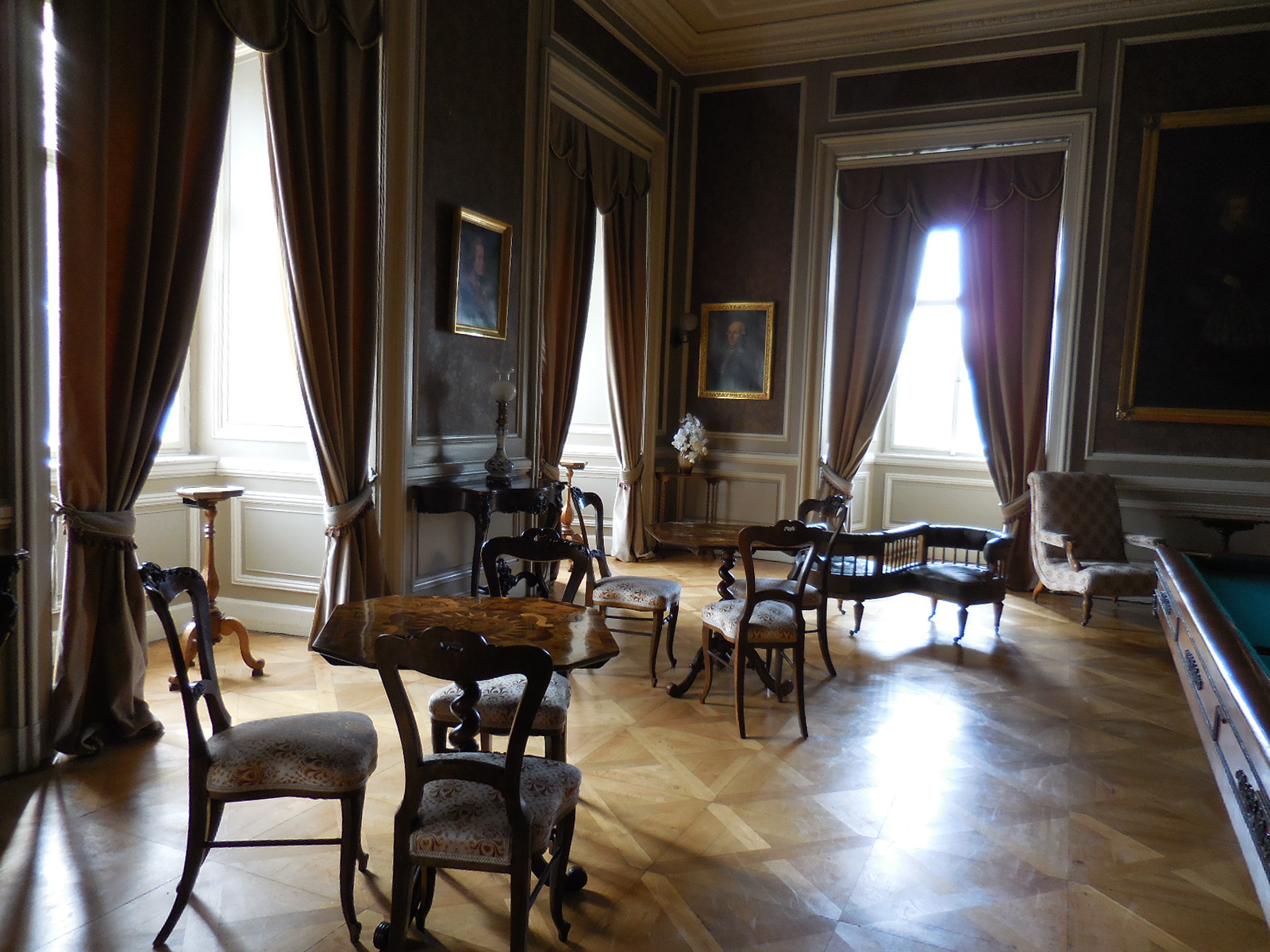
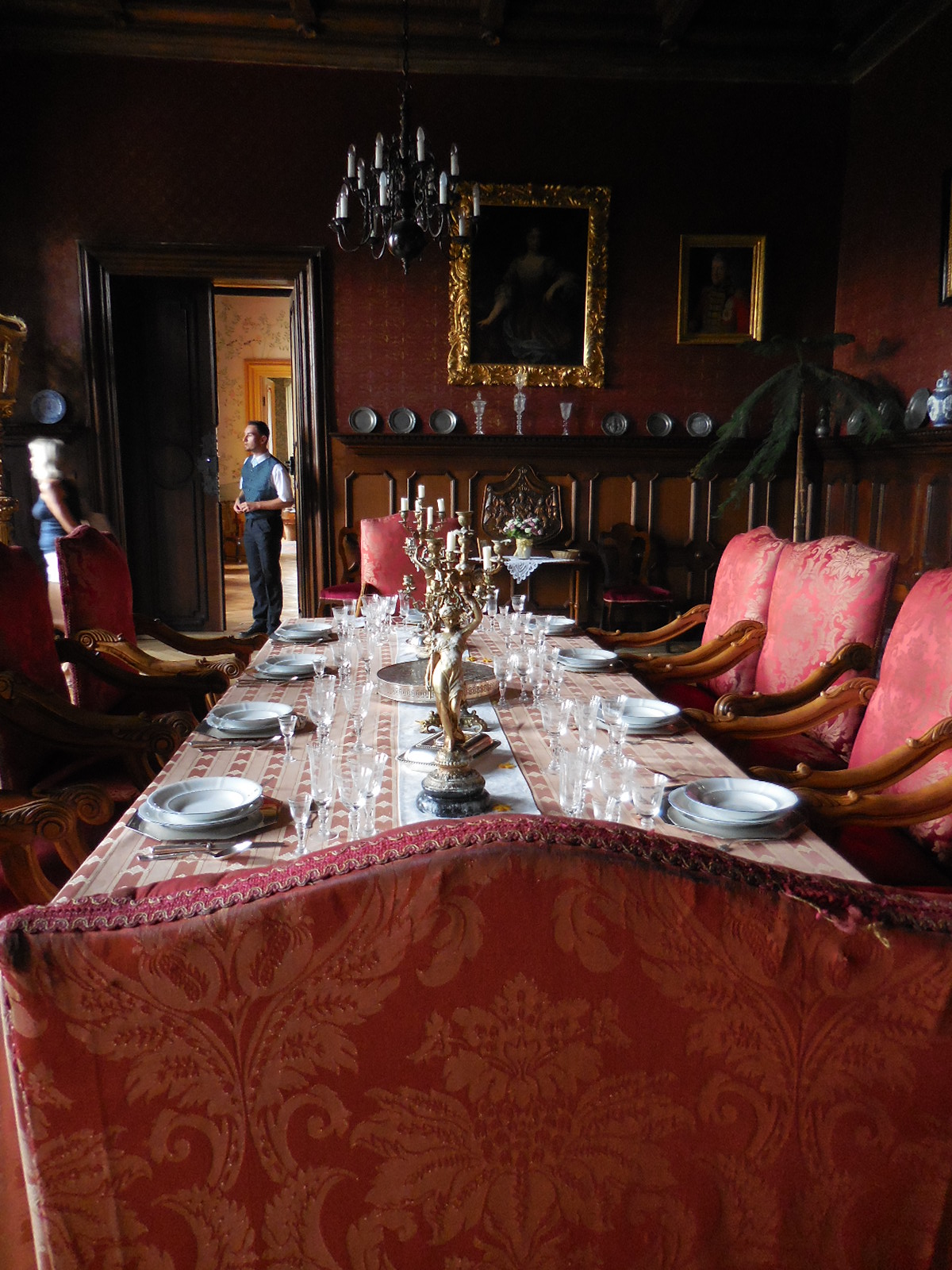
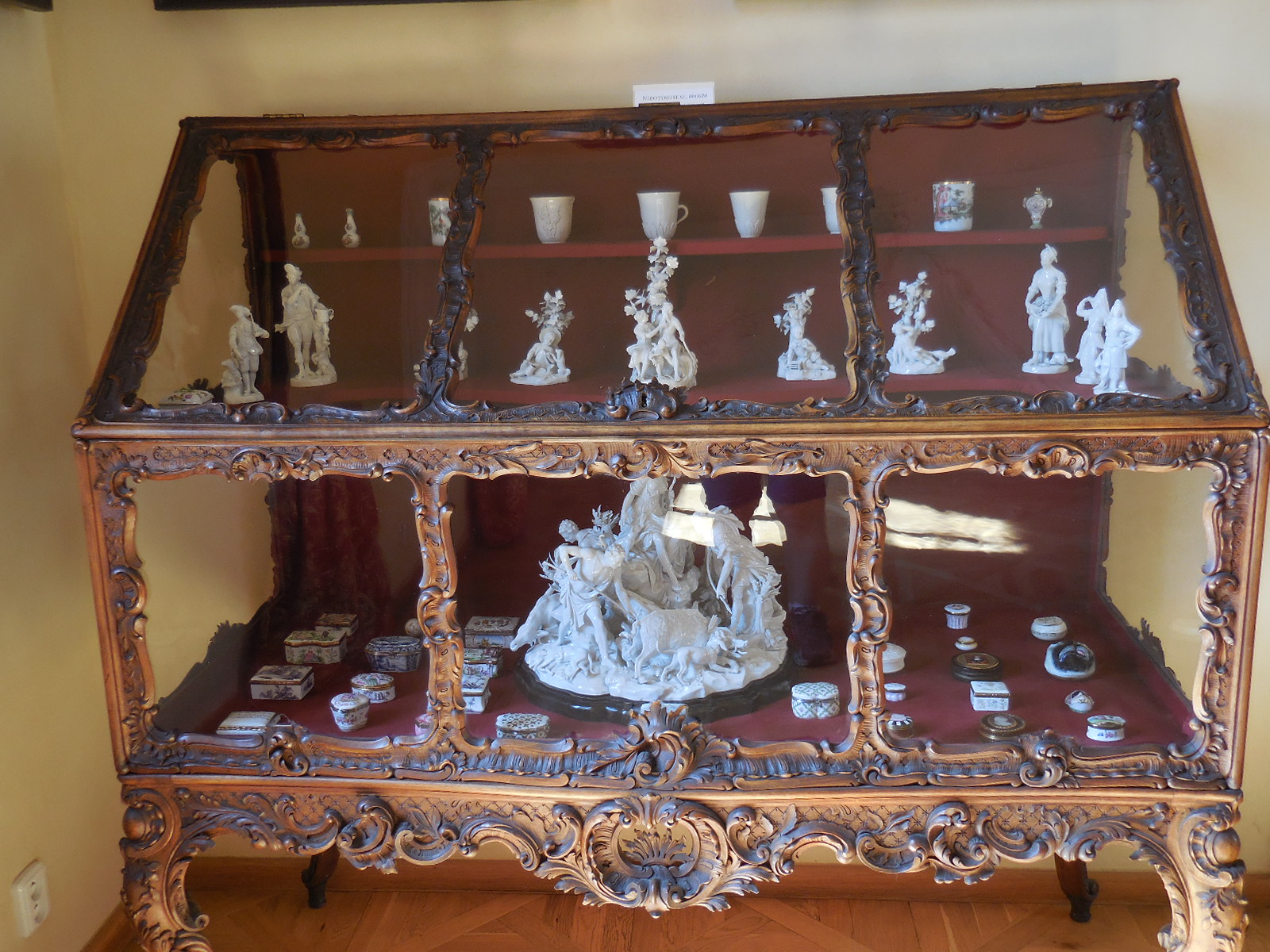
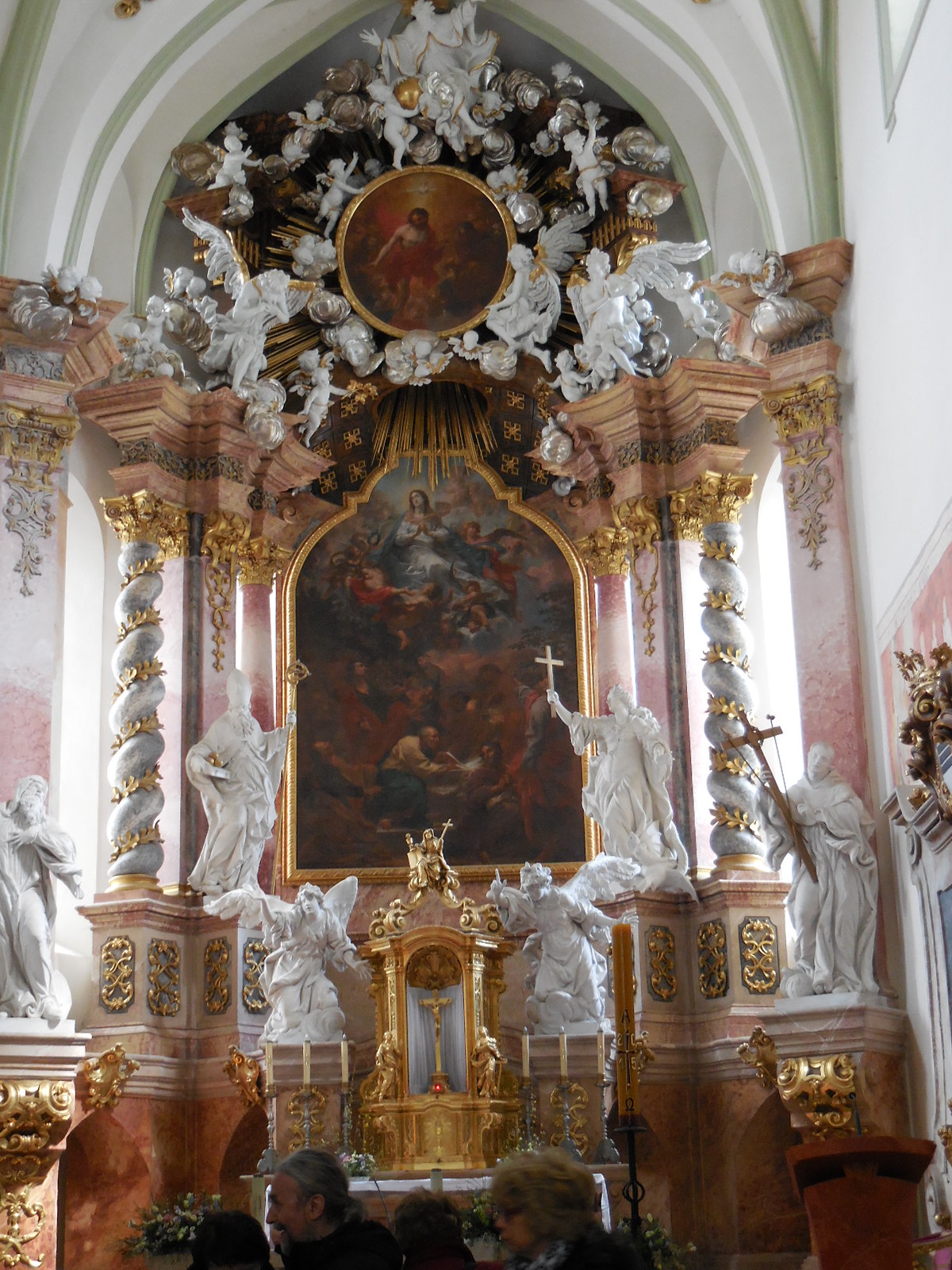
From there, we went up the staircase with the oak balustrade that originated in the 19th century to a landing decked with hunting trophies, rifles and swords intertwined as well as a tattered Austro-Hungarian army cap. I was impressed with the vibrancy of the pink hue in one room that sported a pink couch, pink chairs and a pink tablecloth under a glass table. The gold décor on the white tea cups also caught my attention. I could see the tower from the window.

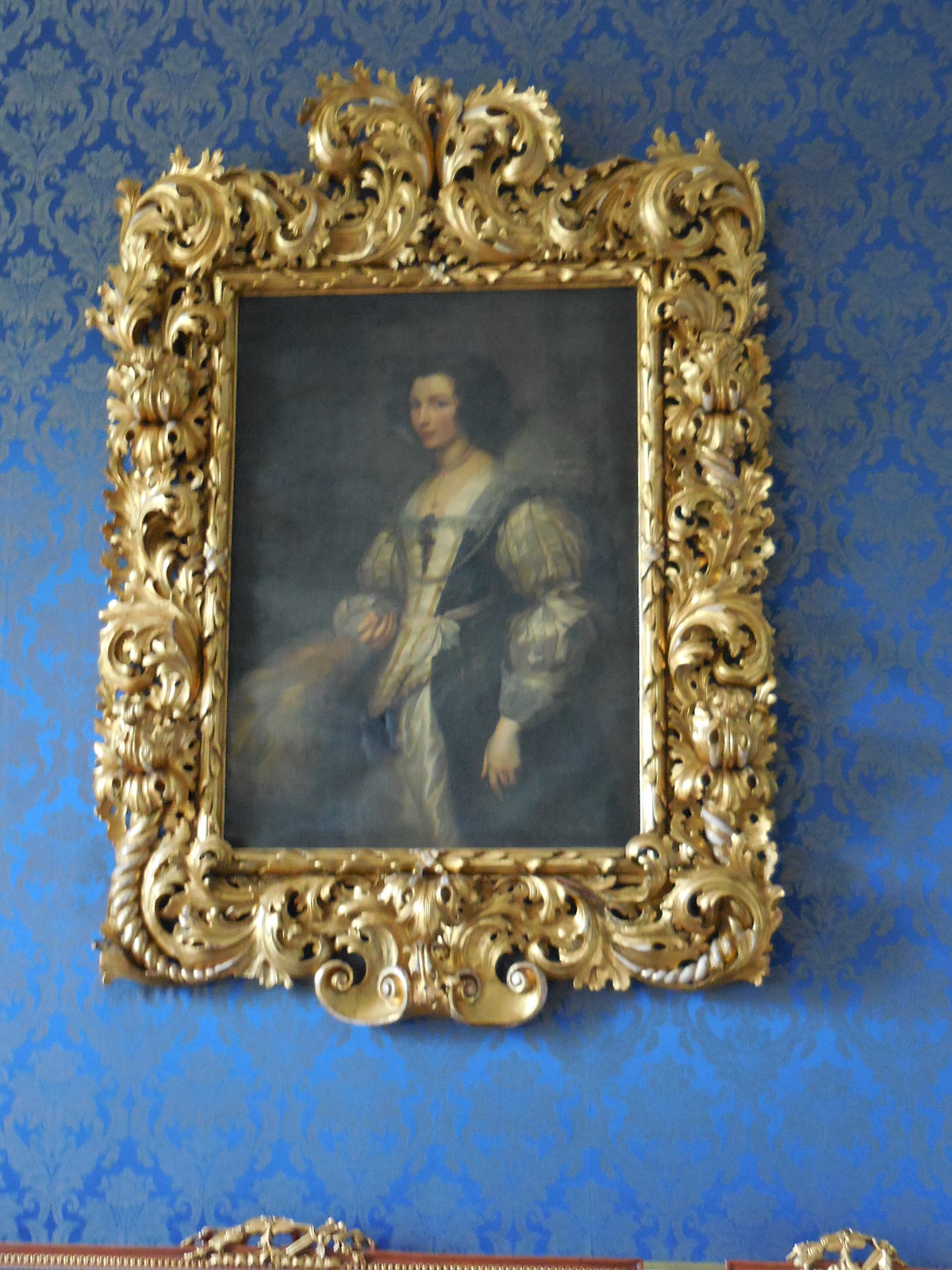
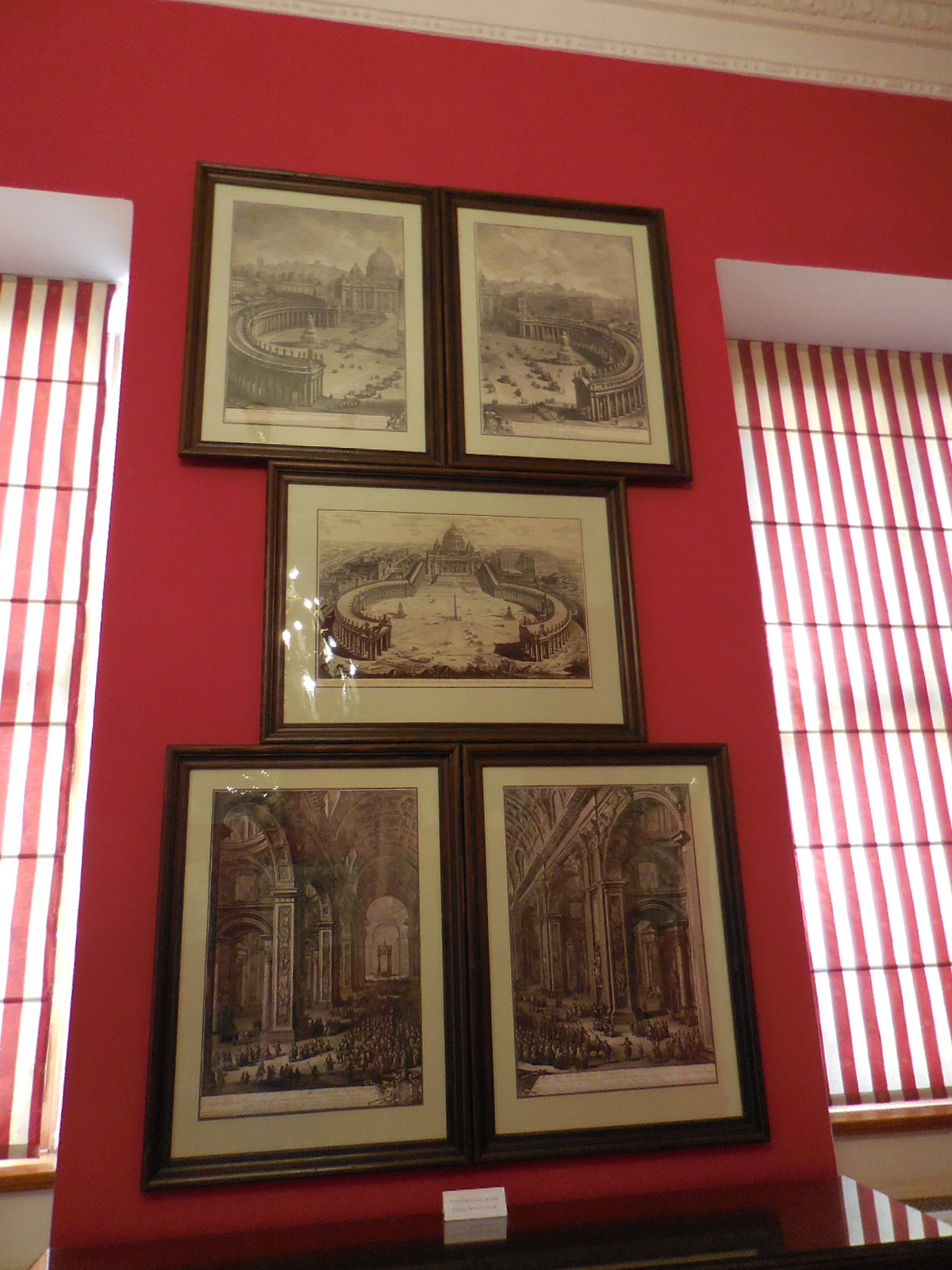
But the most significant part of this room was its graphics’ collection, hailing from the 17th century Netherlands, including one by Sir Anthony van Dyck. There were also four portraits of properties – three chateaus and one castle – owned by the Beaufort family when they had Bečov. Graphics of mythological figures and floral still lifes were on display, too. I also noticed how the female figures in several portraits sat so stiffly and how delicately flowers were handpainted on one vase.

A look at part of the park

A look at part of the park


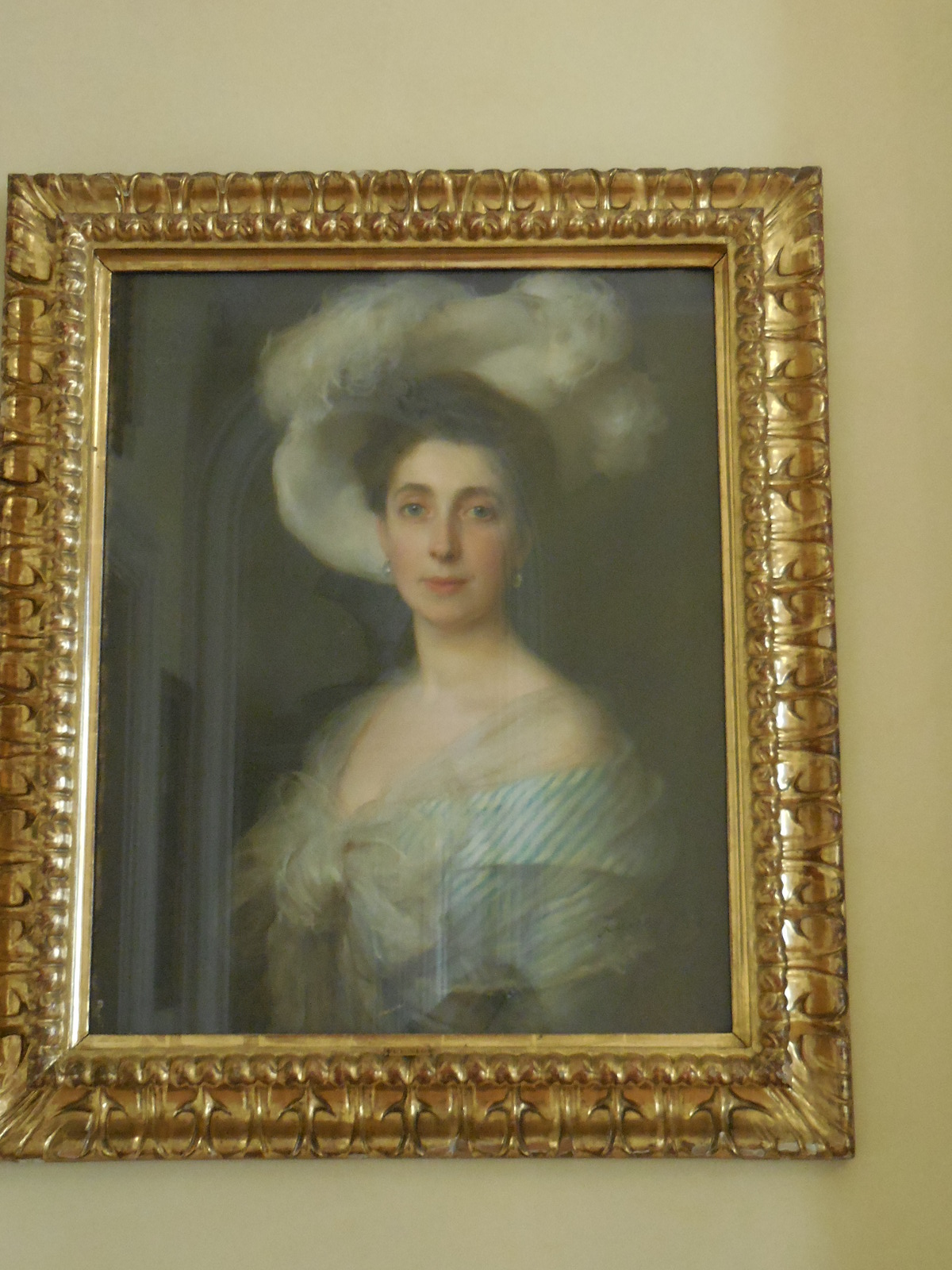
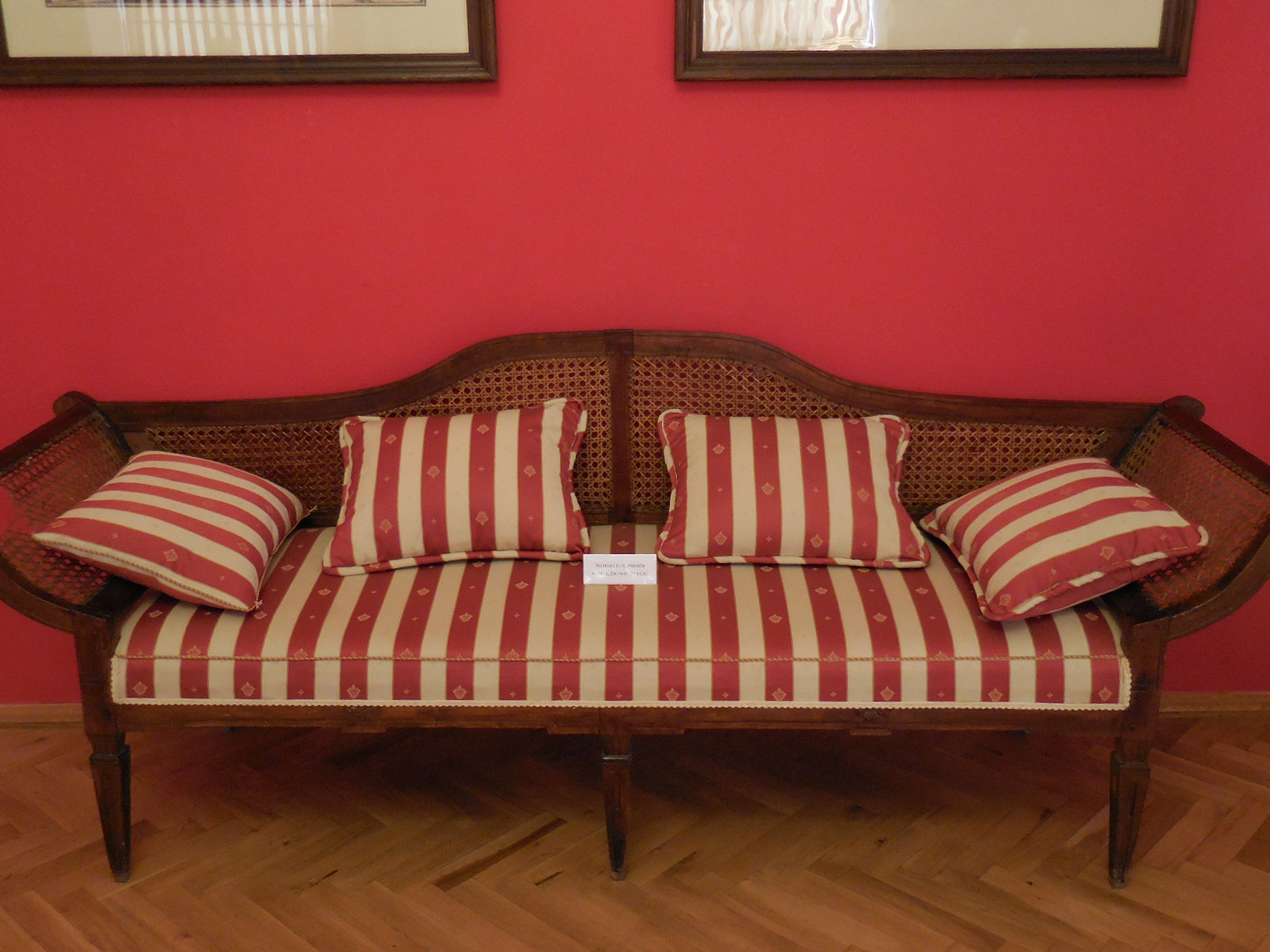
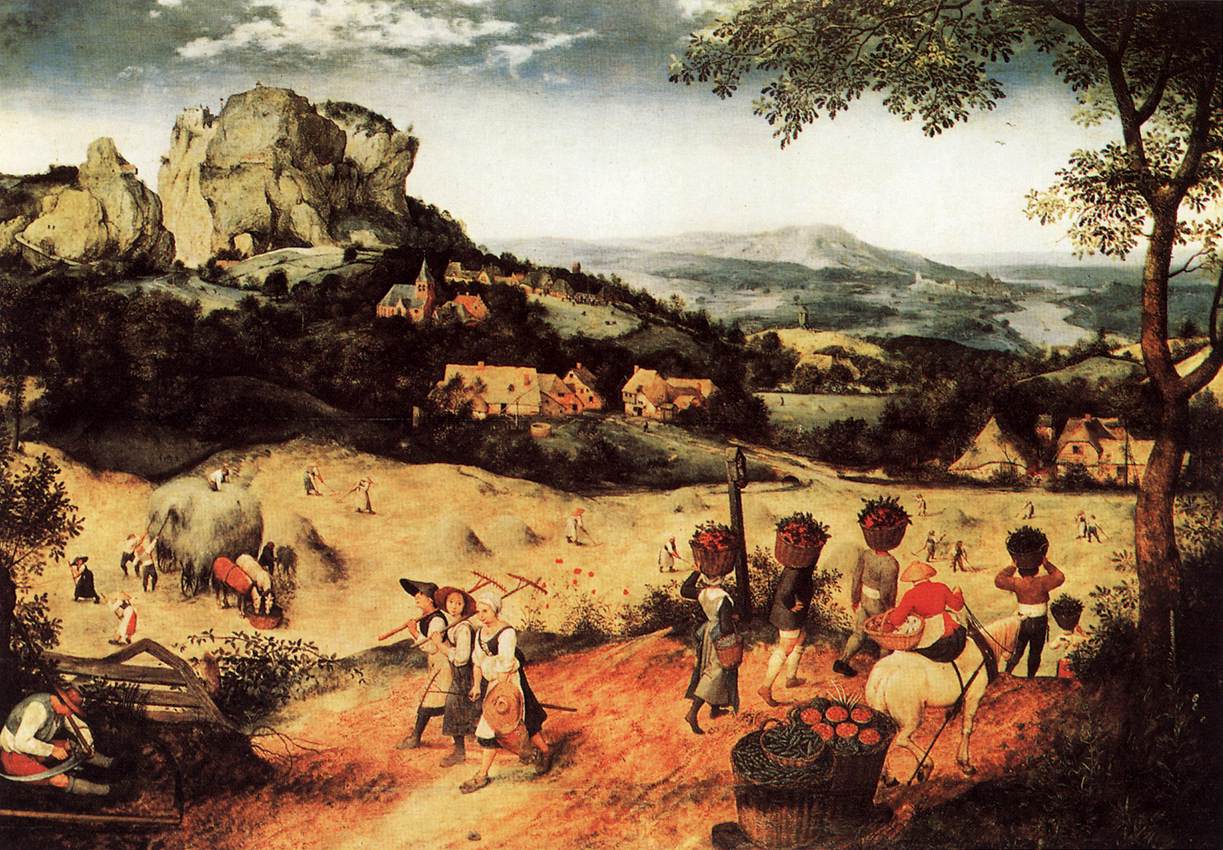
The Red Parlor was next. A blood red couch and four armchairs gave the space its name. One painting from the 17th century Netherlands sported a music theme. Another painting showed nobles in an Italian park. My eyes darted to the brown and white marble columns in the foreground. There were two mistakes in the painting, the guide explained. Firstly, the trees depicted could not grow there. Secondly, through the summerhouse window it would not be possible to see a forest but part of the port and sea rendered next to it. We also saw a toilet with a keyhole. Only the person who had the key could use it. Lower-class nobles would have cleaned it. I also glanced at a portrait of an elegant lady with ruddy cheeks.

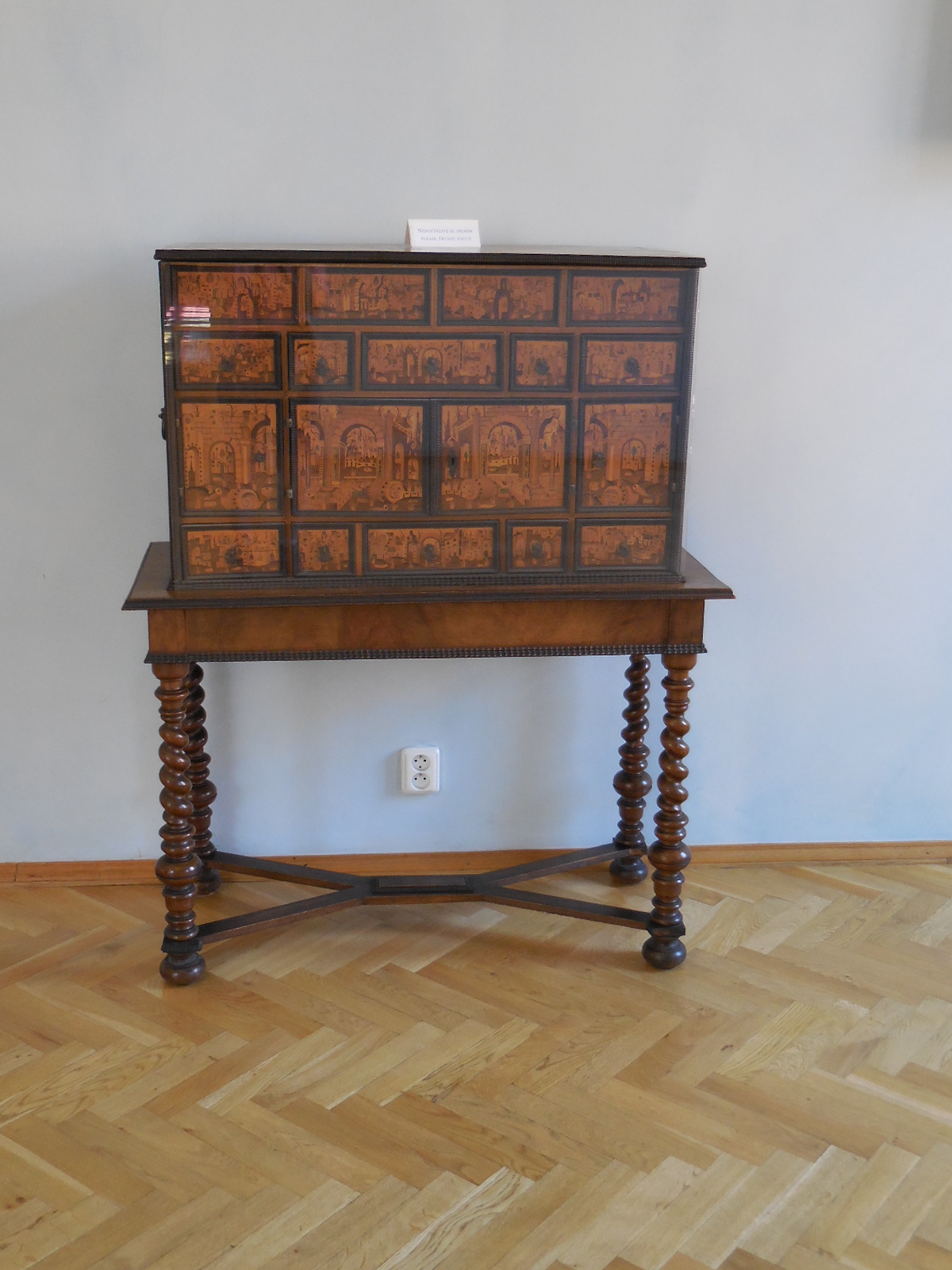
The Tapestry Parlor featured two huge tapestries pictorially narrating the story of David and Goliath. They were made in Brussels from 1620 to 1630. The Baroque table was intriguing as well. Its legs seemed to be decorated in the shape of some strange sea animal. It turned out that the animal depicted was a dolphin, but the artist had never seen a real one so he had used his imagination. On a dresser stood a Baroque clock complete with a realistic-looking giraffe.

Another tapestry hung from the wall in the next room as did several Spanish paintings from the 16th and 17th centuries. In one a woman was crying over the death of the Spanish king and another woman was protecting a child.

A view of the park

A view of the park


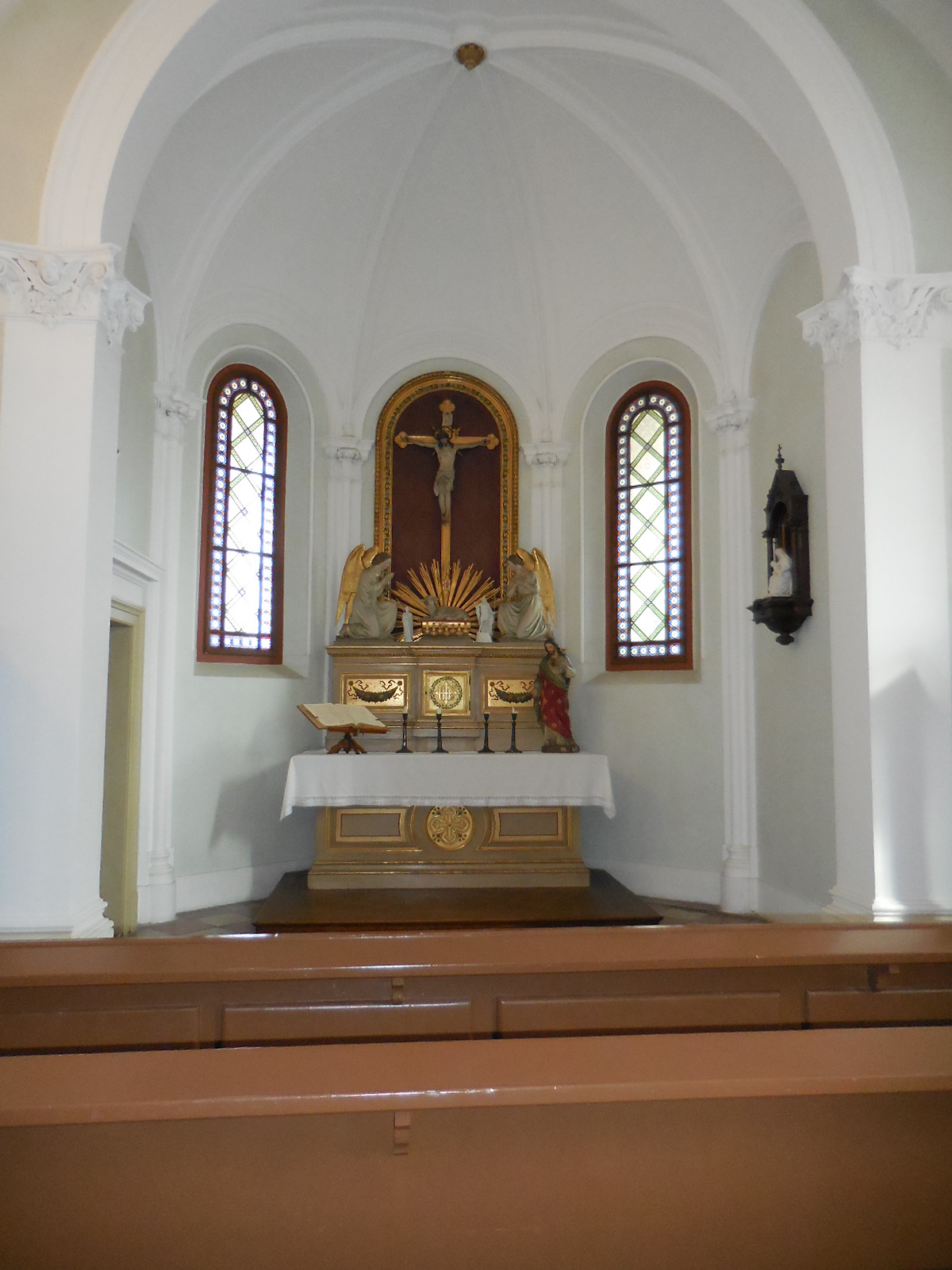
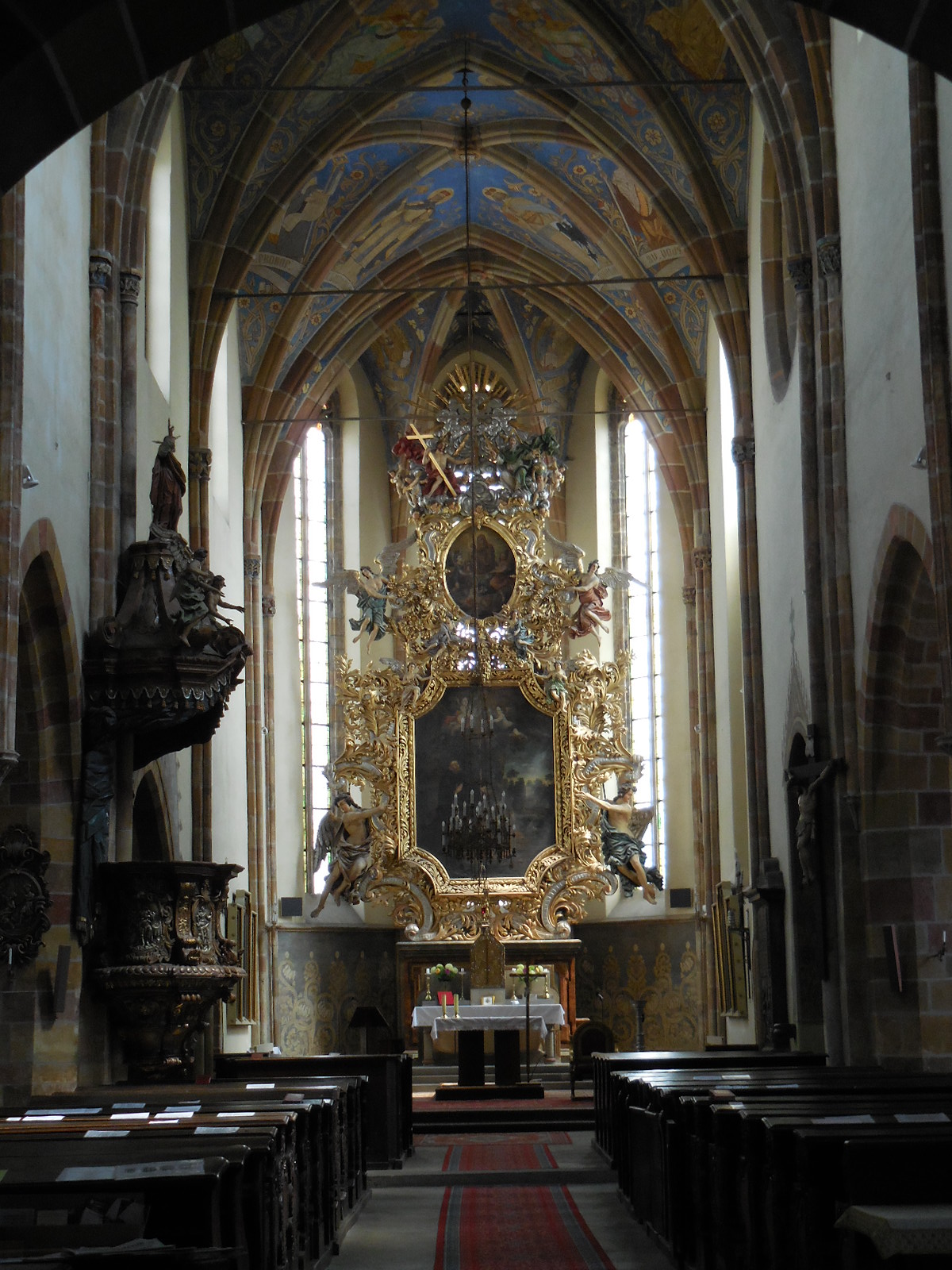
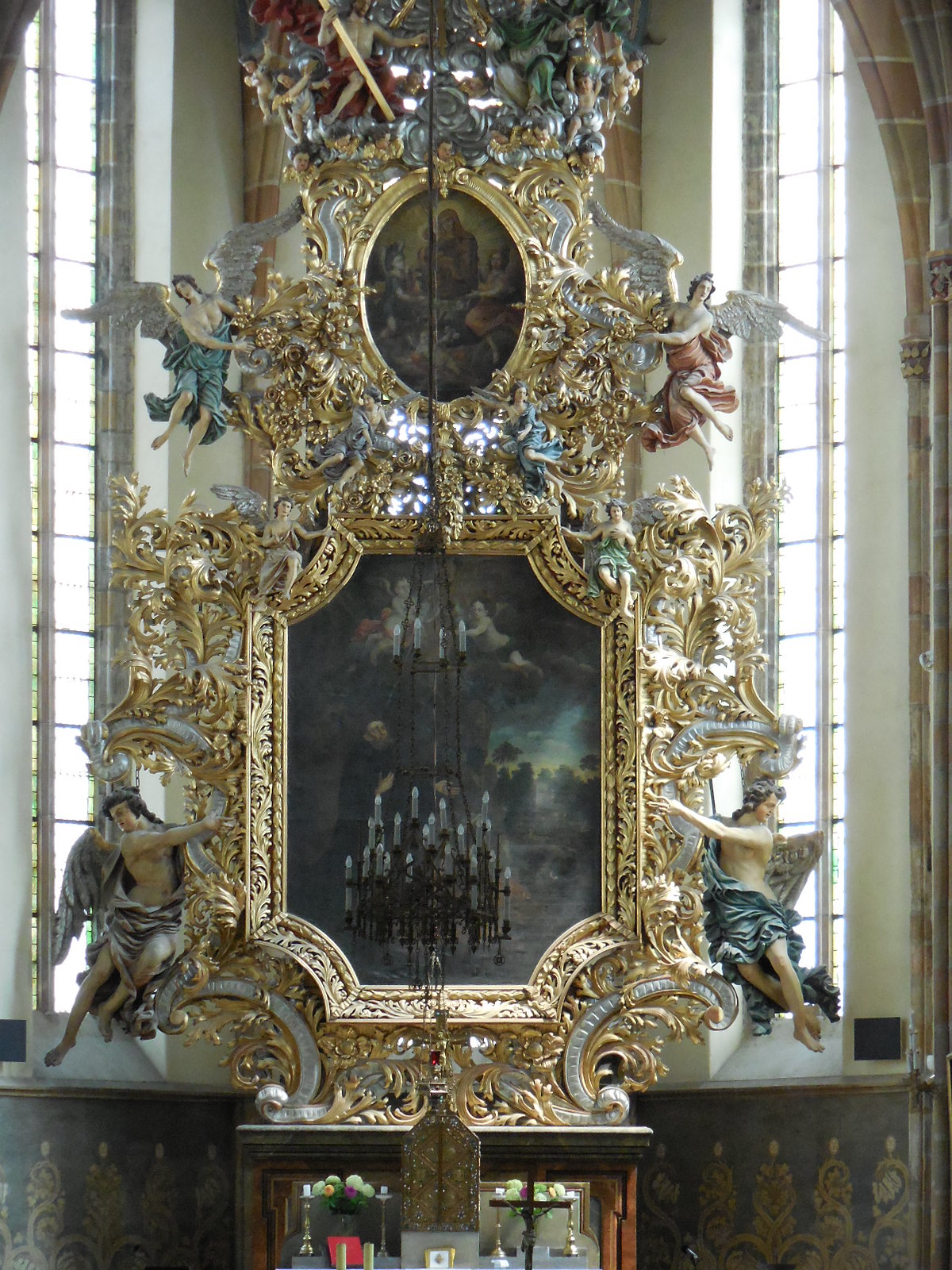
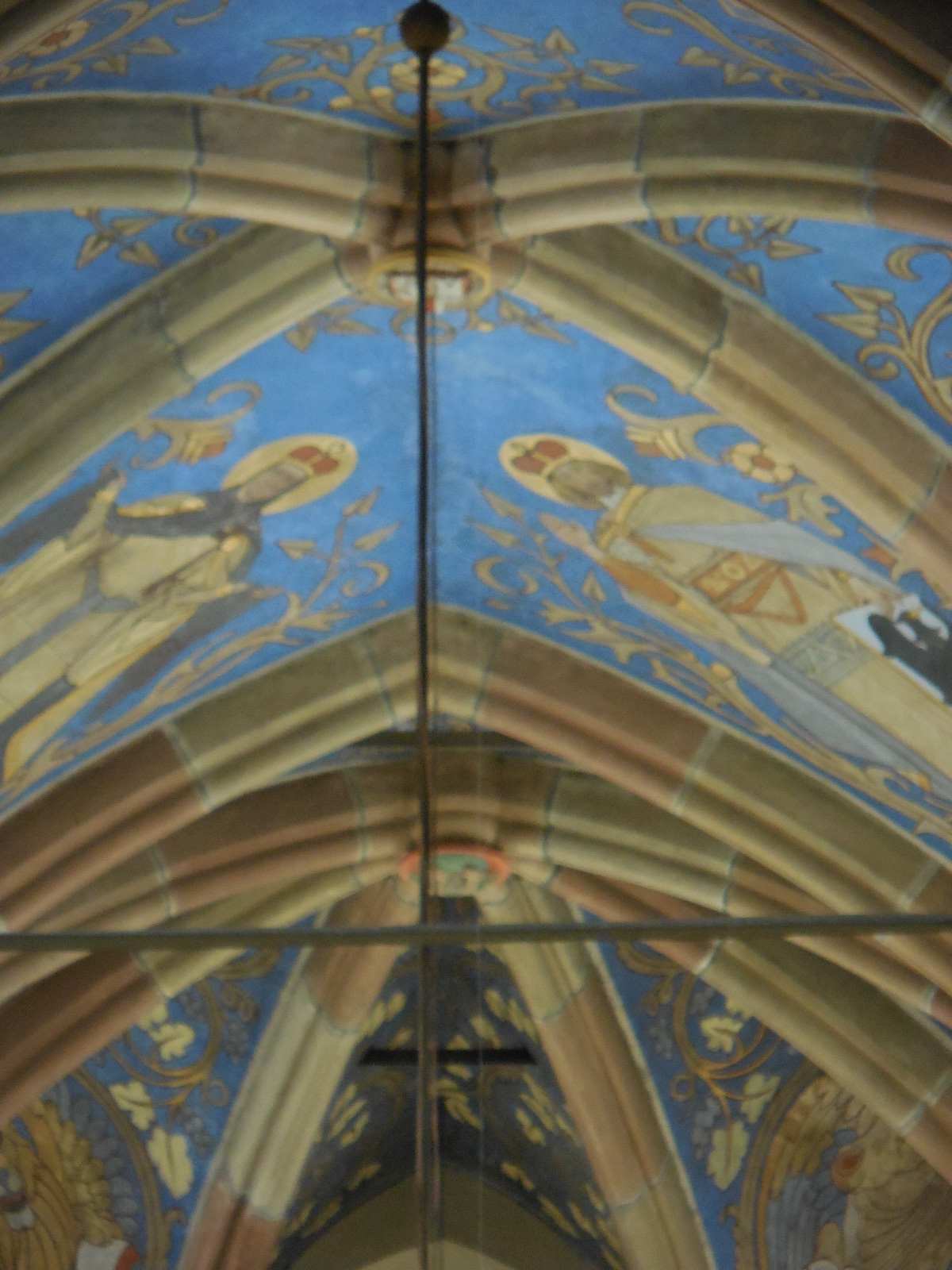
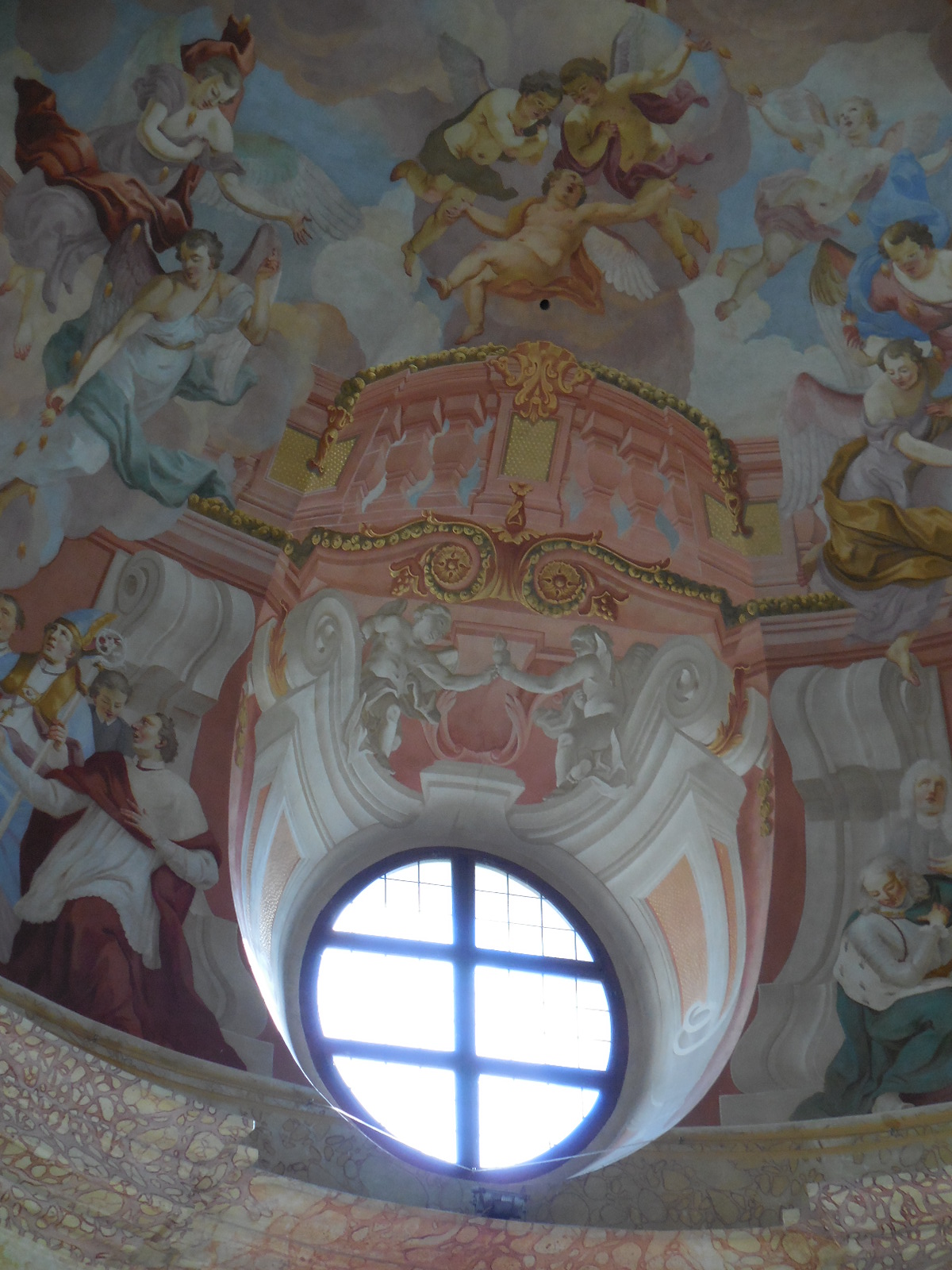
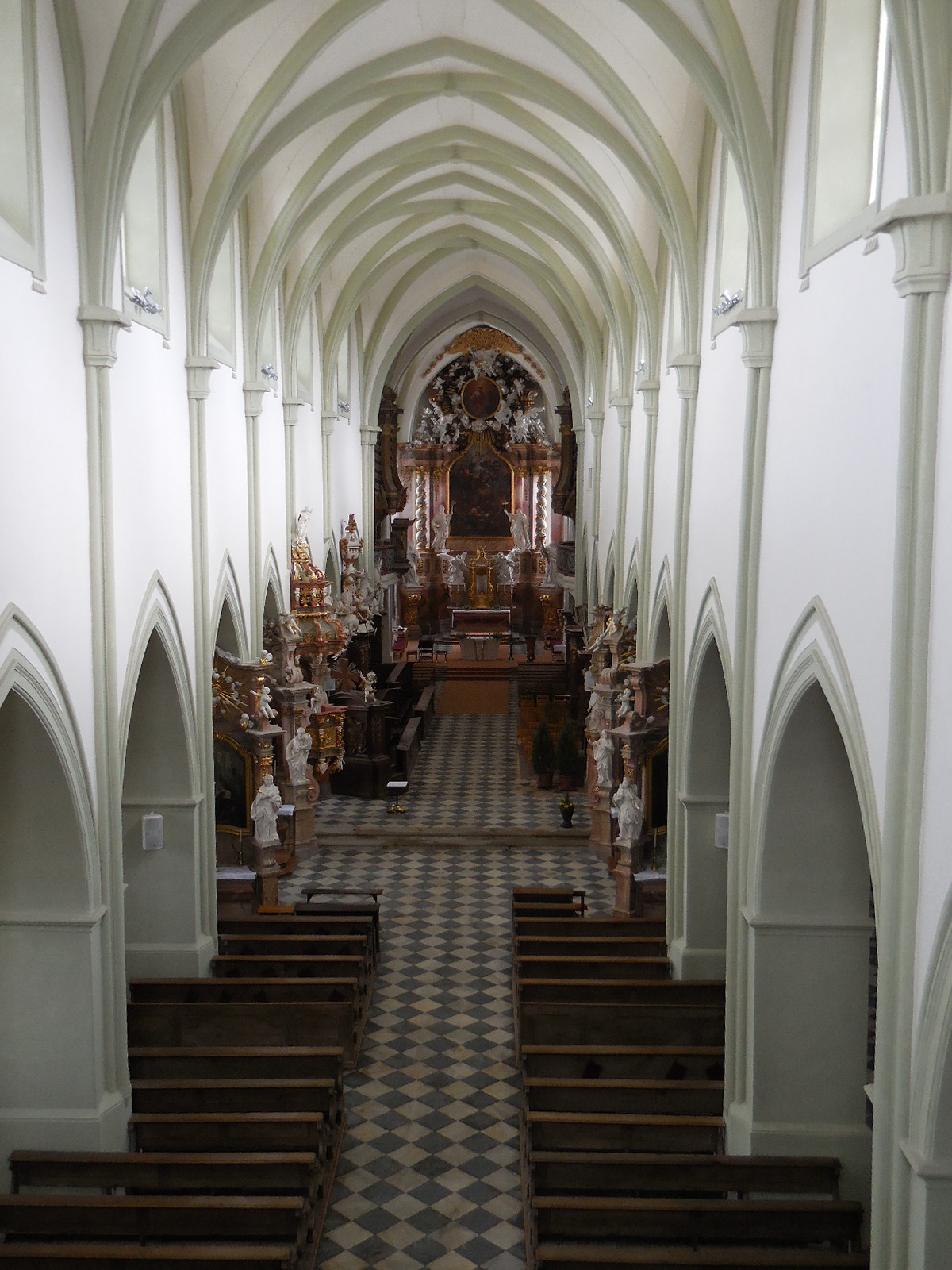
Last but certainly not least we made our way into the chateau’s chapel. At the entrance stood two gold statues of what appeared to be griffins holding candlesticks. Saint Peter Chapel was built in Neo-Romanesque style around 1870. The gilded altar was simple with a painting of Madonna and the Christ Child. Mary held one hand down with her palm up as she looked straight at the viewer, challenging his or her gaze. Both the Madonna and Jesus sported golden halos. On the walls were 14 Stations of the Cross painted in white enamel on copper plates. I noticed how Christ was lugging a heavy, plain cross in one depiction. In another he was sprawled over Mary’s lap, dead, a halo over his head. A white tiled stove stood behind a secret door. What attracted me most, though, was the ceiling. The blue with gold décor on the ceiling made the room dynamic, made it feel almost alive, imbuing it with a distinctive power.

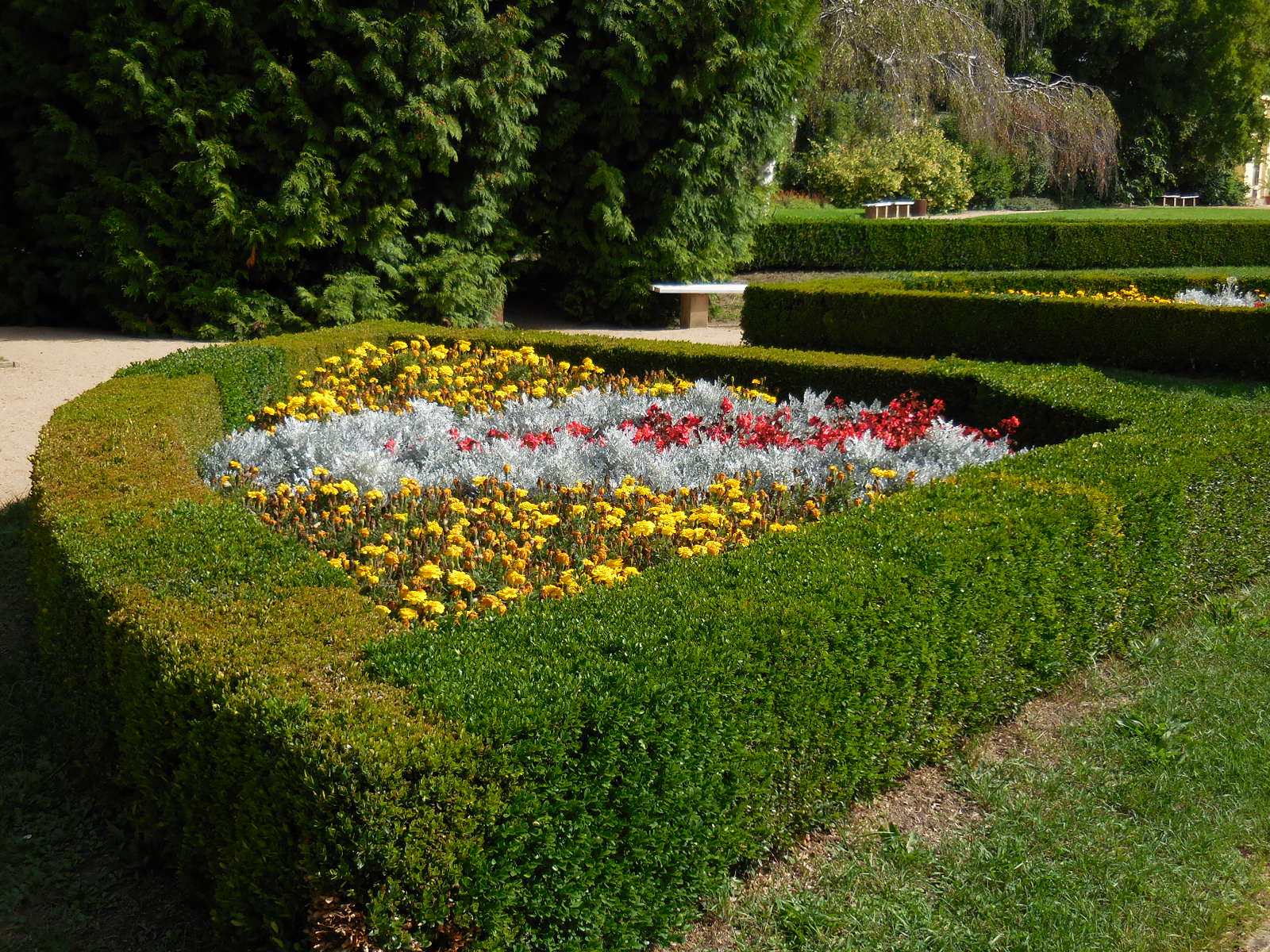
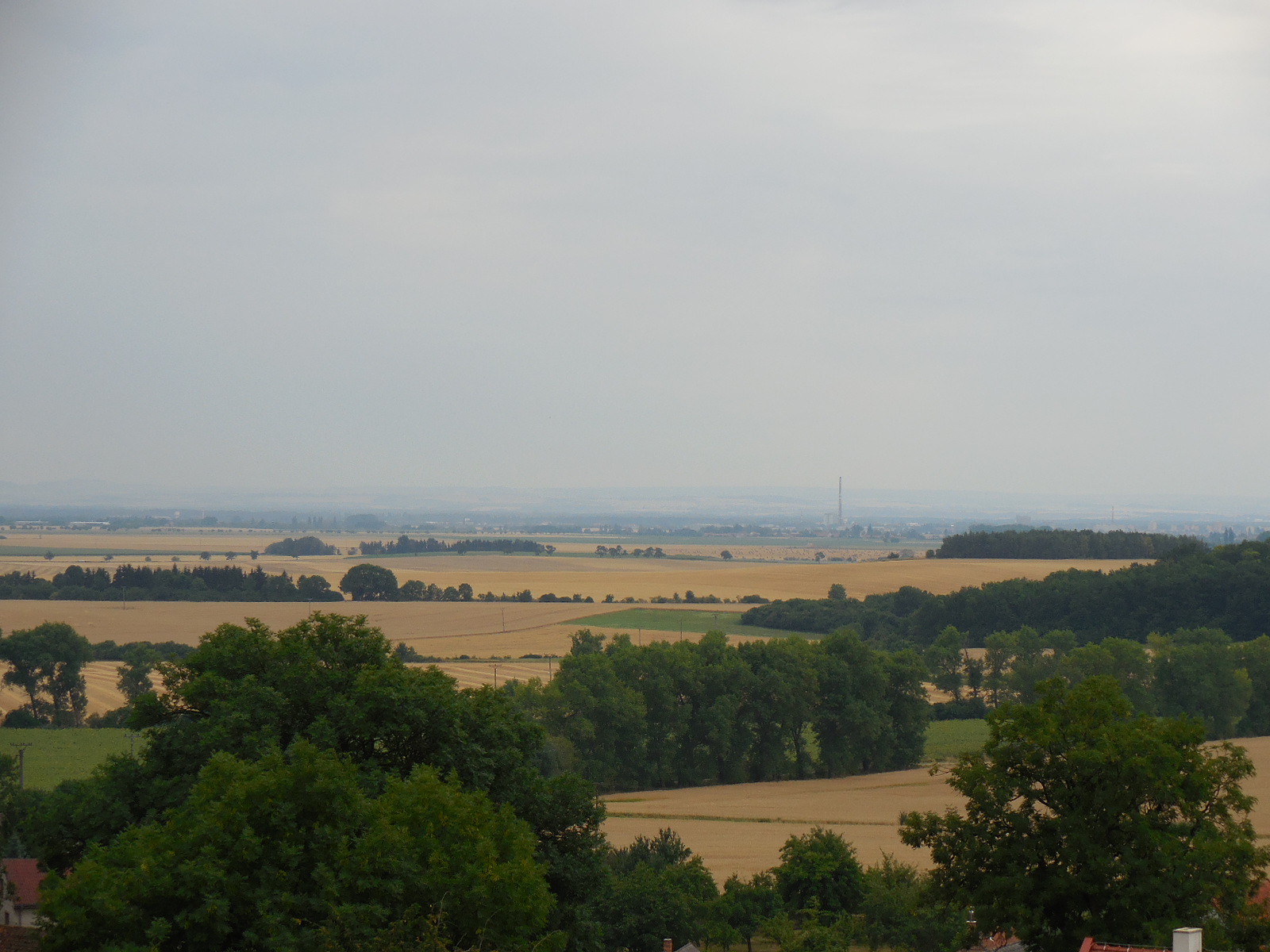
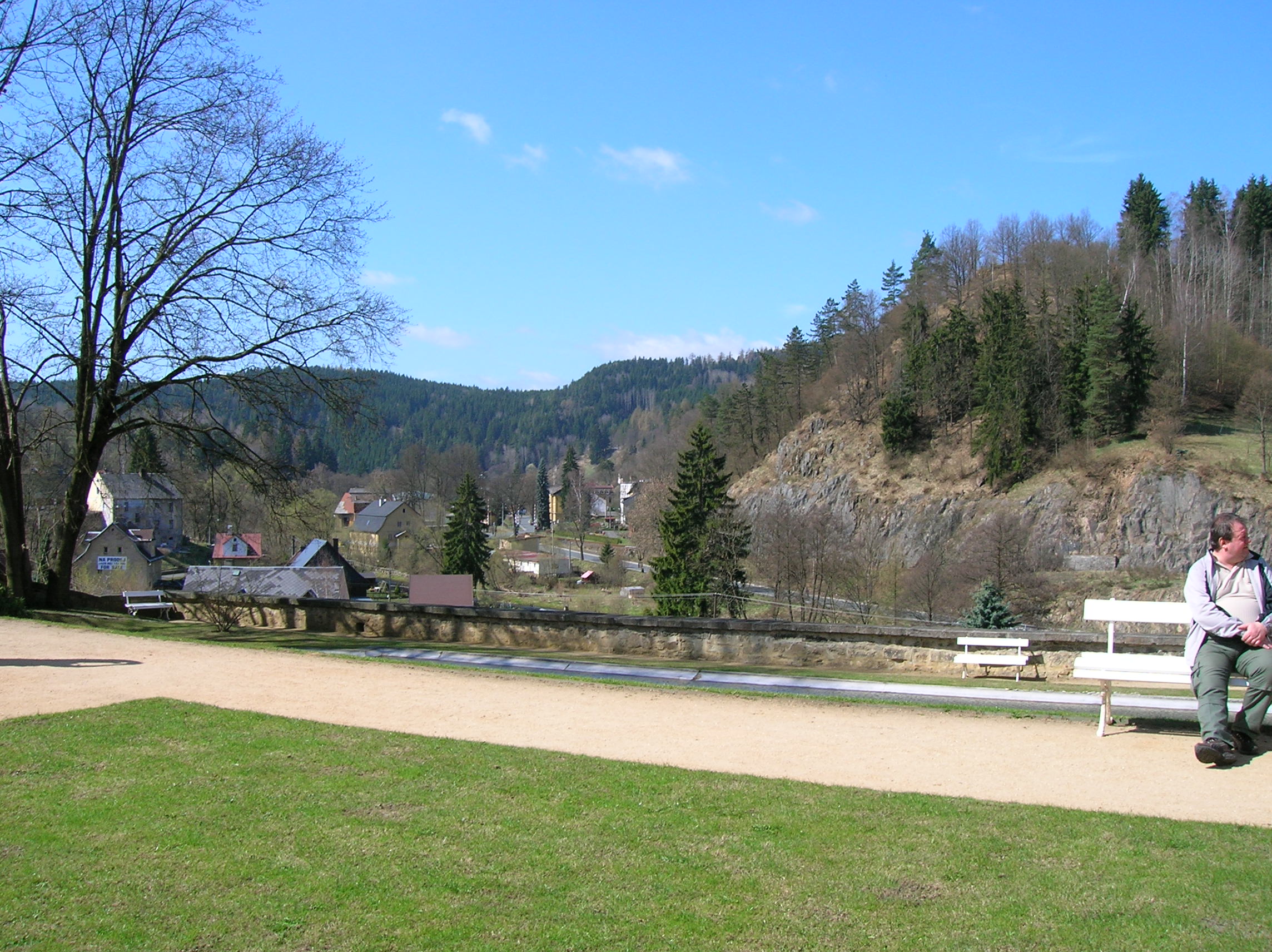
The guide let us into the terraced garden, Baroque in style. From the edge of the garden I got an excellent view of the surroundings, with homes in the valley and a forest beyond. I thought to myself that these last two hours had been well-spent.

The bench where I spent time relaxing after the tours

The bench where I spent time relaxing after the tours


I made my way to an outdoor table at a pension’s restaurant in the picturesque square not far from the museum of toys, motorcycles and bicycles. I sat in the sun, facing the cheery, pink chateau façade for almost two hours, eating chicken, writing postcards and reading. Then I climbed the hill to the town’s church. I tried all three doors but found it locked. I had read in a brochure that the interior was in Rococo style. It was a pity that I could not see the interior.

Walking past the half-timbered, derelict-looking house on Railroad Street, I retraced my steps to the train station, where I waited for the new, clean train back to Karlovy Vary. After another scenic train ride, I made the next bus from Karlovy Vary to Prague with minutes to spare and spent a relaxing two hours thinking back on my exciting day.

View from the park

View from the park

Tracy A. Burns is a writer, proofreader and editor in Prague.

Visit in summer of 2025

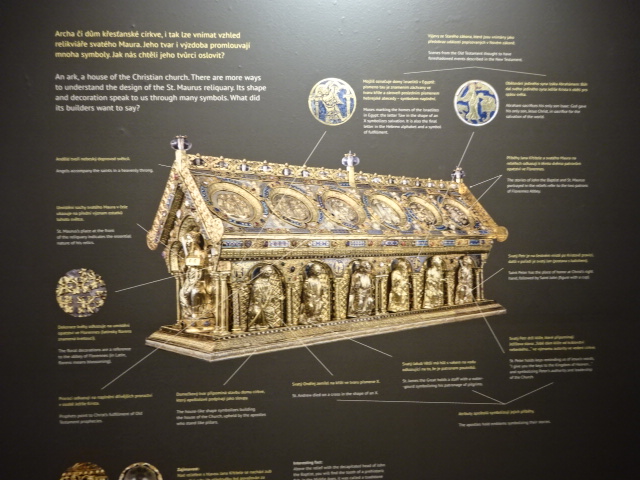
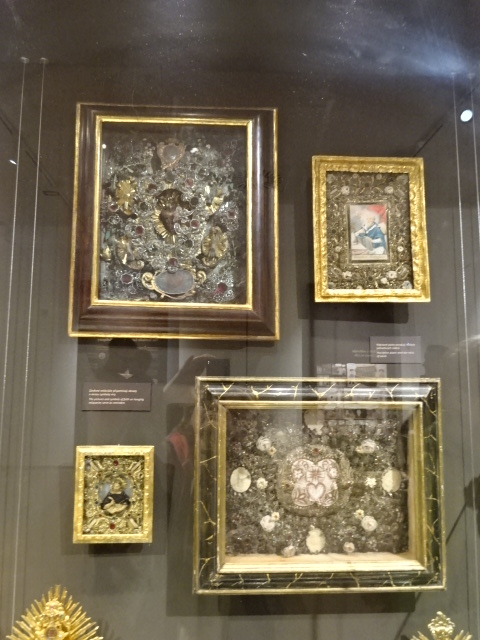
I went back to Bečov in 2025 after the chateau and castle had undergone lengthy reconstruction. I only had time to see the reliquary. I did not have a chance to go on the tour of the interior rooms. The entrance rooms to the reliquary of Saint Maurus had changed considerably. Now visitors read panels on walls to get their information about the history of the reliquary. There was no enthusiastic guide to narrate the mystery about hidden treasure, and this was something I sorely missed. I recalled the guide’s exuberance that made the viewing of the reliquary all the more intriguing. Perhaps these panels, in English and Czech, were more visitor-friendly. They were certainly detailed and easy to understand. When in the main space, tourists get 15 minutes to walk around the reliquary and look at the other objects found with it. There is a display of beautiful relics in the entranceway leading to the room where the reliquary is located, too. Old photographs of the castle also make an appearance.

Some pictures of the entrance rooms before the space with the reliquary:

A detailed explaination of the parts of the reliquary and their significance

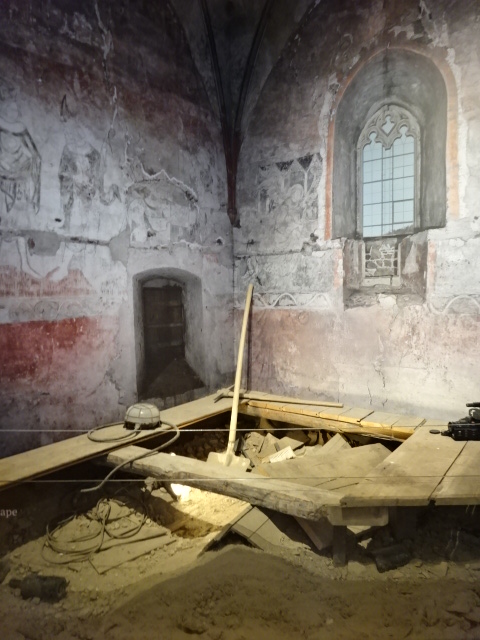
A display that appears as did the church floor when it was excavated for the treasure

Ravenna Diary

RavennaS.Apollinare8
When I booked a trip with arsviva to Bologna and other towns in the Emilio-Romagna region, I was most interested in seeing the mosaics at Ravenna. I had heard so much about them and yearned to see them with my own eyes. While the other sights did not by any means disappoint, Ravenna proved to be as magical as I had hoped, even more so.

I was fascinated by Ravenna’s glorious history from the 5th to 8th century AD. The golden days of Ravenna began when the city was designated as the capital of the Western Roman Empire in 402. Though the Roman Empire came to an end in 476, it did not at all mean the end of Ravenna’s influence in the world. During the reign of Ostrogoth Theodoric the Great, who had captured the city in 493, Ravenna prospered, though 19th century poetry would present him as a sinner and persecutor. In charge for more than 30 years, Theodoric was set on Romanizing the kingdom, bringing the splendor of Ancient Rome to his own territory. Indeed, Ravenna’s buildings from that era have many Roman features. He was an excellent ruler and a restorer of ancient monuments. Many of the places of worship filled with dazzling mosaics date back to Theodoric’s reign.

Theodoric the Great from www.medievalists.net

Theodoric the Great from http://www.medievalists.net


Theodoric’s tenure also brought peace to Italy. These were good times. For the most part, at least. However, there was more than a little fiction between Theodoric’s religious beliefs and those of the Byzantine Emperor Justinian I. Theodoric promoted Arianism, which focused on the relationship between God the Father and the Son of God. Nonetheless, Theodoric demanded that his people be tolerant of other religion, and he did not attack Catholicism.

Ravenna went through many changes when the Byzantines took over in 553, led by Emperor Justinian I. While the Byzantines brought with them a dramatically different culture and religion, Ravenna still flourished with its mosaics. Ravenna’s magical era came to a definitive halt when the Longobards took charge of the city in 751, but the monuments remain a testimony to the city’s past splendor and significance in Europe.

Ravenna includes eight sites on the UNESCO World Heritage List – the Mausoleum of Theodoric, the Mausoleum of Galla Placidia, the Neonian Baptistery, the Arian Baptistery, the Basilica of Sant’Apollinare Nuovo, the Chapel of San Andrea, the Basilica of San Vitale and the Basilica of Sant’ Apollinare in Classe.

The Mausoleum of Theodoric

The Mausoleum of Theodoric


First we visited the Mausoleum of Theodoric, which the ruler had constructed in 520 AD. A UNESCO World Heritage site since 1996, this structure made of Istrian stone is the only king’s tomb from Theodoric’s era. While I was disappointed that there were no mosaics inside, I was intrigued that the roof was made of one piece of Istrian stone weighing 300 tons. There were two floors, and Theodoric had once been buried on the upper level where a porphyry stood in the middle of the small space. I walked slowly around the porphyry, trying to imagine Goths paying homage to their dearly departed leader. Would they have put flowers on the porphyry? What kind? Or laurel wreaths? I mused that they must have paid elaborate respects here. I imagined the people were pondering over Ravenna’s future, a future without the ruler who had brought peace to Italy and had brought architectural and artistic glory to the city. When the Byzantines came to town, Theodoric’s body was taken away from the mausoleum and the place served as a Christian oratory.
The Neonian Baptistery

The Neonian Baptistery


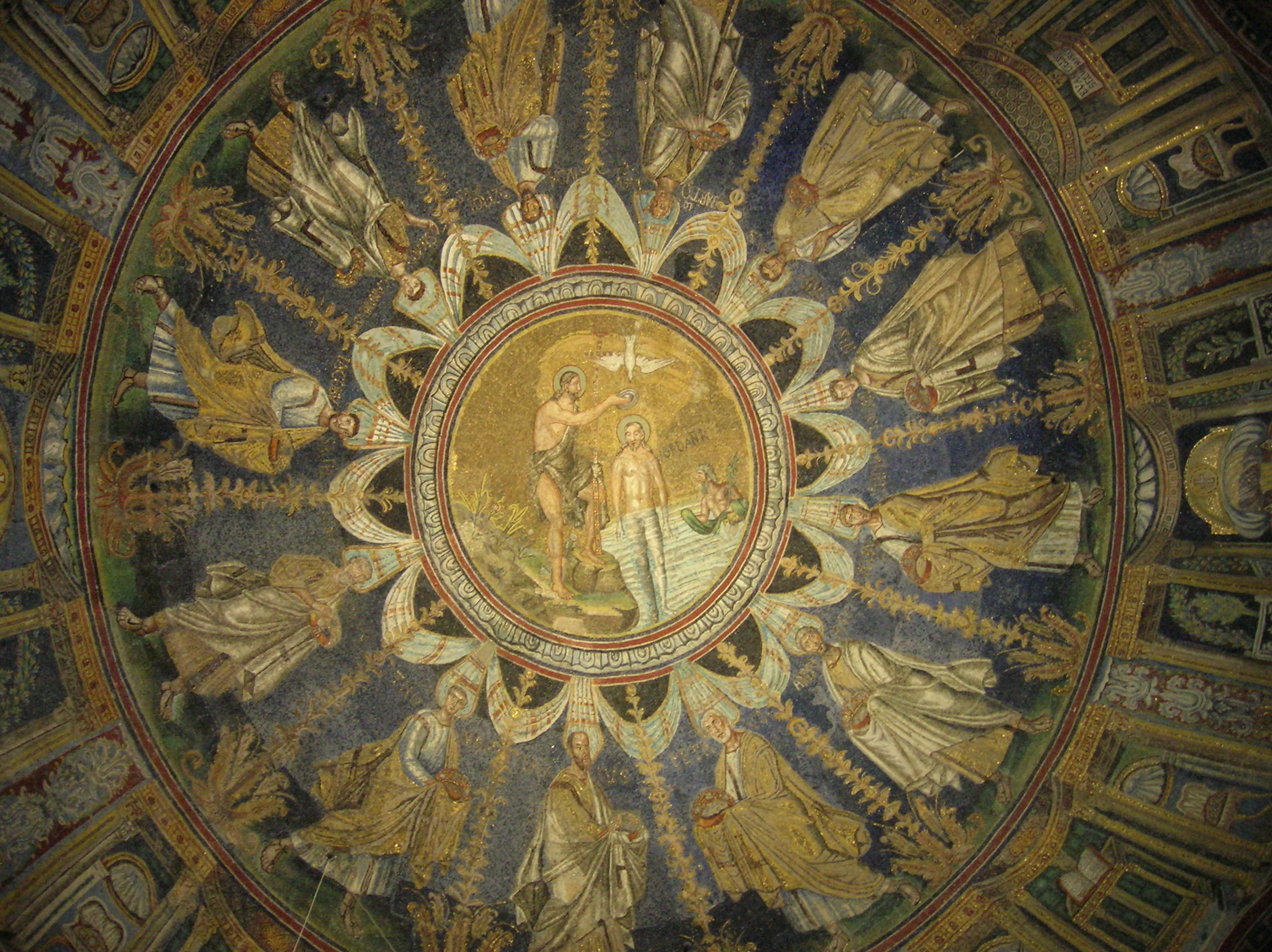
Next we visited the octagonal-shaped Neonian Baptistery, which hailed from the turn of the 5th century. Even though the structure was small, it held so many delights. My introduction to Ravenna’s mosaics was enthralling, to say the least. The mosaic-covered dome features the baptism of Christ in the center as John the Baptist poured water over Christ’s head. Even though only the dome showed off mosaics, it was overwhelming. To think that these mosaics dated back to the end of the 4th or beginning of the 5th century!
The Neonian Baptistery

The Neonian Baptistery


The Mausoleum of Galla Placidia would only make my morning more fascinating. This structure was built to house the tomb of the daughter of Emperor Theodosius, Augusta Galla Placidia, but it never served that purpose as her grave was in Rome. When her brother Emperor Honorius passed away in 423, Galla Placidia took charge because her son was too young to rule. She was a very competent empress, and the city prospered artistically, for instance.

My head was practically spinning. I was standing in a building dating from the 5th century! The Latin cross-shaped mausoleum featured mosaics on vaults, the central dome and lunettes on each end of the four vaults. The central dome was dominated by a cross studded with jewels. Golden stars and angels clad in gold were portrayed against a blue background. In the lunette over the main entrance the mosaic showed Christ gently caressing a sheep. The flock was totally focused on Him. I loved the gold color – Christ was dressed in gold attire and sported a golden halo. The lush green landscape was rocky, and the sky was a beautiful blue. Two lunettes featured deer about to drink baptismal water from a pool. Other details I loved included the red and white clouds on a blue background in the cupola and the books of the four Gospels depicted in one lunette.

What fascinated me most about this mausoleum and about all the mosaics I had seen so far was the use of color. I could not believe that something so many centuries old could survive in such rich, vivid colors. The brilliant colors transported me back way into the past and also invigorated me with an energy to live life to the fullest in the present, making me feel truly alive.

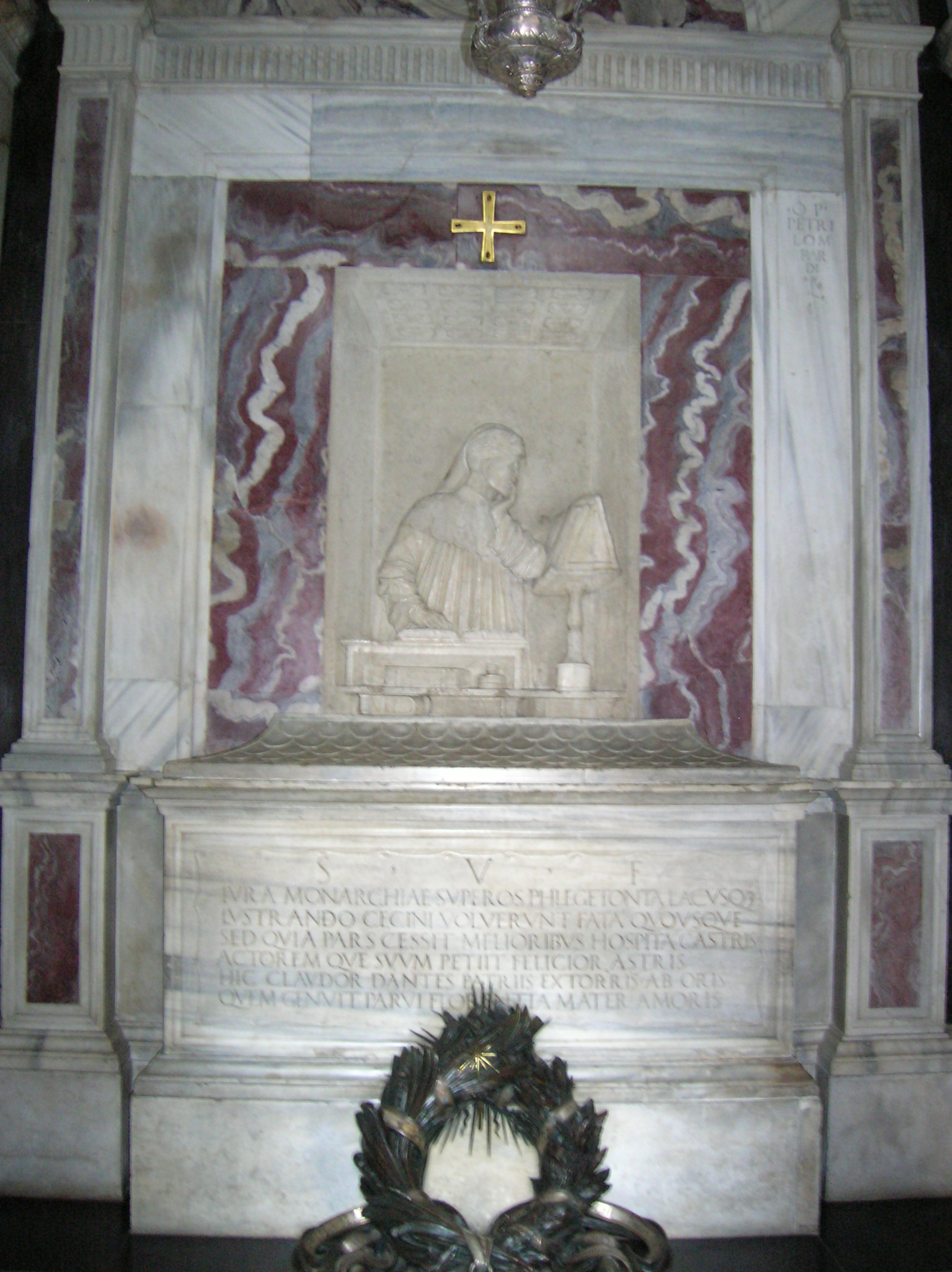
Dante died in Ravenna on September 13-14, 1321.

Dante died in Ravenna on September 13-14, 1321.


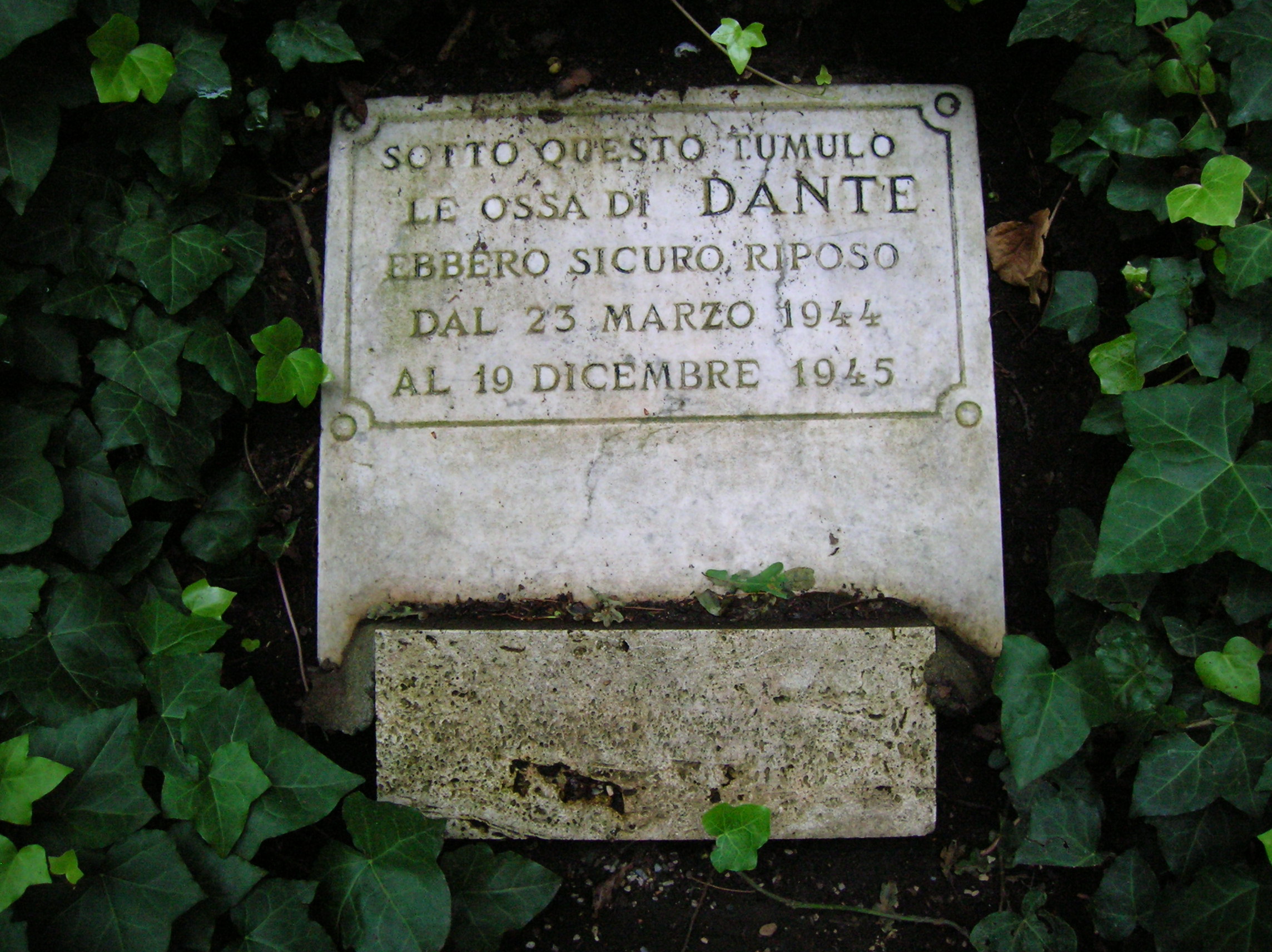
Ravenna has a literary legacy, too. Dante died in Ravenna during the night of September 13 and September 14, 1321 after being exiled from his native Florence for political reasons. The Neo-classical, square-shaped temple that houses the remains of the author of The Divine Comedy and Vita Nova anthology is part of the Church of San Francesco, also called the Church of San Pier Maggiore. A sculpture of “The Supreme Poet” decorates the interior. I was standing in front of the remains of the man whose love for Beatrice had kept him alive. Here were the remains of the man who considered exile a kind of death in itself.

I recalled an intriguing tale concerning Dante’s remains. The Florentines requested that Dante’s remains be returned to them in 1296, 1428, 1476 and 1519. Ravenna refused until 1519. However, when the tomb was opened, the inhabitants of Ravenna discovered that it was empty. It remained a mystery for centuries. Then, in 1885, while reconstruction work was being carried out in the chapel, a small wooden box was found. It included a note explaining that Dante’s remains had been moved there on June 3, 1677. The skeleton was nearly complete. So it seemed that Dante was not destined to leave Ravenna after all.

Small portico of chapel of Church of San Pier Maggiore, where Dante's remains are kept

Small portico of chapel of Church of San Pier Maggiore, where Dante’s remains are kept


Then we visited the Archiepiscopal Museum with its impressive Chapel of San Andrea, which had been recognized by the UNESCO World Heritage List in 1997. The chapel, shaped like a Greek cross, consisted of an oratory and atrium with barrel vault. It hailed back to Theodoric’s reign, when it was privately owned. I was intrigued at seeing Christ clad in armor on the lunette over the entrance. I could not remember seeing many portrayals of Christ in armor. I loved the star-studded sky background behind the cross in the apse. The sky made me feel safe, giving me a feeling of tranquility. Medallions showed Christ, his Apostles and saints. The silver cross in the chapel could be traced all the way back to the 6th century. I was amazed by the attention to detail. No less than 40 images were depicted on embossed silver-plate medallions.

My favorite artifact in the museum, besides the chapel, was Maximian’s ivory throne. I inspected the detail of the ivory reliefs covering the throne. The reliefs included scenes from Christ’s life and much more.

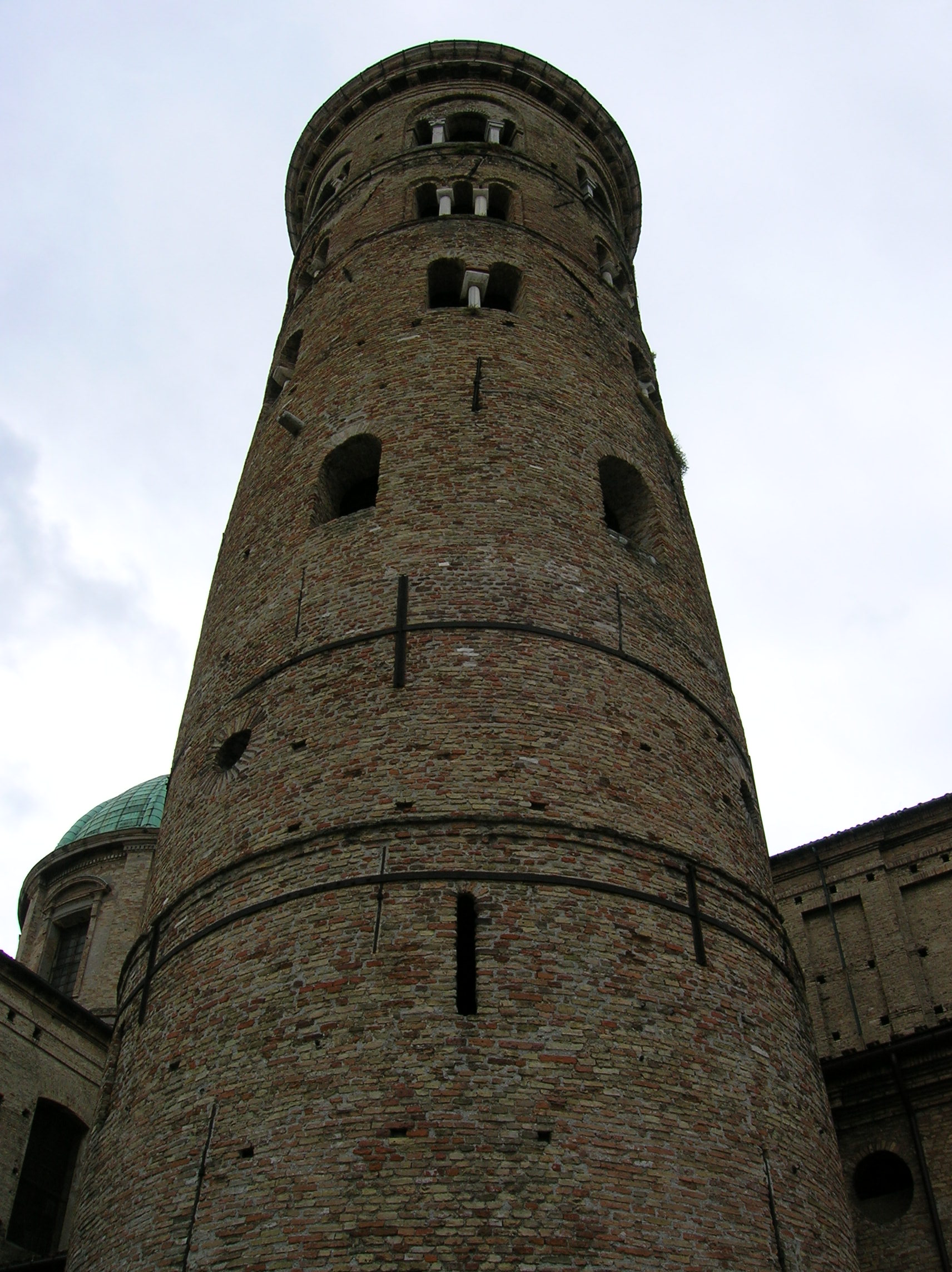
The tower of the Basilica of Sant' Apollinare Nuovo

The tower of the Basilica of Sant’ Apollinare Nuovo


Next we visited what would become my favorite sight, the Basilica of Sant’ Apollinare Nuovo, constructed in the late 5th or early 6th century. Apollinare, sometimes referred to as Apollinaris of Ravenna in English, held a very important place in the history of the town. He was the very first bishop, and his tenure lasted 26 years. It is said he worked miracles. Because he promoted Christian beliefs, he had been banished from Ravenna. Apollinaris paid the ultimate price for his preachings. He was tortured: His persecutors repeatedly stabbed him viciously and poured scalding water over his wounds. He was killed with a sword and martyred. His remains were located in this basilica from the 9th century until they were transferred to the Sant’ Apollinare Basilica in Classe during 1748. The basilica we would visit last, Sant’ Apollinare Basilica in Classe, is located on the spot where Apollinaris was martyred.
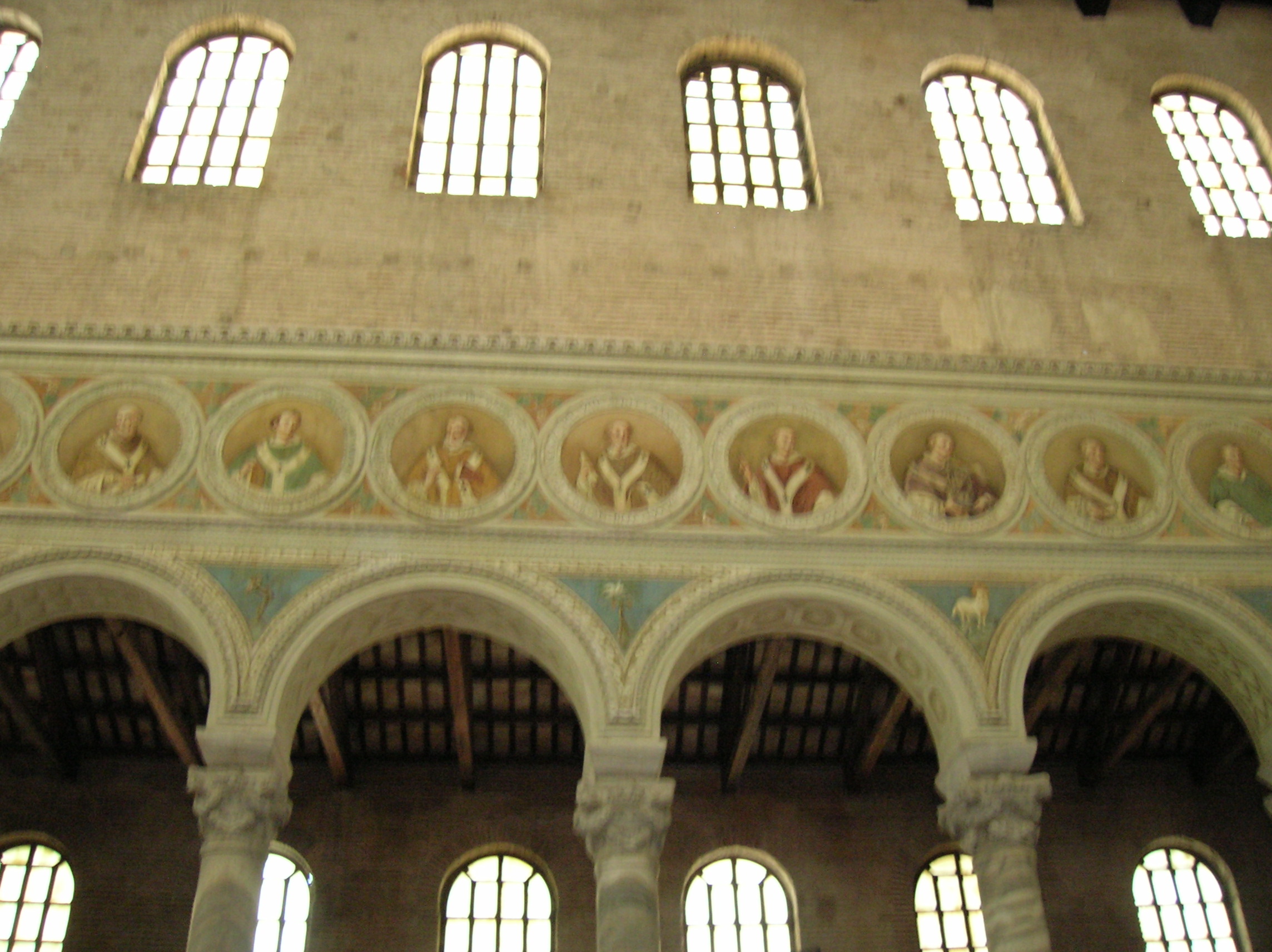
Back to the Basilica of Sant’ Apollinare Nuovo. The exterior was simple in design. I noticed the marble portico, and the cylindrical bell-tower from the 9th or 10th century immediately caught my attention. Inside, the décor was not simple at all. The three-nave structure showed off 24 columns with Corinthian capitals but mostly boasted of the mosaics from Theodoric the Great’s reign. Originally this place had been intended as an Arian place of worship.

The Basilica of Sant' Apollinare Nuovo

The Basilica of Sant’ Apollinare Nuovo


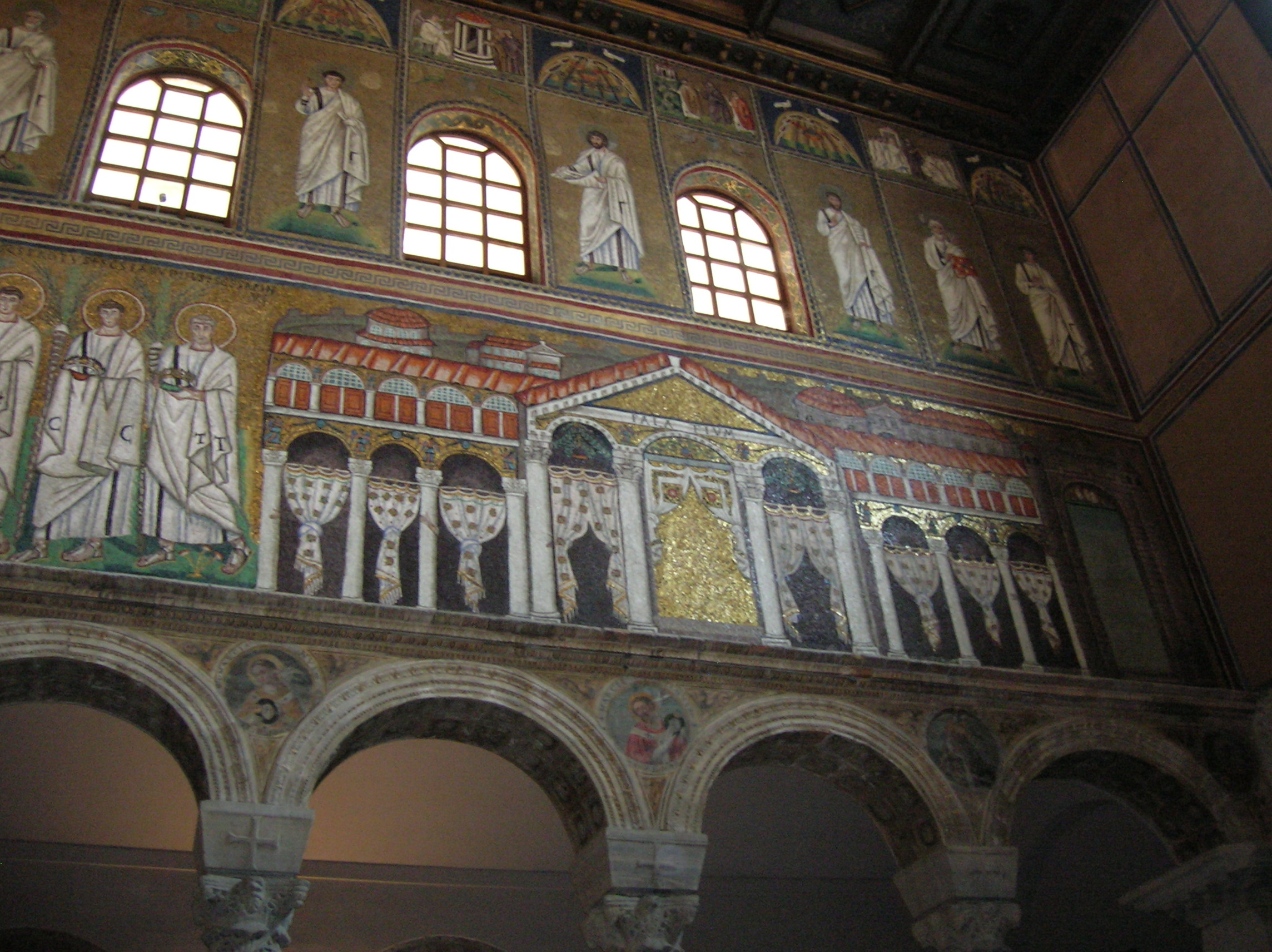
I concentrated first on the mosaic of Theodoric’s lavish palace with loggias, arcades and a peristyle. I felt as if I could walk into the palace, even though the rendition had some unrealistic spatial characteristics. Still, the palace looked so real to me. I could almost see Theodoric the Great strolling through the loggias.
The Basilica of Sant' Apollinare Nuovo

The Basilica of Sant’ Apollinare Nuovo


On the opposite wall I saw a representation of the port of Classe. One boat had a white checkered sail that looked as though it could be fluttering gently in the wind. It reminded me of those summers in Maine, staring at the boats floating in the bay.
The Basilica of Sant' Apollinare Nuovo

The Basilica of Sant’ Apollinare Nuovo


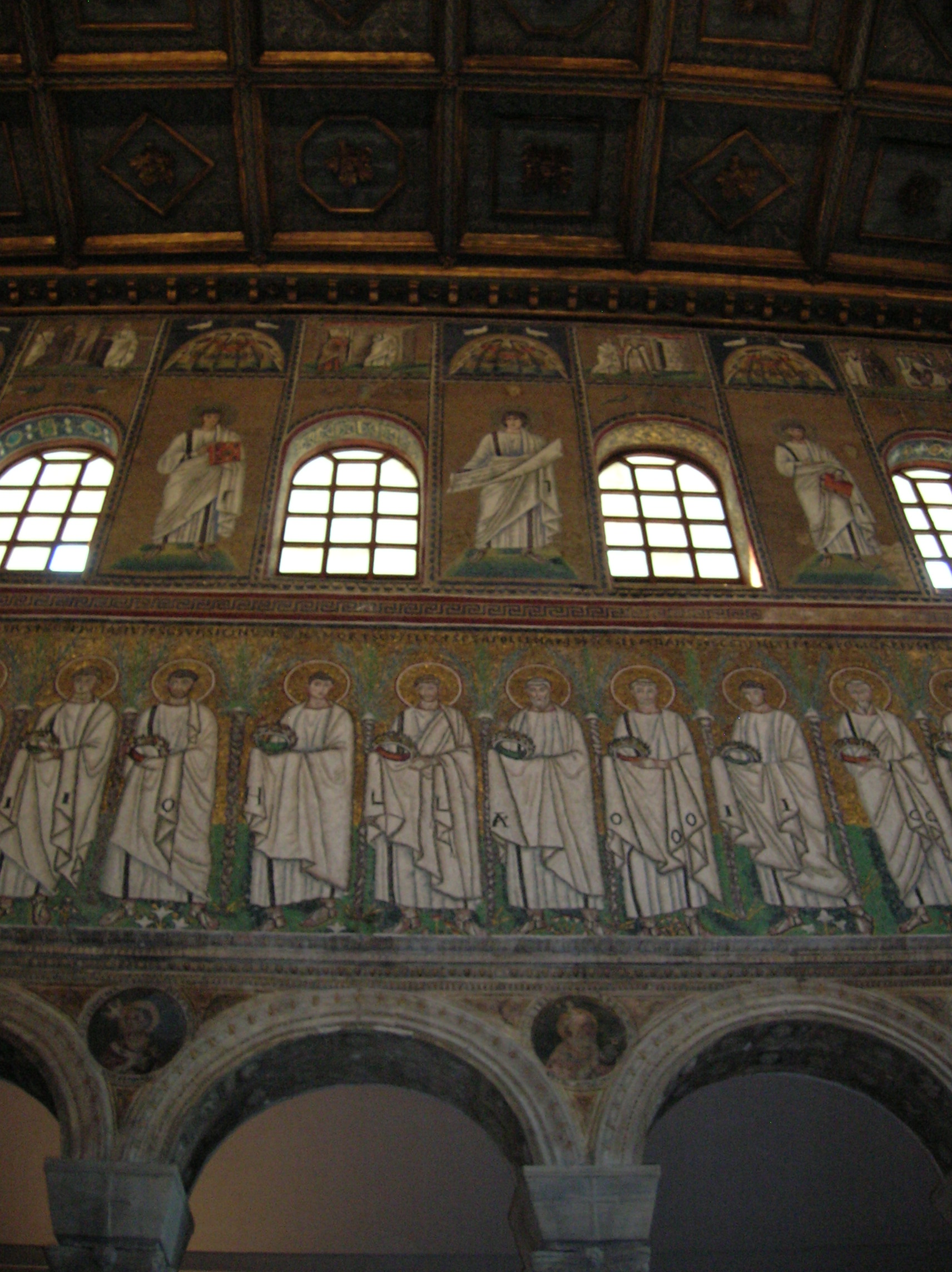
The portrayals of the processions caught my undivided attention. On one side there was a procession of 22 virgins and on the other a procession of 26 martyrs. Because some sections were added much later, it was possible to see Roman characteristics as well as the stylized Byzantine features.
The Basilica of Sant' Apollinare Nuovo

The Basilica of Sant’ Apollinare Nuovo


The 22 virgins were clad in golden tunics and donned crowns. Veils covered their faces. They were headed toward the Virgin Mary who held Jesus on her lap. While the Virgin Mary looked expressionless, staring straight at the viewer, in the four angels surrounding her I saw an attempt at differentiating facial expressions. The Three Kings led the virgins to the Virgin Mary. I noticed how their figures seemed to actually move, as they were bending forward toward the Holy Mother.
The Basilica of Sant' Apollinare Nuovo

The Basilica of Sant’ Apollinare Nuovo


There was much more to see. The octagonal-shaped Arian Baptistery had four apses. Even though only the dome’s mosaics have survived the centuries, it was rich in artistic treasures. In the center Christ stands in hip-high water as John the Baptist baptizes Him. Above Christ’s head is a dove. The outer circle is filled with crown-carrying Apostles separated from each other by palm trees. I liked the detail of the blue precious stones decorating the crowns.

Next we visited Basilica Di San Vitale, which was consecrated by Bishop Maximian in 548. Bishop Maximian, often referred to in English as Maximianus of Ravenna, had served as the 26th bishop of the city. Emperor Justinian I had been his mentor, and the people had resented him for this reason, though he was able to convince them to trust him. Not only did he establish this basilica but he also had Sant’ Apollinare in Classe constructed. He was also a patron of illuminated manuscripts. And who was San Vitale? It is not clear. According to one legend, he was a martyred Roman soldier.

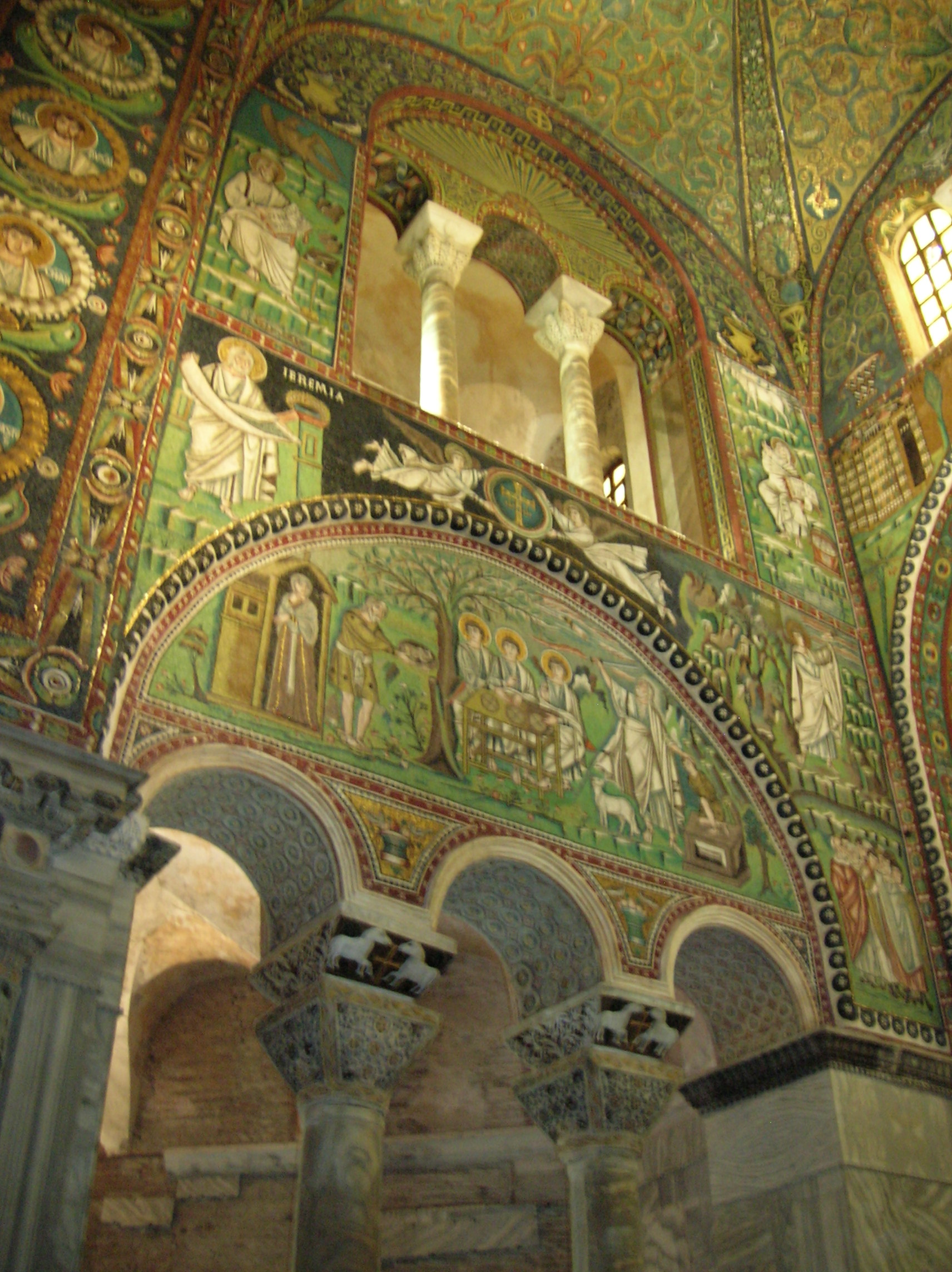
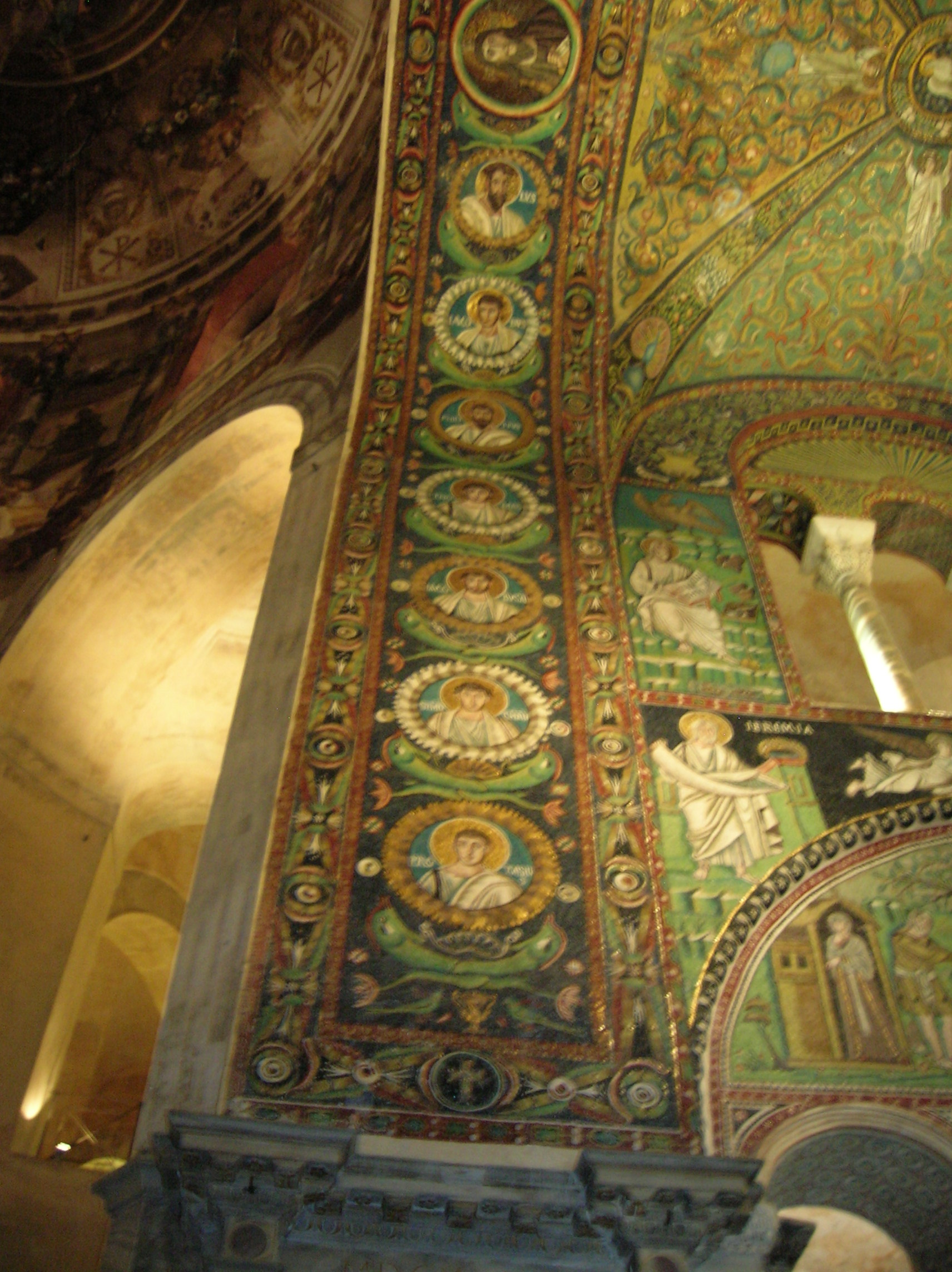
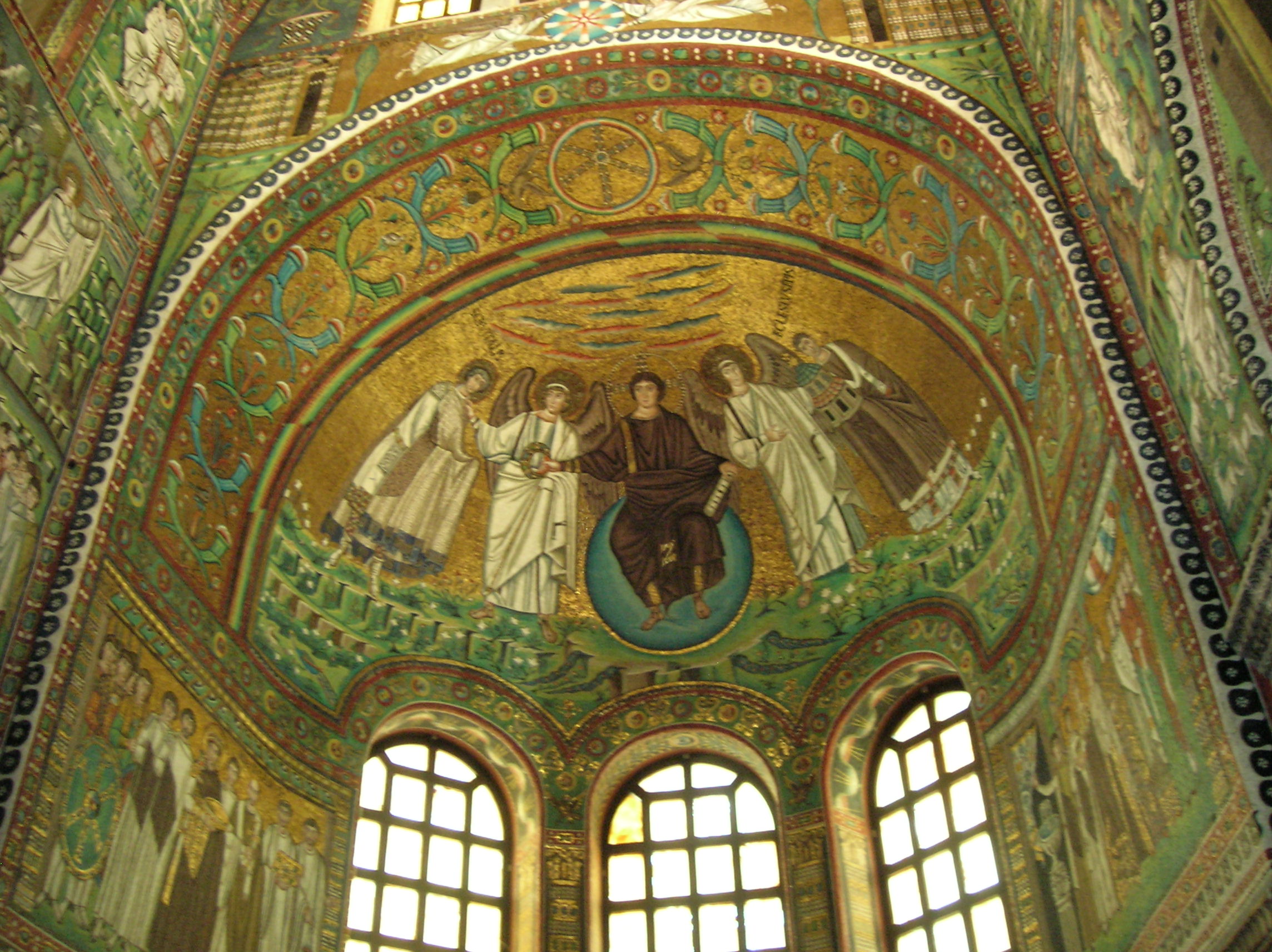
I loved the way the light shined into the basilica. It enhanced the beauty and magic of the mosaics that were found on the walls and in the presbytery and apse, where I marveled at a mosaic depicting Christ, dressed in Roman attire, seated on a blue globe. While he presented Bishop Ecclesio with a scroll, the Bishop held up a model of the church. I noticed how lavish Saint Vitalis’ clothes were. I loved the golden background and especially the detail of the red, blue and white clouds.

The Basilica of San Vitale

The Basilica of San Vitale


Another mosaic showed Emperor Justinian with Bishop Maximian and retinue, and yet another depicted Empress Theodora with her retinue. She was clad in purple, which made the mosaic even more brilliant in color. She wore pearls, a nice detail. I recalled that the empress had once worked in the circus as a dancer or bear-tamer. Who would have thought that this circus performer would become an intelligent politician?
The Basilica of San Vitale

The Basilica of San Vitale


In the panel with Emperor Justinian I, loved the detail of the crown with sparkling emeralds. Bishop Maximian stood by his side gripping a golden cross. The detail of the precious stones that decorated the cross was phenomenal. I also noticed that the soldiers, all decked out in gold, were depicted as individuals rather than sporting the same facial expressions. I mused that they looked like they liked their jobs. It was interesting how the courtiers covered their hands in the presence of their rulers.
The Basilica of San Vitale

The Basilica of San Vitale


At the Basilica of San Vitale the panels with the emperor and empress bore typical traits of Byzantine art. In the rendition of Emperor Justinian and Bishop Maximian et al, the figures faced the viewer, and their faces lacked even the slightest hint of expression. Also, the figures were rigid. Yet this was a realistic portrayal as well because emperors were required to stand or sit completely still to impress on their subjects the divine solemnity of their rule. Still, there were some attempts to differentiate one character from another.

What impressed me the most was the detail that had such historical value. I marveled at how a picture could speak a thousand words. Historians learned about the way people of this period dressed and what kind of hairstyles they had. The jewelry and fabrics of clothing were other helpful features for those interested in the era.

The Basilica of San Vitale

The Basilica of San Vitale


There were also many dazzling mosaics in the presbytery on the wall, loggia, women’s gallery and vault. I especially liked the four peacocks perched on blue and white globes. I liked the detail of the feathers. They brought to mind the peacocks strutting in front of Ploškovice Chateau during that visit to north Bohemia in 2005. I also was drawn to the star-studded sky.

Lastly, we visited the red brick Sant’ Apollinare in Classe with its cylindrical bell-tower. The section of Ravenna called Classe had been situated on the seashore before the sea withdrew. Construction started on the basilica in 532 AD, and it was consecrated in 549 AD. There used to be a cemetery here that included Apollinaris’ grave. Inside there were two rows of 24 elegant marble columns with Byzantine capitals. The apse was filled with mosaics of two parts – those above the cross and those below it. Above the cross we could see the transfiguration of Christ on Mount Tabor. There were 99 gold and silver stars in the background, or so I was told. I was too mesmerized by the stunning artistic treasures to count. The area below the cross was dominated by the figure of Sant’ Apollinare surrounded by 12 sheep among rocks and greenery. Apollinaris was raising his arms, gesticulating as he prayed fervently.

The Basilica of Sant' Apollinare in Classe

The Basilica of Sant’ Apollinare in Classe


Ravenna had more than lived up to my expectations. What captivated me most about the mosaics was the use of bright color schemes. The vividness of the images made the time periods when they were created all the more vivid. I had learned about Roman and Byzantine art and the Arian religion and now knew some of the names of the main players during Ravenna’s glorious days. I had seen Goth culture merge with Roman culture. I had seen red brick structures whose exteriors spoke of simplicity and harmony and whose interiors were complex and dazzling, filled with symbolism and color.

We went back to Bologna, and I was more than satisfied with the day trip. I knew that Ravenna would always hold a special place in the memories of my travels.

Tracy A. Burns is a writer, proofreader and editor in Prague.

The Basilica of Sant' Apollinare Nuovo

The Basilica of Sant’ Apollinare Nuovo

Herrenchiemsee Palace Diary

Herrenchiemsee14
I traveled to Herrenchiemsee on a full-day excursion offered by Gray Line in Munich, the city where I was staying. I had been so impressed with Neuschwanstein and Linderhof Palace that I longed to see more Bavarian castles. Herrenchiemsee’s location on an island made it sound remote and romantic.
First, we took two boats to the Island of Fraueninsel, also called Frauenchiemsee or Ladies’ Island, a tranquil environment of 38.8 acres with 300 inhabitants and no crowds. The church with the distinctive onion-shaped tower was constructed in the 11th or 12th century during Romanesque times. The archway around the door dated back to that era. Romanesque frescoes inside the church hailed from 1130. The interior also included Gothic and Baroque characteristics. During the 14th century the flat wooden ceilings of the three naves were changed into star-shaped and net rib vaulting. A new high altar was added during the Gothic period as well.

Even though fires broke out in the convent during 1491 and 1572, the damage was mostly confined to the exterior of the building. Two Renaissance altars were built in the 17th century. The Gothic altars were transformed into Baroque creations during the 17th century as well.

Church interior on Ladies' Island

Church interior on Ladies’ Island

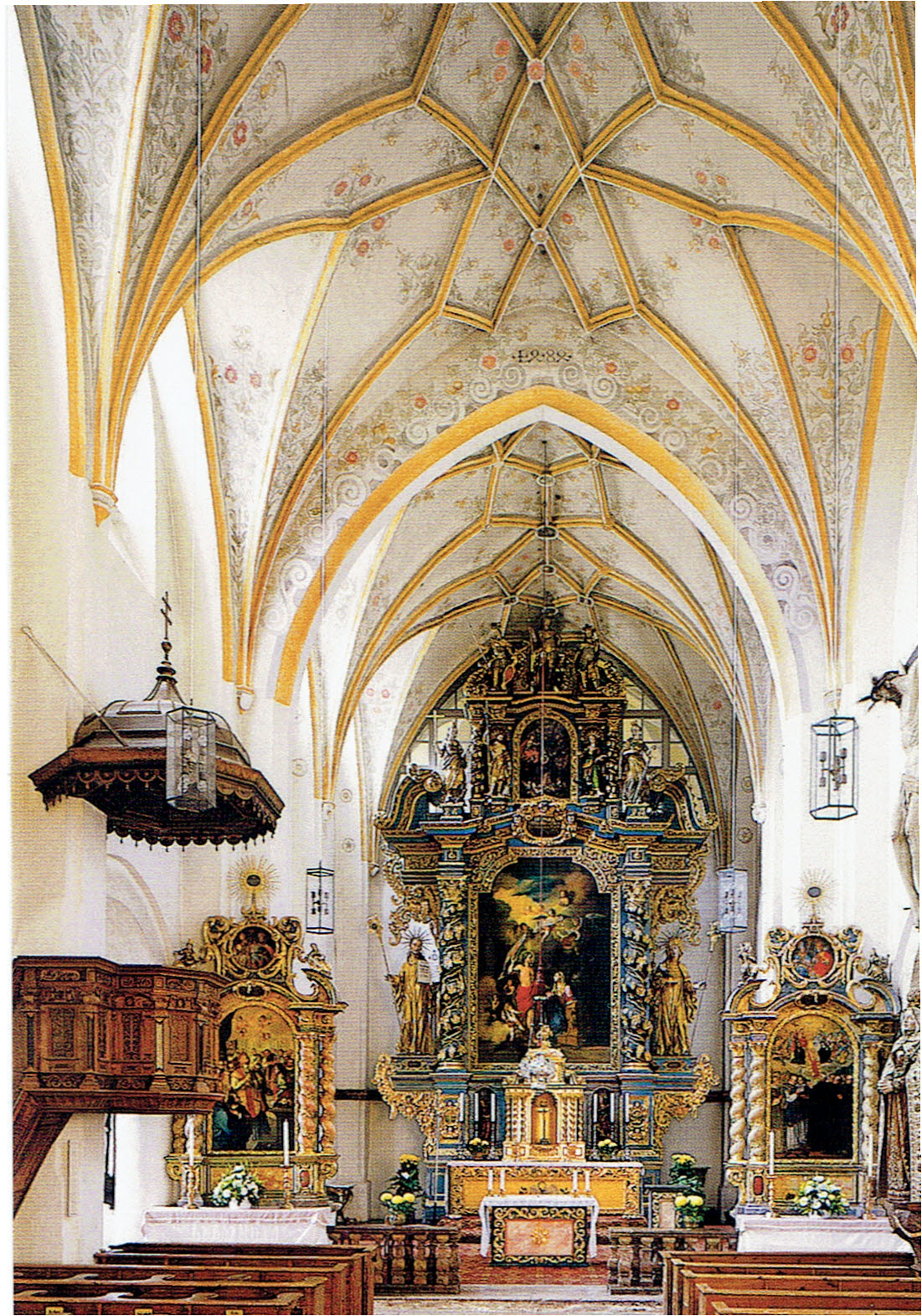
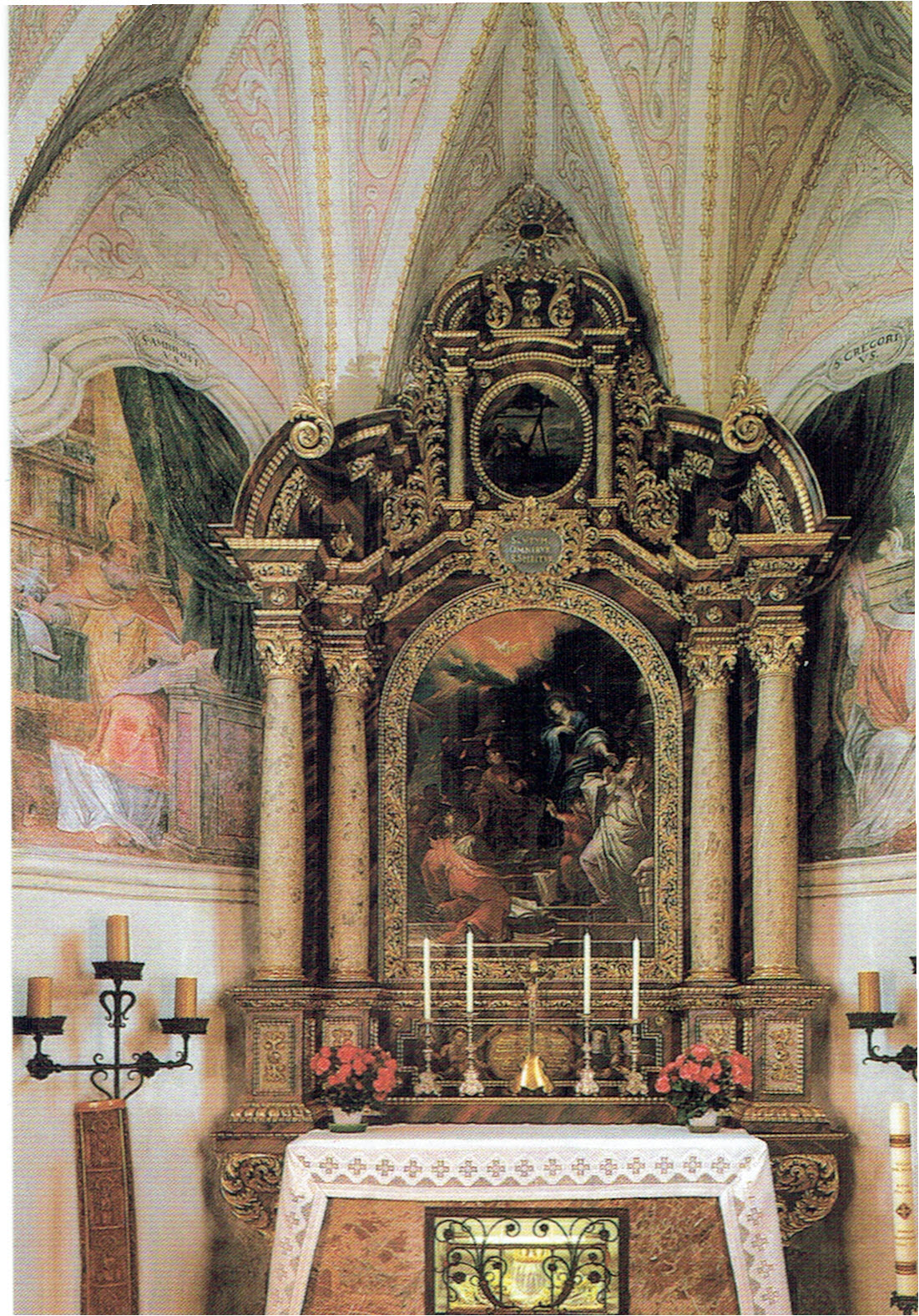
The church has three naves, nine bays and 11 altars. There is a gallery with heavy Romanesque groin vaults. The round arched arcades are situated on rectangular pillars. The half columns have no capitals or plinths as well. The aisles of the main nave boast star-shaped rib vaults. The sacristy features Late Gothic vaulting and is two stories high. The altar stones are Late Gothic, but the altars’ upper structures are all Baroque in style. The high altar is High Baroque, created in 1694. In the middle of the 19th century the original altar was taken away, and a painting of The Risen Christ Appearing to His Mother replaced it. The upper part shows the crowning of the Virgin Mary. Saint Benedict, Saint John the Baptist and Saint George are a few of the holy characters who make appearances on the high altarpiece.

An altar in the church on Fraueninsel

An altar in the church on Fraueninsel

We did not go inside the monastery, but I knew it had been founded by Bavarian Duke Tassillo III in the 8th century, making it the oldest monastery in Bavaria. In 830 about 45 nuns lived in a convent on the premises. Perhaps the monastery’s most famous abbess was Irmingard, a great-granddaughter of Charlemagne, living in the 9th century. A reliquary of the abbess’ remains is located in the church. Her life is still celebrated on the island. The convent holds the distinction of being the oldest still existing convent in Germany. As of 2007, about 30 sisters resided in the monastery.

A picturesque cottage on Ladies' Island

A picturesque cottage on Ladies’ Island

We also saw the picturesque cottages on the island and the fishmongers’ stands. The island was so serene. It made me feel at peace with myself and with the world. I felt as though I could accept the joys plus the hardships life had thrown my way. I had a strong feeling of self-acceptance. If only I could take strolls around this island every day, my life would be so much more balanced and much less stressful!

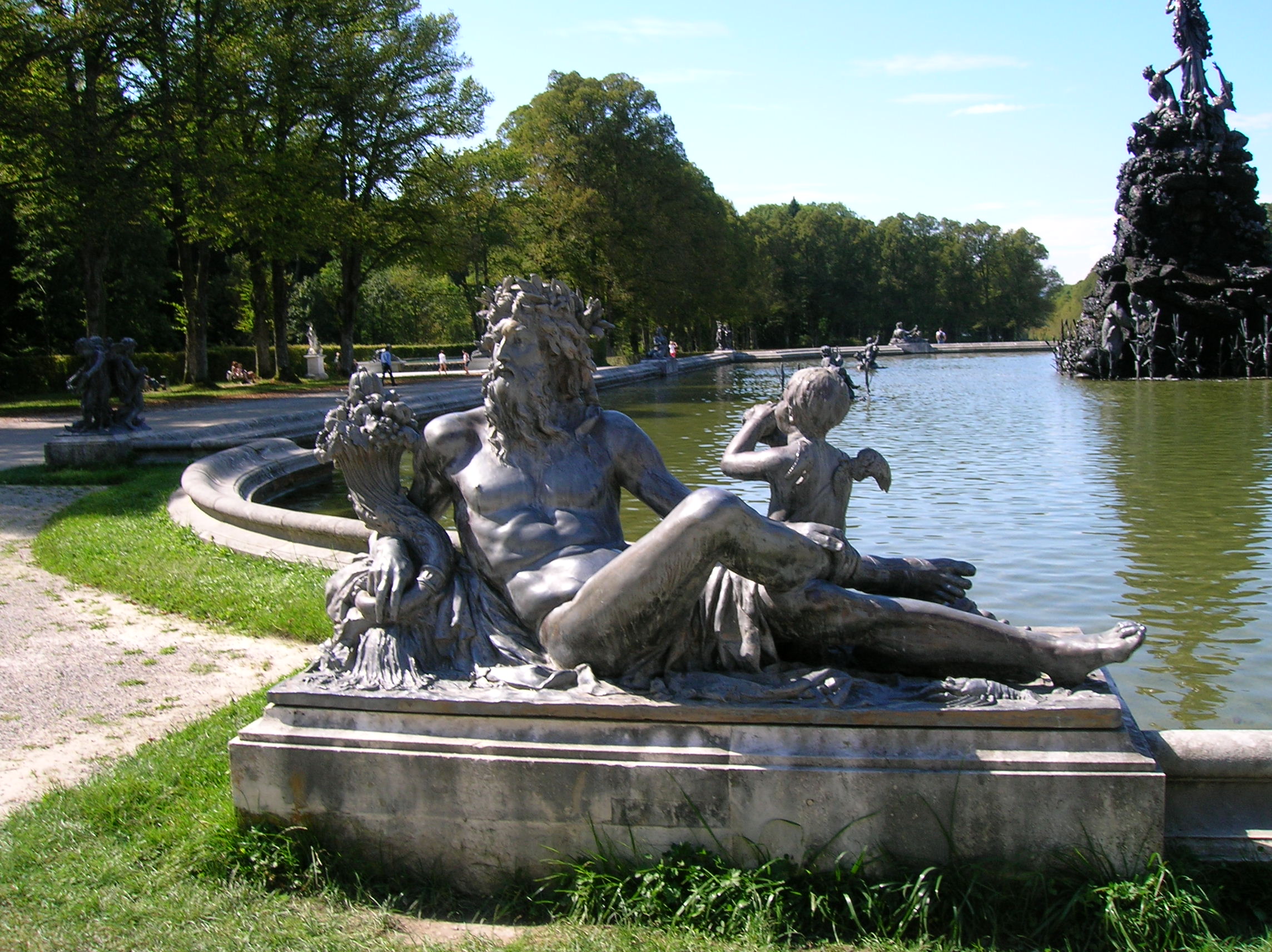
A statue adorning a fountain in the garden

A statue adorning a fountain in the garden

Then we took another boat to the New Palace and Old Palace of Herrenchiemsee. Tourists, notably absent from the Ladies’ Island, had flocked to the New Palace. Created for “mad” King Ludwig II, Herrenchiemsee’s New Palace is a copy of Versailles, though it does differ in some respects.

A statue decorating a fountain in the garden

A statue decorating a fountain in the garden

King Ludwig II created his own fantasy world because he was dismayed that he could not be an absolute monarch. Ludwig II could not accept his royal post in a constitutional monarchy. He idolized French King Louis XIV, who led France for 72 years as the most powerful decision-maker in that realm. Soon after Ludwig became king, the government experienced a financial crisis, and Ludwig II withdrew from society, hiding in his own special, imaginative realm.

A fountain at Herrenchiemsee Palace

A fountain at Herrenchiemsee Palace

Very few of the interior furnishings of Versailles were original; they had been destroyed during the revolutions of 1789 and 1848. Therefore, Ludwig II could not make replicas of the authentic interiors of Versailles. He traveled to Versailles on two occasions. Construction began on his new rendition of Versailles in May of 1878. (King Ludwig II would die under mysterious circumstances on June 13, 1886.)
First, I visited the ornate garden. The fountains with stunning statuary impressed me as did the parterre with ponds. I saw marble statues of animals, of gods Diana and Venus and of Fata and Fortuna. Curiously enough, the garden was not an exact replica of that in Versailles. In fact, the statues of Fata and Fortuna had been greatly influenced by the gardens at the Spanish royal palace of San Ildefonso, Segovia.

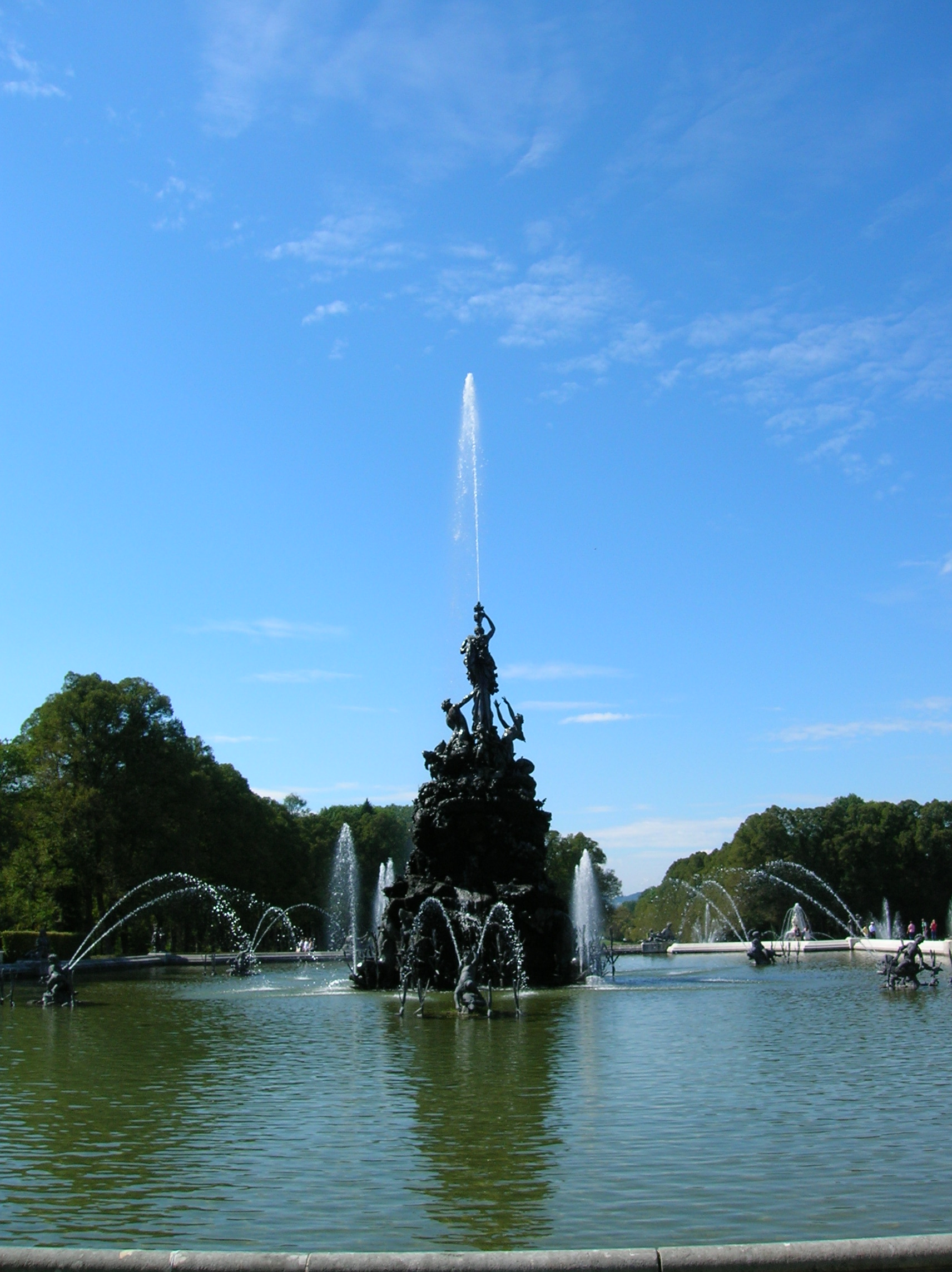
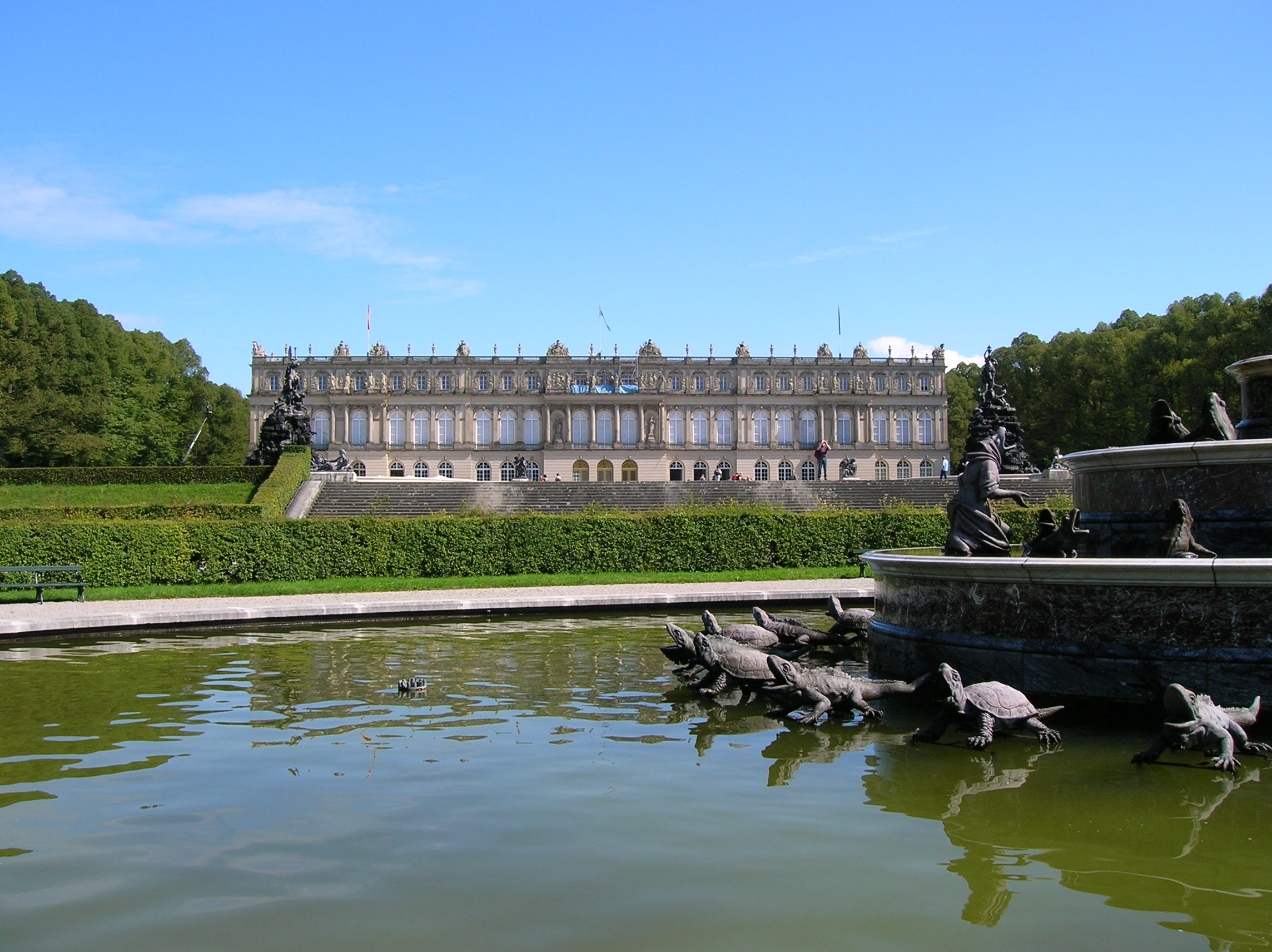
The Latona Fountain in the garden of Herrenchiemsee

The Latona Fountain in the garden of Herrenchiemsee

The Latona Fountain is based on the fountain at Versailles, though. Latona, who had given birth to Apollo and Diana, stood proudly in the center of the fountain. Below her were the farmers she had turned into frogs plus tortoises and toads. After giving birth to Apollo and Diana, Latona wandered around the land. She came upon a pond and was very thirsty. However, the farmers would not let her drink from the pond. So, she changed them into frogs. I loved the sculptures of the frogs and tortoises. The figures of the animals seemed so playful rather than merely majestic. They brought a smile to my face.

The New Palace from the garden

The New Palace from the garden

Then came the tour of the New Palace. The guide explained that there is nothing Bavarian in the palace. Everything was inspired by Louis XIV or Louis XV. We walked up a grandiose staircase that was a replica of the one at Versailles, the version that was destroyed in France during 1752. Stucco marble and statues, paintings, a crystal chandelier and a marble fountain showing Diana with two nymphs all added to the grandeur. However, there was an intriguing 19th century element – a glass roof that somehow complemented the classical characteristics. I was surprised that the skylight did not look out-of-place or mar the elegance of the staircase.

The parterre in the garden

The parterre in the garden

In the Bodyguard Room I saw copies of halberds from Versailles. The ceiling fresco boasted a mythological theme, showing the triumph of Mars as the god peers at a burning city while gripping a white-and-red flag. Stucco marble paneling gave the room a sort of charm. Notably, no guards had ever been stationed in the Bodyguard Room.
In the First Antechamber the white and gold paneling was stunning. The ceiling painting glorified Bacchus and Ceres, who was the goddess of agriculture and fertility, among other things. I was fascinated by the Cornet Cabinet made with the Boullete technique, which was a French way of sculpting. The cabinet was inlaid with dark brown tortoiseshell and showed off gilt bronze figures. The professional and eloquent guide opened the cabinet. I expected to see some ornate jewels inside. However, it was empty because King Ludwig II had never said what he wanted to store there.

The parterre in the garden

A beautiful fountain in the garden

The Second Antechamber included large bureaus, and the chandeliers seemed to enlarge the size of the room in a mirroring effect. Overall, there were 50 chandeliers in the palace, made of Bohemian lead crystal and gilded bronze. A bronze statue showed King Louis XIV on horseback. I was enamored by the detail of the horse’s mane and the riding boots. The draperies astounded with green silk and golden embroidery.
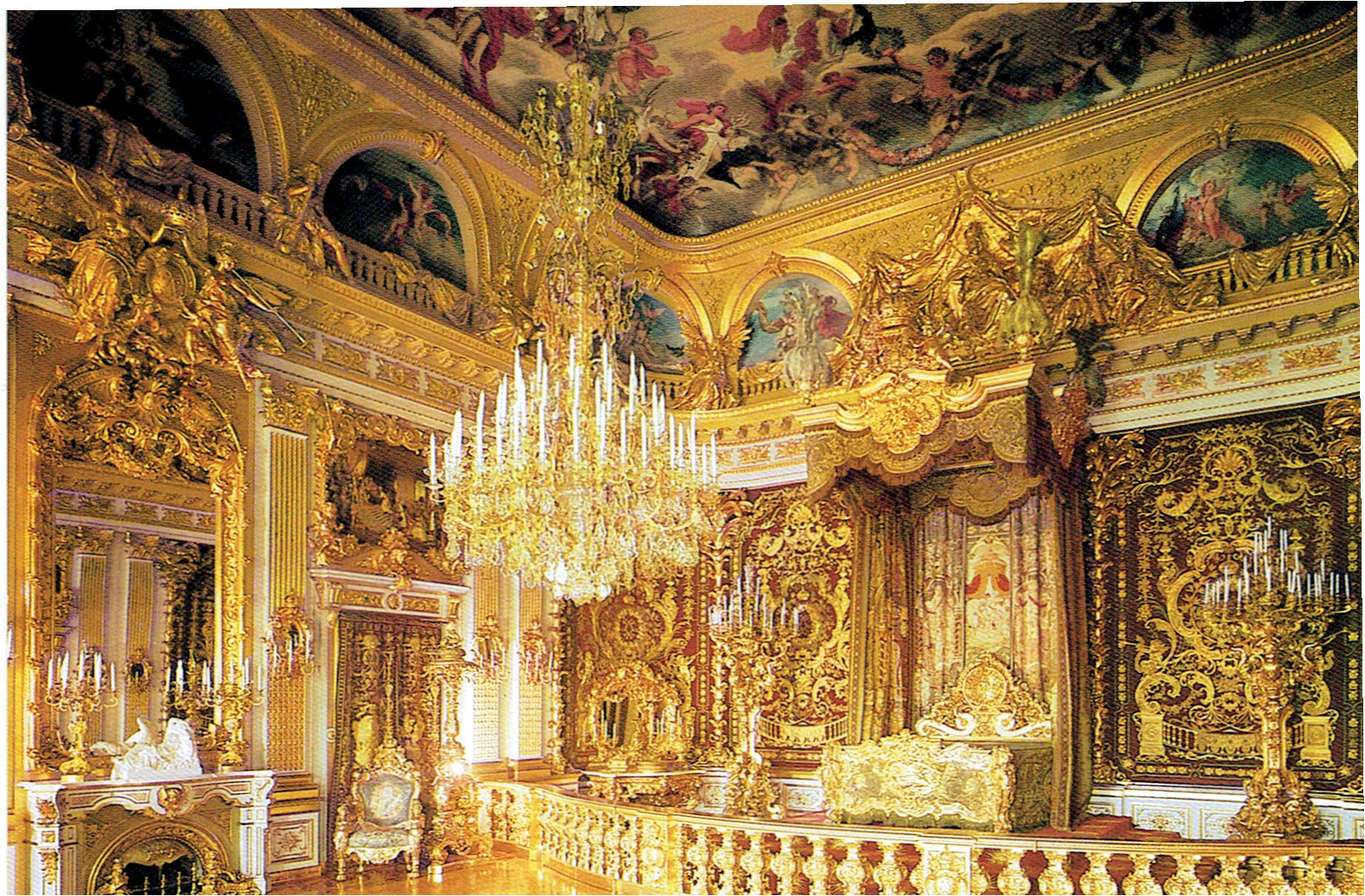
The State Bed Chamber was not a copy of the one at Versailles. It was, in fact, much more lavish than its French counterpart. The space featured a gold leaf gilded bed. Red velvet carpet with designs of suns covered the steps leading up to the bed. How I would like to sleep there! The red velvet textiles were made utilizing needlework and gold embroidering and boasted scenes of Venus and Cupid. However, King Ludwig II never slept there. He intended it to be only a copy of Versailles, not his personal bedroom.

The lavish State  Bedroom at Herrenchiemsee

The lavish State Bedroom at Herrenchiemsee

A life-size portrait of Louis XIV graced the Council Chamber or Conference Hall, carved in gold and white paneling. The Bourbon lily design was displayed on the carpet and curtains. The largest clock in the palace was in the room, too. There was at least one clock in every room in the palace. This particular clock, made with inlaid rosewood designs and gild bronze fittings, had been constructed for King Louis XIV. The ceiling painting portrayed the gods at Olympus. I took note of the white horses rearing up as though they were frightened of something.

The Conference Room

The Conference Hall

The Hall of Mirrors was impressive as well. The Hall of Peace and the Hall of War were copies from Versailles. They were overwhelming. Some 2,200 candles were in the rooms. It had taken 30 to 40 servants to light them. The space also featured 35 chandeliers. The ceiling frescoes were stunning, copies of frescoes from Versailles showing battles with the French in the Spanish Netherlands, which resulted in a peace treaty during 1678. Both the Hall of Peace and Hall of War were decorated in stucco marble of various hues, and each hall boasted the busts of four Roman emperors. The halls there measured in total 98 meters in length. They were six meters longer than the ones in Versailles.

The Hall of Mirrors

The Hall of Mirrors

Next we saw the private apartments built in the style of King Louis XV, but not totally faithful to the rooms at Versailles. The Second Rococo style of the rooms had been influenced by 18th century French and German palaces. King Ludwig II actually lived there from September 7 to September 16, 1885.

The Bedroom was decorated in blue, King Ludwig’s favorite color. I recalled that the elegant bedroom in Neuschwanstein was also decorated in this color. The bed was two meters and 40 centimeters long with a width of one meter and 80 centimeters. (Ludwig II stood one meter and 93 centimeters tall.) Statues of Venus and Adonis also featured prominently in the room. The ceiling painting dealt with mythological figures. When candles had been lit in this space, the blue globe light resembled moonlight. What an atmosphere that must have been! The space featured two secret doors as well.

A bedroom in the palace

A bedroom in the palace

The King’s Study was dedicated to Louis XV. I was enamored by the 1884 roll-top desk that was a replica of a desk that Louis XV had owned. How I would love to compose pieces on that! It was the most valuable piece of furniture in the palace, inlaid with 16 kinds of wood. Two astronomical clocks decorated the room. A half-ton chandelier was on display, too. Green velvet curtains showed off gold embroidery.

The captivating Meissen chandelier

The captivating Meissen chandelier

The King’s Dining Room featured the most expensive chandelier and floral décor. The 18-armed Meissen chandelier was breathtaking. It showed off flower buds in various colors and tiny birds. The chandelier had been assembled in the room from small pieces. It was one of the most original chandeliers I had ever seen. Below it were white flowers in a vase made of porcelain.

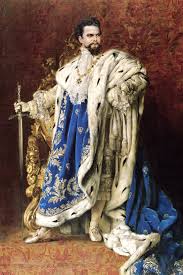
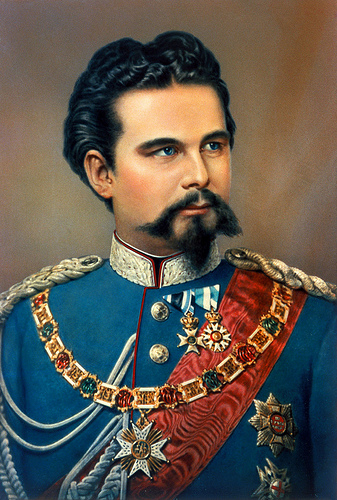
King Ludwig II of Bavaria

King Ludwig II of Bavaria

The table was called a “Tischlein-deck-dich.” It could be lowered when servants needed to set it and then could be hoisted back up, so Ludwig II could dine alone without servants interrupting him. It reminded me of a similar sort of table at Linderhof Palace. White and gold paneling added to the room’s opulence. A porcelain cabinet in the corner of the room also proved intriguing. This space had taken its look from a room in the Hotel de Soubise in Paris.
Overall, King Ludwig II had planned for there to be 70 rooms in the palace, but only 50 rooms had been completed. The king’s private entrance was unfinished, too. I could hardly imagine the grandeur that would have pervaded if King Ludwig II had been able to build all 70 spaces.

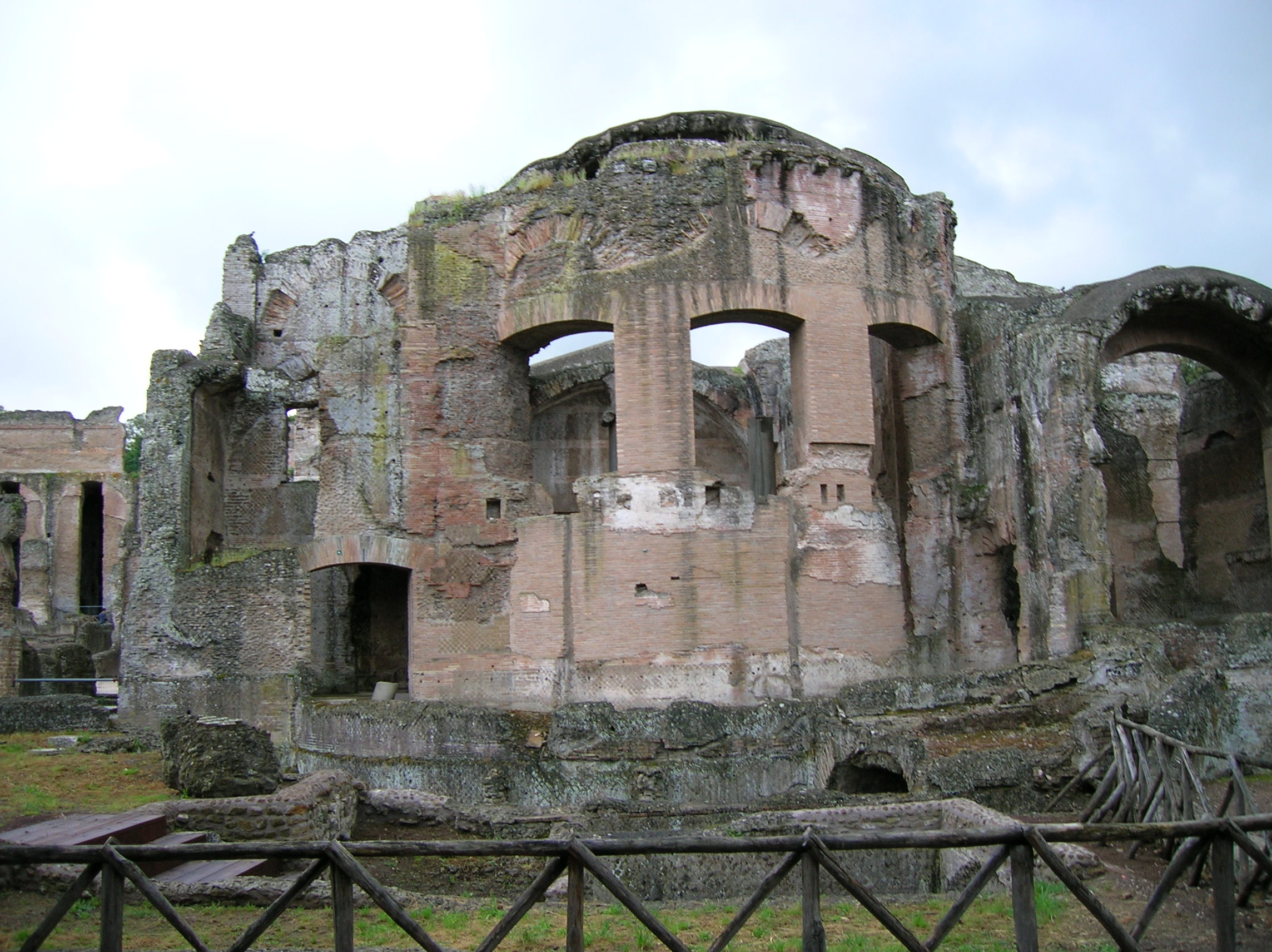
Hadrian's Villa near Rome

Hadrian’s Villa near Rome

During the tour I thought back to my visit to Hadrian’s Villa in what is today Tivoli near Rome. Emperor Hadrian’s immense villa had imitated places and locations around the empire that he had liked the most. For example, there was a copy of the Nile at its estuary, two Greek valleys, several Athenian sites. In total, there had been 30 buildings, including temples, palaces, a theatre and libraries. I thought about how the architecture reflected his inner turmoil and how Herrrenchiemsee, Neuschwanstein and Linderhof Palace reflected Ludwig II’s troubles.

Hadrian's Villa

Hadrian’s Villa

Next I visited the Ludwig II Museum in the palace. In this museum I saw some intriguing artifacts. I was impressed with the long, blood red with silver trim wedding robes made for King Ludwig II and Sophie, Duchess of Bavaria. I could imagine them clad in those lavish robes if they had actually got married. Ludwig’s death mask was on display, too.
In the portrait of Ludwig as Grand Master of the Order of Knights of Saint George, the “mad” king looked devilish, angry even. Perhaps he had just been reminded that he would never have absolute rule in his kingdom. In the picture he was clutching a scabbard with one white-gloved hand.

A colorful tiled stove at Neuschwanstein Castle

A colorful tiled stove at Neuschwanstein Castle

I also spotted a tiled stove in playful, cheery colors. The stove was decorated in a mixture of green with yellow as well as gray with red and had been originally placed at Neuschwanstein, where I had set eyes on a similar tiled stove. I saw other ornate Meissen vases and sculpture as well. The models of stage sets exhibited Ludwig II’s passion for Richard Wagner’s music. In fact, there were many artifacts from Neuschwanstein and Linderhof Palace. One room boasted the original furniture from a bedroom at Linderhof. The original boat from Ludwig II’s winter garden that had been situated on the roof of the Residence Palace in Munich was on display, too.

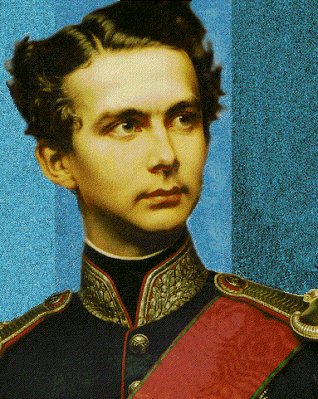
A young King Ludwig II of Bavaria

A young King Ludwig II of Bavaria

Lastly, I visited the Old Palace – the Augustinian Monastery that was founded around 1125. The current monastery buildings dated from the Baroque period, though. The complex consisted of four wings with an almost rectangular courtyard and rose garden. Perhaps it was best known as the setting for the drafting of Germany’s new constitution in 1948, paving the way for Germany’s identity as a republic. Now there is a history museum dealing with the constitution on the premises, but all the placards were in German, so I did not understand it.

The Baroque hall in the Old Palace

The Baroque hall in the Old Palace

My favorite room was covered in Baroque frescoes, an array of dynamic figures in bright colors. Another space was Ludwig II’s Study with intriguing furnishings. While it did not compare to the New Palace in grandeur, the Old Palace had a welcome sense of simplicity and a variety of objects and furnishings on display, not adhering to one, specific theme.
I took a break and sat outside on that beautiful, sunny day and drank some water. There was no doubt about it. Herrenchiemsee was one of my favorite palaces (or castles, as it is often called) though I liked the romantic, 19th century Gothic style of Neuschwanstein even better. Herrenchiemsee definitely ranked up there with Czech castles and chateaus. I was overwhelmed by the beauty and elegance of the palace. I was very satisfied with the tour guide that led our group through numerous rooms. The articulate guide had spoken perfect English and had described each room with contagious enthusiasm. In fact, all the guides that had showed me Bavarian castles and palaces had been excellent, giving vivid descriptions and pointing out intriguing details.

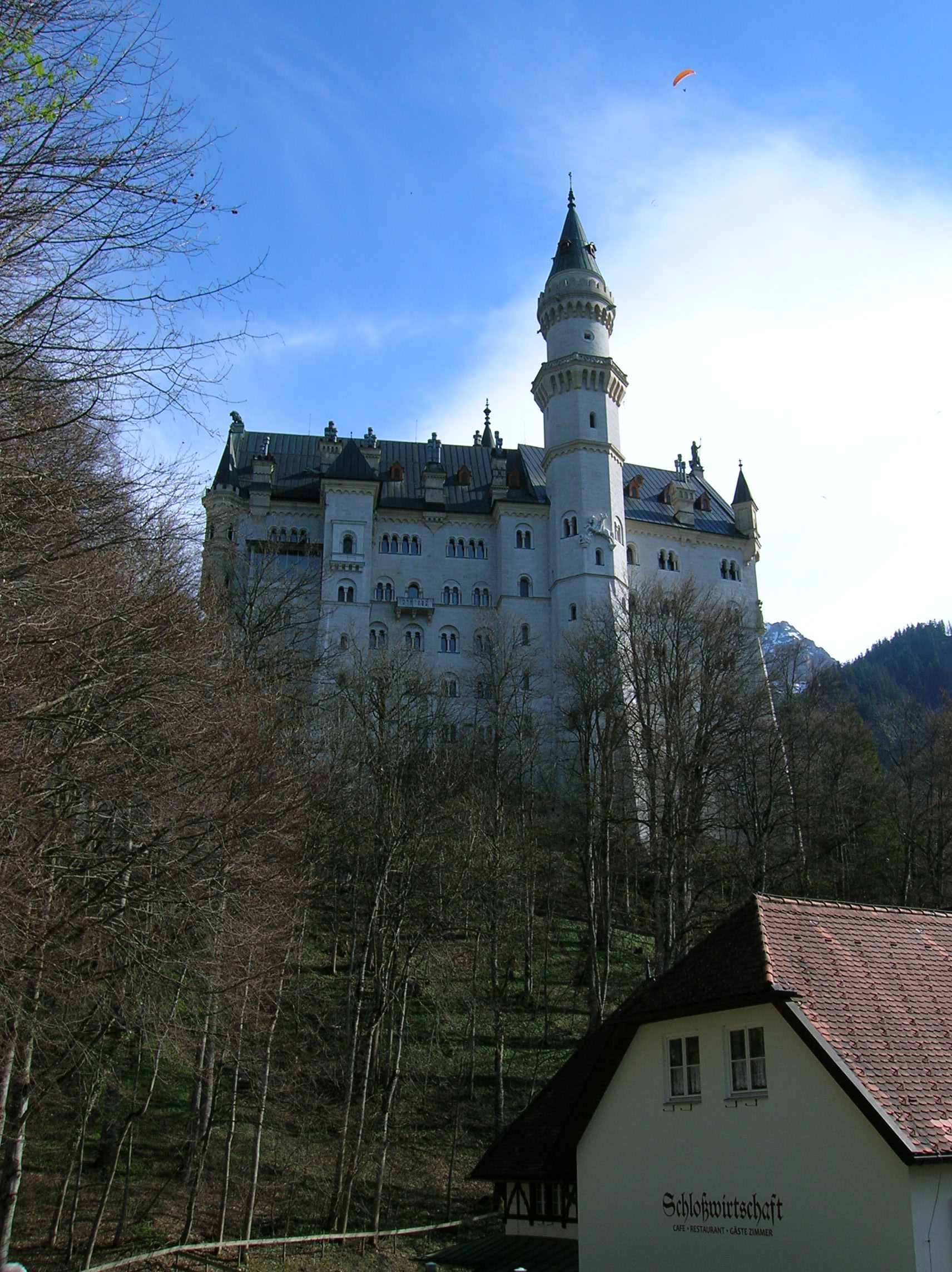
My favorite Bavarian castle - Neuschwanstein

My favorite Bavarian castle – Neuschwanstein

The garden was outstanding, too, with fountains and sculptural decoration that enthralled me. The parterre was stunning as well. I could sit on a bench in this garden all day and read a good book, often gazing around me at the remarkable, calming scenery. I loved those tortoises and frog figures on the Latona Fountain most of all.
The magic of Herrenchiemsee would stay in my mind forever. Versailles had been so crowded when I visited some years ago on one unusually warm February day. It had not been possible to soak up the atmosphere with a throng of tourists elbowing me for positions to take the best photo. During the tour of Herrenchiemsee, I was able to appreciate the elegance of the rooms without fighting my way through crowds as there was only a fixed number of people allowed on each tour.

King Ludwig II of Bavaria

King Ludwig II of Bavaria

The mysterious circumstances of Ludwig II’s death came to my mind as we waited for a boat to take us back to the bus. On trial on June 8, 1886, the king was declared mentally ill and legally incompetent to rule. The statements for his defense were not taken into consideration. His death was mysterious. It seemed to jump out of a Sherlock Holmes whodunit. Five days after hearing the verdict, Ludwig took a walk with his doctor. He did not have any of his guards accompany them. What happened next? Nobody knows. Later both bodies were found in the water. The mystery may never be solved as the Wittelsbach clan will not allow Ludwig II’s corpse to be exhumed.


The New Palace from the Latona Fountain

The New Palace from the Latona Fountain

Tracy A. Burns is a writer, proofreader and editor in Prague.

Harburg Castle Diary

HarburgCastle9

While I was staying in Munich, I went on a Gray Line tour of Harburg Castle, a medieval Bavarian gem and then on to Rothenburg ob der Tauber, one of the most picturesque towns in the world. I had been very satisfied with the Gray Line Munich tour I had taken to Palace Linderhof and Neuschwanstein Castle some months earlier.
Harburg Castle is one of the best preserved, oldest and largest castles in south Germany. In addition to the rooms open to the public, it houses the archives of the Oettingen-Wallerstein branch of the family that took control of the property in 1731. Spanning the 11th to 18th centuries, an art collection is on the premises, too, but unfortunately is not open to the public. Harburg Castle dates from the 11th century. It was first mentioned in writing during 1150.
Standing on the grounds, you can feel its history. Death penalties were carried out here, and bloody battles were fought here. The Oettingen Princes owned the castle for some 700 years. The Prince’s Building even goes back to the first half of the 10th century, where the archives are now located. The two towers were first mentioned in writing during 1150 but are actually much older, dating from 600 or 700 AD. The portcullis was built in 1752. Nailed behind it is the skull of a wolf, the last wolf ever shot in the region. The granary served judicial purposes from 1806 to 1852.

HarburgCastle1
A significant part of Harburg’s history began when Ludwig III von Oettingen gained Harburg in 1251. The Oettingens made the castle their home after 1418. The clan made a name for itself in the military and in politics. Construction of a two-storey hall took place in the late 15th century. In the early 16th century the Oettingens took up the Protestant faith as the Reformation greatly influenced the history of the castle.
The Schmalkaldic War, pitting the Catholic Habsburgs against the Protestants in their Lutheran Schmalkaldic League within the Holy Roman Empire, was fought from 1546 to 1547. The Imperial troops won, triggering devastation for the castle during 1547. Still, the teachings of Martin Luther had already spread throughout the lands and could not be stopped by force.
Things did not fare as badly during the Thirty Years’ War, when it was not heavily damaged, though the area was in ruins. The Oettingen-Oettingen line of the family were elevated to princes during 1674. There was much reconstruction in the 17th century. Pillaging occurred during the Spanish War of Succession from 1701 to 1704. The castle soon rebounded, though. More repairs were carried out in the early 18th century. That’s when the Banquet Hall was built and the church was given a Baroque appearance.

HarburgCastle6
In 1731 the Protestant line of the family ended, and the Catholic branch the Oettingen-Wallerstein line took charge. During the War of the Second Coalition, which was fought between the Austrians and Napoleon’s armies, much pillaging took place. In 1797 a military hospital was located on the premises. The Austrians were unable to protect the castle on June 24, 1800, when Napoleon’s troops captured the decisive victory. Even though there was much damage, that day is now celebrated at the castle as it was a blessing in disguise. Under French rule the 18th century was a time of imperial visits and reconstruction. Kaiser Franz II, the last Kaiser of the Holy Roman Empire of the German Nation paid it a visit in 1766. Napoleon even rode by the castle in a carriage during October of 1805.

We did not go inside the Castle Church of Saint Michael’s, but I read that its Baroque interior hails from 1720 and 1721. A Baroque pulpit and ceiling frescoes are a few of the highlights of this church. The tomb of the Oettingen-Oettingen line of the family has been under the pulpit since the 16th century. The church is still used for services. Now the church’s denomination is Lutheran. Take a good look at the well that is 450 meters deep. It took an hour to get water from its depths to the ground.
The castle featured many intriguing devices used during wartime. One loophole in its side was situated so that the defender could throw hot water on the enemy and burn him. Quicklime was often used, so that the opponent would go blind immediately. Another window in the wall had a beam to which a soldier could hook his weapon. Then there was a loophole that consisted of a wooden wall within a wall. It could swivel around so you could see in all directions. The hole was too small to be seen by the enemy.
We went inside and saw many richly decorated shields. Because people could not read or write, symbols of various clans decorated the shields. One featured the color red for blood and a yellow X for money. Three more showed a donkey, two wheels and a wooden shoe, which reminded me of an advertisement for L.L. Bean. A black shield with a red cow head symbolized the family of Cow Mouth, which would certainly not be a popular name in today’s world.

HarburgCastle5
Then we entered a room that featured a stunning chair that was 500 years old, symbolizing that the person who would sit in it was very powerful. The richly decorated ceiling was made for another castle in Italy in 1750, and the princely family bought it in 1920. The Habsburg clan is not missing from the castle, either. (They seem to be present in all the castles I visit.) Decoration of ladies’ portraits in circular frames showed off females from this distinguished clan.
The two family trees also caught my attention. One dated from the 17th century and was painted on linen. The other dated from the 18th century and was painted on cow skin. That one was made with one hair of a pig. I could not believe it was possible to design a family tree with one hair. What exquisite craftsmanship! I thought of my own family tree and how many questions it posed. If only I had all my ancestors accounted for as the Oettingens did on theirs. From where exactly in Bohemia were my Czech great grandparents? Who exactly were my Mareš ancestors, and from where in Moravia were they?

HarburgCastle10
Situated in many castles, life-size portraits also decorated the room. I recognized Charlemagne. The next room was in front of the first keep. Each wall was 2.5 meters thick, and below each wall it was three meters thick. The inside room was 9 meters deep. Because it was so cool there, it was possible to use it as a sort of refrigerator. A man went down to the fridge with a rope around his stomach and brought the food up. A dungeon was also below us. There’s no way I would want to be stuck down there. Other spaces featured weapons and hunting trophies. A beam was 1,000 years old while a middle pillar was 800 years old. A clock had a 24-hour face.
I was intrigued by the tour but disappointed that it was so short. It would have been nice to have seen at least four or five more rooms. The castle had such a fascinating medieval flair and some stunning objects, but people only got a glimpse of its character. Still, the castle was architecturally intriguing on the exterior and interior. It was worth visiting if you are combining it with a day trip somewhere else. It proved an excellent stop on the way to Rothenburg ob der Tauber.
Still, I considered Karlštejn Castle, Křivoklát Castle and Pernštejn Castle in the Czech Republic to be superior because you were able to take extensive tours and get a real sense of their medieval character. On the way to Rothenburg, our tour guide, an eloquent, friendly woman, told us that Michael Jackson at one time had tried to buy Harburg for 25 million euros. At the last moment, though, the deal fell through. I, for one, was glad. Who knows if he would have opened it to the public at all?

HarburgCastle8

Tracy Burns is a writer, proofreader and editor in Prague.

Lednice Chateau Greenhouse Photo Diary

Ledniceextglasshouse

While I was visiting Neo-Gothic Lednice Chateau in south Moravia, I explored the greenhouse, which was finished in 1845, restored in 1996 and renovated again in 2002. It still retained its early 20th century appearance. The greenhouse was 92.6 meters long and 13.6 meters wide. Its decoration included 44 pillars showing off a bamboo motif. An elliptical pond was one of the highlights.

Ledniceintglasshouse1

Ledniceintglasshouse2

Ledniceintglasshouse4

Ledniceintglasshouse5

Ledniceintglasshouse7

Ledniceintglasshouse9

Ledniceintglasshouse11

Ledniceintglasshouse12

Ledniceintglasshouse14


Tracy A. Burns is a writer, proofreader and editor in Prague.

Lednice Chateau and Park Diary

Ledniceext9
Lednice Chateau in south Moravia has always been one of my favorites because I love Neo-Gothic architecture. Just gazing at the exterior takes my breath away. The interior does not disappoint, either.

Ledniceext6
I was visiting the chateau for the third time. Usually I came alone, but now I was with the arsviva travel agency with whom I had taken tours throughout the Czech Republic and abroad. I had never had time to visit the magnificent park as I was always hurrying to nearby Valtice Chateau to see two chateaus in one day. Now I would not be so rushed. I could enjoy my visit without worrying about catching the bus to Valtice.

Lednice1
I already knew something about the chateau’s background. Lednice was first mentioned in writing as a Gothic fort in 1222. At the end of that century, the Liechtensteins took over Lednice, and they would hold on to it until 1945, for some 700 years. The Liechtensteins would make Lednice their summer residence. Lednice was transformed into a Renaissance chateau during the 16th century. In the following century, when the Czech Protestant nobles revolted against the Catholic Habsburgs, the Liechtensteins took a Catholic stance. Because they supported the Catholics, the chateau remained their property after the Protestants were defeated.

Lednice3
The following years proved to be a golden era for the wealthy family. Lednice was turned into a Baroque masterpiece during the 17th century. It got its Neo-Gothic appearance, inspired by English Gothic architecture, from 1846 to 1858. Fortunately, the family was able to remove most of the furnishings during World War II, so visitors can see much of the original décor today. The Lednice and Valtice area was added to the UNESCO List of World Cultural and Natural Heritage sites in 1996.

Ledniceext5
I had been on all tours of the interior, but this time our visit would focus on the representative rooms, which was my favorite tour. The other tour of the rooms concentrated on the princely apartments. There were also four tours of the park plus two others. We would see the park on one hour-long tour.
In the hallway we saw the biggest chandelier in the Czech Republic, made in Vienna. It had 116 arms and weighed 690 kilos. I also noticed the richly carved wooden staircase and banister, though I knew an even more impressive staircase awaited me. What I loved most about Lednice was its richly carved woodwork, the most impressive woodcarving in the country, in my opinion. It never failed to astound me. I could stare at it for hours.

Ledniceintdesk
I was impressed by the Viennese porcelain in the Ladies’ Salon. In the Empire style Ladies’ Bedroom a 19th century Mexican cross captivated me. It was so exquisitely and richly decorated with such amazing detail. A splendid desk also took my breath away.
The small Chinese Rooms were two of my favorite spaces in the chateau. The wallpaper of the Oriental Salon was hand-painted, made with Chinese paper during the beginning of the 18th century. It featured an idyllic landscape with figures in a vibrant green color.

LedniceintChcabinet
Another space showed off medieval ceiling vaulting and richly carved wood paneling. I found the wood paneling to be comforting. It somehow made me feel safe, as if I were in a place where I could temporarily forget all my worries. I was so awed by the detail of the paneling decoration throughout the chateau. The view was idyllic, too. The room looked out on the garden and a pond. I would explore the park soon. I was psyched.

Ledniceintpainting

The Big Summer Dining Room showed off a Gothic table with pewter dishes. The vaulting was Neo-Gothic, influenced by the Gothic style.
Then came my favorite room, the library. A voracious reader, I have always felt comfortable in libraries, but this one was extra special due to its richly carved oak, self-supporting, spiral staircase, the most exquisite example of richly carved wood I had ever seen. The architectural wonder was created in 1850. The rich blue furnishings and matching blue wallpaper complemented the wood ornamentation perfectly. Even the door boasted an intricate wood design. The library itself held about 2,000 volumes, including many books about architecture, art and travel. The astounding ceiling was made of oak. A 16th century Italian altar showed the genealogy tree of Jesus Christ.

The spiral, self-supporting staircase

The spiral, self-supporting staircase

Ledniceintstaircase2
I loved the wallpaper throughout the chateau, but my favorite was the turquoise with green wallpaper in the Turquoise Hall. The wood furnishings were made from Canadian walnut wood. A copy of a painting by Raphael added to the charm as did an 18th century Chinese vase. Those Neo-Gothic chairs with detailed designs on the backs captivated me not only in this room but also throughout the chateau. The Red Salon or Smoking Salon boasted wallpaper the color of red wine. Coats-of-arms décor was situated high on the walls. Its chandeliers were splendid, too.

The Turquoise Hall

The Turquoise Hall

The Blue Hall was the biggest space in the chateau with crystal candelabras and a ceiling made from linden wood in Neo-Gothic style. I loved the wood ceilings in this chateau, this one especially. This ceiling was extra special because every motif on it was original – no motif was repeated. That made it one of the most impressive ceilings I had seen in chateaus in this country.

The greenhouse at Lednice

The greenhouse at Lednice

After touring the interior, it was time to explore the park. First, though, I went into the greenhouse to see all the stunning plants. The greenhouse was finished in 1845, restored in 1996 and renovated again in 2002. Yet it retained its early 20th century appearance. It was 92.6 meters long and 13.6 meters wide. Its decoration included 44 pillars showing off a bamboo motif. An elliptical pond was one of the highlights.

The greenhouse

The greenhouse

Next we visited the park made up of the natural park and the regular garden. More than 600 types of woody plants now appear in the park. The park harkens back to the 16th century when Lednice was a Renaissance chateau. At the turn of the 18th and 19th centuries, the park took on a Baroque and Classicist look. At the end of the 18th century, exotic plants were added to the park, which has been open to the public since the end of the 18th century. A Chinese pavilion was added by Austrian architect Josef Hardtmuth in 1795, when the park was expanded.

A tranquil stream in Lednice Park

A tranquil stream in Lednice Park

Hardtmuth had served as the prince’s court builder and architect for the Liechtenstein family. He was responsible for the design of many objects in the Lednice – Valtice area. But architecture was not Hardtmuth’s only talent – he also was a skilled inventor, and he came up with the idea of the modern pencil. He even founded a pencil manufacturing company in the late 18th century.

The pond with the Minaret in the distance

The pond with the Minaret in the distance

We gazed across a pond to the Minaret, which was under reconstruction at that time, so there was scaffolding on the lower levels. Built between 1797 and 1804, the Minaret featured a pseudo-Oriental style. It was designed by Hardtmuth as well, and he received much acclaim for his design.

The Minaret was under renovation during my visit.

The Minaret was under renovation during my visit.

Architecturally, the Minaret was composed of a square ground plan that opened with triple axial arcades on the ground floor. The upper floor consisted of eight rooms. The tower was three storeys high, measuring about 60 meters. The Minaret was crowned by a helmet with a half moon. Now the Minaret is the only structure that dates back to the Baroque and Classicist appearance of the park. I wish we had been able to climb to the highest gallery, where it is said that one can see St. Stephen’s Cathedral in Vienna.

Jan's Castle

Jan’s Castle

Then we took a rickety boat ride to Jan’s Castle, a 19th century copy of Romantic castle ruins created on the banks of the River Dyje, according to Hardtmuth’s design. Inspired by Gothic architecture, it had four wings and three gates. The Knights’ Hall was on the first floor, and banquets had been held there. The southern tower had two floors with a balcony. It exemplified the transition from Classical Romanticism to Early Romanticism that was popular in the 19th century. The castle looked like something out of a Gothic novel. The book Valerie and her Week of Wonders by Vítězslav Nezval came to mind.

Statue at the Border Chateau

Statue at the Border Chateau

We saw other structures in the Lednice – Valtice area as well. The Border Chateau, created from 1826 to 1827, was situated near the historical border between Austria and the Czech Republic. The historical border of the two countries was a brook that flowed through the vase of a sculpture of a reclining nymph. Then it went under the chateau and into a nearby pond.

View from the Border Chateau

View from the Border Chateau

It was inspired by Palladian architecture, a style inspired by the designs of 16th century Italian architect Andrea Palladio. The Venice native had focused on symmetry and the characteristics of the formal classical temple from the architecture of the Greeks and Romans in antiquity. This style was often used in the 17th and 18th centuries.

The facade of the Border Chateau

The facade of the Border Chateau

The inside of the chateau featured some Cubist style rooms. The pavilions were connected to wings with a terrace offering spectacular views. It was so harmonious with the nature that surrounded it. Architecturally, it seemed to respect its natural surroundings.

The Rajsná Colonnade

The Rajsná Colonnade

We also saw the Colonnade at Rajsná, which combined a triumphal arch with a colonnade. It was located near the present Austrian and Czech border. You could even see the border buildings from Communist times, and there was an Iron Curtain Museum located there. (Unfortunately, I did not have time to visit it.)

A spectacular view from the Rajsná Colonnade

A spectacular view from the Rajsná Colonnade

Inspired by architecture from Roman and Greek antiquity, this Classicist structure was built from 1810 to 1823 by Hardtmuth and Josef Kornhäusel. The sculptural decoration, designed by Josef Klieber, showed off motifs of triumph and meditation. Reliefs portrayed the allegories of science, art and work. The figures in Roman togas represented the Liechtenstein nobles. The roof terrace offered spectacular views of three countries –the Czech Republic (specifically Moravia), Austria and Slovakia.

The view from the Rajsná Colonnade

The view from the Rajsná Colonnade

The Classicist Diana’s Temple, created from 1810 to 1813 by Hardtmuth, also greatly impressed me. Dedicated to Diana, goddess of the hunt, it looked like a triumphal arch but was really a hunting lodge. Inspired by Roman architecture from antiquity, it had a terrace that must have offered splendid views. Allegories of hunting were portrayed on reliefs. I was surprised how the building was in harmony with nature. It complemented its natural surroundings instead of intruding upon nature.

The Diana Temple hunting lodge

The Diana Temple hunting lodge

There were more structures in the park that we did not have time to see. For instance, there was an obelisk, a fountain, more temples, manor houses and a chapel that all belonged to the Lednice – Valtice area. It would take a visitor days to see everything.

The Diana Temple

The Diana Temple

We went by boat to Břeclav and then took a bus back to Prague. The trip was splendid. Our tour guides were excellent and enthusiastic about their work. I was so glad that I was able to devote so much time to the Lednice -Valtice area as opposed to seeing only the interior of the two chateaus that left me in awe every visit. This part of south Moravia was certainly a special and magical place.

Lednice Chateau from the park

Lednice Chateau from the park

Tracy A. Burns is a writer, proofreader and editor in Prague.

Valtice Chateau Diary

The exterior of Valtice Chateau

The exterior of Valtice Chateau

Often overshadowed by nearby neo-Gothic Lednice, Valtice Chateau is one of the most underrated sights in Moravia. I had visited Valtice Chateau twice before and was bewitched by the Baroque gem both times. The first time I came here, an employee took me quickly through the rooms as she did not want to give a tour to only one person. The Baroque and Rococo interior includes some original 18th century furniture, which never failed to impress me.

Valticeext12
Usually, I traveled to Lednice Chateau and Valtice Chateau by bus from Mikulov, where I had stayed in a hotel. To catch the bus back to Mikulov after visiting Valtice, I always had to hurry and had never had a chance to see the park. This time I was on a tour with the arsviva travel agency, whose tours I had taken to other sights in the Czech Republic and to towns in Germany. Seeing the garden and town were on the itinerary, too.

The facade of Valtice Chateau

The facade of Valtice Chateau

I already knew the background information. Valtice originated in the 12the century or earlier as a castle. The Liechtenstein clan would greatly influence the development of Valtice. They bought it in 1387 and kept the chateau in the family until 1945, creating a legacy that survived for almost 600 years. During 1560 they chose Valtice as their main residence. The castle became a Renaissance chateau during the 17th century. During the Thirty Years’ War the Swedes damaged Valtice. Later it got a Baroque makeover. Much construction took place during the 18th century. For example, the stunning chateau chapel was completed in 1729. At the end of that century, the chateau theatre was built. The garden, established during the Baroque reconstruction underwent renovations at that time.
Representative rooms at the chateau have been opened to visitors since the first half of the 19th century. Austro-Hungarian Emperor Franz Josef I and his wife Princess Elizabeth, often called “Sisi,” came to the chateau as did Austrian Chancellor Klemens von Metternich. When the chateau became the property of the Czechoslovak Republic in 1920, there were no changes made.

Valtice5statue
But those golden days did not last forever. World War II came, and after the war the chateau was plundered. Considered to be traitors, Soviet prisoners-of-war were shot at Valtice. Then a section of the chateau became a forced labor camp for women while another part was used for drying hops. The grounds were in poor condition, too. Extensive reconstruction took place in the 1960s, and now Valtice is a Baroque beauty. The chateau even made the UNESCO World Cultural Heritage List during 1996, an honor that is well-deserved.

Valticext7
The mammoth statues of Hercules in front of the chateau gave me an imposing welcome. When I looked up at them, I felt that I played such a small role in the huge, scary world. This feeling was not negative; rather, it was humbling. The comprehensive tour lasted one hour. It covered the representative rooms, the emperor’s apartments and the chapel that had been lauded throughout Central Europe.

Valticext6
Our guide was a very scholarly and enthusiastic woman. She clearly liked her job. In the entranceway I saw Japanese porcelain from the 18th century as well as an impressive carriage. The Antechamber was a real treat – I loved the Oriental pink-and-green wallpaper decorated with pink flower buds. I loved the ceiling paintings throughout the chateau. They featured mythological characters. The Emperor’s Salon featured portraits of the Habsburg family – Maria Theresa and Joseph II were two of those making appearances. In another space I saw paintings of battle scenes from the Napoleonic Wars. In this particular room the Roman gods’ victory over the Titans was the pictorial theme.

The Dining Room

The Dining Room

The Dining Room was the biggest space in the chateau. The pink-and-grey imitation marble on the walls looked so elegant and majestic. Above the doors I saw extraordinary reliefs of musical instruments. It reminded me of college, when music had played such an important role in my life. I adored my private piano lessons, even though I was not very talented. During college I was introduced to the magical world of classical music, which I still listen to today. I even went to the symphony in a nearby town once a month, momentarily escaping university life. I should make music a more significant part of my present, I chided myself. The Baroque 18th century chandelier and the Empire style side tables added to the splendor of the room. The view of the park was superb, too.
In another space I liked the floral and bird motifs on the royal blue upholstery on the chairs. The design was so lively, so energetic. I also noticed a Baroque landscape painting by a Dutch painter. I had been enamored by Dutch and Flemish landscape renditions ever since my first semester of college, when I took a course on Dutch and Flemish art. The chandelier, though, was what fascinated me most. It featured Triton and was decorated with antlers. Somehow the two looked out-of-place together. They did not complement each other. Yet that only made the chandelier more unique and more intriguing.

The unique chandelier and exquisite furnishings

The unique chandelier and exquisite furnishings

The Red Salon or Smoking Room featured an exquisite large mirror. How I would love to look into that mirror every day! Olympic gods looked down on me from the ceiling. Paintings with biblical motifs also decorated the room. The two bureaus made with ivory were stunning, forged in the Florence style and dating from the 17th and 18th century. The jewel chest in the Ladies’ Salon showed off Chinese motifs, and the wings featured a Chinese landscape. The ceiling painting was outstanding; it showed the conquering of Troy. In a bedroom there was an elegant bed with canopy. The Madonna painting hanging behind it was a copy of a work by Raphael.

A captivating bed in Valtice Chateau

A captivating bed in Valtice Chateau

The Marble Salon boasted ornamentation from the 18th century. I loved the pink-and-grey imitation marble on the walls. It was so elegant, so sophisticated! I would love to have walls decorating in that fashion in my house. Floral still lifes dominated the walls, and the god Flora took precedence in the ceiling painting. On one wall in another room there was the shell of a huge tortoise between rifles. I had seen many hunting trophies on walls, but never that of a tortoise. The library featured over a 1,000 volumes, most in French but others also in German and Latin. There was even an old-fashioned elevator in the chateau.

Another exquisite bed in Valtice Chateau

Another exquisite bed in Valtice Chateau

It was a pity we could only see the chapel through a glass partition from one side of the upper level. I admired the richly decorated balcony of the chapel that dated from 1726. The intarsia on the benches below astounded me. Such exquisite detail! There were several paintings in the room from which we peered at the chapel. A 15th century oil painting of Jesus Christ with the Cross proved to be the oldest picture in the chateau. I loved the Baroque Picture Gallery with the paintings set so close together. It was overwhelming, though. There was so much to see on each wall. Hunting themes dominated the room. The ceiling painting carried the same theme – it featured Diana, goddess of the hunt. I loved the Holland Baroque furniture in the Study. It reminded me of the Holland Baroque furnishings I had seen at Český Šternberk Castle in central Bohemia. Other rooms featured ceiling paintings of the Allegory of Morning and the Allegory of Evening.

Valtice Chateau Park

Valtice Chateau Park

In yet another space there was a unique bureau. A section of it opened to reveal a desk, but the bottom part was for storing laundry. It was dazzling, made of ivory with intarsia from various woods. There were also Dutch still lifes of fruit and vegetables and an elegant, light blue bed with a canopy. The ceiling painting focused on the allegory of spring. I wanted to pick some of the flowers out of the basket that was portrayed there. The Reception Room featured pink chairs and wallpaper, giving it a cheerful atmosphere. Baroque landscape paintings dotted one wall.

Valtice Chateau Park

Valtice Chateau Park

Next we saw the Baroque park, built midway through the 18th century. Fascinating architectural objects had been situated there at one time. Perhaps it had been most famous for its gloriette. At the beginning of the 19th century, the park was expanded. There was even an amphitheatre with Baroque statuary built in the park during the early 20th century. Vases and benches had also been part of the park decor. Now those objects are gone, but the park remains intriguing with its many varieties of trees, bushes and flowers.

Valticechurch1
We also visited the small town of Valtice, focusing on the main square. The Church of the The Assumption of the Virgin Mary, situated on the southeast side of the main square, was the most impressive sight in my opinion. The Baroque masterpiece hailed from 1679. It had been built after the earlier church collapsed. The church proved to be a harmonious and tranquil continuation of Roman architecture with significant sculptural decoration. At one time a painting by Peter Paul Rubens adorned the main altar, but it was transferred to Vienna during the Prussian Wars because of the threat of invasion by the Turks. Now it hangs in the National Gallery in London. The church has one rectangular nave with side chapels and a wide main altar. The stucco decoration and sculptural ornamentation is impressive. I was also intrigued by the cupola.

The interior of the Church of the Assumption of the Virgin Mary

The interior of the Church of the Assumption of the Virgin Mary

The interior of the Church of the Assumption of the Virgin Mary

The interior of the Church of the Assumption of the Virgin Mary

The Baroque Plague Column hails from 1670, when the lands were experiencing a plague epidemic. It was not completed until the second half of the 18th century. The Virgin Mary crowns the column while five saints also make appearances, including Saint Sebastian and John of Nepomuk, who was drowned in the Vltava River on the order of Bohemian King Wenceslas.

The Plague Column in Valtice

The Plague Column in Valtice

I was overjoyed that I had had the opportunity to see all the rooms open to the public plus the garden and town. Thanks to our superb tour guide, I learned information that I would have never known if I had come there by myself. I just wished tourists would appreciate Valtice as much as they did Lednice. Valtice shouldn’t be in second place but tied for first.

Valticeext2


Tracy A. Burns is a writer, proofreader and editor in Prague.

Vysoké Mýto and East Bohemia Diary

The vaulting of the Church of Saint Lawrence in Vysoké Mýto was spectacular.

The vaulting of the Church of Saint Lawrence in Vysoké Mýto was spectacular.

This time I traveled with UNISMA in a small group of 17 participants to see some wonders of east Bohemia. Two wooden churches and the town of Vysoké Mýto were a few places on the itinerary. I had only been to the bus station in Vysoké Mýto long ago. I had not imagined that there was anything interesting in the town.

The fountain with Saint Francis in Vraclav.

The fountain with Saint Francis in Vraclav.

First we visited the Baroque complex of the former spa town of Vraclav. A figure of Saint Francis poured water into a fountain. The Church of St. Nicholas featured 28 Baroque statues made of wood and polychrome plastic by an unknown artist before 1740. It was thought that the creator had been a pupil of Matyáš Bernard Braun, an Austrian sculptor who had worked extensively in the Czech lands and a leading representative of the Baroque style. Three of Braun’s sculptural groupings grace the Charles Bridge in Prague, and he also created a tomb in St. Vitus’ Cathedral. His renditions can be seen throughout churches, palaces and parks in Prague as well as at the former hospital Kuks, the monastery Plasy and the Duchcov Chateau, among other places. The statues had been moved to the Church of Saint Nicholas from a pilgrimage route that had led to a former monastery.

The Church of Saint Nicholas in Vraclav

The Church of Saint Nicholas in Vraclav

At the beginning of the 17th century a chapel and a hermitage were built on the site. From 1724 to 1730 the Baroque church was constructed there. A spring appeared at the chapel under the entranceway, where a statue of Saint Nicholas dominates. A spring flowed underground around the nave from both sides. This former pilgrimage site and spa deteriorated at the end of the 18th century. It was not reconstructed until the 20th century, 1976 to 1986.

Postcard of a statue in the Church of Saint Nicholas

Postcard of a statue in the Church of Saint Nicholas

At the end of the 17th century and the beginning of the 18th century, a well-known spa had been located nearby. However, its popularity dwindled by the end of the 18th century, and the spa became dilapidated. By the second half of the 19th century, it had been abandoned and for the most part forgotten.
The statues of biblical scenes were expressive and dramatic. I especially loved the details in the depictions. In Ecce Homo I noticed the detailed teeth and tongues. They looked so realistic. One statue showed the Virgin Mary with a pleading expression and what seemed to be fluid hand gestures. I also liked her flowing drapery. In another statuary grouping I took note of the real-looking feathers in the helmets. In yet another sculpture Jesus Christ’s thumb looked so life-like. In one statue of Christ, I admired the artist’s rendition of Christ’s veins on his feet. The detail of this unknown artist was more natural than that in Braun’s sculptures. The Baroque artworks were imbued with strong emotion. Beautiful chandeliers complemented the statuary.

Postcard of a statue in the Church of Saint Nicholas

Postcard of a statue in the Church of Saint Nicholas

There was also a hermitage next to the church. It dated back to 1690. Pilgrims had come here to meditate. There was a legend concerning the bell of the hermitage. If a female rings it while thinking of her love, she will marry him within a year.
We trekked uphill to a former fortification from the 12th century. Now a monument from 1908 recalling the murdering of the Vršovec clan in 1108 is located on the site. Our guide explained to us why the Vršovices were killed. The tale fascinated me.
At the beginning of the 12th century during the reign of the Přemyslid dynasty, scheming and intrigue prevailed. In 1105 an ambitious Moravian Přemysl named Svatopluk overthrew reigning Bořivoj, and many of Bořivoj’s former supporters switched sides.
While Svatopluk was busy doing battle, Mutina took over the administrative responsibilities of the state. Mutina was a prominent member of the Vršovec clan. The Poles along with Bořivoj invaded the Czech lands, and Mutina did not seem too enthusiastic about fighting them. When Svatopluk returned from war, Mutina was called to the castle in Vraclav, the seat of Svatopluk, who accused Mutina of having ties with Bořivoj. Many members of the Vršovec clan were murdered there in an act of bloody revenge. However, the entire family was not wiped out. The following year one member of the Vršovec family murdered Svatopluk.

The monument honoring the Vršovec clan

The monument honoring the Vršovec clan

I recalled that Bohumil Hrabal had referred to this historical event in one of his books. (The legendary scribe Hrabal was my favorite Czech writer.) I was intrigued by such historical tales. That information alone made the trip worthwhile for me. And I loved the way the guide knew all the information by heart. I could hardly believe that she was able to keep so much information in her mind. It just spewed out of her mouth as if she were an encyclopedia.
Next stop: Vysoké Mýto, a town only six kilometers from the Baroque complex, with a population of 12,000 residents. Vysoké Mýto’s history could be traced back to the Stone Age. The town was created in 1262 by Czech King Přemysl Otakar II. In 1307 it became the property of Czech queens. We walked by the Prague Gate with rich decoration that went back to the Middle Ages, to the 14th century to be precise. A painting of Saint George fighting the dragon adorned the gate. A tower with a broken Gothic portal stood nearby. The main square, also founded by King Přemysl Otakar II, is the biggest in east Bohemia at a width of 152 meters and a length of 152 meters. Forty-seven houses surround it.

Prague Gate in  Vysoké Mýto

Prague Gate in Vysoké Mýto

The tour guide told us that the term Kujebáci or Kujebas enjoyed popularity here. The town’s sports’ teams were even called the Kujebáci. I found the legend about this nickname particularly intriguing. Many centuries ago, the emperor was slated to visit Vysoké Mýto. The townspeople prepared a huge feast, serving trout. However, the emperor did not show up, so the residents all had the delicious fish for themselves. The following day, though, the emperor did arrive in Vysoké Mýto. The inhabitants fed him trout, and when he remarked that the fish was excellent, a townsperson named Kujeba said, “If you think the trout is good today, you should have tasted it yesterday.” The emperor asked the man his name. “Kujeba,” he replied.
The emperor declared, “Then from now on I will call the residents of this town Kujebáci (the Kujebas).” While this term had once been used as a swear word or had referred to a stupid person, the Vysoké Mýto inhabitants were very proud of the legend and asserted that the name stood for someone who is wise.

The exterior of the Church of Saint Lawrence

The exterior of the Church of Saint Lawrence

The differing Kujebáci connotations reminded me of the controversy about Josef Švejk, the seemingly incompetent yet loveable Czech soldier fighting for Austro-Hungary during World War I in Jaroslav Hašek’s satirical, antimilitaristic, mammoth novel, The Good Soldier Švejk. Whether Švejk was really stupid or clever, exhibiting passive resistance, is open to debate.
In Vysoké Mýto we visited the Church of Saint Lawrence, a sight to be remembered. It was probably as old as the town itself, hailing from the 13th century. Several fires plagued the town and the church, in the 15th, 18th and 19th centuries. Consisting of three naves, the church boasted vaulting from 1525 at a height of 21.3 meters. The five-storey tower is 67 meters high.

The altar of Saint Joseph in the Church of Saint Lawrence

The altar of Saint Joseph in the Church of Saint Lawrence

Now it looks as it did after Neo-Gothic reconstruction from 1892 to 1899. There were 10 Neo-Gothic altars and Neo-Gothic wall paintings. The architects of the repairs were František Schmoranz and Josef Mocker. Schmoranz’s résumé included doing Neo-Gothic restoration on Žleby Chateau. Mocker had helped restore many structures in Prague, including the Old-New Synagogue, Prague Gate and St. Vitus’ Cathedral. He had even done some work on Prague Castle. His restorations out of Prague were just as impressive, including Saint Barbara’s Cathedral in Kutná Hora, Karlštejn Castle, Konopiště Chateau, Křivoklát Castle and Saint Bartholomew’s Cathedral in Pilsen.

The largest painting by Petr Brandl - The Assumption of the Virgin Mary from 1728

The largest painting by Petr Brandl – The Assumption of the Virgin Mary from 1728

I was excited to see this church because the painting of the main altar, “The Assumption of the Virgin Mary,” was the largest painting Baroque guru Petr Brandl had ever created, forged in 1728. I recognized his self-portrait in the figure of Saint John. I had admired his creations in many museums, the Prague Chapel of the Holy Mountain pilgrimage site, Jindřichův Hradec Chateau and in numerous churches.
A Late Gothic Madonna – the Vysoké Mýto Madonna – hailed from before 1500. I also marveled at a pewter baptismal font from 1499. Tombstones in the church dated from the 14th to 16th centuries. One of the bells was made in 1466.

Secession wall paintings in the Church of Saint Lawrence

Secession wall paintings in the Church of Saint Lawrence

I loved the Secession wall paintings, too, especially the angels fluttering near the choir loft and the peacock designs. In the windows motifs included stylized plants. I took note of the Fleeing from Egypt scene at the altar of Saint Joseph. Somehow the Baroque main altar painting and Art Nouveau wall and altar decoration complemented each other.
That would not be the most fascinating place I visited on the trip, however. We also saw the romantic wooden Church of All Saints in the village of Dobříkov. Originally located in the Podcarpathian Rus region that is today part of the Ukraine, the church was moved in four train wagons to this village in east Bohemia during 1930 thanks to the initiative of Czech statesman Václav Klofáč.

The Church of All Saints in Dobřikov

The Church of All Saints in Dobřikov

Dating from 1669, the Church of All Saints first moved – 200 years after its creation – to a village situated where the Romanian-Ukrainian border is now located. Then in 1930 it was transported to Dobřikov. Made of all wood, the church was small, with only one nave, 15 meters long and 6 meters wide. Above the entrance front was a 17-meter high tower with a spiked roof.

The icons inside the church amazed me. I felt as if I were in the Russian Museum in Saint Petersburg, only this was a much more intimate experience than gazing at artwork in a large building. The icons in the presbytery hailed from the 18th century. The icons on the sides were even older, dating from the 17th century. All the gold on the icons was overwhelming. On the sides the 12 Apostles appeared in groups of two. Mass was still said here, every other week.
I found it ironic that the church was situated next to a golf course. Wooden churches had been symbols of poverty in villages while golf courses were symbols of wealth. Seeing the two side-by-side was incongruous.

The church in Dobříkov

The church in Dobříkov

The church reminded me of my visit to Broumov a few years earlier, when I visited the Church of the Virgin Mary, the oldest preserved all-wood structure in Central Europe. There had probably been a wooden church on that site as far back as the 12th century, although the church was first mentioned in writing in 1383. It consisted of a single nave with a pyramid steeple and displayed stunning artwork.
Who was Václav Klofáč? I asked myself. I would find out when we walked to a small museum dedicated to the Czech politician. It was run by Klofáč’s granddaughter, a spunky, energetic 94-year old. I wondered if I would live so long, and if so, if I would be blessed to be so lively and communicative at such an elderly age.

Václav Klofáč Source: WikiMedia

Václav Klofáč Source: WikiMedia

Klofáč, who was born in 1868 and who died in 1942, had been a Czech journalist and politician who had led the Czech National Socialist Party and had worked in the Austro-Hungarian Parliament and later in Czechoslovakia’s Parliament. During World War I he was taken prisoner. After World War I, in 1914, Klofáč was wrongly arrested in Dobříkov and like other Czech heroes, branded a traitor because he had worked in the resistance movement during the war. He was freed in 1917. During 1918, when Czechoslovakia was created, he became the nation’s first Minister of Defense and also served as a senator for a long time. The Czech National Socialist Party, which he co-founded in 1898, was very nationalistic and abhorred Marxism. They sought to foster relations with Americans, for example.
I loved the photos of Klofáč accompanying first Czechoslovak President Tomáš G. Masaryk. If I could meet anyone who was alive or dead, I would probably choose to meet Tomáš G. Masaryk. If I could go back to any time period, I would travel back in time to Czechoslovakia’s First Republic, which lasted from 1918 to 1939. I would have wanted to see the First Republic from 1918 to 1932, before Adolf Hitler came to power in 1933 and the trends of Nazism, Communism and Fascism invaded the country. Masaryk was one of the people I admired the most.

Tomáš Garrigue Masaryk and Karel Čapek

Tomáš Garrigue Masaryk and Karel Čapek

During the First Republic minorities had rights, and all citizens were treated equally. Freedom of the press and universal suffrage existed. Elections were democratic. During Masaryk’s first term from 1918 to 1920, he eased Czech-German tensions. He also stayed in contact with the people. The country had a strong currency and experienced economic success. One of my favorite authors, Karel Čapek, prolific in many genres, was a good friend of Masaryk and even wrote a book about his conversations with him.

The wooden church in Veliny

The wooden church in Veliny

We saw another wooden church, too – the Church of Saint Nicholas in Veliny, which was a prime example of 18th century folk architecture. It was built in 1752 on the site of a former wooden church that hailed from 1576. The timbered church looked so romantic. The one-nave structure had a three-sided presbytery and a flat, wooden ceiling. The choir loft was supported by wooden, carved columns. The interior was sparse, nothing like the Church of All Saints and its dazzling golden icons. The pulpit hailed from 1903. The bareness of the interior emphasized it as a symbol of poverty. I personally liked the interior of the Church of All Saints better, but perhaps a wooden church should be sparsely decorated. It seemed appropriate for to portray such modesty.

The main altar of the Church of Saint Nicholas in Veliny

The main altar of the Church of Saint Nicholas in Veliny

Our last stop was picturesque Zámrsk Chateau with its three-floor, polygon-shaped tower. It was first mentioned in writing as a fortress in 1469 and various owners did restoration work. It burned down in 1924 but was repaired soon thereafter, during 1925 and 1926. There are still remnants of its Gothic days, though, in the east wing and in part of the masonry of both wings. In 1945 it became state property. Under Communism it served as an educational center for youth, and from 1960 to the present it has been the home of regional archives. We were not allowed to go inside, but the exterior was impressive.
The most tragic story concerning the chateau occurred a day after the Nazis took control of the Bohemia and Moravia, on March 16, 1939. At this time Jewish Arnošt and Truda Bondy were the beloved owners of the chateau. Aware that horrific times were beginning, on that day they committed suicide. Arnošt shot his wife and then himself. He fell into the river, where his body was later discovered.

Stories like this always brought to mind the reality of living in that period, and I thought of how I did not think I would have been able to survive living under Nazism, even though I am not Jewish. Living under Nazism and Communism was something I could not even fathom, something too disturbing to ponder.

The chateau in Zámrsk

The chateau in Zámrsk

Jan Blažej Santini-Aichel, of Czech and Italian origin, was considered to be one of the architects contributing to the chateau. His Baroque Gothic style sparkled in a church in the Sedlec area of Kutná Hora and at the pilgrimage church of Green Mountain. His staircase at Plasy Monastery was a gem. A few other sights to which he had contributed included the Kolovrat Palace in Prague’s Lesser Town and the Karlova Koruna Chateau.
Our tour soon ended, but during the ride back to Prague, our excellent and eloquent guide passed around booklets about Slovakia’s wooden churches, some of which I had visited about 14 years earlier. I remembered how my fascination with wooden churches began when I saw the wooden church at Bardejovské Kúpele in east Slovakia. She also let us peruse a book about Václav Klofáč.

The Secession wall paintings in the Church of Saint Lawrence

The Secession wall paintings in the Church of Saint Lawrence

I was more than satisfied with the tour. I had discovered places I have not known existed, such as Vraclav, Dobříkov, Veliny and Zámrsk. I had visited two wooden churches and had become acquainted with some of the splendor of Vysoké Mýto. I had also learned about the Czechoslovak statesman Václav Klofáč, who had greatly contributed to the democratic First Republic. I had been impressed with the historical tales, such as the slaughtering of the Vršovec clan. I was happy with the tour itself. We had an amazing guide. I had met many interesting people on the tour as well.
I came back to Prague richer in my knowledge of the country I loved so much, eager to describe my discoveries to English-speakers who planned on visiting the Czech Republic someday and to Czechs eager to see more sights in their homeland.

The tower of the church in Veliny

The tower of the church in Veliny

Tracy A. Burns is a proofreader, writer and editor in Prague.

Bologna, Italy Diary

A street in Bologna

A street in Bologna

Note: No photos were allowed to be taken in the Basilica of Saint Petronio and in the Oratory of St. Cecilia.

Before traveling to Bologna, I studied the town’s history and was amazed that so many cultures had made such significant imprints on the city. The Romans, the Etruscans, the Byzantines, the Goths, the Gauls, the Celts, the Franks, the Lombards– they all played major roles in the town’s early history. It fascinated me that Bologna’s history dated all the way back to the Bronze Age of 1200 BC. During 9 BC, as a village called Felsina, it made a name for itself in ceramics and bronze objects. The town was under Etruscan rule during the 6th century BC, then the Gauls took over, followed by the Celts. The Romans defeated the Celts in 202 BC. Under Roman leadership the town was transformed into a wealthy and important Roman colony called Bononia.
After dark days of Barbarian raids, the Byzantines took charge in 553 BC and spread Christianity throughout their realm. The Goths and Longobards also made appearances in later centuries. Charlemagne conquered the town, and the Franks became a major influence. When Charlemagne gave the town to the Church, conflict broke out among the residents who wanted the Church to be in charge and those who wanted the town to be part of the Italian Kingdom. The conflict tied to Church versus State under Charlemagne foreshadowed the many centuries of warfare between the pro-Church Guelphs and pro-Emperor Weilblingen and deeply divided cities and territories. Bologna did, in fact, become part of the Italian Kingdom in 898 AD.

The Asinelli tower is the highest in the city at 98 meters.

The Asinelli tower is the highest in the city at 98 meters.

During the 11th century the first university in Europe was established in Bologna. After some civil unrest, the Church took over in the 13th century, and Bologna became very wealthy. By the end of that century, Bologna had the fifth largest population in Europe. During the 12th and 13th centuries, the most prosperous citizens competed by building towers as lookouts and defense structures in case war broke out. Except for the 1795 to 1815 rule of Napoleon, Bologna was part of the Papal State from 1506 to 1860.
The 19th century was fraught with battles, though. Bologna belonged to the Kingdom of Sardinia and then became part of the Kingdom of Italy. At the end of World War I, the town found itself in dire straits with many unemployed and homeless people. The situation during World War II was no better, and the Nazis took over in 1943, the year that bombs fell on the town twice. In April of 1945, Bologna was liberated by the sole partisan unit in Italy that was officially suited and supplied with arms by the Allies. Now nicknamed La Saggia (the Wise One), La Grassa (the Fat One) and La Rossa (the Red One), Bologna is the capital of the Emilia Romagna region with 410, 000 residents.

The statue of Neptune is a symbol of the city.

The statue of Neptune is a symbol of the city.

I knew the city was most famous for its food, its university and its towers as well as its red brickwork. Still, I did not have great expectations of Bologna. I thought it would be an intriguing town, but I was most excited about the trip to Ravenna on the itinerary with this five-day tour operated by the Prague-based arsviva travel agency.
I was amazed by the romantic porticos – they spread 59 kilometers and gave the town a unique flavor. And then there were the towers. I stretched my neck and gazed in awe at the imposing structures. The most famous towers in Bologna, the Asinelli (98 meters tall) and the Garisenda (48 meters tall, formerly 61 meters) had been constructed in 1109 and 1119 respectively as two noble families competed to see who could build the highest tower. Garisenda is the “leaning tower” of Bologna with a slant of 3.25 meters. While more than 100 towers were built in Bologna during the 12th and 13th centuries, less than 20 have survived.
But while Bologna represents food, towers and porticos to some, to me the highlights of the city were the magnificent churches. To be sure, Bologna ranks as one of the most romantic and unique cities I have ever visited. Bologna was mystical and mysterious. Bologna was magical.

The exterior of the Basilica of Saint Petronio

The exterior of the Basilica of Saint Petronio

One of the most significant landmarks in the town and one of the most impressive sights for me was the Basilica of Saint Petronio. Built to honor a 5th century bishop of Bologna, the Basilica of Saint Petronio is the largest church in Bologna and the 15th largest in the world at 132 meters long and 66 meters wide. Often depicted holding a model of this very church, Saint Petronio was important in part because he built the Church of Santo Stefano, inspired by his travels to religious sites in Jerusalem.
To stand inside the solemn structure is awe-inspiring and overwhelming. To think that the foundation stone was laid way back in 1390 (though the structure was not completed until 1670) was mind-boggling. Entering the church, I felt as if I had been transported back centuries. It consisted of 22 chapels, 11 on each side. Four carved crosses were supposedly built by Saint Petronio at the four cardinal points of the city. The three-aisled Gothic interior was supported by 10 pillars. The basilica was shaped as a huge cross. The largest sundial in the world, measuring 66.8 meters and hailing from 1655, was inlaid on the floor.

Postcard of Chapel of the Magi, showing the Journeys of the Magi, fresco by Giovanni de Modena, 1410

Postcard of Chapel of the Magi, showing the Journeys of the Magi, fresco by Giovanni da Modena, 1410

What captivated me the most was the fourth chapel on the left, The Chapel of the Magi. I stared at the Gothic altarpiece with the 27 exquisitely carved, wooden, painted figures, and I was awestruck. Just think of how much work it took to so meticulously carve and paint those figures! I could not peel my eyes away from it. When I finally did, I saw something else magnificent. On the left-hand side wall near the top Heaven was depicted, with the crowned Virgin Mary surrounded by saints.
Underneath that idyllic rendition was Hell – right out of Dante’s Divine Comedy. Lucifer, resembling a gigantic monster, was devouring one of the three traitors – though I could not tell if it was Brutus, Cassius or Judas, as described in the 34th canto. The image was much more than grotesque. It was terrifying. For me it represented all the evil in the world. It brought to mind criminal acts, betrayal, hatred. The travels of the Magi were also pictured along with scenes from Saint Petronio’s life. The stained glass in the chapel hailed from the 15th century.

Postcard of the Chapel of the Magi with Lucifer as the central figure in Hell

Postcard of the Chapel of the Magi with Lucifer as the central figure in Hell

The basilica held other delights, too. The frescoes of the Chapel of Saint Abbondio dated from the 15th century. I tried to imagine the festive atmosphere when Charles V was crowned Emperor in this chapel by Pope Clement VII during 1530. What had the invitees worn? What had they talked about while waiting for the coronation to begin? Where had they gone after the historic event?
The second chapel on the left was dedicated to Saint Petronio, and his skull was kept in a silver shrine. The head of this patron saint of Bologna had only been in this basilica since 2000; before that it had been housed in the Basilica of Santo Stefano. Marbles, bronzes, statues and frescoes also decorated the holy space.

Postcard of the Chapel of the Magi, Journeys of the Magi, fresco by Giovanni da Modena, 1410

Postcard of the Chapel of the Magi, Journeys of the Magi, fresco by Giovanni da Modena, 1410

The Chapel of Saint Ivo featured two intriguing clocks. The clock on the left-hand side showed the real time in Bologna. The one on the right, though, depicted the time as seen on Italian clocks from 1857 to 1893, when time started to be counted in the evening. The huge image of Saint Christopher was imposing, too.
The seventh chapel on the left, the Chapel of Saint James, featured a 15th century altarpiece but was perhaps best known for containing the remains of Napoleon’s sister, Elisa Bonaparte, who died in 1845, and those of her husband, a member of the Corsican nobility named Prince Felix Baciocchi, who attained military and political prominence. Elisa served as Princess of Lucca and Piombino, Grand Duchess of Tuscany and Countess of Compignano. She was a patron of the arts who set up academic institutions, had a new hospital built in Piombino, worked with charities and organized free medical help for the poor.

Postcard of Chapel of the Magi, The Inferno, frescoes by Giovanni da Modena, 1410

Postcard of Chapel of the Magi, The Inferno, frescoes by Giovanni da Modena, 1410

The 15th chapel near the left wall was where Pope Clement VIII conducted mass in 1598 before he walked barefoot to greet his followers in the main square, the Piazza Maggiore. The Our Lady of Peace Chapel was connected with an intriguing story. An irate soldier who lost much money while gambling had struck the Madonna in this chapel with his sword, and the sculpture came closing to falling on his head. He was sentenced to death but later pardoned because he had prayed so fervently. There was a 15th century figure of the soldier near the left wall.

All this stunning art work left me dizzy with wonder as I gaped at the interior, not wanting to leave, feeling compelled to stay there forever just gazing at the various chapels, noticing more and more astounding details.

Basilica of Santo Stefano

Basilica of Santo Stefano

I was also fascinated by the Basilica di Santo Stefano, also called “The Seven Churches,” though now there are only four. It intrigued me so much because so many cultures had played a role in its development over the centuries – Roman, ancient Christian, Byzantine, Lombard, Frank, Ottonian – people of all these cultures had once gathered at the complex that goes back at least 2,000 years.
Founded in the early years of 5 AD by Petronio, the bishop of Bologna who would be buried there and would become canonized. It was built on the site of a first century AD pagan temple dedicated to Isis which was built over a spring. Petronio’s visit to Jerusalem even inspired him to create the only copy in the world of the Holy Sepulchre of Christ. In fact, this complex used to be called “Jerusalem.” Now the Oliveitani Order lives there. Before that Benedictine monks and Lombards had been among the owners of Santo Stefano.

Church of the Crucifix

Church of the Crucifix

I entered the Church of the Crucifix and admired its austere Romanesque style. Once a Lombard church, this holy place has no aisles. A striking papier-mâché Pietà scene stood out on the right side. Stairs led to the presbytery. A yellow marble altar and a fresco of the Crucifixion decorated the church, too.

More stunning decoration at the Basilica of Santo Stefano

More stunning decoration at the Basilica of Santo Stefano

What I loved about the crypt were the various styles of the columns’ capitals that divided the nave and aisles. I saw cubic, Frank and Tuscan styles of capitals. A column with no capitals was connected to an intriguing story. Supposedly, it was forged from two stones that Petronio had taken from Jerusalem. The remains of Saints Vitalis and Agricola, Bologna’s first martyrs from 304 AD, were kept in the crypt, too. Christian Agricola had convinced his slave Vitalis also to take up the Christian faith.

Copy of the Holy Sepulchre in Jerusalem, Basilica of the Holy Sepulchre

Copy of the Holy Sepulchre in Jerusalem, Basilica of the Holy Sepulchre

Next came the outstanding Basilica of the Holy Sepulchre. This was the part that began as a pagan temple, constructed on the site of a spring. I tried to imagine all the people who had entered this place since 1 AD. What had they been thinking about? How had they lived? What had their daily life been like? What were the different kinds of services held here? The model of the Holy Sepulchre in Jerusalem astounded me. Just think: I was looking at the only copy of this holy structure in the world. It was breathtaking. Dimly lit, the space looked mystical and mysterious as if it held many secrets that would never be revealed. Saint Petronio’s remains were under a grill in the center of the model sepulchre, but, as I mentioned earlier, his head was housed in the Chapel of San Petronio.

The ceiling at the Basilica of Santo Stefano

The ceiling at the Basilica of Santo Stefano

The Basilica of Saint Vitalis and Saint Agricola was simple and austere in its Romanesque Lombard appearance with one nave and two aisles. I saw remnants of mosaics and frescoes. I noticed figures of lions and deer decorating Saint Agricola’s sarcophagus. Legend says that the cross in this church was the same one on which Saint Agricola was crucified. Again, the various styles of capitals captivated me. I saw Ionic, Byzantine and Frank capitals. I could not stop thinking that so many cultures had worshipped in this one space.

Marble Lombard basin in Pilate's Courtyard

Marble Lombard basin in Pilate’s Courtyard

Referring to Pilate’s washing his hands of Christ’s blood as he declared Christ innocent, Pilate’s Courtyard included Romanesque Lombard style arcades and a marble Lombard basin dating from 730 to 740 AD on a 16th century pedestal in the center. While the arcaded space showed off chapels and tombstones, there was a unique object there as well – a 14th century stone rooster that symbolized Saint Peter’s three-time denial of Christ’s existence during the night of his arrest and interrogation. (People at the bonfire recognized Saint Peter as one of the apostles, but he pretended he did not know Christ.)

The Adoration of the Magi in the Martyrium Church

The Adoration of the Magi in the Martyrium Church

The Martyrium Church, named after the areas where martyrs were buried, had been restored in the Frank style of the 17th century. It consisted of a nave and double aisles with columns. There were 14th and 15th century frescoes in the apses. I particularly liked the sculptural grouping of the Adoration of the Magi, with its enchanting, bright colors, such as deep red. And it always amazed me to see remnants of Romanesque architecture. I was not disappointed.

The Basilica of Santo Stefano boasts breathtaking artworks.

The Basilica of Santo Stefano boasts breathtaking artworks.

There was a cloister adjacent to the basilica. Supposedly, Dante had been inspired by the animal heads of human faces with scornful, ridiculing expressions. The cloister consisted of two basic sections, the upper part, built at the end of the 17th century and the lower part, constructed around 1000. It was fascinating to see these two greatly different styles side-by-side. I felt as if the human faces with animal characteristics were trying to insult me, as if they were laughing at me. They certainly gave me an uncomfortable feeling.
I was dizzy with delight as I left the basilica. Each church was unique, each church told its own story. I could not believe that I had walked on the same ground that dated back to 1 AD in a structure hailing from 5 AD. I could have spent hours walking through these spaces, taking in the atmosphere, soaking up the ancient history.

The ceiling of St. Dominic's Basilica

The ceiling of St. Dominic’s Basilica

The three-aisled St. Dominic’s Basilica ranked as another highlight of my time in Bologna. Founded in the 13th century, this holy place housed the marble Ark of Saint Dominic, who founded the Dominican Order and died in 1221 in Bologna, when the basilica had been a church. I could hardly believe that I was looking at the 1264 work of master artist Nicola Pisano. I had admired Pisano’s craftsmanship of the pulpit at the baptistery in Pisa and the pulpit at Siena’s cathedral.

The angel carved by Michelangelo on St. Dominic's sarcophagus

The angel carved by Michelangelo on St. Dominic’s sarcophagus

Additions were made from 1469 to 1473, and Michelangelo contributed to the decoration. I was fascinated by the curly-haired angel designed by Michelangelo, who also created the statues of Saint Petronius and Saint Proloco. That angel seemed so lively, as if he could step off the sarcophagus and dance through the aisles. I also admired the gold and silver enameled panels on the reliquary that contained St. Dominic’s head. The statues in niches flanking the reliquary were impressive, too. The ornate spire that crowned the Ark was another delight. Two putti and four dolphins held the candelabrum. The four Evangelists also made appearances.

Saint Dominic's sarcophagus

Saint Dominic’s sarcophagus

The Oratory of St. Cecilia also caught my undivided attention. The St. Cecilia Church was first mentioned in writing during 1267, and it was moved to its present location in 1359 by Augustinian hermits. Connected to the Church of St. James Major, a 15th century stunning Renaissance structure, the Oratory of St. Cecilia featured paintings from 1505-1506. They told the story of Saint Cecilia’s life.

Oratory of St. Cecilia, St. Cecilia's Trial

Postcard of the Oratory of St. Cecilia, St. Cecilia’s Trial, 1505-1506

The story of Saint Cecilia was intriguing. On her wedding night St. Cecilia told her pagan husband Valerian that an angel would protect her if he tried to take away her virginity. She convinced him to become a Christian and before long he was baptized by Pope St. Urbano. His brother Tiburzio also converted, and together they spread Christianity throughout the land. They were beheaded for their beliefs. Even when St. Cecilia was tortured, she was not injured. She managed to give all her belongings to the poor before she was killed in 230 AD. Interestingly, although St. Cecilia is considered to be the patron of music, there were no references to that art in these renditions.

Postcard of the Oratory of St. Cecilia, St. Cecilia's Charity from 1505-1506

Postcard of the Oratory of St. Cecilia, St. Cecilia’s Charity from 1505-1506

I noticed the classicized angel clad in a fluttering blue drapery in the fourth scene, “Angel bearing the Crowns of Martyrdom” and the gruesome beheading in the “Martyrdom of St. Valerian and St. Tiberius.” I felt the sense of desperation of the naked woman with an emaciated child waiting for alms from St. Cecilia as St. Cecilia gave money to a grateful, kneeling man. I noticed how in “St. Cecilia’s Burial” the bright red garment she was clad in contrasted with the white sheet that held her corpse.

Fascinating medieval art at Bologna's National Gallery

Fascinating medieval art at Bologna’s National Gallery

A museum addict, I also enjoyed my time at the Museo Civico Archeologico, perusing its prehistoric, Etruscan, Roman and Egyptian collections. My favorite museum, though, was the National Picture Gallery and its plethora of art from the Middle Ages. The museum certainly held an impressive collection of 14th century works. When the Church was losing power in Bologna, many of these masterpieces were moved from the churches to the picture gallery. When Napoleon’s reign ended, the museum acquired even more artworks. Its 29 halls were filled with fascinating works by Nicola Pisano, Tintoretto, Titian, the Carraccis and Il Perugino, to name a few. Then there was Raphael with his Ecstasy of St. Cecilia. In addition to medieval art, other periods were covered, such as Mannerism and Baroque.

The National Picture Gallery was full of medieval delights.

The National Picture Gallery was full of medieval delights.

Bologna definitely meant towers, porticos and food. Bologna was the delicious Pizza Margherita – the best I had ever had – at a bar I frequented in the center of town. I loved the bars frequented by locals who came in for cappuccinos or shots of espresso, downing them as they stood at the counter and chatted with the bartender.
Yet most of all, Bologna to me will always be churches and the many cultures that they represented. Bologna was romantic and picturesque, but it was first and foremost mystical and mysterious. The churches seemed to contain so many secrets.

National Picture Gallery, Bologna

National Picture Gallery, Bologna

I had stood in what had been a first century temple to Isis and a church dating back to the 5 AD. I had seen a copy of the Holy Sepulchre in Jerusalem. I had marveled at the exquisite carving of the figures on the Gothic altarpiece in the Chapel of the Magi and at the paintings of Heaven and Hell that adorned it. I had been captivated by St. Dominic’s Ark in the basilica, by the exquisite carving of the statuary and other decorations on the sarcophagus. The story of St. Cecilia fascinated me. The medieval art at the National Picture Gallery left me in awe.
However, most of all, for me Bologna was hope and faith. The city reminded me of the importance of having faith in the world, of having faith in myself. When it was time to say goodbye to Bologna, I left this city with a new and more positive perspective on life.

More stunning medieval art at Bologna's National Picture Gallery

More stunning medieval art at Bologna’s National Picture Gallery

Tracy A. Burns is a writer, proofreader and editor in Prague.


Gothic Churches in the Čáslav and Posázaví Regions Diary

The Church of Saints Peter and Paul in Čáslav

The Church of Saints Peter and Paul in Čáslav

I traveled with arsviva again, this time to Gothic churches in the Čáslav and Posázaví regions of central Bohemia. After the last trip spent seeing Romanesque and Gothic buildings in South Bohemia, I was psyched. We would have the same enthusiastic, informative, organized expert as our guide, too. During the last tour I had especially enjoyed visiting churches in villages because they played an integral role in the village’s identity and had helped me come to the realization that each village was unique, with its own story to tell.


My best friend ever

My best friend ever

I was not sure if I would be able to go on the tour when my cat, Bohumil Hrabal Burns, suddenly died of a tumor in his mouth two days before the excursion. I lived alone and did not socialize much, and he had been my best friend, who had gotten me through so many troubles and heartbreaks over the previous 15 years. He always sat on my lap when I wrote on the computer. He always relaxed on my chest when I read in the evening. Since I worked mostly at home, we were almost always together. I would never have children. I cared about him as I would for my own child. He and I were inseparable.

Bohumil Hrabal Burns, 1999 - 2014

Bohumil Hrabal Burns, 1999 – 2014

At times I felt bitter. Why did he have to die now? One day it became apparent that he had a tumor in his mouth, two days later he had to be put to sleep. He was supposed to be taking vitamins for his liver, and I was certain that his condition would be improving. It was so hard to see him so sick on my bed. He just wanted to die alone. He would not rest on my lap anymore. And it was the worst moment of my life when I had to take him to the doctor to put him to sleep, knowing he would never be coming back to the place he had called home, where he had shown me so much love. I couldn’t imagine life without him.

Český Šternberk Castle

Český Šternberk Castle

The tour began, and I was happy. I was glad I was on the excursion and excited about the day to come. First, we stopped at Český Šternberk Castle to take in the view and to use the bathroom in a pub. I had toured the castle last year and had written about it for a travel agency.
Perched on a hill overlooking the Sazáva River, Český Šternberk Castle dominates the Posázaví region with its imposing, massive Gothic exterior. It looked both protective and threatening at the same time. I recalled the eclectic collection of treasures from Renaissance chests to Rococo furniture inside the castle. The castle’s history began sometime before 1242. I remembered seeing the Sternberg clan’s eight-pointed star throughout the castle, which is currently owned by one of the family. I would see that star on the tour that day as well.

The Neo-Gothic interior of the Church of Saint Havel

The Neo-Gothic interior of the Church of Saint Havel

Then we were ready to devote our time to Gothic churches. The first was the Church of Saint Havel in Otryby. It had Romanesque and Gothic features, dating from around 1200. I was amazed at the portals before I entered the church. The side portal was French Gothic, dating from the 13th century. It never failed to amaze me that something that old could stand the test of so much time, so many centuries. I wondered who the people who had walked through that portal during the Middle Ages had been. Who were they, what had they done for a living? Had they been beggars, merchants or farmers? Maybe nobility?

The Neo-Gothic portal

The Neo-Gothic portal

The main portal was of a totally different nature, in 19th century Neo-Gothic style. The interior was Neo-Gothic, too, which strangely complemented the Early Gothic construction and the Romanesque apse. I liked the mixture of styles and have always been a fan of Neo-Gothic features, but I wondered what the entire church had looked like when it was pure Early Gothic or Romanesque style.

The Church of Saint Havel

The Church of Saint Havel

The Church of Saint George in Malejovice was next on the itinerary. It was typical of Early Gothic village architecture, dating from 1250 or earlier, but parts were much younger. The tower dated from 1886 and the main altar from the end of the 18th century. The windows were NeoRomanesque, hailing from the 18th and 19th century. It was intriguing to see so many styles in a relatively small space. The different styles offered a sort of a pictorial narration of the church’s history.
CASPOSMalejovice2
Church of Saint George in Malejovice
Then we stopped in a town with a busy outdoor market on the main square. It was called Ulhířské Janovice, named after Jan Sternberg, who founded a settlement there back in the 13th or 14th century. First we entered the Baroque Church of Saint Alois on the square. The church had been built in 1777, completed in 1792. Its main portal dated from 1784.

The painted main altar of the Church of Saint Alois

The painted main altar of the Church of Saint Alois

The intriguing feature of this church was that the altars were painted onto the walls. The guide explained that this was cheaper and quicker than decorating the church with real, three-dimensional altars and statuary. I recalled the spectacular painted main altar at Hejnice Basilica in northern Bohemia. You would not even guess that the altar in Hejnice was painted; it looked so real. What surprised me about the main altar in this church was that even the statues were painted on.

Uhlířské Janovice, Church of Saint Giles, ceiling panting

Uhlířské Janovice, Church of Saint Giles, ceiling panting

Nearby was the Church of St. Giles, which could not be more different. The church had a Romanesque nave and a 14th century Gothic presbytery and sacristy. The one-nave church was made out of quarry rock with sandstone. A Romanesque window adorned the north side. However, the church did not only boast Romanesque and Gothic styles. The altar was Rococo while the pulpit was in Empire style.
It was a typical Gothic construction with Gothic wall painting. These frescoes dated from the 13th or 14th century but were in poor condition. They depicted the martyrdom and celebration of Jesus Christ. Even though a fire ravaged the church in the early 20th century, the frescoes and the Gothic presbytery had been saved. The church was rebuilt four years later, but the frescoes were not discovered until 1895. They were restored in 1953. I thought about the Stalinization of the 1950s, when Czechoslovakia was under harsh Communist rule and was surprised that frescoes in a church would have been restored then.

Wall paintings in the Church of Saint Giles

Wall paintings in the Church of Saint Giles

In the frescoes it was possible to make out Christ being taken to Jerusalem, and I saw the gate of Jerusalem with a palm tree in the background. I could make out Christ with a halo above his head, but the scene of the Last Supper was hardly visible. King David and King Solomon were present in the paintings, too. It was difficult to see the Crucifixion scene. The frescoes I liked best were the stars on what had been a blue background and the Sternberg family coat-of-arms.

Košice, Church of the Annunciation of the Virgin Mary

Košice, Church of the Annunciation of the Virgin Mary

Then came the village of Košice, where the Church of the Birth of the Virgin Mary was located. As we entered the church through a magnificent Gothic portal, we saw an old inscription, but I am not sure what it said. The church had been originally built in Early Gothic style. The oblong nave and elongated square presbytery were Gothic, dating from 1300. The vaulting, which astounded me, hailed from 1563. One astounding feature of this church was its western tower, also going back to 1563. The tower had a Late Gothic portal and an inscription that dated from the year that the tower was built. The altar was much younger, from NeoBaroque days. I was so amazed that so much of the Gothic construction of this church remained. It was almost as if by walking through that Gothic portal, I had stepped into the Middle Ages.

The ceiling painting in Košice

The ceiling painting in Košice

I knew many castles, but I had never heard of the Sion Castle ruins. Located eight kilometers from the popular town of Kutná Hora, the castle had been constructed from 1426 to 1427 for Hussite leader Jan Roháč from Dubé as a representative seat rather than as a fortification. During the 15th century the castle had been the last stronghold of the Hussite revolutionary movement, when the followers of martyr Jan Hus took on several Catholic monarchs, including the King of Bohemia and the Holy Roman Empire. Hussite factions fought on both sides. The castle had then consisted of a triangular ground plan and a two-storey rectangular palace where Jan Roháč had lived.

A monument at the Sion Castle ruins

A monument at the Sion Castle ruins

It was conquered by Emperor Zikmund Lucemberk after a four-month standoff during September of 1437 and ended the Hussite wars. During the attack about 100 cannonballs damaged the castle palace. After the emperor’s victory, the castle was razed. Two days later Jan Roháč from Dubé was tortured in Prague and executed, most likely in Old Town Square. I tried to imagine the defeated Jan Roháč in red clothes and gilded restraints as he was hanged in public on my favorite square in the world.
The moat had been preserved. We had to walk over flimsy wooden planks to get over it. I looked at these foundations and was amazed at what a story these ruins told in a scene that so resembled a painting by Caspar Friedrich.

The Church of Saint Andrew

The Church of Saint Andrew

Then we hustled through a forest with steep inclines to get to a field where we could see the Church of Saint Andrew with its remarkable wooden bell storey in Chlístovice. We did not go inside because it was not open, but I read that the presbytery was polygon-shaped without supporting pillars, and it had a rectangular nave. While the church dated back to 1352, the entranceway was Baroque.

The Church of Saint Markéta in Křesetice

The Church of Saint Markéta in Křesetice

The next stop was Křesetice, the Church of Saint Markéta. This church had a rectangular presbytery with crisscrossed, ribbed vaulting. One Gothic window had been preserved in the presbytery. The Baroque high tower dated from 1680. Many features of the church hailed from NeoBaroque days. The wooden organ loft was probably NeoBaroque. The windows of the nave and the pulpit were NeoBaroque, too.
The church had been the home of a spectacular Late Gothic Madonna, but it was not on display there anymore, unfortunately. A marble portal dated from 1706. The ceiling painting did not seem to complement the NeoBaroque interior with Gothic elements. It was too modern, dating from 1946. The children and rainbow depicted on the ceiling jumped directly out of the 20th century and marred the interior, in my opinion.

The 1946 ceiling painting in Křesetice

The 1946 ceiling painting in Křesetice

Next we came to Čáslav, where I had waited for a train for two hours about eight years earlier. I did not know the town at all, though. Dominating the town, the deacon’s church of Saints Peter and Paul stood at 12 meters high with a tower that loomed 88.5 meters over Čáslav. Not surprisingly, it was listed as a cultural monument in the Czech Republic. Just one look at the massiveness of the exterior overwhelmed me. This was one of the most powerful churches I had ever seen. Its history goes back to the 12th century, even before the founding of the town.

The exterior of Čáslav Church of Saints Peter and Paul

The exterior of Čáslav Church of Saints Peter and Paul

It had been through some tragic times. Several fires had made rebuilding necessary, and it was plundered more than once during the 15th, 16th and 17th centuries. During the 18th century the interior was changed to Baroque, but during the 19th century, Neo-Gothic furnishings were installed.
One can still see Romanesque elements of the church. Originally, the Romanesque Church of Saint Michael had been located where the sacristy stands today. The Church of Saint Michael had boasted a rectangular nave with apse. A Romanesque portal that still exists had an intriguing tympanum. A Romanesque tower had been preserved with its bell storey and Romanesque latticed windows.

The exterior of the church in Čáslav

The exterior of the church in Čáslav

The Gothic style was also well-represented in this huge sacral building. It had a 13th century early Gothic presbytery and Gothic ribbed vaulting that overwhelmed me. I just stared at that vaulting, gaping. For some reason Gothic vaulting made me feel a deep spiritual connection. The organ loft also dated from the Late Gothic period. During the Middle Ages the presbytery had been covered in wall paintings. I tried to imagine the space with brightly colored frescoes giving it a certain vibrancy. Now all that was left of the wall paintings there was the head of Saint Christopher.

The vaulting in Čáslav

The vaulting in Čáslav

There were other frescoes in the church, though, but they were younger, from about the 15th century. These included the red Crucifixion of Saint John scene from the 1430s. The Virgin Mary was missing from the left-hand side. I wondered if she had never been painted or had been painted over.
The astounding church had features from the Renaissance period, too. In addition to Renaissance tombstones, there was a Renaissance holy water font as well as a pewter baptismal font from that era. The tabernacle was Rococo in style. The Chapel of Saint Anne was 17th century Early Baroque with stucco décor and cross-shaped vaulting. The main altar was Baroque, dating from 1794. In the front of the church stood Neo-Gothic altars.

The interior of the church in Čáslav

The interior of the church in Čáslav

I loved the way all these architectural styles came together to give each church its own personality. There was a little something of almost everything in this church that loomed protectively over the town and made me feel safe. This was one of the most monumental holy sites I had ever seen. And to think I had only been familiar with the train station before this trip!

The Crucifixion of Saint John wall painting

The Crucifixion of Saint John wall painting

To get to the Church of Saint Mark in Markovice, we had to walk down an overgrown path surrounded by high grass in a cemetery that must have been neglected for some time. Only the presbytery still existed, and it looked very modest from the outside as someplace one might easily overlook. Inside, though, were Gothic wall paintings, but the centuries had not been kind to them. It was possible to make out scenes from the martyrdom of Christ and to see Saint Peter in what used to be green drapery. Another part of the wall showed Moses accepting the 10 Commandments. The paintings were probably symbolic of the Old and New Testament.

The wall paintings in Markovice

The wall paintings in Markovice

I tried to imagine it as it had looked at the end of the 13th century or the beginning of the 14th century when it was founded. The place with wall paintings must have been stunning. I stared in awe at its original Late Gothic portal from 1531. I also admired the Gothic windows. An Early Baroque altar dated from 1667. The church had been repaired in 1531, when it served as the parish church. But when the parish was moved to nearby Žleby (where there is a spectacular chateau, by the way), this church’s condition began to deteriorate. Though it was renovated in the 17th century, it still was not in good condition.
Among the wild, high grass we saw the grave of Alois Eliáš, a Czech military leader, politician and supporter of the resistance during World War II, even though he had served as chairman of the Nazi Protectorate government from 1939 to 1941. The Nazis executed him for his resistance activities in June of 1942, when they were killing prisoners to avenge the assassination attempt and subsequent death of high-ranking Nazi Reinhard Heydrich.

A fragment of a wall painting in Markovice

A fragment of a wall painting in Markovice

The more I read about Eliáš, the more intrigued I was. He had made a name for himself fighting with the Czechoslovak Legion during World War I. He had spent part of his military career in Čáslav, not far from Markovice and had met his future wife in Čáslav. During the democratic First Republic Eliáš also advised Czechoslovak Minister of Foreign Affairs and future president Edvard Beneš. Although he was a member of the Nazi government during World War II, he was a symbol of the Czech nation to many Czechs living under the regime. He stayed in contact with underground organizations and the foreign resistance led by Beneš. One intriguing story about his resistance work concerned how he, his wife and his doctor murdered a pro-Nazi journalist by poisoning the bread they gave him.
However, his resistance work did not go unnoticed by the Germans. The Nazis put him on trial, and he received the death penalty. Eliáš languished in prison for a while, and then the assassination attempt on Heydrich took place. After that, the Nazis sent prisoners to concentration camps or to the execution grounds. He was taken to the Kobylisy execution area and shot during June of 1942.
Perhaps Eliáš’ grave had not been looked after for some time because during 2006 his ashes had been brought to Vítkov in Prague. Yet I had read his urn had to be hidden from the Communists because the totalitarian regime considered him to be a traitor. I wondered why he had a grave when his ashes had been in an urn all this time. Maybe initially he had been buried there, but then his wife had been allowed to take his ashes home. I also wondered why he had been buried in this long-neglected church cemetery, where the grass was seemingly never mowed.

An ancient portal in Okřeseneč

An ancient portal in Okřeseneč

The next stop was Okřesaneč, at the Church of Saint Bartholomew. The one-nave sacral building dated from 1300 and featured early Gothic construction. Yet there were Romanesque elements as well. The late Romanesque portal and three Romanesque windows enthralled me. While the sacristy on the north side and the nave were Gothic, the south side featured a Baroque side altar. The church also had a late Gothic tower with three floors. The cross-shaped ribbed vaulting in the presbytery was stunning. The interior was very modest. The church also included Neo-Gothic furnishings. The early Baroque altar featured Saint Bartholomew from 1680. Even though it had experienced Baroque and NeoBaroque reconstruction, the original core of the church was medieval.

The interior of the Church of Saint Bartholomew

The interior of the Church of Saint Bartholomew

Kozohlody was home to the Church of All Saints, constructed around 1300. There were Gothic wall paintings, but they were a bit difficult to decipher. The Last Judgment was pictured, but it was only possible to see Hell. At the top of the eastern side was the Escape into Egypt. Other scenes included the Birth of Christ and the Death of the Virgin Mary with two angels in the foray. On the south side I could barely make out Jesus Christ with Doubting Thomas, and behind the altar were fascinating though faded frescoes of the flogging of Christ. I tried to imagine these wall paintings full of vibrant colors. It was such a shame they had not been better restored and had not stood the test of time so well.

Church of All Saints in Kozohlody

Church of All Saints in Kozohlody


The paintings on the triumphant arch

The paintings on the triumphant arch


The wall paintings in Kozohlody

The wall paintings in Kozohlody

In Bohdaneč the Church of the Annunciation of the Virgin Mary featured an original Gothic portal with a Gothic presbytery that boasted ribbed vaulting and a rectangular nave. The pulpit hailed from the 13th century. Tombstones in the church went back to 1350. The tower, though, was Baroque, and the benches were younger – from the 18th century. There were two remarkable chandeliers made from Czech crystal. They dated from around 1890.

The church in Bohdaneč

The church in Bohdaneč

In the entranceway I saw a plaque to the hometown victims of World War II and read names of people who had died in the Terezín and Mauthausen concentration camps. I was reminded of my most recent visit to Terezín, when I practically vomited from seeing the inhumane conditions in which prisoners were forced to live and die. Auschwitz had been even harder to swallow, but luckily, I somehow managed to get through both places without becoming physically ill. Seeing plaques referring to those lost in concentration camps certainly made me appreciate life more. Even with the death of my best friend, things were not that bad. The sun was shining, and I lived in a beautiful, democratic country.

The chandeliers in Bohdaneč

The chandeliers in Bohdaneč

The Church of Saint Lawrence in Zbraslavice had a Romanesque core, dating from the 12th century, though not much from that period survived. There was a Romanesque portal, though. The church had been reconstructed around 1300 into Gothic style. There was one spacious Early Gothic nave with an Early Gothic polygon-shaped choir plus a Gothic sacristy. The three-storey tower was of Late Gothic origin.

The main altar in Zbraslavice

The main altar in Zbraslavice

I loved the cross-shaped, ribbed vaulting in the presbytery. It somehow made me feel the presence of something or someone omnipresent. There had been Baroque and NeoBaroque reconstruction, and a lot of the furnishings were Neo-Gothic. Still, the medieval construction was very authentic. Once again, I felt as if I had stepped into a time period I could never know. For some minutes I felt such a strong connection to the distant past.

The Romanesque portal in Zbraslavice

The Romanesque portal in Zbraslavice

The Church of the Elevation of the Cross in Zruč nad Sázavou was first mentioned in writing in 1328. The Gothic portals were breathtaking. Again I wondered about the personal histories of all the people who had walked under those portals back in the Middle Ages. Their stories would never be told, but they must be fascinating. The church had a rectangular nave. The pewter baptismal font hailed from around the turn of the 17th century. The organ dated from 1861. The presbytery featured arched ribbed vaulting. The tower had a pyramid-shaped roof with a bell storey.

The Church of the Elevation of the Cross

The Church of the Elevation of the Cross

There was a Neo-Gothic chateau next to the church, and we had time to walk through the park. Since the town had prospered when a Bata shoe factory had been built there in 1939, the chateau featured a museum about shoe-making as well as an exhibition about dolls. It also offered two tours of its representative rooms. It had begun as a Gothic castle in the 14th century and had been changed into a chateau in 1547. It burned down in 1781, but various owners made repairs. Extensive reconstruction occurred from 1872 to 1878. In 1891 and 1892 it was changed into Neo-Gothic style with a stunning Neo-Gothic gate. There were also gazebos and garden terraces in the park.

The pulpit in the Church of the Elevation of the Cross

The pulpit in the Church of the Elevation of the Cross

It was fascinating to be able to visit so many Gothic churches that were normally closed to the public. I was glad I went on the trip and had been happy throughout the tour. Now it was time to go home to an empty apartment, without my loving and faithful Bohumil Hrabal Burns, who I had lived with for so many years. After visiting so many churches, I believed that it must have been his time to die. He had had a long life and would have died much earlier if he had not been on a strict diet. I was glad I was home when he died, that I hadn’t been on a trip when he was feeling so miserable. I realized that everyone had their time.

Zruč nad Sázavou Chateau

Zruč nad Sázavou Chateau

There were things I could not control as much as I wanted to, and in time I would be able to go back to an apartment filled with the joy and excitement of a new cat who got a chance to live a normal life rather than live in a cage in a shelter because of me. I had been necessary for all these generations going back to Romanesque days to believe in God to get them through their trials and tribulations. It was necessary for me to believe, too. Maybe not in God, but in something or someone who had a reason for taking my best friend from me.
I came back to Prague, happy. I was ready to enter my empty apartment, ready to welcome tomorrow as a new day, as a fresh start.

Another wall painting in the Church of Saints Peter and Paul in Čáslav

Another wall painting in the Church of Saints Peter and Paul in Čáslav

Tracy A. Burns is a writer, editor and proofreader.