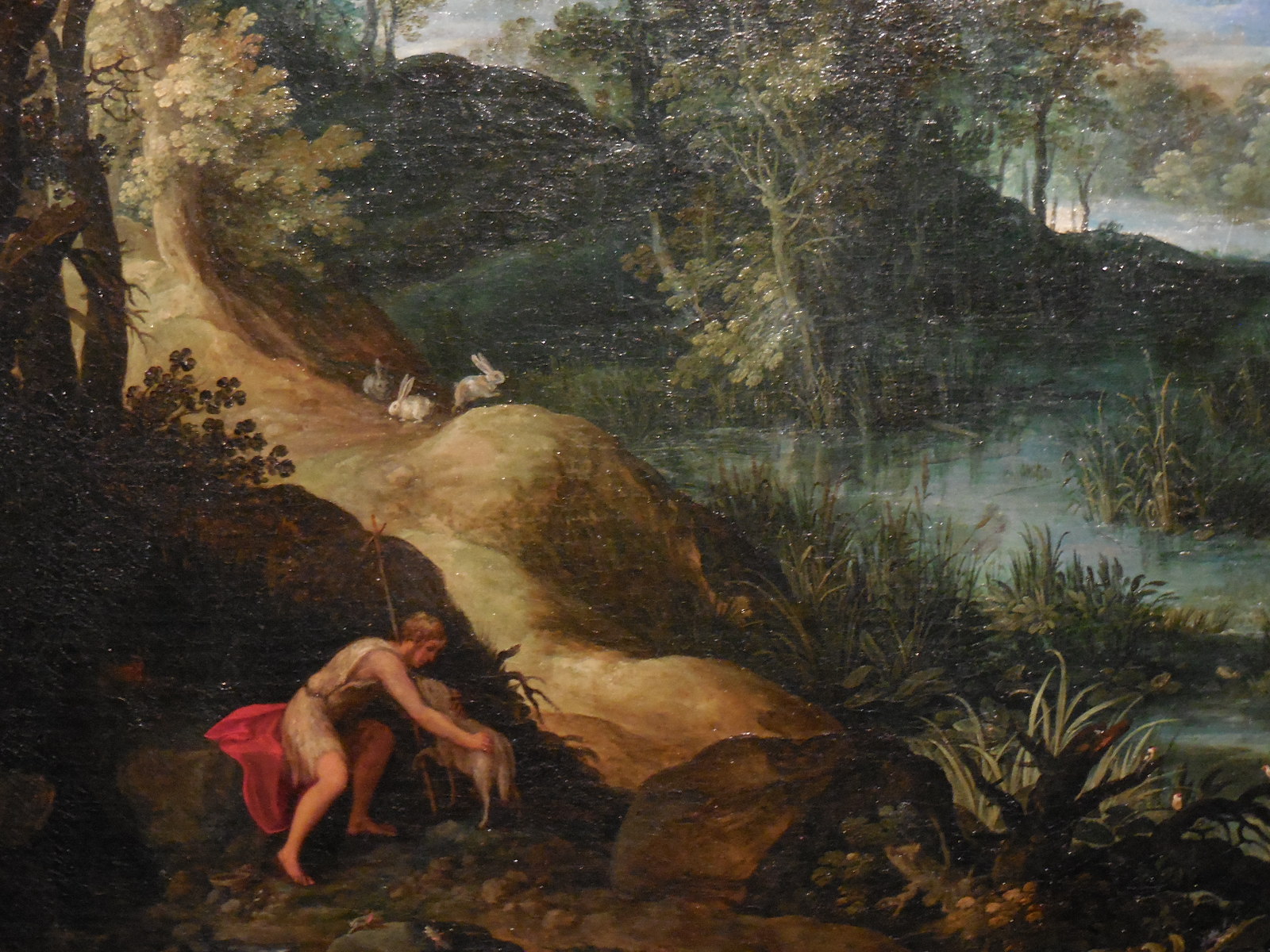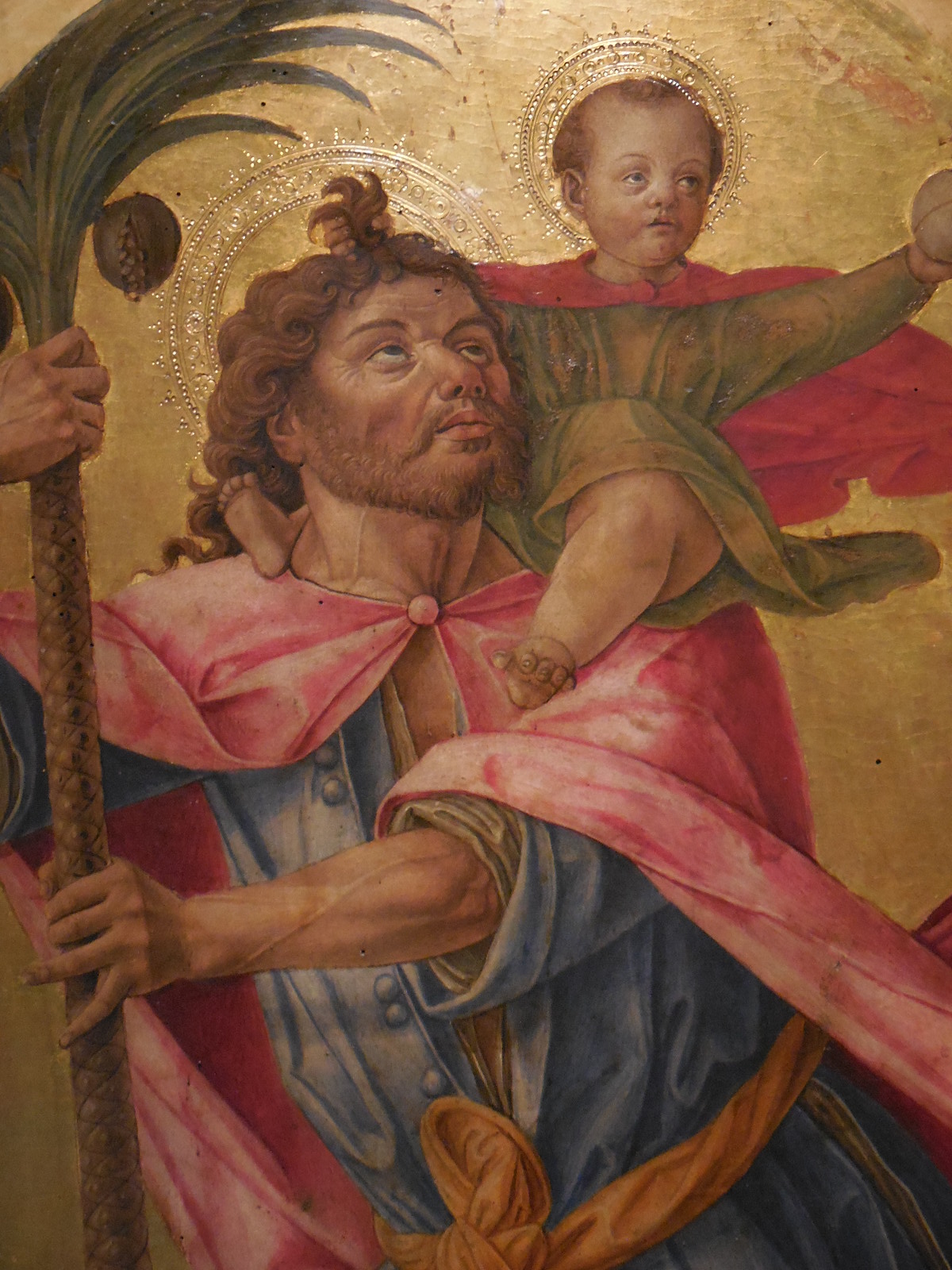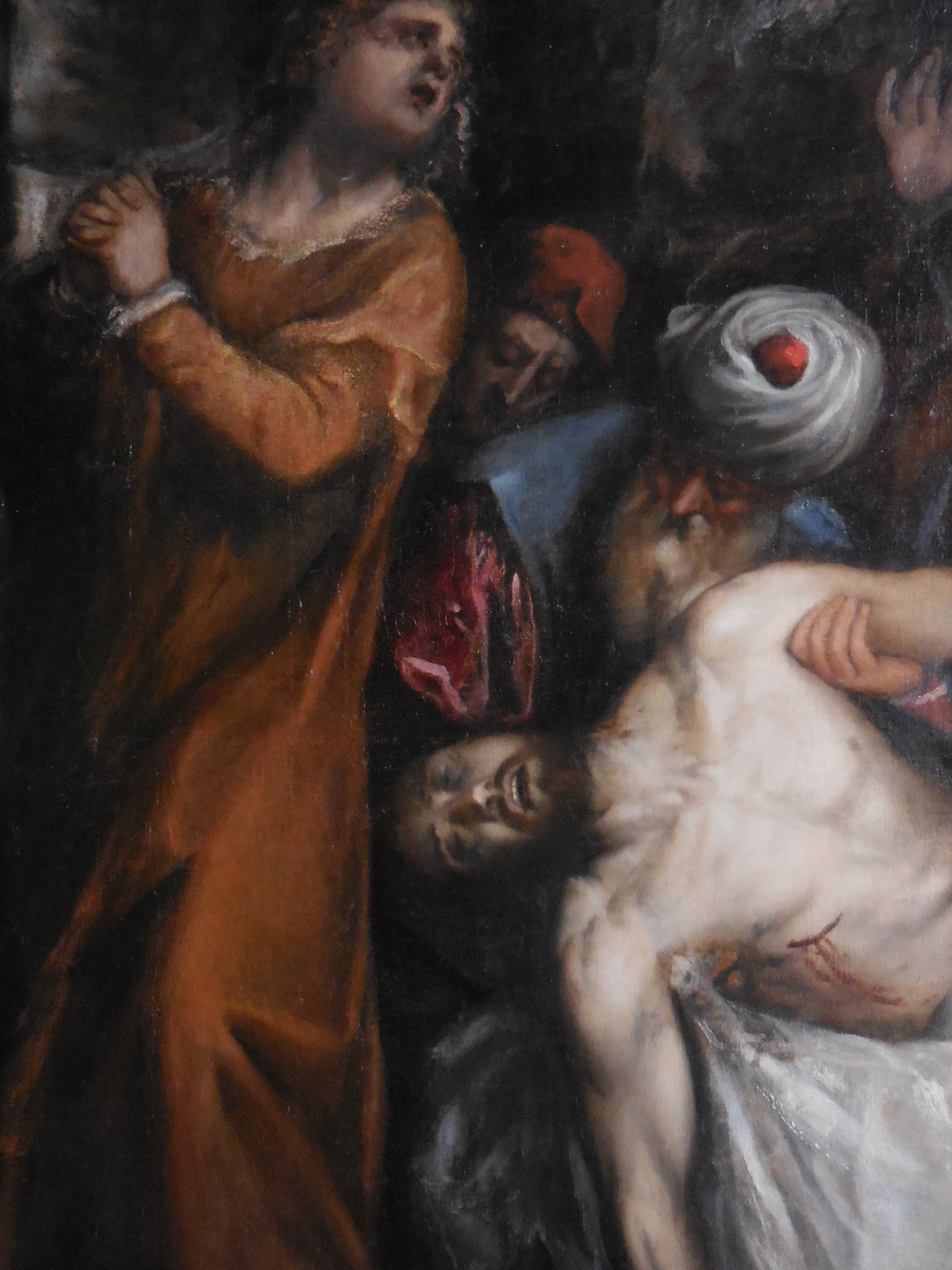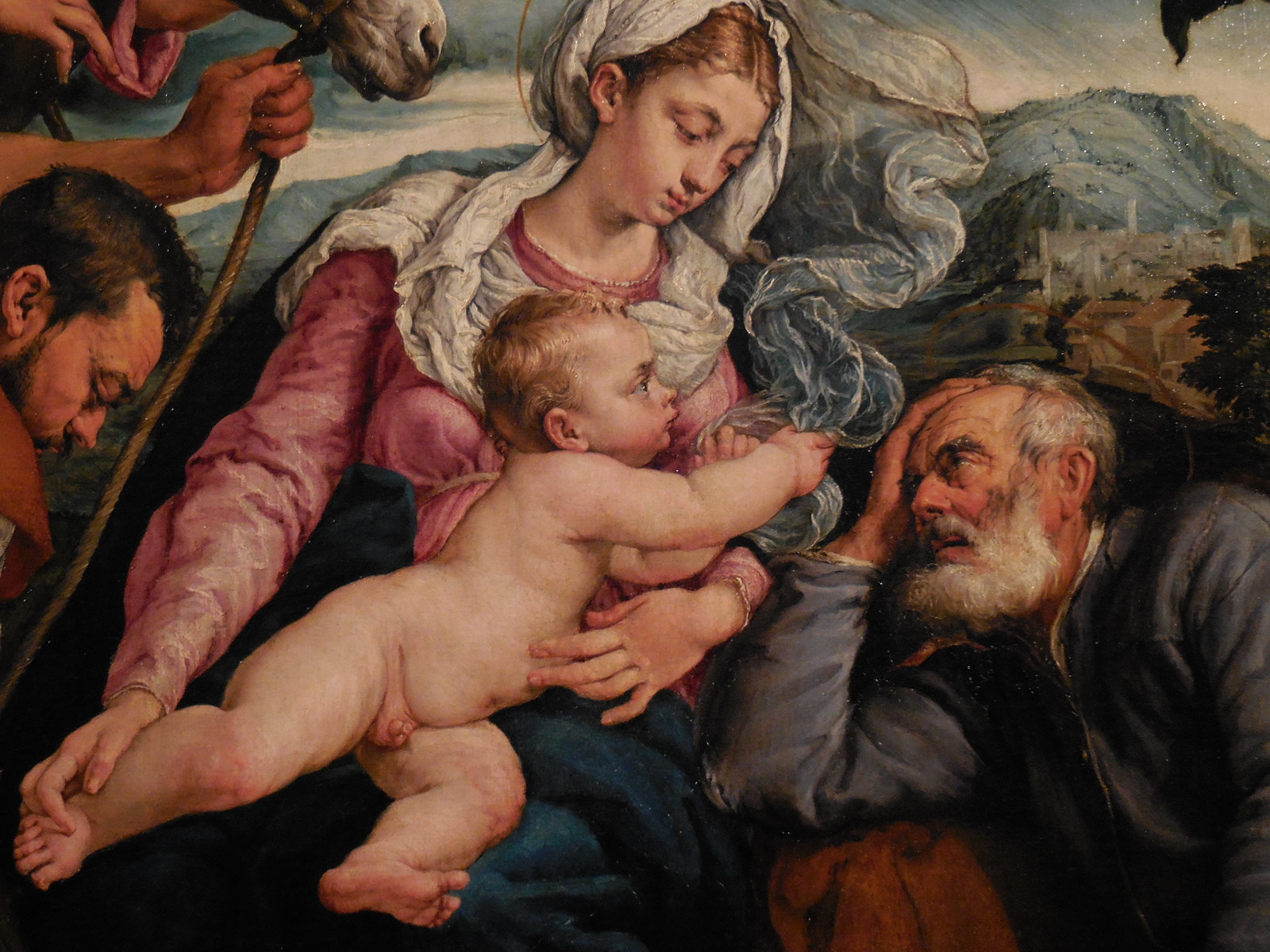
Paul Gauguin Exhibition in Vienna Diary

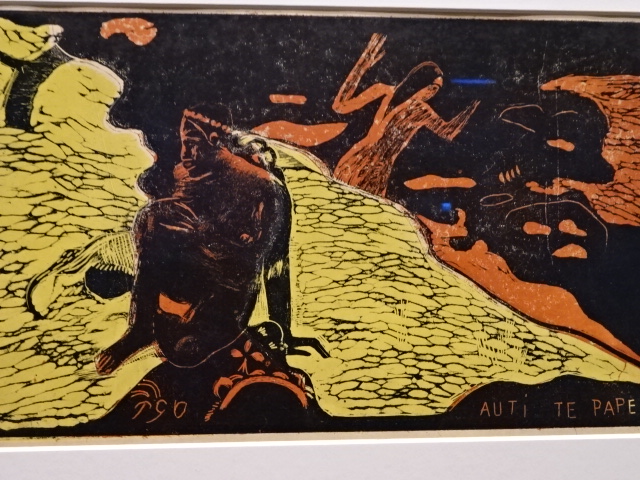
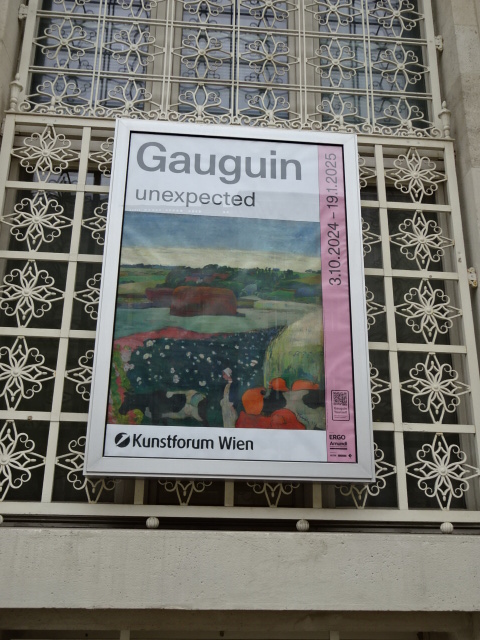
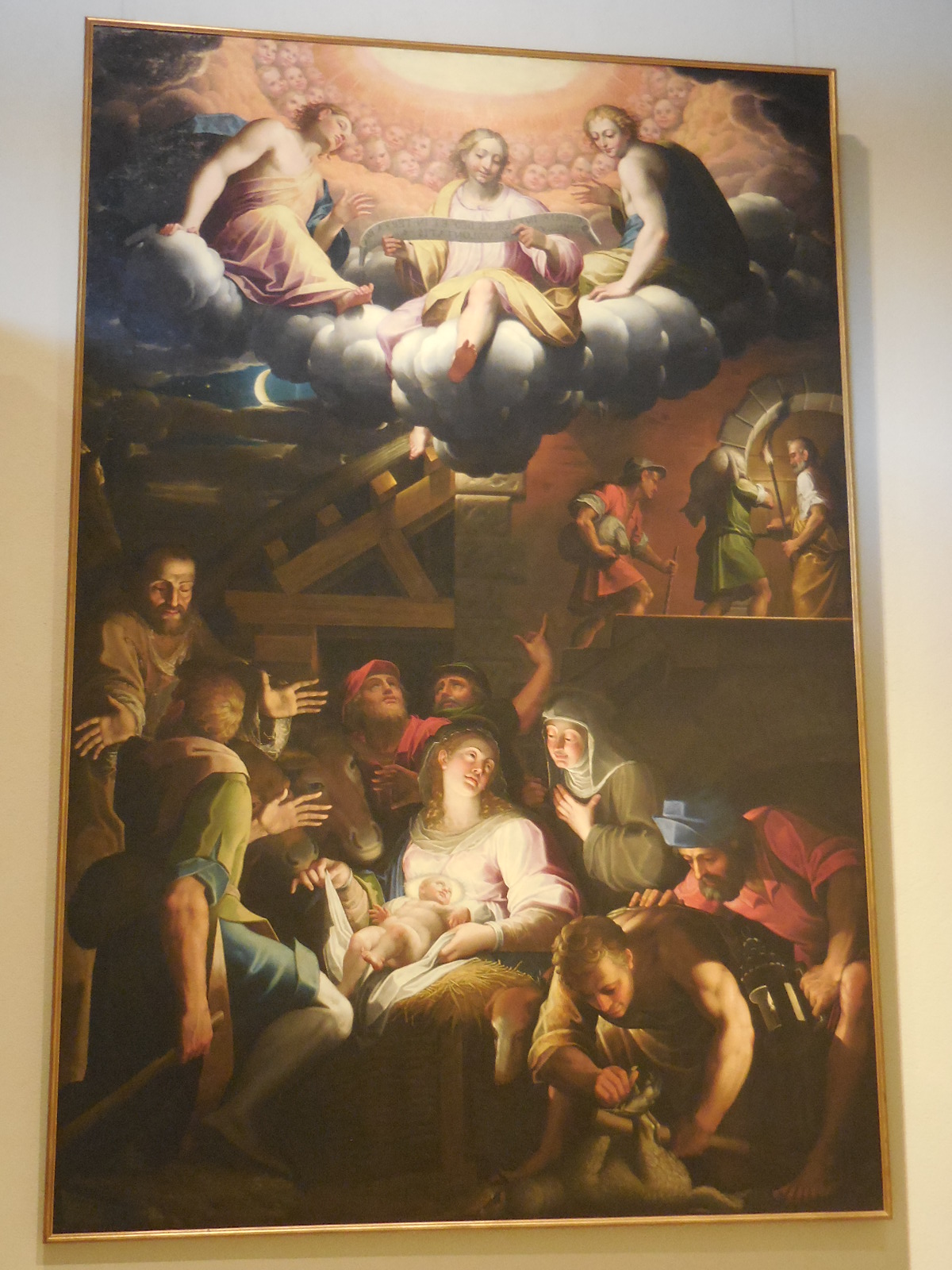
During the fall of 2024, I went to the Paul Gauguin retrospective “Gauguin Unexpected” in Vienna, Austria at the Kunstforum Wein. The last extensive showing of Gauguin’s works in Austria had taken place during 1960. The recent exhibition included not only Gauguin’s paintings but also graphic art and sculpture, tracing his career from Post-Impressionism to the initial stages of the modern era. More than 80 works were on display from October of 2024 to January of 2025. 

Eugene Henri Paul Gauguin was born in Paris on June 7, 1848, the revolutionary year of turmoil in Europe. At the age of 18 months, he and his parents moved to Peru because his father had to leave France. He was related to high-ranking politicians there. However, his father died during the voyage and never made it to Peru. Gauguin and his mother lived a privileged life there. Due to political turmoil in Peru, Gauguin returned to France when he was still a child. Gauguin would serve in the French navy before becoming a stockbroker at age 23.

In his early career, he worked in Impressionist style and had exhibitions of works in this style during the early 1880s. He worked as a stockbroker for 11 years, and in 1873 married Mette-Sophie Gad from Denmark. They had five children. His marriage fell apart in 1882, when he turned to painting full-time, a time when stock market prices plummeted. He lived in Rouen and then Pont-Aven, where the works of Vincent Van Gogh, Georges Seurat and Eduard Degas impressed him so much that he changed his style. His Post-Impressionist works were unique in use of color, which was the dominant feature of the paintings. His thick and bold brushstrokes also played a major role.

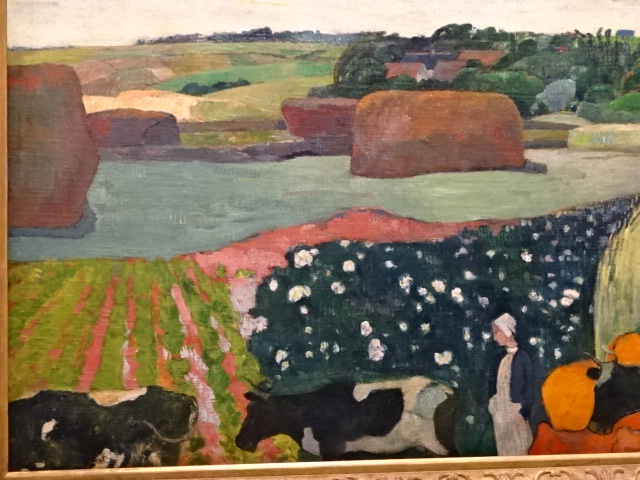
In the summer of 1886, he was influenced by the Pont-Aven School and spent time in Brittany, where he created many landscapes and pastel drawings. I liked his Brittany-based landscapes from this period as well as the scenes of everyday life in this region of France. His employment of Synthesist features comes from this time period of bold colors and dark outlines. Complexity was absent in the subject matter of this time in his career. He pictorially recorded simple, daily life in Brittany. He also thought that African and Asian art held great significance. Japanese art especially enthralled him. Then travels took him to the Panama Canal and Martinique, where he was influenced by Indian people and Indian symbols. His landscapes from his tenure in Martinique are very noteworthy, as I found out at the exhibition.

For a while, he lived with Van Gogh at Van Gogh’s Yellow House in Arles. Van Gogh had bought three of Gauguin’s paintings and held him in great esteem. However, the two had a falling out, and Van Gogh even cut off his ear when Gauguin was present. That’s when Gauguin left Arles.

In the late 1880s, Gauguin began making zinc plates or zincographs. Rejecting the traditional limestone material, he opted to use zinc plates combined with yellow poster paper, which made for bold creations in bright yellow. One of my favorite features of this exhibition was the number of zincographs displayed. Some showed female forms with black outlines on a bright yellow background. The result was stunningly bold and brazen.

Entranced with the exotic and a supporter of colonialism, Gauguin wanted to flee from Western civilization. After six years in Tahiti, which was under French colonial rule that took advantage of natives, Gauguin left but decided to settle again in the Polynesian Islands during 1895 and never to return to Europe. His works showed off the Primitivism style as he depicted island natives as well as gods in the traditional religion via painting and sculpture. The colors were brash, overly aggressive, the settings wild. His figures did not have realistic boy proportions and showed off geometric qualities. In Tahiti he often produced his works on a rough surface, such as sackcloth or hessian. He used thick and bold brushstrokes. His Primitivism style would greatly influence Pablo Picasso’s works. I was impressed how the exhibition did not fully focus on his time in Tahiti but took into consideration his entire career equally.

Gauguin experienced problems with his heart, sight and ankle, for instance. He took morphine for the pain. At the end of his life, he spent much time writing as his pain sometimes did not permit him to paint. On May 8, 1903 Van Gogh died from syphilis in the Marquéses Islands at age 54.

A sign at the entrance to the exhibition addressed Gauguin’s sexism and promotion of post-colonialism, inviting people to look at Gauguin’s work in these contexts. Gauguin had married three young teenagers at various times while living in the Polynesian Islands. Gauguin’s use of Primitivism showed Polynesian women in a racist way, and his works from this era pictorially asserted the power of colonialism. I was impressed with the curator’s attention to the present perspectives.

Overall, I was most impressed by the Brittany and Martinique landscapes as well as by the zinc plates. I had mostly seen Gauguin’s work from his Tahiti tenure. I was glad to get an overview of his work throughout the decades and to see how he developed as an artist in a chronological manner. His use of vibrant color and bold brushstrokes also spoke to me.

Tracy A. Burns is a writer, proofreader and editor in Prague.

Marc Chagall Exhibition in the Albertina Photo Diary

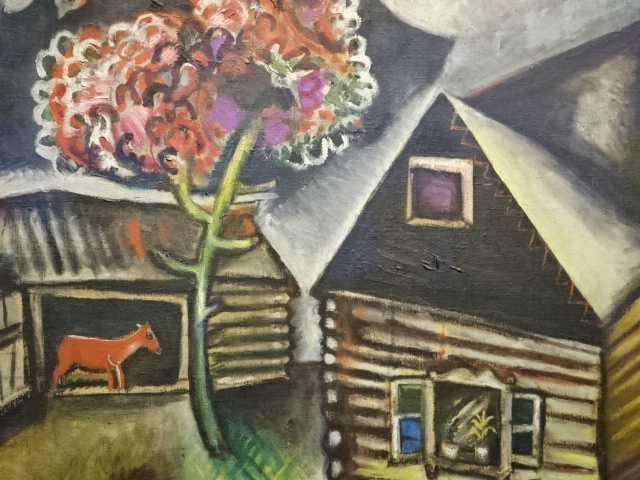
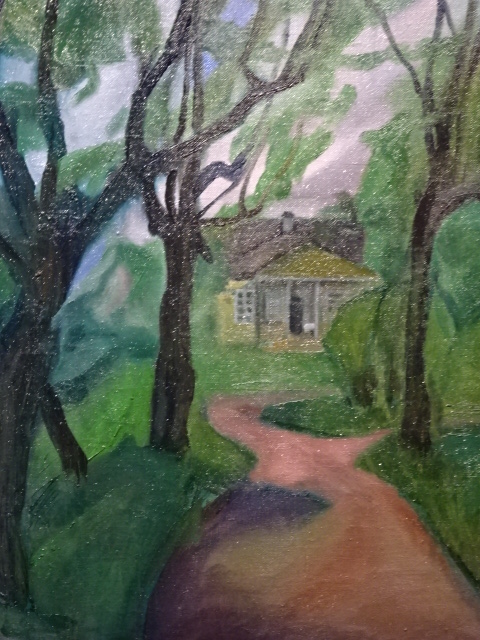
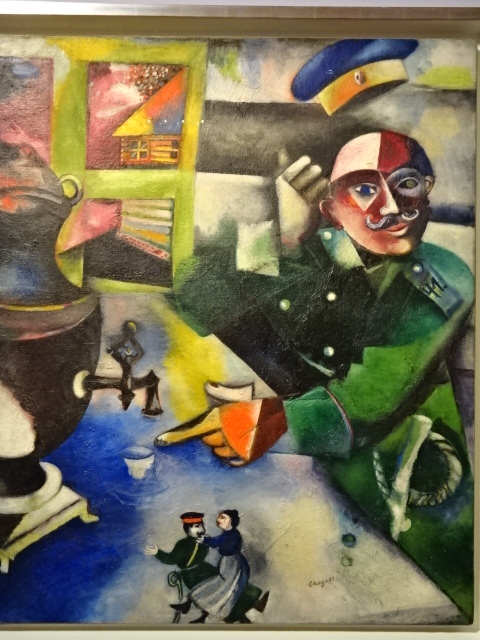
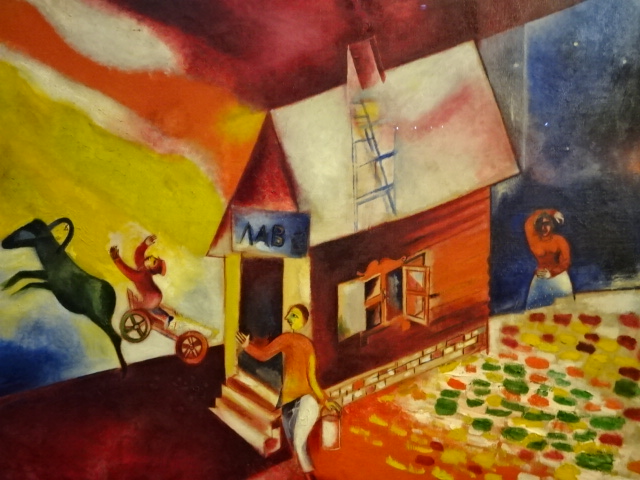
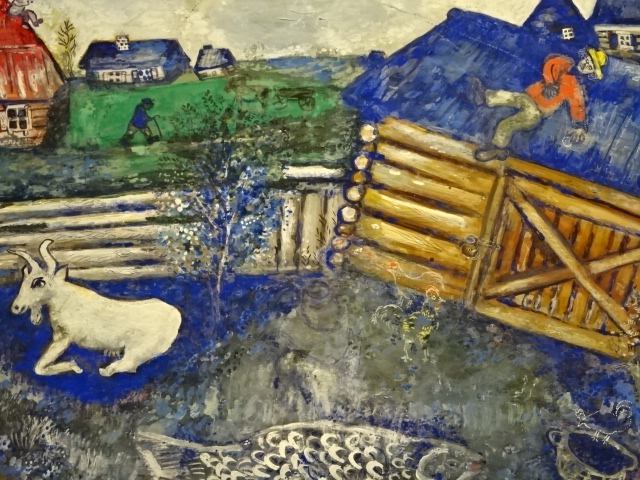
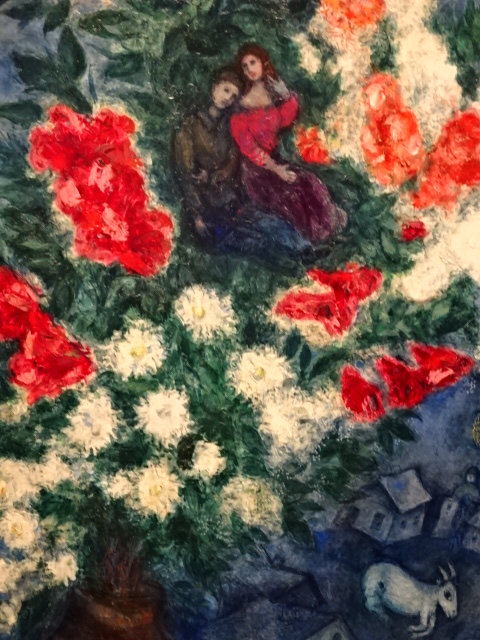
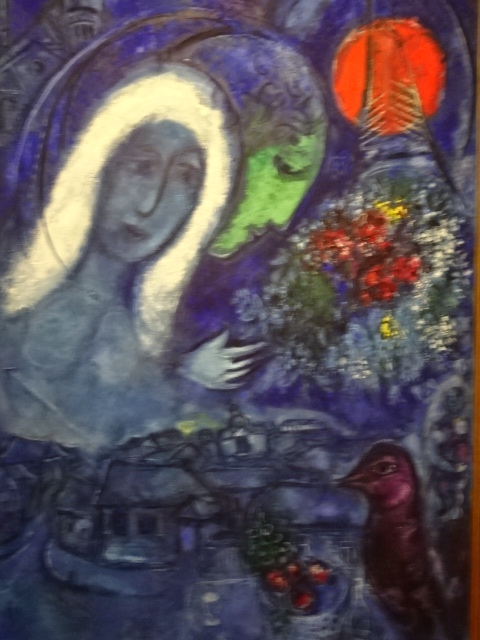
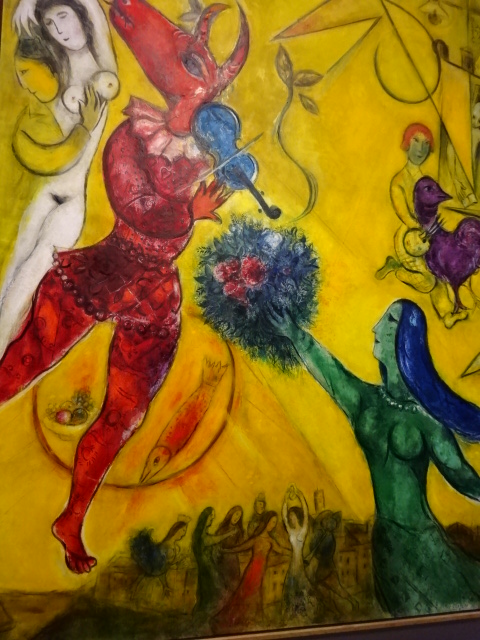
I admired Marc Chagall’s works at the Albertina venue in Vienna, Austria during late October of 2024. I have always loved going to exhibitions in the Albertina. I recalled a comprehensive show of works by Durer at that venue some years ago. A long-time fan of Chagall, I loved his use of bright colors and atmosphere of playfulness in his paintings that had a dreamy, fantasy-filled quality. I was enamored with his mastery of color to express various emotions and to create new worlds. I loved his renditions of Paris, the Eiffel Tower often dominating his creations.

Before this show I hadn’t realized how strongly his Jewish background had influenced his art. Chagall’s paintings were punctuated with Jewish folklore and motifs. I saw a painting of a synagogue and portraits of rabbis, for instance. Many paintings boasted biblical themes. I also hadn’t realized how often he had rendered his hometown, both sadness and joy intermingled in the memories. His yearning to return to his hometown was extremely visible in his art.

The symbolic nature of his artistic creations also enamored me as I noted the many violinists, animals, half-human creatures, wooden houses, circus characters, roosters and floating married couples as well as beautiful floral arrangements. Because I had visited an exhibition in Prague’s Wallenstein Riding Stables about the interwar years of the École de Paris movement, I knew he had been associated with that era during his Paris sojourn.

The exhibition allowed me to become better acquainted with the artist’s life. Marc Chagall (1887-1985)was born as Moishe Shagal on July 6, 1885 into a Hasidic Jewish family in Vitebsk, located in today’s Belarus. During the late 19th century the town was situated in the Russian Empire. His impressive, varied resume includes paintings, drawings, book illustrations, ceramics, prints, tapestries, stained glass and stage sets, but this vast exhibition focused solely on his paintings.

While he spent World War I in his hometown, he went to Paris before the war broke out, moving there in 1910 when he was 23 years old. In France he made friends with Guillaume Apollinaire, Ferdinand Léger and others creating avant-garde works. He often depicted Jewish themes and also evoked Paris in many paintings. During World War I, back in Vitebsk, he married Bella and held exhibitions in Russia as the war made it impossible for him to leave the empire. He founded an arts college in his hometown, too. However, he was in dire financial straits during the Russian Civil War. After World War I, much of his work was Moscow-based.

Following the Bolshevik Revolution, he moved to Paris for the second time, but fled during World War II after the Germans took control of France. The Nazis in occupied France took away Chagall’s French citizenship, and he and his wife were arrested. However, with the help of others, he and his wife found a way to escape to the USA. He felt like an outsider and didn’t speak English.

While he was in New York City, tragedy struck his hometown of Vitebsk, which was destroyed by the Nazis. Things would get even worse. Bela passed in1944 because it was not possible to get her any penicillin. It was no surprise then that Chagall’s late spouse appeared in many of his paintings. In 1948, though, he returned to Paris, and there his paintings focused on Jewish themes and his yearning for the existence of his hometown. Also, he would marry two more times.

He devoted much time to other fields as well. Some of his accomplishments included creating stained glass decoration in the cathedral in Reims and at the Art Institute in Chicago. He also made stained glass adornment for places in Switzerland and Israel. He became even better known for his ceiling painting of the Paris Opera. I remembered gazing in awe at this ceiling several decades ago. It was an experience I will never forget, even though I saw it so long ago. He also made sculpture and ceramics as well as tapestries.

Chagall died at the age of 97 on March 28, 1985 at the age of 97. He is buried with his third wife in a cemetery in Saint Paul-de-Vence, located in the Provence region.

Tracy A. Burns is a writer, proofreader and editor in Prague.

The Art of Mannerist Printmaking Exhibition Diary

Caricature of Laocoon, Niccolo Boldrini, 1540-45, woodcut.

In the exhibition “From Michelangelo to Callot: The Art of Mannerist Printmaking,” held at Prague’s Wallenstein Riding Stables, I studied more than 200 works of 16th and 17th century graphic art, drawings, paintings, jewelry, etchings, lithographs, ceramics and other artistic crafts that hailed from the Netherlands, Germany, France and the Czech lands. The Louvre lent Prague’s National Gallery many works. Some pieces in the collections were being displayed to the public for the first time. A superb small drawing by Michelangelo drew crowds, and art by Hendrick Goltzius, Paul Bril,  Aegidius Sadeler and Niccolo Boldrini stood out to me.

The Great Hercules, Hendrick Goltzius, 1589, engraving.

While Mannerism became a major trend during the 16th century in Italy, Northern Mannerism lasted into the 17th century. Because European artists north of the Alps did not have as many opportunities to travel to Italy in order to familiarize themselves with Mannerism, they often studied the style through prints and books. The decoration at the Chateau of Fontainebleau impressed many artists utilizing this style, and France was the center of the Mannerist movement. The Northern Mannerists also looked to da Vinci, Raphael, Vasari and Michelangelo for inspiration.

The Martyrdom of Saint Lawrence, Cornells Cort, 1571.

The Northern Mannerist style was very visible in Holy Roman Emperor Rudolf II’s collection in Prague, then the capital city. Influenced by prints, Mannerism appeared in Prague during 1576. An avid art collector, Emperor Rudolf II had hired the Flemish painter Bartholomeus Spranger and German artist Hans von Aachen to work for him, and they produced some works in Northern Mannerist style. Both Spranger and von Aachen were known for their Mannerist mythological scenes while von Aachen also concentrated on portraits of the emperor. Rudolf II’s father, Emperor Maximillian II, had chosen Giuseppe Arcimboldo as one of his painters, and Arcimboldo’s fantasy-filled still lifes and portraits feature Mannerist traits. This style also suited Rudolf II when he took over for his father.

The Combat of the Monkey and the Rat, Christoph Jamnitzer.

Mannerist art often included mythological scenes, the grotesque and fantasy. Harmony, symmetry and rationality were notably absent. While Mannerists showed a great interest in anatomy, the figures were often elongated, and many forms had a sculptural quality. Clothing was elaborate. Attention to detail prevailed. Complex and unstable poses as well as dramatic lighting also characterized the Mannerist style. Artists of this era liked to employ symbols and utilize hidden meanings in their works. Black backgrounds were common. A distorted perspective was employed. Mannerism did not often feature religious themes. After Mannerism came the Baroque style, which focused heavily on religious art.

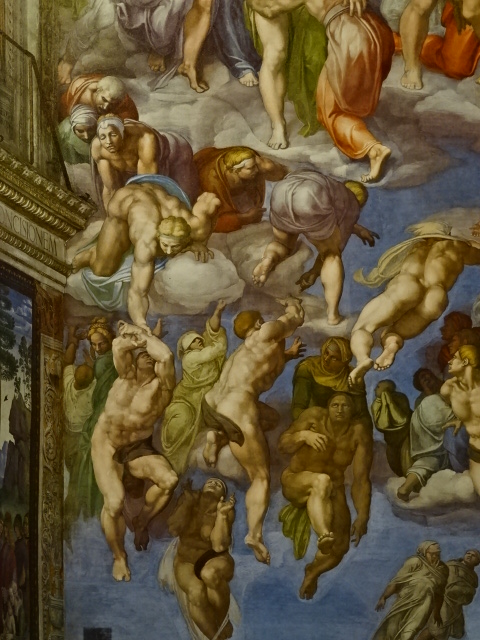
The Last Judgment, Michelangelo, 1536-1541.

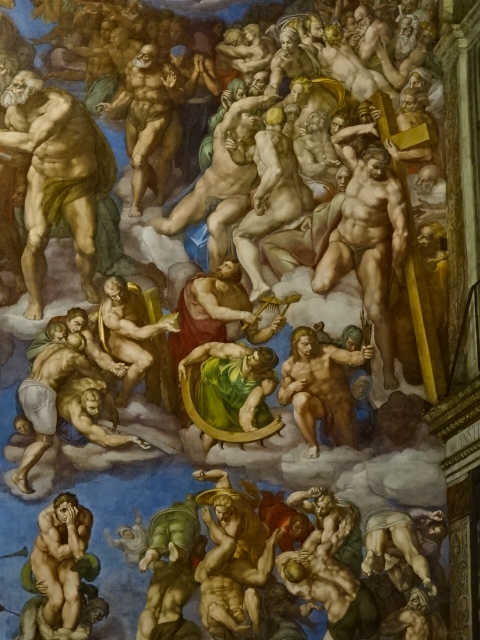
The Last Judgment, Michelangelo.

The Last Judgment, Michelangelo.

The Last Judgment, Michelangelo.

A copy of a section of “The Last Judgment” as seen in the Sistine Chapel was on display at this exhibition, as this masterpiece greatly influenced Mannerist art. This fresco at The Vatican portrayed more than 300 figures as the dead made their way to idyllic Heaven or horrific Hell. Mythological figures and devils appeared along with a beardless Jesus Christ, the Virgin Mary and saints. I noticed the looks of horror on descending figures. Details in superb portrayals of human anatomy greatly impressed me.

Head of a 12-Year Old Christ, Albrecht Durer, 16th century.

For me, German Albrecht Durer’s 16th century “Head of the 12-year old Christ” was one of the highlights in the exhibition. Durer was a master of High Renaissance printmaking, especially of woodcuts and engravings. He inspired Raphael and Titian. I realized how Durer’s portrayal of human anatomy had impressed Mannerists. While most works displayed did not focus on religion, the Mannerist engraving “The Martyrdom of Saint Lawrence” from 1571 also caught my attention. Cornells Cort created it in the style of Titian.

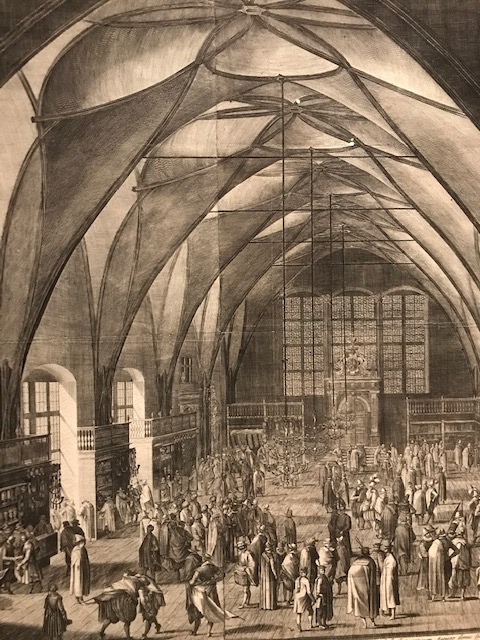
Vladislav Hall, Aegidius Sadeler, 1607.

Some prints showed off specific architectural structures, such as Aegidius Sadeler’s Vladislav Hall from 1607. A fan of Czech architectural history, I was especially engrossed in this rendition of the late 15th century and early 16th century section of Prague Castle built by Benedikt Reid. I loved its complex vaulting system. I noticed Late Gothic and Renaissance elements of the building. This was one of my favorite buildings in Prague due to its exquisite vaulting and its past use for historical events, such as coronations and knights’ tournaments.

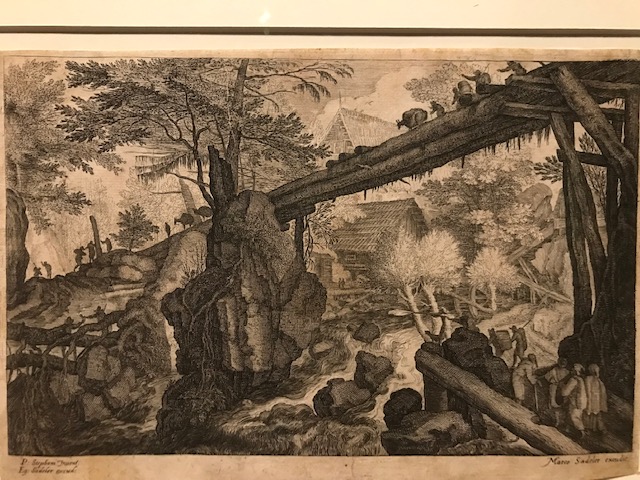
Wooden Bridge from Series Eight Bohemian Landscapes, Aegidius Sadeler, 1605, engraving.

Mountain Landscape, Paul Bril.

Another work by Sadeler, created in the style of Pieter Stevens, was the landscape “Wooden Bridge from Series Eight Bohemian Landscapes.” The 1605 engraving of the idyllic, romantic bridge reminded me of picturesque Vermont, where I had lived for a while. I was also enamored with “Mountain Landscape” by Flemish painter and printmaker Paul Bril. Inspired by my favorite artist Pieter Bruegel the Elder, Bril authored works in the Vatican and Italy. I appreciated the power and beauty of nature as I peered at these two tranquil landscapes.

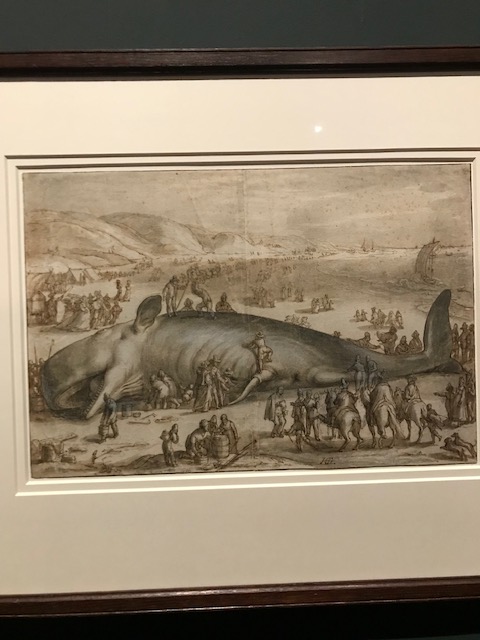
Beached Sperm Whale near Berkhey, Hendrick Goltzius, 1598.

A prominent name in the exhibition, Henrick Goltzius was a stellar printmaker whose works were influenced by drawings he acquired from Prague. My favorite of his contributions was “Beached Sperm Whale near Berkhey” from 1598. People gathered around the gigantic, deceased animal. This artwork was inspired by a real event as a 58-foot long whale had washed up on that shore.

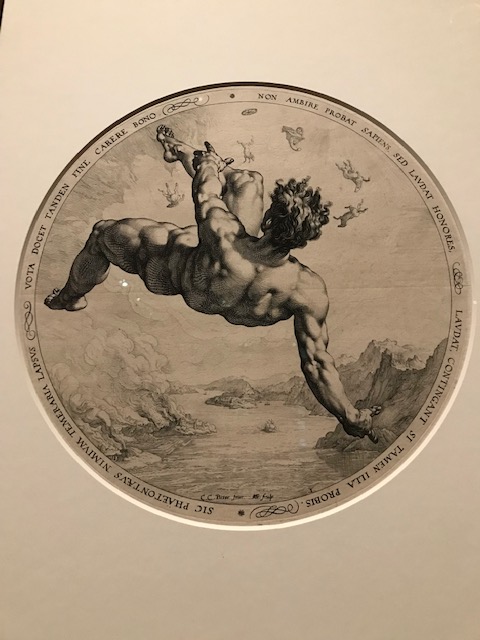
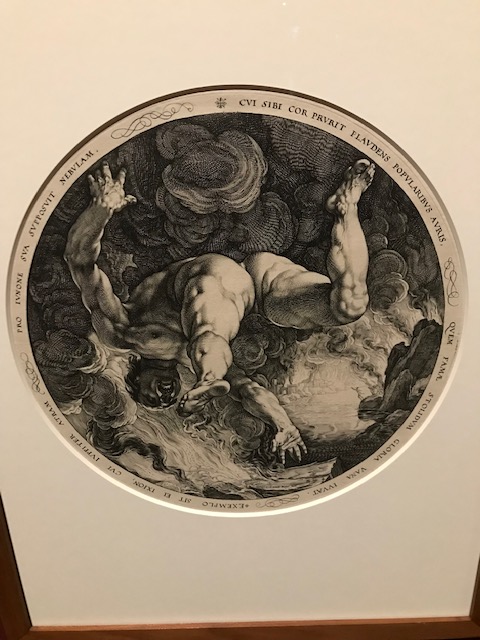
The Four Disgracers, Hendrick Goltzius, 1588, engraving.

The Four Disgracers, Henrick Goltzius, 1588, engraving.

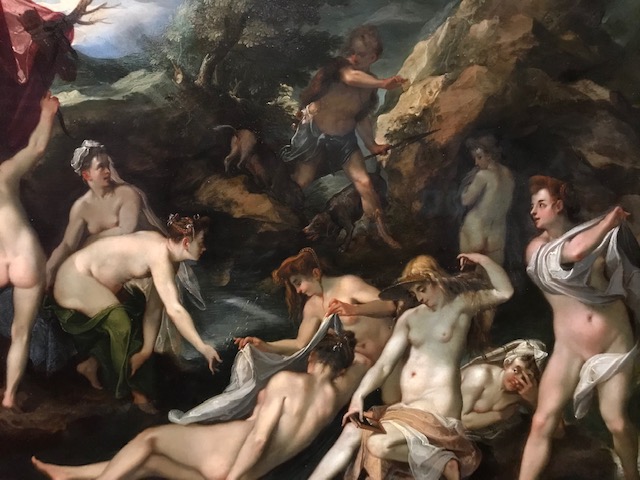
Goltzius also took on mythological themes, such as his rendition of “The Four Disgracers (Tantalus, Icarus, Phaethon and Ixion).” This engraving appeared to have a three-dimensional quality. The illusion of three-dimensional features, mastered by engravers in the Netherlands during the late 16th century,  was often featured in Northern Mannerist art. Goltzius was the author of “The Great Hercules,” an engraving from 1589. The detailed anatomy, though not correct, interested me. Other works with mythological themes that caught my attention were “Diana and Actaeon” by Joseph Heintz the Elder from 1597 to 1598 and Niccolo Boldrini’s “Caricature of Laocoon,” a woodcut from 1540 to 1545.

The Pairs of Grotesque Heads, Philippe Soye, 1550-65.

The grotesque played a significant role in Northern Mannerist creations. Philippe Soye rendered “The Pairs of Grotesque Heads” after a masterpiece by da Vinci. Soye’s portrayal hailed from 1550 to 1565. Christoph Jamnitzer also stressed grotesque features in his “The Combat of the Monkey and the Rat.” I was also impressed with the masked figures in “Venetian Carnival,” a 1595 engraving by Pieter de Jode the Elder. Seeing the grotesque made me think of gargoyles on cathedrals, such as Milan’s Duomo or Saint Vitus’ Cathedral in Prague.

Fantastic Sea Creatures, Nicolaes de Bruyn, 1594, engraving.

Prints with scenes immersed in the fantasy world made numerous appearances. At the end of the 16th century, Nicolaes de Bruyn became known for his portrayal of animals and fictional sea creatures. His “Fantastic Sea Creatures,” depicted here from a series, was an engraving that made up part of a book about fish. Engravers often worked with fantasy themes in this style.

Diana and Actaeon, Joseph Heintz the Elder, 1597-98.

A section of the exhibition was devoted to Northern Mannerist decoration of objects such as vases, plates, mirrors and jewelry. Adornment was often floral or geometric, and I noted similarities to illuminated manuscripts. Artists of this sort of ornamentation were inspired by the grotesque, mythological figures and Roman wall paintings, for instance. I saw examples of mythological themes and the grotesque in the decoration of a majolica plate from the second half of the 16th century. A 16th century black enamel mirror exuded elegance with Mannerist designs.

Venetian Carnival, Pieter de Jode the Elder, 1596, engraving.

The exhibition was comprehensive, divided into clear sections. I was drawn most to the landscapes as I was reminded of the work of Pieter Bruegel the Elder. I also thought of Paul Bril’s creations in Milan’s Ambrosiana Picture Gallery. It was intriguing that the scenes on many prints showed the main figures in the background and the lesser important ones in the foreground. I liked the decorative patterns that were influenced by illuminated manuscripts. I spent my fortieth birthday gazing at the Sistine Chapel and mulled over the experience of seeing those writhing, terrified souls guided by devils and the blessed blissfully ascending into Paradise. I also thought of the awe-inspiring experience of walking into Vladislav Hall because I loved Late Gothic vaulting. That print captured the daunting atmosphere perfectly. Seeing a masterpiece by Durer brought me back to an exhibition of his works at the Albertina in Vienna some years ago. I could hardly catch my breath because I had been so impressed. I had learned a lot about Mannerism from this exhibition and had discovered works that I would never forget.

Tracy A. Burns is a writer, proofreader and editor in Prague.

House Museum Poldi Pezzoli Diary

One of Milan’s four house museums, the Poldi Pezzoli was a highlight of my two trips to the city I love so much. The variety of art exhibited made this a top attraction for me. The collections include paintings, sculpture, weapons, tapestries, furniture, glass, ceramics, watches, clocks, goldsmiths’ work and jewelry, for instance. Artists whose works are represented  include Andrea Mantegna, Giovanni Bellini, Sandro Botticelli, Michelangelo Buonarroti, Canaletto, Francesco Hayez and Lucas Cranach the Elder.

I favored the medieval paintings, but each space had something extraordinary to offer. The Golden Room with its 15th century collection enamored me as did the elaborate, superb furnishings of the Dante Room. The Black Room had six masterfully crafted mahogany and walnut doors. The Lombard Room dazzled with north Italian Renaissance paintings.

The collections were amassed during the 19th century by Gian Giacomo Poldi Pezzoli, who had inherited much money. The Austrians exiled Gian Giacomo from Milan for one year after he supported the revolutionaries during a Risorgimento battle in Milan. He spent that year traveling, but then returned to Milan. Sadly, Gian Giacomo’s life was cut short in 1879, when, at the age of 57, he passed away in the palace’s Dante Study. The museum was opened to the public in 1881. During World War Two the palace was severely damaged. For example, the Neo-Gothic armory was destroyed. Many artifacts were lost. The museum underwent much restoration, not opening its doors again until 1951. The new armory opened much later, in 2000.

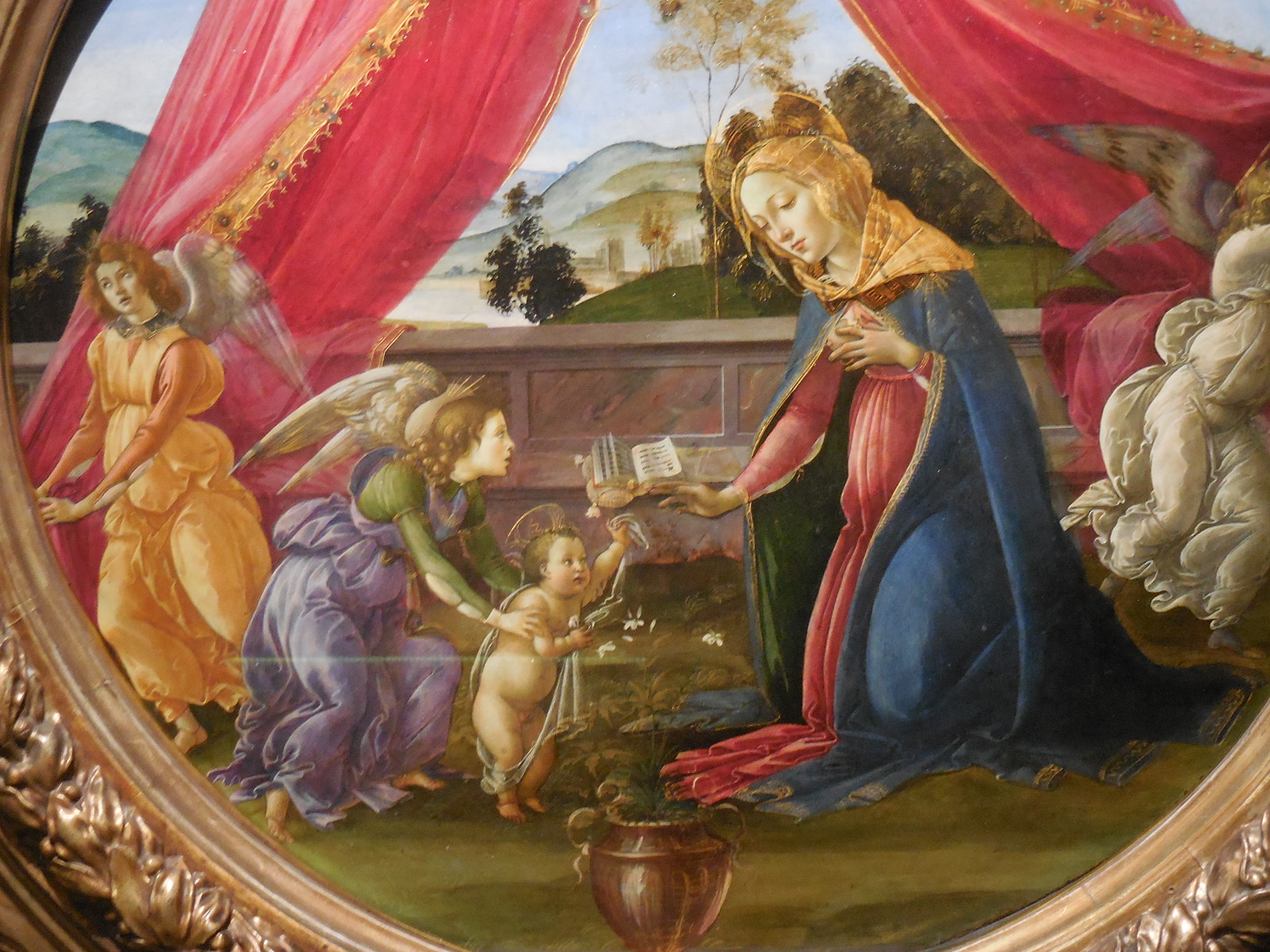
Numerous artworks enthralled me, but I would like to concentrate on several of the many that were remarkable. Some paintings that caught my undivided attention included Sandra Botticelli’s The Virgin and Child (the Madonna of the Book), dating from 1482-83. Showing the Virgin and Child reading, the painting reminded me of how important reading and literature have been in my life. The scene had a mystical appearance due to the superb lighting. I could understand how the act of reading has a sort of mystical power. The painting also exuded elegance.

Another religious rendition that left me in awe was The Madonna of Humility with Musician Angels by Zanobi Strozzi, hailing from 1448 to 1450. In this painting the Christ Child is seated on the Virgin’s lap as I can almost hear the musicians playing a sorrowful tune. Strozzi masterfully portrayed the texture of the clothing, such as Virgin’s red garment with its green lining and blue mantle. I felt as if I could touch the fabric of the veil on the Virgin’s head as it was also superbly rendered. The background was dominated by a stunning gold material.

My admiration of medieval art in the Poldi Pezzoli continued as I became enthralled with Filippo Lippi’s The Pieta (1440) in which the Virgin and Saint John the Evangelist hold up the limp Christ figure who has a gray complexion reminiscent of death. In the distance I saw a mountainous landscape.

Antonio Vivarini and his brother-in-law Giovanni D’Alemagna captivated me with their work, The Virgin and Child Enthroned with Two Angels. In this painting, perhaps part of a polyptych, the Madonna and Child’s throne is pleasantly situated in a garden, giving off a tranquil vibe. The late Gothic and Renaissance features of the throne, figures and landscape were striking.

A sculpture that particularly caught my attention was labelled The Virgin and Child, a Florentine masterpiece from 1280 with many Byzantine elements. While Jesus’ body parts aren’t all proportional, the two figures are nevertheless masterfully sculpted.

I was also enthusiastic about the tapestries. For instance, I saw the Tapestry with Esther Presented to Ahasuerus, made in Brussels in the late 15th and early 16th century. The stunning fabrics included wool, silk, silver and gold. One of the most significant Flemish tapestries in Italy, the masterful work takes its theme from the Old Testament. I noted the characters’ luxurious costumes, especially the king’s extravagant hat. The variety of colors also caught my attention.

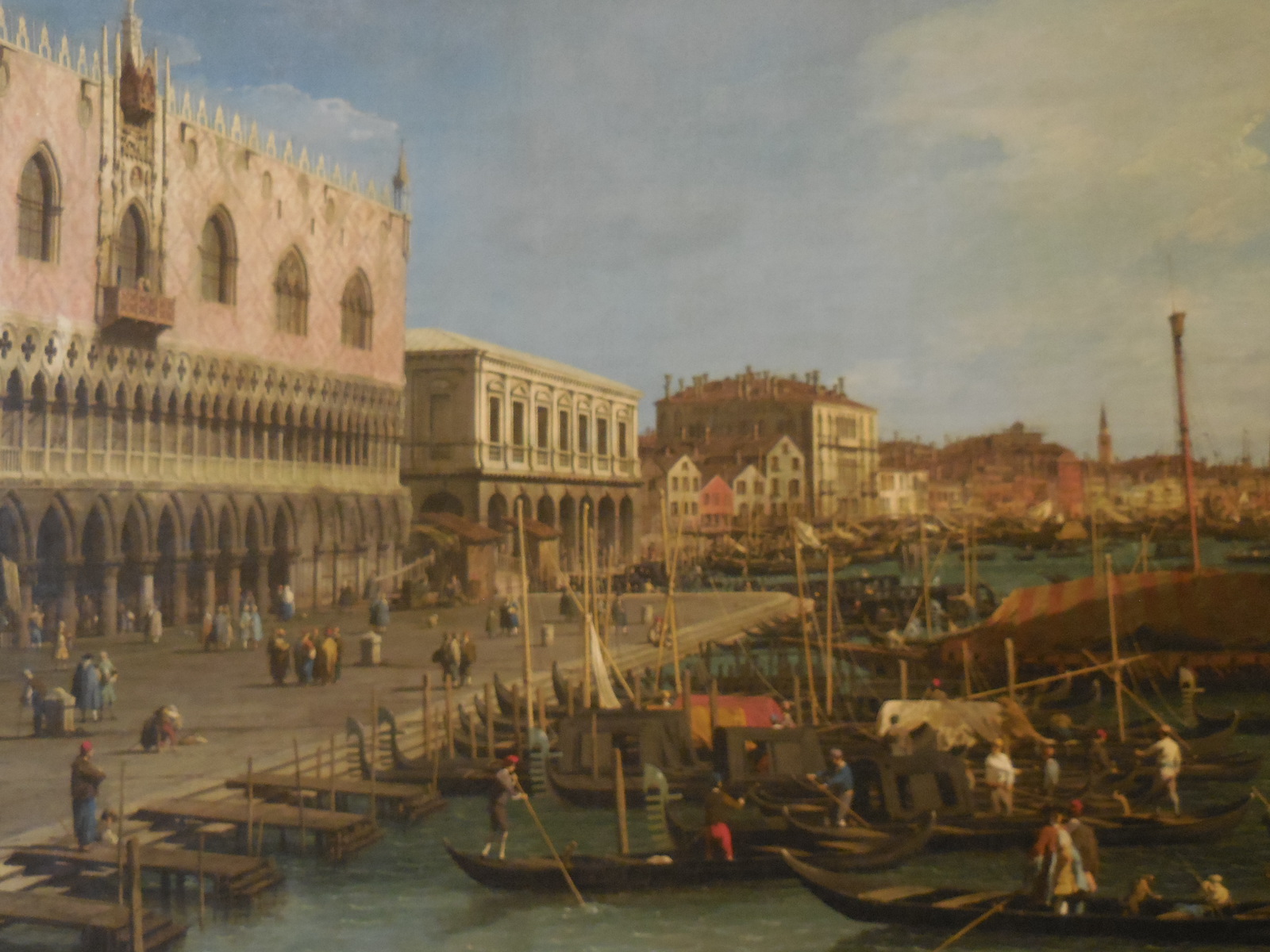
I also admired the Canaletto landscapes of Padua and Venice with all the architectural features of the cities. Looking at Canaletto’s works gave me a sense of Italian history as if I could go back in time and look deep into the painting as a witness of the scene portrayed. I fondly recalled the extensive exhibition of Canaletto’s work I had seen in Aux-en-Provence a number of years ago.

The armory, refurbished in 2000, included many 16th century weapons, such as a Borromeo helmet from the 16th century. Its exquisite gilded decoration was made up of designs of a unicorn and Saint Justine. The Gonzaga Helmet, also from the 16th century, was also gilded and showed off adornment of a crescent moon, leaves and flowers. I loved the meticulousness and precision of the designs.

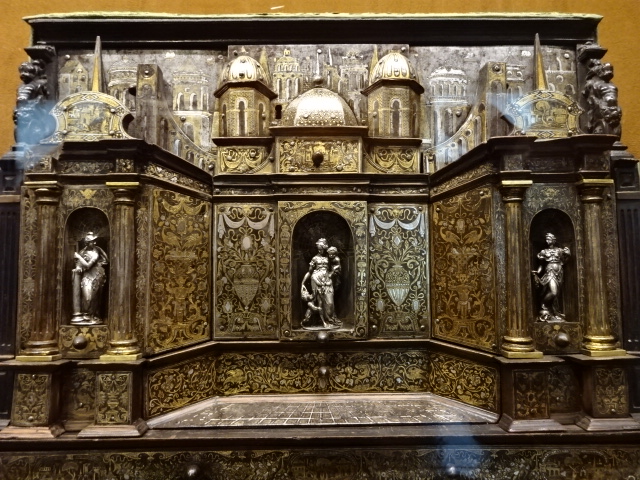
I admired the many stunning pieces of furniture, including the cabinets. One cabinet from the mid-17th century was made of ebony, bronze, silver and semi-precious stones. The small drawers were exquisitely decorated.

My favorite piece of porcelain was a Meissen called The Tooth-Puller from 1750. The woman looked terrified as the evil man held her jaw in an almost violent manner. The facial expressions of terror and evil were well-crafted. I liked the use of the color purple in the designs: the wig-clad tooth-puller was dressed in purple, and the woman wore a purple jacket. Her white skirt was decorated with a purple floral design. The collection included over 80 European porcelain pieces from the 18th century.

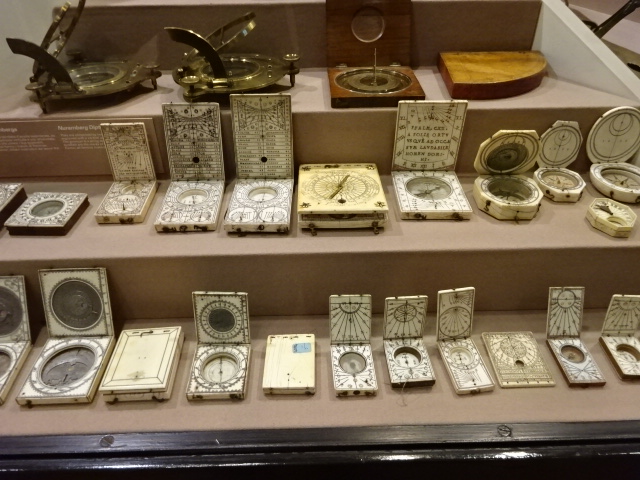
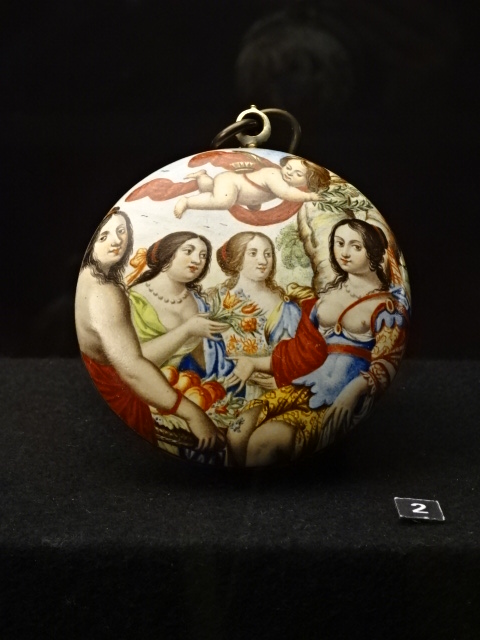
I also admired the decorations on the watches hailing from the 16th to 18th centuries and the various designs of the many clocks and sundials. The jewelry and Murano glassware also captured my undivided attention.

This museum housed such a wide array of stunning artifacts in an intimate setting. I loved the house museums in Milan, and visiting the Poldi Pezzoli was certainly one of my most treasured memories of the Italian city that I hold so dear to my heart.

Tracy A. Burns is a writer, proofreader and editor in Prague.

Museum of Inlaid Wood in Sorrento Diary

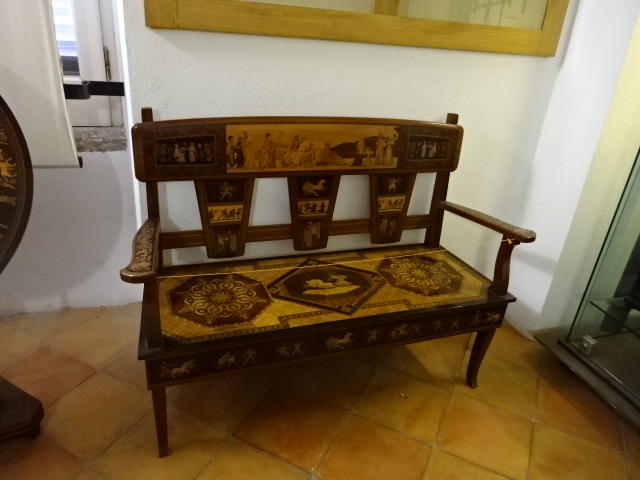
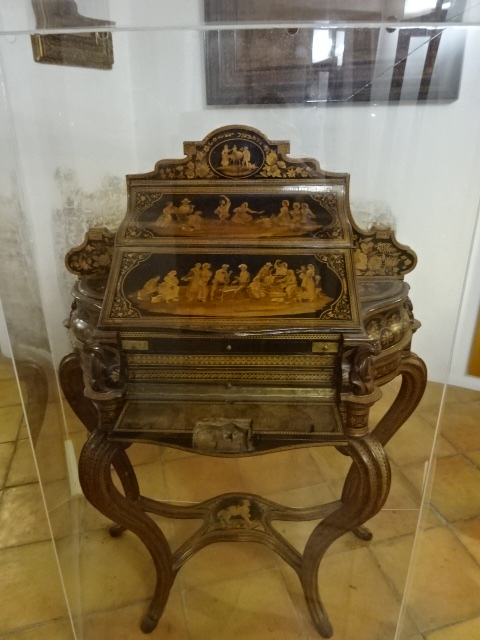
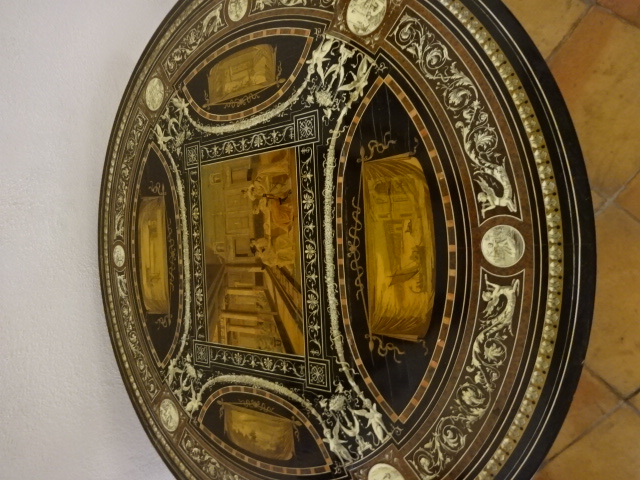
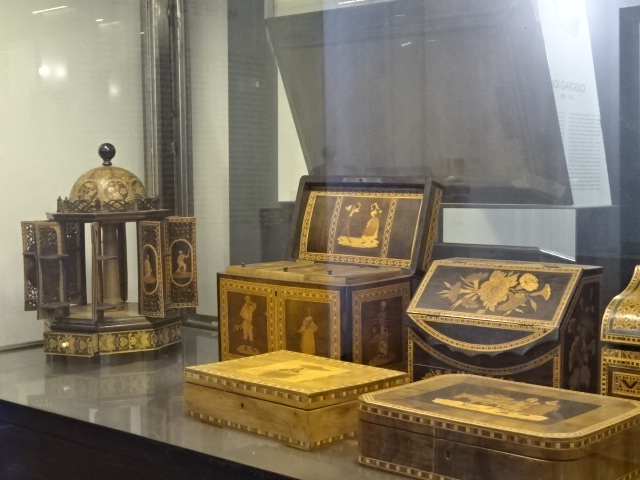
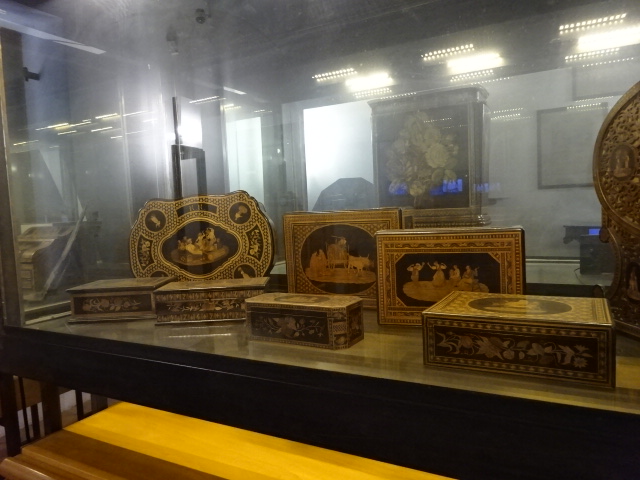
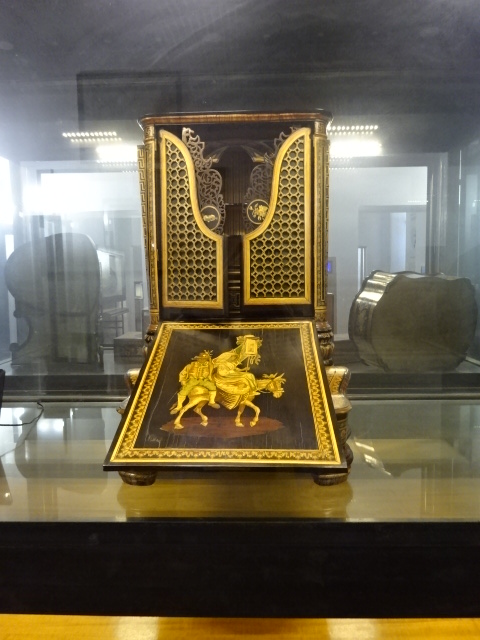
I loved visiting Sorrento during the summer of 2023, and the highlight of my time there was seeing the furniture, paintings, drawings and artifacts at the Museum of Inlaid Wood, known in Italian as Museobottega della Tarsialignea or MUTA. The displays pictorially narrate the history of 19th century intarsia (inlaid wood), the objects all made by local artists who were masters at their trade. The details of the works amazed me.

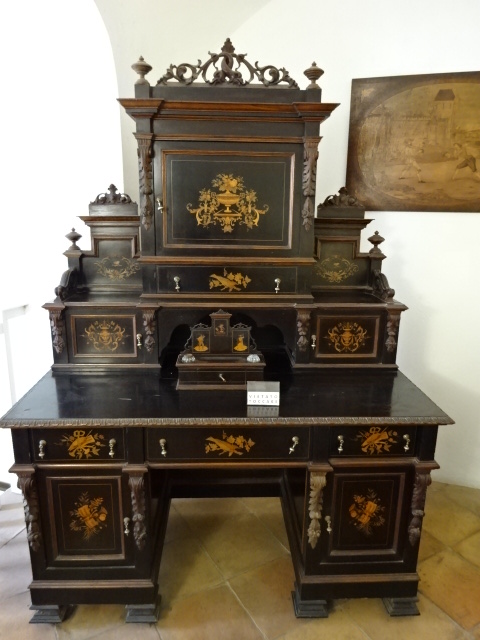
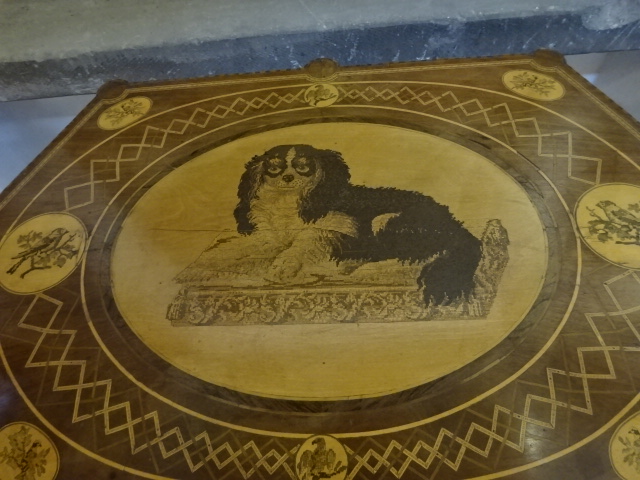
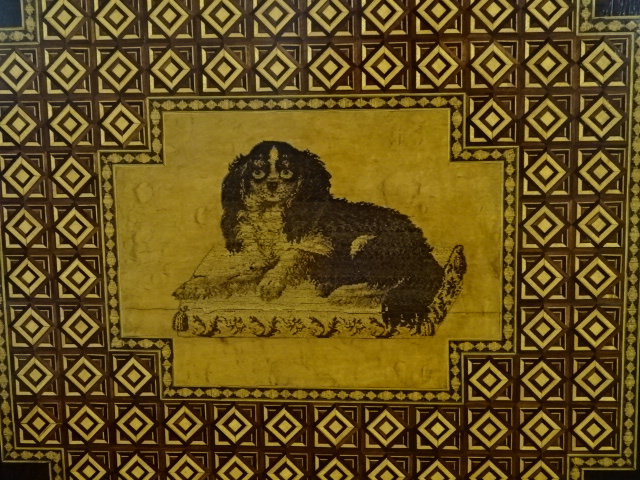
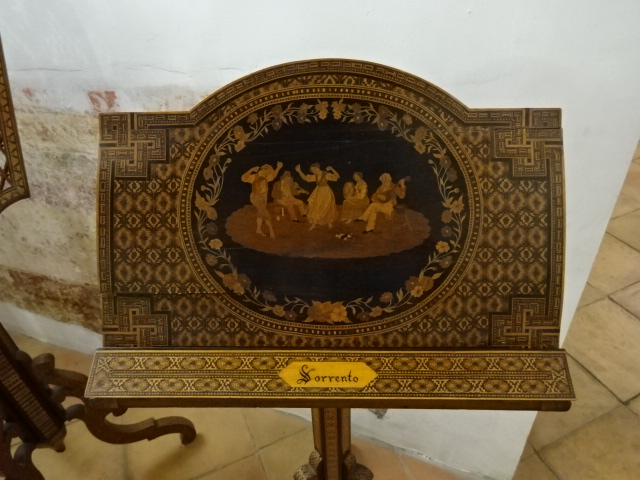
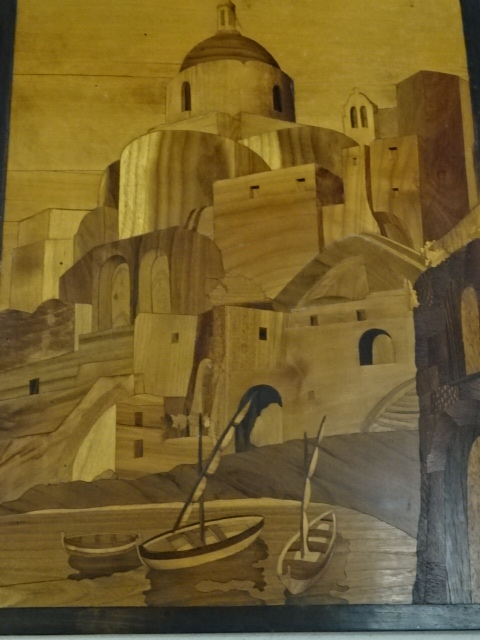
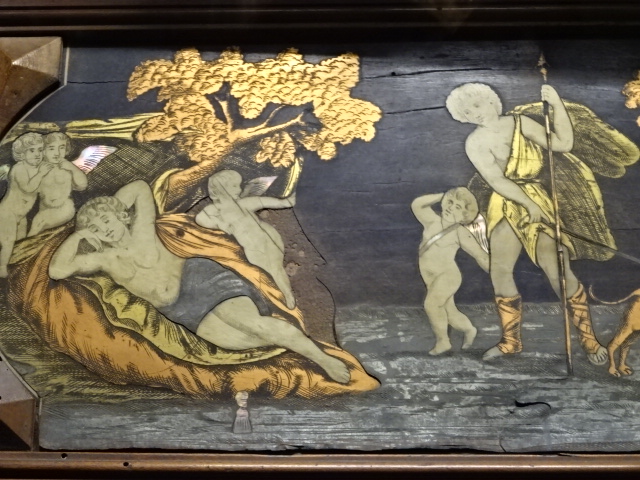
I saw furniture decorated with an inlaid wood rendition of a black-and-white fluffy dog reclining in an adorable pose. Many boxes of various small sizes were decorated with intarsia. I loved the music stand adorned with a scene showing figures dancing and playing instruments on a black background with floral trim. A table depicted a scene of seated women in 19th century attire, positioned next to a columned structure that looked like it belonged in antiquity. The geometric shapes on a intarsia-decorated bench captivated me. I loved another piece of furniture that showed off a scene of three small boats in a tranquil sea. On the shore, a very steep hill was dotted with archways and structures made of geometric shapes.

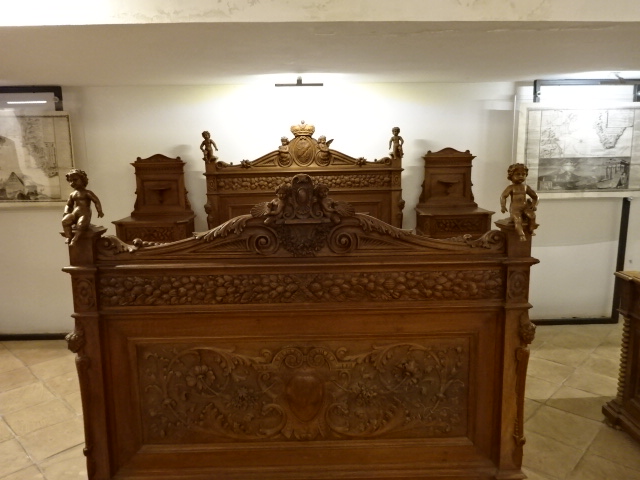
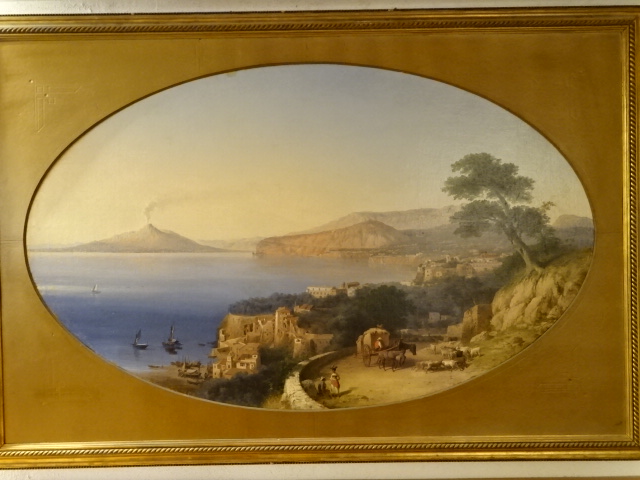
Another section described life in Sorrento during the 19th century. Landscape paintings, portraits, costumes and other objects were the focus. I was especially interested in the tranquil landscapes with portrayals of the soothing sea and craggy terrain. The economy of that era is also featured in this part of the exhibition.  I read the impressions of famous artists who had visited Sorrento during that era. I got to know more about the Old Town part of the city, where the museum is located, during the 19th century through these artworks. Placing the objects made with inlaid wood in historical context was one of the many major pluses of this museum. One piece of furniture that I admired in this section was a bed adorned with inlaid wood ornamentation. The headboard was exquisite.

I also saw how such beautiful objects are made as various tools and materials utilized in this trade were on display. The technique of creating works with inlaid wood was well explained. Understanding the process made me even more appreciative of the art itself because it was so painstakingly difficult to create such beauty.
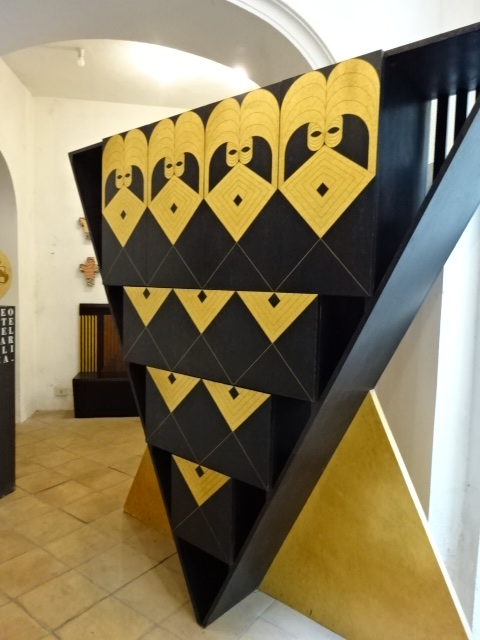
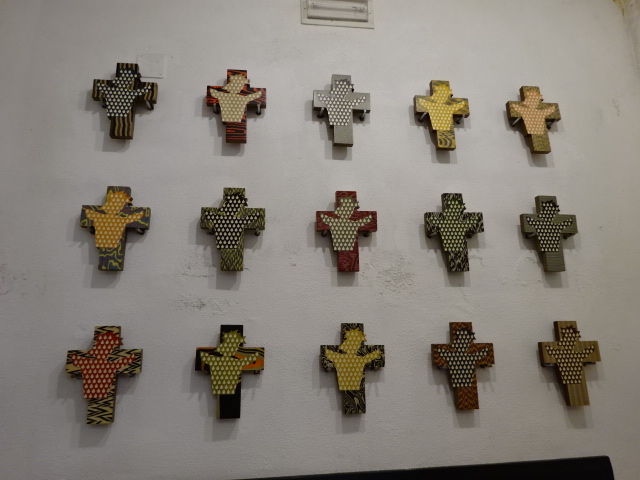
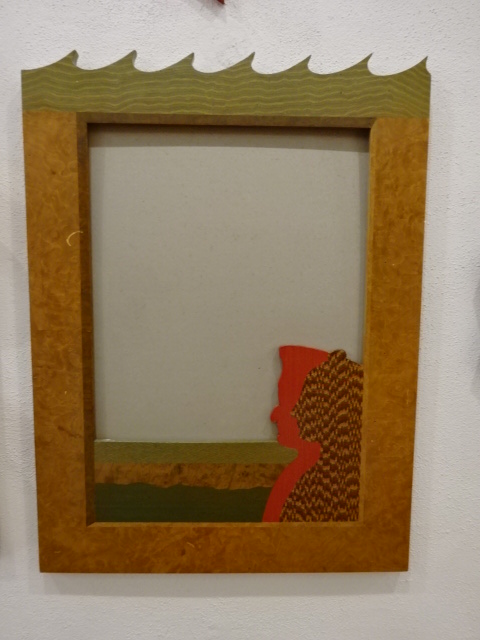
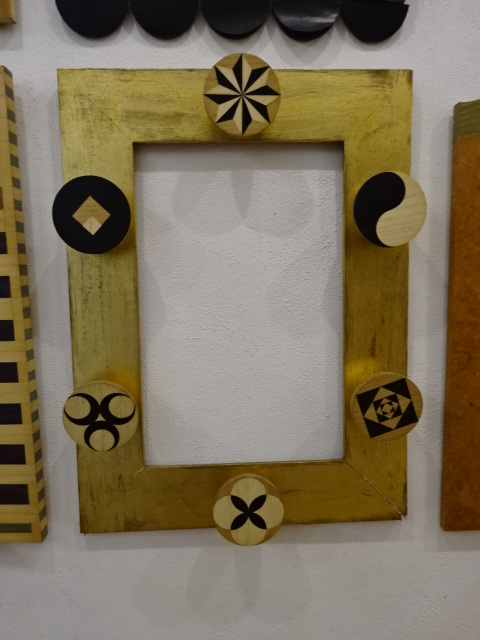
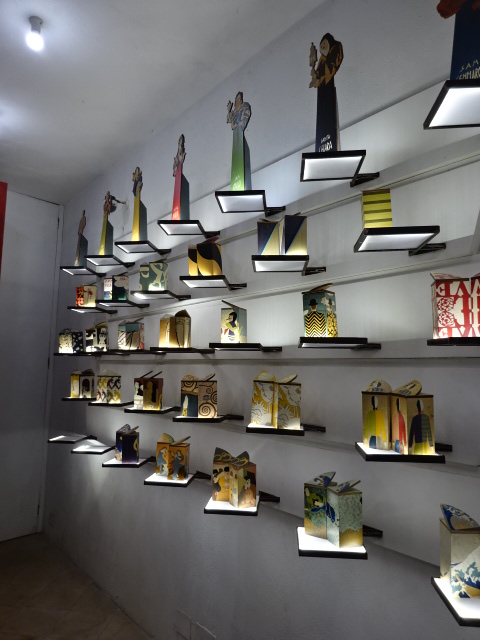
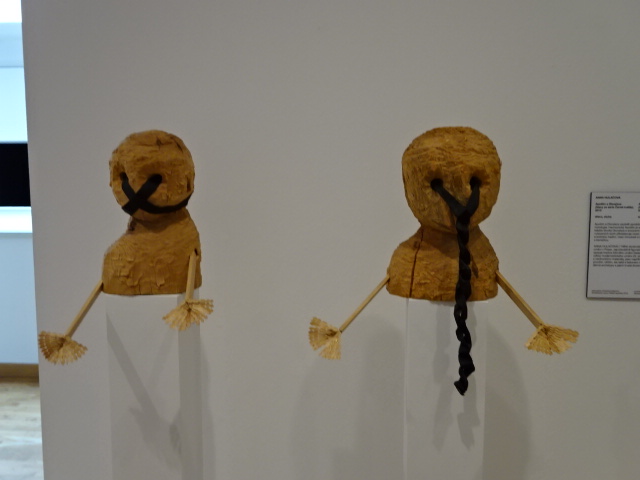
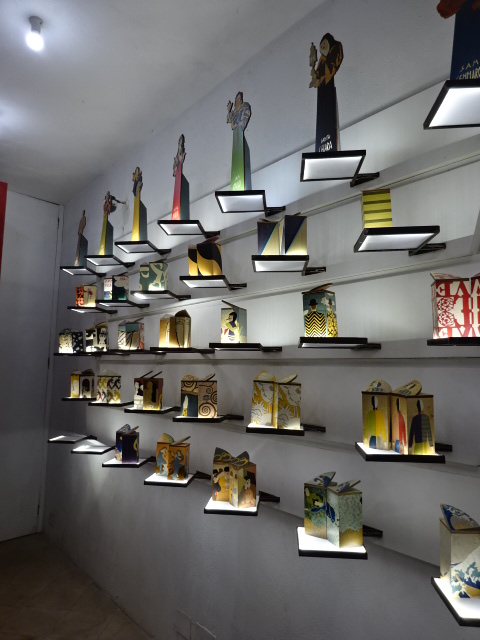
In the basement there was an intriguing collection of contemporary works with intarsia. They spoke to life during the present rather than the past by using this old technique. I saw an amazing room inlaid with intarsia, too. Contemporary-designed boxes were on display, too, showing off abstract features and brightly colored designs. An inlaid cupola was another gem. A creative sideboard consisted of an upside-down black triangle with white adornment. Frames decorated with inlaid wood and modern-looking crosses also made appearances.

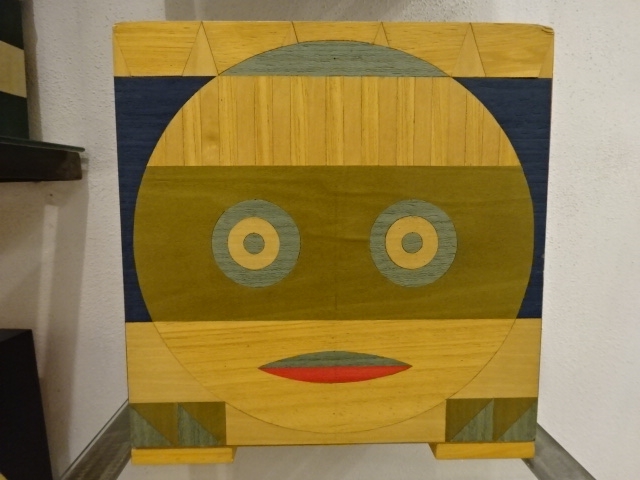
I liked the sculpture of a large circular face on a dark blue and light wood background. The grey at the top of the face seemed to symbolize a small amount of hair. I saw gray circles around light wood-colored eyes that featured gray pupils. The mouth was partially red and partially gray. The lips seemed to be pursed in a blank or unreadable expression. I thought of the mechanization and impersonalization of society when I saw the gray pupils and gray circles around the eyes. There were so many ways to interpret this sculpture. It fascinated me.
Indeed, all of the works at this museum fascinated me. I was thrilled to discover a unique museum in a picturesque city punctuated by seascapes, an amazing cathedral, beautiful churches and romantic streets lined with shops and cafes. This experience took place during my first day visiting the Amalfi Coast, and my trip was off to a remarkable start.

Tracy A. Burns is a proofreader, writer and editor in Prague.

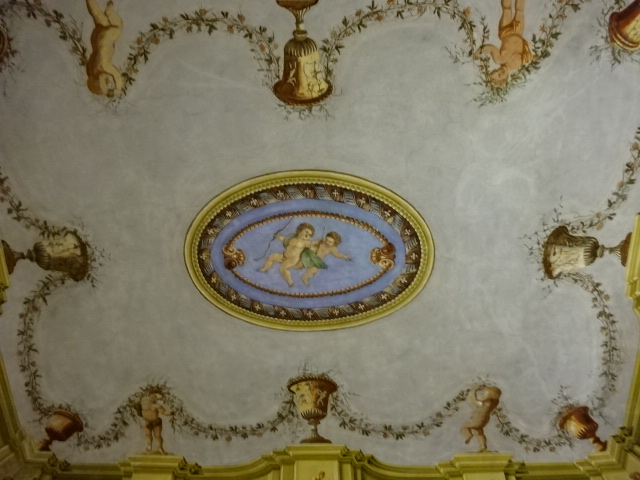
Frescoes decorated the 18th century building housing the collections.

Biblioteca and Pinacoteca Ambrosiana Diary

This library and art gallery in Milan is named after the patron saint of the city, Ambrose. The library harkens back to 1609, when Cardinal Federico Borromeo founded it, and the same year it opened to the public.

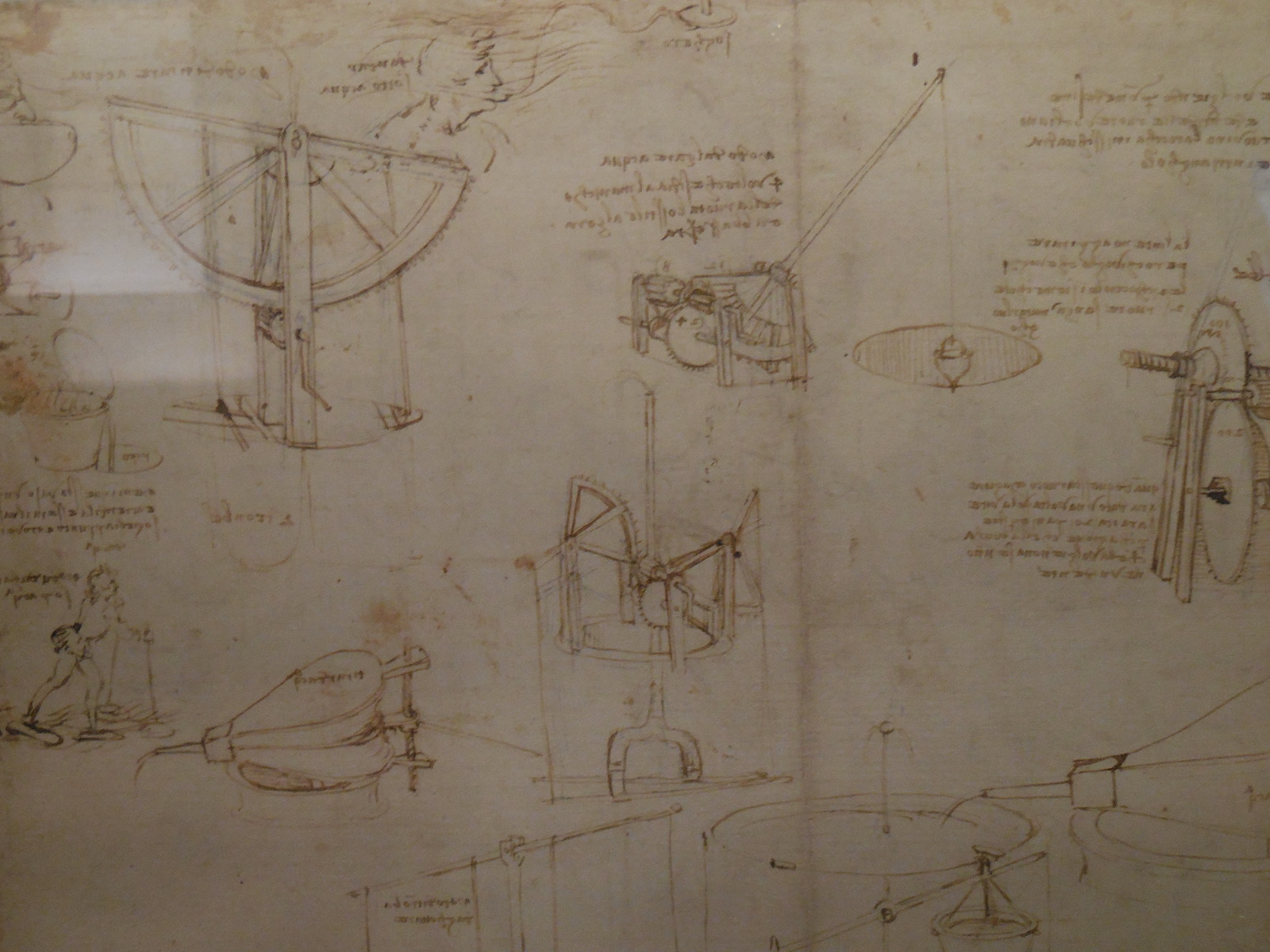
One of Leonardo da Vinci’s drawings of the Codex Atlanticus

The biblioteca houses the Codex Atlanticus by Leonardo da Vinci as well as many of his other manuscripts plus about 12,000 drawings by European artists, ranging from the 14th to 19th century. Raphael and Pisanello are represented in this collection of drawings, too. Many of its more than a million printed volumes hail from the 16th century. There are almost 40,000 manuscripts in numerous languages, including Italian, Latin, Greek and Arabic as well as some 22,000 engravings. Ancient maps, musical manuscripts and parchments also make up the collection. Some prominent guests included poet Lord Byron and novelist Mary Shelley.

Another of Leonardo’s drawings from the Codex Atlanticus

During World War II the library was damaged, and the opera libretti for La Scala Opera House were destroyed. The building was opened again in the early 1950s after undergoing renovations. More reconstruction took place in the 1990s.

When I visited, some of Leonardo’s works for the Codex Atlanticus, the largest collection of da Vinci’s drawings and writings, were on display in the library. The exhibition left me spellbound. I perused studies in aerodynamics and drawings of mechanical wings as well as various types of weapons. Leonardo rendered a large sling to throw stones and a machine to pump water from a well inside a building, for example.

I gazed upwards after studying the drawings by Leonardo, and I was filled with awe. I don’t know if I have ever seen such an incredible library. I just wanted to stand there all day, gazing at the wall-to-wall bookcases as I wondered about the titles and contents of each volume.

Established in 1618 with the collections of Cardinal Federico Borromeo, the pinacoteca was just as impressive as the library. The 24 rooms were dominated by Renaissance artworks but also boasted of renditions by 17th century Lombard artists, 18th century painters and 19th and early 20th century creators. I was especially struck by da Vinci’s 15th century “Portrait of a Musician” as it was the only portrait that he had painted. I noted the musical scroll in one hand of the sitter and was captivated by the detailed curly locks of hair, the musician’s brown eyes and his red cap.

Caravaggio’s insect-infested “Basket of Fruit” tells a story of diminishing beauty by displaying rotting fruit. Bramantino’s “Adoration of the Christ Child” shows the kneeling Bernardino of Siena, Francis of Assisi, Benedict of Nursia and the Virgin Mary making an understandable fuss over baby Jesus. I loved the angels playing musical instruments behind those figures. Emperor Augustus also makes an appearance.

Bergognone’s “Sacred Conversation” shows the Virgin Mary and Christ Child on a massive golden throne, baby Jesus on the Virgin Mary’s lap. Solemn angels flutter in the background. I was struck by the details of the Virgin Mary’s hair and by the material of the clothing worn by the Virgin Mary and baby Jesus. The two were surrounded by saints with captivating headwear, including Saint Ambrose and Saint Jerome.

Another painting that left me speechless was Sandro Botticelli’s “The Madonna of the Pavilion.” The artist’s meticulousness was evident. The artwork shows the Virgin and Child with much symbolism. The pavilion that two angels open to reveal the Christ Child is rich in biblical meaning both in the Old and New Testament. I could almost feel the paper of the pages making up the open book in the painting.

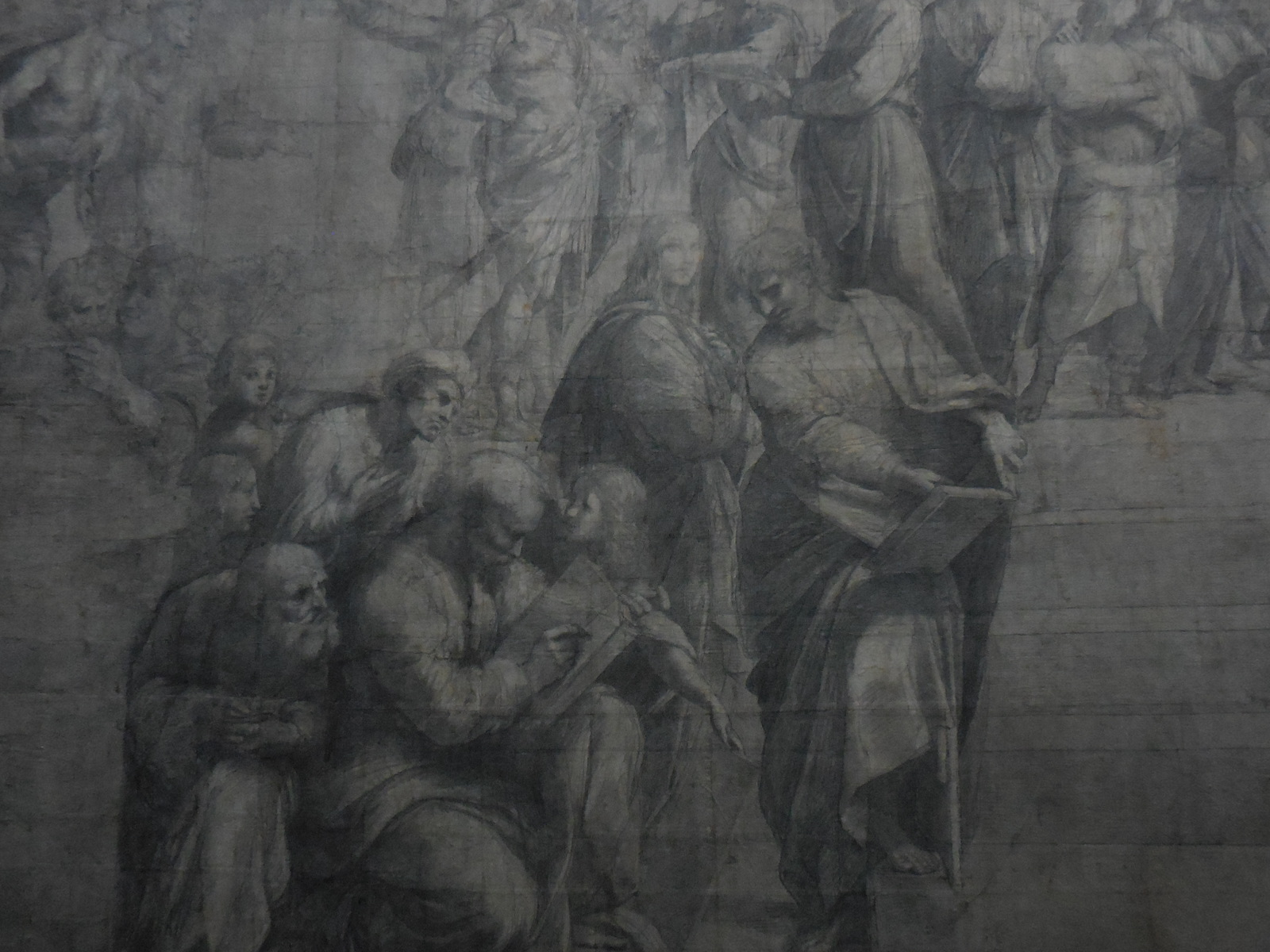
Raphael’s School of Athens

Raphael’s cartoon of the “School of Athens” is a study for the Italian Renaissance fresco painted in the early 1500s for the Raphael Rooms in the Vatican Museum. I recalled seeing the skillful rendition of philosophers and scientists from Ancient Greece at the Vatican on my 40th birthday as I mulled over the dominant role that perspective played in the artwork. Plato, Aristotle and Pythagoras appear in the fresco. Leonardo and Michelangelo are present as Plato and Heraclitus.

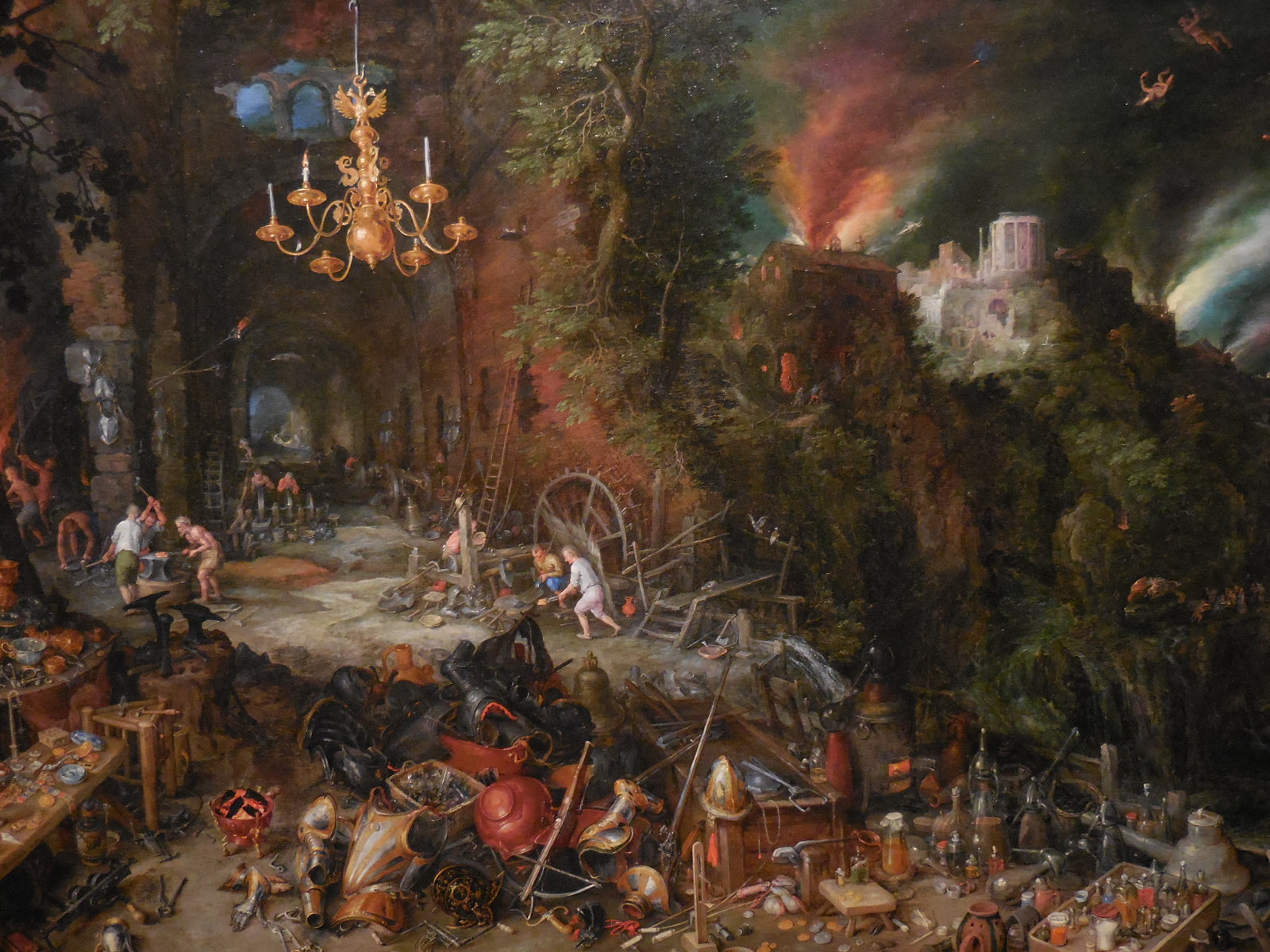
Other paintings that awed me were the fantastic landscapes of Paul Brill, whose works I had discovered some years earlier in Edinburgh. Jan Brueghel’s detailed landscapes and still lifes also are close to my heart, and I adored masterpieces from the Netherlands. I stared at these paintings, losing myself in the fantastical landscapes and details that were so masterfully rendered by both artists. I felt a special connection to these works featuring a dream-like quality as if I could be transported into a fantasy world by merely peering at the canvases.

Other paintings that captured my undivided attention had been created by Bernardino Luini (I fondly recalled his paintings in Milan’s Church of Saint Maurizio), Tizian, Jacopo Bassano, Moretto and Daniele Crespi as well as Francesco Hayez, whose works I knew well from the Brera Gallery in the same city. Andrea Bianchi had created “The Last Supper,” imitating da Vinci’s masterpiece. Tizian’s “Adoration of the Magi,” Bramantino’s “Madonna of the Towers” and the locks of hair of Lucrezia Borgia all left me awe-struck.

The sculptures and frescoes from the second to 16th century in the Sala del Bambaia are very noteworthy. The Hindu art of the Berger Collection captivated me. The Flemish and German painting from the 15th to 17th century enthralled. Ceramics also play an intriguing role in the collection.

I was so awed by this gallery and library that I visited it twice during my first trip to Milan. I peered at every painting and sculpture, trying to take in each artistic creation, feeling so blessed to be able to see all these masterpieces with my own eyes.

Tracy A. Burns is a writer, proofreader and editor in Prague.

The Last Century – Twenty Artists Exhibition Diary

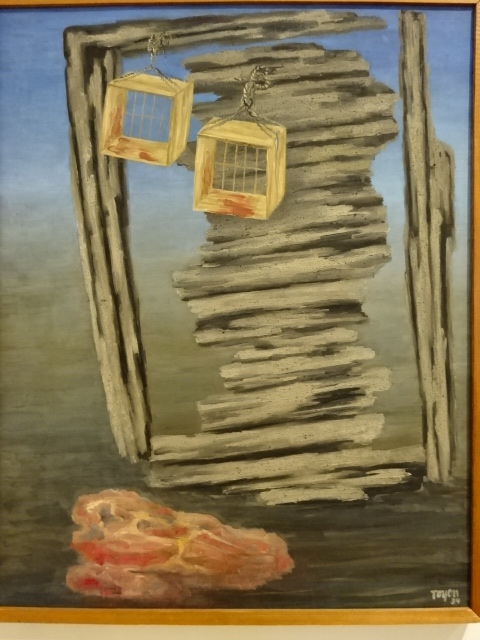
This permanent exhibition at the Gallery of Modern Art in Hradec Králové showcases the works of some of the most influential Czech artists of the 20th century. I liked the fact that the works were organized by person with commentary about the artists’ backgrounds and styles. I will highlight the creations that most influenced me, although all the painters and sculptors are important.

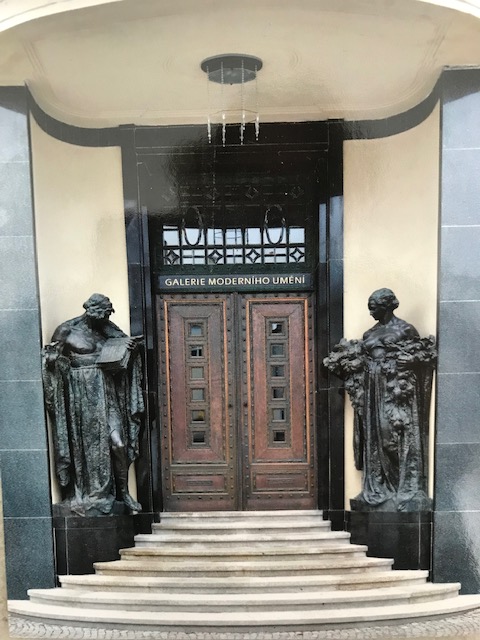
First, about the building housing the Gallery of Modern Art: Like many edifices in Hradec Králové, the museum is an architectural gem. Facing the town’s main square, the building that was completed in 1912 by Osvald Polívka is impressive with two statues flanking the façade. These sculptures were made by Ladislav Šaloun in 1908 and show allegories of commerce and the harvest. Reliefs of atlases with dogs at their feet also make up the external ornamentation. Polívka’s Art Nouveau designs can be found in Prague’s Municipal House, which he decorated from 1905 to 1912. I tell everyone coming to Prague to tour the Art Nouveau Municipal House, as it is certain to be a highlight of any visit. Šaloun created the statue of Jan Hus that dominates Prague’s Old Town Square.

Several banks were housed in this building before and during the First Republic. For many years under Communism, the Cotton Industry Association and an agricultural company called the place home. Renovations took place in the late 1960s. In 1987, the totalitarian regime transformed the building into the Museum of Revolutionary Traditions. This totalitarian exhibition was closed after the 1989 Velvet Revolution that freed Czechoslovakia from Communist control.

In 1990, the Gallery of Modern Art took up residence there. From 2014 to 2016, both the interior and exterior underwent a vast renovation. A walkway was formed around the central atrium, for example. The interior boasts geometric shapes, floral designs and Art Nouveau-styled adornment of garlands and cherubs. I especially liked the stained glass window decoration.

Here are some of my favorite artists represented in this exhibition:

Fate of the Artist, 1909

Quido Kocián

The expressive sculpture of Quido Kocián was influenced by symbolism and Art Nouveau. I love how he was able to express basic emotions like love and suffering. I went to a superb exhibition of his work about 15 years ago on Husova Street in Prague. In some statues I could see the turmoil and anguish of the persons depicted. Other sculptures triggered feelings of happiness and fulfillment. Kocián had a knack for depicting various psychological states and the depths of the human soul. He studied under legendary artist Josef Václav Myslbek but wound up rebelling against Myslbek’s traditional style, opting for expressiveness instead. Kocián’s works were not fully appreciated in the Czech art history sphere for a long time.

Ladislav Zívr

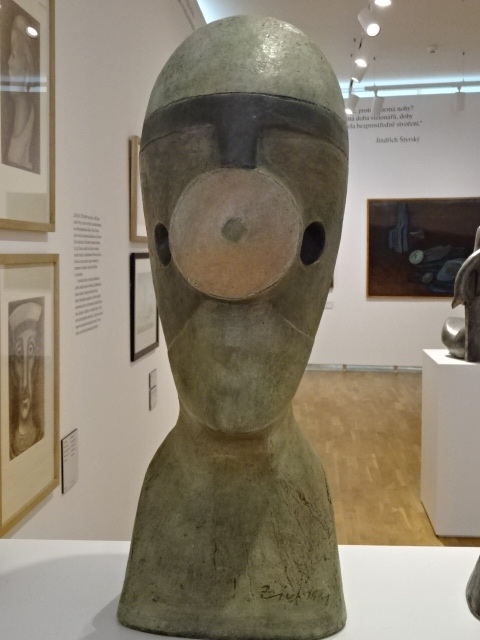
Surgeon, 1961

A member of the artist Group 42, Zívr focused on everyday life, a feature that is dear to me in all art forms. Inspired by Cubism and the creations of Otto Gutfreund, he made sculptures that have machine-like qualities as well as human traits. He had a penchant for surrealism. After the world wars, Zívr was influenced by nature, and his works portrayed strong symbolism. I liked the way he was able to express a person’s soul through primitive forms.

Jiří Kolář

I had been to a large exhibition of Kolář’s works in Prague’s Kinský Palace some years ago and was very familiar with his collages that included cut out images and words from publications. (See my article about the exhibition in a much earlier post called Jiří Kolář Exhibition Diary) He was a poet and prose writer as well as a fierce critic of Communism. Kolář emigrated to Paris in 1979. He often used phrases from books or created his own poems in his collages. His works lingered on the border of the dream realm and reality, a trait I found very intriguing. A staunch supporter of democracy, Kolář was also one of the first Czechs to sign Charter 77, a document written by dissidents to promote human rights in the normalization era of Communist Czechoslovakia. He played a major role in publishing literature banned by the regime. Kolář was also one of the founders of the influential Group 42.

Jaroslav Róna

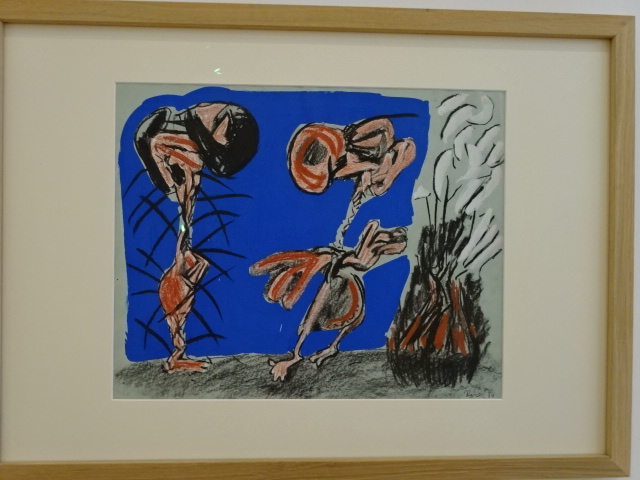
Scene by the Fire, 1984

I know Róna’s sculptures well, but I was not familiar with his paintings. Róna designed the abstract Franz Kafka Monument in Prague’s Jewish Quarter, an important sculpture to see in the Jewish Town. He is, indeed, a man of many talents: He has also worked as a painter, illustrator, screenwriter, author of books, actor, singer and educator. His works have a certain dynamic energy. He has been inspired by the Expressionism style of Edvard Munch, Oskar Kokoschka, Max Beckmann, Egon Schiele and Pablo Picasso. A supporter of democracy, he drew brochures for the Velvet Revolution during 1989. Rona is also an avid traveler. His sculptures can be found at Prague Castle as well as on the island of Crete and in many other places.

Josef Váchal

Sacrifice, undated

I liked the mystical quality in Váchal’s works. He was a graphic designer, wood engraver, bookmaker, writer and painter who excelled in all those genres. Váchal was inspired by expressionism. His works featured symbolism, naturalism and Art Nouveau tendencies. A soldier during World War I, he fought in 12 battles. The Communist coup brought hard times for Váchal, who remained isolated after 1948. People did not show much interest in his work then. In the 1960s, he received some acclaim. Much later people recognized that Váchal had created some of the most significant works of Czech graphic design in the 20th century.

Augusta Nekolová

Four Seasons, 1914

Because Nekolová was female, she had limited educational opportunities during the 19th and early 20th century. She did, however, study unofficially under the prominent Czech artist, Jan Preisler. Nekolová worked as a painter, illustrator and graphic artist. She steered away from representations of modern life in her works. She was known for her landscapes and for her emphasis on motherhood. Nekolová strove to promote the national identity of the Slav nation. She developed a strong interest in folk culture. At the end of World War I, Nekolová was hospitalized. She died in 1919 at the age of 29.

Bohumil Kubišta

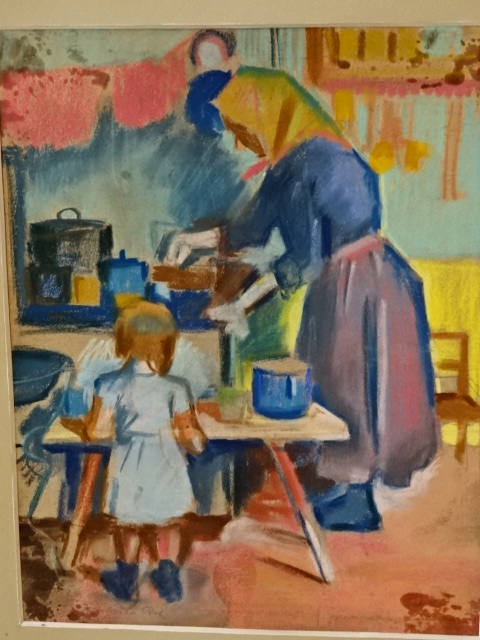
In the Kitchen, 1908

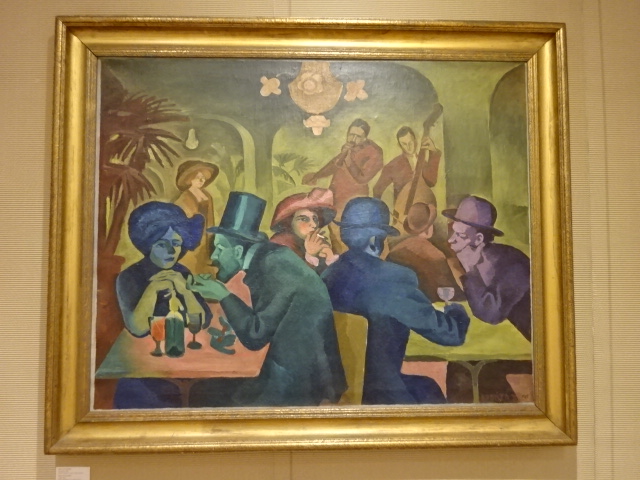
Café, 1910

A prominent avant-garde artist, Kubišta helped found the Expressionist group the Osma (The Eight). He was a painter, graphic designer and theoretician and is considered to be the founder of Czech modern painting. His works dealt with existential issues. Kubišta’s expressionism was inspired by Munch. He was also influenced by Braque and Picasso’s Cubism. Kubišta analyzed the works of Eugene Delacroix and Vincent Van Gogh. His works also contain elements of Futurism and Fauvism. Kubišta often explored themes dealing with modern technology and nature. While serving in the Austrian army during World War I, he won the distinguished Leopold Order. He died of the Spanish flu at the age of 34 in 1918.

Emil Filla

Dance of Salome, 1911

Hej hore háj, Folk Song, 1948

Along with Kubišta, Filla established the Osma group. He also was known for his writings about art theory. During his early artistic endeavors, he drew inspiration from Edvard Munch’s Expressionism. Later he took up Cubism, influenced by Picasso and Braque. He also was captivated by Baroque still lifes by Dutch painters. El Greco and his symbolism fascinated Filla. In the 1930s, he became enthralled with surrealism. His landscapes demonstrate his knowledge of Chinese calligraphy. My favorite trait in his paintings involves his use of a harmony of colors.

Repression (Anxiety) by Josef Wagner – temporary exhibition

I especially liked the exhibition’s pieces of art influenced by Expressionism and Cubism. The colors and shapes in Kubišta’s and Filla’s works caught my undivided attention. I was introduced to Nekolová’s art and intriguing background at this exhibition. I was fascinated how Quido Kocián captured the emotions of the human soul in his sculptures while Zívr concentrated on simple forms to create profound meaning. Kolář’s collages were a sort of visual poetry. Váchal and Róna’s creations displayed impressive energy.

Moscow Diary, 1989 by Anna Daučíková

It was my first visit to Hradec Králové, except for brief stops at the train station and bus station. The Gallery of Modern Art with its poignant exterior and interior decoration and use of space was one of the most impressive buildings I saw.

Tracy A. Burns is a writer, proofreader and editor in Prague.

Landscape, 1962 by Vladimír Boudník

Apollo and Dionysus, 2013 by Anna Hulačová

The gallery also has an impressive collection of contemporary art.

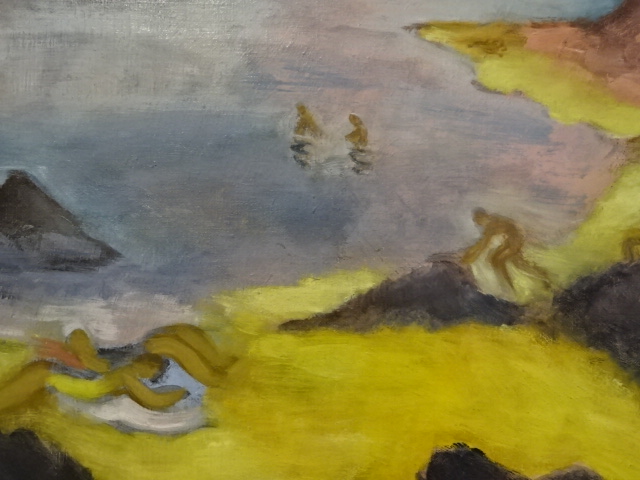
Beach in Crimea (In A Small Bay), 1936 by Věra Jičínská, temporary exhibition

See my post Věra Jičínská Exhibition Diary for more information on this temporary show.

Museum of the Risorgimento in Milan Diary

Museum of the Risorgimento in Milan Diary 

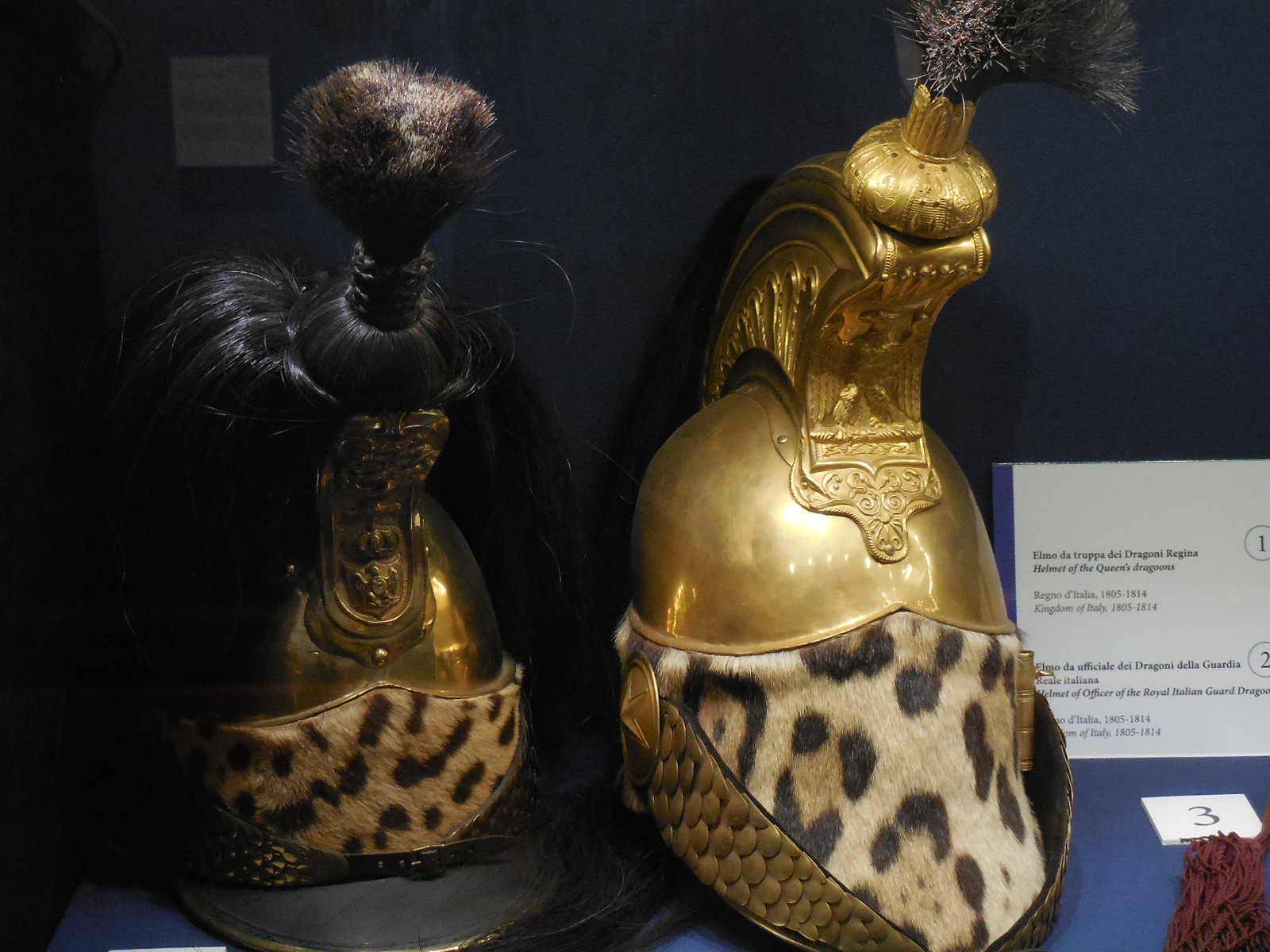
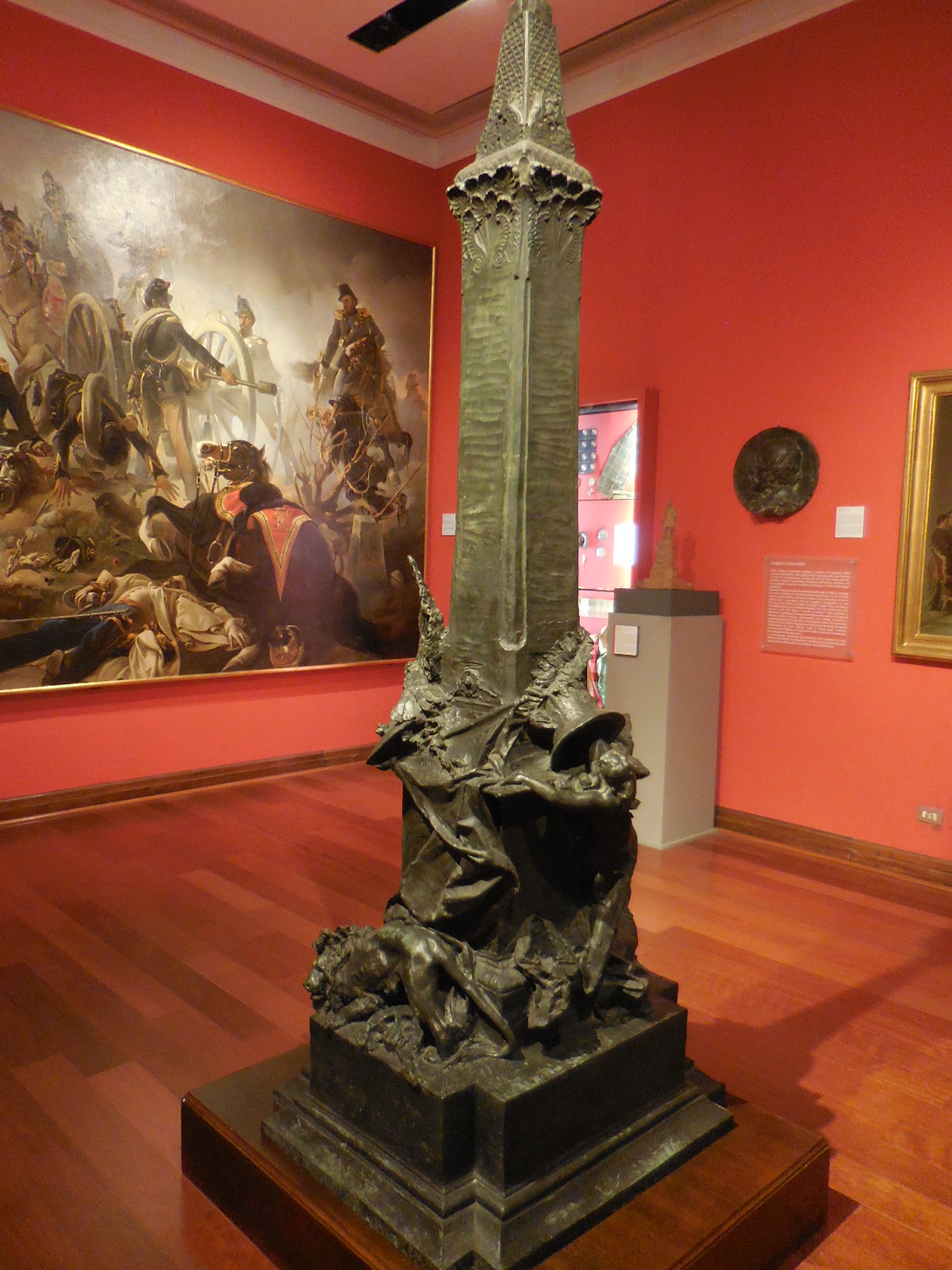
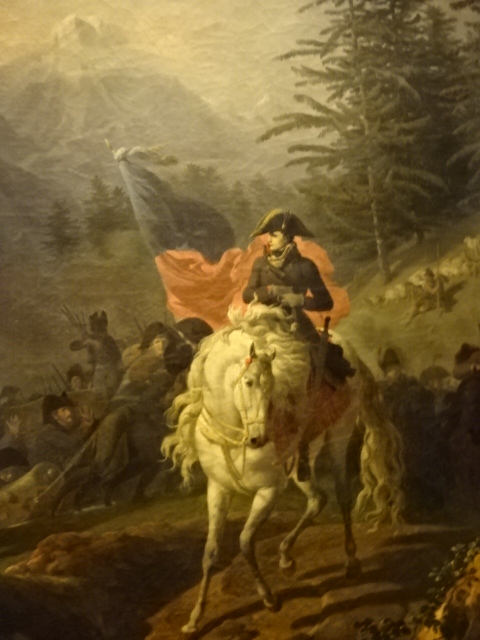
After visiting the Brera Art Gallery in Milan, I walked to the nearby Museo del Risorgimento, which featured 14 rooms of paintings, prints, sculptures and artifacts depicting Italian historical events from 1796 to 1870 as well as arms. It traces the periods from the call for Italian independence to Italian unification. I learned about Napoleon’s reign in Italy as well as the Austrian monarchy’s control. I noticed how prominent Milan’s role had been during the Five Days of Milan, the nickname of the 1848 uprising against the Austrians.

I saw paintings depicting Italian King Victor Emmanuel II, who took the throne in 1861 and reigned until his death in 1878. Two of the paintings were created by Gerolamo Induno. Nicknamed the Father of the Fatherland, Victor Emmanuel II had the distinction of being the first king of a unified Italy since the sixth century. He was born the eldest son of Habsburg Empress Maria Theresa of Austria and made a name for himself in the First Italian War of Independence during 1848-49 before being crowned king.

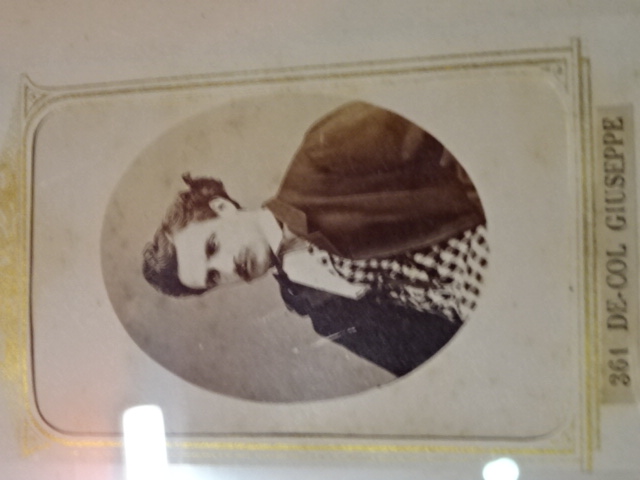
I spent a lot of time staring at the photos of soldiers in the Album of the Thousands, the volunteers in the Expedition of the Thousand, a campaign that took place in 1860. The group of volunteers armed only with out-of-date muskets defeated the more powerful navy of the Kingdom of the Two Sicilies. Portraits of the 1,089 soldiers in business card format made up this album. I saw the volunteers as individuals rather than as a group of soldiers who conquered Bourbon rule in south Italy. Looking at their portraits, I felt as if I could see the personalities of the men.

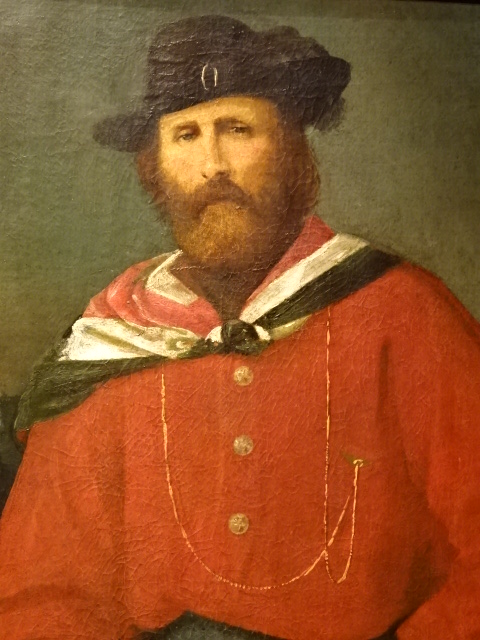
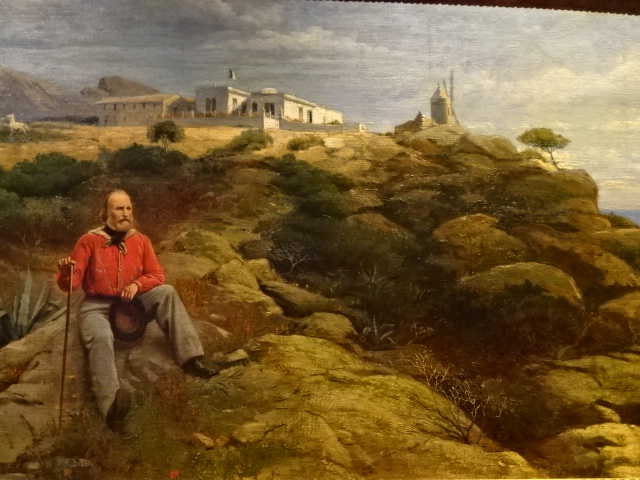
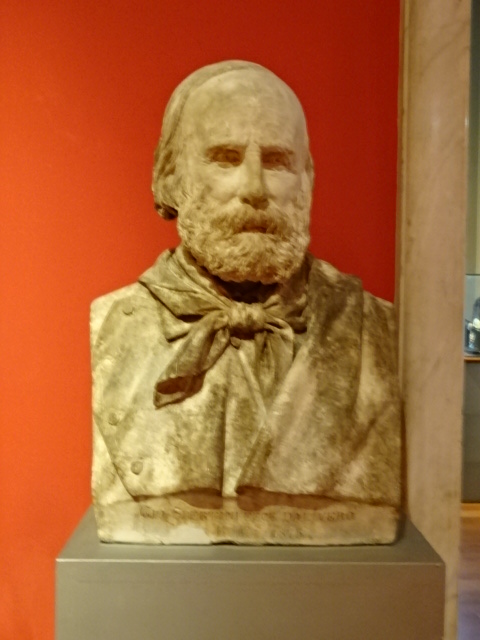
Giuseppe Garibaldi, one of the most prominent generals in modern history, guided the volunteers in the Expedition of the Thousand. Their uniforms were made up of red shirts and grey pants. In the exposition I saw the actual poncho and red shirt donned by Garibaldi, who also had military successes in South Africa and elsewhere in Europe.

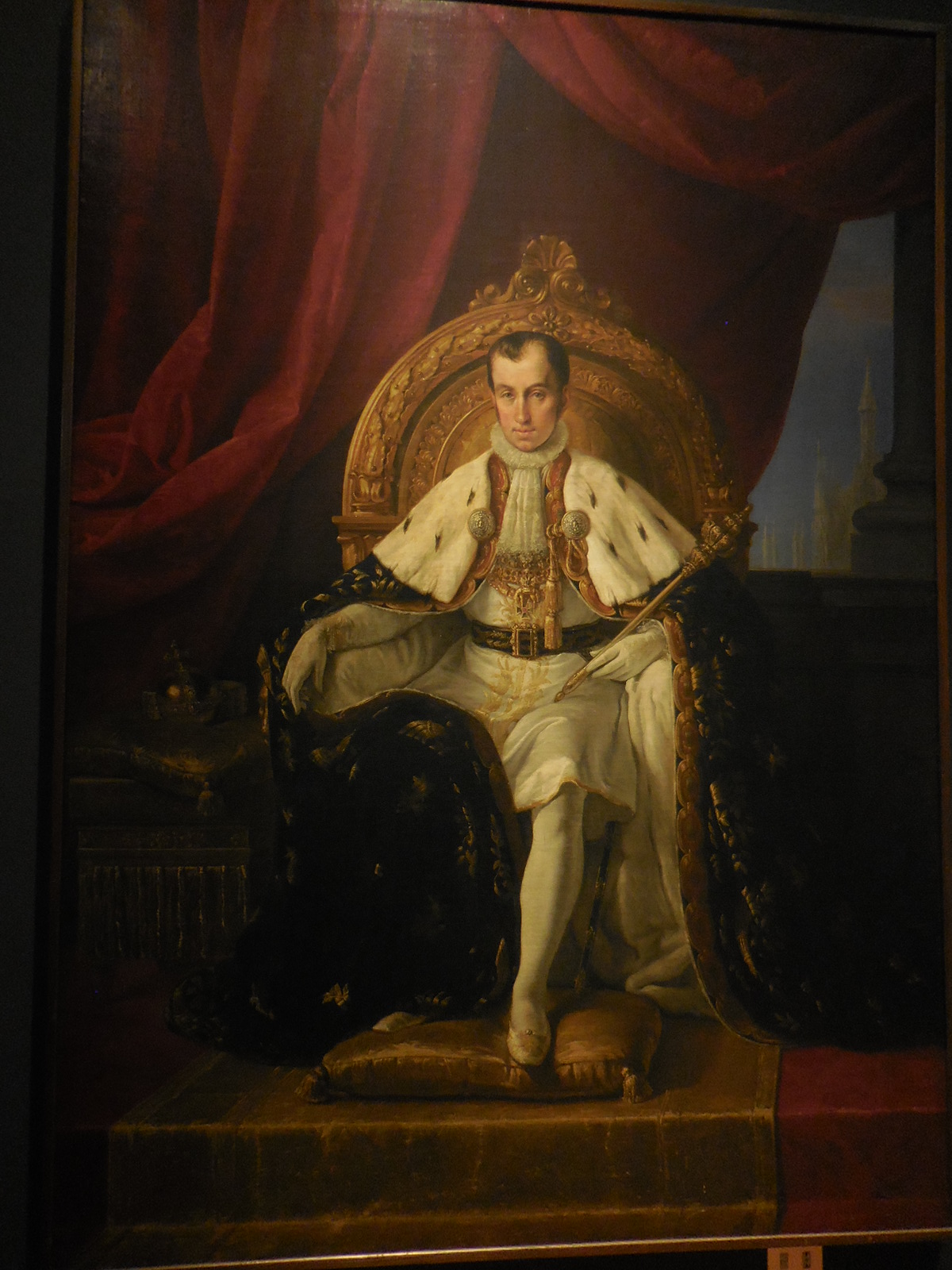
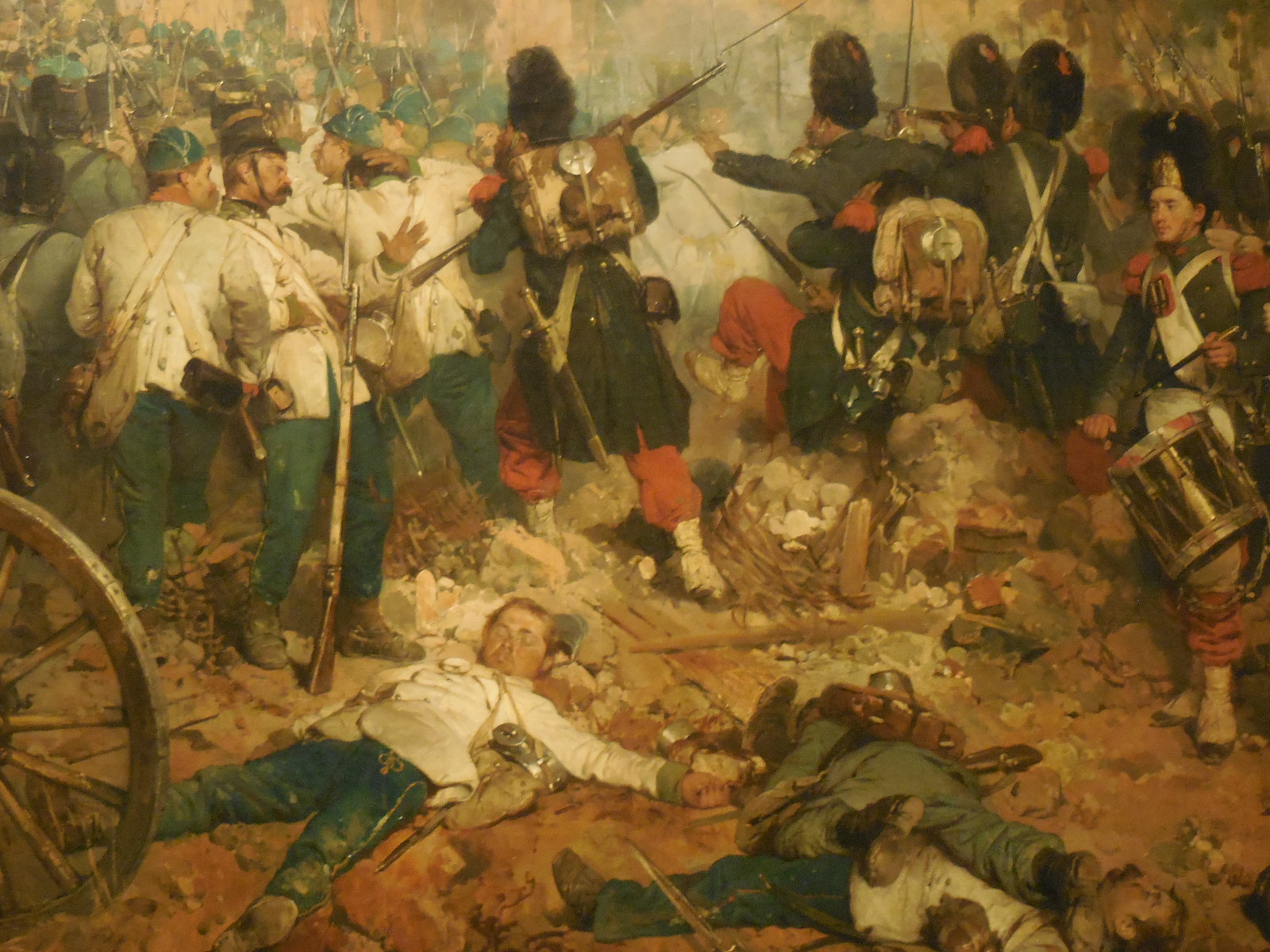
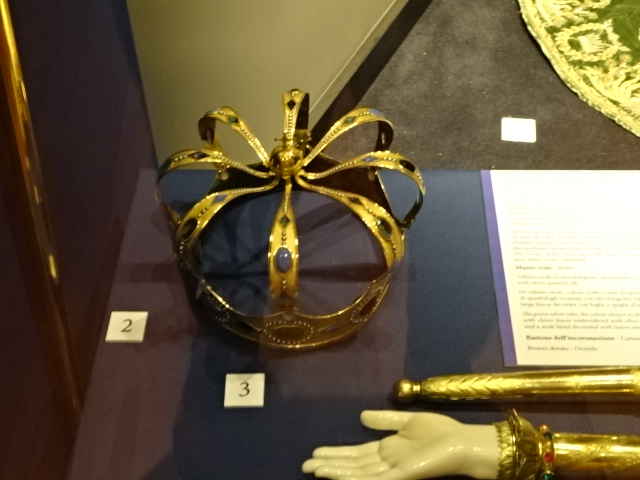
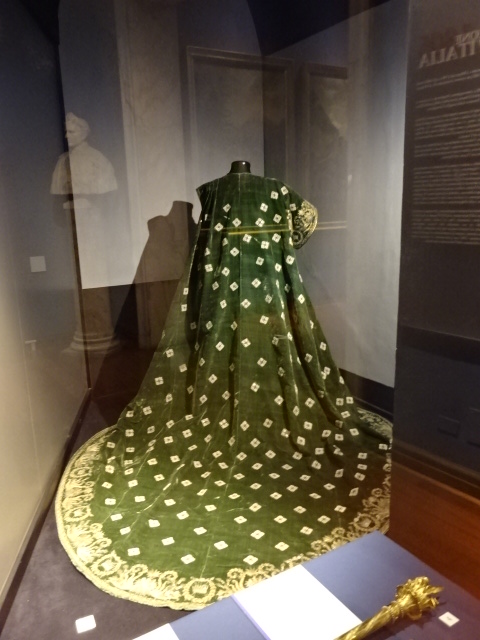
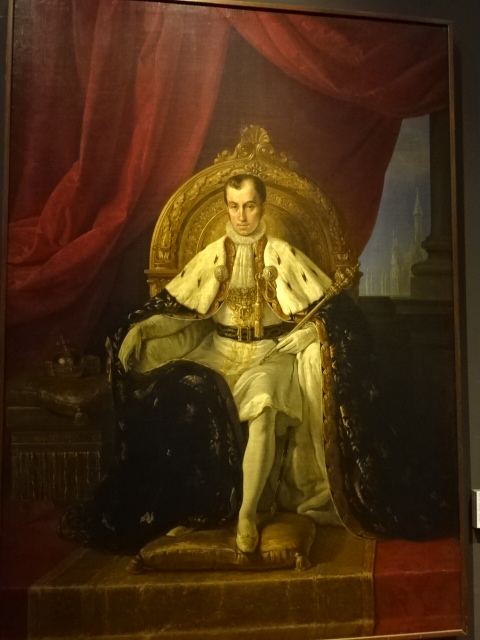
I loved the paintings and sculptures most of all. These collections were especially noteworthy. The collection of paintings depicting the Imperial period from 1804 to 1814 was perhaps the most poignant of all eras represented by this genre. Francesco Hayez, whose works I had seen in the Brera, had depicted Emperor Ferdinand I of Austria in a moving portrait. Also, powerful canvases of the Five Days of Milan had been rendered by Carlo Canelli, Carlo Bossoli and Pietro Bouvier, for example. Gerolamo Induno and Domenico Induno contributed to the paintings depicting the Second War of Independence. The original Italian flag that flew over the Duomo in Milan on March 20, 1848 was another highlight. The cloak and regal insignia from Napoleon’s coronation as King of Italy were also enthralling.

The 18th century Palazzo Moriggio that houses the museum had an intriguing history as well. The museum had been situated there since 1951. Under Napoleon’s reign the Ministry of Foreign Affairs and then the Ministry of Defense had been located in the palace.

This museum really opened my eyes to many events in Italian history. I had known only very basic information about this museum before my visit. It wasn’t on my list of most important places to see. I learned so much about the time periods in which the Risorgimento took place. I had never been a big fan of battle scenes, but I was struck by the details and by the historical significance of these paintings. While the museum is relatively small, it allows visitors to develop much knowledge about poignant eras in Italian history. In this museum I could actually feel the history come to life. Each artifact tells a story.

Tracy Burns is a writer, proofreader and editor in Prague. 

Picture Gallery in Sforza Castle Diary

The Sforza Castle in Milan was built for Galeazzo II Visconti in the second half of the 14th century. It was destroyed in the mid-15th century, but the duke of Milan, Francesco Sforza, rebuilt it. Then the Sforza family inhabited the castle. The end of the 1400s was a time of splendor. During the 15th century, Leonardo da Vinci and Bramante created frescoes in the castle. The castle became one of the largest in Europe in the 16th century.

Later, the castle fell on hard times and was transformed into a citadel. The ducal apartments were used as barracks and stables under Spanish, Austrian, French and again Austrian rule. An armory was for a time also on the premises. At the end of the 1800s, the castle became the property of the city of Milan. The unification of Italy prompted the complex to be reconstructed and made into a museum. The castle took on the appearance it had when it had been under Sforza control. Though the central tower is not original, it is made to look like it had when built in 1521.

During World War II, the complex suffered much damage but was reconstructed. Now the castle includes museums and cultural institutes. Several of the other museums include those featuring ancient art and arms as well as one highlighting antique wooden furniture and sculpture. The Pieta Rondanini by Michelangelo is also a sight not to be missed.

The Picture Gallery focuses on Milanese and Lombard paintings from the 15th to the 18th century with over 230 works on display. It also includes remarkable Venetian and 17th century Dutch and Flemish works. Some Lombard artists represented are Foppa, Bramantino and Bernardino Luini. Other artists whose paintings amaze are Andrea Mantegna, Bergognone, Giovanni Bellini, Lorenzo Lotto, Correggio, Tintoretto, Tiziano, Tiepolo and Canaletto. One highlight is the Trivulzio Madonna by Mantegna from 1497. This important work shows Madonna on a throne, flanked by saints. Angels sing, and cherub faces are included in the decoration. Yet the exhibition does not only contain paintings. Some sculptures, busts and medals are on display, too.

Tracy Burns is a writer, proofreader and editor in Prague.

Prague Castle Picture Gallery Diary

Joseph Heintz the Elder – The Last Judgement

The permanent collection of the Prague Castle Picture Gallery has been closed since 2019 due to an air-conditioning defect and a lack of financial means for repairs. A special exhibition of about half of the collection’s works opened at the Castle’s Imperial Stables during July of 2022 and will last for three months.

Veronese – Saint Catherine of Alexandria with an Angel

The Picture Gallery originated during the reign of Emperor Rudolf II, at the end of the 16th century. Rudolf II chose Prague as his residence when he was Holy Roman Emperor. The ruler was passionate about collecting works of art – paintings, curiosities, statues and more. For almost 30 years, Rudolf II amassed artifacts, and inherited other pieces. He exhibited his vast art collection in the then newly constructed north wing of the Castle, the part of the complex where he built the Spanish Hall. The majority of his painting collection was Italian in origin.

Joos van Cleve – Altarpiece with the Adoration of the Shephards, Saint Jerome with the Donor and Three Sons and Saint Lucy with the Donor and Three Daughters

Stellar artists worked as court painters in Prague: Hans von Aachen, Bartholomeus Spranger, Pieter Stevens and many others. First, allow me to mention Giuseppe Arcimboldo, a portrait painter serving Emperor Maximilian II and Emperor Ferdinand I. Arcimboldo began serving the emperor in 1562. Rudolf, the son of the emperor, was very taken with his work. He composed still lifes for Rudolf, and, after Arcimboldo returned to Milan in 1587 due to illness, he had a now famous portrait of Rudolf, called Vertumnus, sent to Prague. Arcimboldo’s portraits were allegorical, often composed of various objects that would make up the person’s head, for instance.

Lucas Cranach the Elder – Saint Catherine, Saint Barbara and fragments of the figures of Saint Dorothea and Saint Margaret, from Prague Altarpiece

Hans von Aachen was Rudolf II’s favorite when he was emperor. He began painting for Rudolf II in 1592 and wound up making Prague his home, where he created his best portraits. The painter became good friends with Rudolf II, too. The picture gallery still has von Aachen’s portrait of his daughter Maria Maxmiliana. His style was a precursor to the Baroque features that would later dominate Czech art.

Bartholomeus Spranger – Allegory on the Triumph of Fedelity over Destiny

Spranger’s tenure in Prague lasted from 1580 to 1590. His often complicated and ornate works displayed Mannerist features. Spranger created numerous paintings for the Rudolfine collection. In 1607, Spranger created Allegory on the Triumph of Fidelity over Destiny – Allegory on the Fate of Hans Mont, referring to the sculpture to worked for Rudolf II until an eye injury prevented him from doing so. Mont’s whereabouts were unknown. This is one of Spranger’s paintings that has remained at the Castle throughout the centuries. He also created a masterful portrait of Jacob König, a German goldsmith who was selling antiques in Italy.

Pieter Stevens – Forest Landscape with a Water Mill

Pieter Stevens was another masterful court painter. He resided in Bohemia with his family and excelled at landscapes, influenced by Paul Brill and Hans Bol. He often portrayed village scenes or rendered forests and mountains in his unique way.

In 1585, Rudolf II’s collection was comprised of 3,000 paintings, including many Italian, Dutch, Flemish and German works, not to mention the numerous curiosities and statues.

Lucas Cranach the Elder – The Ill-Matched Couple

After Rudolf II died in 1612, his successor Emperor Matthias had many of Rudolf’s paintings taken to Vienna, where he had his imperial residence. The Bohemian Estates sold some of Rudolf’s works so they had enough money to pay their soldiers. After the Catholics defeated the Protestant nobles in the Battle of White Mountain during 1620, Archduke Maximilian of Bavaria confiscated many of the works. Others were destroyed. During 1630, while the Thirty Years’ War was raging, Saxon soldiers took over Prague Castle and stole much of the artwork.

Bassano – The Good Samaritan

When the Swedes occupied Prague Castle in 1648, they took some of Rudolf’s collection to Queen Christina in Stockholm, but the most significant works had already been sent to Vienna. The queen sold some of the artwork and gave away others. She also took her favorites to her residence in Italy. Part of the collection was destroyed in a fire at the Royal Palace of Stockholm. Some works stayed in Prague when the Swedes took control because they were hidden.

Tintoretto – Christ and the Woman taken in Adultery

A few paintings made their way to England, becoming part of Lord Buckingham’s collection. Several were returned to Prague from Vienna. Other paintings were sold in Europe. Empress Maria Theresa had the picture gallery at the Castle shut down. In 1782 many of the Rudolfine artworks were sold at auction.

Domenico Fetti – Saint Jerome

Some paintings have perhaps miraculously remained at Prague Castle throughout the trials and tribulations of history. Paolo Veronese’s Portrait of Jakob König and Christ Washing the Feet of his Disciples as well as The Adoration of the Shepherds became property of the gallery in the middle of the 17th century and never left. Titian’s Young Woman at Her Toilet has called Prague Castle home since the 18th century. Several of the paintings by the Bassano brothers have remained in Prague, though many were transported to Vienna.

Bassano – September

In 1796, Czech aristocrats and burghers organized the Picture Gallery of Patriotic Friends of the Arts in Prague, which would later become the National Gallery. Some paintings were not sent to Vienna because they were on loan at the time to this Prague society. The year after its creation, the group was able to get 67 of Rudolf’s paintings back from Vienna. Gradually, they obtained more and more paintings from Vienna.

In 1918 Czechoslovakia was formed, and Prague Castle became the office of the president. In 1930 the Masaryk Fund began to purchase paintings for Prague Castle. During the Nazi Occupation some of the paintings hung at the president’s summer residence of Lány and others stayed at Prague Castle.

Peter Paul Rubens – The Annunciation to the Virgin

Much reconstruction took place at Prague Castle from 1960 to 1961. The National Gallery Commission brought many paintings to the National Gallery and the Museum of Decorative Arts in Prague. Many paintings were stored in a depository at Opočno Chateau during 1961. After the reconstruction, the Prague Castle Painting Gallery was established, taking up six rooms and including works of Titian, Rubens, Veronese and Tintoretto. German masters and Baroque artists from the Czech lands and the Netherlands also made up the collection.

Titian – The Virgin and Child with the Young Saint John the Baptist

The Velvet Revolution of November of 1989 triggered the downfall of Communism. A few years later, in 1993, the Prague Castle Administration was set up. One of its purposes was to organize new exhibitions at the painting gallery. From 1995 to 1998, much reconstruction took place at the Castle, and the Prague Castle Administration bought more paintings from Rudolf’s collection.

Lucas Cranach the Elder – Portrait of a Lady with an Apple

There has not been such a vast collection at Prague Castle since Rudolf’s death. It is impossible to faithfully recreate the Rudolfine collection because there are not enough inventories. Many of the paintings taken during the Thirty Years’ War have disappeared. Still, the Prague Castle Picture Gallery houses 120 outstanding works, including ones from the original collection.

Tracy A. Burns is a writer, editor and proofreader in Prague.

Veronese – Christ Washing the Feet of the Disciples
Johann Heinrich Schonfeld – Battle of Jericho
Peeter Snayer – An Ambush in a Village