2024 Travel Diary

David Caspar Friedrich, The Wanderer

As usual, this past year was punctuated by travel, though most trips only lasted one day or half of a day. Still, I was able to explore many sights within a two-hour distance of Prague. Once again, I realized that the Czech Republic blossoms with beauty in every niche of the country.

Perhaps the painting that best expresses my year of travel is one I saw at an exhibition of David Caspar Friedrich’s paintings from the Romanticist era. While admiring his “The Wanderer,” I saw the back of a male figure in the forefront, standing on a cliff as he peered at the mist-filled mountains beyond. It epitomizes why I love travelling: to discover new worlds, to muddle through that mist, reaching a clarity that allows me better to understand myself as well as to gain historical knowledge.
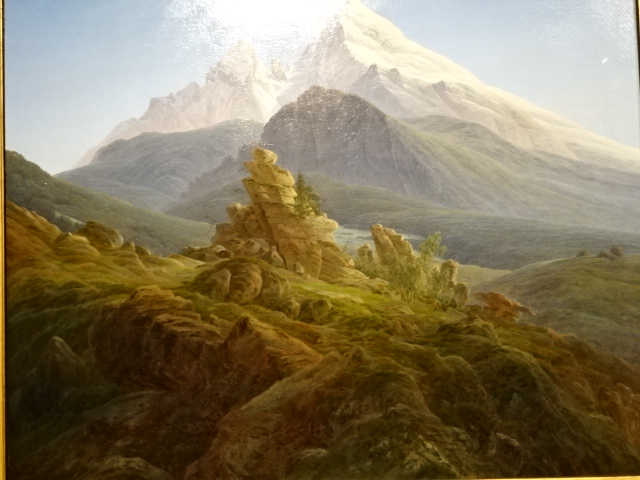
By David Caspar Friedrich, on display at Albertinum for temporary exhibition

In the Dresden Albertinum, I was mesmerized by Friedrich’s landscapes. Many featured vibrant colors and a brilliant use of light. He also created dark paintings with a chiaroscuro element that gave them a mystical appearance. Some of his landscapes included a solitary figure traveling alone in nature. Friedrich’s gnarled trees in barren environments were symbolic. I felt especially drawn to his portrayal of mountains in shades of pink.
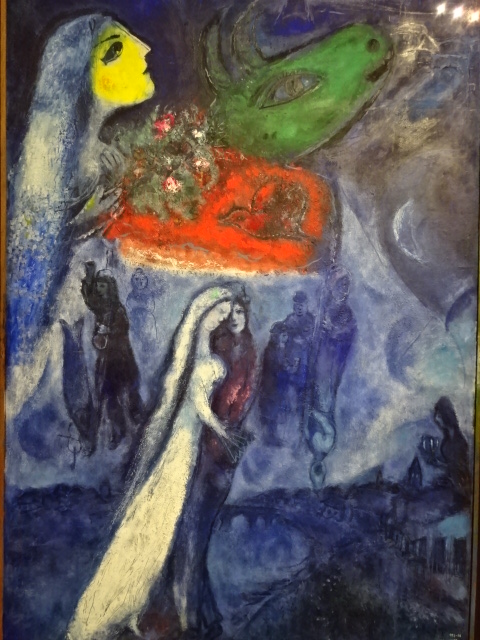
By Marc Chagall, on display at Albertina in Vienna for temporary exhibition
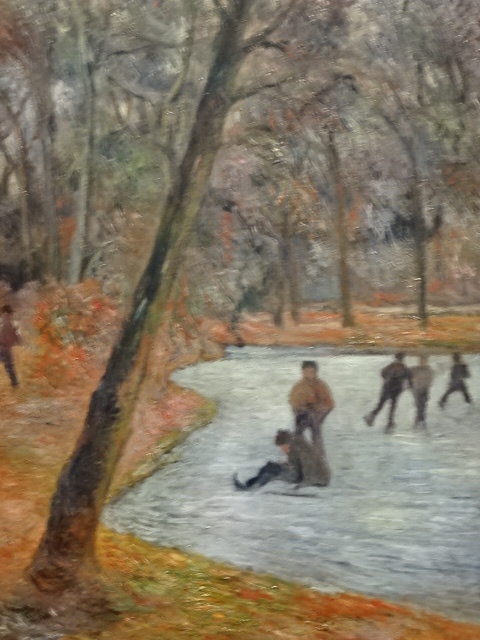
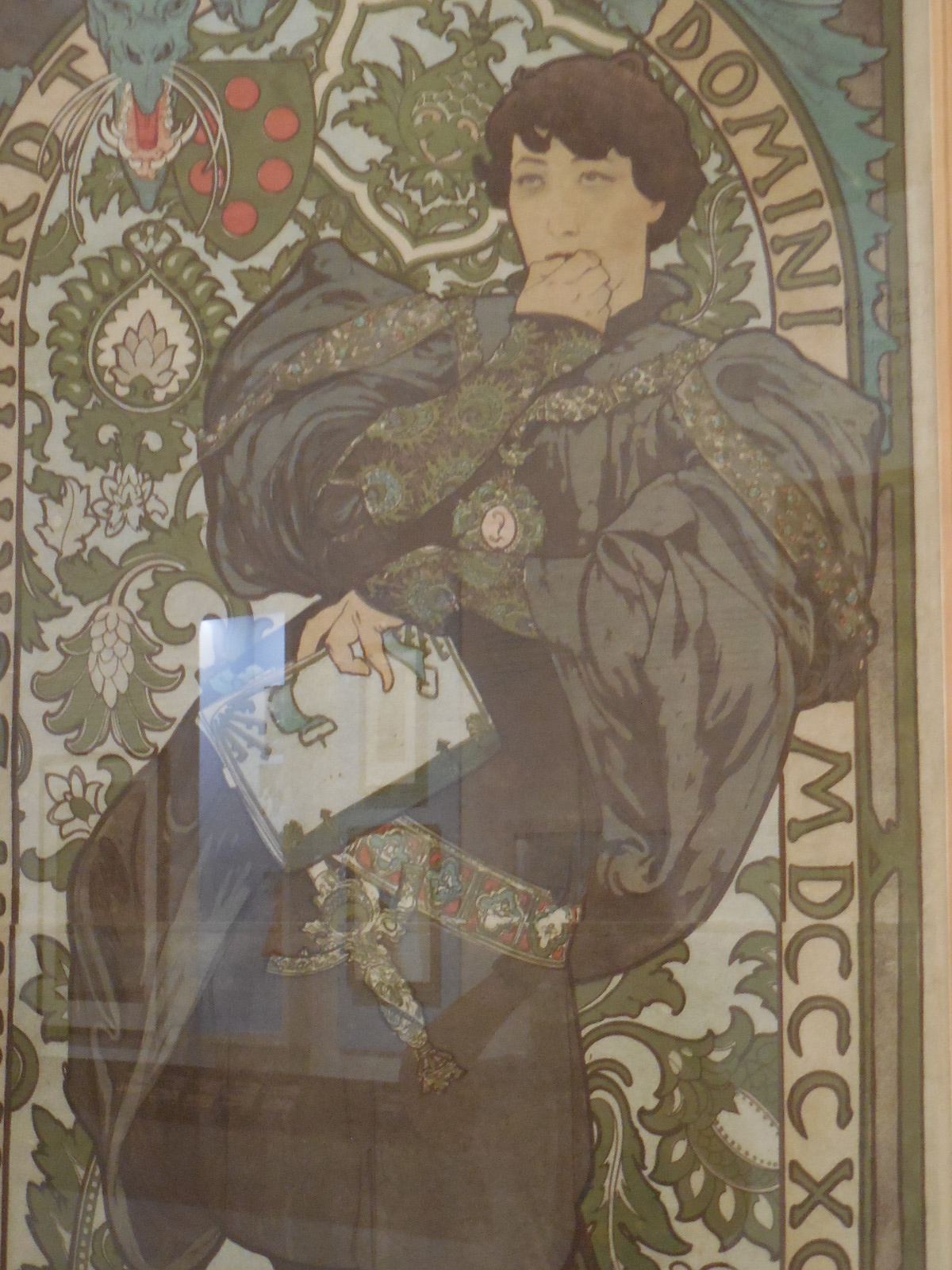
By Paul Gauguin
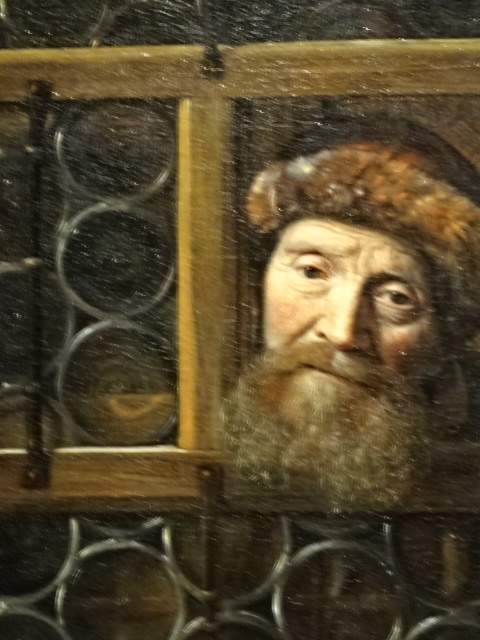
By Hoogstraten, Rembrandt’s pupil

I spent three days in Vienna going to major exhibitions featuring works by Chagall, Gauguin and Hoogstraten, a star pupil of Rembrandt. I hadn’t realized how many of Chagall’s paintings took on Jewish themes and serious topics. I had always thought of Chagall’s art as fun-loving and colorful. My favorites were those inspired by Paris and the circus, created in bright blues and yellows. The Gauguin retrospective showed his works from various time periods, so it was possible to see his specific artistic developments. I was most impressed with his early landscapes. I had not heard of Hoogstraten, whose portraits brought out the soul in the sitters just as Rembrandt’s did. His intriguing use of perspective in some paintings also impressed me. Works by Rembrandt also enchanted me in this exhibition.
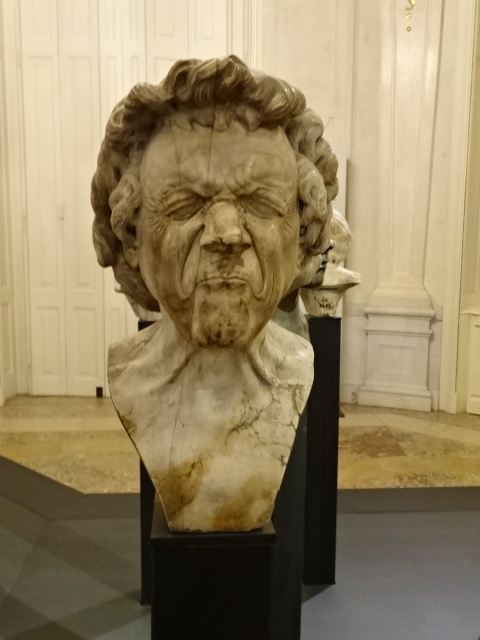
Franz Xaver Messerschmidt, Character Heads

by Gustav Klimt on permanent display at Upper Belvedere

By Václav Špála, on display at Upper Belvedere

City of Vienna Museum, permanent collection

We also visited the Upper Belvedere Palace Museum in Vienna. While it is best known for its Gustav Klimt and Egon Schiele creations, I was entranced with the medieval art in the basement and the Central European collection that featured Czech greats such as Jan Procházka, Bohumil Kubišta and Václav Špála. The Klimt paintings were extremely powerful as were all the Impressionist and Post-Impressionist works. My favorite part of the museum involves the unique Late Baroque Character Heads by Franz Xaver Messerschmidt, who rendered alabaster busts of insane people with unique facial expressions. You could see into their souls. In Vienna I entered the City Museum for the first time. The exhibits trace the history of the city from the beginnings to modern day. I saw intriguing paintings, furnishings, posters and objects, among others.
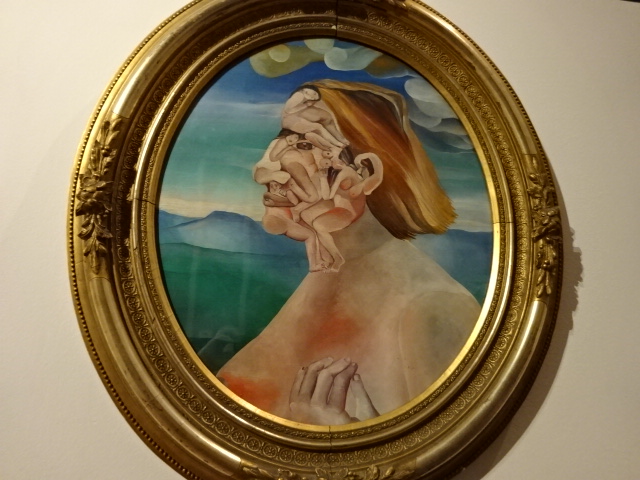
by Eva Švankmajer
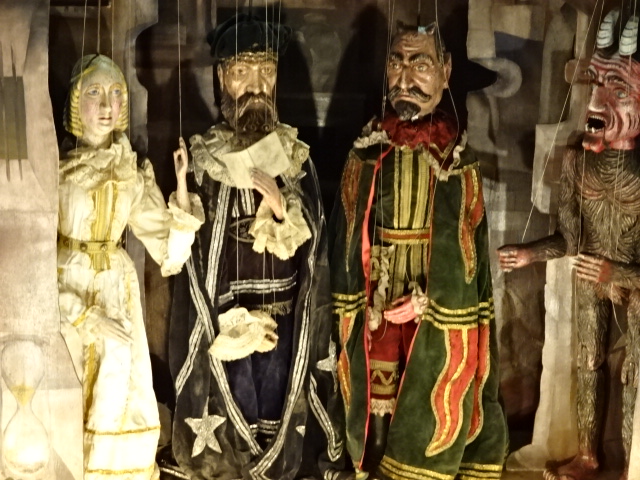
Puppets by Jan Švankmajer
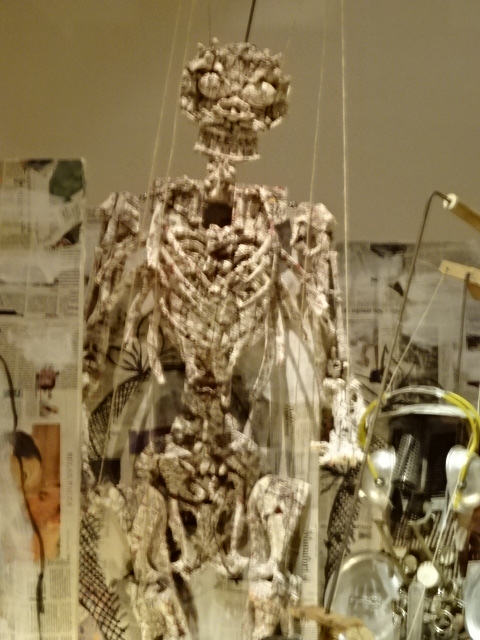
Puppet by Jan Švankmajer
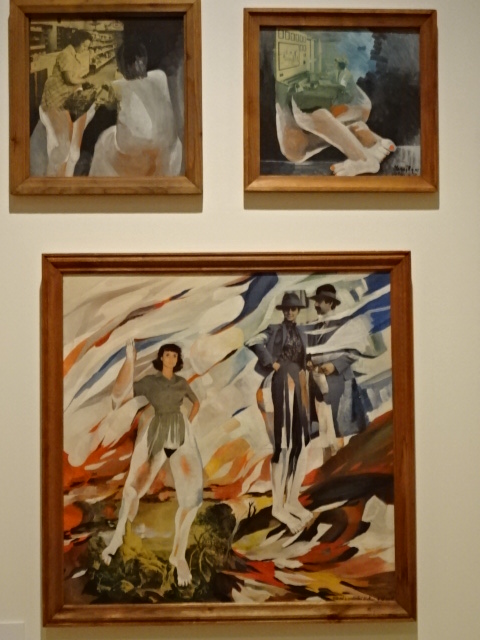
I also went to many exhibitions in the Czech Republic outside of Prague. In Kutná Hora I visited an exhibition of works celebrating the 90th birthday of Jan Švankmajer, a surreal artist, along with creations by his wife Eva. The exhibition Disegno Interno included collages, graphic art, objects, book illustrations, drawings, paintings, animated film creations and puppet theatre of both artists from the 1960s and later. Their creations included works that resemble Rudolfine Mannerist renditions as kinds of cabinet of curiosities and art inspired by Giuseppe Arcimboldo. I also noted the inspiration of the Baroque tradition in puppet theatre. Other works fell into the categories of art-brut, eroticism, fetishes and collages influenced by Max Ernst. Much of their art was deeply rooted in the writings of Edgar Allan Poet and Lewis Carrol. Scenography for Czech film was another section. I realized for the first time that surrealist art had been influenced to a great extent by Mannerist trends.

From Through Kafka’s Eyes, graphic art about The Metamorphosis
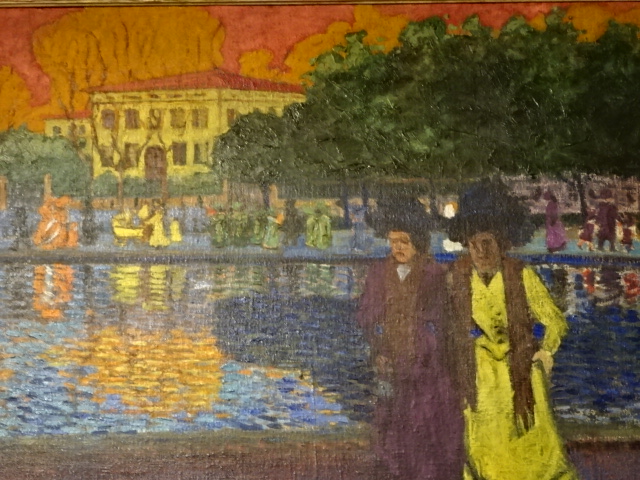
Through Kafka’s Eyes, Oto Kubín, Brindisi, 1906

In Pilsen I went to an exhibition called Through Kafka’s Eyes, featuring the art that had surrounded Kafka at the end of the 19th century and the beginning of 20th century. I saw posters for Czech art exhibitions in the early 20th century and those advertising 19th century Japanese art as well as works by stellar Czech artists. Paintings by Kubišta, colorful and vibrant, were represented along with sculpture by František Bílek. Czech artists who spent their interwar years in Paris were included, such as Oto Kubín and Georges Kars. Kafka’s own Jewish-themed drawings were a highlight. German art and literature rounded out the intriguing exhibition.
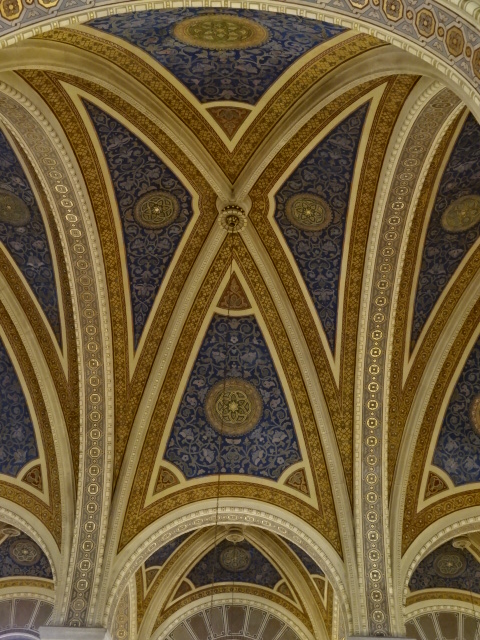
Great Synagogue, Pilsen

Great Synagogue, Pilsen

I also took the time to visit the Great Synagogue in Pilsen, the second largest synagogue in Europe and third largest in the world. On the onion-shaped dome the Star of David stood out. What I admired most was the vaulted ceiling punctuated with blue and gold adornment. Another feature that amazed me was the artistic mastery of the stained glass windows with geometric shapes and figures. The interior is furnished in Oriental style with Neo-Renaissance elements.

Pilsen, U Saltzmannů

We ate at my favorite restaurant in Pilsen, U Saltzmannů, the oldest pub in the city. The Czech food at this establishment cannot be surpassed. I had fried chicken steak this time.
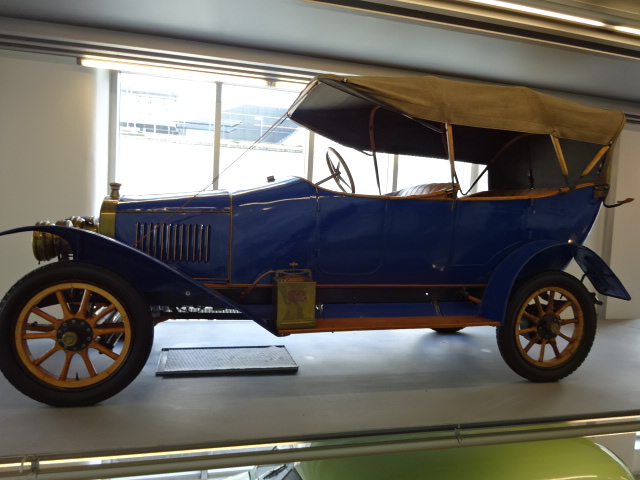
Škoda Museum

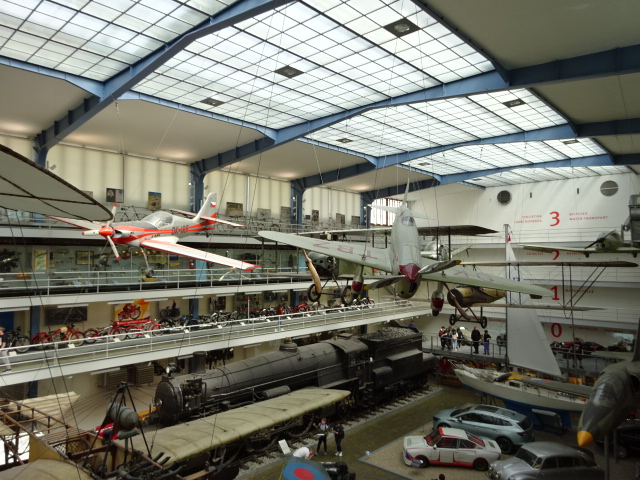
In Mladá Boleslav, about 70 kilometers from Prague, I visited for the first time the Škoda Museum, named after the popular Czech automobile manufacturer. The company began making bicycles with Václav Klement and Václav Laurin at the helm in 1895 and soon developed a rich tradition of producing cars. The automobiles on display ranged from vehicles made at the end of the 19th century to those produced in the modern day. I liked the early bicycles, including a two-seater for postal carriers. The cars from the early 20th century were also favorites.
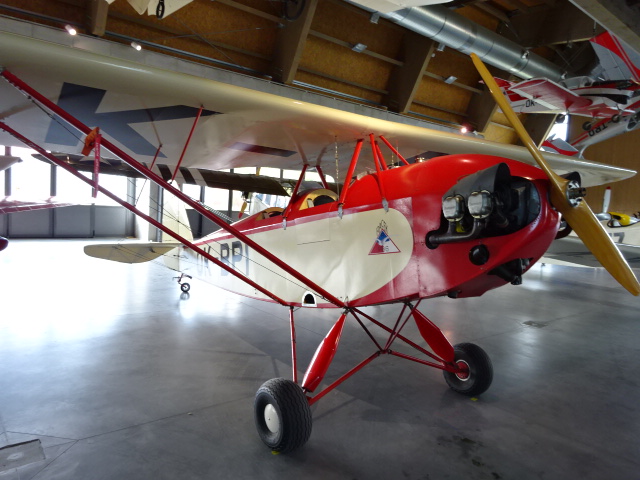
In that same city, we also visited the Aviation museum of Metoděj Vlach, which explored the history of aviation with more than 25 airplanes in the main hall, some hailing from World War I. I saw the 1913 G-III by Gaston and Réné Caudron. It had an open cockpit and 9-cylinder rotary engine. The two-seater wooden plane constructed by the Beneš company called a Be-60 Bestiola featured a 4-cylinder engine and had been flown from 1936 to 1940. The adorable W-01 Little Beetle had been used for airshows in the 1970s.

At that museum, I also learned about the career of pilot Alexander Hessman, who also had starred in a 1926 silent Czechoslovak film. He was the organizer of the Czechoslovak aircraft for the 1936 Olympics. After the Nazi Occupation in 1939, he helped pilots escape with false passports, and he wound up fleeing from the Protectorate to France and then to the USA in January of 1940. After World War II, he returned to Czechoslovakia but fled from the Communist regime, settling in the USA, where he was a technical assistant with PAN AM in New York City.
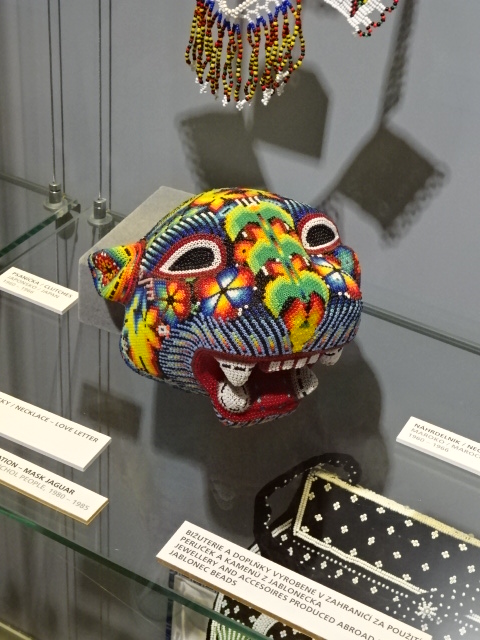
Mexican mask, Museum of Glass and Jewellery, Jablonec nad Nisou
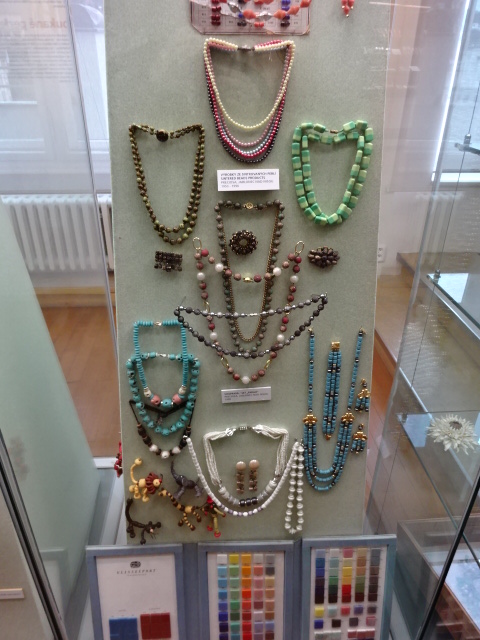
I traveled several times to north Bohemia this past year. One time I went to Jablonec nad Nisou, where the Museum of Glass and Jewellery was located because of the rich local tradition in these fields. I was immersed in the exotic jewellery of strung and woven glass seed beads by North American Indians, using products from north Bohemia. A mask of the jaguar hailed from the Huichol Indian tribe in Mexico. Glass seed beads from Jablonec nad Nisou were used to make a necklace by the South African Zulu tribe, dated from 1880 to 1900. Jablonec has been the location of the mint for the country’s currency, so many commemorative coins were on display.

I also was impressed by buttons made of glass, metal jewellery and black glass jewellery as well as wooden and plastic jewellery. Colorful handbags, masterfully designed, also made up the collection. The Waldes Museum of Buttons and Pins included more than 5,00 buttons, clasps and buckles with the oldest dating from 9 BC. The Bohemian glass exhibition showed off glass in many styles  ranging from medieval and Renaissance to Empire and Biedermeier to Art Nouveau and Art Deco to modernism and contemporary. The museum also has the largest public collection of glass Christmas ornaments in the world with more than 15,000 objects. I saw ornaments of angels, birds, cats, dogs, Santa Clauses, gingerbread men and much more, all contemporary.
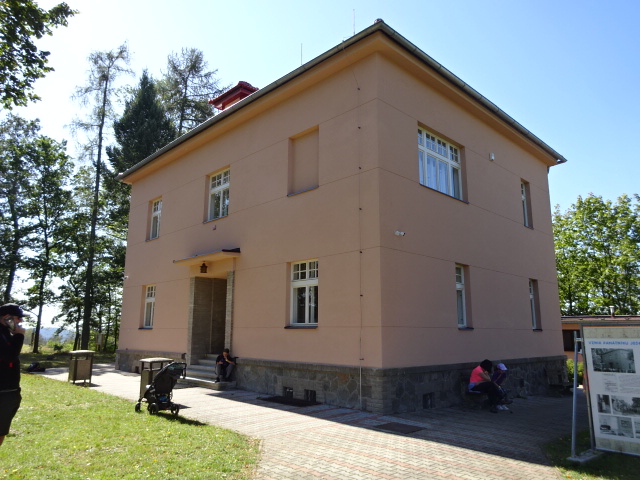
Josef Lada’s Villa in Hrusice

I made my first visit to Josef Lada’s Villa in Hrusice, where that author, painter, book illustrator and scenographer had lived while making some 600 paintings and 15, 000 illustrations. I saw his paintings of idyllic village life featuring all four seasons. Children threw snowballs and make snowmen in a quaint village in one painting while a squirrel was perched attentively on a tree branch, overseeing a tranquil village scene in another. Pub scenes showed humorous drunken brawls. I would have loved to have owned one of the charming cottages depicted in his paintings. I loved the paintings of knights and dragons from fairy tales as well as the paintings representing the months of the year. His paintings of scenes from Jaroslav Hašek’s antimilitaristic, multi-volume classic about the Good Soldier Švejk in the First World War caught my attention. Many of his paintings focused on holiday traditions. I also saw his humorous drawings and caricatures.
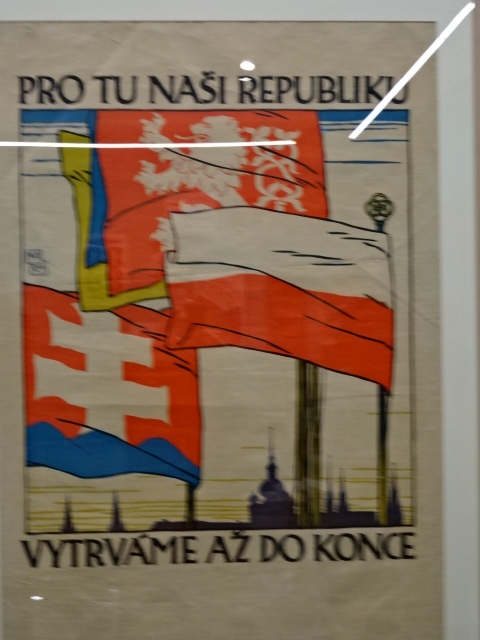
From the First Republic of Czechoslovakia
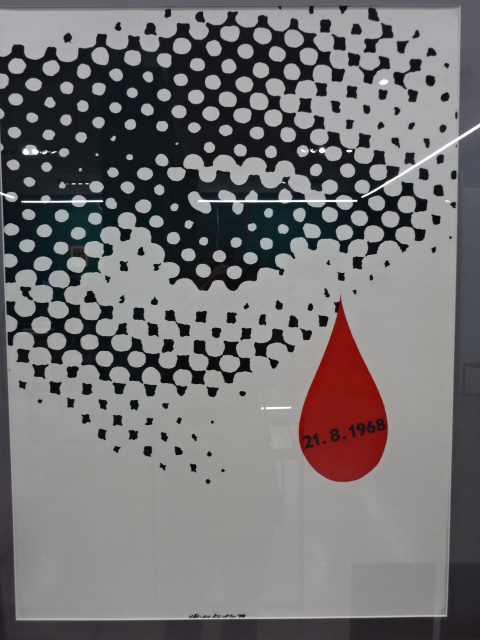
Poster by Václav Ševčík commemorating the day of the invasion by the Warsaw Pact armies, August 21, 1968

In Prague I took advantage of the stunning exhibitions this past year. I went to two excellent shows at Kampa Museum. One featured Czech graphic art from the founding of Czechoslovakia in 1918 to the present. I saw the first star-studded designs for the Czechoslovak flag as well as many political posters from the World War II era through Communist times to the Velvet Revolution of 1989. Václav Ševčík made a poster focusing on the day of invasion of the Warsaw Pact armies into Czechoslovakia on August 21, 1968, when the country’s liberal reforms were squashed. The poster shows a blood-red tear below an eye outlined in black on a white background.

Vítězslav Nezval, Alphabet, with typography by Karel Teige
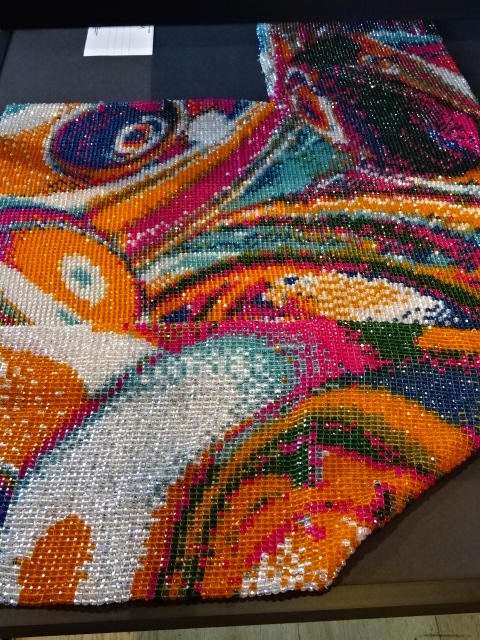
Kampa Museum, Identity exhibition of graphic art, Cindy Kutíková

Other sections concentrated on magazine and book design. I saw beautiful children’s volumes illustrated by Lada, Josef Čapek and Jiří Trnka. I was drawn to the covers and typography of Karel Teige, an avantgarde interwar artist. The exhibition showcased contemporary times by displaying a colorful, large Quantum Beaded Sweater created in 2020 and 2021 by Cindy Kutíková, for instance.

Václav Tíkal, 1944
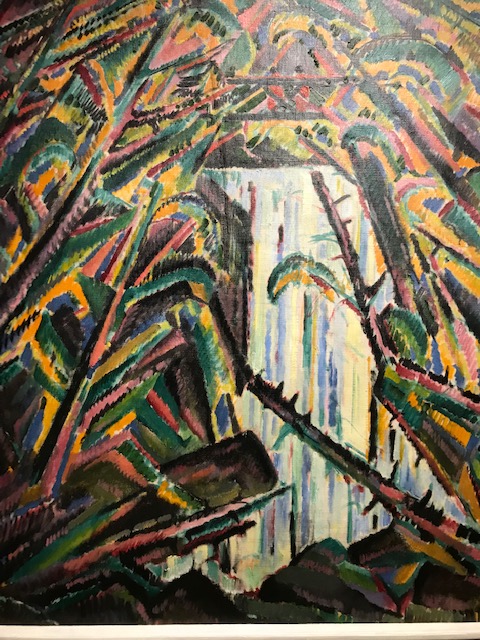
Otakar Nejedlý, Waterfall, 1913-14

Another exhibition at Kampa Museum focused on paintings from the private collection of entrepreneur Vladimír Železný, purchased for his Golden Goose Gallery. Called The Goose on Kampa, the show featured 70 paintings representing works from the beginning of the 20th century through the 1960s, such as creations by Toyen, Jiří Štyrský, Špála, Emil Filla, Jan Zrzavý and Mikuláš Medek. One painting that caught my undivided attention was Václav Tíkal’s 1944. A hand partially covered in a ripped black glove showing the fingertips, thumb and part of the palm was emerging out of the frozen, snow-covered earth in a barren landscape.

Otto Gutfreund, Viki, 1912-13 from Cubist period

On that day I also explored the Kampa Museum’s permanent collection, specifically the sculptures of Otto Gutfreund, whose early works can be classified as Cubist. His later creations, made after World War I, featured traits of Civilism, which promoted themes of everyday life.
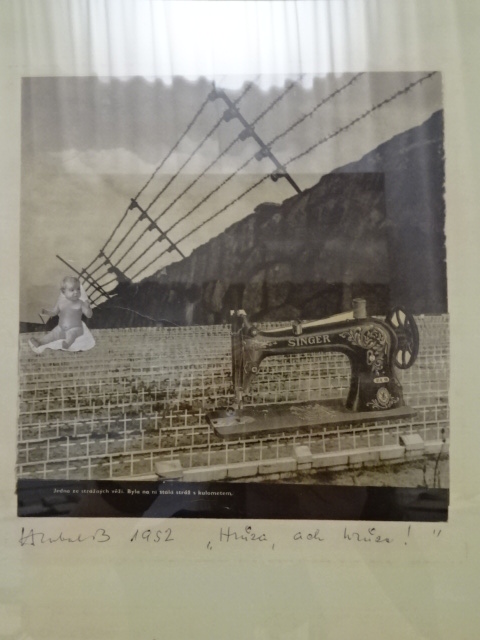
Bohumil Hrabal, 1952, Tragedy! What a Tragedy!

At the Museum of Czech Literature, I greatly appreciated a small exhibition due to my interest in the works of the late 20th century Czech fiction writer Bohumil Hrabal. The modest show emphasized the artistic relationship and friendship of Hrabal and abstract artist Vladimír Boudník, who created the “Explosionism” style. I was most impressed by Hrabal’s collages from the 1950s. One featured a Singer sewing machine, a naked baby and barbed wire heading into the horizon as white crosses in a graveyard punctuated the picture. It was called “Tragedy, What a Tragedy!”

Oto Kubín, Chapel in Simione, 1926
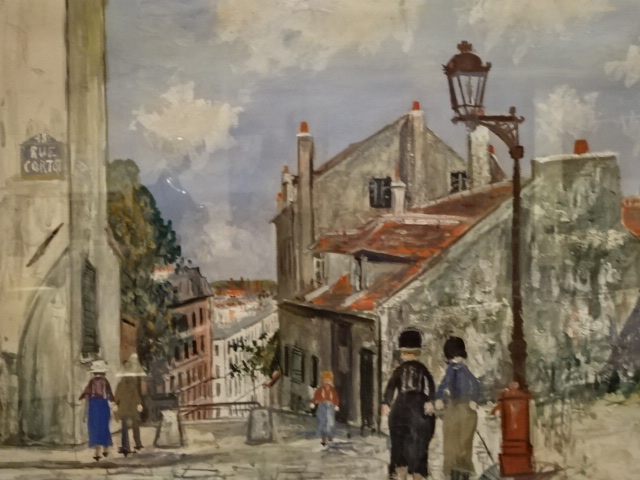
Maurice Utrillo, Chateau de la Seigliere (Aubusson), 1930

The Wallenstein Riding Stables was the site of an intriguing exhibition about artists from Bohemia residing in Paris between the wars. They were part of the “Paris School,” which featured a variety of styles. Czechs Kars, Kubín (Othon Coubine) and Francois Zdeněk Eberl made strong impressions in the lively, vibrant Paris of the 1920s. The themes of the paintings were many: portraits, cityscapes, street life scenes, café and entertainment scenes as well as a focus on the circus and cabaret. I was drawn to Kubín’s landscapes of Provence. The lavender fields were my favorite. Also represented were foreign artists, including Marc Chagall and Maurice Utrillo.

Hendrick Goltzius, The Four Disgracers, 1588

Also at the Wallenstein Riding Stables, the exhibition “From Michelangelo to Callot: The Art of Mannerist Printmaking showed off more than 200 works of 16th and 17th century graphic art, drawings, paintings, jewelry, etchings, lithographs, ceramics and other artistic crafts that hailed from the Netherlands, Germany, France and the Czech lands. The Louvre lent Prague’s National Gallery many works. Some pieces in the collections were being displayed to the public for the first time. A superb small drawing by Michelangelo drew crowds, and art by Hendrick Goltzius, Paul Bril,  Aegidius Sadeler and Niccolo Boldrini stood out to me.

Painting by Karel Kryl, temporary exhibition at House of the Golden Ring

Karel Kryl giving a concert

On my birthday I went to the House of the Golden Ring near Old Town Square. I saw an exhibition about the late dissident singer and songwriter Karel Kryl, whose music had been poetic, profound and political. He had lived in West Germany during much of the Communist era and had worked for Radio Free Europe. I realized how politically-motivated his songs had been and how he had supported the Poles as well as the Czechoslovaks in their fights for freedom. I was engrossed by his artwork, disturbing and grotesque scenes with one-legged clowns and half-human, half-creature figures.
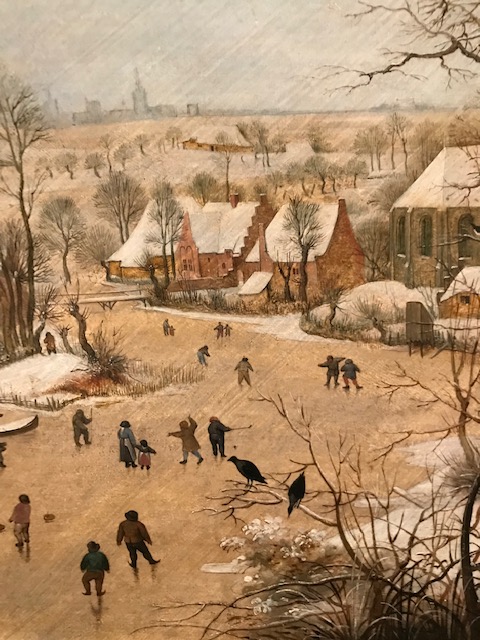
Pieter Brueghel II

One of my favorite exhibitions of the year, taking place in Kinský Palace, was called “Get on the ice!”, featuring hockey and skating in paintings and other artistic creations. It reinforced the fact that ice hockey and skating have played significant roles in Czech and Slovak identity. I especially was impressed by the works of the Dutch masters who had inspired Czech painting. Pieter Brueghel II’s scene of skating on a pond caught my undivided attention. Czechs first represented skating on the Vltava River and on ice rinks.

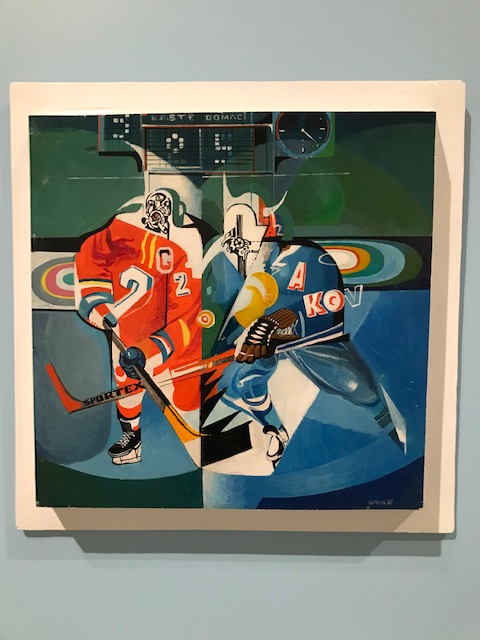
Then hockey became the major theme, first portrayed realistically and then in the 1960s expressed in an experimental fashion. I was drawn to František Tavík Šimon’s “Ice Rink Under the Charles Bridge” (1917) with its large falling snowflakes and idyllic, historical setting. One example of the experimentation of the 1960s is Vojtěch Tittlebach’s “Hockey” from 1965, with abstract shapes and simple forms. The players in this painting had no facial traits. Jiří Kolář also added to the experimentation of the 1960s with his “Hockey Sticks,” composed of three wooden sticks decorated with paper collages, many of them maps and some historical scenes. The 1998 Czech Olympic victory at Nagano was celebrated in large photographs, including one that showed the moment Czech Petr Svoboda scored the winning goal while the crowd in Old Town Square erupted in joy.
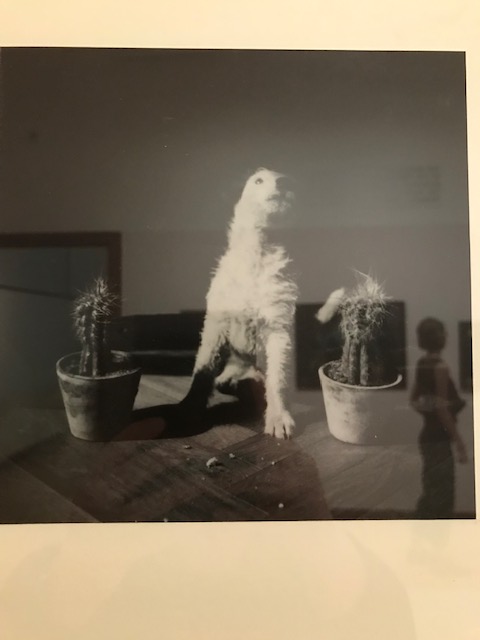
New Realisms, Karel Čapek from series Cactuses, first half of the 1930s

One-Handed Ice Cream Man, Miloslav Holý, 1923

In Prague I also saw the New Realisms exhibition, which focused on modern Realist trends in Czechoslovak art from 1918 to 1945. The more than 600 works hailed from the Czech and Slovak lands as well as Germany and Hungary. I especially liked Karel Čapek’s photographs of cactuses and his dog Dašenka as this field focused on the everyday during this era. I also liked the many café scenes, realistic portraits of people, magic realism in landscapes, the focus on the societal and economic dilemmas in Czechoslovakia and the depiction of modern labor. I have always been interested in the paintings of Group 42 as their works had an existential quality, often punctuated by telegraph wires and deserted streets.
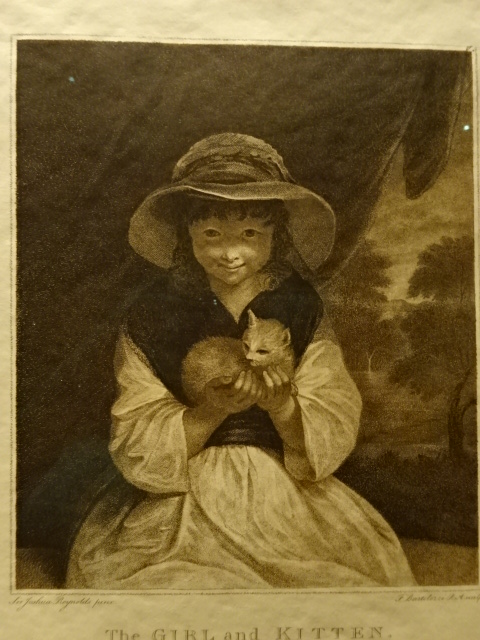
Francesco Bartolozzi, The Girl and the Kitten, 1787

One of my favorite exhibitions in Prague this past year was called “The Good Cat and the Treacherous One,” featuring cats in graphic art from the 16th to the 18th century. The art shows how some people revered cats while others hated felines. They often symbolized something or were shown for entertainment. Some considered them to be a form of the devil. Others gave them positive religious connotations. I especially enjoyed the Mannerist works by Goltzius and the graphic art by Wenceslaus Hollar, who portrayed cats with both positive and negative qualities. I saw pictures of cats symbolizing maternal love, sight, hearing, devotion, courage, yearning for freedom, foolishness, frivolity, cruelty, greed, treachery, lust and adultery. I also noticed cats as protectors against snakes. A French painting showed how, in 18th century France, cats had epitomized personal and political freedom.

Clam-Gallas Palace

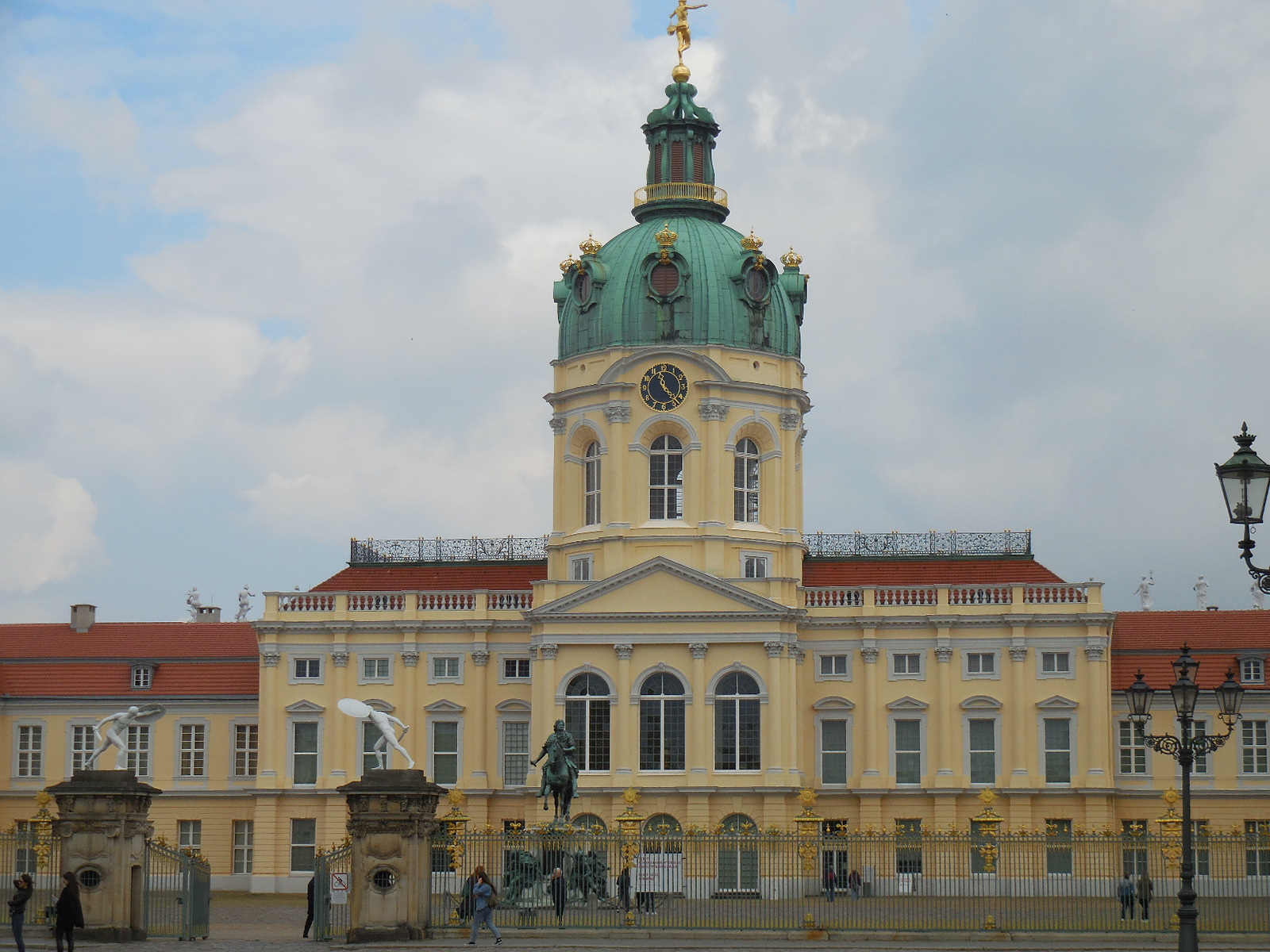
I focused mostly on day trips when traveling this past year. While I visited chateaus, castles and monasteries outside of Prague, I did also become acquainted with the renovated Clam-Gallas Palace in the capital city. The Baroque palace became the property of the Gallas family in the 17th century. The palace has a rich musical and theatrical history as Mozart and Beethoven both performed there during the late 18th century. The colossal exterior portal is decorated with statuary by Baroque master Matyáš Bernard Braun, and he also created the fountain portraying Triton.
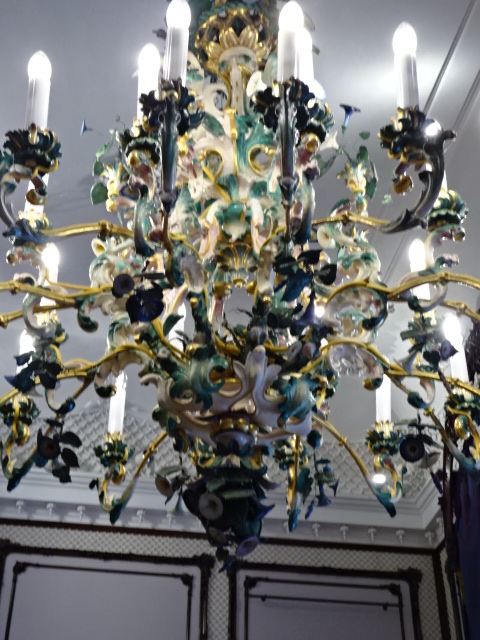
Murano chandelier in Clam-Gallas Palace

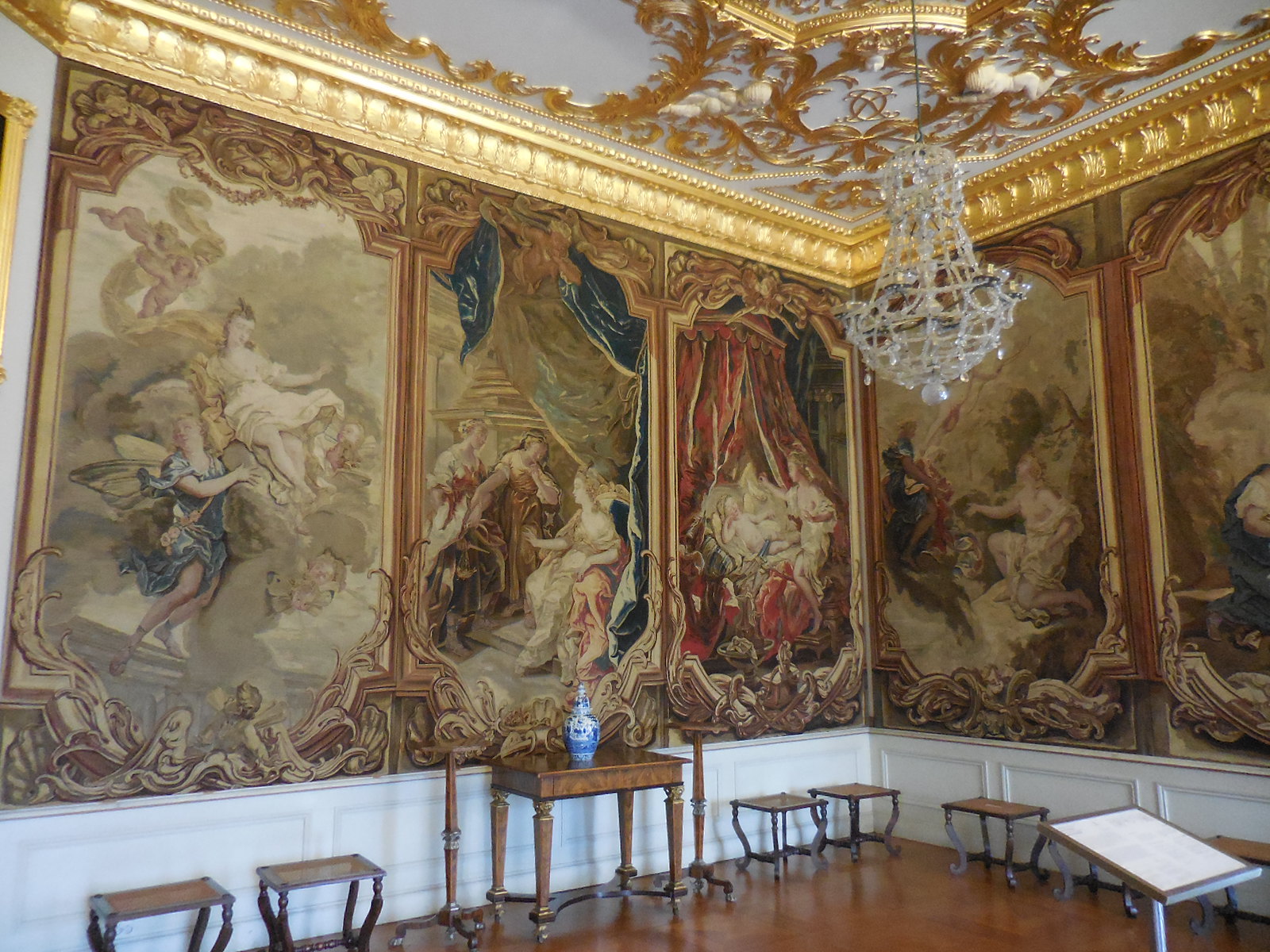
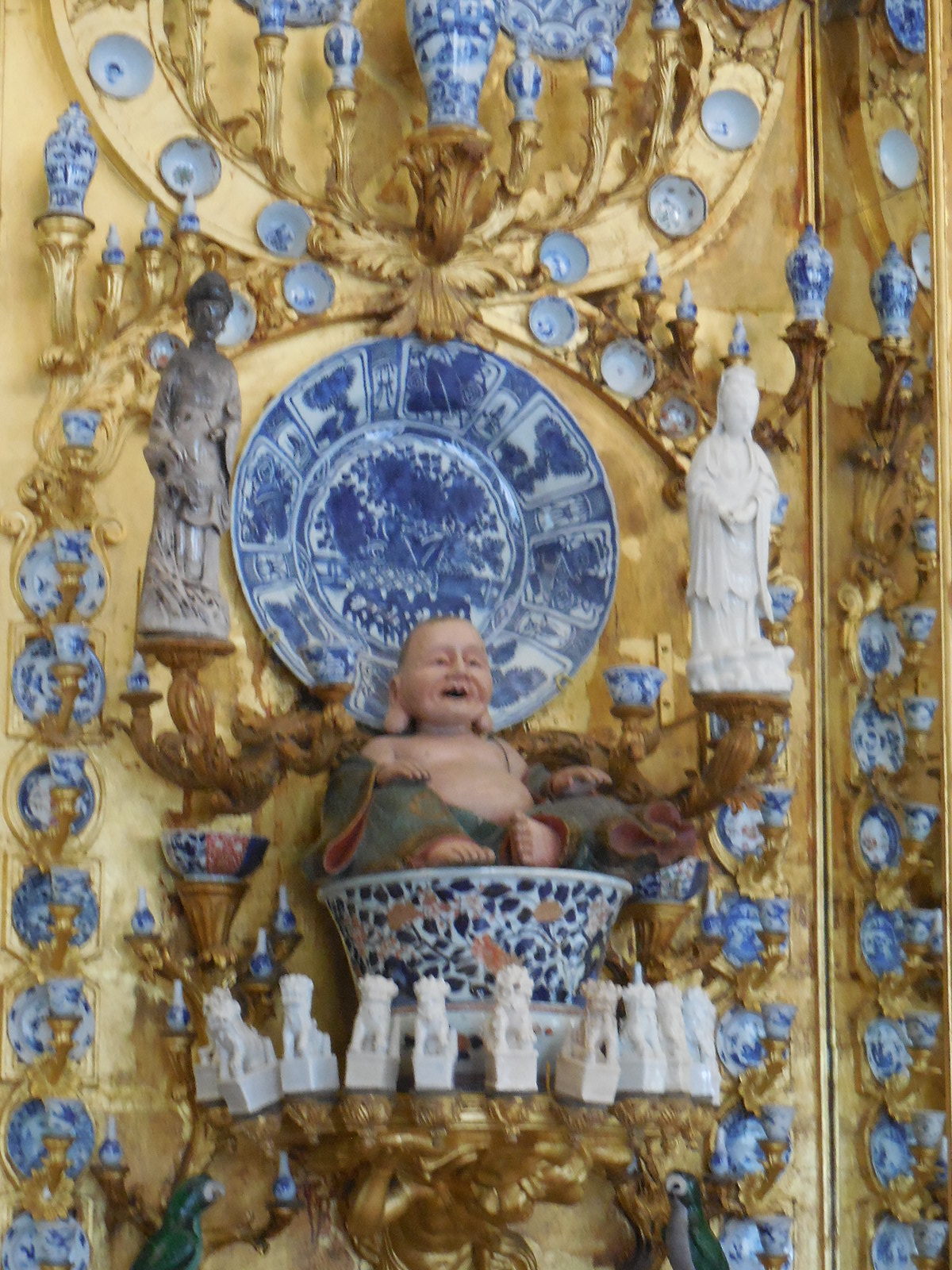
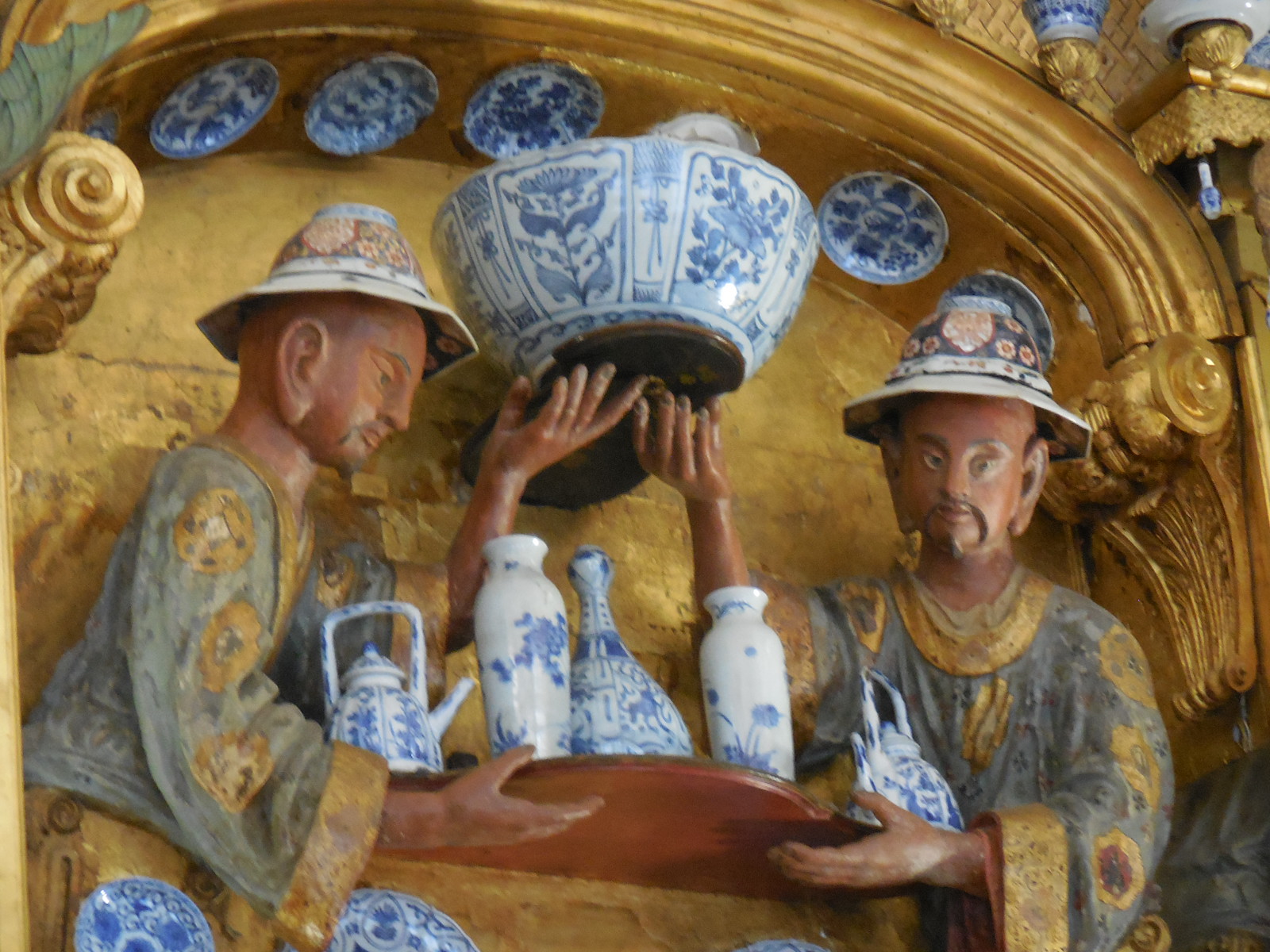
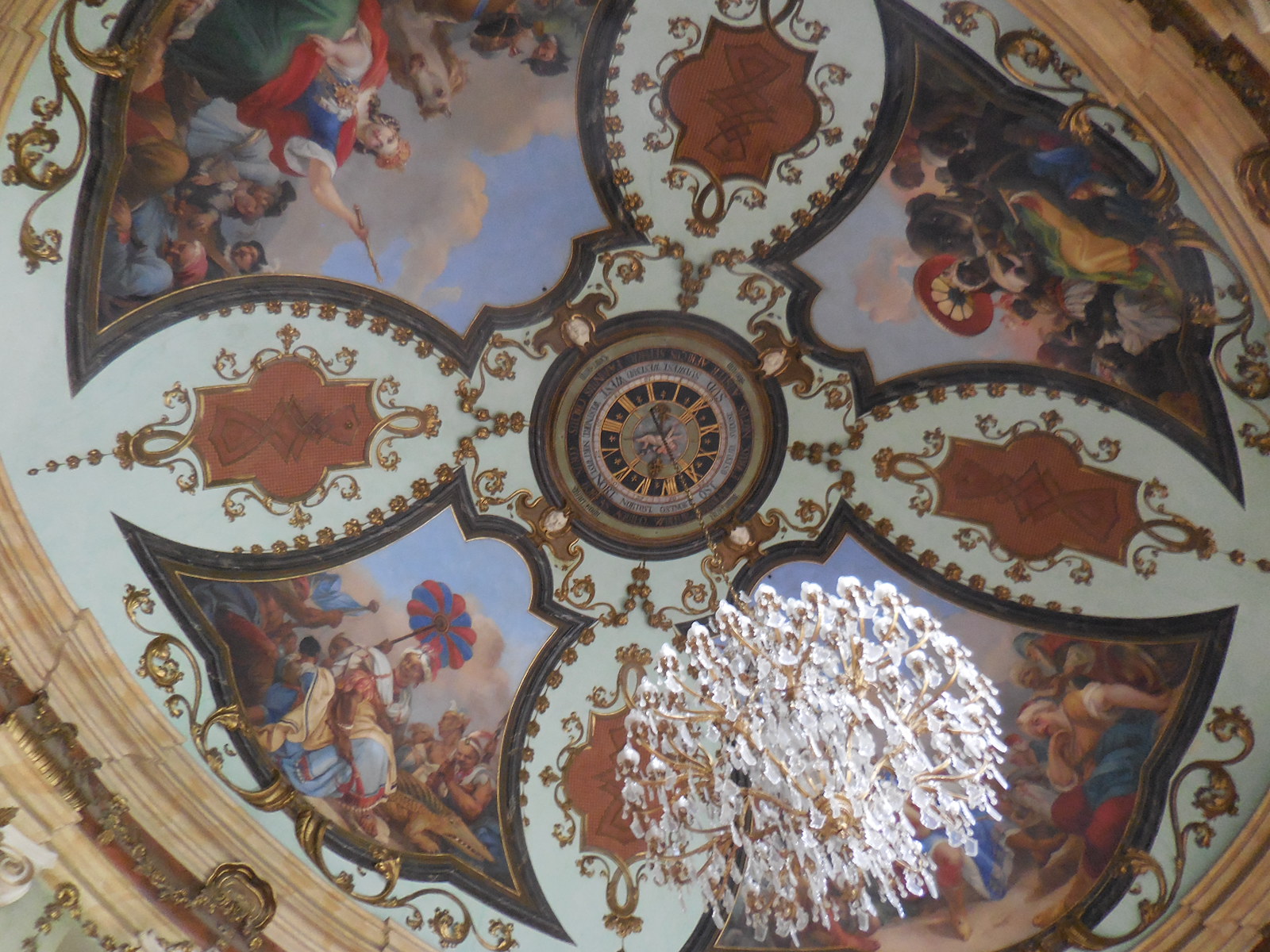
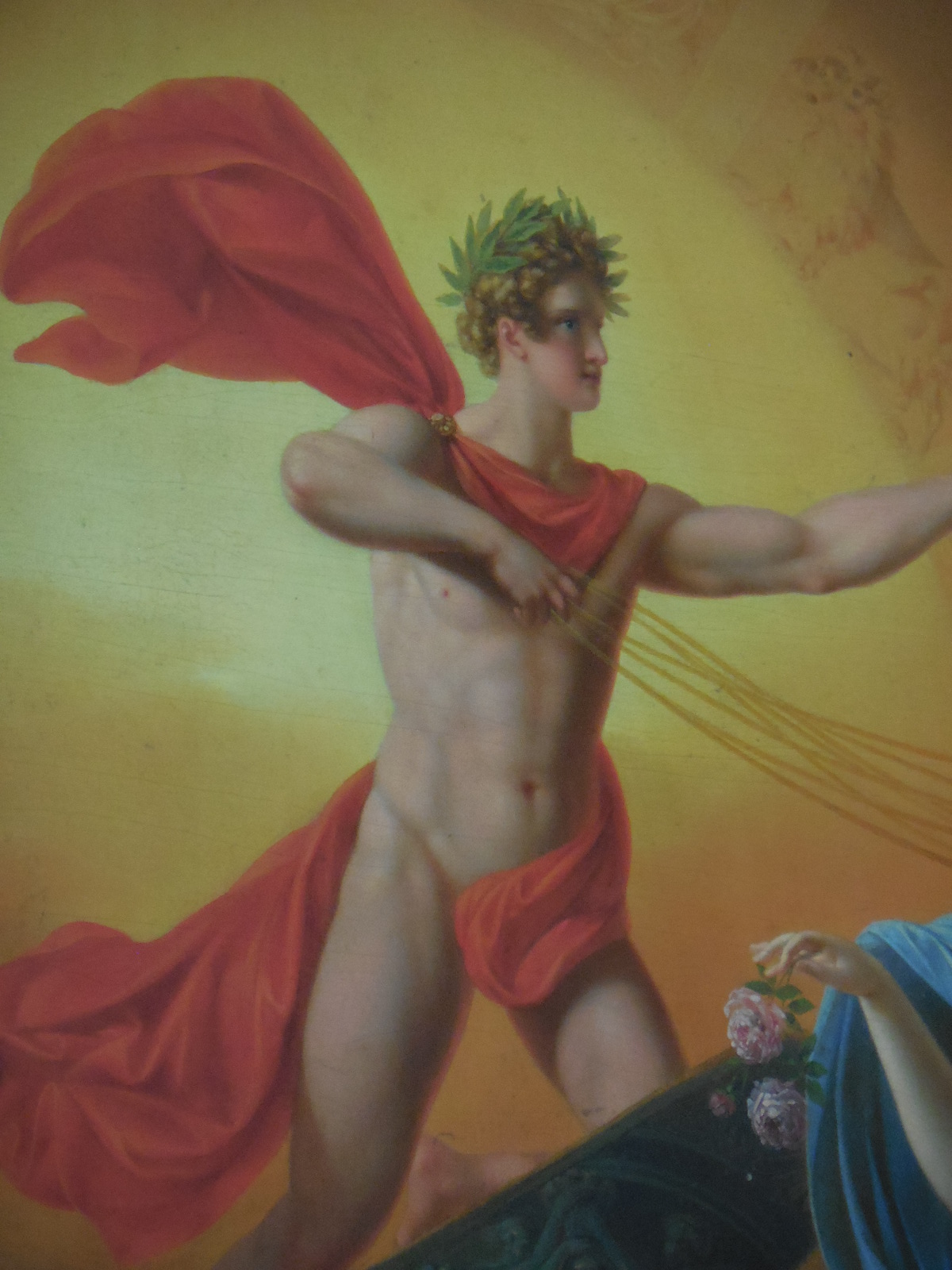
The many monumental frescoes amazed as did the chandeliers, especially the 19th century chandelier made of Chinese porcelain cups, saucers and vases. Frescoes depict the triumph of Apollo and gathering of the gods on Olympus, for instance. Allegorical figures representing sculpture, architecture and painting stand out in another fresco. I was very impressed with the former office of the first Czechoslovak Minister of Finance, Alois Rašín, though it was sparsely furnished. He had tried to gather support for the creation of Czechoslovakia during World War I and had even been imprisoned for taking part in the resistance. Rašín was assassinated in Prague during January of 1923 by a 19-year old anarchist.

Bohumil Hrabal’s cottage in Kersko

Kersko near Prague is one of my favorite tranquil spots in the country, a village where Hrabal resided from the 1960s until his death in 1997 and where he fed many feral cats daily. Hrabal’s two-story cottage opened to the public for the first time this spring. I saw the garden where he wrote some books and the charming enclosed terrace where he composed his works when weather did not permit him to spend time in his garden. I saw the chair in which Hrabal wrote his last literary piece, during 1995. The top floor was adorned with many paintings – a moving portrait of Hrabal by Jan Jirů, a drawing featuring heads of Hrabal from his youth to old age in a rendition by Jiří Anderle. Another portrayed cats on chairs in a forest setting along with Hrabal himself. Portraits of his family and a collage focusing on one of his books also caught my undivided attention. The place captured the soul of Hrabal, and I was very moved.

In the local shop, known for its ceramic figures of cats, there was an exhibition of drawings of Hrabal – at the pub, in Heaven, in Kersko, each rendition celebrating the author in a creative way. We ate at my favorite restaurant outside of Prague, Hájenka, a prominent landmark in Kersko. Whether I chose the chicken with cheese sauce, the meat with dumplings or the fried chicken steak, I was always delighted by the meal in a rustic, charming atmosphere.

Mariánská Tynice complex

I traveled about 35 kilometers north of Pilsen to pay a second visit to the High Baroque complex with pilgrimage church Mariánská Tynice, an aerial constructed by renowned architect Jan Blažej Santini during the 18th century, using geometric forms such as quadrangles and triangles as features of his Baroque Gothic style. The church with a Greek cross plan had an impressive illusionary main altar of the Holy Trinity while the east and west ambits were constructed with open arcades featuring eight chapels. The masterful painting on the vaulting and walls celebrates the lives of the Virgin Mary and Cistercian saints. The cupola of the church is lit by eight windows.

Frescoes on the walls and vaults of the ambits

Part of the complex was the Museum and gallery of the North Pilsen region. I liked the Gothic altarpieces and Baroque paintings as well as the 19th paintings of pilgrimage sights. The reconstruction of rooms resembling 19th century and early 20th century village life included a classroom, a countryside chapel and a pub.

Museum of the High-Rises, Kladno, ceramic tile on the facade

Gas masks in the nuclear bunker of the Museum of the High-Rises

In Kladno near Prague, I toured the Museum of the High-Rise, which was located in one of the six Rozdělov high-rises designed by Czech functionalist architect Josef Havlíček in the 1950s. He received acclaim during the interwar years as a member of the avantgarde and studied under Cubist architect Josef Gočár. The façade of the 13-floor building was created from ceramic material, and on that particular high-rise were ceramics of a cat and a dog. There was a small museum in one basement floor. We also visited the nuclear bunker, complete with numerous gas masks and many hard benches. The big rooftop terrace was a prominent feature for that time period. In the representative flat for the higher-ups, we saw 1950s furniture and a balcony. The flat measured about 65 meters squared, quite a luxury in that day and age.
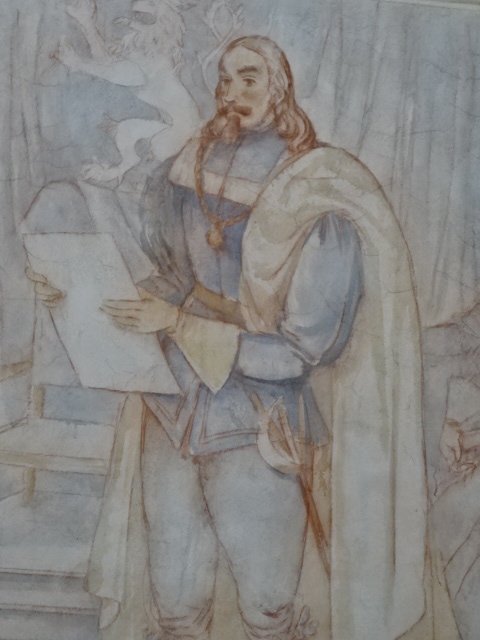
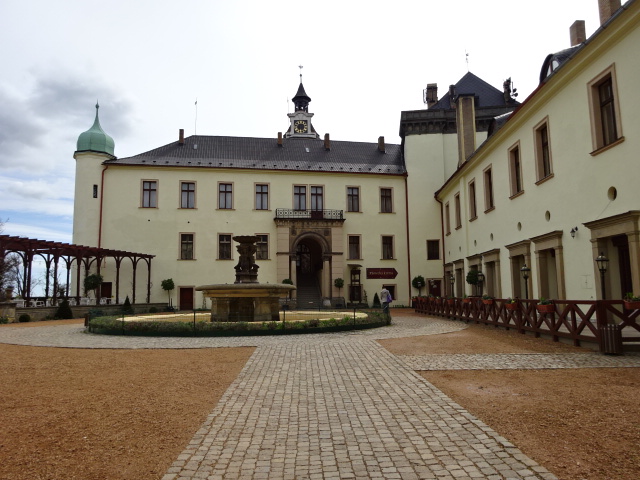
Humprecht Chateau

View from Humprecht Chateau

I also visited many chateaus within a two-hour distance of Prague. Seventeenth century Humprecht Chateau in the central Bohemian Paradise region had an elliptical shape. Much of the interior featured hunting themes. I saw paintings of Venice, Biedermeier bookcases in the two libraries of about 4,000 volumes, a black kitchen with an original fireplace and utensils from the 17th century. The main hall featured four frescoes from the 1930s, showing scenes from the life of the Černín family, the long-time owners of the chateau. Baroque furniture decorated several rooms. The picture gallery includes works from the 17th century. What I liked best about the chateau were the panoramic vistas from the top floor.

Volman Villa

Also, not far from Prague, the newly reconstructed Volman Villa, a large, geometric functionalist structure built from 1938 to 1939, featured big terraces, a circular driveway, a monumental winding staircase and outer stairs that lead to a bridge heading into the building. It is possible to access the terrace from each spacious room. Volman used exotic materials such as travertine and marble for the construction. The marble bathrooms with beautiful pink and light blue bathtubs were vast. While there are now many trees obstructing the view, at one time it was possible to see the Labe River in the 40-hectare English park.
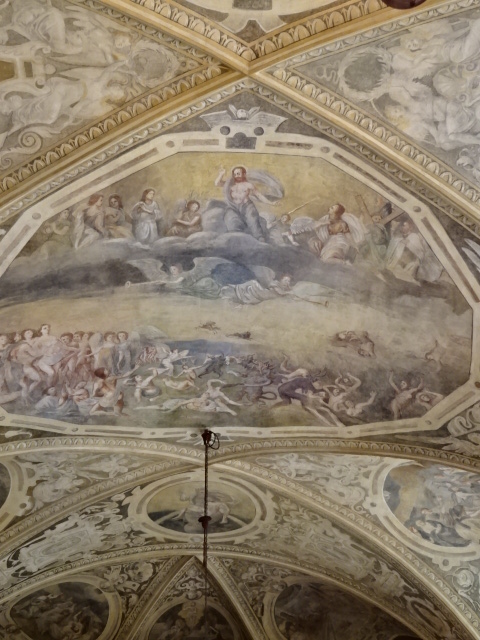
Grabštejn Castle, Chapel of Saint Barbara

I visited several castles and chateaus in north Bohemia – Grabštejn Castle, Jezeří Chateau and Červeny Hrádek Chateau. I was shocked at the vast improvements made during the reconstruction of Grabštejn and Jezeří as I had last visited the two about 20 years ago. Grabštejn, originally a 13th century castle, took on the structure of a Renaissance chateau in the 16th century. The 16th century Chapel of Saint Barbara featured exquisite vaulting and wall painting that included 13 apostles. One tour featured the 18th century administrative offices that made up the castle interior during that time period while another showed the rooms of the nobility, including a gigantic wall painting with chateau-like gardens and fountain. I saw furnishings and artifacts from the 16th to 19th centuries.
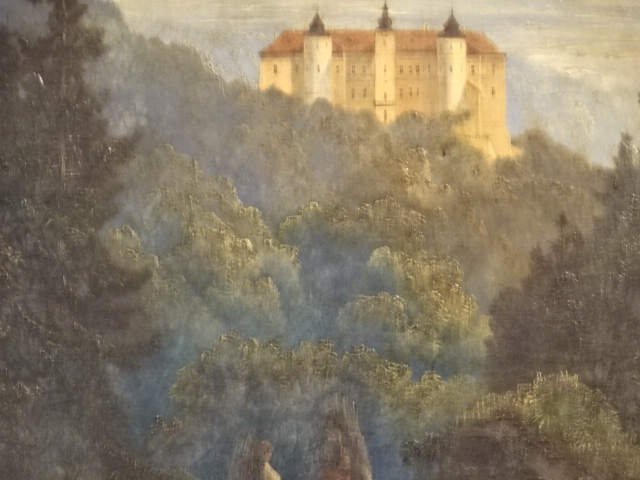
Jezeří Chateau, painting by Carl Robert Croll

While only a few rooms of Jezeří Chateau were opened about 25 years ago, now there are about 10 impressive spaces on the tour. I loved the paintings of Carl Robert Croll, renditions which showed the interior of the chateau during the early 19th century. I was especially impressed with the room dedicated to Jan Masaryk, the son of the first president of Czechoslovakia and once the Minister of Foreign Affairs. He was thrown out a bathroom window at the Ministry of Foreign Affairs by the Communists after the 1948 coup. The Winter Garden was light and airy, punctuated by much greenery. The lavish Theatre Hall included sculptural and stucco adornment as well as an original fireplace. The paintings throughout were impressive, too.

Červený Hrádek, Knights’ Hall

Červený Hrádek dated back to the early 15th century and gets it current appearance from the 17th century. The Knights’ Hall from that era included lavish sculptural decoration with medallions featuring battle scenes and exquisite crystal chandeliers. Other spaces harkened back to the 18th and 19th centuries with period furnishings. Seventeenth century sculptor Jan Brokoff created sculptures, fountains and vases that decorated the monumental staircase. The English style park was beautiful, too. In August of 1938 the Sudeten Party leader Konrad Henlein and English Lord Walter Runciman had a meeting there, shortly before the Munich Agreement was signed.

Dobříš Chateau Park

Dobříš Chateau Park

Because the interior had been recently renovated, I returned to Dobříš Chateau not far from Prague. I was disappointed there were not as many rooms decorated with period furniture. Instead, the self-guided tour mostly featured spaces celebrating the Colloredo-Mansfield family’s accomplishments, which were very intriguing and noteworthy, to be sure. Still, I missed the longer, guided tour and former exciting interior décor of the Rococo and Classicist eras. The Writers’ Room remained on display, decorated the way the space would have looked when the chateau belonged to the Writers’ Union from the 1950s to the 1990s. It was possible to enter one side of the spectacular Hall of Mirrors, although it was roped off and walking through the room was not permitted. The fresco-filled hall amazed with 18th century décor and eight Venetian chandeliers as well as monumental fireplaces.

Illusionary painting on the orangery in Dobříš Chateau Park

The park, measuring nearly two hectares, was the reason to visit the chateau. On that sunny summer day, it was spectacular to stroll through the Rococo style park established in the 1770s. It had five terraces, a fountain with astounding Baroque sculptural grouping and an orangery with illusionary wall painting.

Slatiňany Chateau

Interior of Slatiňany Chateau

I traveled to Slatiňany Chateau for the second time and noted the prominent hunting and horseback riding themes. The Auerspergs held on to the chateau for 200 years and were responsible for the charming interior. I loved the exquisite canopied beds decorated with religious paintings. The tapestries were another delight. In the Big Dining Room I admired a large painting of hunters and their dogs getting ready for the hunt as well as a stunning 18th century Murano chandelier.
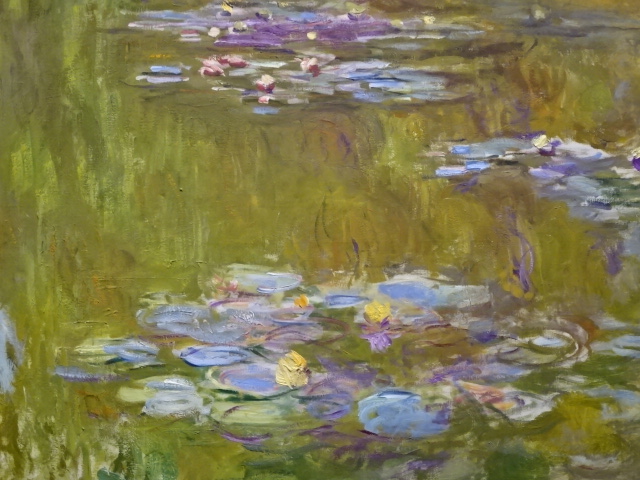
Vienna, Albertina, Monet, Waterlillies, in the permanent collection

I had many exciting adventures traveling in 2024 and had many impactful experiences at art exhibitions in the Czech Republic, Germany and Austria. Every time I go on a trip or to an art show, I come away changed, with a sharper perspective on life and with more enthralling knowledge.

Albertinum, Dresden, Hans Grundig, The Thousand-Year Empire, in the permanent collection

Tracy A. Burns is a writer, proofreader and editor in Prague.
Kersko Diary

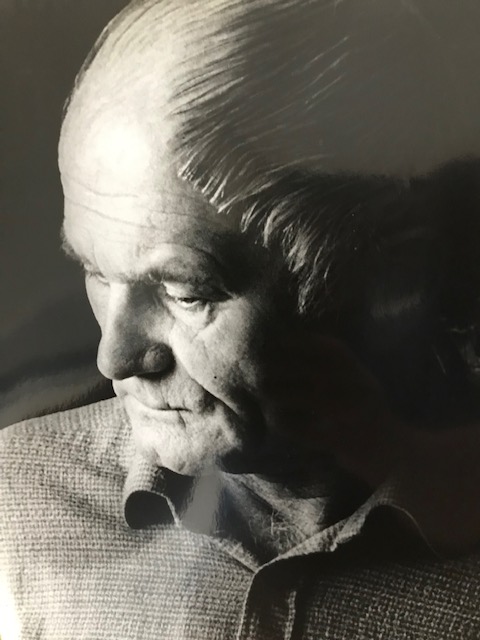
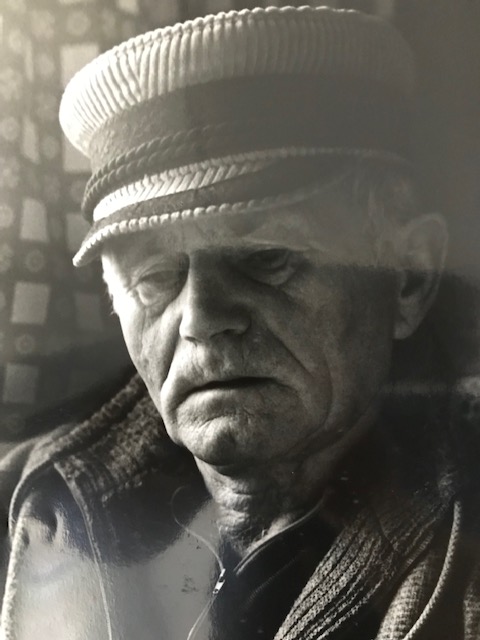
Czech legendary writer Bohumil Hrabal. Photo by Karel Kestner. Bought by me in Lesní atélier Kuba, Kersko some years ago.

For me Kersko is a sort of catharsis, easing my anxiety about daily life’s concerns and bringing me a sense of tranquilly. I feel at home here, even though I have no personal connection to this area not far from Prague. I can breathe in the clean air and be at peace with the world and myself. I would love to own a house in Kersko, a forested village dotted with traditional cottages and huge homes built by millionaires.

The Kersko restaurant Hájenka

Every now and then I made the trip to the village restaurant Hájenka, a traditional pub-like establishment with delicious Czech food. On the television in the pub, customers can watch scenes from late legendary Czech author Bohumil Hrabal’s film Snowdrop Festival. Some of the exteriors were shot at Hájenka while the interiors of the pub seen on the film were actually shot at a studio. Directed by the world-renowned Jiří Menzel and based on Hrabal’s 1978 novel, the stellar film remains a Czech classic with many unforgettable scenes.

One of many ceramic cat figures at Lesní atélier Kuba, Kersko.

I also always stop at the souvenir and craft shop Lesní atélier Kuba, where beautiful handmade ceramic cats are sold along with other superb figures. The shop has been open since 1992. While a cat theme plays a major role in the inventory, there is much more to see. I always buy some of their delicious cookies. They sell much more than beautiful ceramics: t-shirts, postcards, books, candles and many other things. During my visit in May of 2024, the downstairs area was home to a fascinating temporary exhibition of witty drawings focusing on Hrabal’s life.

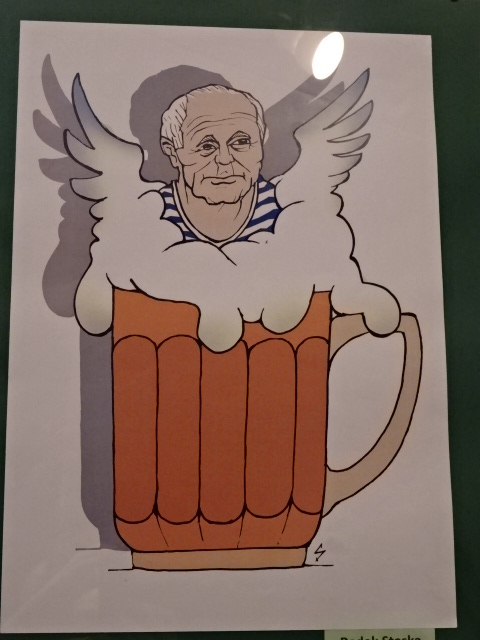
Drawing by Radek Steska showing Hrabal and his cats at The Golden Tiger pub in Prague, exhibited in Kersko at Lesní atélier Kuba.

Indeed, Kersko is intricately tied to the life and career of Hrabal, my favorite Czech writer and the name of my first cat. I penned my master’s thesis on his books, focusing on their historical context. From 1965 until his death in 1997, Hrabal often resided in a quaint, two-floor cottage in the village, fed the semi-feral cats, took walks, rode his bike and frequented the pubs, including Hájenka.

Bohumil Hrabal signing autographs in Spain during the mid-1990s. Photo property of Tracy Burns.

Born in the Austro-Hungarian Empire during 1914, Hrabal was renowned for his grotesque, absurd and irreverent humor and witty anecdotes. While he is mostly  known as an author of fiction, he excelled at poetry early in his career. What I like best about his writing is his creation of the pábitel, a word connoting a dreamer living on the outskirts of society. Although the pábitel has experienced tragedy, he learns how to be content with life and how to find beauty in even the most horrid conditions. The pábitel often tells meandering, absurd anecdotes that make the reader both laugh and cry.

Bohumil Hrabal and Czech writer Arnošt Lustig in Golden Tiger pub, Prague during the 1990s. Photo property of Tracy Burns.

Hrabal held many jobs throughout his writing career. He worked as a train dispatcher in Kostomlaty, where he was almost killed by Nazi soldiers. Hrabal later was employed as an insurance broker and traveling salesman. After the Communist coup of 1948, he took a position at the Poldi steelworks in Kladno, but in 1952 a crane fell on him. Then Hrabal became a paper baler. He would later make a living as a stagehand in a theatre.

Bohumil Hrabal in photo taken by Karel Kestner, bought by me at Lesni atélier Kuba some years ago.

The year 1956 was very significant for Hrabal as he married Eliška Plevová, a German-Czech kitchen worker in Prague’s luxurious Hotel Paris. In 1965 they bought a cottage in Kersko. During the more liberal 1960s, Hrabal was able to spend more time writing, and he was even able to travel abroad. His 1968 film Closely Watched Trains, directed by Menzel, won an Oscar, based on the novel Hrabal had scribed three years previously.

Bohumil Hrabal in photo by Karel Kestner. Property of Tracy Burns and bought at Lesní atélier Kuba some years ago.

After the Warsaw Pact tanks crushed the Prague Spring of liberal reforms in 1968, Hrabal was banned as an author, and his works only appeared in illegal publications. During 1970 his book Buds (Poupata) was burned by the Communists. These were tumultuous years. Hrabal relented to intense pressure and signed the anti-Charter denouncing the Charter 77 document that called for human rights in Czechoslovakia, and he became an “official” author again. Yet his career was still not without its problems.

Bohumil Hrabal writing in photo by Karel Kestner. Photo property of Tracy Burns and bought at Lesní atélier Kuba some years ago.

During the 1980s, he wrote a famous trilogy that was part autobiography and part fiction, depicting times from the late fifties and the turbulent 1970s, for instance. In 1987 his wife died of cancer. He continued writing and traveled to the USA and Moscow at the end of the 1980s. In 1988 his legendary, long-time apartment on Na Hrázi Street in Prague’s eighth district was demolished to make way for the Metro station Palmovka.

Bohumil Hrabal with then Czech Republic President Václav Havel and then US President Bill Clinton at The Golden Tiger pub, January, 1994. Photo property of Tracy Burns

In the 1990s, Hrabal could be seen drinking beer at the Golden Tiger (U zlatého tygra) pub in Old Town and traveling to Kersko to feed his many semi-feral cats. He won the Jaroslav Seifert prize during 1993 and accepted foreign literary awards as well as honorary degrees. He gave lectures and readings abroad. In January of 1994, the acclaimed author met then US President Bill Clinton and Ambassador to the United Nations Madeleine Albright at the Golden Tiger pub.

Drawing of Bohumil Hrabal by Radek Steska, exhibited at Lesní atélier Kuba in 2024

I first met Hrabal at the Golden Tiger pub in 1994, a few months after the author’s meeting with President Clinton and Ambassador Albright. He always ordered me fried chicken or pork steak because that is what President Clinton had eaten there. (I happened to like that food, too.)

Sometimes, he was in a cheerful mood and other times, he was angry and depressed. He could no longer take walks, something he had loved doing. Hrabal had to take a taxi to the pub. He often complained that his entire body hurt.

Cat sculptures in Kersko

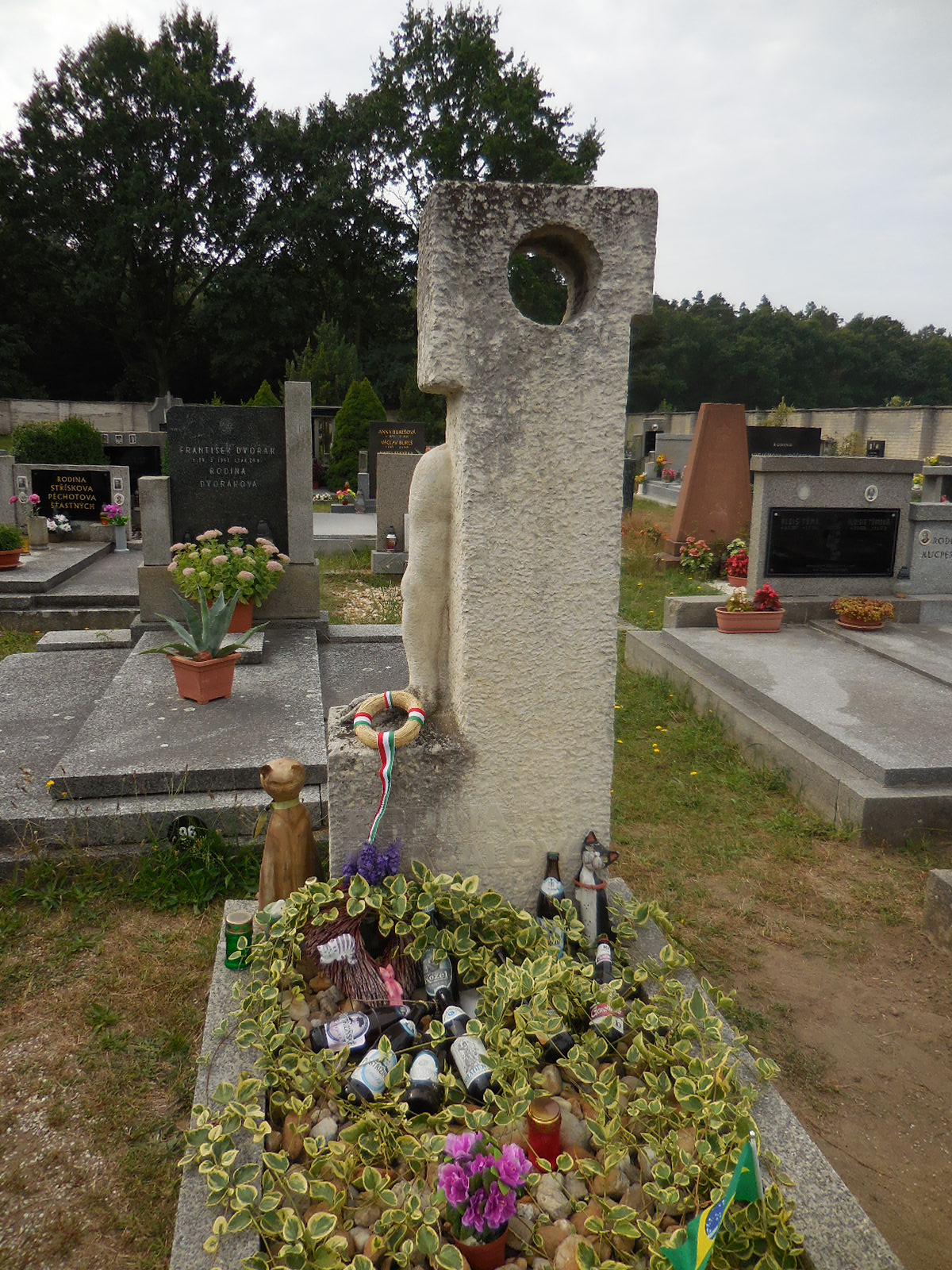
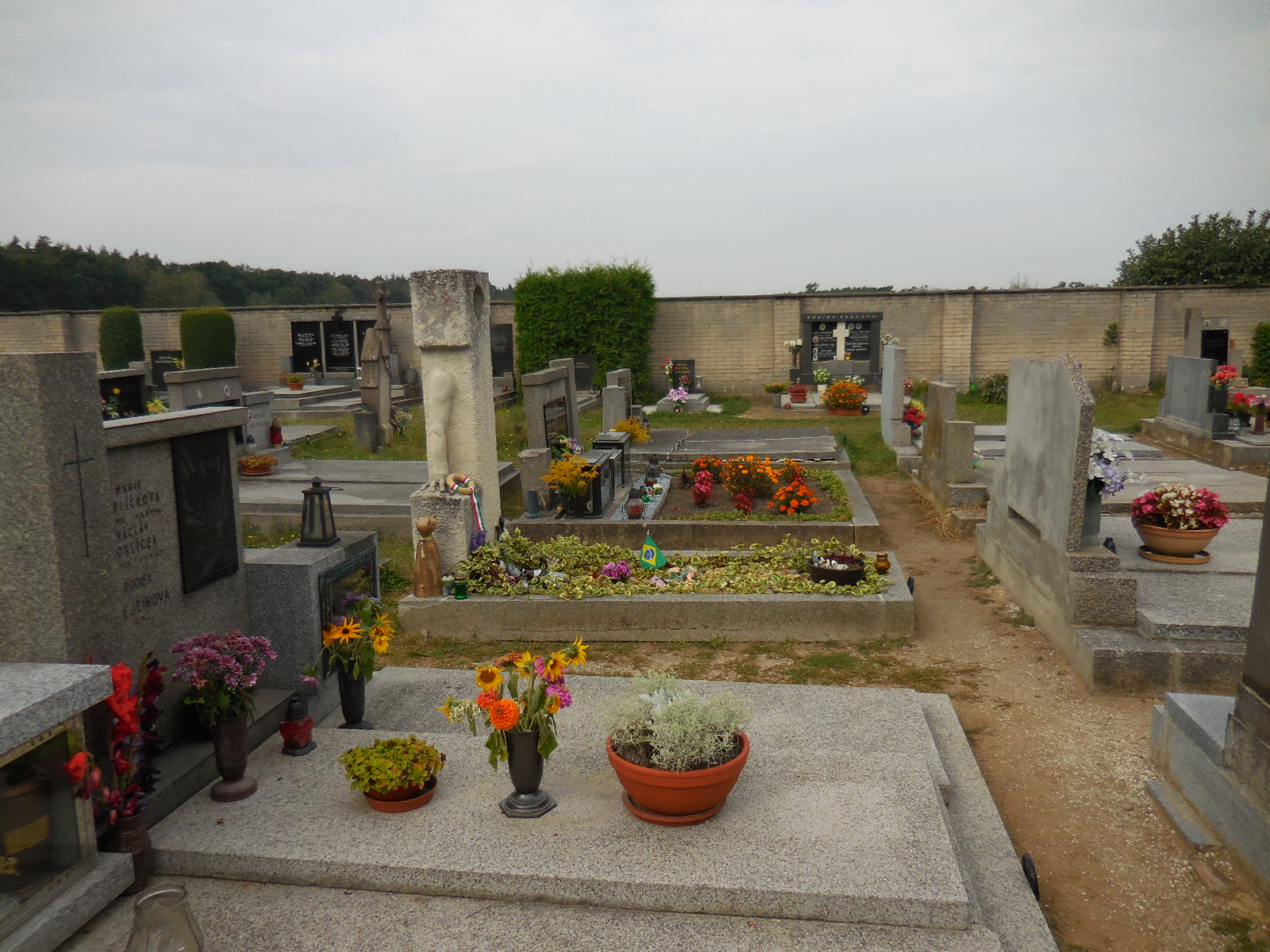
At the end of 1996, Hrabal was hospitalized with neuralgia. He was about to be released when he jumped or fell from the fifth floor window on February 3, 1997. He is buried in the cemetery in Hradištko, near Kersko. The irregular gravestone is especially noteworthy for the sculpted arm and hand seemingly emerging out of the stone monument. The top square section of the gravestone has a circle in the middle. Many wooden and ceramic cat figures as well as beer bottles decorate the grave site. I like the gravestone. It is innovative and unique just as Hrabal had been.

Bohumil Hrabal’s grave in Hradištko

Kersko has an intriguing history. Hradištko was first mentioned in writing during the 11th century and at that time included a fortress called Keřsko. In 1376 Eliška from Lichtenburk acquired the territory. She was the grandmother of George of Poděbrady, who would become a Czech king. The fortress area expanded into a village between 1354 and 1357, but it was destroyed during the Hussite wars of the 15th century. A pond was later created on the site of the former fortress. At the beginning of the 20th century, archeological digs in the village unearthed Gothic weapons and other historical objects. Some trees in Kersko are over 200 years old. The oldest oak in Kersko is 193 meters high. The area includes three small ponds and a mineral spring as well as walking trails.

Some feral cats in front of Hájenka restaurant some years ago

Fast-forward to 1934, when private citizens were first allowed to buy property in Kersko. A café dominated by an octagonal tower was built the following year. Later, it would become the restaurant Hájenka. The village aspired to become a forest spa town. Plans were made to build a hotel, two swimming pools and a sports complex. Then World War II took place, and plans were stalled. The Communist coup of 1948 put a halt to the entire project. In the 1950s, small cottages cropped up in the picturesque lanes.

Odkaz, book about the Mašín brothers by Barbara Masin, published by Mladá fronta, 2005.

While Kersko is most famous for being the location of Hrabal’s cottage, it also made a name for itself in the history books long before Hrabal bought a home there, during September of 1951. The Mašín Brothers, an anti-Communist resistance group of young men who fought against the Communists from 1951 to 1953, made some stops in the Kersko forest. Members included Ctirad Mašín, his brother Josef, Milan Paumer, Zbyněk Janata and Václav Švéda. Their objective was to fight their way to freedom, and the two Mašín brothers and Milan Paumer were successful at doing just that in 1953 when they dramatically escaped to American territory in West Berlin. The armed group carried out violent attacks to get money for their cause. To be sure, the Mašín Brothers’ group is very controversial. Some consider them to be heroes who fought against the Communists while others claim they were murderers because they killed innocent people.

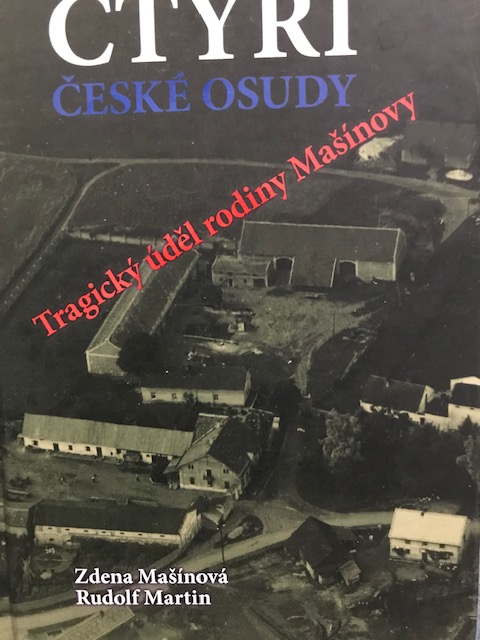
Čtyří české osudy, book about Mašín Brothers, by Zdena Mašínová and Rudolf Martin. Published by Ergo, 2018.

Back to their ties with Kersko: In the Kersko forest, Ctirad Mašín and Milan Paumer tied up a taxi driver and stole the cab in order to rob a police station in Chlumec nad Cidlenou. Two weeks later, three Mašín members came to Kersko in an ambulance they had stolen. They tied up the ambulance works in the forest. Then they robbed a police station in Čélakovice, using the stolen ambulance as transportation.

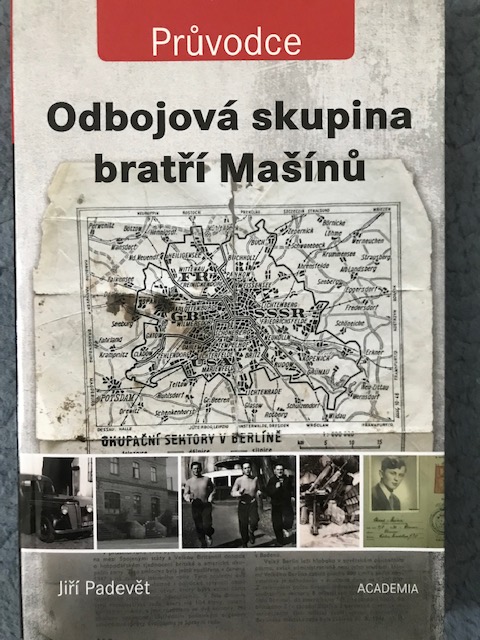
Guide book Odbojová skupina bratří Mašínů, about the Mašín brothers, by Jiří Padevět, published by Academia, 2018.

I had read and written about the Mašín Brothers’ group and was very interested in the anti-Communist resistance movement of the 1950s, so I found these facts to be very intriguing. I also was intrigued with the public’s perception of this armed group because some called them heroes, others cruel killers.

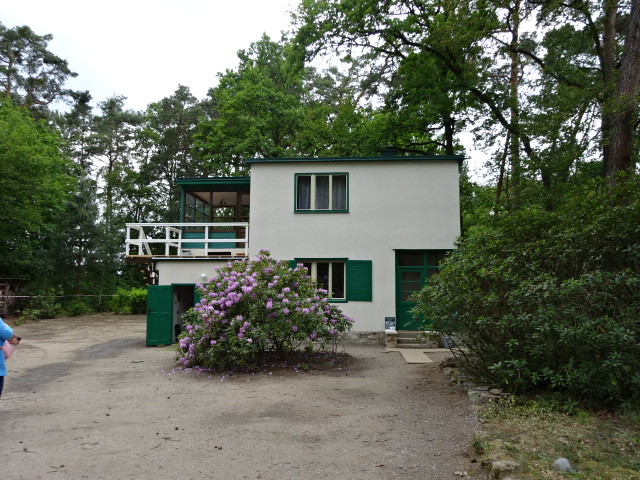
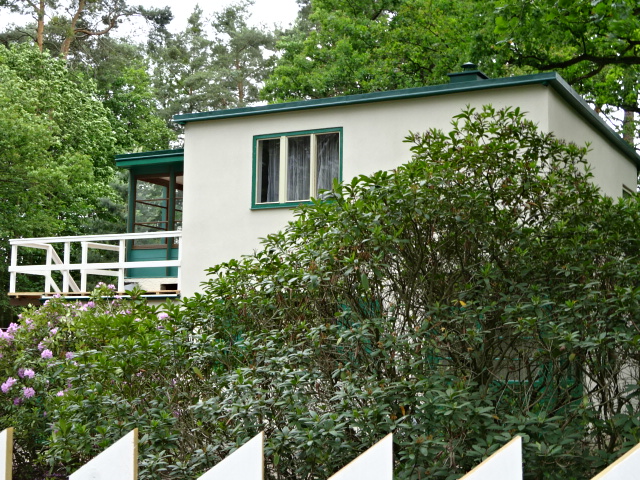
Bohumil Hrabal’s cottage in Kersko, photo from 2024.

Back to Hrabal. In May of 2024, I visited his cottage, which had recently opened to the public. Hrabal’s neighbor had inherited the cottage, and after a while the neighbor’s son sold it to the Central Bohemian Region, which did some reconstruction and made it look like it had during the 1980s. Some of the furnishings were original, some not.

Bohumil Hrabal’s cottage from the back. Photo taken in 2024.

The small, white, two-story structure had an exterior staircase leading to the enclosed balcony surrounded by windows with views of the big garden. Hrabal spent 18 days one July writing the novel I Served The King of England, seated in that garden. He loved to write on his typewriter in the garden.

Bohumil Hrabal’s cottage from one side. Photo taken in 2024.

We entered the tiny ground floor of the house, which was dominated by bunk beds and a table with three chairs. It served as a bedroom and dining room. Hrabal and his wife slept there when it was cold because the heater was in the space. He sometimes wrote in this room. In 1995 Hrabal wrote his last published piece here. I noticed that the date on the Svobodné slovy newspaper on the table was November 29, 1989, not even two weeks after the Velvet Revolution that brought the end of Communist rule. The hats and boxing gloves on a stand made of antlers were authentic. A small TV from the 1980s stood in a corner above the table. A collage by Karel Marysko was one intriguing artwork in the small space. The kitchen was tiny with a wooden stove and hot plate, for instance.

In the beautiful garden of Bohumil Hrabal’s cottage. Photo taken in 2024.

Upstairs there were only two spaces, much larger. Two single beds, decorated old chests and a closet were placed on a red carpet. I noticed the thick brushstrokes in the portrait of Hrabal by Josef Jíra, who was not only a painter but also a graphic artist and illustrator. He also frequented the Golden Tiger pub. The anxiety of people in the modern world often played a role in Jíra’s works. In the painting Hrabal looked sad and serious. Another painting, a collage, showed him in profile with logos of various beers, such as Pilsner Urquell, Primus and Prior. Another collage featured scenes and objects from the novel Cutting It Short, showing a brewery, an old record player and a couple dancing, among other pictures. I also saw portraits of Hrabal’s beautiful wife and parents.

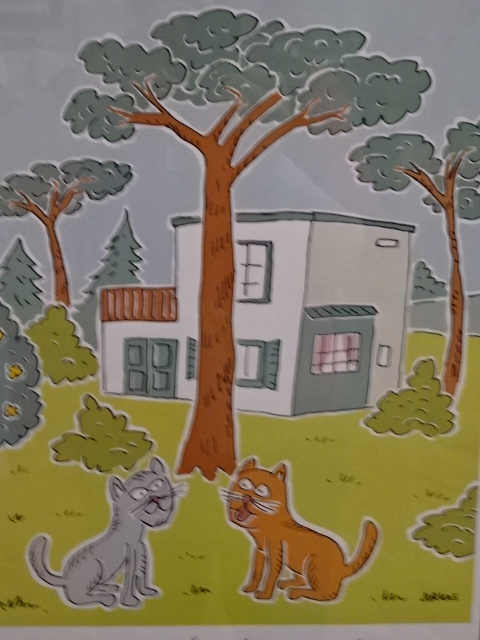
Drawing of Bohumil Hrabal’s cottage with the semi-feral cats he feed, picture exhibited at Lesní atélier Kuba, 2024.

There were other paintings that caught my undivided attention. One showed a bright blue sea with two people looming above the water in a hot air balloon while a man and woman stood on the coast. The bright blue hue gave me a feeling of tranquillity. The drawing “A Loud Monologue” by Jiří Anderle included faces of Hrabal from early childhood to old age. My favorite picture showed Hrabal, sporting a scarf and hat, with cats seated on chairs in a forest. I knew that Hrabal considered his cats to be his children, which is one reason I named my first cat after him.

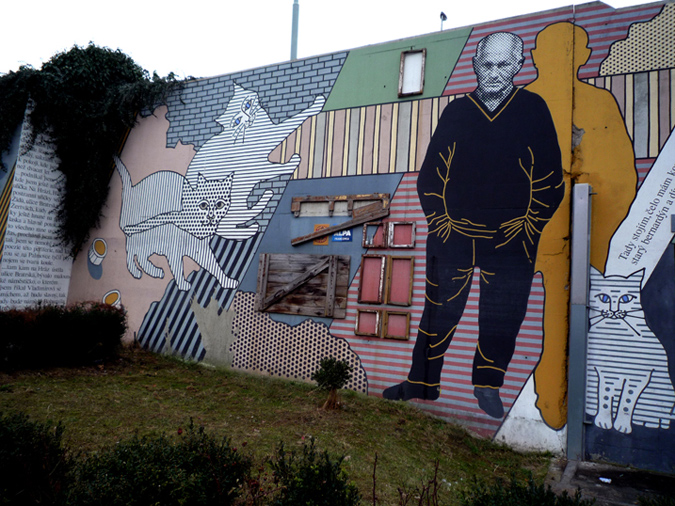
The street art memorializing Bohumil Hrabal’s home on the former site of Na Hrázi Street, Libeň, Prague, after his home there had been demolished to make way for the Palmovka Metro station.

The enclosed balcony was fabulous because it was so light and airy with views of the garden. I saw two typewriters and a large table with beer glasses and loose pages with handwritten corrections on it. Hrabal wrote here if the weather was bad. He penned Cutting It Short and The Snowdrop Festival here as well as many other works. I didn’t want to leave the balcony because it had such a calming effect on me.

Bohumil Hrabal’s cottage. Photo taken in 2024.

While Hrabal’s cottage was small, it had character. I could see him on the balcony writing while drinking glasses of beer or seated at the table downstairs playing cards or watching the small TV. I could feel his presence during the tour and realized how his writing was tied intricately to Kersko, a tranquil place where I feel at home and at peace.

Tracy A. Burns is a writer, proofreader and editor in Prague.

Bohumil Hrabal’s grave in Hradištko

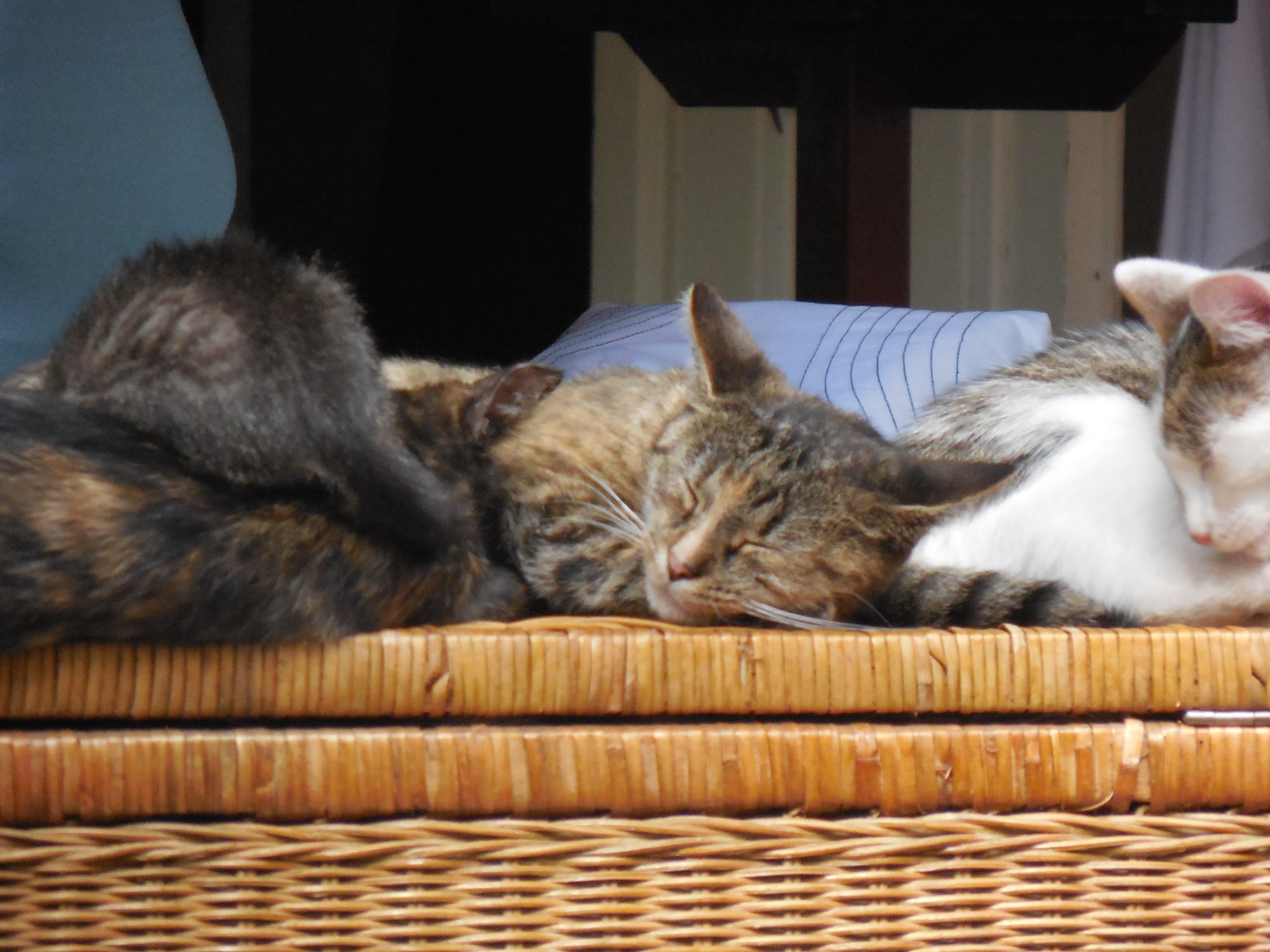
Cats at Hájenka Restaurant some years ago

2023 Travel Diary

Amalfi Coast

Amalfi Coast

This past year’s travels included two trips to Italy, one to my beloved Milan and environs and the other to the Amalfi Coast, somewhere I have dreamed of going for many years. I also spent time visiting sights in the Czech Republic, such as Zbiroh and Karlova Koruna chateaus and the towns of Kutná hora and Hradec Králové. I also dined in the traditional Czech pub Hájenka in Kersko. I flew to northern Virginia to see my parents for two weeks in March and had a great time with them as well as with four friends. In Washington, D.C., I visited the National Portrait Gallery and Museum of American Art.

From Petr Brandl Exhibition

I saw many thrilling art exhibitions, including ones focused on the Baroque art of Petr Brandl and the Art Nouveau works of Alphonse Mucha. Karel Teige, Czech avant-garde artist best known for his interwar works, was the focus of an exhibition at the Museum of Czech Literature, which I visited for the first time in 2023.

Campari Tomb at Monumental Cemetery in Milan

My May trip to Italy last year saw me back in Milan, which I had visited for the first time the previous year. I went to several sights I had not seen before. I toured Milan’s Monumental Cemetery to see the architectural gems of tombstones in various styles from the 18th century to contemporary. A colossal sculptural grouping of Da Vinci’s The Last Supper, made for the Campari family, was my favorite.  I also saw a structure resembling the Tower of Babel and another looking like Trajan’s Column. An Egyptian pyramid shape made up another monument. Another artistic delight was Italian artist Lucio Fontana’s design of a modern angel. The sculptural decoration throughout the cemetery was astounding.

At National Museum of Science and Technology Leonardo da Vinci in Milan

I also visited the National Museum of Science and Technology Leonardo da Vinci, where I was enamored by the 170 models of Da Vinci’s drawings of buildings, machines and weaponry. I also loved the hangars featuring planes, ships and trains. A Vega Launcher hailed from 2012. A submarine also stood outside.

Paintings lined the walls at the House Museum of Boschi Da Stefano in Milan.

The House Museum of Boschi Da Stefano, located in a posh apartment outside the city center, featured 300 works of 20th century art, mostly paintings but also drawings, furniture and sculpture. Most pieces hailed from 1900 to 1960. The walls were covered with art from top to bottom. Some artists represented were Fontana, Giorgio De Chirico, Pablo Picasso and Amadeo Modigliani.

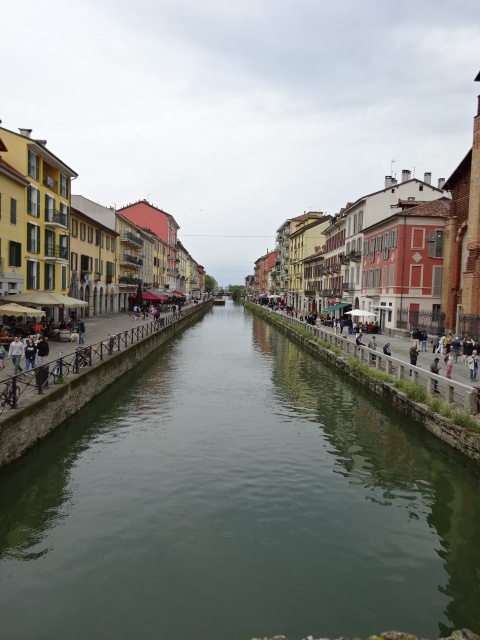
Navigli section of Milan

I also visited the Navigli district of Milan, where two picturesque streets flanked a canal, making for a picturesque setting. The Navigli is dotted with outdoor cafes and stores, including a few intriguing bookshops.

Basilica of Saint Anastasia, Verona

I spent time outside of Milan, too. I traveled to Verona for the second time. I marveled at the Basilica of Saint Anastasia, the largest church in the city as well as the cathedral and three museums – the Castelvecchio Museum, the modern art museum and the House Museum Palace Maffei – my favorite. The Basilica of Saint Anastasia was built in the 13th century and boasted a Late Gothic façade. The main altar was made from light yellow marble while one chapel housed a famous 15th century fresco. Red and white marble columns decorated the interior. The Pelligrini Chapel included a fresco from the 14th and 15th century as well as intriguing sculpture. A fresco at the left transept had been rendered by a disciple of Giotto. A rudder of a 16th century ship added to the splendid interior decoration.

Verona, House Museum Palace Maffei

Verona, House Museum Palace Maffei

However, it was the House Museum Palace Maffei that captured my heart. Half of the Palace Maffei was designed as a luxurious home punctuated by art from various eras ranging from the 14th century to modern day. The other half was a 20th century art gallery, featuring works by Picasso, Duchamp, De Chirico, Warhol, Ernst, Modigliani, Fontana and others. Paintings, sculpture, drawings, engravings, pottery, bronzes, frescoes and furniture of both Italian and foreign origin dazzled my mind.

In the Castelvecchio Museum, Verona

The Castelvecchio Museum, established in the 14th century, included 30 halls of Italian and European painting and sculpture from the Romanesque days to the 1700s. Not only did I see many paintings but also ancient weapons, ceramics, gold objects and more. The exterior featured panoramic views of the romantic city.

A romantic lane in Bellagio

My other day trip was to Lake Como, where I visited picturesque Como, Bellagio and Mennagio. Unfortunately, it rained all day, but I still had a great time. I also saw the exterior of some noteworthy villas, such as Richard Branson’s waterfront home, the Villa Carlotta and a villa where some episodes of Succession had been filmed. I saw a hotel where Greta Garbo had acted, too. The Villa Olmo in Como had a neoclassical exterior and stunning lake views. Bellagio featured steep, cobblestoned lanes and the Romanesque Basilica of San Giacomo. Mennagio was home to several intriguing churches and had a picturesque lakefront square.

House Museum Bagatti Valsecchi, Milan

House Museum Poldi Pezzoli, Milan

In Milan I also visited beloved sights that I had first seen the previous year. I returned to the House Museum Bagatti Valsecchi with its Renaissance and Neo-Renaissance art and to the House Museum Poldi Pezzoli with its art of various eras, such as medieval triptychs, ceramics, historical pocket watches and other time pieces.

Gallery of Modern Art, Milan

Gallery of Modern Art, Milan

I visited the second floor of the Gallery of Modern Art with its Grassi and Vismara Collections. The Grassi Collection featured both Italian and foreign works ranging from the 14th century to contemporary times. Oriental art was displayed, too. The Vismara Collection concentrated on 20th century masterpieces. On that floor I saw impressive art by Manet, Picasso, Gauguin, Renoir, Van Gogh and Cezanne. Toulouse Lautrec was well-represented, too.

Museum of the Risorgimento, Milan

Brera Art Gallery, Milan, Work of Andrea Mantegna

The Museum of Risorgimento remains another of my favorites with its painting, prints, sculptures and artifacts depicting Italian historical events from 1796 to 1870. The Brera Art Gallery was another highlight, as I gawked at the Italian art from the 13th to 20th century as well as at the foreign works in the 38 vast halls. I loved the paintings from the Netherlands, including those by Peter Paul Rubens and Jacob Jordaens. Other Brera-represented artists dear to my heart included Francesco Hayez, Andrea Montegna, Tintoretto and Caravaggio. I even visited an exhibition of ancient manuscripts in the historical Baroque library. Once again, I was amazed by the 16th century frescoes by Bernardino Luini, his brothers and his son in the Renaissance Church of San Maurizio in downtown Milan.

Sorrento, Nativity Scene, Cathedral of Saints Filippo and Giacomo

During my trip with arsviva travel agency to the Amalfi Coast in June, I fell in love with Sorrento. The streets were picturesque, and the Cathedral of Saints Filippo and Giacomo was Romanesque with a Neo-Gothic façade. Three lunettes showed off beautiful frescoes while a rose window also astounded. Inside, the Latin cross interior boasted three naves with 14 pilasters. The pulpit, hailing from the 16th century, had Doric columns. Stunning frescoes on the cupola, intarsia adornment and a Baroque ceiling were other remarkable elements. The Chapel of Nativity displayed a Neapolitan Nativity scene from the 17th century.

Correale Museum, Sorrento

Museum of Intarsia, Sorrento

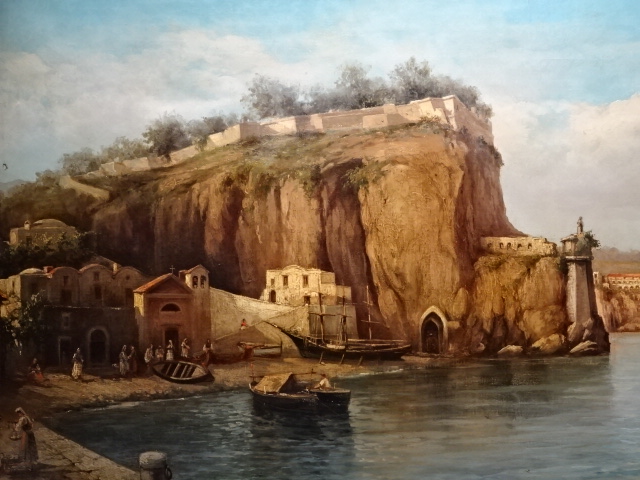
The Correale Museum served as a provincial art gallery, and I was enthralled by the 17th and 18th century Italian landscapes, especially those of Castellammare di Stabia, where we were staying. Greek and Roman fragments, historical furniture, clocks, ceramics and porcelain were also on display. The waterfront boasted spectacular views of the sea, which were very soothing. The highlight of my visit to Sorrento was the Museum of Intarsia, with everything from music stands to large beds showing off intarsia decoration by local artists. Some historical paintings were also on display. Downstairs, I saw the innovative, avantgarde designs of contemporary intarsia artwork.

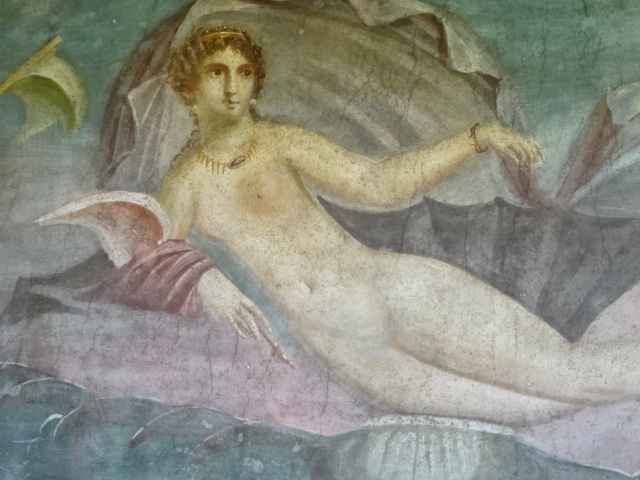
Pompei

I also visited Pompei for a second time. Even though the day was scorching hot, I enjoyed seeing the small and big theatre, the basilica and three temples, especially the one named after Apollo with its 48 Ionic columns. The amphitheatre with a capacity of 20,000 spectators also caught my undivided attention. The wall paintings and mosaic floors of what had been luxurious homes were sights to behold as well.

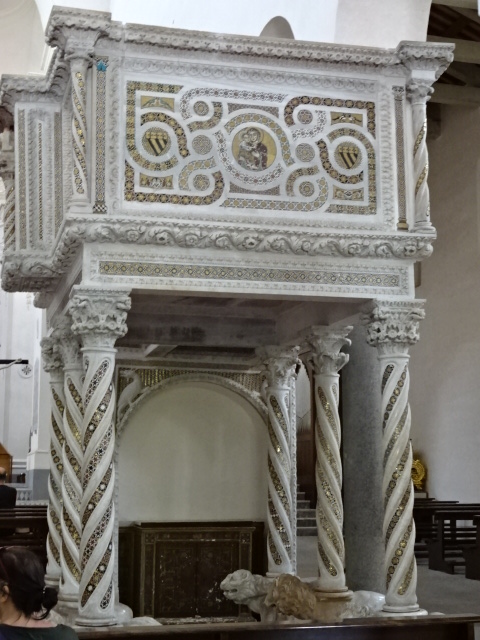
Ravello, pulpit in cathedral

We moved to a nice hotel in the picturesque, tranquil town of Maiori, where I could spend time in a café or restaurant overlooking the beach or savor homemade ice cream. The town that had made it on UNESCO’s list during 1997 was a perfect place to relax after a busy day out. Before arriving at our hotel in Maiori, we saw Ravello’s Romanesque Cathedral of Saint Maria Assunta and Saint Panteleone, hailing from the 11th century. I admired the 12th century bronze doors and remarkable 13th century Pulpit of Gospels adorned with mosaics. One 16th century chapel contained an phial of blood of Saint Panteleone. The views of the sea from the hilly town were spectacular, too. Numerous famous guests, from Richard Wagner to Virginia Woolf and Greta Garbo, had graced the streets of this town.

Ravello Cathedral, bronze doors of central portal

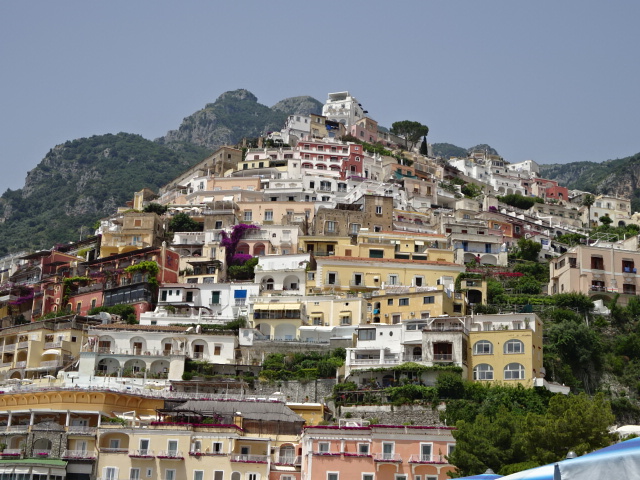
Positano, a UNESCO-listed tourist site since 1997, was a picturesque hillside town, but, unfortunately, during this past June, it was much too crowded to enjoy. I did peek into the church, though. Its main altar showed off a Byzantine icon from the 13th century. The views of the sea were fabulous.

Cathedral of Saint Andrew, Amalfi

Cathedral of Saint Andrew, Amalfi

Another highlight of my trip was visiting the Cathedral of Saint Andrew in Amalfi, which was founded in the ninth century AD and boasted a 13th century Arab-Norman exterior with Italian Neo-Gothic elements. The mosaic adornment in the tympanum is stunning. Sixty-two steep steps led to the bronze doors of the central portal that hailed from Constantinople, made in the 11th century. A cloister included some intriguing fragments of wall paintings while the interior had Baroque features along with Gothic and Renaissance chapels. The Basilica of the Crucifix harkened back to the ninth century and served as a museum of sacral objects, including sculpture and vestments. The crypt, where the relics of Saint Andrew were held, was stunning with much ceiling and wall decoration.

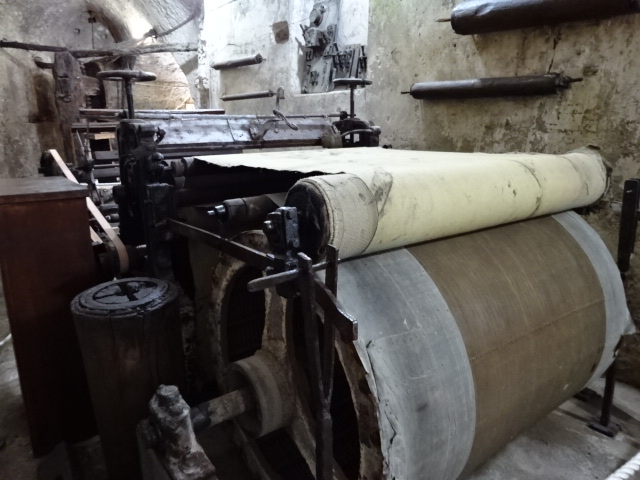
Paper Museum at paper mill, Amalfi

I also was enamored with the still functioning paper mill at the Paper Museum. The Pope used paper made in Amalfi, which held the distinction of being the oldest paper manufacturer in Europe. The machines and the processes of making and drying the paper were enthralling.

Cathedral of Saint Matthew, Salerno

Salerno was a pleasant surprise. The Romanesque Cathedral of Saint Matthew hailed from the 11th century. The tower was a mixture of Byzantine and Norman styles. The central bronze door was made in Constantinople. Two Byzantine mosaic-decorated pulpits with intricate intarsia amazed in the once Romanesque interior that had been mostly transformed into Baroque style. Mosaics throughout the cathedral were stunning. Frescoes in the treasury chapels were accompanied by a silver statue of Pope Gregory VII. The Late Mannerist ceiling and wall frescoes in the crypt were remarkable, hailing from the middle of the 17th century. A reliquary of Saint Matthew’s arm was on display, too.

Diocese Museum, Salerno

I also visited the nearby Diocese Museum, which featured paintings, sculpture and objects from the Middle Ages to the 20th century.  I was most drawn to the medieval altarpieces. The provincial picture gallery was small but included an eclectic array of intriguing works from the 15th to 18th century.

Cathedral of Saint Barbara, Kutná hora

Cathedral of Saint Barbara, Kutná hora

I took some day trips in the Czech Republic, too. We visited Kutná hora, the home of prosperous silver mines from the 13th to 15th century, during one stunning fall day. Saint Barbara’s Cathedral, with its Neo-Gothic exterior of buttresses and gargoyles, astounded me. Inside, I admired exquisite stained glass windows as well as remarkable late Gothic frescoes and a 16th century stone pulpit. The Gothic royal chapel with Art Nouveau decoration at the Italian Court was another remarkable gem.

Pub in Kersko

I visited Kersko twice this fall. I dreamed of owning a cottage in the tranquil, wooded village. I had lunch at the traditional Czech pub called Hájenka, where several films based on Bohumil Hrabal’s writings had been shot. Hrabal had lived in a cottage nearby for many years, feeding all the feral cats that would wander hungrily toward his home.

Zbiroh Chateau

I also toured the chateaus of Zbiroh and Karlova Koruna. Zbiroh, built before 1230, for decades served as a top-secret facility for the Czechoslovak army. Its representative rooms were open to the public only in 2005. The chateau boasted many Madonna statues and other sculpture of great interest as well as African masks, tapestries, Empire furnishings and copies of Leonardo da Vinci paintings. Alphonse Mucha had used the spectacular main hall as his studio early in the 20th century. A beautiful skylight, two Czech crystal chandeliers and impressive paintings adorned Mucha’s former studio.

Exterior of Karlova Koruna Chateau

Karlova Koruna Chateau, designed by Santini-Aichel and built during the 18th century, had a roof shaped as a crown. The chateau consisted of two stories in cylindrical shape with three one-floor wings. The interior featured paintings of horses, including the unique gold-colored horses that the Kinský family had bred as well as pictures of steeplechase races. One painting of a horse race was made of 12 pieces of deerskin.

Beneš Villa

We visited the former villa of Edvard Beneš, president of Czechoslovakia during the interwar years and a prominent member of the Czechoslovak governments-in-exile during the First World War. The stunning Neo-Spanish structure included the room where Beneš died, a dark landscape painting by Antonín Slavíček hanging over his single bed. The furnishings and artworks in the house were intriguing, to say the least. Beneš and his wife Hana were buried in a monumental tomb on the premises as well.

Sucharda’s Second Villa, Prague

In Prague I visited the second villa of sculptor and relief artist Stanislav Sucharda in the Bubeneč district. Jan Kotěra designed the structure with many architecturally intriguing elements. Much of the remarkable interior furnishings had been designed by Kotěra and Sucharda. I saw examples of Sucharda’s artwork as well as pieces by Edvard Munch, Auguste Rodin and many Czech artists.

Gallery of Modern Art, Hradec Králové, Work by Emil Filla

Gallery of Modern Art, Hradec Králové, Věra Jičínská, Brittany

I saw many impressive art exhibitions this year. I traveled to Hradec Králové, where I saw the Gallery of Modern Art with its impressive collection of works by 20th century artists including Bohumil Kubišta, Emil Filla, Jaroslav Róna, Ladislav Zívr, Quido Kočian and many others. The temporary exhibition of artist and writer Věra Jičínská’s works included paintings of her travels to Brittany and Paris. Her renderings of Paris showed off orange rooftops and the Eiffel Tower. She also created paintings inspired by folk art and dance. Her photography amazed me as well. Influenced by her work as a journalist, she created a painting dedicated to this genre.

Museum of East Bohemia, designed by Jan Kotěra, Hradec Králové

The museum devoted to the history of Hradec Králové was an architectural gem designed by Kotěra. I especially liked the furnishings and designs by Josef Gočár and Kotěra as well as the sculpture by Sucharda. The mock shops from the First Republic (1918-1938) were very intriguing as I could see goods that were sold during that era and feel the atmosphere of those times.

National Technical Museum, Prague

In Prague I saw the National Technical Museum for the first time. The cars, especially the 1935 Tatra 80 vehicle belonging to first Czechoslovak President Tomas G. Masaryk, fascinated me as did the motorcycles, bicycles and planes. The dining car of Habsburg Emperor Franz Joseph I, later used by President Masaryk, was also on display. I also was enamored by the architecture and engineering section and the display of old household items in another section. The TV studio, in use from 1997 to 2011, was another delight. Other areas of interest included astronomy, chemistry, printing, photography, time pieces, metallurgy and mining.

Museum of Czech Literature, book cover by Karel Teige

Another astounding sight in Prague was the newly-located Museum of Czech Literature, which moved to the Petschek Villa in Bubeneč during 2022. The displays cover literary developments from the 19th century National Revival movement through the 20th century. I came to appreciate the significance of the literary and art criticism periodical The Critical Monthly from the 1930s and 1940s as well as the symbolist and mystical paintings of Josef Váchal. I was most enamored by the avantgarde book covers designed by Karel Teige in the 1920s and 1930s. His unique typographical work in Vítězslav Nezval’s The Alphabet book was on display, too. A pantheon of great Czech 19th century artists included objects associated with the writers and their busts.

Karel Teige, Greetings from a Journey

A temporary exhibition focusing on Teige’s youth and early career from 1912 to 1925 was amazing, showing off his artwork, photographs, correspondence and more. I understood very well why this artist, writer, theoretician, critic, translator, book designer, typographer and photographer was considered the leading figure of the Czech avantgarde movement between the wars.

Trade Fair Palace, Prague, Fire by Josef Čapek

At The Trade Fair Palace in Prague, I saw the newly installed End of the Black-and-White Era permanent exhibition of art from 1939 to 2021 in chronological order. More than 300 works, mostly Czech, were displayed with historical context. Josef Čapek’s painting “Fire,” showing a fury of flames behind a woman, presents an anti-Nazi theme. The focus on urban life and factories as well as everyday life was highlighted with the works of Kamil Lhoták. The exhibition featured many works made during the Stalinization period of the 1950s with the style of social realism. Martin Slanský depicted Lenin in a snowy Prague. A model of the design of the monument to Stalin in Prague was on display, too.

Trade Fair Palace, Prague, The Dialogue by Karel Nepráš

The progressive movements of the 1960s made way for the red abstract figures of Karel Nepráš. From the late 1960s to early 1980s art as installation came to the forefront. Action art, performance and body art were often the focus of the times. The late 1980s triggered the impersonal postmodernism movement. After the 1989 Velvet Revolution that toppled the Communist regime in Czechoslovakia, individuality and quests for personal identity came to the fore. Some artists focused on the commercialization of society. This new exhibition was extensive and moving. I felt drawn into each historical period up to the present day. The works displayed well represented the movements expressed. I could see how society and culture kept changing and how art reflected those changes.

Saint Jerome by Petr Brandl

I went to many intriguing temporary exhibitions in Prague, too. I saw 64 religious works, genre paintings and portraits by Czech Baroque artist Petr Brandl. An extensive exhibition of Alphonse Mucha’s versatile works owned by his descendants included some originals never before put on display. Mucha’s ad posters, drawings, paintings, sculptures, photographs and jewelry all captured my undivided attention.

Sculpture by Janouch

I saw sculpture of athletes in motion and busts of illustrious Czechs by Petr Janouch in Prague’s Kooperativa Gallery. An earlier exhibition there featured Czech 19th and 20th century paintings involving water – puddles, lakes, waterfalls, streams, rivers and so on. I especially liked one painting by Josef Čapek showing a fisherman on a boat in a river. Landscapes with water themes by Slavíček and Antonín Hudeček also astounded.

Sculpture by Ivan Mestrovic

At the City Library Gallery I saw an exhibition of sculpture by Croatian Ivan Mestrovic (1883-1962). I had come across his art at his villa in Split during a vacation many years ago. Mestrovic, who had befriended first Czechoslovak President Masaryk and Czech sculptor Bohumil Kafka, had delved into a variety of styles, including Art Nouveau, Symbolism, Impressionism, Art Deco, Neoclassicism and late Realism, while preserving a Classical foundation. He focused on numerous themes – religious motifs, portraits and monumental works as well as studies of figures.

Olinka

However, shortly after I returned from the Amalfi Coast, I had to temporarily halt any traveling so I could be at home with Olinka, who was diagnosed with neurological issues that greatly affected her mobility. A MRI showed that she suffered from inflammation of the middle ear. A terrified Olinka spent a total of four nights in the hospital and was on antibiotics for ten weeks. Every two weeks we went to the vet so she could get her antibiotic shot.

Olinka

The first four days at home after three nights in the hospital she could hardly walk and was very disoriented. Those initial few days she stayed mostly in the bedroom closet, only appearing for food and the use of the litter box. She didn’t play with her toys for three weeks. Before her illness, I had been frustrated with Olinka because she always knocked everything off tables and the kitchen counter. Sometimes it felt like a never-ending battle. At the start of her illness, I came to appreciate even her most frustrating quirks. I just wanted her knocking everything off surfaces again, back to her old self. The broken glass on the screen of my mobile phone is proof that she is once again doing just that. 

Olinka

I will never forget her first night back from the hospital. She somehow made her way onto the bed and reclined below my pillow. I rested next to her, my arms around her. We stayed like that for an hour or two, just spending time with each other, appreciating that she was alive and at home. I will always remember that feeling of relief and love more profoundly than any experience during my exciting travels.

Tracy A. Burns is a writer, proofreader and editor in Prague.

Olinka on Christmas Eve

From Alphonse Mucha exhibition

Municipal House, Prague, Mayor’s Hall, decoration by Alphonse Mucha

I toured the Municipal House in Prague. Once again, I was captivated by its Art Nouveau interior.

2021 Travel Diary

Bust of first President of Czechoslovakia, Tomáš Garrigue Masaryk from TGM Museum in Lány

This past year my travel was once again marred by the dangers of the pandemic, and I didn’t want to take any unnecessary risks. I took day trips in the Czech Republic during the summer months, when the chateaus and castles were open. While I did not wander far from Prague, these trips did provide me with a fresh perspective of the world around me and of my own life. I tended to spend most of my time at home as a sort of recluse, and these trips offered me a chance to appreciate the world around me. Fears of getting coronavirus despite being vaccinated prevented me from gathering with friends in cafes. When I went on these trips, I traveled with a good friend, and that also helped keep me sane. We always went by car, which was much easier and much more comfortable than going by public transportation.

Tomáš Garrigue Masaryk
Czech soldiers during World War I

Our first trip in late May was to Lány, where the presidential summer residence was located along with its stunning park. I also visited an intriguing museum dedicated to the founder of Czechoslovakia and its first president, Tomáš Garrigue Masaryk. I had named my cat Šarlota after the first First Lady of Czechoslovakia, American Charlotte Garrigue Masaryk. (Šarlota is Charlotte in Czech.) I also paid my respects to the Masaryk family at the cemetery nearby.

Furnishings from the First Republic period
Panels explaining architecture and construction during the First Republic

The museum highlights, for example, Masaryk’s time as head of the government-in-exile in London and his trip to the USA to convince US President Woodrow Wilson to support Czechoslovakia becoming a country of its own. Masaryk abdicated due to poor health  after 17 years in office. His many accomplishments and problems during his tenure are well-explained in these exhibits. One section shows off the role of the Czechoslovak legions fighting in Russia as part of the French army during World War I. Intriguing information about society and sport during the First Republic are on display, too.

The Masaryk graves in Lány

Then we went to the cemetery, where simple slabs mark the graves of Tomáš, his wife Charlotte (who died in 1923), son Jan and daughter Alice. I admired the modest yet eloquent gravestones in a quiet part of this cemetery. I recalled watching a film about Tomáš’ son Jan, a prominent politician whom the Communists pushed out a bathroom window to his death. I had visited the scene of the crime in the Ministry of Foreign Affairs palace some years ago, when an employee showed me around. I recalled that Tomáš, the first president of Czechoslovakia, had died at Lány chateau, where we were headed next.

Lány Chateau
The park at Lány

Only the park was open to the public. I had fallen in love with this park during my first visit back in the summer of 1991, less than two years after the Velvet Revolution had toppled Communism in Czechoslovakia. Lány Chateau has served as the summer residence of Czechoslovak and Czech presidents since the state purchased it in 1921. From the late 17th century until 1921 it was the property of the Furstenberg family. In earlier days it had even been owned by Holy Roman Emperor Rudolf II. Masterful Slovenian architect Josip Plečník had decorated the park during Masaryk’s tenure. A symbolic, spectacular fountain, two ponds, three small bridges, a cottage with fairy-tale decoration, beehives and Neo-Gothic Riding Stables all mesmerized me along with a greenhouse. Walking down the main chestnut-lined path, I saw better the beauty of the world around me as well as the beauty inside me. I tried to imagine Masaryk riding one of his beloved horses in the park or seated on a bench talking with prominent Czech writer Karel Čapek, one of my favorite authors.

Červená Lhota Chateau
Interior of Červená Lhota Chateau

We made the trip to the fairy-tale bright red chateau Červená Lhota, which used to be surrounded by water. Alas, there is no water around it now. I recalled my first visit, when I was entranced by the reflection of the cheerful-looking structure in the pond. I also recalled my first attempted trip to the chateau, more than 15 years earlier, when I mistakenly traveled to another village with the same name in an entirely different part of the country. I also recalled the four friends I had made the first time I was successful at traveling to the chateau, walking the 10 kilometers from the train station while talking about life with my friendly companions.

Interior of Červená Lhota Chateau

The chateau got the name Červená Lhota – červená means red in Czech – during 1597, when it was painted that color. Legend claims that the devil had kidnapped a lady at the chateau, and she had died. After her murder, a spot of blood could be seen under a window of the then white façade. Another legend says that her blood had covered the chateau exterior, and the red color was permanent. Perhaps the family best associated with the chateau is the Schonburg-Hartenstein clan, who owned it from 1835 for 110 years. Indeed, the interior took its appearance from the start of the 20th century, when this family was in residence. We saw mostly authentic furnishings, which is always a treat. The painted ceilings, superb artwork, elaborate clocks, beautiful tiled stoves, intarsia-decorated furniture and graphics collection all held my undivided attention.

Jemniště Chateau

Another week we traveled about an hour from Prague to Jemniště Chateau, a Baroque gem completed about 1725, though most of it burned down in 1754 and had to be rebuilt. Leading Czech Baroque painter Václav Vavřinec Reiner and legendary Baroque sculptor Matyáš Bernard Braun did some of the reconstruction. The Sternberg family took possession of the chateau in 1898, but it was confiscated by the Nazis in 1943 and then nationalized by the Communists in 1951. After the Velvet Revolution, the Sternbergs did get the chateau back, and some members of the family live there today.

Park of Jemniště Chateau
Jemniště Chateau from the park

The Main Hall was astounding with four portraits of Habsburg rulers on the walls, ceiling frescoes with mythological themes and a superb rendition of three allegories of the four seasons. In other spaces, I loved the Dutch Baroque furniture with colored woods. Saint Joseph’s Chapel featured remarkable frescoes.

Český Šternberk Castle in the distance
View from Český Šternberk Castle

Another trip took us to Český Sternberk Castle, which is, in my opinion, the most impressive of the three medieval castles in Central Bohemia, outdoing Karlštejn and Křivoklát. The exterior is imposing Gothic with a steep climb to the entrance gate. The interior spaces are decorated in various historical styles from Renaissance to Rococo. The castle dates back to the mid-thirteenth century, when Zdeslav of Divišov changed his name to Sternberg, the family that owns the castle today. When the Communists took the castle away from then owner Jiří Sternberg in 1949, he and his family still resided there, allowed to use only two small rooms. Jiří even gave tours of the castle. At long last, in 1992, the current owner got the property back.

Interior of Český Šternberk Castle
Knights’ Hall

The Knights’ Hall dated from around 1500 and features ornate 17th century stucco adornment. Life-size portraits on the walls showed generals from the Thirty Years’ War and King George of Poděbrady. Two 250-kilogram Czech crystal chandeliers amaze. This was the first but certainly not the last room where the eight-pointed Sternberg star had a prominent presence. The Yellow Salon featured its Empire wall painting of idyllic country scenes. The Dining Room showed off marvelous paintings. Dutch Baroque furniture with a floral motif graced another room. On the tour, we saw many renditions of battles – Sternberg owns 545 paintings of the battles during the Thirty Years’ War. Paintings by Filip Sternberg also are on display.

Karlštejn Castle from the picturesque main street

It was stupid of me to book a tour of Karlštejn Castle for a Friday afternoon. Traffic was hell, but there was nowhere to turn back. It was scorching hot. We walked up the steep road to the castle, gasping for air and needing a few short water breaks. Astounding Gothic Karlštejn Castle loomed above us. Its history was legendary. The castle was constructed for Holy Roman Emperor Charles IV in 1348, and the crown jewels of the Holy Roman Empire had been stored there until 1420. Throughout the centuries, the castle would never be totally conquered. Even a seven-month siege by the Hussites in the 15th century was successfully warded off. I had been to Karlštejn many times but not for some years. The Church of the Assumption of the Virgin Mary showed off beautiful 14th century frescoes. The walls of the small Chapel of Saint Catherine were decorated with exquisite frescoes and semi-precious stones.

Entrance gate at Karlštejn Castle

Gothic frescoes are by no means in short supply on the tour that included the chapel.  On one ceiling about 40 angels played various medieval instruments. The Chapel of the Holy Cross, the highlight of the tour, dazzled with its ornate decoration. Designed by Charles IV, the space featured semi-precious stones and 129 paintings of saints, popes, knights, emperors, martyrs, kings plus the Apostles and others. The legendary Master Theodoric, Charles IV’s court painter, created the impressive works. The gold ceiling was adorned with thousands of stars made from Venetian glass.

Blatná Chateau

Unlike Červená Lhota, Blatná in south Bohemia was surrounded by water, adding a romantic flair to the already impressive structure. It was first mentioned in writing during the 13th century. Renovation during the 15th century was carried out in part by famous architect Benedikt Ried, who was responsible for designing part of Prague Castle. The highlight for me was the Green Chamber with its exquisite Renaissance art. The Sternbergs feature in the story of this chateau as well. They took control of the structure in 1541 and added a Renaissance palace. During 1798 Baron Karel Hildprandt bought it and held onto it until the chateau was nationalized in 1948. The family was able to live there, albeit in two small rooms, despite the takeover. In 1952 they were forced out, though. When the Emperor of Ethiopia paid a visit to Czechoslovakia in 1959, he asked that the Hildprandt family be allowed to emigrate to his country. They got permission and resided in Ethiopia until the Soviet coup in the 1970s. During 1992, the family returned to the chateau and made their home at Blatná.

The chapel includes Gothic vaulting and thin, high Gothic windows. The cheerful yellow color of the Baroque Salon reminded me of the yellow kitchen in my parents’ home – a kitchen I would never see again. I loved the intarsia furniture in this space. An English clock’s decoration showed the four seasons. I also was captivated by an Oriental jewel chest with hidden drawers. I recalled my visit to the extensive ruins of Rabí Castle when I saw that structure rendered in an impressive artwork. The Painting Gallery featured a rendition of a vast landscape on a wall and a superb chandelier made of Czech glass. A map in a hallway amazed. It hailed from the 17th century and was one of only two copies in existence. I saw Prague’s Charles Bridge before the statues had been built on it.

Park at Blatná Chateau

In the Hunting Salon some furniture was made from deer antlers. Archduke Franz Ferdinand d’Este visited occasionally to go on hunting trips with the Hildprandt owner. In the Dining Room, I was drawn to the red-and-black chairs and the daiquiri green tiled stove. The 19th century Neo-Gothic furniture was impressive.  Japanese plates decorate a wall of another space with a Neo-Renaissance tiled stove and chandelier in Empire style. I noticed some Egyptian features of the Empire furniture. In other spaces an exotic landscape graced a tapestry and four paintings of Italian towns decorated a wall. A huge black Empire style tiled stove stood out in one space. In the Study of Jaroslav Rožmítl, I saw paintings of Adam and Eve plus renditions of saints George, Wenceslas and Catherine. There was an intriguing room with artifacts from Ethiopia that I had seen on previous tours, but for some reason, we did not visit that space this time. My friend and I were disappointed.

Děčín Chateau gate

We also went north to Baroque – Classicist Děčín Chateau, which had served as barracks for the Austro-Hungarian army, the Germans and the Soviets for many decades. The last Soviet soldier had departed in 1991. Its history dates back to the end of the 10th century. Děčín became a castle in the second half of the 13th century, though later it was burned down. In the 16th century the Knights from Bunau transformed it into a Renaissance chateau. The historical landmark gets its current appearance from the Thun-Hohenstein period. That family owned it from 1628 to 1932 and had nurtured a friendship with Franz Ferdinand d’Este. In fact, after Ferdinand d’Este and his wife Sophia were assassinated in Sarajevo during 1914, his children spent time at Děčín. Emperor Franz Joseph and his wife Sissy also stayed at the chateau three weeks after their wedding during the 19th century.  A 270-meter steep street gave access to the chateau. Blind arcades adorned seven-meter high walls flanking the street. There was an exquisite Rose Garden, too. A gloriette and statues of mythological gods added to the splendor of this section as did a sala terrena.

View from the chateau

The interior was vast and impressive. The library, which at one time was situated in the biggest hall, had held 90,000 books, but due to financial problems, the Thuns had to sell them. Since no one wanted to buy the entire collection, the Thun clan sold the books by the pound. Only 4,500 volumes of the previous collection have been returned. This huge space currently looked like a ballroom with splendid crystal chandeliers.

Rose Garden
Statue in Rose Garden

The exquisite Blue Room included two blue-painted walls with rich decoration, only uncovered during a 2001 restoration. A classical landscape showed people, boats, trees and temples. A large painting of the Thun family tree weighed 150 kilograms. Another room was decorated with floral motifs on blue walls. A wooden bed was made for women who slept half-seated as to not upset their elaborate hair styles. Also, people slept half-seated because they were worried they would die if they lay down on beds. A room showed off the paintings of Děčín by Karl Graff. The Chapel of Saint George was very impressive, too.

The house where my family lived for almost 50 years

In September, my last trip of the year, I spent two weeks in Virginia visiting my parents and four friends. I was constantly worried I would get covid as cases were on the rise. I tended to spend most of the time in my parents’ apartment for this reason. I wanted to go into DC to museums, but I chose to take precautions against covid and stay with my parents. It was the first time I had seen them in two years. That May they had moved from the townhouse where I had lived since the age of three. I missed the red, white and blue rug in my old room, the mahogany piano in the living room and most of all the sunny yellow kitchen where I had talked through so many problems over tea and muffins or scones. I felt as if I had not had the chance to say goodbye to the previous abode, and that rankled me. The thought of a stranger using my childhood home upset me. I liked the apartment, but my heart was back in the townhouse. Still, nothing could compare to the moment I stepped out of the taxi and saw my mother with her hands out, ready for a hug, for the first time in two years. That was one of the best moments of my life.

Šarlota on her cat tree
Šarlotka on her Prague castle
Šarlotka napping with her toys when she was 11

Yet, during that summer I had experienced one of the worst moments of my life, too. My 11-year-old black cat Šarlota suddenly lost the use of her back legs and had to be rushed to the emergency vet. She had heart problems and stayed overnight in the hospital. The next morning, I was on the balcony, trying to read but unable to concentrate, when the vet called. He said there was no hope. She had to be put to sleep. I was at the vets in an hour or less and spent about 20 minutes talking to Šarlota and petting her, explaining that she was going to meet Bohumil soon in Heaven.

I was crushed. After four horrible years, Šarlota had found me, and she had been so happy living by my side. She had been such a good cat, always thankful and appreciative of her rosy life. It was cruel for her to die after only six years with me, I thought. I spoke to her calmly and thanked her profusely for being my best friend. I will always treasure those 20 minutes. Her death was so sudden that her death still greatly pains me. Every day I almost burst into tears because she is not here.

Olinka

Four days after she died, I adopted a four-year old black cat I named Olinka Havlová Burnsová after Václav Havel’s wife, the first First Lady of the Czech Republic. Olinka’s history was tinged with sadness as well. About two weeks before I got her from a cat shelter, Olinka’s human, with whom she had a wonderful life, had been murdered at her home by a drug addict. For several days Olinka and her brothers and sisters had been alone in the house with the corpse. When the police came, they all ran away. Olinka was the first to come back to her previous territory, returning the next evening. The cat shelter where I knew the owner had caught her, and she had spent a few weeks there.

Olinka on Christmas Eve, 2021
Olinka resting while I read on the couch

The moment I saw a photo of her on the cat shelter’s Facebook page, I wanted to adopt her. When I got her, she was dealing with the death of her first mother, and I was dealing with the death of Šarlota. Now she is happy again, loves playing with all her toys, eating soft food and napping in one of her many beds. She also loves knocking everything off tables, so I have to be careful. Pens, notes and cases for glasses are sprinkled on the carpets of my flat. So far she has destroyed one alarm clock and one lampshade. She was just playing.

I wanted Christmas to be special for Olinka so I filled two stockings with toys. She was very happy during her first Christmas without her first mother, brothers and sisters. I am always astounded at how friendly she is. If a stranger comes in, she will go to him or her and demand petting. The only person she is not sure about is the cleaning lady who moves her toys in order to vacuum.

I so badly want to go back to Italy next year, to travel a little outside the Czech Republic, to wander through museums I have never visited before, to contemplate life in cathedrals, gaze up at the dome and be overcome with awe. I want to walk down picturesque streets for the first time, discovering something new at each corner. I plan on visiting my parents again, too. I hope the situation will be better in the USA whenever I do fly there again.

Tracy A. Burns is a writer and proofreader in Prague.

Italy – Puglia, Altamura
Puglia, Matera
Rome – Colosseum

Assisi

2020 Travel Diary

View of Prague from the district where I live

This past year started with me looking forward to my trip to Milan, scheduled for May because I had had to cancel in November of 2019. I was assuming I would begin castlehopping around the country at the beginning of April. The last thing I expected was a pandemic. I never would have guessed that seeing people in face masks would become a familiar sight. I changed my trip to Milan to October, thinking the pandemic would be pretty much over by then. I would cancel for a third time, not feeling safe enough to fly or going sightseeing when a deadly virus was raging through the world.

A chapel in my home district

During the first three weeks of the pandemic, I only went outside to take out the trash. I felt traumatized. I watched CNN International whenever I had a free moment as the network provided nonstop coverage of the coronavirus pandemic. On TV, I was constantly confronted with death – so many deaths. I was convinced I would die soon of the coronavirus as did many of those featured on TV, so I did not go out. Then one day I had to go to the pharmacy. I was hyperventilating because I was so anxious to be outdoors. Soon, though, I started walking to the nearby park and spending time sitting on one of my favorite benches with the most stunning views of lush green hills that looked like they belonged in Vermont.

Křivoklát Castle

It all changed at the end of May, when the castles opened again. The number of coronavirus cases were low. My friend and I started going on day trips once a week, giving me a welcome respite from my endless fretting and CNN’s constant portrayal of tragic suffering and death.

The main altar of the chapel in Křivoklát Castle

We started at the Gothic Křivoklát Castle, which harkens back to the 13th century. My favorite room in this castle is the well-preserved chapel that was built in the 1470s. The winged main altar of the crowning of the Virgin Mary hailed from 1490. Masterfully carved statues of the 12 apostles added to the impressive décor. Another space was devoted to Gothic art with altarpieces, statues and paintings. Of course, we had to wear masks and try to stay apart from each other. No more than 12 people were allowed on a tour. Still, it was crowded in some spaces.

Painted decoration on a window in the Knights’ Hall at Žleby Chateau

Next came Žleby, a chateau I had visited years earlier with another friend. I loved the romantic 19th century appearance. The chapel boasted of a Neo-Gothic 19th century style. The Knights’ Hall was a real gem with 16th century knights’ armor, hunting trophies and weapons. However, what I liked best about it were the 188 painted glass pictures covering one wall. They had been created from 1503 to 1749. My favorite feature of the chateau was the leather wallpaper, for instance in the Prince’s Study, the Rococo Salon and the library. The Red Room also dazzled with gold-and-red leather wallpaper. Of great interest were the elaborate tiled stoves, some of the most beautiful I had ever seen. The armory was another delight. And who could forget those Renaissance arcades on the exterior.

Tiled stove at Žleby Chateau
Leather wallpaper lines the walls at Žleby Chateau.
Kačina Chateau

I also returned to the biggest 19th century Empire style chateau in the Czech Republic, Kačina. The representative rooms displayed 19th century Empire, Biedermeier and Classicist styles. But there was more. A 19th century library sported roundels with painted cupolas and stylized squares. The light streamed into the three sections. The small theatre was another treat, with two balconies of gold-and-black décor. The entrance room of the chateau had a 16-meter high roundel, which brought to mind the Pantheon in Rome.

Kačina Chateau library
Nebílovy Chateau
Dancing Hall at Nebílovy Chateau

We set off for West Bohemia to Nebílovy Chateau one weekday. It is comprised of a Baroque chateau with another building behind it. The structure in the background looked so dilapidated – as if it would fall apart before our very eyes. Yet both buildings were filled with great beauty inside. The Dancing Hall was the highlight with its idyllic ceiling and wall painting of palm trees, monkeys, birds and people. The Rococo designs amazed. Other rooms were stunning, too, with little details that made the spaces charming.

Průhonice Park

One beautiful morning I traveled to Průhonice Park with another friend. It included 250 acres of beauty with a Neo-Renaissance chateau. I admired the rose garden, the central lake with its stunning views, the open meadows dotted with haystacks, the waterfalls and the brook as well as the floral species.

Mnichovo Hradiště Chateau

I also paid a second visit to Mnichovo Hradiště Chateau, which featured rare 18th century furnishings. I loved the mural spanning three walls in the Italian Room. Naples and Venice loomed in the distance of the town represented. The Delft Dining Room proved to be a treasure. The porcelain from the 17th to the 19th century was all original and handmade. Giacomo Casanova worked in the library during the 18th century.

Koněprusy Caves

For some variety, we explored some caves about an hour from Prague one week. The Koněprusy Caves were discovered in 1950 and became open to the public nine years later. They measure 2,050 meters in length. The tour covers 620 meters and shows visitors part of the middle and upper floors. (There are three floors in all.) The middle floor is the longest, dotted with wide galleries and large halls. A special kind of limestone – Koněprusy limestone – has been mined from this area since the Middle Ages. In fact, one of the foundation stones for Prague’s National Theatre came from this quarry in 1868.

I loved the decoration of this cave system. The ornamentation was one of the most beautiful in the Czech Republic. It is formed by stalactite and stalagmite structures made from calcite.

Peruc Chateau

I traveled to one chateau for the first time – all the other trips were return visits. Peruc had opened a month or so earlier after lengthy renovation. The elegant Rococo exterior had an interior that did not disappoint. The religious paintings and tiled stoves, mostly in Classicist style, were highlights of the tour. The outdoor toilets comprised of holes in the ground certainly were not very comfortable.

Manětín Chateau
Manětín Chateau

We made a lengthy journey mostly on country back roads to Manětín Chateau in west Bohemia. The ceiling frescoes delighted me. In the biggest room, a ceiling fresco from 1730 showed three figures representing Love, Strength and Fortune. The four seasons made appearances, too. Painted Baroque statues looked real. Mythological themes played central roles. The chateau was unique for its impressive collection of paintings of servants and clerks who had worked at the chateau. Thirty Baroque statues dotted the town, too.

Rabštejn nad Střelou

After visiting Manětín, we drove to nearby Rabštejn nad Střelou, which was once the smallest town in the country and possibly at one time the smallest town in Europe. It featured a Baroque chateau, a castle ruin and timbered houses that belonged in another century. The town was a quaint place, but since my last visit, many tourists had discovered it. During my first visit, I was one of the only people exploring. This time the town was crowded with Czechs taking advantage of the nice weather and low number of coronavirus cases.

Chapel at Lnáře Chateau
Lnáře Chateau

One of my favorite trips was to Lnáře Chateau. We ate at a restaurant where three stray cats begged for handouts. The black one received some of my macaroni and cheese. Then we headed to the 17th century chateau with an elegant courtyard boasting of arcades. Inside, the wall and ceiling frescoes were Baroque, and many dealt with mythology. The Baroque Chapel of Saint Joseph hailed from the middle of the 17th century.

Coat-of-arms in the Cat Museum
Copy of Egyptian goddess represented by a cat in the Cat Museum

What my friend and I loved most about Lnáře Chateau was the Cat Museum. We saw figures of cats, paintings, drawings and coats-of-arms of towns symbolized by cats. A two-meter high copy of an Egyptian goddess represented by a cat stood in one space. I also adored the cheerful painting of a feline by one of my favorite Czech artists, František Pon. It was one of my happiest days of the summer, and I often think back to that day when I want to capture that feeling of utter joy.

Konopiště Chateau
Konopiště Chateau

Our last venture out of Prague was to the ever-popular Konopiště Chateau, known to most as the former home of Franz Ferdinand d’Este and his wife Sophie Chotek, who were assassinated in Sarajevo, an event that triggered World War I. The couple lived there for 14 years. What I liked best was not the collection of hunting trophies that people always talk about but the chapel with its Gothic statues and Renaissance paintings. The light blue vaulted ceiling was studded with stars. Red designs also added to the elegance of the small space. I remembered my first visit here in 1991. I had imagined getting married in this chapel someday. Alas, I would never get married but would find happiness in being single. The first tour concentrated on the luxuriousness of the chateau furnishings while the second tour revolved around accounts of Franz Ferdinand’s family and how they had influenced his life as we explored intriguing furnishings.

Konopiště Chateau Museum of St. George

A museum addict, I enjoyed visiting the Saint George Museum with 808 paintings, statues, ceramics, glass and altarpieces sporting Saint George fighting the dragon. Franz Ferdinand had amassed an impressive collection. The Shooting Hall was unique with moving targets painted in detail.

Konopiště Shooting Hall

Perhaps the best thing about that day was that there were only five or six people on each tour. Normally, there are 30 or more on a tour at Konopiště. It was wonderful to be there without the crowds. I had a three-scoop sundae in the chateau restaurant, a fitting end to our escapades for the year. By then coronavirus cases were increasing, and it was becoming dangerous to travel.

Rembrandt exhibition at Kinský Palace

I did manage to make it to one art exhibition this year. Rembrandt’s Portrait of a Man exhibition took place in Kinský Palace on Old Town Square. The portraits and self-portraits spoke to me as Rembrandt evoked the soul of his subject and knew how to reveal the deepest depths of his own soul in his self-portraits. Modern work inspired by the great artist was on display, too.

Rembrandt exhibition

I missed going to restaurants and eating indoors, something I won’t do during a pandemic. I missed going to the theatre, going to concerts, taking the Metro and tram often and just feeling free to go wherever I wanted to without being concerned about catching a deadly virus. I really missed not being able to fly to the States and see my parents because it was too risky, and part of the time the borders were closed. And I missed spending time in foreign countries, exploring new places such as exciting art museums. I missed Italy specifically. I hope that, by the spring of 2021, I will be able to, at the very least, take trips to castles and chateaus around the country.

Tracy A. Burns is a writer, proofreader and editor in Prague.

My dessert at Konopiště as I celebrated the short season of travel

Lnáře Chateau Diary

I hadn’t been to Lnáře for 13 years. This time a friend drove me there. We had lunch in a local restaurant, where three cats begged for food when not basking in the summer sun. I fed the black cat some macaroni. I love black cats. I’ve had two of them. I think they are good luck, and it is a shame they are least likely to be adopted.

The two-storey Baroque Lnáře Chateau hailed from the 17th century and has four wings as well as an elegant courtyard with arcades. It is situated in an area of south Bohemia dotted with numerous ponds. The chateau has had 17 owners. I found the 20th century information to be the most intriguing. In 1936 Prague lawyer Jindřich Vaníček bought it from Karel Bondy. During the Second World War, the Hitlerjugend occupied the chateau. At the end of the war, American troops stayed there. The first group of Americans to reside there was very well-behaved. However, when they left a second group of Americans came to Lnáře. These Americans were rambunctious, wild; bullet holes in the chateau walls attest to their despicable behavior. On the tour I would read information about the Americans’ time in Lnáře.

Information about the American troops arriving in the town

This chateau is also known as the place where Soviet General Andrey Andreyevich Vlasov capitulated. Vlasov’s military career was unique, to say the least. He made a name for himself fighting for the Soviets in the Battle of Moscow. Then, trying to thwart the siege of Leningrad, he was captured by the Nazis and switched sides, fighting for the Nazis. Thousands of bulletins showing his picture were circulated, as the Soviets were eager to capture him. With the Germans, he formed the Russian Liberation Army. At the end of the war, he changed his allegiance again, when the Russian Liberation Army was ordered to aid the Prague Uprising that pitted Czechs against Germans. The Soviets captured him while he was trying to escape to the West. He was hanged for treason.

After the war, the chateau was returned to Vaníček, but he didn’t have it for long. The Communists took it away from him, and in 1948 the chateau was nationalized. Lnáře was in decrepit condition until 1972, when repairs got underway. In 1985 it became a recreational center for high-ranking Communists. It was returned to Vaníček’s descendants in 1992 and remains family property.

Arriving at the chateau, we walked across a stone bridge with six statues of saints from the 18th century. In the courtyard, my friend took my picture in front of a 17th century fountain of Neptune.

Soon it was time for the tour. The stunning statues on the staircase of the main hall were the work of master Czech and Austrian sculptor Ignác František Platzer, who had been considered the best in his field during the second half of the 18th century. He created sculptures in late Baroque style and later worked with classicist forms. Whenever I thought of Ignác František Platzer, the two statues of the Battle of the Titans at the entrance gate of Prague Castle came to mind.

However, that was by no means his only claim to fame in Prague: the Archbishop’s Palace near Prague Castle and Kinský Palace in the Old Town were just two more examples of his many contributions to the Prague art scene. I knew his sculpture also graced Dobříš Chateau and Teplá Monastery, two sights I had visited years earlier. I also was a big fan of the Church of Saint James in the Old Town, another structure that featured his statues.

Two of my favorite artists had added to the decoration there – Baroque painter Petr Brandl and Czech Secession sculptor František Bílek. Statues of Greek gods and goddesses were the work of Ignác Michal Platzer, the son of Ignác František.

I was entranced by the many wall and ceiling frescoes as well as the stucco decoration. Many frescoes featured mythological themes. The Main Hall was one of the highlights of the interior with its frescoes and stucco adornment. Weddings often took place in the chateau. We saw a luxurious room for the bride and groom. Rooms for other guests were also available.

Another highlight was the early Baroque Chapel of Saint Joseph, which dated from 1654. The choir’s stucco and painting decoration hailed from around 1660 as did the main altar that was flanked by Saint Wenceslas and Saint Ludmila. In the nave I saw more frescoes – these portrayed scenes from the life of Saint Joseph and illustrated figures in the Old Testament.

We were excited to visit the Cat Museum, too. Figures of cats, paintings, drawings and coat-of-arms of towns symbolized by cats were some of the highlights. I especially liked the two-meter high copy of an Egyptian goddess represented by a cat and the cheerful painting of a cat by František Pon, a pseudonym for a married couple who designed books and paintings featuring felines. A shoe cleaner with a brush on the back of a cat figure was a unique item.

I liked the fact that my favorite Czech author, Bohumil Hrabal, was mentioned in the description about cats and literature. He had taken care of many cats and had written about them. I thought back to my visits to the U zlatého tygra pub in the 1990s. Hrabal would always order me fried schnitzel because that was what Bill Clinton ate when he had come to meet the legendary Czech writer. Then Hrabal would pour some of his beer over my schnitzel.

Overall, it was an excellent outing, and I was cheerful despite the pandemic riddling the world when I returned to Prague.

Tracy A. Burns is a writer, proofreader and editor in Prague.

2019 Travel Diary

BerlinEastSideGallery5

At East Side Gallery

Despite battling illnesses and undergoing an operation, I did manage to do some exciting traveling last year. I returned to Berlin, a city that I had only a year earlier become reacquainted with after a 27-year absence. Last year I explored the Charlottenburg district and even found time to visit the East Side Gallery for the second time in 28 years.

IsolaBellaint17

Inside the palace on Isola Bella

In the summer, I spent a brief but bewitching time in the Lake District of Italy. Seeing the Borromean Islands off Lake Maggiore was the highlight for me, although Malcesine, Verona, Bergamo and other spots were all fascinating.

Kuksstatue13515

Baroque former hospital Kuks with its 24 statues of vices and virtues

I did not have much time to travel in the Czech Republic because I had an operation during the summer. I did travel to the Baroque former hospital Kuks – one of my favorite sights in the country – as well as Ploskovice Chateau. I also was glad to be able to spend time at the Azyl Lucky Cat Shelter in Černov, located about an hour from Prague. I adopted my beloved Šarlota from that shelter and since then, I have enjoyed visiting the owner of the shelter and the beautiful cats and dogs that await forever homes.

AzylLucky201918AzylLucky201919

Cats at the Azyl Lucky Shelter

Let’s start with Berlin in May. The weather was coldish and windy, but the sights were as magnificent as always. There’s always something fascinating to see in Berlin.

BerlinCharlottenburgext2

Charlottenburg Palace

The objective of my short stay was to visit Charlottenburg Palace. I stayed in the Charlottenburg district with its tranquil, wide streets. There were not many tourists in the area, which was very pleasant.

Charlottenburg Palace began as Lietzenburg, commissioned by then Electress and future Queen Sophie Charlotte. Frederick the Great renamed it after his wife when she died in 1705 at age 37. Under the guidance of Sophie Charlotte, the chateau had been a cultural hubbub.

BerlinCharlottenburgint7BerlinCharlottenburgint11BerlinCharlottenburgint26BerlinCharlottenburgint29

I was overwhelmed by the Baroque and Rococo décor and especially by the chinoiserie ornamentation. My favorite room was the Porcelain Cabinet, which featured about 2,700 objects in a luxurious and elegant space. I also loved the white harpsichord decorated with chinoiserie features in the Golden Cabinet.

BerlinBerggruen3BerlinBerggruen5BerlinBerggruen6BerlinBerggruen13

Several museums are located across from the palace. While one museum featuring Art Deco and Art Nouveau works was closed, I did get to explore the Museum Berggruen, where I excitedly perused paintings by Picasso, Braque, Matisse and Klee. Sculptures by Alberto Giacometti and African art rounded out the exposition. The museum of surrealist art nearby also had some intriguing works by artists such as Goya and Klee.

BerlinEastSideGallery6BerlinEastSideGallery14BerlinEastSideGallery18BerlinEastSideGallery24

I wound up having some time to revisit the politically motivated murals of the East Side Gallery that had entranced me so much when I was a tourist back in the summer of 1991. Back then, when I was visiting after graduating from college in the States, the Berlin Wall had fascinated me. Now I knew many people who had lived and suffered under totalitarian rule, and the Wall to an extent sickened me. But not this portion of the Wall. The murals represented an exuberant and vivacious celebration of freedom, a good riddance to the oppression that had darkened so many decades of life behind the Iron Curtain. I loved these bright and bold statements of euphoria and optimism. Sure, some murals portrayed fear and anxiety as a new era beckoned, but that was only to be expected. This was the longest stretch of the Berlin Wall still standing. During my visit in 1991, so much more of the Wall had yet to be taken down.

BorIslands7BorrIslands5

My four-day jaunt to Italy was not without its disappointments. I fell ill shortly after the lengthy bus ride and five-minute breakfast that we were allowed. I went to Italy with my good friend, traveling with an agency that I had not used before.

IsolaBellaint11IsolaBellaint23IsolaBellaint31IsolaBellaint45tap

Isola Bella palace interior

My favorite day was the one when I felt healthy, the last day of the trip, but it was also the most special to me because I saw the amazing Borromean Islands that had me bewitched. My favorite island was Isola Bella, the site of a magnificent palace and ten-tiered garden shaped as a truncated pyramid. Shaped as a boat, the island boasted a luxurious palace along with six grottoes. The Music Room included 80 paintings by Pieter Muller the Younger, who was known for his renditions of stormy landscapes and thus had earned the nickname “The Tempest.” I was awed by the harpsichord in golden cypress wood, too. The Throne Room featured Lombard Baroque art. The gilded, wooden throne hailed from the 18th century. I also liked the two large cabinets made with tortoiseshell. The Tapestry Gallery was remarkable for its six Flemish tapestries. I have always loved tapestries! Visiting the Italian Baroque gardens topped off a great day.

IsolaBellagarden10IsolaBellagarden4IsolaBellagarden5

Garden of Isola Bella

Before experiencing the glamor of Isola Bella, I had been engrossed in the beauty of Isola Madre and Isola dei Pescatori or Fishermen’s Island. Isola Madre was a botanical park dotted with white peacocks and rare birds. The largest of the three islands, it boasted a palace with 16th to 19th century furnishings, including Lombard paintings, marionettes and puppet theatre stage sets, such as a grotesque one punctuated by dragons, devils and skeletons. I also liked the machinery for making thunder and lightning as well as terrifying noises. The five-terraced garden also showed off a pond of water lilies, among other delights.

IsolaMadre5

Birds on Isola Madre were plentiful.

IsolaMadrechapel1

Church on Isola Madre

IsolaMadrepalace2

In Palace on Isola Madre

IsolaMadrepalace13

In Palace on Isola Madre

IsolaMadreview4

View from Isola Madre

Isola dei Pescatori was the only of the three islands with permanent residents – as of 2018 there were 25 people who called the small place home year-round. The cobbled streets and narrow passageways that led to gorgeous views of Lake Maggiore were postcard-perfect. The modest yet elegant Church of St. Victor was furnished in Baroque style, though it had been built as a chapel during the 11th century. I also saw the picturesque town of Stresa, a wonderful place to relax after a day of island hopping.

IsoladeiPescatori2

House on Isola dei Pescatori

IsoladeiPescatori6

Street on Isola dei Pescatori

IsoladeiPescatorichapel6

Church of St. Victor on Isola dei Pescatori

I spent one day in Malcesine during the scorching heat of the early summer. Even though I started to feel ill while riding the funicular to Mount Baldo, which is 1,800 feet above sea level, I appreciated the amazing views from the first cable car installation in the world with an all-rotating cabin. (It did not help my dizziness, though!) On Mount Baldo it was cold and windy at 8 am, so I did not spend much time there. I preferred to explore the picturesque town of Malcesine and chill out at cafes, drinking mineral water to ward off the effects of the harsh hot weather. The castle ruins were romantic and offer superb views of Lake Garda. Goethe was even briefly imprisoned there because the authorities thought he was a spy. There are several medieval frescoes in the castle complex.

Malcesinecastle2

Castle in Malcesine

Malcesinecastle9

Castle ruins in Malcesine

Malcesineview3Malcesineview10

Views from rotating cable car from Malcesine to Mount Baldo

Bergamo was another town that will always be close to my heart. We only had time to explore the Upper Town, so I was not able to visit the Accademia Carrara art museum in the Lower Town, but it gave me a good reason to make a trip back there someday. Just standing on the Piazza Vecchia was awe-inspiring. The Palazzo della Ragione, located on this square, was built in the second half of the 12th century and boasted elegant arches and three-mullioned windows as well as porticoes. The most amazing architectural delight was the Colleoni Chapel, which was closed, unfortunately. Still, the façade sporting delicate colors of marble exuded such a sense of harmony and balance plus a vivaciousness that overwhelmed me. It is one of the best examples of Renaissance architecture in northern Italy. The sculptural decoration did not disappoint, either.

Bergamochurch1Bergamochurch2Bergamochurch3

Colleoni Chapel in Bergamo

The cathedral, which was not completed until the 19th century, was impressive with a Baroque altar that featured a carved Episcopal throne. Unfortunately, the Diocese Museum was not open, but that was another reason to come back to this bewitching town.

Bergamo4Bergamocathint3Bergamostreet1

What I liked best about Bergamo were the romantic, narrow, hilly streets that reminded me of those in Urbino. Walking by medieval houses or houses with facades from the 16th or 17th century was magical. The best thing about Bergamo’s Upper Town was that there were no souvenir shops. There were shops selling local delicacies and bookstores, but no shops promoting crazy t-shirts and gaudy objects. It was so refreshing. I wish the Old Town of Prague had banned souvenir shops.

Verona2VeronaJbalcony4

Juliet’s balcony in Verona

We were only in Verona for half a day, so we did not see much of the city. After several minutes there, I know I would be yearning to come back for a longer stay. We saw Juliet’s House, the balcony that was said to be famous for the Romeo and Juliet scene in Shakespeare’s play. In reality, Verona created a tourist trap when they bought the house from the Cappello family. No one named Capulet had ever lived there. The house’s façade is impressive, in Gothic style, dating back to the 13th century. The balcony hails from last century. A statue of Juliet stood in the small courtyard. It is said to be lucky to rub her left breast, but I didn’t try it.

Veronastreet1

The main drag in Verona

I also saw the exterior of Romeo’s House, which never belonged to the Montague family. It was only given this name for sightseers. The building is medieval, in Gothic style and includes an archway with crenelated walls.

Verona11Verona16

Then we saw a few of Verona’s main squares. Piazza Brà is one of the largest in Europe and boasts palaces, a museum and the city hall. Piazza delle Erbe was once the site of chariot races. During the Roman era, a large market took place there. Now visitors see palaces, a tower and a remarkable fountain dating from 1368. We walked down Via Giuseppe Mazzini, the central shopping street that was, during medieval times, dirty and lined with warehouses as well as barracks. Now expensive shops call the stunning renovated houses home.

Veronaarena1Veronaarena4Veronaarena6

I loved the arena, though I did not get much time there. Built in the first century AD, it is the third largest area, measuring 140 meters in length and 110 meters in width. The original seating capacity was 30,000, back when it was used for games and gladiator events. It became dilapidated after Emperor Honorius banned events there in 404 AD. For centuries, it was abandoned. At one point, prostitutes used the arena. Now, though, the arena is a remarkable sight that should not be missed.

Sigurta8Sigurta35Sigurta37Sigurtalillypond4

Sigurtà Park

We also visited Sigurtà Park with its extensive, beautiful grounds. I loved the water lily ponds and many monuments plus views of the villages beyond. You really needed a full day to explore the vast grounds properly.

Kukscycleofdeath2Kukscycleofdeath6

Dance of Death Baroque frescoes at Kuks

Kukslapid8515Kukslapid9515

Braun’s statues in the lapidarium at Kuks

Kukspharmacy2515

The pharmacy at Kuks

I also visited several places in the Czech Republic last year. Kuks, a former hospital in gushingly Baroque style, is famous for its twenty-four 18th century statues of virtues and vices, sculpted by Matyáš Braun. In the lapidarium I was almost in a trance while peering at Love, Despair, Sloth and Hope. I also was enamored by the grotesque Dance of Death frescoes, as the figure of Death intruded on people’s lives. The pharmaceutical museum and one of the oldest pharmacies in the country were also very intriguing. There’s a lot to love about Kuks.

Ploskoviceext1

Ploskovice Chateau

Ploskoviceint9Ploskoviceint25

Painting by Navrátil at Ploskovice

Ploskoviceint28

The Main Hall at Ploskovice

Ploskovice was first mentioned in writing during the 11th century. The chateau was born in the 16th century. The vestibule was decorated with sculpture, frescoes and stucco ornamentation. The Knights’ Salon is Rococo in style. Vedutas of French kings’ castles and French parks hung on the walls. The Ladies’ Bedroom showed off the Rococo style as well while an early Baroque jewel chest was decorated with bas-reliefs and inlaid with various kinds of woods.

Ploskoviceint40Ploskoviceint47Ploskoviceint48

The painted ceiling in the Ladies’ Study was the work of the renowned Josef Navrátil, whose masterful work I had also witnessed at Zákupy Chateau a year earlier. His remarkable and delicate painting was evident on the ceiling of the Dining Room as well. The Main Hall has 12 pilasters and shows off stucco works of Hope, Motherhood, Bravery and Nature. The painting on the cupola was remarkable, showing the four continents, created by masterful Czech artist V.V. Reiner. I had seen his masterpieces at Duchcov Chateau a few years earlier. Navrátil painted 36 oval medallions in the Main Hall.

Ploskoviceint70Ploskoviceint77Ploskovicepeacock1

I also liked the grottoes at the chateau. They originated during the Baroque era. Baroque fountains in the grottoes boasted figural decoration. Perhaps what I loved most about Ploskovice were the peacocks fluttering around the grounds.

I wish I had had more time to explore the Czech Republic last year, but my health and occasionally the weather prevented me from doing so. This year I am planning to go back to Italy and to take more trips in the Czech Republic. I also hope to see art exhibitions in Berlin and Vienna.

Tracy A. Burns is a writer, proofreader and editor in Prague.
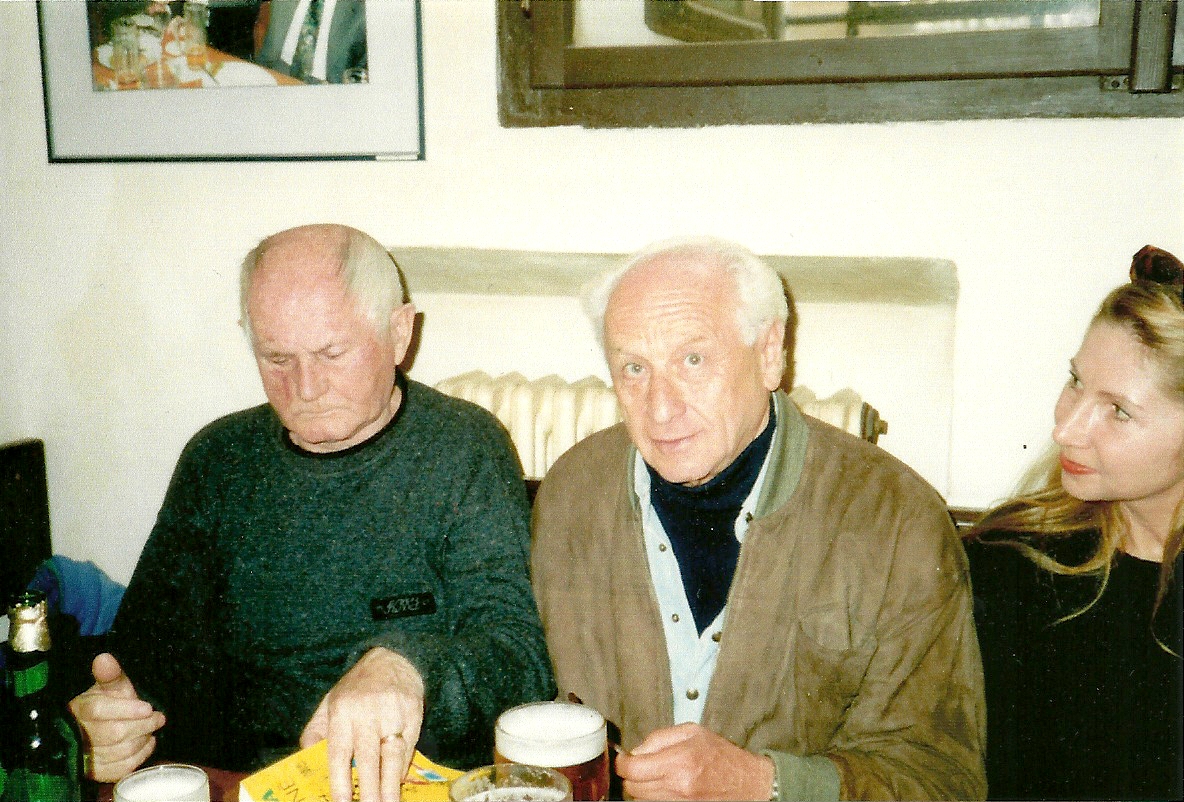
IsolaBellaview2IsolaBellaviewfromgarden6


Lucky Cat Shelter Diary

Bohous in garden

Bohumil Hrabal Burns when he was one or two years old

In this post I am taking a break from describing castles, chateaus and towns. Instead, I have written about one of my passions that has nothing to do with traveling – cats. When I was a small child, I wanted a cat so badly, but, because my mother is afraid of animals, I was only allowed to have Sparky the goldfish, who had to be flushed down the toilet soon after I got him. During my youth I enjoyed the company of the neighbors’ cats – Phydo, the grey female cat and Pink, the black tomcat. After getting to know Pink, I fell in love with black cats. It is such a shame that so many people consider them to be bad luck and that they are least likely to be adopted. My dream is to have my own villa or townhouse full of black cats – at least ten of them.

Bohous in his Irish bed

Bohumil in the bed I bought him in Dublin

I got my first cat in 1999. He was a feisty and often naughty black tomcat who stole my heart when I first saw him at the age of two months. His name was Bohumil Hrabal Burns, after the Czech writer who used to pour his Pilsner Urquell on my fried steak at the pub because he claimed it tasted better that way. Hrabal was a master of black humor. I found the grotesque anecdotes in his writings to be hilarious.

Bohous on boogie-mat 2

Bohumil on his couch

The first thing Bohumil did when I took him out of the carrier at my efficiency apartment was to urinate on the Czech flag, which served as my bedspread. On the last day of his life, he also urinated on my bed. We experienced life together, all the trials and tribulations as well as good times filled with joy and happiness. He died in late May of 2014, several weeks shy of his 15th birthday.

Bohous and Irish mouse 2

Bohumil Hrabal Burns playing

I will never forget having to take Bohumil to the doctor to be put asleep on May 29, 2014. He wanted to die on his favorite spot of my bed, directly in front of my pillow. I looked into his blue eyes and said, “Okay, it’s time to go now.” For the first time he did not put up any resistance when I picked him up to go to the doctor’s – the tumor on his mouth had made him very weak. I’ll never forget kissing him on the head as he lay dead on the doctor’s steel table, as I sobbed.

Sarlotaonfavoritetree

Šarlota Garrigue Masaryková Burnsová

I wanted another black cat as soon as possible. A friend of mine recommended that I contact the Lucky Cat Shelter in Černiv, a village about an hour from Prague. The owner of the shelter, Jana Zárubová, found the perfect cat for me, and I strongly admire her for the sacrifices she makes to help her cats. She has been operating the shelter for more than 20 years. Even before that, when her now adult children were young, she was always taking care of the abandoned kittens they brought home. I have never met someone so dedicated to her work, which involves so much dedication and perseverance.

Sarlotaoncomputer3

Šarlota as my writing muse

The new cat was four-year old black female Šarlota Garrigue Masaryková Burnsová. I named her after the wife of first Czechoslovak president Tomáš Garrigue Masaryk. In her younger years, children had abused her. She did not get along with the other cat in the household when she was brought to the shelter and was covered in fleas when she first came there. The last person interested in adopting her had decided not to take her because she did not like Šarlota’s eyes. In my opinion, she has the most beautiful eyes I have ever seen. When I entered the room where she was staying at the shelter, she walked right up to me, asking to be petted. Even though she had had a rough life, she did not hate people.

SarlotaOct24251514

Šarlota after a hearty breakfast

Šarlota is the perfect cat for me. She does not wake me up if I sleep late. Rather, she sleeps alongside me. She is patient with me if I feed her dinner later than usual because I am involved so intensely in my writing. She loves to be petted, to cuddle and to read with me on the couch. She often waits patiently on the bed in the study for me to take a break from my writing or proofreading. While I eat breakfast, she jumps up on my lap, purring ecstatically. The only thing she does not like is going to the doctor. I think she had some scary experiences at the vet’s in her past life.

Sarlotaoncastletower

Šarlota on her castle tower

I visited the cat shelter again in 2017 to spend time with the cats there and with Mrs. Zárubová. In this post I am including some photos of the cats and dogs that were residing there at the time. I got my picture taken with a grey cat who jumped into my arms. Unfortunately, I couldn’t take him home because I do not think my princess would approve of not getting my full attention all the time.

MeatCerniv1

Making a new friend at Lucky Cat Shelter

When I was at the shelter, I just wanted to adopt all the cats. I wish I could afford a villa, so I could have cats everywhere! For me, traveling to Lucky Cat Shelter in Černiv was an unforgettable day trip that reminded me of the importance to be compassionate, to sacrifice for others who are more needy. I love traveling, writing and reading, but I love cats – especially black ones – most of all.

Tracy A. Burns is a writer, proofreader and editor in Prague.
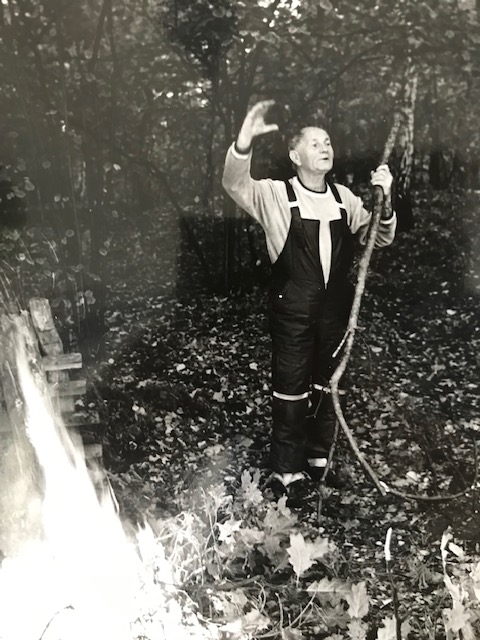
Cats at the Lucky Cat Shelter, August 2017

Cernivcats4black

Cernivcats7

Cernivcats9

Cernivcats11

Cernivcats12

Cernivcats14

Cernivcats16

Cernivcats22

Cernivcats23

Cats at the shelter from May 2018 visit:

Azyllucky518Bertik

Bertik, my good friend during my visit

Azyllucky518Bertik2

Bertík enjoying the good weather

Azyllucky518kittens

Kittens born about a half hour before returning to the shelter from the doctor

Azyllucky5181

Azyllucky51810

Azyllucky51811

And a few dogs from the shelter in August of 2017

Cernivcats3

Cernivcats6

Some dogs at the shelter during May of 2018

Azyllucky5187dogs

Azyllucky5182dog

Azyllucky51812dog

During May of 2018 there were four turtles at the shelter, too.

Azyllucky518turtle

August 2019 Visit

During this visit I fell in love with two black kittens who reminded me of Bohumil when he was a few months old, but, unfortunately, I was not able to adopt them. The Bertík white-and-ginger cat in photos above died this year, but another cat of the same color had been given the same name. The newest Bertík gave me a kiss while I was holding him. I was immediately smitten with him as well. Here are some photos of the many cats and dogs that stole my heart during that beautiful summer day.

AzylLucky20191

The newest Bertík who gave me a kiss

AzylLucky20192

The two black kittens stole my heart.

AzylLucky20196AzylLucky20197AzylLucky201918AzylLucky201925

Both of the black kittens helped themselves to my ham.

AzylLucky201928AzylLucky201933

AzylLucky201910AzylLucky201912AzylLucky201913AzylLucky201914AzylLucky201915AzylLucky201919AzylLucky201924

AzylLucky201916

And those adorable dogs:

AzylLucky20194AzylLucky20195AzylLucky201922AzylLucky201929AzylLucky201932AzylLucky201936AzylLucky201937

During a 2022 visit, I saw many adorable cats and dogs. One cat even posed for me. I petted a very friendly black cat.

This time I took a picture of Jana Zárubová, the owner of the cat shelter who does phenomenal work helping these cats and dogs get well and finding them new homes so they can start their lives anew. I greatly admire her dedication and determination to make a difference and to give cats a chance to experience happiness and well-being. I adopted my Olinka from her last year.

One of my heroes, Jana Zárubová
Olinka Havlová Burnsová