Osek Monastery Diary

Osek Monastery 1

Note: No photos were allowed inside

I traveled to the picturesque region below the Krušné Mountains to see Osek Monastery in 2018. It was my second visit in eight years. I remembered shivering with cold as I wore my rather thin jacket during that first visit, probably in October of 2010. Feeling partially frozen, I waited patiently for the bus back to Prague after a wonderful tour. I had enjoyed my time there immensely, but what I remember most is the cold that seeped through my garments.

Osek Church 2

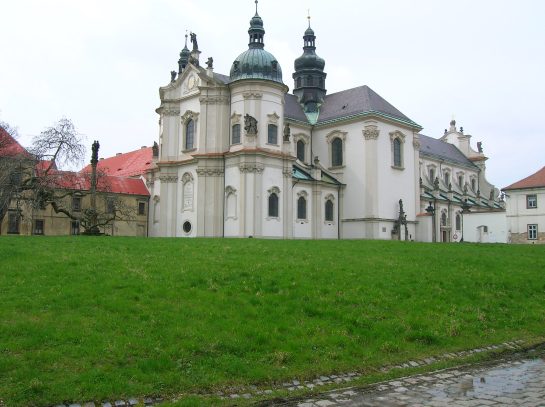
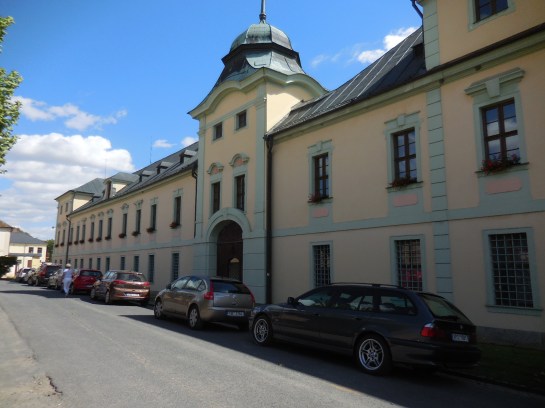
It was July when I came back for another look at the Cistercian monastery that was founded in the early 13th century, though monks had called the area home even at the end of the 12th century. This time, I arrived by car with a friend.

The Church of Our Lady at the monastery was a Romanesque creation, built as a three-aisled basilica in the shape of a Latin cross. The chapels and choir are rectangular. Measuring 76 meters long, during Romanesque days it was the biggest monasterial church in Bohemia.

The monastery was damaged during the Hussite wars of the 15th century during two years. The Hussites detested the Cistercians because, among other reasons, they were the wealthiest order in the Czech lands. The Thirty Years’ War brought devastation to the holy place. From 1580 to 1628, the monastery was closed.

Osek Church facade 2

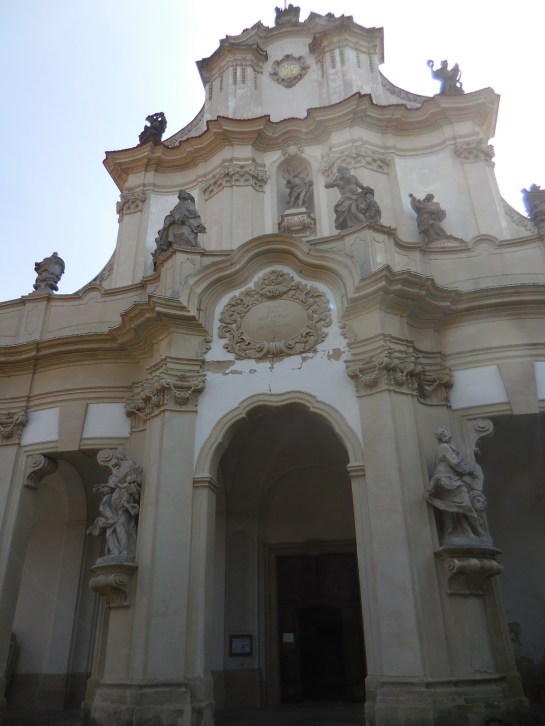
In the early 18th century, the Abbot Benedict Littweig ordered Baroque reconstruction. Two cupolas, the façade, sculptural ornamentation and the main altar all hail from that time period. The main architect of the makeover was an Italian born in Bohemia, Octavian Broggio from the Litoměřice region. He favored radical Baroque style and had experience working in Prague and in the area where he was born.

Osek1

During 1945 and 1946, the German monks who were living there were resettled in Germany for a while, and during 1961, they were sent to Germany again. At one point, the Salesians lived there, but the order was closed in 1950. The year 1950 would be the beginning of dreadful times. From 1950 to 1953, the monastery was used a detention center for priests. After that, it became a detention center for nuns. The Cistercian monks reclaimed the property in 1991 and left in 2010, when Abbot Bernard Thebej, who had overseen the monastery from 1991, died.

Osek8

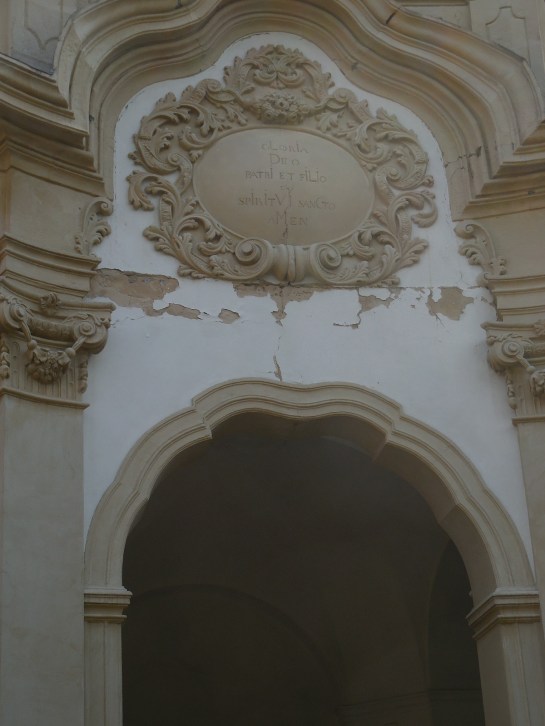
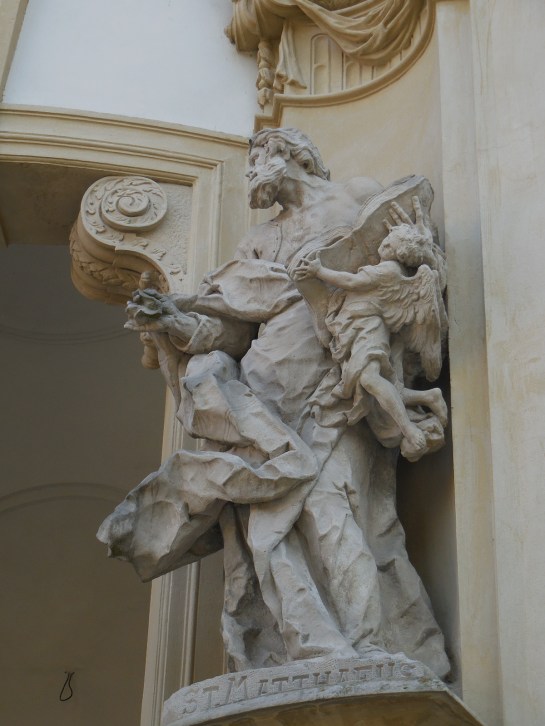
I waited for the tour as I gazed at the Baroque façade with a superb portico. Saints John, Mark, Luke and Matouš faced me. I saw Saints Peter and Paul above them. I thought of the other Cistercian monasteries I had visited. In south Bohemia, I had seen both Vyšší Brod and Zlatá Koruna. At Vyšší Brod, I was most enamored by the library of 70,000 volumes, the third Czech monastic library. The Theological Hall with one of the largest collections of Bibles in Central Europe had also captivated me. I recalled the elaborate Rococo stucco decoration and numerous Rococo wall paintings at Zlatá Koruna as well as the early Gothic Chapel of Guardian Angels. Near Kutná Hora, not far from Prague, Sedlec Monastery had amazed me with its Santini-created Baroque Gothic style interior and paintings by Baroque master Petr Brandl. Plasy in west Bohemia also came to mind. Santini had done his magic there as well, and the Baroque pharmacy had such superbly painted drawers. I had toured Plasy at least three times. I had been impressed by Velehrad in Moravia, but I had been there so many, too many, years ago.

Osek10

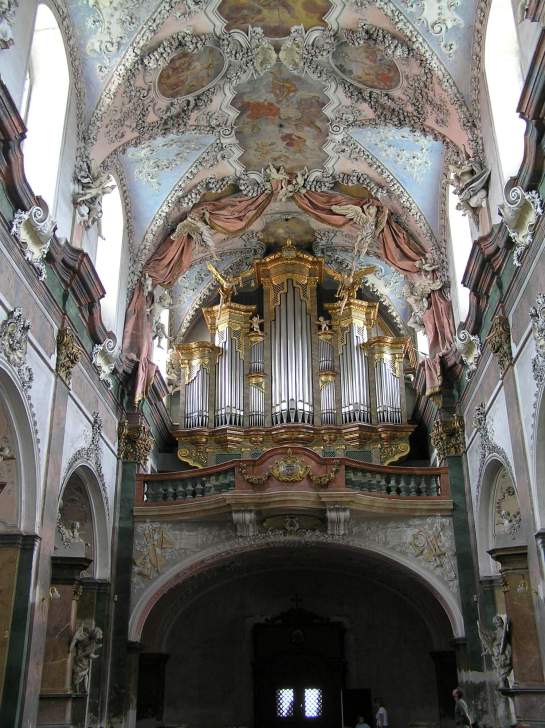
The guide took us inside. The superb interior was pure Baroque with much stucco ornamentation. I was particularly drawn to one side altar because of its extremely morbid character. The altar featured Christ on the Cross, flanked by two angels, but the ornamentation made it feel creepy. It was adorned with figures of skulls and bones in Classicist style. At the foot of the Cross, there was a golden skull. I recalled the Cycle of Death murals at Kuks, a former hospital in splendid Baroque style. I had visited it on several occasions, so I was well-versed with the Baroque obsession for skeletons, skulls and bones. At the altar, there was a reliquary with remnants of Saint John the Baptist and other saints. All the chapels were impressive, but this one especially caught my attention.

OLYMPUS DIGITAL CAMERA

Interior of the church, from http://www.rajce.net, Photo Album from 2006

There were two Baroque cupolas. I saw painted windows on one – a trademark of the Baroque style. Two Baroque organs graced the church. One of them had 666 pedals, giving it a mystical quality.

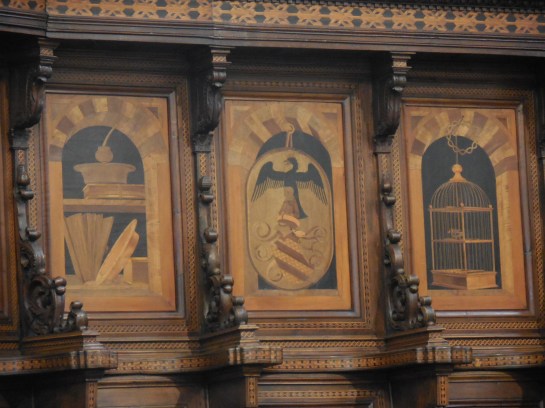
The choir benches – Baroque, of course – were amazing, made with intarsia decoration of wood on wood. The inlays were breathtaking. Black spiral columns and gold ornamentation added to the Baroque ambience. The guide opened a cabinet behind a bench: Hymnbooks were stored there. I could imagine the Cistercian monks singing in celebration and could almost hear their voices resound through the church. In front of the choir, there were modern benches where services were currently held. Facing these benches, underneath the floor, was the tomb of the last abbot.

Osek16

The main altar included impressive sculptures of the four apostles. Figures of angels also had prominent roles in the adornment. The painting of Assumption of Our Lady – the patron saint of the Cistercians – was the work of Jan Krištof Liška, a truly remarkable Czech artist. Václav Vavřinec Reiner, whose monumental painting I had seen at Duchcov Chateau a few months earlier, was responsible for the painting of the side altars as was Michael Leopold Willmann. Reiner also had created, along with Jan Jakub Steinfels, the ceiling paintings in the main nave and chancel. They portrayed scenes from the life of Christ and from the Old Testament.

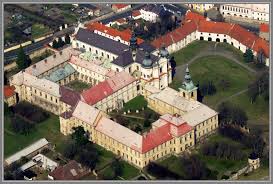
Osekaerialview

Aerial view of Osek, from http://www.mapio.net

The cloister surrounds a garden that is decorated with three tombstones from the 14th to 16th centuries. Eighteenth century paintings promoting the history of the order are features of the cloister. I could see Romanesque traits in the entrance portal to the cloister from the church.

OLYMPUS DIGITAL CAMERA

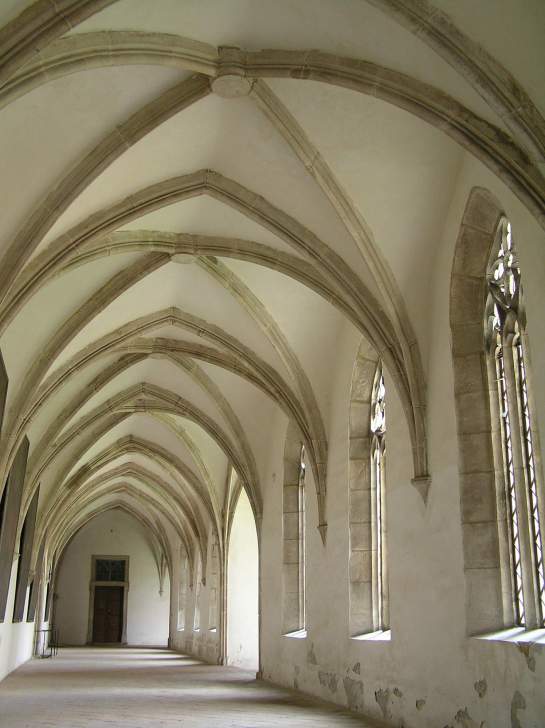
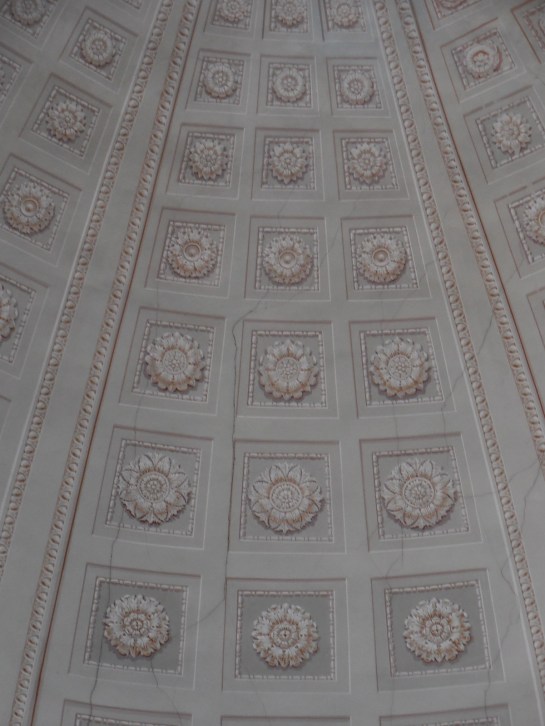
Vaulted ceiling, from http://www.rajce.net, Photo Album from 2006

We passed by Well Chapel. A well, the monks’ source of water for a lengthy period, was the central element of the chapel, as the name suggests. Sculptural decoration adorned the well. On the wall behind it, there was a bright orange sliver of glass. This piece was original, dating back to the Gothic era. At that time, the glass had been brightly colored.

OLYMPUS DIGITAL CAMERA

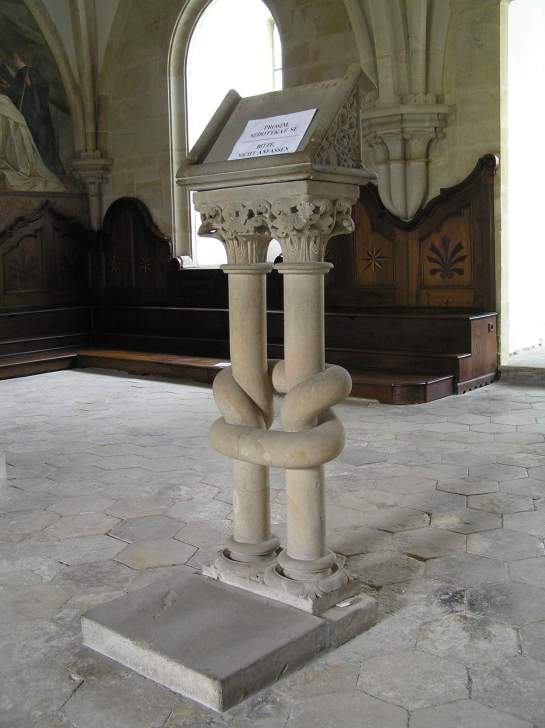
Reader’s Lectern in Chapter Hall, from http://www.rajce.net, Photo Album from 2006

The Chapter Hall was a Gothic delight. Constructed from 1225 to 1250, it was one of the first Gothic buildings in the Czech lands. The sandstone sculptures from this era were impressive. A Gothic statue of the Madonna hails from around 1430. Monks had frequented this area every day. In the middle of a room was a reader’s lectern from which monks would read aloud to those gathered in the space. A Gothic mechanism allowed the top of the lectern to swivel from side to side. In the chapel, the altar looked a bit flamboyant for late Gothic, with white and gold decoration. The wall paintings illustrating the history of the order were newer, dating from 1750.

OLYMPUS DIGITAL CAMERA

Gothic ceiling, from http://www.rajce.net, Photo Album from 2006

Near the entranceway to the chapter hall was a dog’s paw print. I wondered what kind of dog had made the imprint and if the dog had lived during the Gothic period or Baroque era.

I loved that the monastery’s architecture celebrated both spectacular Baroque and Gothic styles. After the tour, my friend and I found a busy restaurant with outside tables, where we had delicious food. The establishment seemed to be the popular place for lunch in the town.

Osek15

Our stomachs filled with a satisfying lunch, we headed back to Prague. I had learned during the tour that the monastery would soon be closing for three years to have the entire interior renovated. I felt lucky I had had the chance to visit before the renovation and knew I had to come back in three years, to see an even more superb Baroque and Gothic creation.

Tracy A. Burns is a writer, proofreader and editor in Prague.

Osek18


Teatro Olimpico Diary


VicenzaTeatroOint17I cannot choose one place as the highlight of my trip to the magical world of Palladian architecture in Vicenza, but certainly seeing the Teatro Olimpico ranks right up there. Recognized by UNESCO, this is one of the three Renaissance theatres in existence. The 72-year old Andrea Palladio designed what is now the oldest covered theatre in Europe, and construction began in 1580. When Palladio died in August of that year, Vicenza-born architect Vincenzo Scamozzi took over.

VicenzaTeatroOint9

Still, the theatre clearly features many Palladian characteristics. For instance, the plan for the theatre was based on classical architecture. As usual, Palladio had found inspiration in the writings of Roman architectural guru Vitruvius, who lived during 1 BC. Indeed, I felt as if I were seated in a theatre dating back to antiquity. The classical forms gave the Teatro Olimpico a very majestic quality.

VicenzaTeatroOint11

The theatre held its first performance on March 3, 1585, as actors who were at the time well-known performed Oedipus Rex, a play chosen for its classical theme. The costumes were extravagant. About 1,500 spectators watched, and the play was a huge success. However, the theatre was only used for a few performances.

VicenzaTeatroOint13

Palladio had had his work cut out for him. The theatre was built on the site of a former prison, which had a box-like shape. Palladio was able to turn the audience hall into an oval shape, and the seating was sloped steeply, as if it were a Roman amphitheatre. The amphitheatres I had visited in Taormina, Segesta and Syracuse, Sicily and in Arles, France came to mind. I also thought of the Roman amphitheatre I had seen the previous year in Lecce, Puglia.

VicenzaTeatroOint18

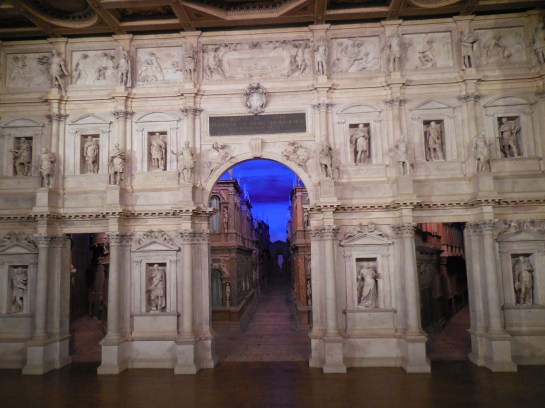
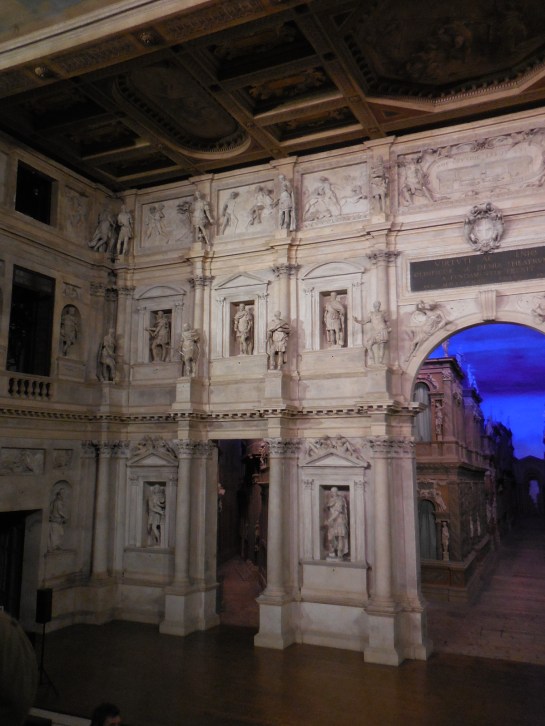
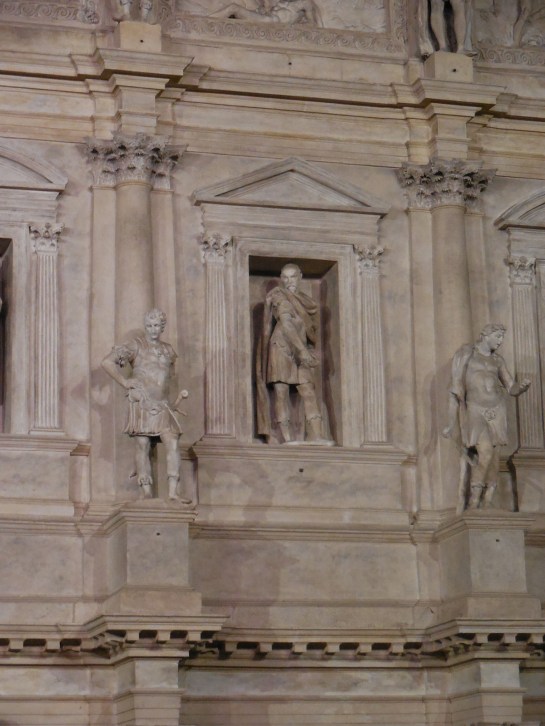
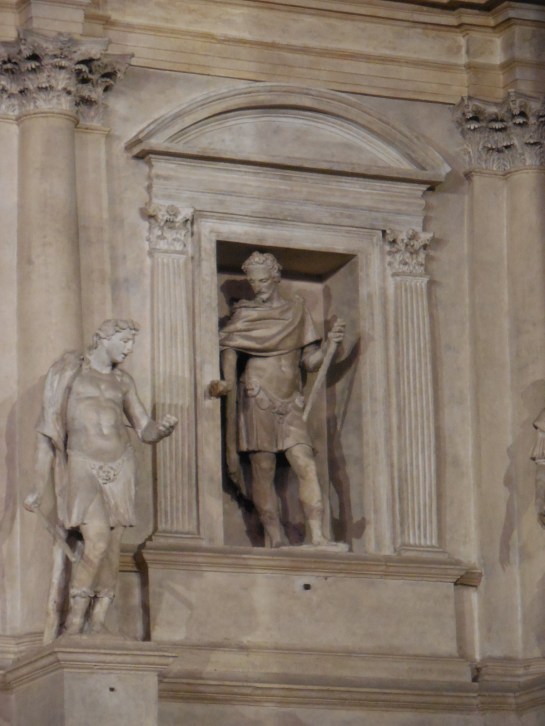
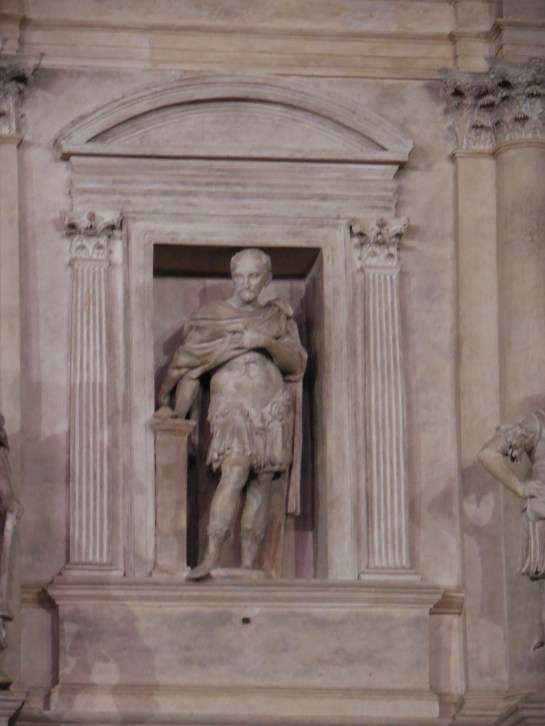
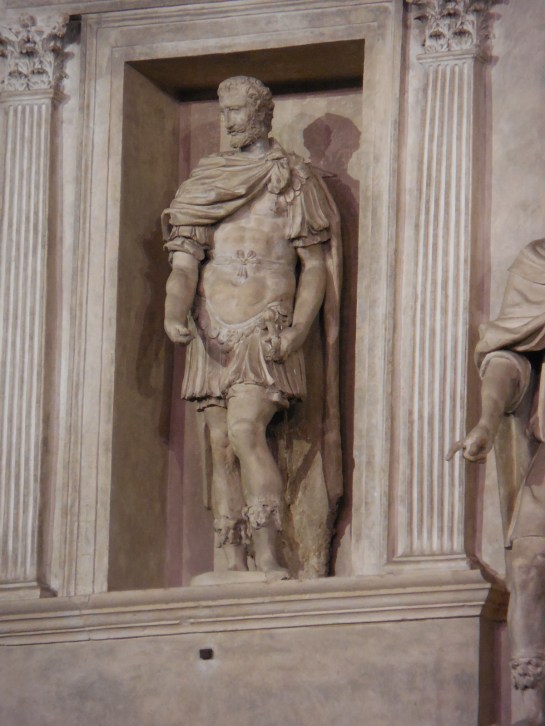
The classical architecture and statuary captured my immediate attention. Three orders of columns decorated the proscenium. The 41 statues that adorned the theatre on the proscenium and in the wings looked as if they were made of stone. That was just one of the many illusions in this theatre. In reality, the statues were sculpted from swamp reeds, tow, earthenware and mortar. While the statues showed off aristocrats from the 16th century, these figures were clad in classical attire, often wearing armor or long gowns. Thus, they were not portraits but likenesses set in a past time period. Because Leonardo Valmarana had been an ardent supporter of the Habsburgs, his statue has a face similar to that of Emperor Charles V.

VicenzaTeatroOint19

Notably, there were no women represented. Still, some of the men rendered had distinctive feminine features. Initially, some of the statues had been designed to show female figures, but they were changed into men. This produced some hilarious results. In the upper tier, the statue of Gerolamo Forni sports a beard but has a female body.

VicenzaTeatroOint20

VicenzaTeatroOint7

Furthermore, all of the statues were not of the same quality. That’s because the quality of the statue depended on two factors – how influential the man represented was and how much the man had paid to have the statue sculpted. It would have been interesting to be able to inspect each one and learn who was most valued in Renaissance society. There were other statues, too. These included renditions of Olympic deities and one of Palladio himself, designed after the masterful architect had died.

VicenzaTeatroOint1

Hercules held a prominent position in the décor of the theatre. This legendary figure was the focus of stucco-clad bas-reliefs that told the story of his life. The artistic narration included scenes in which Hercules takes over for Atlas holding up the world, the Hercules – Antaeus encounter in which Hercules was victorious and Hercules’ successful fight against the Cretan bull. Thus, another classical theme was portrayed. The bas-reliefs by no means stagnant. There is a strong dynamic quality to the episodes that are brought to life in a vivacious way. So, while the theme stems from the classical world, the bas-reliefs provide a much livelier look than that expressed in the classical world. The figures even have a Baroqueness about them.

VicenzaTeatroOint14

One feature that enamored me was the illusive architecture, the false perspectives utilized in the design. The set for Oedipus Rex, the oldest existing theatre scenery, looked as if the seven roads of Thebes led from the stage far into the horizon, but it was really painted so that it created a fake perspective. I couldn’t believe that it was all an illusion. I could see myself meandering down the streets. It was architecturally amazing. I thought of the basilica at Hejnice and how the main altar was really painted on the wall, while it appeared three-dimensional. This feature of the theatre was designed by Scamozzi, who was known for his talent using false perspective. Via Theatres showed spectators a world of illusion. The world of the play was not the real world. This theatre also was a place of illusion itself.

VicenzaTeatroOint16

Another illusionary feature was the false sky above. It looked like the theatre was not covered at all, as if it were open and light under a clear sky. The likeness to a real sky was incredible. I did not sense I was in a closed space. This feature was designed at the beginning of the 20th century.

VicenzaTeatroOint2

The lighting played a major role in producing the illusive perspectives due to their location. Originally, the lights consisted of colored oils inside glass bulbs or wicks in metal boxes. They were hidden within the architecture featuring false perspective, so no one could tell where the source of the lighting was. It was a masterful idea, I thought. Scamozzi was responsible for the lighting. I wondered if my friend and former college lighting professor had ever been here. She would have a field day studying the lighting features.

VicenzaTeatroOint3

The theatre soon became an entertainment venue. During the 17th century, the theatre was used for receptions of VIPs the town was hosting. Fencing tournaments also took place there. Until recently, graduation ceremonies were held there. It is still used as a theatre on occasion, but only 400 spectators are allowed to watch performances for safety reasons.

VicenzaTeatroOint4

I appreciated the classical features of the theatre that had a distinguished feel. The statues added a classical elegance, and the bas-reliefs gave the theatre’s décor a vivacious character. I also was enthralled by the false perspective. Both the scenery and the fake sky were unbelievable.

VicenzaTeatroOint21

When it was time to leave, I did not want to go. I could have stared at the proscenium, wings and false sky for hours. It certainly was a unique structure. It would prove to be one of most bewitching sights I visited in Vicenza.

Tracy A. Burns is a writer, proofreader and editor in Prague.


Church of Saint Corona Diary

VicenzaSantaCoronaint1

VicenzaSantaCoronaint2

VicenzaSantaCoronaint5

VicenzaSantaCoronaint8

VicenzaSantaCoronaint11

The first place our guides took us in Vicenza was the Church of Saint Corona, a three-nave Gothic structure with many treasures inside. The church harkens back to 1261, when it was constructed to house a Holy Thorn that the bishop of Vicenza had received as a present from French King Louis IX.

VicenzaSantaCoronaint12

VicenzaSantaCoronaint13

VicenzaSantaCoronaint14

VicenzaSantaCoronaint16

VicenzaSantaCoronaint17

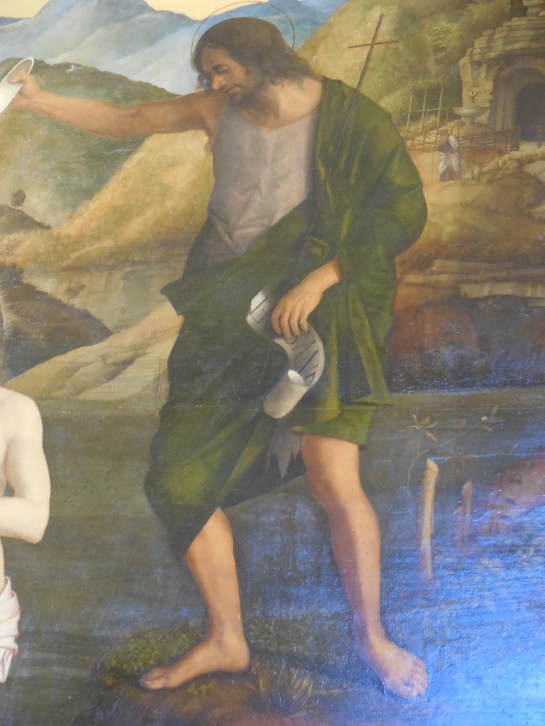
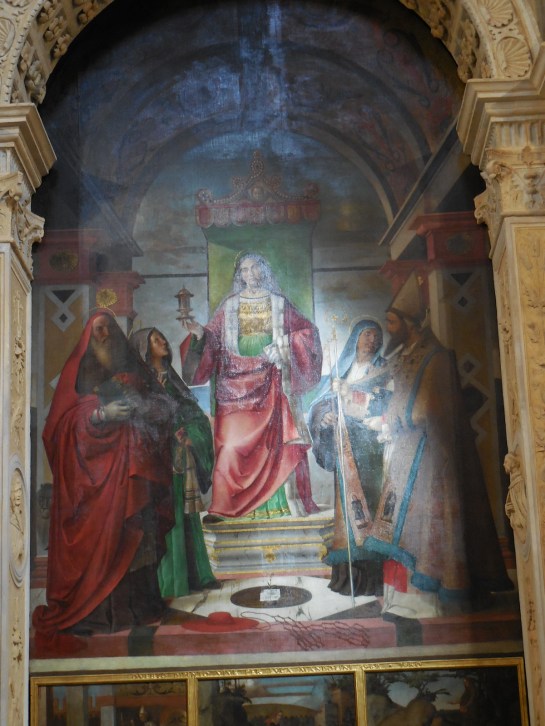
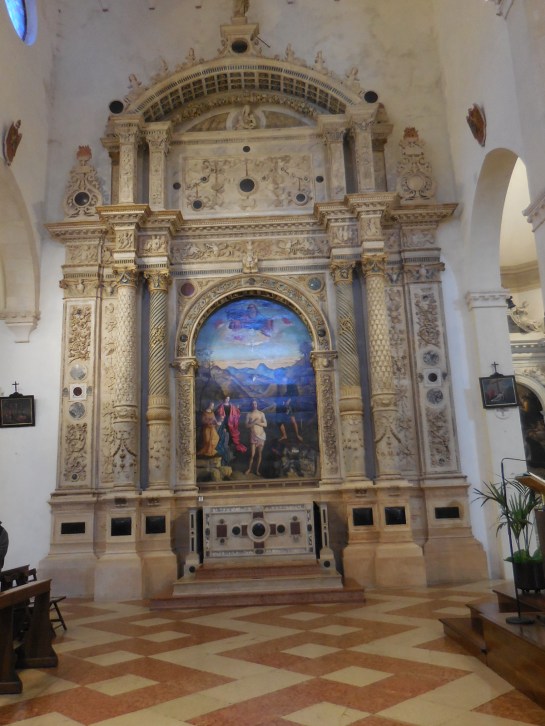
I loved the interior with its paintings, frescoes, superb choir, ceiling and chancel. The artwork included a masterpiece by Paolo Veronese, “Adoration of the Magi.” The main altar featured Giovanni Bellini’s “The Baptism of Christ” while Bartolomeo Montagna’s “Magdalen and Saints” also made an appearance. I was especially entranced with Giabattista Pittoni’s “Enthroned Madonna and child venerated by Saints Peter and Pius V,” though all the paintings greatly impressed me. I loved art, and seeing these paintings filled me with joy and excitement as if I were at a renowned art museum.

VicenzaSantaCoronaint19

VicenzaSantaCoronaint21

VicenzaSantaCoronaint22

VicenzaSantaCoronaint23

VicenzaSantaCoronaint24

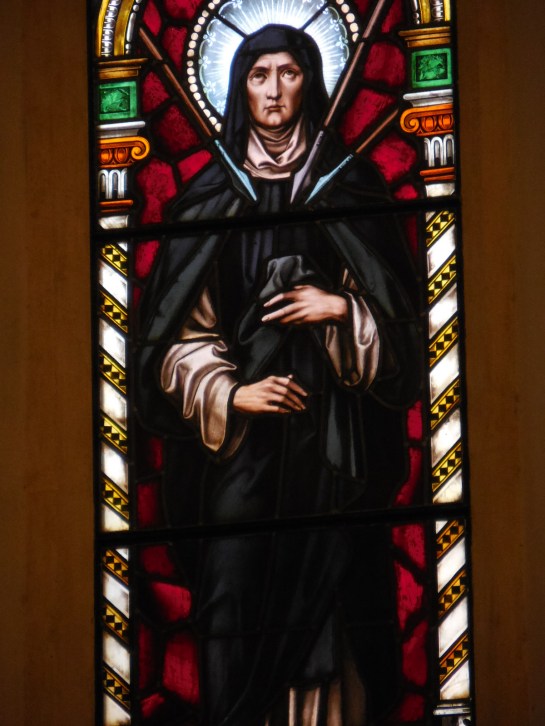
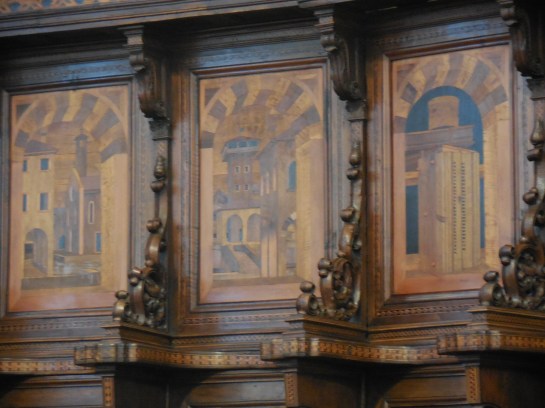
The choir in the apse was another wonder. The carved, inlaid decoration on the wooden choir was so delicate and detailed. The frescoes in the Thiene Chapel hailed from the early 15th century. The chancel was also of Renaissance origin. The painted coffered ceiling with stucco decoration was another jewel.  The superbly adorned main altar also appealed to me. The stained glass windows amazed.

VicenzaSantaCoronaint25

VicenzaSantaCoronaint26

VicenzaSantaCoronaint27

VicenzaSantaCoronaint31

Of course, we could not take a good look at the church without paying close attention to the Valmarana Chapel, designed by Andrea Palladio around 1576 and located in the crypt. The Valmarana clan had been buried in the church, so it was no surprise that Antonio Valmarana had chosen to be interred there. The chapel was simply designed as a balanced space with a square space. The two niches in the chapel were simple yet helped give the space a sense of elegance. I liked the symmetry, and I would appreciate this characteristic of Palladio’s architecture in many other works that day and in the following days of our trip.

VicenzaSantaCoronaint32

VicenzaSantaCoronaint35

VicenzaSantaCoronaint37

VicenzaSantaCoronaint39

Every element of the church seemed unique. The paintings each told a powerful story. The Gothic characteristics, the ceiling, the chancel, the choir, the chapel designed by Palladio – everything fused together to make this an architectural gem, just one of the many architectural gems that awaited me in Vicenza.

VicenzaSantaCoronaint40

VicenzaSantaCoronaint41

VicenzaSantaCoronaint42

VicenzaSantaCoronaint45

VicenzaSantaCoronaint49

VicenzaSantaCoronaint51

VicenzaSantaCoronaint54

VicenzaSantaCoronaint55

VicenzaSantaCoronaint57

VicenzaSantaCoronaint58

VicenzaSantaCoronaint60

VicenzaSantaCoronaint61

VicenzaSantaCoronaint64

Tracy A. Burns is a writer, proofreader and editor in Prague.

Kačina Chateau Diary

Kacina121

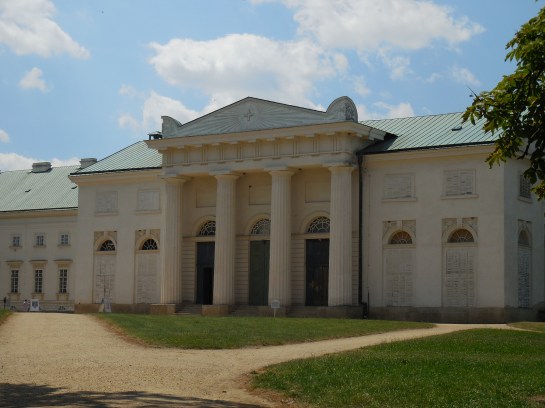
My friend and I went to the chateau by car, driving a little over an hour to the sprawling white-columned, two-floor chateau of Kačina, sporting an elegant tympanum on its main façade. I would visit again, in 2020, also by car.

Kacina2020ext11Kacina2020ext13

The huge chateau – the biggest 19th century Empire style chateau in the Czech lands – boasts not only representative rooms in 19th century Empire, Biedermeier and Classicist styles but also a 19th century library, theatre and pharmacy plus an agricultural museum. An unfinished chapel is on the vast grounds as well. The chateau was built from 1802 to 1822.

Kacina2020ext10

The balanced Empire style hails from the early 19th century when symbols and decorations were influenced by ancient Greece and Rome. Biedermeier style, from 1815-1845, refers to furniture that is simple yet elegant with very little decoration. During this period ebony, cherry, ash and oak woods were often used. The Classicist trend can be defined as symmetrical, proportional and geometrical, taking its name from the style utilized in Classical antiquity and that of ancient Rome.  Architecture of this style is very well-organized with columns, pilasters, lintels, hemispheric domes and niches.

Kacina2020ext2

I was lucky that I had a guide who was so enthusiastic and knowledgeable about the place. When I came back in 2020, I had another terrific guide. In fact, I had always had the best guides at this chateau: they were enthusiastic and animated, not merely uttering words they had memorized from a text. Their zeal was contagious. They were exactly the kind of guides I wished I had had on every tour I had taken. The details of each room just spewed spontaneously from this tour guide’s mouth. She even took me to parts of the chateau that were usually off-limits to tourists.

Kacina2020ext15

First, we hit the representative rooms. The ground floor consisted of the spaces used for social occasions and guest rooms while the first floor, which cannot be visited, had been made into a family residence.

Kacina124

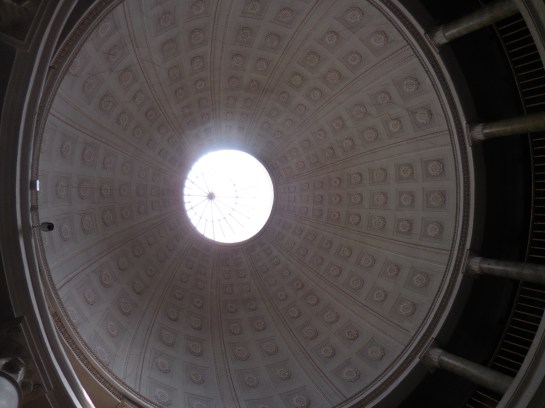
The first room we walked into took my breath away. This hallway with a roundel or circular window that is 16 meters high was so light and airy yet elegant that it reminded me a bit of the Pantheon in Rome. I remembered sitting across from the Pantheon at a restaurant for my fortieth birthday dinner, an experience I shared with my parents. That was one of my most treasured travel-related memories. We continued into a hallway with some hunting trophies and black-and-white British lithographs sporting hunting and horse-jumping themes.

Kacina2020int2

The first three rooms, formerly guest rooms, gave background information about the chateau and explained the history of the Chotek family, who had chosen this chateau as their summer residence during the 19th century. Models of chateaus adorned each room, such as the blood red model of Veltrusy, destroyed by the 2002 floods, the chateau where the Choteks had once had their family residence. In a portrait Jan Rudolf Chotek, the founder of Kačina, looked as if he was harboring a secret he would never reveal.

Kacina2020int3

First, you need some background about the Chotek family. Veltrusy Chateau was their family residence from 1716 to the 20th century. Jan Karel served the emperor as an armorer, and his youngest son Rudolf worked as the highest chancellor in the Czech lands. Because he did not have a son, his nephew Jan Rudolf took over in the 18th century. Jan Rudolf was a man of many achievements. He built the magnificent park in Veltrusy and Kačina chateau in the 19th century. He was responsible for the construction of many embankments and parks throughout the Czech lands.

Kacina2020int4chandelier

His youngest son Karel spent 17 years as the highest Czech burgrave and built the highway between Karlovy Vary and Mariánské Lážne. He even learned Czech from legendary historian František Palacký. He also established a residence at Velké Březno chateau, built from 1842-1854, in northern Bohemia – a charming building that looks like a hunting lodge or villa. I fondly recalled my trip to Velké Březno, where I had looked out the window at the park, suddenly feeling free of stress as if I had been cleansed of my worries. Ferdinand Maria Chotek, the fourth son of Jan Rudolf, was the Olomouc archbishop for four years. Žofie Chotková married František Ferdinand d’ Este, both of whom were assassinated in 1914.

Kacina2020int5

The last male Chotek was Karel, who along with his wife Lívie became German citizens after World War II and emigrated to Germany. During the war the chateau was sold to the Germans, and the HitlerJugend resided there. The chateau was nationalized after the war according to the Beneš decrees, which gave property owned by Germans during the war to the state.  In 1950 the chateau belonged to the Ministry of Agriculture, and it became an agricultural museum. Now the chateau looks as it did when Jan Rudolf lived here. The coat-of-arms for the Chotek family shows a half wheel, a gold bear in a blue field and a black imperial eagle on gold.

Kacina2020int6

The ladies’ wing was first, then the men’s wing. The Ladies’ Study boasted pink and grey decor with white ornamentation. Family portraits adorned the walls as did pictures of three summerhouses that once graced the park, founded as far back as 1789 and now composed of 20 hectares with 61 kinds of trees and 20 kinds of bushes. An oil painting depicted knights readying for a tournament on Chotek property. I gazed at a square, gold clock in a gold frame, positioned high on a wall. I was drawn to the geometric symmetry of the square design.

Kacina2020int9

Next was the Pink Salon. The original chandelier was second Rococo in style, gilded with gold and dominated by Czech crystal. An Empire style small black table with gold legs and a circular table with the same decoration got my attention. Pink and white porcelain dominated a circular table in the middle of the room. Corinthian columns were painted on the walls.

Kacina2020int10

The Ladies’ Bedroom included some magnificent intarsia furniture. A picture with cupids was carved into a wooden bedframe.  I immediately took to the Empire style black-and-purple closets for accessories in the Ladies Changing Room. A light pink chair and couch complemented a Venetian mirror decorated with black and pink. The purple, pink and black colors went together superbly, I mused.

Kacina2020int17

The Small Dining Room, still used for concerts, included an Empire style table and a Biedermeier side table plus a gold chandelier. The Dance Hall was 22 meters long, 12 meters wide and 16 meters high with fantastic roundels. A crystal chandelier captivated me. The brown parquets on the floor sported circular and diamond shapes. For a moment we stood on the terrace and took in the vastness of the park land around us.

Kacina2020int11

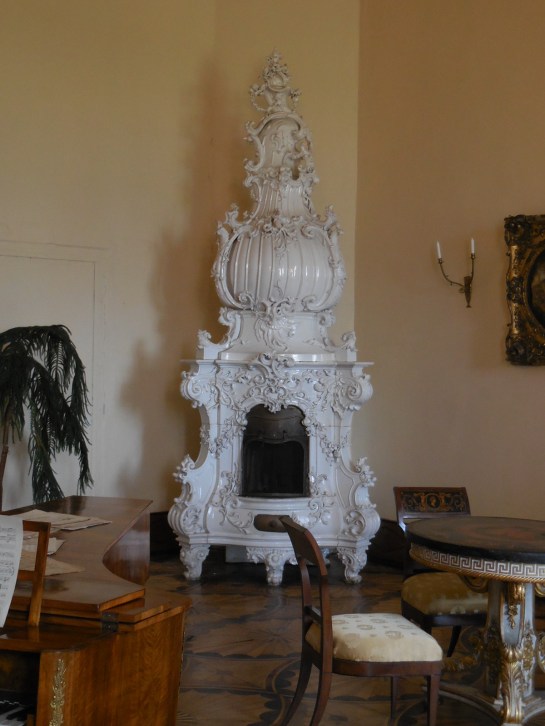
The Men’s Salon had a Baroque pool table, but it was the Renaissance brown tiled stove that entranced me. The unique feature of the room was the oak leaf motif. I recalled that oak was often utilized in the Biedermeier style. Wooden circles with oak leaf motifs decorated the ceiling and the tops of the walls. Frames were also covered in wooden oak leaf ornamentation. The couch and chairs were Second Rococo in style. I noticed that the armchairs where the Choteks sat when playing cards were very low.  I wondered what sort of conversations had taken place there while the Choteks had played cards. What had they talked about? What were their interests and worries? What events had brought them joy? Vienna porcelain and Czech glass also lit up the room.

Kacina2020int15

The white stove in the Music Room had white décor and hailed from the Second Rococo period. I also noticed a Baroque bureau and two big portraits of Jan Rudolf Chotek and his youngest son Karel, both wearing prestigious golden medals around their necks. Jan Rudolf was holding a plan of Kačina in one hand while Prague dominated the background of Karel’s portrait.

Kacina2020int19


The furniture in the Men’s Study or Smoking Room was captivating as well. The green couch and chairs were Empire style as was the chandelier. The desk hailed from the Biedermeier period. I notice a small statue of Empress Elizabeth, fondly called Sissy, on a desk top. I thought about how she had loathed the strict regimen of royal life and how she danced to the beat of her own drum. She had become a symbol of individual identity during her 44-year reign as the longest reigning Austrian empress. She had been so independent, traveling around the world. And she had had to deal with so many tragedies. A large portrait of her husband, Austro-Hungarian Emperor Frantisek Josef I, also hung here – in the painting he was a young man with many medals on his uniform. The young man in that painting would become the most respected and most beloved member of the Habsburg dynasty, ruling the Austrian Empire and then Austro-Hungarian Empire for 68 years, the third longest reign in the history of Europe.

Kacina2020int26

On another wall was a huge brown map of the Chotek property as of 1734. The guide pointed out that the fields were numbered. There was also a secret door to the south colonnade, but we went downstairs instead to see the former bathroom, which was a large hole in the dilapidated floor. The person taking the bath used to sit on a chair in the tub while servants poured water over him or her.

Kacina2020int29

We trekked upstairs again, this time to the Men’s Bedroom. The prayer stool was made with intarsia, wooden with wood decoration. Paintings with religious themes also adorned the room. Plants made the room come alive. In the Men’s Changing Room there were small paintings of Italian towns on the walls. The chandelier hailed from the Empire period. The Hunting Salon was dominated by a polar bear rug. I noticed the animal’s sharp teeth.  A white tiled stove boasted white ornamentation with two female figures on its sides. Oriental chairs also made up the space. The furniture was Baroque and pseudo-Baroque and included a Baroque bureau.

Kacina2020int30

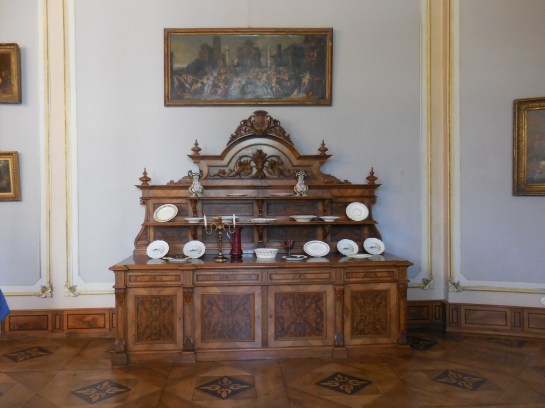
The Big Dining Room featured a folding table that usually sat 24 guests during the Chotek’s days. The table was decorated with a green clover motif. Each chair had the coat-of-arms of the Chotek family with a crown on top. The rich wooden décor on the wooden sideboard got my attention. Ceramics and the Chotek coat-of-arms were displayed on the superb piece of wooden furniture. A Second Rococo mirror had a lavish gold frame with the coat-of-arms prominent at the top. The high walls were decorated with gilded wood, and an exquisite crystal chandelier hung from the ceiling. There was also a secret door.

Kacina2020intlib1

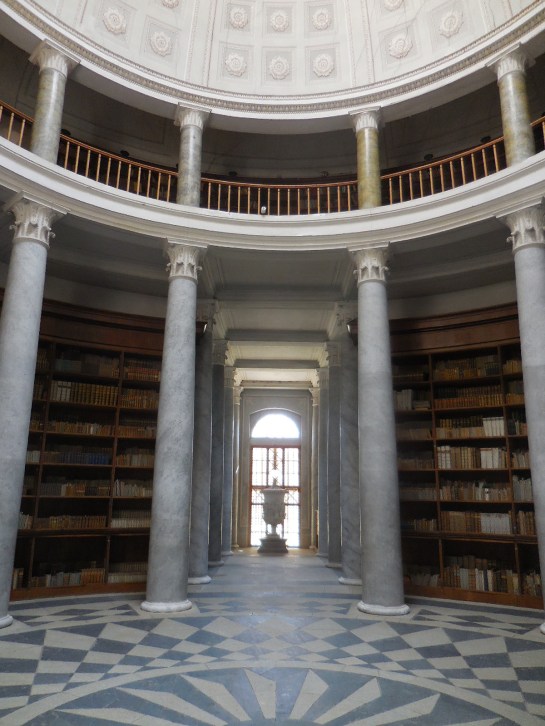
Next came the library, my favorite part of the tour. Roundels or circular windows with painted cupolas and stylized squares allowed light to stream into the three sections, onto the colored shapes on the floor. The library from the turn of the 19th century reminded me of a structure out of antiquity. The fake grey marble columns gave the place a dignified air. Tall bookcases were crammed with books, some of which looked like they had golden spines. A gallery above held magazines and newspapers. The Chotek coat-of-arms was present on all 40,000 volumes, the guide said. Mostly written in German, the books also included publications in French, Spanish, Italian and old Czech. Some of the volumes were older than 1500 – the oldest was a book of Russian psalms hailing from 1480.

Kacina2020intlib4

Among the most significant in the space was the 18-volume complete set of the French Description of Egypt from 1809-1818, which consisted of encyclopedias that documented everything French military leader and political leader Napoléon Bonaparte had seen in Egypt, from plants to pyramids. There were only two other complete sets in the world: one was in the Louvre and the other in the King’s Library in England. These books were printed specifically for European rulers. 

Kacina2020intlib2

The editions in the breathtaking space also included 398 handwritten manuscripts, 38 handwritten maps and 250 catalogues. Among the books, I saw downstairs in the first part were S. Dionysii Opera, a fat two-volume set and collections of Lumír magazine, established in 1851 and written by Czech patriots such as Karel Havlíček Borovksý, who is considered the founder of Czech journalism, satire and literary criticism. Tall medical books stood nearby.

Kacina2020intlib8

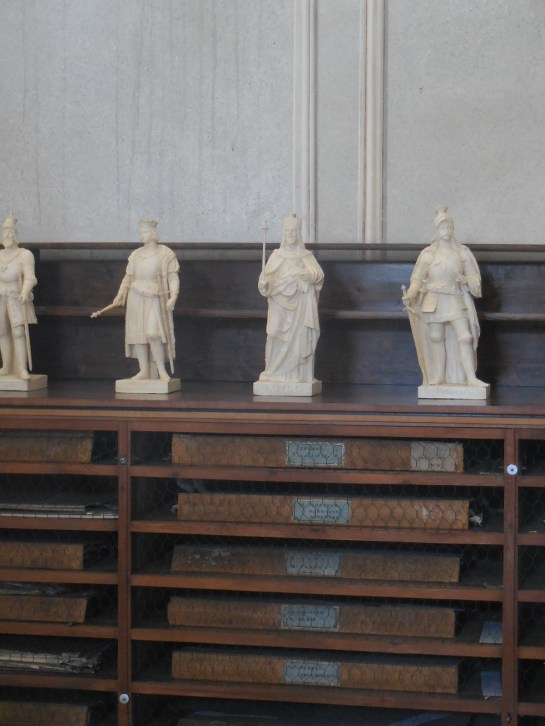
The second part of the library was a study with small statues of Czech rulers and one of Michelangelo. Among the 19th century statues, I spotted the mythical Libuše who prophesized the founding of Prague; Jiří of Poděbrady, a Czech king who ruled from 1458 to 1471; Emperor and Czech king Charles IV, who reigned from 1346 to 1378 and was responsible for founding Charles University, the New Town in Prague and the Charles Bridge; and Holy Roman Emperor and Czech king Rudolf II, who was in charge from 1576 to 1611 and is known for his love of alchemy and cultural pursuits.

Kacina2020intlib19

Then the guide showed me the object that enthralled me the most during my visit. It was a globe put together in eight layers. There were top and bottom layers and then six layers representing the continents. On one side was a picture of a continent, and on the other side there was information about it. I spotted a polar bear on one picture. It seemed to me to be an excellent visual teaching aide for young students.

Kacina2020intlib12

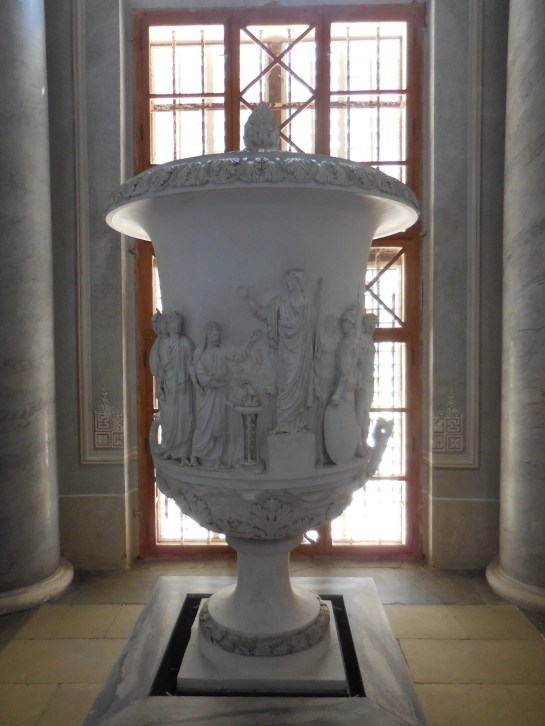
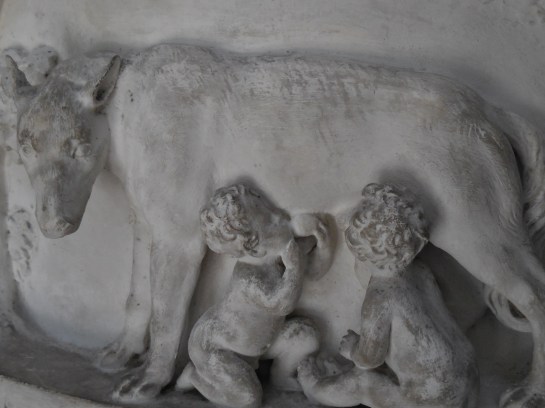
The third part was dominated by a huge vase with ornate décor. I could see Romulus and Remus with a wolf in relief on the exquisite object. Then the guide showed me an Empire style card catalogue, with a card for each book. The golden writing on the cards had been scribed in flowing, fancy script.

Kacina2020intlib17

Then we went up a narrow staircase to the gallery, a part that was usually off-limits to tourists. I spotted editions of the newspaper Prager Zeitung and sheets containing information about new publications in the Austro-Hungarian Empire. Illustrated magazines were also kept here.

Kacina2020intlib16

The guide even led me through the back study rooms. Paintings adorned the walls, and I spotted a grey tiled stove with white ornamentation. Each painting hung in one space had been executed with a different technique. A display case illustrated the technology of painting and materials for painters, such as paraffin. In another display case I saw handmade paper and an ancient book made from handmade paper.

Kacina2020intlib14

Yet another space featured brightly colored, dynamic scenes of Divoká Šárka Park in Prague, one painting for each month, though the set here was not complete. I was entranced by the green hills of the park I loved so much, where I felt so at home, one which reminded me a bit of Vermont. I was glad I lived so close to that park. It made me feel relaxed and worry-free.

Kacina2020intpharmacy1

Soon we came to the 19th century pharmacy. One exhibit showed how to dry herbs, another displayed various baskets. A machine for mixing syrup was on display, too. I saw a press for making fresh herbs and a press for making tablets as well. The jars behind the counter and old scale came in various colors. A large book about herbs dated from 1920. Ceramic jugs also decorated the room.

Kacina2020inttheatre1

The theatre, on the opposite side of the chateau, hailed from 1851. It had never been open to the public. It was used only by the Choteks and their good friends. The Chotek family wrote the plays themselves in German and acted them out. Jan Rudolf’s 15 plays on then current themes are now in Prague’s National Museum. The group had even prepared plays by William Shakespeare, tailoring them to their own needs. How I would have loved to have seen those plays!

Kacina2020inttheatre2

The stage was made of wood, but it was not original. The walls were made of imitation marble on the lower section while stylized painting adorned the upper half. A compartment seated four people in the middle of the back wall. The two balconies boasted gold and black decoration. There was an orchestra pit, and there were pulleys above the stage. A crystal chandelier hung from the ceiling that had been partially damaged by water during the 1960s. Some set designs had been saved. The gallery now contained wooden benches, but it had consisted of comfortable chairs back in the Chotek days. There were bleachers for standing room at the top level. On the relatively new ceiling I spotted the two bears holding a coat-of-arms.

Kacina2020inttheatre3

Last but not least we visited the unfinished chapel, which was occasionally decorated with flowers and candles and used for weddings. What had been initially planned to be a crypt was only a hole because it was never completed. In the 1950s the floor had been cemented. Before that, it was made of earth. The cross-shaped structure was composed of rock with brick so it could be dry. I imagined how breathtaking the chapel would have looked if it had been finished in a simple and elegant Empire style, for instance.

Kacina2020inttheatre4

Then it was time to say goodbye to one of the best guides I had ever met. I thanked her profusely and my friend and I went to nearby Kutná Hora, where a sumptuous chicken lunch awaited me. We walked briefly through the picturesque town, up the hill to Saint Barbara’s Cathedral and along the bridge flanked by statues. All too soon, though, it was time to head back to Prague.

Tracy A. Burns is a writer, proofreader and editor in Prague.

Kacina2020int22Kacina2020intlib5Kacina2020intlib7

Regensburg Diary

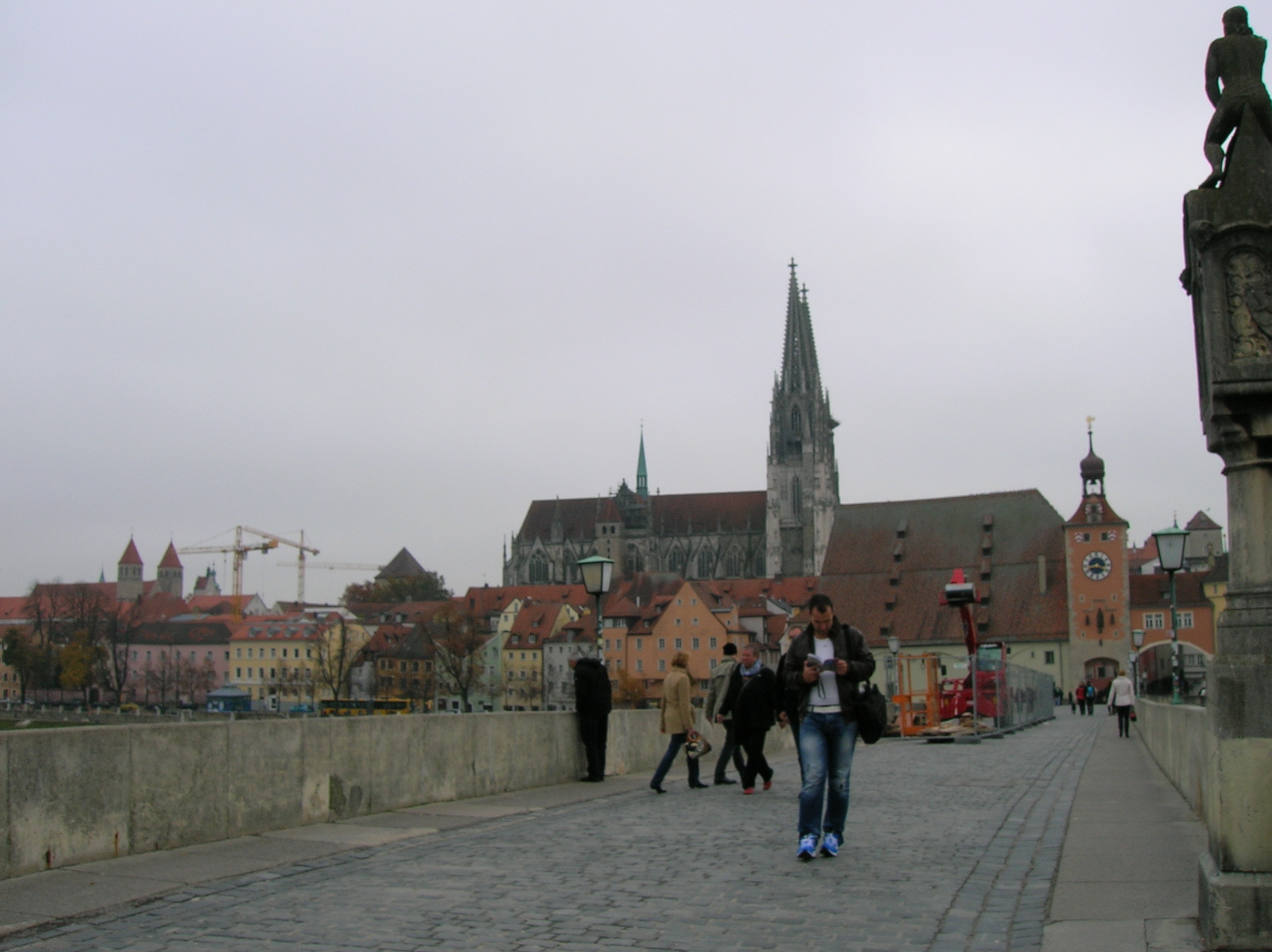
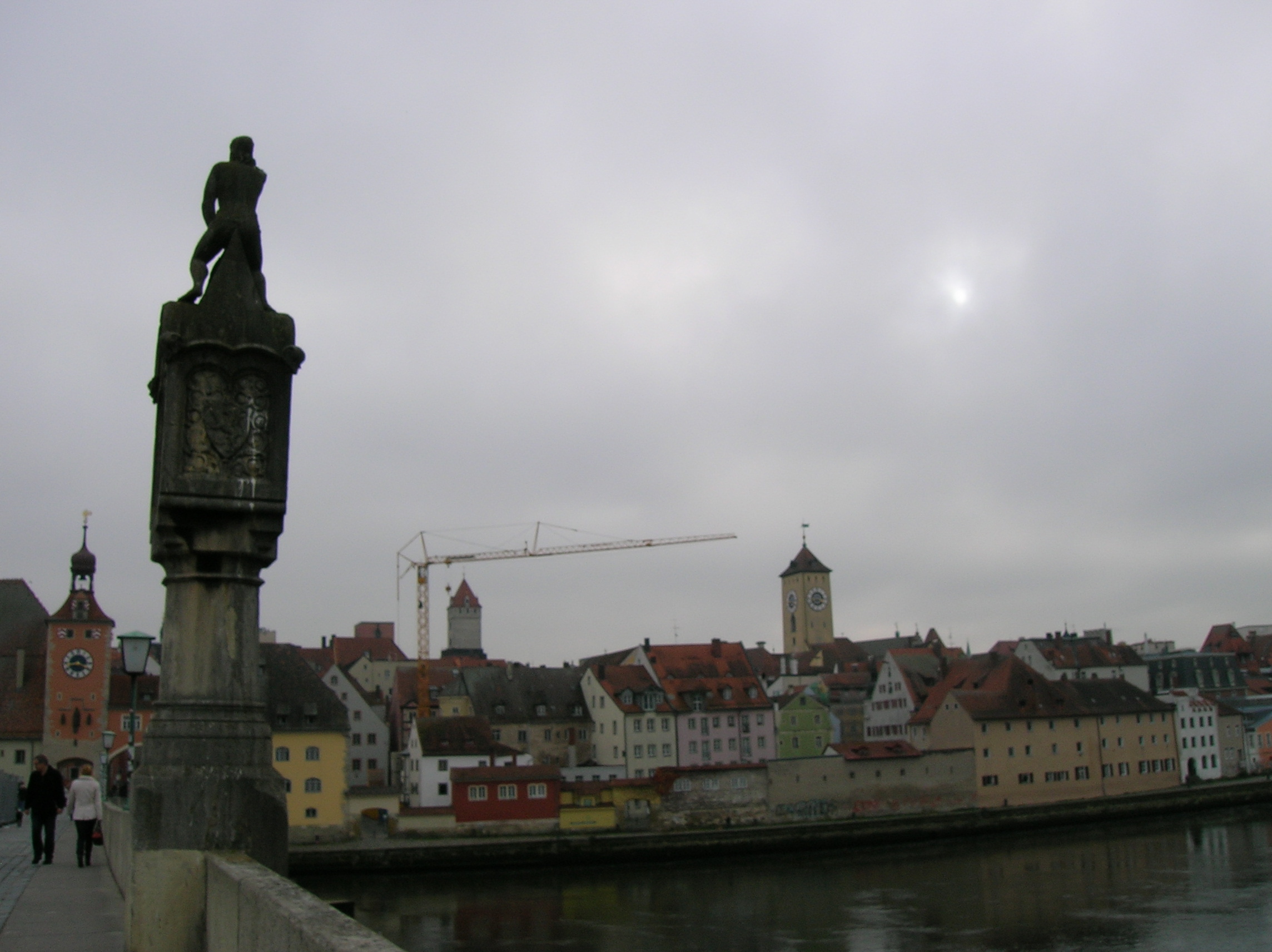
A view of the town from the Stone Bridge

A view of the town from the Stone Bridge


My boss at a languageschool where I had taught had praised Regensburg back in 1997. Ever since then, I had wanted to visit the historic town, but the trip kept being postponed. Then I went on a one-day excursion with arsviva to Bamberg, Germany and got my first taste of the wonders of Bavaria. (I only have faint memories of my visit to Munich when I was nine years old.) I was so enthralled with Bamberg that I just had to explore other towns in Bavaria. So, during October of 2013, the next time I had a few days off work, I took the train to Regensburg.

The direct train only took a little over four hours to get to the only preserved medieval town in Germany. On the train I acquainted myself with the history of this architectural gem. A UNESCO World Heritage site since 2000, Regensburg did not experience much destruction during World War II, enabling it to keep its medieval character. A Roman military camp was located there as far back as 179 AD, and the Romans would greatly influence the town for 300 years. During the Middle Ages, emperors, dukes and kings had frequented the town. After it became a part of the Carolingian Empire, Charlemagne visited Regensburg three times. Regensburg acquired the status of a Free Imperial City in 1245 and also was a bustling trade center. The town lost its independence and became part of the Duchy of Bavaria in 1486, but soon the tables turned again, and Regensburg regained its independence.

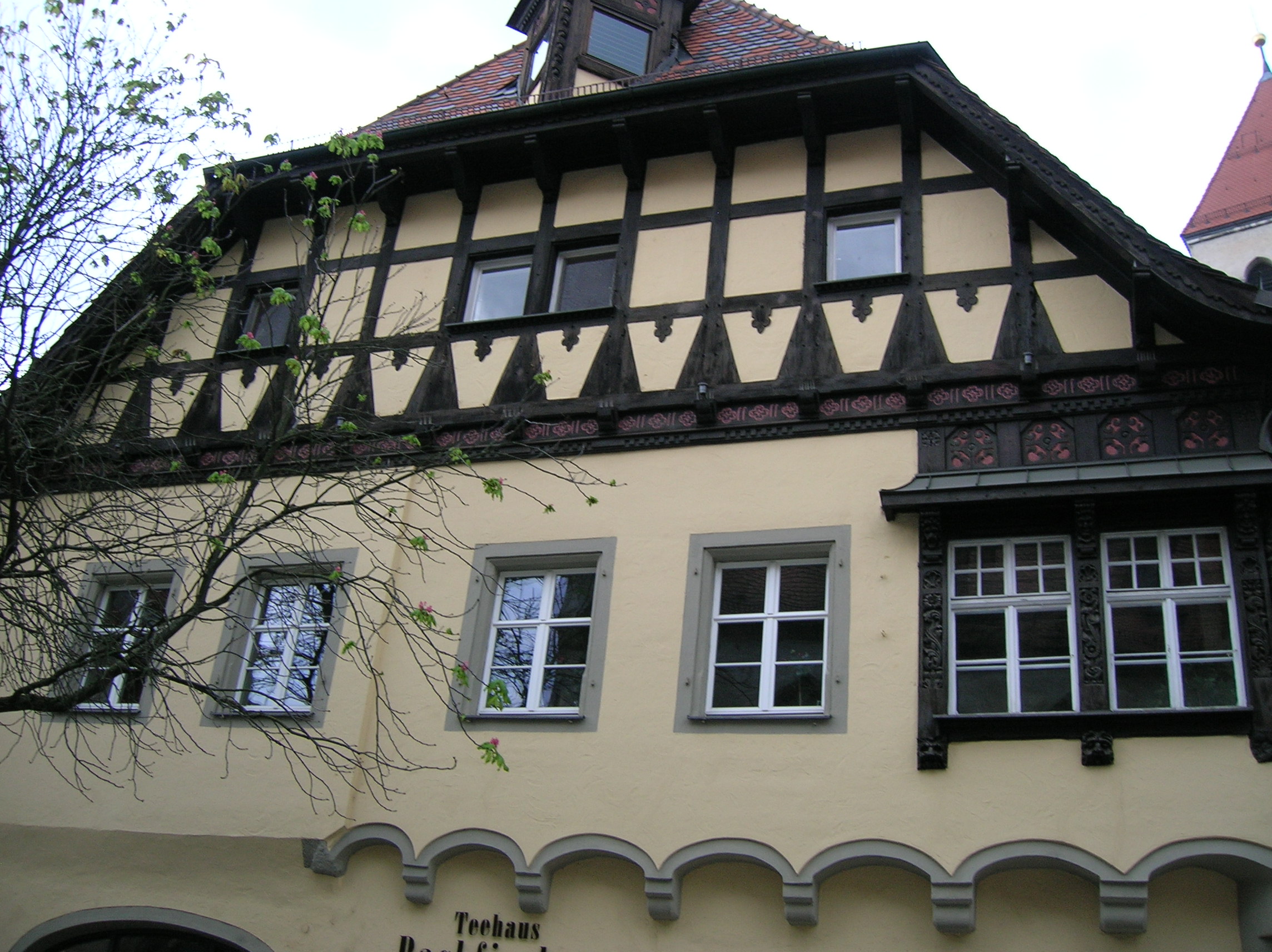
The facade of an architecturally intriguing building in Regensburg

The facade of an architecturally intriguing building in Regensburg

When the Turks overtook Constantinople, this Bavarian city was no longer a gateway to the East, triggering financial hardships. As a result, according to the unwritten law that blamed minorities for economic difficulties, the Jews were expelled in 1519. During 1542 Regensburg became a Protestant town. The town became a household name once again when the Imperial Diet political gatherings took place there for 150 years, from 1663 to 1806, when the assembly of estates held conferences at the Old Town Hall. Electors and princes were among those present for the meetings.

During Napoleon’s reign the town found itself in dire straits. The Imperial Diet was cancelled in 1806, and Regensburg was stripped of its independence once again. In 1810 it became a part of the Kingdom of Bavaria. From 1945 to 1949, the town was the site of the largest displaced persons’ camp in Germany, with mostly Ukrainians in residence. And to think that throughout all those centuries, throughout all those trials and tribulations, Regensburg never lost its medieval flavor!
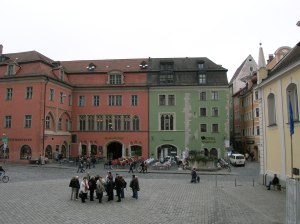
The Hotel Kaiserhof across from the cathedral

The Hotel Kaiserhof across from the cathedral

My hotel, the pistachio-colored Hotel Kaiserhof, was situated across from St. Peter’s Cathedral, a Gothic wonder. The clean, no-frills, comfortable room sported a double bed, even though I was paying for a single room. I had stayed in other singles the size of a closet in various hotels throughout Europe. It was refreshing to find myself in a room that was spacious enough, though not large.

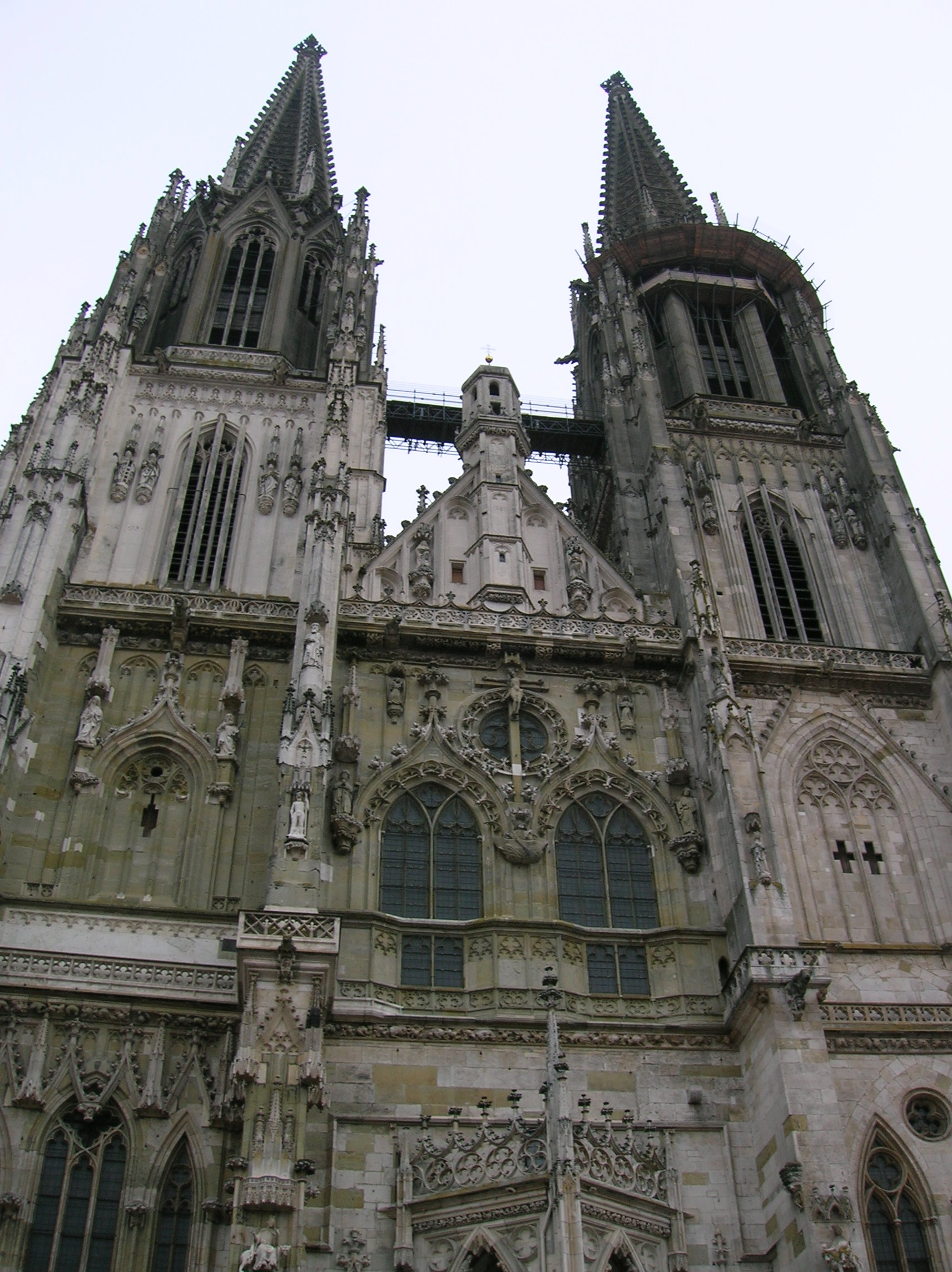
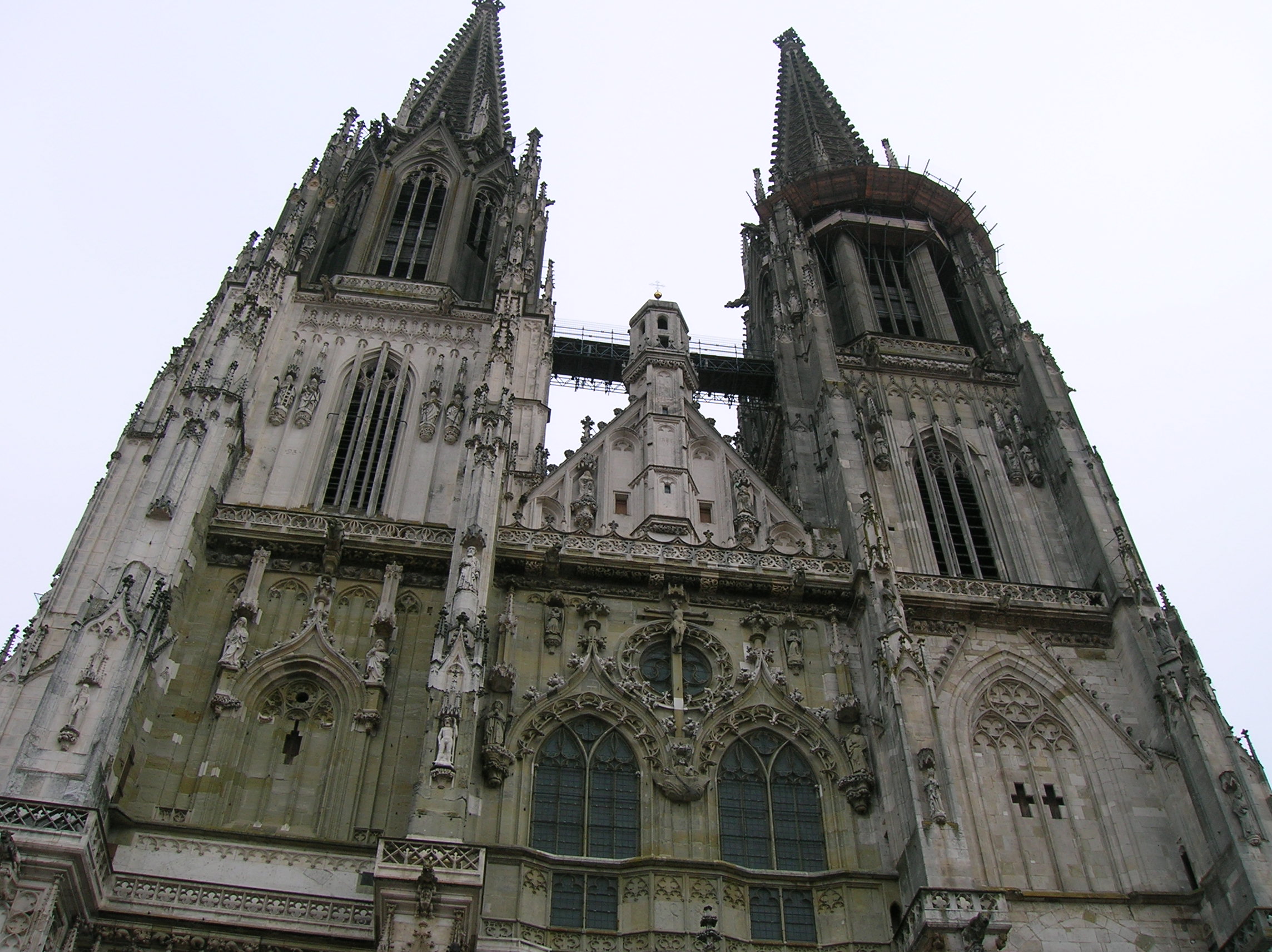
After unpacking the necessities, I headed straight for the St. Peter’s Cathedral. The first cathedral in the town had hailed from the end of the eighth or ninth century, but it fell victim to a fire in 1273. Then this cathedral was erected in a Gothic style inspired by France.  However, there were interruptions, and the cathedral was not completed until 1872, some 600 years later. The west façade boasts two towers while the cathedral has a triple-choir design. The nave is short and has five bays. I had read that the architectural design of the cathedral had influenced Peter Parler’s plans for Prague’s St. Vitus Cathedral, my favorite cathedral in the world.

St. Peter's Cathedral

St. Peter’s Cathedral

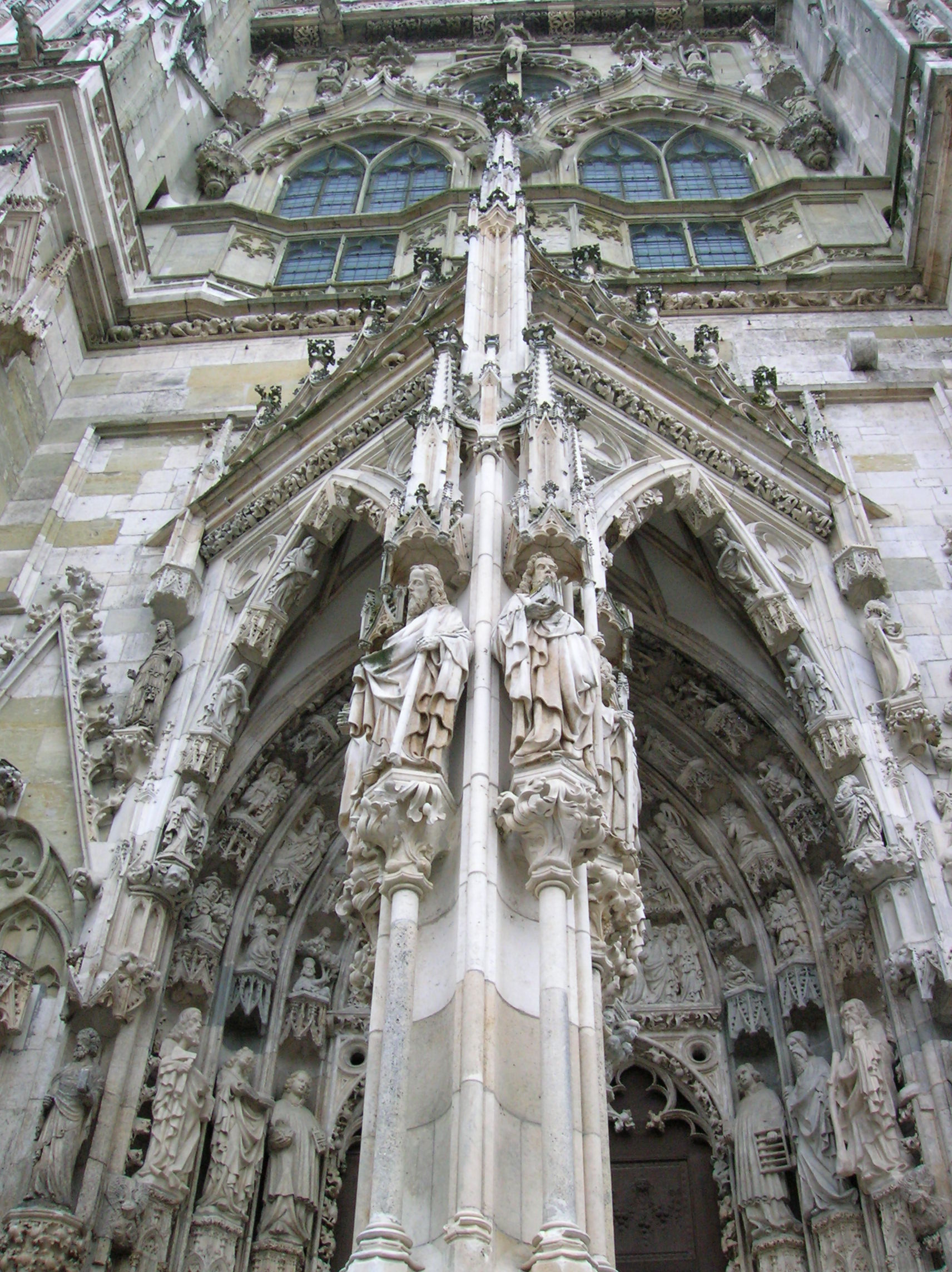
The medieval sculptural decoration on the façade, which dated from around 1400, was breathtaking.  On the train I had learned that this sculptural adornment ranked among the most impressive artistry of the Middle Ages. I gazed up at the main portal with its stunning tympanum and the 22 reliefs focusing on the Virgin Mary’s life.

On the south portal I was awed by a scene showing St. Peter being scooped out of prison by an angel.  I could hardly believe that the relief hailed from 1320. The tympanum of the south façade boasted plentiful rich sculptural ornamentation as well. Reliefs decorated the buttress fronts, too. I spotted St. Peter in a boat, a rendition that I knew appeared on the current coats-of-arms for the cathedral chapter.

However, it made my stomach churn when I saw a sculptural figure of Jews suckling from a pig. I recalled reading that Jews had been expelled from the town in the 16th century. The anti-Semitic artwork reminded me of the anti-Semitic and racist portraits of a Jew, an Arab and a black man stricken with diseases in the library of the Hrádek u Nechanic Chateau in Bohemia. I also recalled eating in a pizzeria in downtown Prague a few years ago, when a waiter told me that Neo-Nazis were marching through the Jewish Town. I also thought of the prejudice against Roma in Czech society today. So many centuries later and religious and racial tolerance were still serious concerns.

The rich ornamentation on the facade of the cathedral

The rich ornamentation on the facade of the cathedral

Upon entering the cathedral, I was instantly transported back to the Middle Ages. It was dark and gloomy except for the light that the stained glass windows let in, giving the cathedral an airy quality. Made from 1300 to 1370, the windows had a mystical aura. I felt as if the light cleansed me spiritually, as if it cleansed my soul. I was so entranced. I could not believe I was looking at original Gothic stained glass. I had read that one window portrayed scenes from Christ’s childhood while another showed scenes from the lives of St. Peter and St. Paul. Pictures of saints decorated the windows, too. Some of the stained glass came from the original cathedral that had burned down. That part was in Romanesque style, dating from 1230.

The vibrant colors inside the cathedral

The vibrant colors inside the cathedral

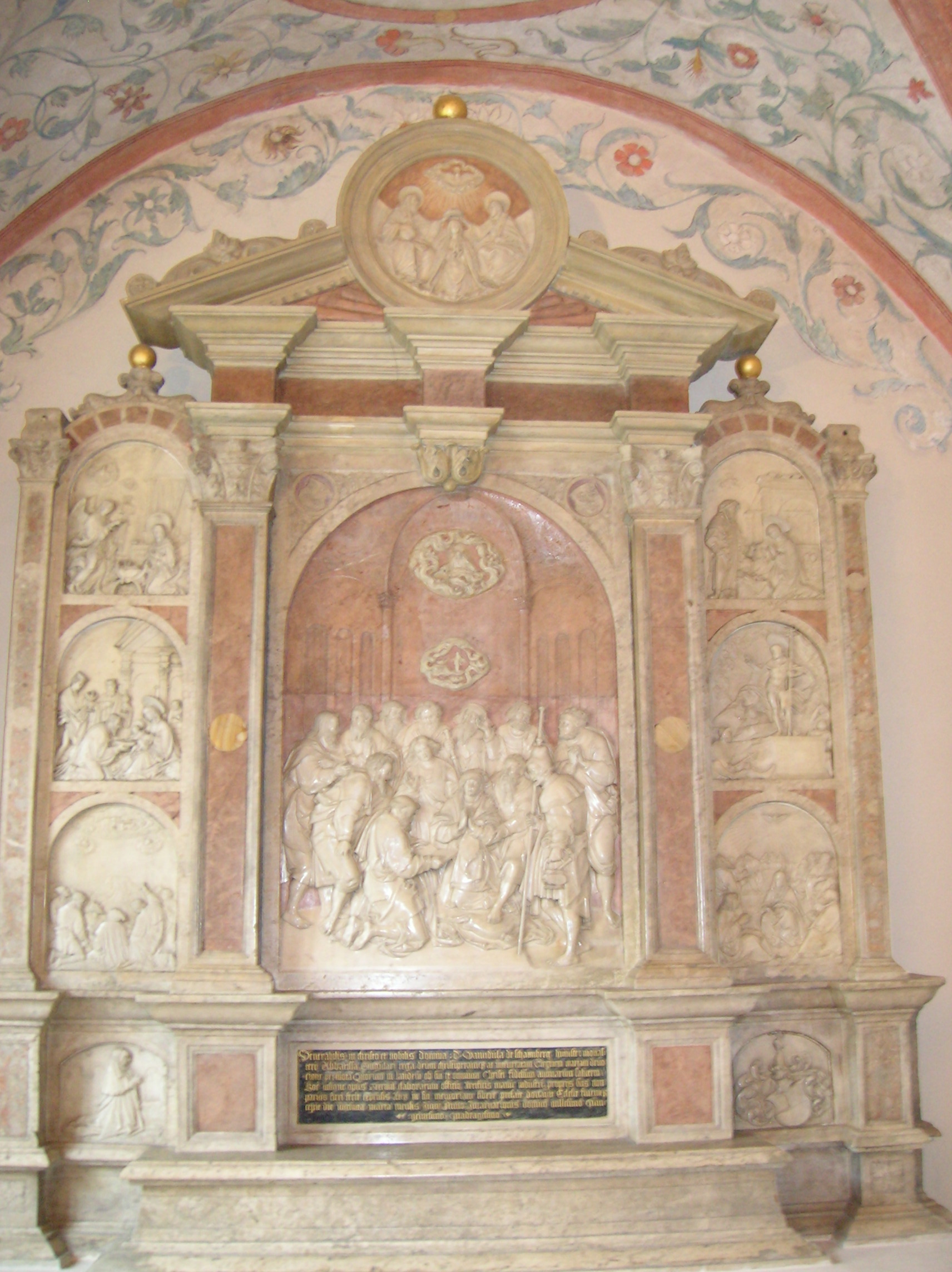
Then I took notice of sculptural figures of St. George and St. Martin on horseback. They were remarkable works of art hailing from the 14th century.  I also saw something I had never seen before – creepy creatures with human heads in niches near the main entrance. Called the Devil and his Grandmother, the figures supposedly kept away any evil spirits that might try to wander inside. Bishops’ tombs also made up the interior. A stone sculpture of a Madonna and Child above one altar was created in 1320. A huge colored wooden crucifix dated from the 16th century. The main altar was silver and was made glorious by busts of St. Mary and St. Joseph as well as Saints Peter and Paul.

On one section there was a relief of St. John of Nepomuk, a Czech saint who was thrown into Prague’s Vltava River from the Charles Bridge on the order of Bohemian King Wenceslas IV, who was married to Joanna of Bavaria. The Queen’s confessor, John of Nepomuk would not tell the king what his wife had said to him in confidence. I thought of the many times I had walked by the five-haloed statue of St. John of Nepomuk on the Charles Bridge. Once again focusing on this cathedral, I was amazed by the ribbed vaulting designed with crossing piers. There was a Late Gothic pulpit, and exquisitely carved Baroque stalls adorned the nave.
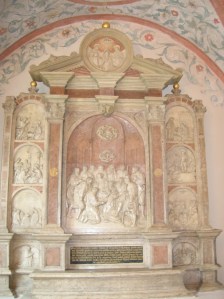
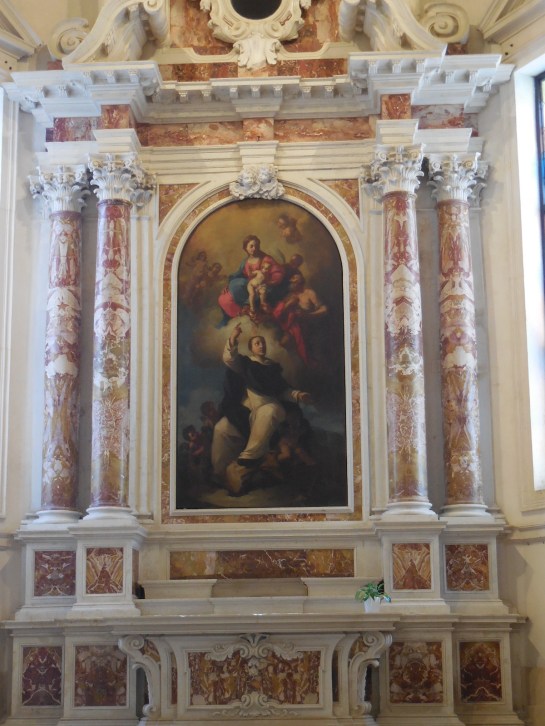
One of the side altars in the cathedral

One of the side altars in the cathedral

Another highlight of the interior for me was the Smiling or Laughing Angel, one of the Annunciation figures. Enthusiastic about bearing exciting news for Mary, the angel was absolutely jubilant, and the sense of pure happiness that emanated from the sculpture made me joyful and thankful for everything I had in life. The joy was characterized by a sense of innocence, and it brought to mind the happy moments of my childhood. Opening Christmas presents in my grandparents’ house as Grandpa pretended to be Santa Claus, striking out batter after batter in Little League baseball, riding my sleigh in the fresh snow near our townhouse, reading Paddington the Bear books over and over, holding my Paddington and Snoopy stuffed animals, receiving an autographed picture from one of my favorite baseball or ice hockey players, hugging my mother and knowing that everything would be okay. I was amazed that a sculptural figure from the late 13th century could depict emotions so poignantly.
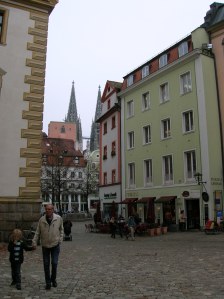
Downtown Regensburg

Downtown Regensburg

Then I walked around the center of the town, admiring the large patrician houses, some even with towers. One building dating from the 14th century even had a fresco of David and Goliath, created from 1570 to 1580. Dating back to the 12th century, the Stone Bridge measures 30 meters in length and includes 15 arches. I tried to imagine knights of the second and third Crusades marching over the bridge on their way to the Holy Land. The views of the river and town from the bridge were incredible. I loved the small street called Kramgasse, next to my hotel. Once home to shops of grocers and junk dealers, now it flaunted luxurious shops. The oriels on the buildings intrigued me. 

There were other delights in this colorful, vibrant town, too. The Fountain of Bishop’s Court was built in 1980 and showed a priest giving a sermon to geese while a fox nabbed one goose by the neck.  In the tale the priest is an impostor, the Devil pretending to be a man of the cloth. It made me think of the false friends I had known through the years, the times I felt betrayed by people I had trusted.

View from the Stone Bridge

View from the Stone Bridge

I explored Neupfarrplatz, where the homes of 500 Jews had once been located until their expulsion in the early 16th century. The homes were gone now, and stylish shops lined the square. A reminder of the Jewish presence in the town, a relief showed the floor plan of a Jewish synagogue that had once stood near the middle of the square. I felt an emotional connection with the relief. It was modern and fresh, yet also represented the lost history of the town.

The Goldener Turm, built from 1250 to 1300, included the highest patrician tower in the city. Part of the Old Town Hall dated from the 13th century and had a tower, too. I was intrigued by its Gothic windows. Patrician houses also lined Haidplatz Square. Emperor Karl V had been a guest at the architecturally captivating Goldenes Kreuz building. I also gazed at the Porta Praetoria Roman gate from 179 AD with its stone arch and side tower. As I walked through the center of town, I was surprised that Regensburg had so many tea shops and bookstores. A teetotaler and a literature addict, I wandered through each one. The varieties of teas offered were astounding.

In the morning I ate croissants in the hotel’s quaint breakfast room and headed for the Collegiate Church of Our Lady of the Alte Kapelle. A farmer’s market was in progress in the square where the church was situated. All the fruit and vegetables looked delicious. 

The interior of the Alte Kapelle

The interior of the Alte Kapelle

I knew the church dated from 875, when a grandson of Charlemagne had it erected. The medieval sculptures decorating the main portal did not prepare me for the strikingly different interior. I gaped at the 18th century Baroque and Rococo ornamentation. This was definitely one of the most beautiful chapels I had ever seen.  It was light and airy, full of vibrant colors that emitted joy and hope. The main painting depicted the Pope handing Holy Roman Emperor Henry (Heinrich) II a picture of the Virgin Mary.  It was only possible to see the two naves and six bays through an iron grille, unfortunately. I longed to walk through the chapel and peer closely at each decoration.
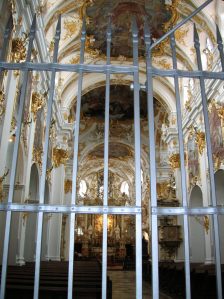
The Alte Kapelle

The Alte Kapelle

The stucco work was astounding, and the white walls were adorned with putti. The frescoes narrated described the legend of how the church came into being. They also celebrated the Virgin Mary as the patron saint of the church and glorified the founders of the church, Emperor Henry II and Empress Cunigunde of Luxembourg. Emperor Henry II had believed in centralized authority and had strongly supported the Catholic Church. Due to his devotion to the Catholic Church, Pope Eugene III canonized him in 1146. He was the only German bestowed this honor. His wife Cunigunde was involved in politics, participating in the Imperial Diets in Regensburg. She is said to have performed miracles, such as walking over flaming irons. One fresco showed the Virgin Mary as the Queen of Heaven, surrounded by angels and saints. The main altar was decorated in rocaille and focused on the Virgin Mary. God the Father was perched on a globe above her, and a dove symbolizing the Holy Ghost also appeared.

It fascinated me that this church retained elements of the Middle Ages and at the same time celebrated the Baroque and Rococo periods with a flourish. I could not get over how the 18th century styles gave the chapel a sort of weightlessness and airiness that so poignantly represented joy and hope for me.  It was uplifting. I was in an ever better mood when I left the chapel, after staring through the grille for at least a half hour.

Next I found my way to the Emmeram Abbey. I would be touring the Thurn und Taxis Palace adjacent to it later in the day. The monastery had gained independence from the bishopric in 975 and did not lose its independence until 1803. Then, at the beginning of the 19th century, the abbey was secularized. The King of Bavaria gave the Thurn und Taxis family the monastery because the postal services that they had managed for centuries had been nationalized. I had read that the stone reliefs on the north portal, dating from the Middle Ages, were the oldest north of the Alps.
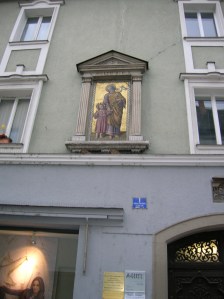
Religious ornamentation on the facade of a building

Religious ornamentation on the facade of a building

The complex was named after the bishop Emmeram, who had lived in Regensburg in the 700s. Inside frescoes told his exciting life story: He had worked as a missionary for Theodo I, the Duke of Bavaria and was much respected throughout the realm. Then the duke’s unwed daughter confided in him that she was pregnant, and she did not want to tell the duke who the father was. Emmeram advised her to lie and say that he was the father. Then he set off on a pilgrimage to Rome.

When the duke’s daughter told her father the news, he had his son and followers chase Emmeram. When they caught the pious missionary, the duke’s followers tied him to a ladder and chopped him into pieces, slowly torturing him. Then the duke found out that Emmeram was not the father of his daughter’s child and ordered his body to be bought back to Regensburg. Emmeram was made a saint.  I also saw fascinating altars and a crypt dating from 780, showing off masterful Romanesque architecture.  The high altar hailed from 1669.

My next stop was the palace. I had to use an audio guide at the palace because the tours were only in German.  I was disappointed that the Electors’ Fountain was covered in scaffolding. I wanted to see the sculpture of Emperor Arnulf bearing a scepter and shield and the eight coats-of-arms standing for the Holy Roman Empire and the seven electors who selected the emperor.
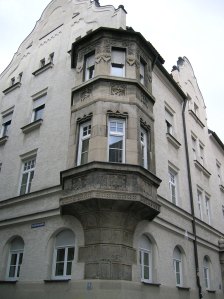
The architecture of Regensburg

The architecture of Regensburg

Upon entering the palace, we came to a monumental marble staircase. The guide spoke animatedly for some minutes before my audio guide started. The German-speaking tourists were enthralled with whatever he was saying. Then we went up one of the 14 marble staircases in the complex that was the largest residential palace in Germany. It included more than 500 rooms. A ceiling  painting looked as if it was about to burst with color above the staircase.

The Thurn und Taxis clan dated back to the 13th century when the family was named Tasso. During the end of the 15th century, Francesco Tasso created the first postal system going from Innsbruck to Brussels. It took a week for the mail to reach its destination. The key to its success was that the rider and horse were changed at each postal station. For his ingenuity, Tasso was given nobility status by Emperor Maximilian I and thus became Franz von Taxis in 1512. By the end of the 18th century, the postal system was flourishing.

Then bad times came. At the beginning of the 19th century, most of the postal service was nationalized. The French Emperor Napoleon Bonaparte put an end to the Thurn und Taxis’ control of the postal service in 1815. After the Napoleonic era, the family managed the postal service once again, but only until Otto von Bismarck became Chancellor of the North Germany Federation in 1867. A very conservative politician and nationalist who did not favor democracy, the prominent Prussian statesman was responsible for forming the German Empire in 1871.

A fascinating facade in downtown Regensburg

A fascinating facade in downtown Regensburg

I was intrigued by the grotesque figures on the ceiling of the Conservatory, also called the Winter Garden. Female figures represented the seasons, though winter was conspicuously absent. I noticed that a sickle and grain stood for summer. The Brussels’ tapestries in the Large Dining Room were astounding. The Throne Room featured a throne from the 18th century and tapestry decoration. The Ballroom took my breath away. Its wall paneling, frames, balustrades and stucco ceilings boasted Rococo and Neo-Rococo styles. Faience Neo-Rococo stoves were present, too. The Ballroom, created in 1730, had been transported from Frankfurt to Regensburg in 1890, when the Thurn und Taxis clan moved to Regensburg. Even the glass chandeliers had been equipped with electric lighting at the end of the 19th century. I liked the idyllic landscape paintings hung high on the walls and the rich white decoration that included garlands and putti as well as plant and ribbon motifs.

I noticed a portrait of Elizabeth of Austria, often called Sisi, in the Balcony Room. Because her sister Helene was married to Crown Prince Maximilian Anton von Thurn und Taxis, she had often stayed here. The sisters’ father had been a Bavarian Duke while their mother was the daughter of the Bavarian King. I had read how uncomfortable Sisi had felt around the ceremony of royal life and how she had been a free spirit who had traveled around the world. I thought about Franz Joseph intending to propose to Helene but changing his mind and asking for Sisi’s hand in marriage instead. And I thought of Sisi’s assassination in Geneva, when an Italian anarchist stabbed her while she was taking a walk. And I remembered reading about the lavish funeral with all the pomp and ceremony that she had despised.

The gate to the Stone Bridge

The gate to the Stone Bridge

The Silver Room featured a silver chandelier with cupids holding candles. The tapestry with a battle theme in the Gobelin Salon got my attention as well. The Yellow Salon exploded with color. It was decorated in Rococo style and dated from about 1740.  I tried to imagine members of the noble family playing music here, the tinkling of piano keys or rich melody of a clarinet. I was happy whenever I saw yellow because it was my Mom’s favorite color and the color of the kitchen walls in my parents’ house. I recalled all the earnest conversations I had with my Mom, seated at that circular kitchen table, sipping green or black tea.

The Green Salon had served as a bedroom for Princess Therese from 1812. I was mesmerized by the bed decorated with four swan figures on its legs. I loved the detail of the feathers and long necks of the swans. A curtain was adorned with gold bees. Both the swans and bees were characteristics of the French style that dominated this room. In the Czar Nikolaus Salon a portrait of Princess Theresa von Thurn und Taxis showed the 37-year old clad in a chemise dress and wearing pearls in front of a forest. I noticed an exquisite blue with gold tea set in another room.

Then we came to a contemporary art exhibition of portraits of the living family. The portraits of four women and one young man had blinking eyes. I thought it was a good idea to put portraits of the current family in the exposition, but I did not understand why their eyes were blinking. I guess it was meant to emphasize that they were living, that the tradition of the family continued, but it seemed out-of-place with the décor of the other rooms. Then I saw the House Chapel that had once been a bedroom for Crown Princess Helene. After the Princess’ death in 1890, her son Prince Albert I had it reconstructed into a chapel. The alloyed coats-of-arms decorating the windows impressed me.
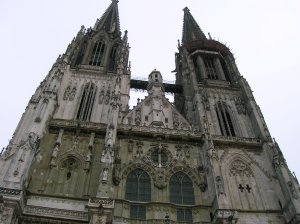
Regensburg's cathedral dominates the skyline.

Regensburg’s cathedral dominates the skyline.

Next we entered part of the cloister. I imagined monks walking through the round Romanesque arches while singing hymns. I saw statues dating back to 1200. I imagined how the room had looked in the Middle Ages with its then colorful decoration depicting biblical stories. I admired a Neo-Gothic tomb chapel as well. Another wing featured high and thin Gothic arches. The cloisters were certainly full of architectural wonders!

After touring the palace, I visited its museum. I saw a Japanese lacquered cabinet from 1690 and took special notice of the exquisite Asian landscape scenes on the front. White gold porcelain featured floral motifs. A ceremonial carrying chair also caught my attention. Medals from the chivalry Order of the Golden Fleece that was founded in 1430 and 55 richly decorated 18th century snuff boxes also made up the exhibition. One room was decorated with Biedermeier furniture, dating from 1815 to 1848. The furniture was not positioned against the walls in order to encourage communication. The highlight, though, was the white with gold porcelain service set from the early 1700s, made by a Viennese manufacturer that had only been in existence for 30 years. It was the only complete service of this manufacturer in the world.
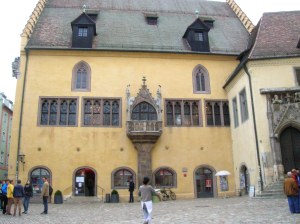
The Old Town Hall

The Old Town Hall

I had a late lunch at an otherwise empty café near the monastery. It was decorated plainly and appeared to be a place for locals as the menu of five entrees was written only in German. I imagined that the restaurant would be packed on weekdays. I chose the Wiener Schnitzel and received a generous portion. It was delicious. I had dessert at the oldest coffeehouse in Germany, the Café Prinzess, where I managed to find a free table despite the crowd. I ordered almond cake and green tea. Surprisingly, service was not slow. The cake and the green tea were excellent.

Soon it was time for the English tour of the Old Town Hall across the street from the coffeehouse. I got a free ticket because I have a press pass and would be writing about the exhibition. However, only the torture chambers in the cellar were open that day. The lavish rooms once used for the Imperial Diet were closed for a conference. Two tourists complained that they had to pay full price for their tickets, even though the Imperial rooms were off limits that day. They decided to come back the following day when both parts of the tour would be open. I was leaving the next day, so I had no chance of seeing the Imperial rooms on this trip.

For almost 150 years from the 17th to the beginning of the 19th centuries, the Imperial Assembly had held political meetings in this building. But the Imperial history of the town was above, in those lavish rooms that I could not see. I descended into the torture chamber, which helped paint a portrait of the history of the town. I peered down at a dungeon that was three meters deep with no light. A Jewish gravestone served as the toilet seat, another reminder of the rampant anti-Semitism that had riddled the town. Once again, I recalled the 1519 expulsion of the Jews.

An ancient door at the Old Town Hall

An ancient door at the Old Town Hall

I also saw a so-called spiked rabbit, consisting of spikes on a wooden chair. I could not imagine the pain a person would feel seated on those spikes. It was too awful to think about. Some prisoners were locked in a neck iron, exposed to the public in a pillory. I also saw a timber cell without any light.  Prisoners sentenced to death stayed in the Dead Man’s Cell, where there was light and fresh air. An opening allowed family members to touch the incarcerated’s hands before the execution. A big beam balance from the 16th century kept the merchants honest. If merchants cheated customers, they went to the pillory.

The instruments had been used from 1530 to 1781, during three centuries. It was difficult for me to imagine that such horrific methods had been used for such a long time. Then again, in in today’s world there is waterboarding. When the accused was detained, he or she might have heard a concert taking place in one of the Imperial rooms above, but the prisoners were never tortured to musical accompaniment.  
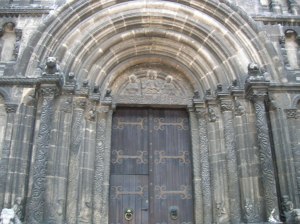
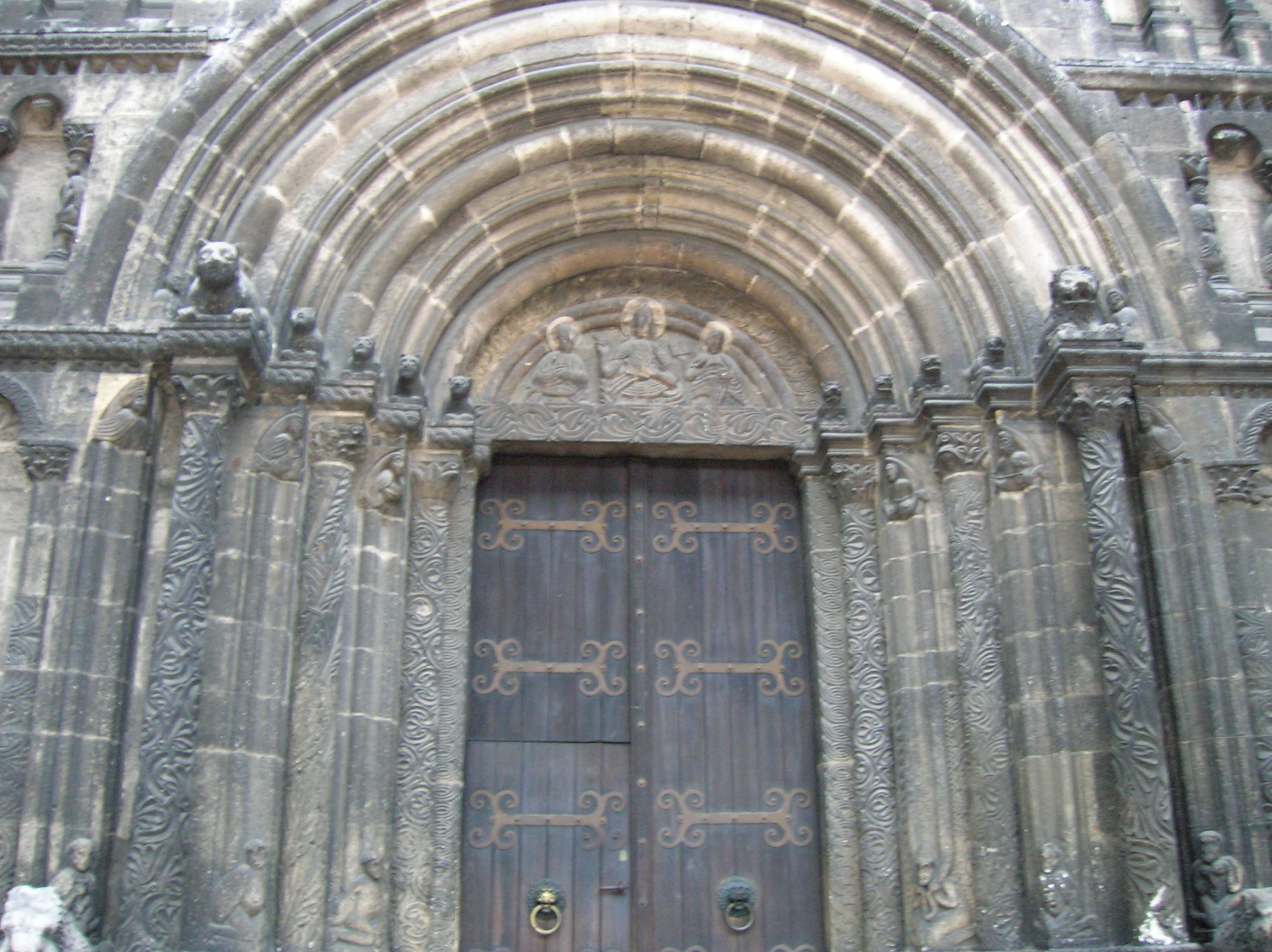
The Romanesque portal at St. James' Church

The Romanesque portal at St. James’ Church

I walked around town for the rest of the day, the history of the town seeping into my soul. The next morning I had a little time before I headed to the train station. I was disappointed that I did not have a chance to visit any of the museums, especially the Historic Museum that told the tales of the town from as far back as Roman times.

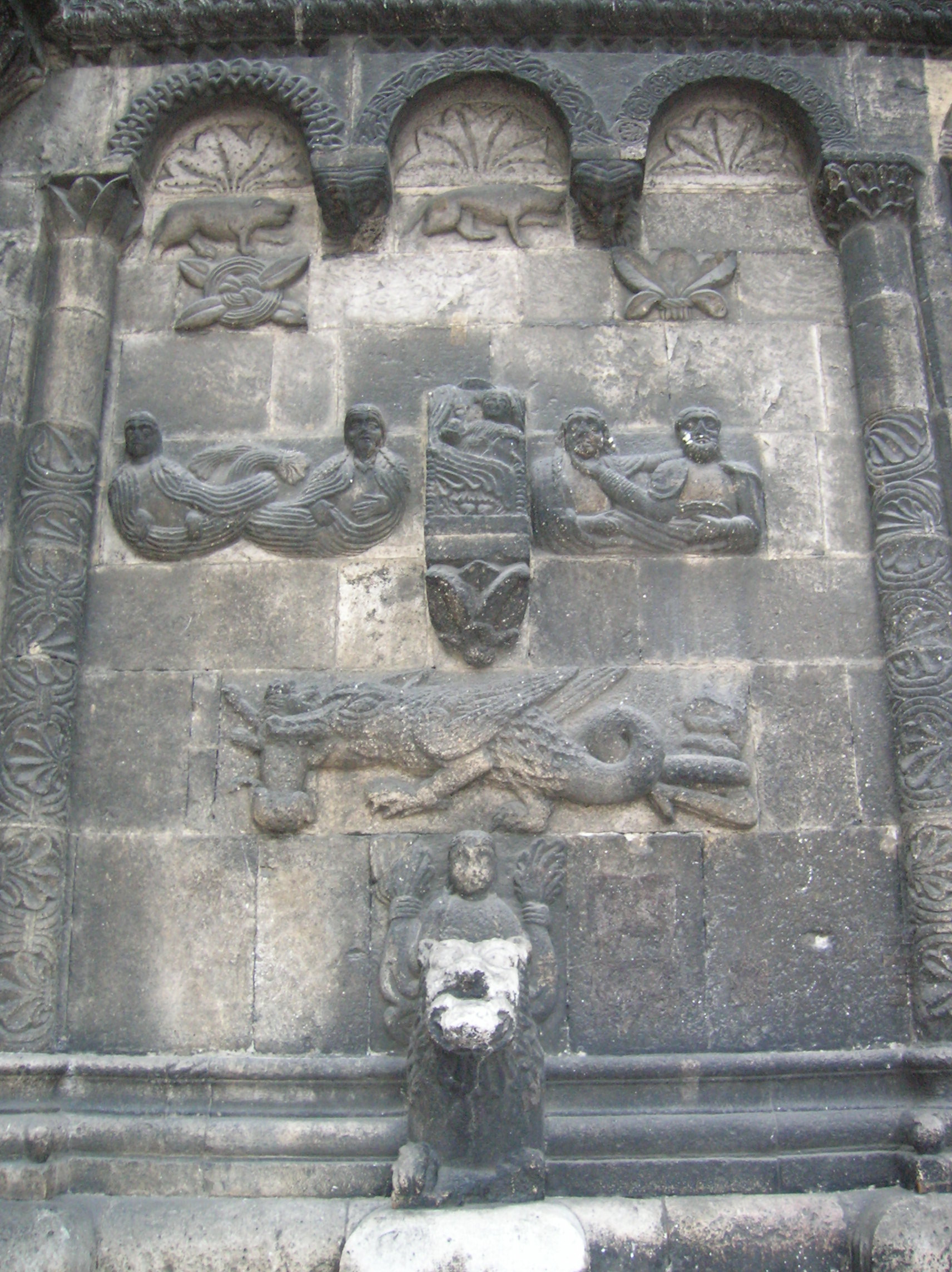
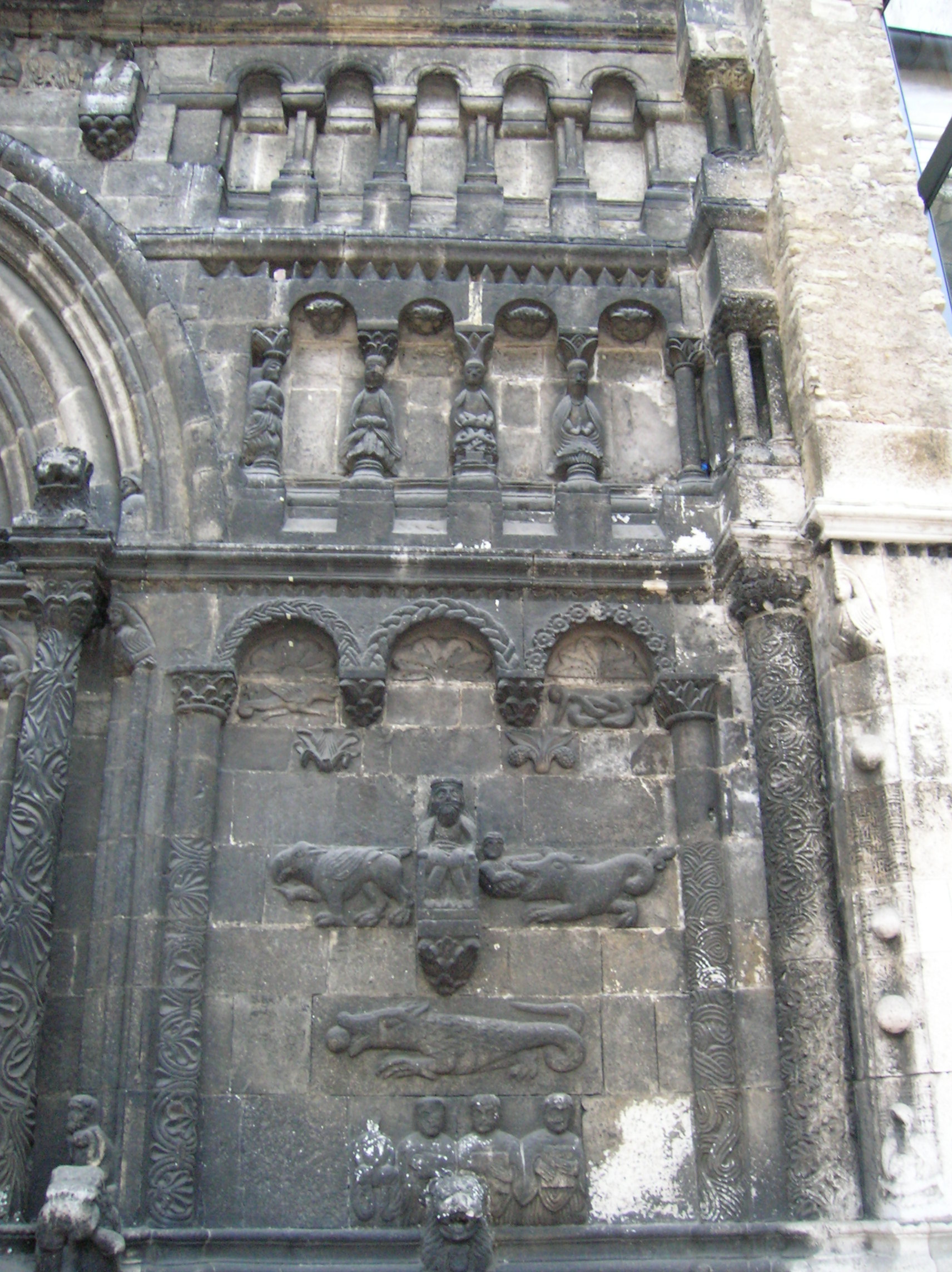
First I walked to the Church of St. James, which was built by Scottish monks in 1150. The church still retained its Romanesque style. The entrance portal was pure Romanesque, richly decorated with sculptural figures and grotesque symbols. The architectural gem was encased in glass, so there was a physical barrier between the viewer and the object. I could understand the need to protect such an ancient treasure, but the glass barrier restricted the visual communication with the viewer. I gaped at the entrance portal for about a half hour. The interior was austere but beautiful.

Next, I headed for Dachauplatz, trying to find the remnants of the Roman wall as they were marked on my map. A small section of the wall that did not even come up to my knees disappeared into a parking garage. Modernization had destroyed some of the historical roots of the town, replacing significant reminders of the past with an eyesore common in the contemporary world. I was very disappointed that a car park had been built in the historical center of the town, marring the cityscape. I had read that in the past a monastery had been on the premises.

The decoration on the Romanesque portal

The decoration on the Romanesque portal

As I had made my way to Dachauplatz, I had taken note of all the various architectural styles of the buildings and the artwork adorning the facades. Standing on the square, facing the Historic Museum, I tried to imagine what it would have been like to have been present in 1945, near the end of the war. Residents had taken part in a demonstration, eager for the Americans to take over the city. Some protestors were executed in that same square.

Soon it was time to take the train back to Prague. I yearned to visit the town again and to get to know Bavaria even better. On the train a pleasant surprise awaited me. I began chatting with the woman seated across from me, an American world traveler in her sixties on her way to Prague. It turned out that she also loved reading mysteries and adored cats. As we discussed many topics, I realized that the best thing about traveling is the people you meet on the way to your destination. We would keep in touch, for sure.

I returned to Prague, elated, ready to face the long winter ahead with energy and enthusiasm and ready to plan a spring trip back to Bavaria.

Tracy A. Burns is a writer, proofreader and editor in Prague.


Another look at the Romanesque portal of St. James' Church

Another look at the Romanesque portal of St. James’ Church
Manětín Chateau Diary


Image

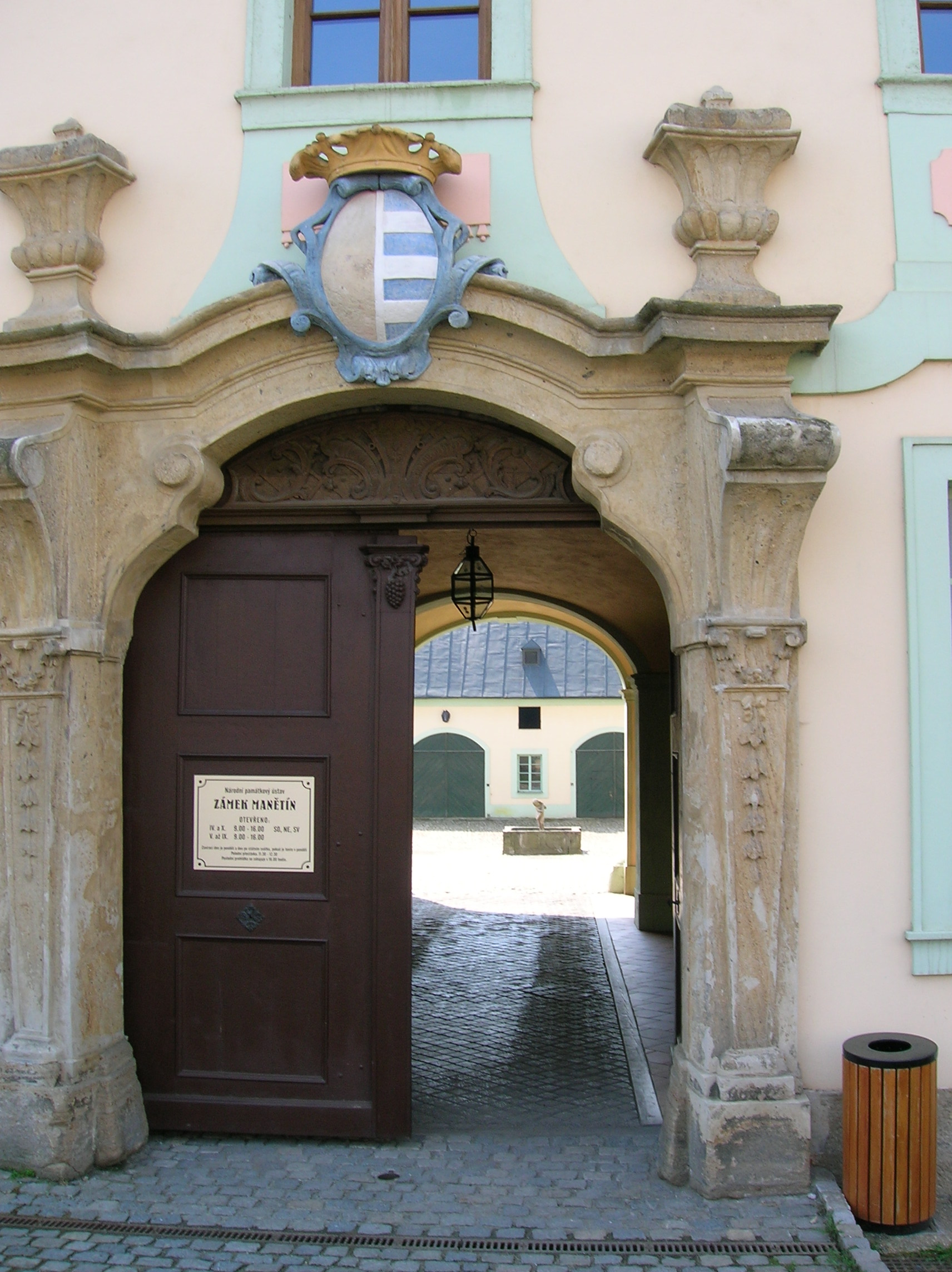
I had wanted to visit the Baroque chateau Manětín, about 45 minutes from Plzeň by car in Western Bohemia, for many years, but for some reason I had been under the impression that it was closed to the public. Only while I was at Chyše Chateau did I find out that Manětín had been open to the public since 1997. Today I would finally see it with my own eyes. I was very excited about the trip. I had to go by car as there was no public transportation that went to Manětín. We drove through the bewitching countryside and passed many haystack-dotted fields.

Manetin1

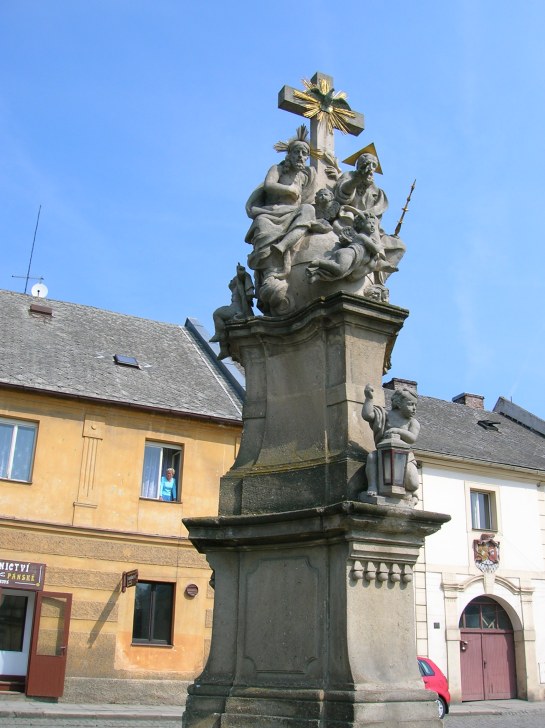
When I arrived at Manětín, I was bewitched by the Baroque statues and a sculptural grouping of the Holy Trinity in front of the main square. A road led down to the Baroque chateau itself, situated behind the statues. At the small white church next to the chateau a group of six or seven musicians were playing funereal music on trumpets. People dressed in black walked solemnly into the church.

Image

It was almost 10 am, and my tour began at the top of the hour. I had a few minutes to pop into the park. The Baroque and English park looked elegant and well-kept, very different than it must have looked between 1945 and the 1990s, when it was in a decrepit state. It had been restored in the 1990s to appear like it had during 1790.

Manetinext4

Then it was time for the tour. The knowledgeable young man acquainted me with the history of the chateau that had been first mentioned in 1169. The chateau that had begun as a medieval fortress had been transformed into Renaissance style before 1600. After a devastating fire in 1712, it was reconstructed with a Baroque appearance thanks to the then owner, Marie Gabriela Lažanská.

Manetinext3

The chateau had been confiscated several times.  Volf Krajíř z Krajku owned the place from 1544 to 1547, when it was confiscated because he had rebelled against Holy Roman Emperor Ferdinand I.  Following The Battle of White Mountain in 1620, which pitted the Protestant nobles against the Emperor and Catholic Habsburgs, the defeated nobles lost their property. The chateau was confiscated for the second time in 1622.

ImageThat was when Ester Mitrovská from Nemyšle, born Lažanská from Bukova, bought the chateau. When she died, the chateau came into the hands of her brother, Ferdinand Rudolf Lažanský. The Lažanský family would keep the chateau for more than 300 years. Times of cultural prosperity followed, especially when Václav Josef Lažanský and Marie Gabriela Lažanská manned the chateau.

Manetinext9


After World War II, though, the chateau was confiscated for the third time, becoming the property of the state because two Lažanská women in charge of the chateau had married two Austrian brothers.  Thus, the chateau had been in part the property of the Austrian family. Due to the Beneš decrees that took away property from Germans and even expelled them from the country, Terezie Lažanská, one of the women who had married an Austrian, was deported to Austria. Some rooms were open to the public as early as 1959, and the chateau became a national monument in 2002.

Manetinint4Manetinint5

Upon entering the hallway, I was enthralled by the sculptures dotting the staircase as well as the ceiling fresco.  The four statues with putti on the staircase represented the four elements. One cherub was holding a fish, representing water. Another was depicted with a cannonball and decked in an old-fashioned fireman’s helmet that looked more like military headgear. This was Fire. Earth was portrayed by a cherub with a melon and snake, and Air was depicted by a putti flying on a bird. I could almost imagine the cherub whizzing through the cold, damp chateau air on the big bird.

Manetinint3Manetinint2

A portrayal of what the chateau was supposed to look like in the 18th century took centerstage in the ceiling fresco. Allegories of architecture and painting also adorned the fresco as did the coat-of-arms of Marie Gabriela Lažanská, perhaps the most influential of the Lažanský owners. (The guide mentioned that Marie Gabriela had been addicted to card playing. In fact, more than once she had put the chateau at stake when she had made her bet.)

Manetinint6

In the Reception Room there were four paintings depicting soldiers during the Thirty Years’ War, which lasted from 1618 to 1648 and started due to religious disputes. One held a spear, another a sword. The oldest piece of furniture in the chateau stood in this room as well; it was a 1640 bureau, dating from the Thirty Years’ War as well. I paid particular attention to the elegant, brown fireplace and gold with black clock and vases, all in lavish Rococo style. I liked the gold with black décor.

Manetinint7Manetinint8

The portrait of the young woman depicted in black was Terezie, who was killed in a hunting accident when she was 21 years old. (Note that this is a different Terezie than the one who was deported to Austria.) But perhaps it hadn’t been an accident at all, the guide conceded. Some say she was killed on purpose so she could not get married. Supposedly, her lover hated the man to whom she was engaged.

Manetinint12Manetinint13

In a corner of the next room, a window was painted onto the wall. The guide explained that there had been originally a window there, but it had been filled when new rooms had been added in the 19th century. An 18th century chaise lounge, a Venetian mirror made in Morano and a group of white, Viennese porcelain also adorned the room. On the ceiling there was a small fresco of part of a boat, dating from the first part of the 18th century; most of the fresco had been destroyed, though. I tried to imagine what it would have looked like if the entire fresco had been visible. A port with boats and nobility strolling along an embankment on a crisp afternoon? I wondered.

I loved the way the porcelain cups were displayed on small black shelves set at different levels on the wall. In a round portrait Marie Gabriela, clad in a silver dress, appeared strong-willed and somber with a no-nonsense expression. A light wood, Baroque desk hailed from the 18th century while the tapestry covering one wall showed a scene from the Old Testament with Moses. The two dressers, both green with floral patterns, were intriguing, for their irregular, curving shapes and color. A view of Venice was painted on each one. I recognized the Doges Palace on one and thought back to the thrilling time I toured the palace during my first day in that magical city.

Manetinint14

The next hallway was decorated with green pictures of castles, chateaus and various places – the pictures had been cut out of magazines. I recognized the chateau of Blatná, as two people rowed a small boat around it. Another scene showed woods in Karlovy Vary. Still others showed the castles Orlík, Točník and Žebrák. Then we came to a room with a hunting theme. Nineteenth century guns, petrified hawks and a woodpecker made up the décor. The Baroque desk, closet and dresser looked out of place.

Manetinint20

In the room where the nobility had gathered, the paintings on the wall showed boats at sea and hailed from 18th century Holland. A black Baroque table and bureau from the same era also adorned the room. The glass chandelier caught my attention.  It was exquisite. Made in Venice’s Morano, the chandelier was decorated with glass flower buds that looked almost as if they were icicles taking on decorative shapes. There was also an Italian mirror with a simple, gold frame.

Manetinint19

Decorating another hallway were more green pictures of castles, chateaus and places. I saw Plzeň, a major city now, as a 19th century village and Roundice nad Labem before its chateau had become dilapidated. A room with a horses’ theme was decked with small paintings of horses, a clock with four, white columns, a desk with cards and a German newspaper dated 1859.

Manetinint21

Then we came to a room with unique paintings on the walls. They did not depict the nobility, but instead the servants and clerks who had worked at the chateau. A rarity in chateaus, this collection included 13 portraits from 1716 to 1717 hanging in several rooms and in a hallway. They were painted by Václav Dvořák, whose life remains mostly a mystery. All the people portrayed in this room were dressed in black. Two carriage drivers next to a carriage wore tall, fluffy hats with big feathers. In one portrait a solemn-looking priest stared back at me. He had written a chronicle of Manětín in three languages, the guide said.

Manetinint22

Objects in the next room proved to be rarities as well. The space boasted a complete collection of porcelain, plates with tea and coffee service sporting white with brown decoration. It was not often that a chateau had a complete collection; usually there were only pieces of a collection featured.  In the former Billiards’ Room, there was no table, but there were more paintings of servants and clerks. Three men donning large, white wigs gazed at me. There were also portraits of a doctor, the chateau’s caretaker and the priest who was also a historian. An elderly woman held keys in one hand; she was responsible for the keys to the chateau and to the food storage rooms. The yellow tile stove with squiggly brown vertical lines appealed to me. A small device that functioned as a bell was there, too.

Manetinint26Manetinint28

The biggest room was now used for weddings and concerts. The 1730 ceiling fresco boasted its original, vibrant colors and portrayed three figures showing God’s qualities in the center. I spotted the one in red with the heart as Love. The female clad in blue represented Strength. The third portrayed a girl pouring water from a jug onto a coat-of-arms. This was symbolic of Luck or Fortune. In the corners of the ceiling, the painted figures represented the four seasons.  Fall showed a naked girl with grapes and Bacchus, the god of wine. Summer was represented by a girl donning a big, straw hat and weilding a sickle as well as a woman holding a parasol. Spring: One girl was pouring water while another was holding a parrot.

Manetinint30

Winter had two symbols. One was Death as an angel, but there was also a woman in a black mask to depict winter as a time of social gatherings and parties. When I went back to the chateau in 2020, the black mask triggered thoughts of the coronavirus pandemic as cases were increasing in the Czech Republic. In America, where my octogenarian parents lived, the situation was horrendous with over 1,000 dying every day. In the Czech Republic we didn’t have to wear masks anymore, though I still did because I wanted to be as careful as possible. I had spent the first three weeks of lockdown in my apartment, afraid to go out, before I started taking walks and calming down. Thoughts of the coronavirus and my parents’ and friends’ health often kept me up at night.

Manetinint32

Mythological events were also portrayed on the ceiling. I spotted Poseidon and a falling Icarus. There were two portraits of the Lažanský family in this room as well. One showed Marie Gabriela and her daughter along with a black servant. In the portrait of her husband with their sons, the painter put himself in the work, holding a palette and brushes.

Manetinint31Manetinint40

 Painted Baroque statues flanked the doorway that led to the magnificent library, which held 5,000 books, many with golden spines.  Most were in German and dealt with economy, but books by Johann Wolfgang von Goethe and Johann Christoph Friedrich von Schiller also graced the shelves. There were also books in English, Italian and French, for example. Only two books in Czech were in the collection, and both described how to make beer. Topics of other books included fishing, fruit growing, history and theatre. There was even a Turkish textbook. Above me was a fresco of Zeus and his daughter Pallas Athena, the goddess of war. The ceiling had been reconstructed in the 20th century due to a fire that had erupted because a tile stove had not been closed properly.

I found the remaining two portraits of servants in the hallway. One showed a cook and woman washing dishes in the chateau kitchen. Another showed a woman pouring water into a basin. Since there was no hot or cold water back then, the water had to be boiled in the kitchen, the guide explained. The woman pouring the water was decked in a traditional folk costume.

Manetinint45Manetinint44

We saw the chapel from the oratory behind glass. The main altar painting was by Baroque master Petr Brandl, my favorite Baroque artist. He also created two paintings on side altars. Brandl actually came to the chateau to paint the works during 1716.

Manetinint42Manetinint41

After the intriguing tour I went outside to take photos of some of the 30 Baroque statues that sprinkled the town and hailed from 1680 to 1780. I still could not enter the Baroque church next door. A simple, wooden coffin was placed in a black van, followed by a procession of people dressed in black, along with two decked in purple and white robes. I did not see the Church of Saint Barbara, either, though I later read it was Baroque in style and featured eight wooden statues of saints.
The St. John the Baptist statue, now situated at a church, had suffered much turmoil. It originally stood in front of an administrative building. Then it was placed on a small bridge. In 1944 it was severely damaged by the Nazis. Then children did more damage to the statue. After the Russians came in 1945, it was tied to a telephone pole. In 1954 it was moved to its current location.

Manetinstatue3

I went to the chateau restaurant and had my favorite excursion lunch of chicken with peaches and Cola light. Then I got back in the taxi and headed for the smallest town in Europe called Rabštejn nad Střelou, situated only nine kilometers away.
Manetinext6

Tracy A. Burns is a writer, editor and proofreader in Prague.