Zlatá Koruna Monastery


Image

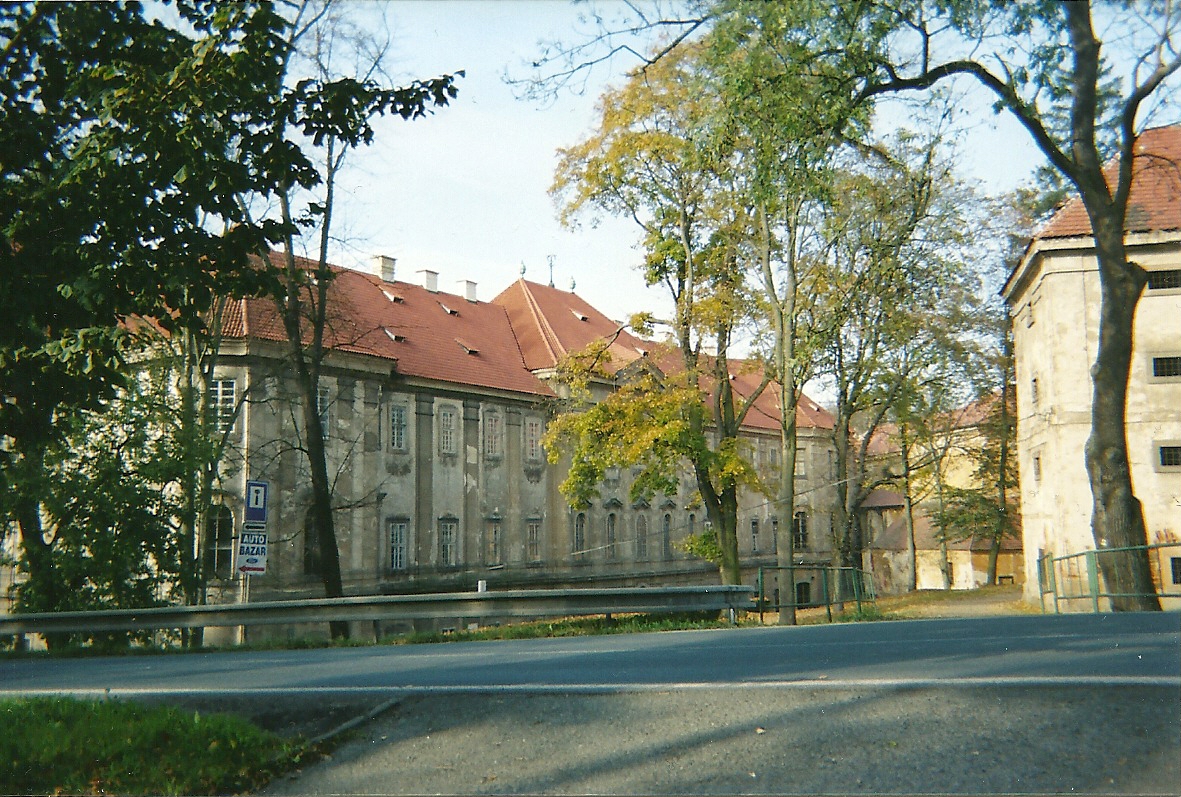
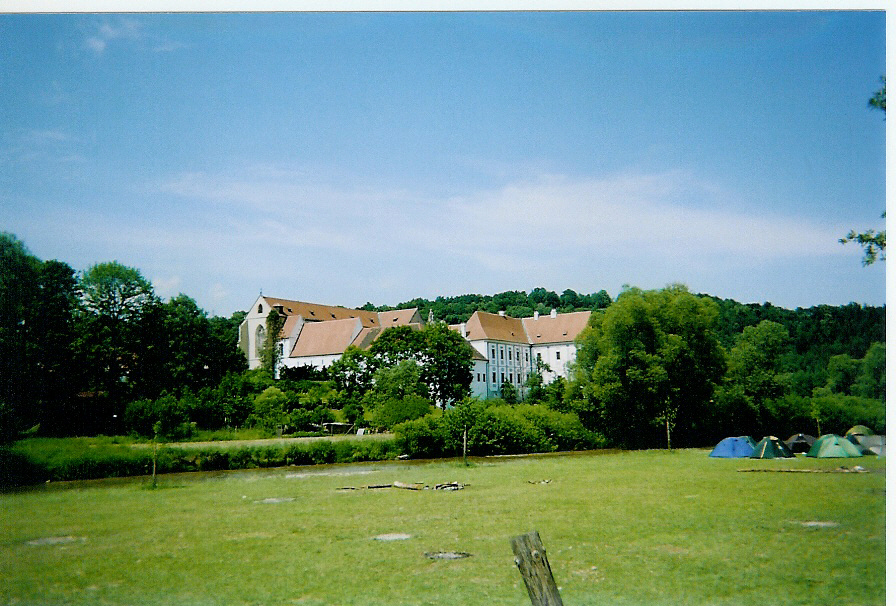
I traveled by a very comfortable train to the monastery of Zlatá Koruna (“The Golden Crown”) one summer morning. When I got off the train, I almost panicked. I was in the middle of nowhere. Soon, though, I got my bearings, found the village and made my way to my destination. The monastery is situated only six kilometers from the historical, romantic town of Český Krumlov, in a picturesque setting next to the Vltava River.

The monastery of Zlatá Koruna was founded by King Otakar II of the Přemyslid dynasty in 1263 for the Cistercian Order. Legend has it that King Otakar II promised to establish a monastery and dedicate it to the Virgin Mary if he won the Battle of Kressenbrunn in 1260. Though burned down by the Hussites during the Hussite Wars in 1420, the monastery was reconstructed in the 17th and 18th centuries. Zlatá Koruna suffered again, though, when, at the end of the 18th century and the beginning of the 19th century, it housed various factories.

It looks nothing like a factory now, I thought to myself as the tour of the three-aisled basilica, big and small convent buildings and chapel began.

The elaborate Rococo stucco décor and exquisite Rococo wall paintings throughout the monastery astounded me. I was impressed by the refectory, the former monastery dining room, which housed three early Baroque frescoes dating from 1685. The painting at the door of the refectory showed prophet Habakkuk with an angel. The middle fresco took up the Holy Trinity theme. Another fresco was devoted to Hagar with his son Ishmael and an angel. The entranceway to the refectory was decorated by a huge canvas that told the story of Josef in Egypt.

The Chapel of Guardian Angels was the oldest preserved part of this monastery, dating back to the late 13th century and, I soon realized, a gem of early Gothic architecture in the Czech lands. In 1763 painter František Prokyš adorned it with beautiful Rococo frescoes.

The Chapter Hall, built in 13th century Gothic style, featured Rococo paintings depicting religious allegories. In the Cruciform Passage area of the Big Convent, my eyes were drawn to the rich Rococo stucco decoration and stunning frescoes by Lukáš Plank. These works illustrated scenes from the history of the Cistercian Order, the guide told our group.

The Church of the Annunciation of the Virgin Mary was also dominated by stucco ornamentation. The main altar dated from the late 18th century and was adorned with sculptures by Jakub Eberle. I did not miss the High Gothic rose window in the transept, either.

Other sights that enthralled me included the epitaph of Přemysl Otakar II.  An empty coffin was opened by the God Saturn, Pallas Athena standing at his side. Designed circa 1772 by Jakub Eberle, the epitaph showed off a black coffin surrounded by rich sculptural ornamentation and dynamic, twisting figures as well as white and gold decoration.

During the 1700s the monastery served as a school for children, and part of the tour highlighted teaching aids in the form of small pictures depicting significant personalities from Czech history. Other pictorial learning tools included pictures of a carpenter’s workshop and a blacksmith’s workshop, for instance. An exhibition about literature in southern Bohemia rounded out the tour. A Czech literature enthusiast, I was enthralled with the displays.

Afterwards, I took a walk across the bridge to the other side of the Vltava and relaxed on the embankment. I thought about many things – happy and sad moments, failures and successes – as I gazed at the monastery from the opposite embankment. It was a sunny summer day, the perfect weather for traveling. I watched many people canoe down the gentle river. Before long, though, it was time to get lunch and then head for the small shack that served as a train station. While waiting for my train back to Prague, I stared at the monastery in the distance. Then I boarded the train, and the monastery disappeared from sight. View from Zlata Koruna

Tracy A. Burns is a writer, proofreader and editor living in Prague.

Plasy Monastery Diary


Image

NOTE: I added photos of the interior from my third visit.

I have been to Plasy twice, both times changing trains in Plzeň (Pilsen). It is only 45 minutes from the home of pilsner beer. The exterior of the building did not impress me, but when I got inside, I was in for a treat.

First, a bit about the history of the monastery: Founded in the 12th century by Prince Vladislav II, Plasy was burned down by the Hussites, followers of the martyr and preacher Jan Hus, in 1421 during the Hussite Wars, which pitted radical Hussites against the more moderate ones teamed up with the Holy Roman Empire, Royalists, Hungary and The Pope. (The Radical Hussites lost, and Holy Roman Emperor Sigismund put on the Bohemian crown.) In the 18th century architects J.B. Mathey, Jan Blažej Santini-Aichel and Kilian Ignác Dientzenhofer (the younger of the two Dientzenhofers, who hailed from Bavaria but worked in Bohemia during the 18th century) gave it a High Baroque appearance.

Plasyint2

Things took a turn for the worst, though, when Holy Roman Emperor Joseph II closed down the monastery in 1785. Austro-Hungarian Empire chancellor, diplomat and politician Klement Václav Lothar Metternich bought it in the early 1800s, and his family tomb is located in the Church of Saint Václav (Wenceslas) across the street from the monastery, Plasy is also associated with one particular composer: famous Czech Bedřich Smetana spent a week here. He was not the only Czech personality to set foot in Plasy, though: Czech King Václav I (Wenceslas I) also stayed here on several occasions.

Plasyint6

At the beginning of the tour, I walked along the 61-meter long Cloister Hallway, boasting eight ceiling frescoes by Jakub Antonín Pink. One tripartite fresco depicted the Virgin Mary offering food to monks while another showed the Virgin Mary helping monks work in the fields. I noticed the modern art on the walls of the hallway: All the paintings shared the theme of Saint Jan Nepomucký (whom English speakers might better know as John Nepomuk). The works of modern art seemed out of place, though.

Plasyint7

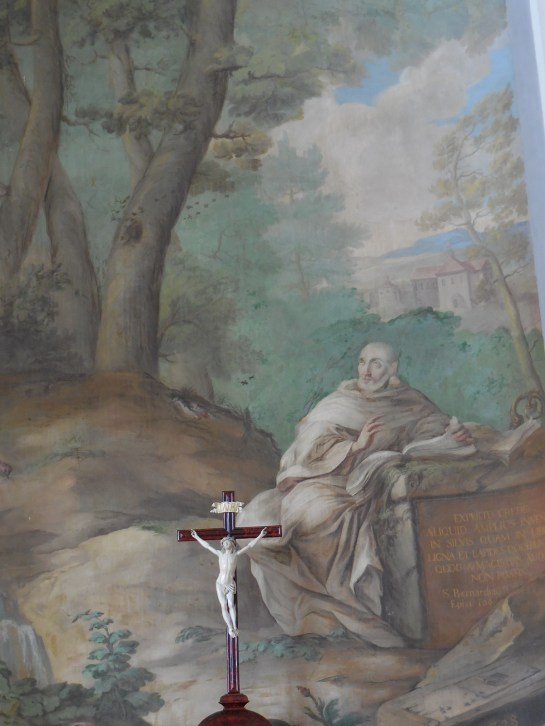
My group continued to the Chapel of Saint Bernard. Surprisingly, there was no furniture in this room. That was because Metternich sold all of it during his tenure there. Stunning, though, was the high wall painting of Saint Bernard, painted by premiere Czech Baroque artist Petr Brandl, whose works I greatly admired. Saint Bernard was leaning on a rock in a forest as angels flocked above. The ceiling fresco depicted Jesus Christ and the 14 disciples.

Plasyint8

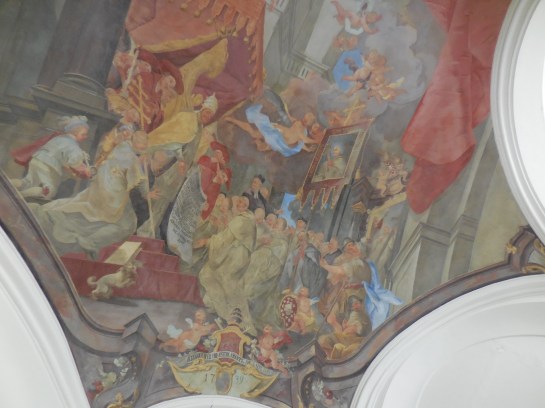
The Chapter Hall, measuring 27 meters in height, was designed by famous architect Kilian Ignác Dientzenhofer. This was where new monks used to be accepted, and where monks had cast their votes for new abbots. I glanced up at the ceiling and was impressed with what I saw – a fresco of the Virgin Mary and a gathering of monks. The tour guide told us to bang our fists on one of the wooden benches: The echo would last more than nine seconds, she claimed. She was right.

Plasyint9

One step into the first part of the library and I wondered where the books were: In the second part there were indeed three tall bookcases, though one was almost empty. There was a reason for this, the guide explained: Metternich had changed the library into a smoking room and theatre. The first section, the former smoking room, featured a ceiling fresco. What did it depict? Hard to tell. All the smoke that had lingered in the air had turned the fresco black. In the other area Metternich had installed a seating area and stage, but I saw a Secession bureau, the three tall bookcases and a ceiling fresco depicting an allegory concerning medicine, philosophy and theology.

The former circular Reading Room was intriguing, too. It was home to eight larger-than-life canvases by Pink. These 18th century Baroque paintings all dealt with themes about eating and drinking, taken from the Old Testament.

Plasyint3

When I walked into Winter Dining Room, I noticed that there were no tables or chairs. Instead, I saw an impressive sculptural grouping of Saint Luitgarda standing in the otherwise empty space. Created by legendary Czech sculptor Matyáš Bernard Braun, its original could be seen on Prague’s Charles Bridge. On the far right-hand side, I peeked into a small window of the monastery prison, where monks were sent if they came late for prayer, for instance.

Plasyint29

I also viewed two foundation water basins set there because the monastery was so close to the Střela River. These were part of the elaborate water pressure system designed by Czech architect Santini-Aichel, who, in order to give the monastery a firm foundation, constructed the convent on 5,100 oak piles and also created a system of connecting channels as a sort of defense against flooding. He specifically used oak wood because oak hardens in water. It fascinated me that Santini also came up with a unique hydrological system for the monastery.

Plasyint20

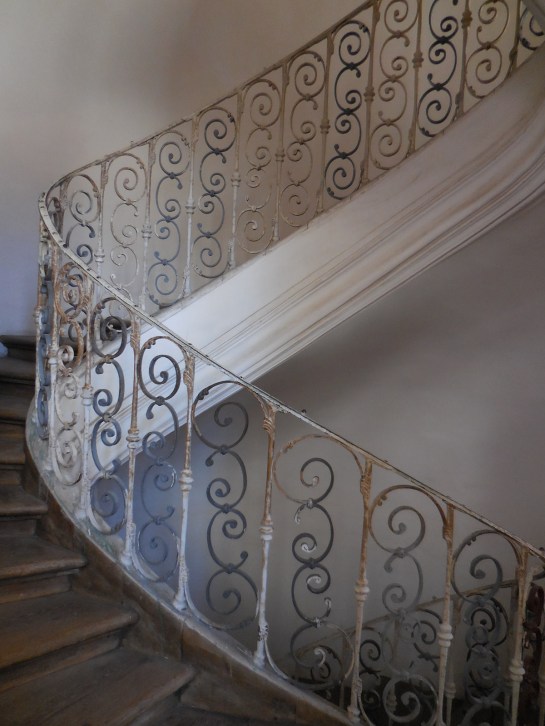
I didn’t miss the Baroque toilets, which were composed of circular holes in wooden benches. I looked down through the toilet seat and saw water below. On the way to the Hospital Wing, our group stopped at a self-supporting, winding staircase designed by Santini-Aichel, who I knew for his unique Baroque-Gothic style in a church at Sedlec, near Kutná Hora. I stretched my neck to glimpse the ceiling fresco of Archangel Michael fighting a dragon.

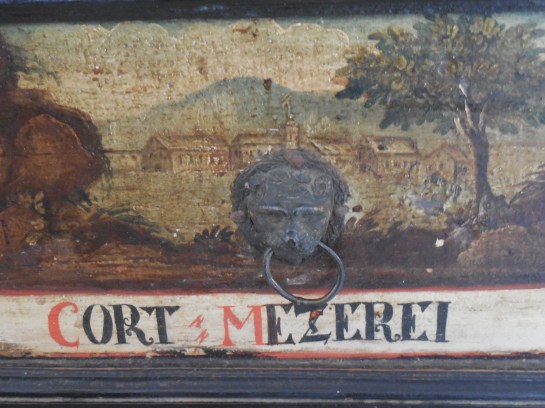
Then we moved to the Hospital Wing, where the pharmacy exhibitions were situated. First, I came across the Baroque pharmacy: I noticed the hand-made, exquisitely painted pictures on the drawers. My eyes were especially drawn to the drawer marked “opium.” It was the only one with a lock on it, the guide said.

Plasyint18

The Classicist pharmacy featured a white theme: wooden shelves were stocked with white jars, and the glass jars had white labels. All the labels on the drawers were white as well. Before reaching the Secession pharmacy, I stopped in the small hospital chapel. The Virgin Mary and 14 saintly helpers stared down at me from the ceiling. The Secession pharmacy flaunted many decorations of flowers and plants on the walls and cabinets. A chandelier impressed me, too. I liked the glass jars with white labels and the red and green fancy trim.

Plasyint15

Then our group left the main building of the monastery, crossed the street, passed the bust of Smetana in the small park and entered the Church of Saint Václav (Wenceslas), where Metternich’s family tomb was located. Originally a Gothic church, it had been reconstructed in Baroque style. Richard Metternich, Klement V. L. Metternich’s son, was the last of the family to be buried in the tomb, during 1938. Several abbots were also buried here.

After the remarkable tour I went to a restaurant nearby and had my usual, chicken with peaches and cheese. Then it was time to return to Prague, so I set off for the small train station. The numerous works of Baroque art had been stunning. Two paintings by master Karel Škréta, a creation by Esther I. Raab and six more canvases by Jan Kryštof Liška also helped to represent the rich Baroque art in the monastery. I better appreciated the differences among the three artistic styles by visiting the pharmacies. The Baroque ceiling and wall frescoes were unforgettable.Image

Teplá Monastery Diary

OLYMPUS DIGITAL CAMERA
Located in west Bohemia, situated near the famous spa town of Mariánské Lázně (Marienbad), Teplá Monastery is noted for its Baroque frescoes and spectacular library. I got there by train, changing once. This was my second visit. Facing the monastery, I looked up at the tall, gray towers that dominate the entrance.

Established in 1193 for the Premonstratensian Order by Czech nobleman Hroznata who later became a monk at Teplá, it is now owned by the Premonstratratensian Order. Historical figures have graced this sacral building. Even Czech King Václav I (Wenceslas I) attended the monastery’s first mass. Unlike the Břevnov, Plasy and Zlatá Koruna, this monastery wasn’t destroyed by the Hussites during the Hussite Wars. That was when two factions of the followers of Jan Hus fought each other, the moderates supported by the Holy Roman Empire, the Pope and others in the early 15th century (approximately from 1420 to 1434). While the church has been preserved from the 12th century, the library, my favorite space, is the newest building, constructed from 1902 to 1907. It is now the property of the Monastery of the Premonstratensians at Teplá.

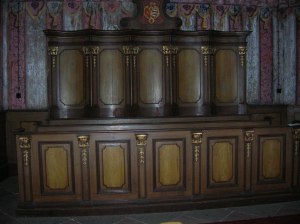
First, I entered the Chapter Hall with its ornate, stucco ceiling frescoes of the 12 apostles and Saint Norbert. One ceiling fresco depicting Saint Norbert’s coffin being hauled to Prague’s Strahov Monastery in 1627 especially caught my attention. In the refectory, once the summer dining room, tables and chairs were notably absent. The only furniture saved was the exquisitely wood carved cupboard standing in one corner. Still, the room didn’t disappoint: on the wall was a fresco of the Last Supper from 1816, and a ceiling fresco paid homage to Saint Paul.

While making my way from the refectory to the church, I glanced out a window at the courtyard which appeared so tranquil with its four Baroque sculptures of Saint Prokop, Saint Jan Nepomuk, Saint Václav (Wenceslas) and Saint Vít (Vitus).

Teplafromweb3We came to The Annunciation of the Lord Church, the oldest part of the monastery, dating back to the end of the 12th and the beginning of the 13th century. Originally built in Romanesque Gothic style, it had been redecorated with Baroque ornamentation. The Baroque reconstruction was carried out in 1735 under the plans of architect Kryštof Dientzenhofer, the eldest of the two Dientzenhofer architects who hailed from Bavaria but worked in the Czech lands during the 18th century. The space dazzled me. There was so much exquisite décor in one place that I could hardly take it all in. I checked out the impressive large wooden statues by Ignác Platzer, studying those depicting saints and four religious teachers. The Baroque organ and the stained glass window above were intriguing, too.

A large wooden slab and plaque on the floor demarcated the place where Hroznata was originally buried in 1217, in front of the Rococo main altar, which showed Saint Norbert and Saint Václav (Wenceslas) in the middle with Saint Augustine, Saint Michal and Saint Anna accompanying them. I also noticed that the enormous 18th century Baroque canvases on the sides of the main altar that featured both Moses and the crucifixion.

Tepla2To one side of the main altar I saw the Hroznata Chapel, where the remains of Hroznata were kept in a white marble altar. A painting on the right-hand side of the chapel showed Hroznata as a knight founding two cloisters. I was especially intrigued by the altar of Saint Theodore with its finely carved wood and statue enclosed in glass. The fresco above the chapel is divided into three sections, all of which fascinated me equally: one showed Hroznata being captured by robbing knights, another showed the dead Hroznata in prison at Kinsberg Castle, and the third showed him ascending to Heaven.

Then I walked down the hallway, noticing the elaborate oak benches on either side. At the end of the hallway, I looked back at the entire church: it was 65.25 meters long and 15.60 meters high. It was so overwhelming to take in all the breathtaking Baroque handiwork.

Teplafromweb2Now it was time to leave the church and enter the library. The first room welcomed me with an enormous illustrated Gothic manuscript and portraits of Austro-Hungarian Empress Maria Theresa (the only female to rule the Habsburg domain) and her husband Francis Stephen of Lorraine.

I entered the main hall of the second oldest library in the country, now housing scientific collections. The fresco on the ceiling by Karl Kratner depicted monks and angels celebrating flanked by four religious teachers and four Evangelists. While the library contained more than 100, 000 books, not all of them were on display. Still, the library was astounding! So many books I wished I could touch and read! I felt so comfortable around books, objects that had become good friends to me over the decades.

Tepla3This particular collection included 700 manuscripts and 540 first printings. Wow! The books were written mostly in Latin (40 percent) but also in German and Czech. The oldest book dated from 915 to 930 AD (Can you believe that?), while perhaps the most well-known was called the Codex Teplensis, which is the oldest translation of The New Testament into German, hailing from the 15th century. Most volumes, though, dated from the 18th and 19th centuries.

Then the tour was over. I could have stood in that library for hours! It had to be one of my favorite libraries in the world! No, I did not want to leave. I walked out of the space slowly, reluctantly.

I had my favorite chicken with cheese and peaches in a comfortable hotel restaurant near the monastery and made my way back to the train station. I got lost returning to the station because I was thinking about the library and not paying attention to where I was going. I wound up walking down a deserted road, fields on either side of me. An elderly man finally crossed my path person, and I began walking toward the station. I had such a bad sense of direction! Not a good quality for someone who loves to travel! Yet for me part of the fun of traveling was getting lost and losing myself so I could find myself again, a changed person with a new perspective on life.

Tracy A. Burns is a writer, proofreader and editor in Prague.

Tepla5


Broumov Monastery Diary

Broumov2Getting to Hradec Králové from Prague was the easy leg of the trip, only taking one hour and 15 minutes courtesy of the comfortable Student Agency buses with plush seating. I had an hour before my connection, which would take me to Broumov on a journey lasting two and a half hours.

I had wanted to visit Broumov for about 10 years, but I was always put off by the four-hour or longer bus ride to get there. I do not like traveling by bus. A four-hour trip seemed too much to bear.

This time, though, I was determined finally to see the monastery that many of my friends had praised. Unfortunately, I would not have time to explore any of the rock formations near my destination, a town at the Polish border of northeast Bohemia.

My connecting bus pulled up on time. I spent about an hour reading about the monastery’s history. The town, I found out, had been established as far back as the 13th century. The first mentioning of the monastery that I could find came from 1306, when the Benedictines began to run a grammar school there. Several of the students would make names for themselves in Czech history: Arnošt of Pardubice, who served as the first Archbishop of Prague during the middle of the 14th century; writer Alois Jirásek; and the first Czechoslovak Minister of Finance, Alois Rašín. The history of the school was fraught with trials and tribulations, though. The Hussites destroyed it during 1420, and the uprising of the Bohemian Estates from 1618 to 1620 during the Thirty Years’ War also forced the school to shut its doors. The history of the uprising was intriguing, to say the least. Holy Roman Emperor Matthias had appointed Ferdinand as his heir, which caused a major fuss among the Protestants because Ferdinand abhorred Protestantism.
Broumov3I also read that in the early 17th century, Protestants constructed their own church near the Lower Gate of the monastery, causing much friction. Even though Emperor Ferdinand II ordered it to be shut down and put some rebels in prison, the church remained open. This Catholic-Protestant conflict in Broumov helped instigate the Prague defenestration of vice-governors on May 23, 1618, when the two representatives Ferdinand had sent to oversee the Czech government at Prague Castle were pushed out a window along with the secretary. (They survived because they fell on a pile of horse manure.) This marked the Second Defenestration of Prague and triggered the Bohemian Revolt.

That is when the directors of the Bohemian Estates confiscated the monastery, which was purchased by the citizens of the town. The complex was returned to the Benedictines after the Battle of White Mountain in 1620, when the Catholics, led by Holy Roman Emperor Ferdinand II’s army, defeated the Protestant Bohemians. The monastery was in ruins but was restored. The school was not closed again until 1939, when the Nazis controlled the complex. Benedictines from the USA oversaw the monastery from 1945 to 1948, but then the Communists took over, and the American monks went home. During 1950 the monastery became an internment camp for monks. It was not returned to the Benedictines until 1990.

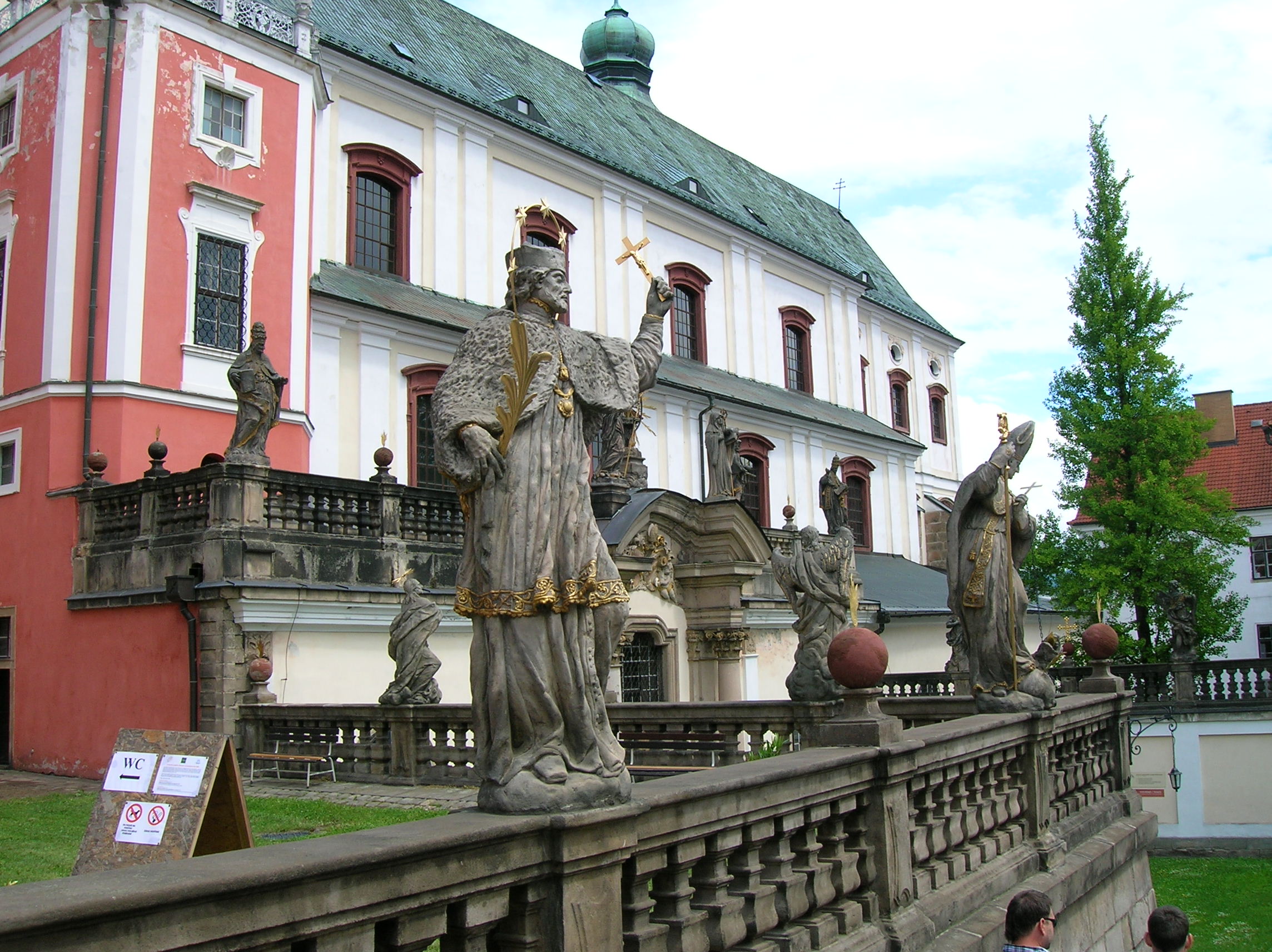
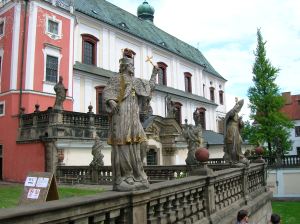
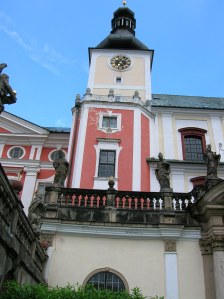
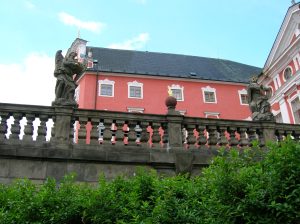
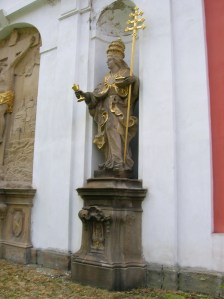
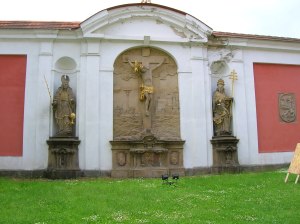
To get to the monastery, I had to walk through the main square. Renaissance house number 105 boasted of a portal from 1595. I noticed two buildings in Neo-Renaissance style as well. The monastery was practically on the square. I purchased my ticket and gazed at the Baroque statues of saints on the balustrade of the monastery’s terrace before the tour began. Saint Prokop, in almost fluttering drapery, proudly gripped a cross. The Baroque masterpieces seemed to twist and turn on their own and gave the exterior a dramatic and dynamic atmosphere.

First, we entered the Church of Saint Vojtěch (Adalbert) – a Baroque wonderland thanks to Italian builder Martin Allio and the Dientzenhofer team of father Kryštof and son Kilián Ignáz during the 18th century. (The Dientzenhofers remodeled the other monastery buildings in Baroque style as well.) I was overwhelmed by the pink fresco-filled ceiling with white stucco décor. I felt dizzy with awe as I peered at the fresco showing the death of Saint Vojtěch. In the Saint Benedict Chapel, white angels fluttered amidst spiraling pink columns. In the choir I admired the carved wooden benches with gold decoration as well as the frescoes above them.  The 20-something guide with long blond hair pointed out a rendering of “The Last Supper”. The main altar, dating from 1706, was not disappointing, either. Flanked by Saint Václav (Wenceslas) and Saint John of Nepomuk, Saint Vojtěch stands proudly in the middle.
Broumov4Next, we went upstairs to the library – one of my favorite rooms on any tour. Originally, there were three libraries with a total of 67,000 books, but now only one remained, and the number of books has dwindled to 17,000. The guide explained that during the totalitarian regime, Communists threw books out the window. Other books went to Prague, and still others were stolen.  I tried to imagine someone hurling these exquisite volumes outside, but it was too painful. It was just one of the many ways that the Communists tried to suffocate Czech culture. Once again, I was reminded of how horrific the totalitarian era was. The reading material that remained was written in Latin, Spanish, French and Czech, among other languages. The books dealt with subjects such as law and history, the guide remarked, showing us a seven-volume set of The Old Testament, which made up the heaviest books. Each weighed 20 kilograms. I was moved by the portraits decorating the balustrade and the frescoes that adorned the ceiling. The illustrated manuscripts featured in display cases were a treat, too.

Downstairs to the first floor, we entered the refectory. The treasure in the room was one of 40 copies of the Shroud of Turin, discovered in the Saint Cross chapel during 1999. What a day that must have been! Imagine discovering a 17th century relic three centuries later!

Supposedly, Jesus Christ was wrapped in the original shroud after his body was taken down from the cross. Those who believe in its authenticity argue that an impression of a coin circulated at the time of Jesus of Nazareth’s death was shown on one of the eyes. Originally kept in Constantinople, it has been stored in Turin since the 16th century.

Made in 1651, this copy – the only one found north of the Alps – was a gift to Broumov Abbot Sobek of Bílenberk from Turin Bishop Bergirius. The shroud featured a brown impression of Christ’s body with a light outline. For some reason I had expected the impression to be more pronounced and the outline more visible, darker. Still, it was exciting to be able to see such a significant piece.
Broumov12In the corridor we stopped at three charts on boards. One denoted events from the 19th century, marking that the cholera epidemic had ravaged the region during 1836. A board from 1812 showed that hop-plant was the most expensive product that year.

Then the tour guide asked who wanted to see the mummies. I did not know anything about any mummies there, but, curious, I tagged along with two others. We walked deep down into the crypt. In two spaces I saw 20 mummies of 17th and 18th century townspeople in open coffins. There were 32 mummies in all, but only 20 were on display, the guide remarked. Then she explained that due to renovation work in Vamberk, the mummies had been kept here since 2000. She did not know when they would return home. I was aghast that the mummies were so small, the size of children rather than most adults. For a moment I was brooding and philosophical. I wondered if that is all there is after life. You wind up in a coffin, there is no God, no Heaven. You are stuck in a dark place for eternity. Moved by the sight of the open caskets, I tried not to dwell on those depressing thoughts and instead marveled at the mummies’ preservation.

The tour ended, and I went to the museum in the monastery, six halls focusing on 700 years of the Broumov region’s rich history. Gothic, Renaissance and Baroque objects were just a few of the attractions. Weapons, folk nativity scenes, shooting targets and regional folk costumes rounded out the permanent exhibition. There was also an exhibition of clocks – from ornate Baroque clocks to 20th century alarm clocks. The most intriguing object for me was the poster announcing that this region – the former Sudetenland with a German majority – was being incorporated into The Third Reich. The German citizens had been enthusiastic about it, I remember reading. They had welcomed the Munich Agreement of 1938 that ceded Czechoslovakia’s Sudetenland to Hitler. And I thought of the Beneš decrees instigated after World War II when Czechoslovak President Edvard Beneš expelled all Germans from the Sudetenland. History had certainly made a poignant mark on this seemingly tranquil town. Looking at that poster, I saw the brutality of 20th century events that had seeped throughout the region.

Wooden church in Broumov

Wooden church in Broumov

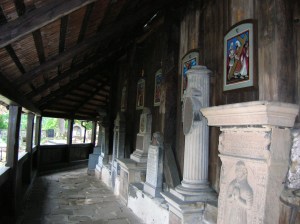
Next, I made my way toward the hospital. Across the street was a small cemetery with an exquisite wooden church – the Church of the Virgin Mary – that is the oldest preserved all-wood construction in Central Europe. There may have been a church on this site as far back as the 12th century, when this part of town made up a village. Legend has it that the church was built by a pagan princess during 1171. However, the first written documentation of its existence dates from 1383. In 1421 the church was destroyed by the Hussites, though the extent of the destruction is uncertain. The current church was constructed by the Benedictines in 1449. The Gothic structure had a single nave with a trihedral end and a steep gabled roof. A pyramid steeple punctuated the building. The ground floor was surrounded by an open gallery, and the interior was covered with planks.

The main altar

The exquisite interior of the church

The tombstones outside the church

The tombstones outside the church

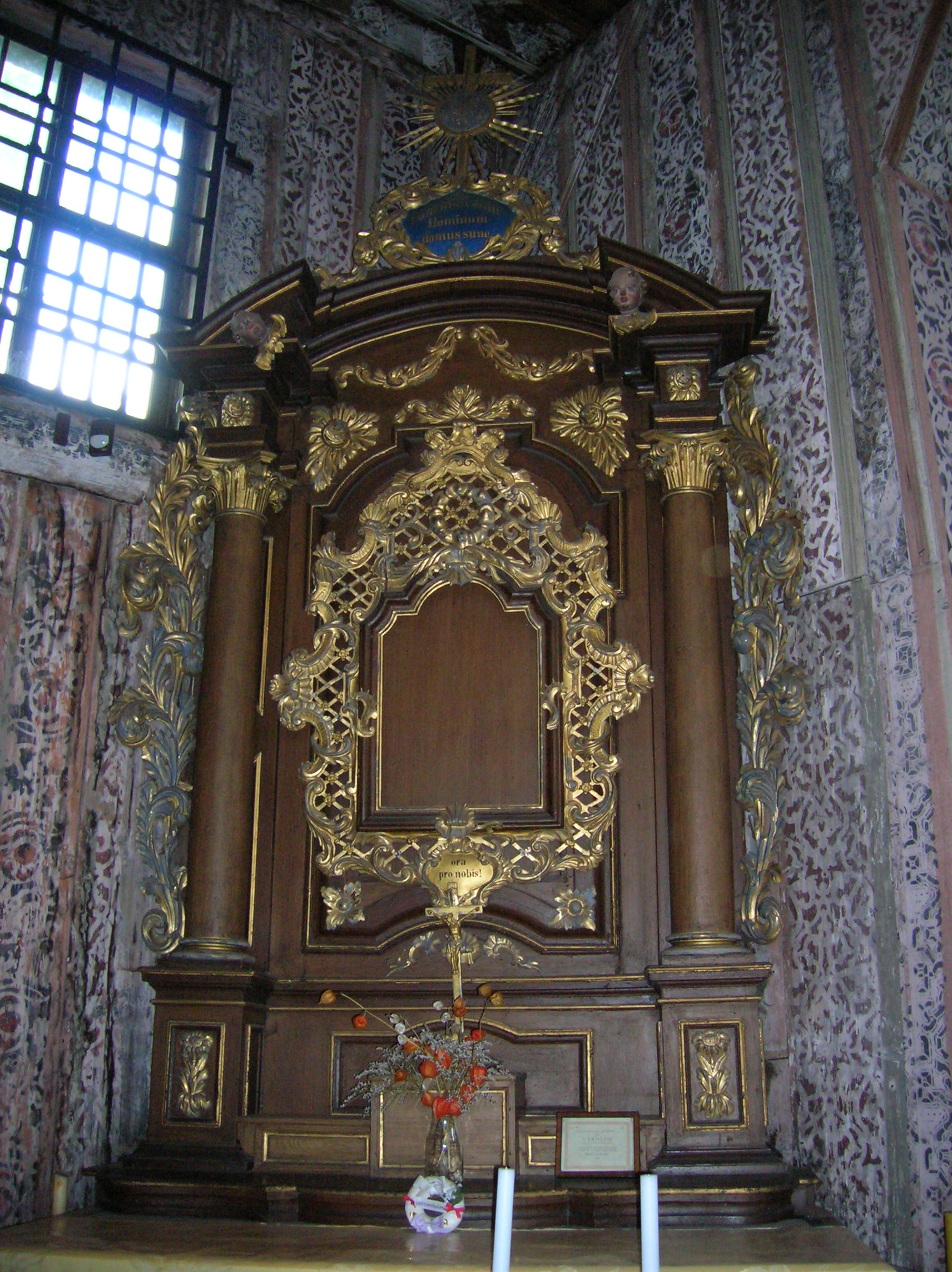
The art work was incredible. There was a remarkable stencil mural on a wall. I admired the black stencil motifs of geometric shapes and vegetables on the ceiling and walls, too. The main altar depicted the Virgin Mary looking up to Heaven, surrounded by a gold frame supported by two angels. Two columns were situated behind the angels. A huge halo dominated the top of the exquisite structure. 
Another photo of the interior of the church

Another photo of the interior of the church

After spending about a half hour in that modest yet fascinating architectural gem, I had lunch in a hotel restaurant with a garden and terrace. There was a fountain and statuary in the garden that seemed to belong to a palace. The prices were the same as the pizzeria I often visited in downtown Prague, yet the dining atmosphere was much classier. I felt as if I were at a resort.

My stomach filled with delicious chicken and diet Coke, I walked around the corner to the bus stop. It would be a four-hour journey back to Prague on the direct bus. I was surprised to find out that there was no break during the trip, such as a 10-minute interval to use the bathrooms. I did have five minutes in Náchod, though, where I raced around the corner to the train station restroom and made it back with a minute to spare. While the skies had foreshadowed rain during my entire trip, it did not start pouring until I got off the bus at the Černý Most Metro station in Prague. Still, nothing could damper my excitement about a trip that had been well worth the arduous journey.Broumov5
Tracy A. Burns is a writer, proofreader and editor in Prague.
Vyšší Brod Monastery Diary

Vyssi Brod MonasteryWhile staying in the picturesque southern Bohemian town of Český Krumlov, I took a day trip to the nearby Cistercian monastery Vyšší Brod, located in the town by the same name and nestled in the Šumava mountains region. Now once again the property of the Cistercian Order, the monastery, founded in 1259 and built over a period of 100 years, still retains a Gothic appearance with features of both Early and Late Gothic architecture, as I noticed upon my arrival.


First, I stepped into the church itself and especially took note of the high altar and the side altar of the Virgin Mary. Built from 1644 to 1646, the Early Baroque high altar is made of brown gilded wood. I loved how it was adorned with statues, such as those of Saint Eugene the Pope and Saint Bernard. A sculpture of the Crowning of the Virgin Mary and another of the Holy Trinity also impressed me.


The side altar of the Virgin Mary boasted a valuable panel painting of the Madonna of Vyšší Brod by the Master of Vyšší Brod sometime after 1400. Set against a golden background, the blond Mother of God cradled a naked baby Jesus while angels hovered above her and saints posed at the sides.


Then there were the abbots’ tombstones, some in Mannerist style and others from the Baroque era I also saw the wood inlaid and gilded choir studded with Baroque statues of various saints. A glance upwards and I was looking at exquisite Gothic stained glass windows decorated with themes from the lives of saints.


An art lover, I was enthusiastic to see the monastery’s art collection. Mostly Gothic and Baroque, it featured many Dutch and Flemish works (yes!) as well as Baroque creations by Czech artists such as Petr Brandl (one of the Baroque painters I hold dearest!). Baroque seascapes and landscapes by Norbert Grund and František Xavier Palko’s rendition of the 12 apostles and a portrait by Czech master Jan Kupecký were among the dazzling canvases in the exhibition. I especially liked Grund’s landscapes.


Soon it was time to visit the library, which held 70,000 volumes, making it the third largest Czech monastic library. Only Strahov and Teplá boasted more books. I set my eyes on Rococo bookcases dating from 1756. Works from 1500 to 1800 made up part of the collection, though some pieces dated as far back as the 13th century. A five-volume Latin Bible also caught my attention. It hailed from the early 14th century. Chants of the Cistercian Order were written at the turn of the 15th century.


VyssiBrod1Then our group came to the Library Corridor, which is home to 19th century and early 20th century collections written mostly in Latin and German. We moved on to the Philosophical Hall where books about such subjects as math, biology, and chemistry as well as German dictionaries are stored. The astounding fresco on the ceiling was the work of Lukáš Vávra. Latin quotations by Saint Bernard promoting education could be seen above the windows. In the center of the room I was blown away by a detailed map of the Czech lands that featured even the tiniest villages from the 1600s. I was awed by the attention to detail.


The Theological Hall was best known for keeping one of the largest collections of bibles in Central Europe, and the holy books in the collection come in 40 languages. Can you believe it? The white pigskin bindings hailed from the middle of the 18th century. Another fresco by Vávra adorned the ceiling, this one showing a 12-year old Jesus in a temple. The guide pointed out something intriguing about the painting. If you look closely, you notice that some of the things featured in the fresco didn’t exist when Jesus was alive. For example, one man donned glasses, another held a book, and there was glass in a window. The style of clothing and the architecture were also ahead of their time. Then the tour ended.


On the main square in the town, only steps away from the monastery, I found a restaurant in a hotel where I was able to have my favorite chicken with peaches and cheese. Then I stood across the street, waiting for the bus back to Český Krumlov, but it seemed that I had the wrong information. It would be another two hours before a bus came along, according to the schedule at the stop. I spent another hour in the restaurant, downing Viennese-style coffee and glasses of nonsparkling water and then stood at the bus stop for a while on that nice, though crisp, day. I let my mind wander and just succumbed to the feeling of happiness that overwhelmed me.

 Tracy A. Burns is a proofreader, writer and editor in Prague.
VyssiBrod2