
During my first trip to Milan, I didn’t have time to see the Monumental Cemetery, where graves adorned with magnificent sculpture abound. Designed by master architect Carlo Maciachini in various styles, it was open to the public during 1866. The tombstones are elaborate works of art showing off styles from the end of the 18th century through the 19th century and beyond. For example, I saw a tombstone shaped as an Egyptian pyramid and another resembling Trajan’s Column. I even found some graves decorated with modern architecture.


The Neo-Gothic Famidio, which looks like a church but houses tombstones of eight famous Italians, was the first place I entered. One wall is covered with names of others who are buried on the premises. Smack in the center of the Famedio is the tombstone of Alessandro Manzoni, a 19th century Italian author who wrote the patriotic worldwide masterpiece, The Betrothed. I knew he had been instrumental in creating the modern Italian language and had been admired during the Risorgimento, the movement that culminated in Italy’s unification. I had seen displays dedicated to him in the Museum of the Risorgimento in Milan and had viewed editions of The Betrothed in a temporary exhibition at the Brera Art Gallery’s historical library. I also had visited the museum dedicated to his life and work, though I hadn’t been that well-schooled in his background and literary works to appreciate everything I saw. In that museum, I especially liked the paintings showing scenes from his works.


Many famous Italians are buried in this cemetery – the painter Francesco Hayez whose creation “The Kiss” I had admired in the Brera along with many other of his works; Dario Fo, a playwright whose literary contributions I had read with great enthusiasm; and conductor and cellist Arturo Toscanni as well as pianist Vladimir Horowitz. I had been introduced to their classical music accomplishments when I had studied classical music in college.

The cemetery has three main sections – one for Catholics, one for non-Catholics and one for Jews. The central edifice in the Jewish section boasts beautiful windows that symbolize the 12 tribes of Israel. Inaugurated during 1876, the Greek Revival styled Cremation Temple has the distinction of being the first crematorium used in the Western world. It was in service until 1992. I also saw a moving monument to those 800-some Milanese who died in Nazi concentration camps. It was created in 1945.

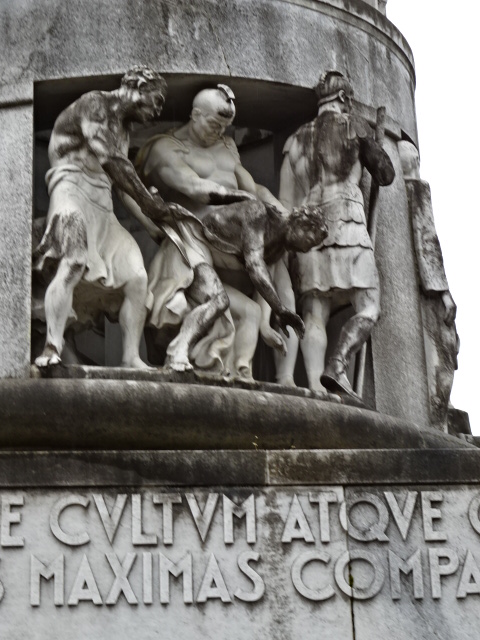

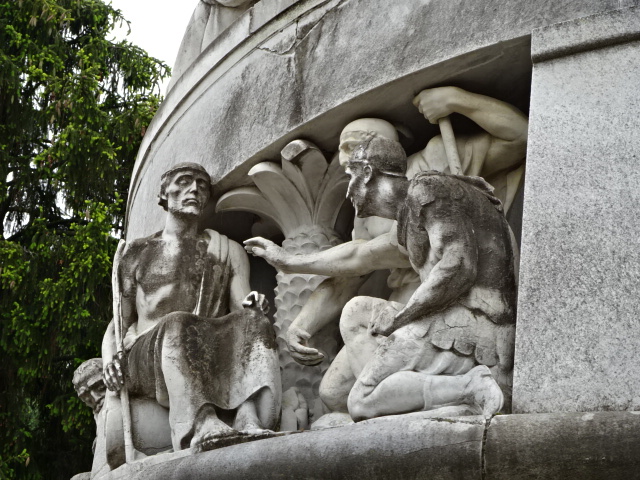
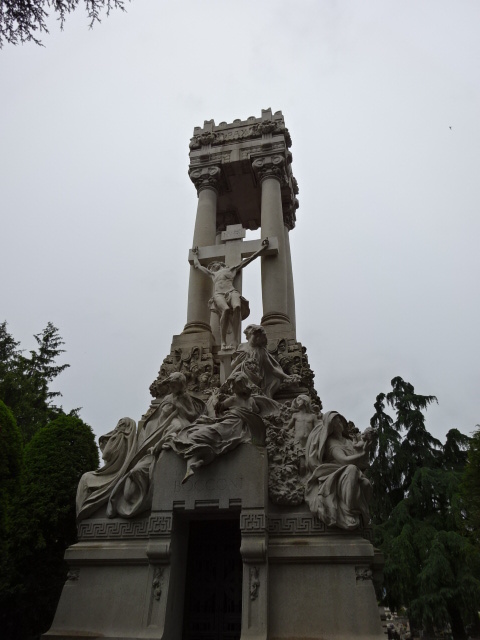
All the tombstones I viewed were outstanding works of art. I saw a tall tombstone that symbolized the Tower of Babel in the center of the cemetery. Looking like a tower with many sculpted figures on the outside, the tombstone was empty on the inside. Designed by architect Alessandro Minali and sculpture Giannino Castiglioni in 1936, it featured numerous biblical scenes. I recalled viewing Peter Bruegel’s painting called “The Tower of Babel” at an exhibition in Vienna. Though markedly different, both works contained an amazing amount of detail in the various scenes portrayed.


Another tombstone on the central path was nubbed “Work” because it extolled an allegory on that subject, played out in a scene devoted to agriculture. The female figure looking down on the scene symbolizes Mother Nature, her face so well-sculpted by Enrico Butti in 1912. The episode shows a male figure pulling his cattle with some difficulty. He is leaning in one direction due to the heavy weight of the animals. The two cattle and male figure are made of bronze while Mother Nature above is made of red-colored rock. I found this tombstone to be very compelling, especially with Mother Nature looming over the scene.


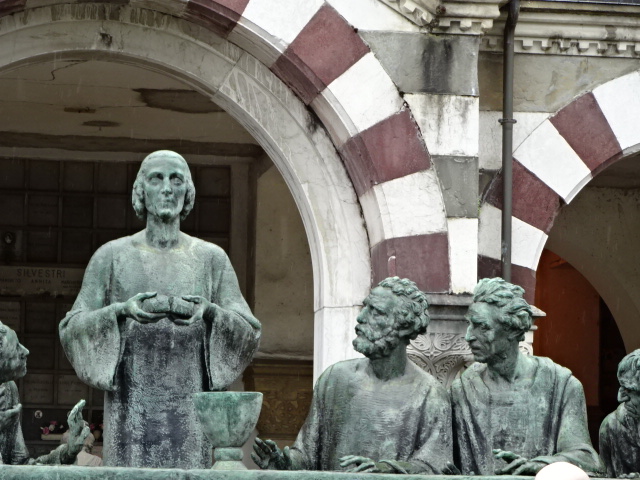
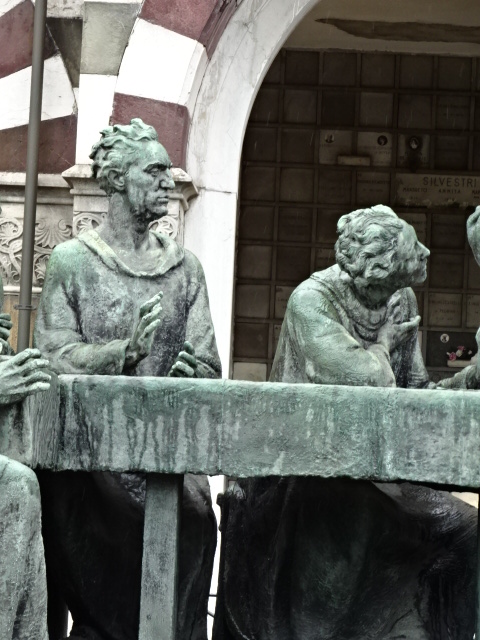

My favorite sculptural grouping represents Leonardo da Vinci’s “Last Supper.” I had viewed the painting in Milan during my previous visit and had been drawn to the details in the work, especially the facial expressions and gestures of each character that was portrayed uniquely and exquisitely in the unfolding drama. In this sculptural rendition, the bronze larger-than-life-sized figures share the same theme as the painting, though there are some differences from the masterpiece in the Church of Santa Maria delle Grazie. This tombstone overwhelmed me with its dramatic and vibrant qualities. It had been made for David Campari and the Campari family and designed by Giannino Castiglioni in 1935. Representing a painting in sculptural form was audacious and formidable. I especially noticed the detail in Judas’ bag of money.


I also saw a more modern work, dated from 1949 and created by modern Italian artist Lucio Fontana for the Chinelli family. The large sculpture of a headless blue angel was made in paper mâché, hovering over the earth. I took notice of the vibrant color.
After an hour and a half, I had to leave the cemetery because it was just too depressing looking at graves, even though they were masterfully made. Every one told a unique story. I was glad I had finally made it to the cemetery and certainly was not disappointed.
Tracy A. Burns is a writer, proofreader and editor in Prague.




 Tracy's Travels