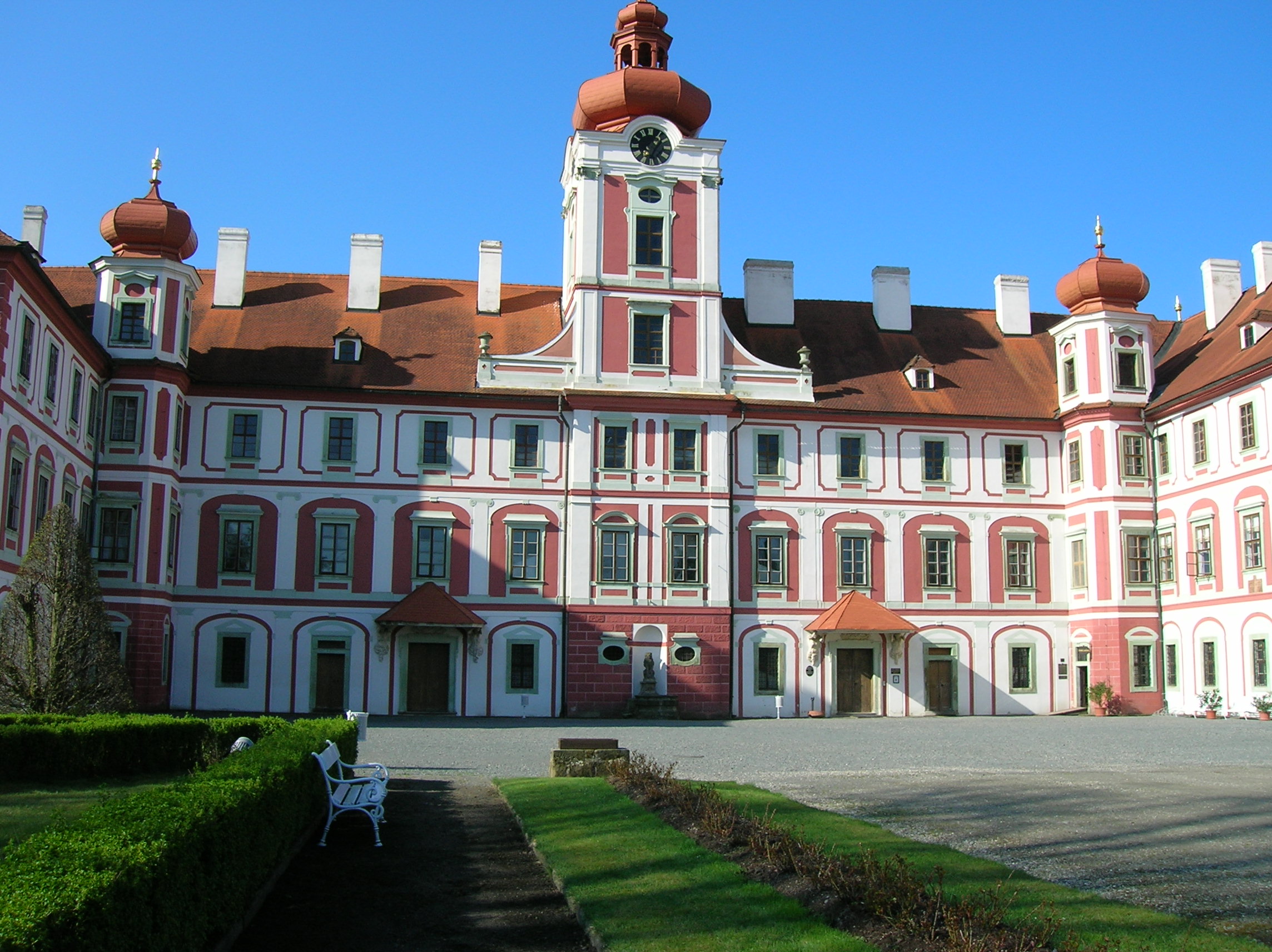
Mnichovo Hradiště Chateau Diary

MnichovoHchateau3

I had taken this train many times before, usually to Turnov, which was one stop further than today’s destination – Mnichovo Hradiště. The last time I had taken this route, the train had been furnished with new, comfortable seats, though the exterior had appeared dilapidated. This time, the seats were the usual ugly, red, vinyl kind divided into compartments that looked dirty. After riding the pleasant Viamont train to Bečov nad Teplou, I guess I had become a bit spoiled concerning train travel.

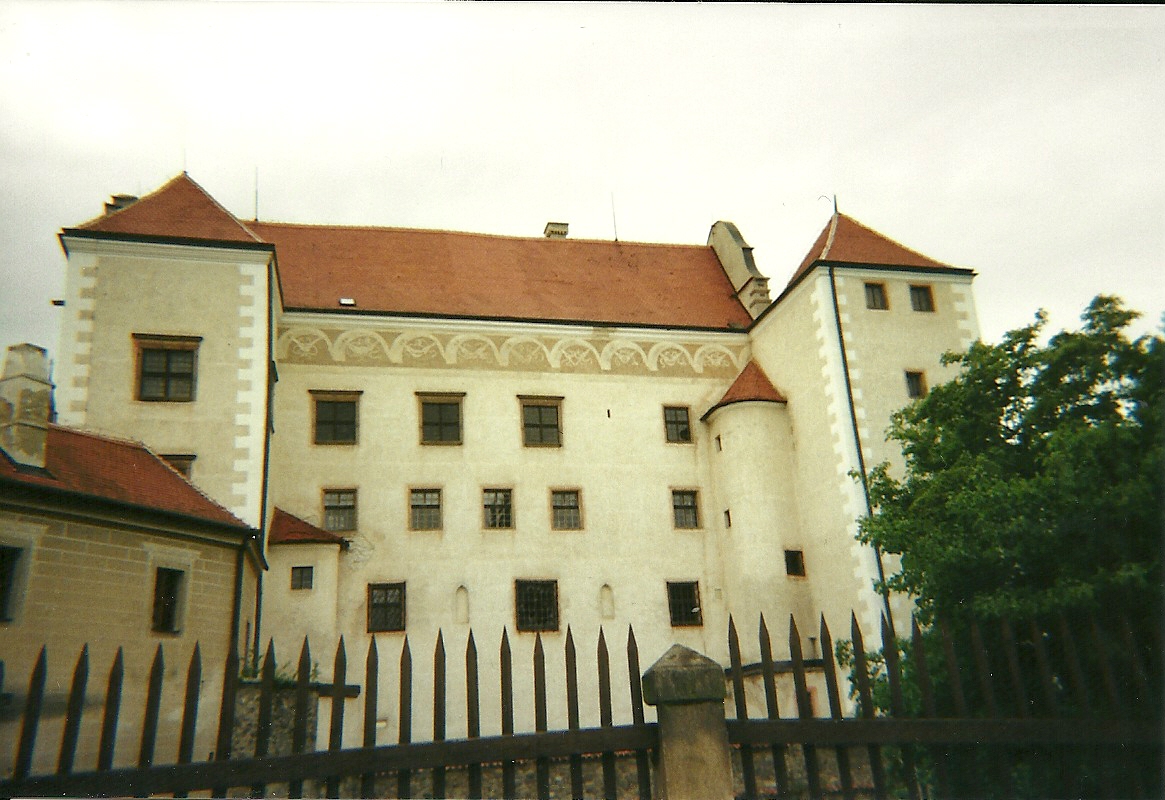
The trip took about an hour and 45 minutes, and it took another 15 minutes to walk through the pleasant town to get to the chateau. I remembered the chateau’s exterior from my visit here about 10 years ago, but it looked as if the walls had seen a few fresh coats of paint since my first time here. There were three parts to the tour – the Empire style theatre for about 50 or 60 spectators, the interior rooms with mostly 18th century furnishings and the lapidarium where 25 statues were kept in the church and chapel of a former convent.

The guide and I started with the tour of the theatre.  On the way there, we stopped in a hallway where I saw large portraits and Baroque bureaus. A huge painting traced the genealogy of the Waldstein family, the clan who had owned the chateau for generations. I picked out Vilém Slavata from Chlum and Košumberk in a long, red robe and big, red cap in one portrait. I had visited enough chateaus to know that this nobleman and writer had been thrown out a window of Prague Castle during one of Prague’s defenestrations. Thankfully, he had fallen on a heap of manure.  Passing the Hunting Hallway, I glanced at black-and- white graphics of various animals and noticed a depiction of a deer with one antler. Then we came to a machine that made the sound of wind. By turning a lever, the round, wooden contraption with a white sheet over it moved to produce the sound.

MnichovoHchateau6Then we entered the Empire style theatre. I took a seat on a bench that resembled the original seating. While the theatre was first mentioned in archival documents during 1798, it was renovated and given an Empire style appearance in the early 1800s on the occasion of the Holy Alliance negotiations, when Austrian Emperor Franz I, Russian Tsar Nicholas I and Prussian Crown Prince Frederick William discussed how to handle the revolts taking place throughout their lands, during 1833. The first play performed here was Carlo Osvaldo Goldoni’s The Servant of Two Masters, performed in German and Czech by actors who came from Prague. Three theatre groups from Prague’s Theatre of the Estates gave performances here for three nights. In the second half of the 19th century, the theatre fell into disrepair and was used as a furniture warehouse. It was not open for the public until 1999. The curtain was restored in 2001.

 I was enthralled by the romantic landscape backdrop that was currently on display. It gave me a soothing, calm feeling. Some of the 11 plain, flat backdrops that the theatre possessed included a street view, a castle, a hall with columns and Prague Castle with the Lesser Quarter and Charles Bridge. The stage was 32 feet wide, 28 and a half feet deep and four feet high while the proscenium opening was 22 feet wide and 13 and three-fourths feet high. The theatre had one curtain and 54 wings, which were set at an angle to the stage instead of being placed parallel to it, as was the usual custom. The theatre did not use a mechanized wing system or wing trolley, either, but rather employed a groove system that utilizes upper and lower grooves to assure that the wings will stay upright. Also, the wings in this theatre were double-sided and therefore could be reversed easily. On the back wall behind the balcony a large genealogy painting of the Waldstein family, complete with cherubs, caught my attention. It celebrated the family’s pride of its heritage. The theatre is still on occasions used today.

The chateau had an intriguing history. It was built in the 17th century, during Renaissance times. The owner Václav Budovce of Budov joined forces with other nobles in a revolt against the emperor and was executed on Old Town Square in Prague during June of 1621. In 1623 the chateau was confiscated and subsequently bought by Albrecht Eusebius of Waldstein.  In 1675 Arnošt Josef of Waldstein purchased it and kept it until the middle of the 20th century. The chateau was given a Baroque appearance in the early 1700s, although some rooms were given a Rococo makeover around 1750.

In a hallway full of portraits, I spotted the pointed beard of Albrecht of Waldstein, the one who had bought the chateau in 1623. A large painting explained the genealogy of Emanuel Arnošt of Waldstein. The guide said that when the researcher could not find all the ancestors of the Waldsteins, he made them up. The large, grey, puffy wig that Maximilian of Waldstein was wearing caught my attention, too. I also noticed that Count Vincenc had only one eye open. There was also a room to the side, roped off. Leaning over the rope, I glimpsed a tiny chapel with a Baroque altar of Saint John of Nepomuk and a Madonna with child. The altar was flanked by black Corinthian columns with golden tops.

Next came the Countess’ Antechamber. Someone had installed a 20th century telephone and placed it on a Baroque bureau, a sight which vividly contrasted the two eras, so far apart in technology and time. A still life painting adorned one wall, and a laundry basket with an exquisite floral pattern and muted yellow background sat on the floor. The stunning green, blue and brown chandelier symbolized the four seasons. I noticed that grapes stood for fall.

The oldest painting in the chateau, showing an old lecherous man and a young woman whom I suppose was very naive, hung on a wall of the Countess’ Bedroom. I noticed how both figures had baby pink skin. Why a countess would want such a painting in her bedroom is beyond me. In the visitors’ book, a thick, red book on an ancient desk, I could read the names of nobility such as Schwarzenberg and Lobkowicz.

MnichovoHchateau4The Italian Salon enthralled me with its stunning mural spanning three walls. The painter had never visited the Italian town presented; rather, he had painted it from an etching. From the embankment of the town pictured, one could see Naples and Venice in the distance. Two men and a woman were talking in one section, nobles had gathered in another, and in yet another part two men manned the oars of a small boat.

The Study, which later became known as the Music Salon, featured a piano with the white and black keys reversed. I had never seen a piano with this unique trait. The Baroque white tile fireplace was decorated with two sea monsters that were supposed to be dolphins, as they slivered through the water with their heads pointed down.  Small portraits also adorned the Music Salon. One showed Habsburg Empress Maria Theresa dressed in black, mourning the death of her husband.

The small picture gallery was roped off, which disappointed me. I wanted to study each painting in minute detail, but only was afforded a side view of the three walls totally covered in art. I noticed a woman reading while holding a skull and other paintings boasting hunting themes.

Next came the Hunting Salon. The three walls were covered in a mural painted in shades of dark green and featuring a forest, dogs and hunters. I noticed that a backgammon game consisted of pieces with faces carved on them.  The ceiling fresco was devoted to Diana, goddess of the hunt. She held an arrow; one of her plump breasts was bare. The room also boasted a secret door.

The biggest room in the chateau was the Dancing Salon or Reception Salon, Rococo in style. A mirror sat flat on a round table that looked like a three-tier table for cakes wheeled around in luxurious restaurants. Porcelain figures decorated the three tiers while murals decorated two walls. I spotted this very chateau in the background of one part of the mural. Men clad in red with dogs were seen in a forest as a woman stood in the doorway, something having caught her sudden attention.

The Ladies Salon featured murals on four walls. They showed a countess posing in different professions. She was portrayed as a dancer, a flower-seller, a hunter, a fisherwoman and a traveler, among others. In the depiction of the countess as a flower-seller, I took note of the English park in the background and the flowers that decorated her hat. I was enamored by the backs of the chairs on which landscapes had been painted. The floral cushions were exquisite as well.
MnichovoHchateau2The most beautiful room in the chateau, in my opinion, was the Delft Dining Room that is immersed in blue-and-white Delft Faience porcelain from the 17th to 19th century, all original and handmade. I noticed some geometrically shaped vases and admired the wooden compartment ceiling, too. The Waldstein gold with blue coat-of-arms decorated the center of the Renaissance ceiling. I noticed some plates on a wall featuring windmills while a tray depicted a park with a fountain and statue.

The Oriental Salon was full of Japanese and Chinese porcelain. I admired the orange and blue swirls of one Chinese plate hanging on a wall. The table and chairs were made of bamboo. Four vases represented the four seasons. A Japanese painted partition also adorned the room.

The table in the Meissen Dining Room was set for breakfast with its blue-and-white porcelain taking center stage. Yet what astounded me about Meissen craftsmanship were the chandeliers. Hailing from the beginning of the 19th century, this particular chandelier featured floral decoration colored green, pink, yellow and orange.

Although the library was composed of three rooms, a gate with bars prevented visitors from entering. This was the library where Giacomo Casanova had served as librarian during the 18th century, the guide reminded our group. His letters and manuscripts made up a significant part of the chateau archives, as did material from the Thirty Years’ War. I wished I could see more of the 22,000 volumes inside the gate as the shelves were decked with fiction as well as specialized literature, such as legal and historical works. Many books focused on alchemy, too. They were written in a variety of languages, including German, Latin, Czech, Italian and Hebrew. Two big globes stood in the foreground while a smaller globe and telescope could be seen in the background of the closest room.

Walking through a hallway before descending the stairs, I spotted a large portrait of an armor-clad Albrecht of Waldstein on a gray, spotted horse. Then it was time to visit the lapidarium.

The church and chapel of the former Capuchin convent appeared to be plain, nondescript. The exterior was even dilapidated. What was inside, though, proved absolutely stunning and breathtaking. As we first entered the Church of the Three Kings that joined the Chapel of Saint Anne, I saw about six small statues in a dark, small space. This will be disappointing, I remember thinking to myself. Then we turned the corner, and the room came alive with 25 statues of Baroque, Rococo and Empire style twisting and turning, dynamic and vibrant, most made of sandstone.

Home to these statues since 1966, the lapidarium featured monuments that had been deteriorating in the outdoors. Our group stood in front of the headstone of Alburtus de Waldstein, the name engraved prominently on one wall in what looked like marble. Then I walked through the room, my head spinning from all the dynamic and expressive movement flowing from the statues. I inspected the altar of the Saint Anne Chapel and noticed that Saint Anne had a child on her lap as they were reading, cherubs fluttering above. Next to them a figure seemed to be holding a painting.
MnichovoHchateau5Then I took in the statues. In a sandstone work hailing from the third quarter of the 18th century, the Virgin Mary had her hands clasped to her breast. A Saint John of Nepomuk portrayal by Josef Jelínek the Elder, dating from the second quarter of the 18th century and made of polychrome wood, featured that saint as a sort of visionary, peering into the distance, determined and confident. I noticed the dynamic folds in his white drapery. It looked as if they were fluttering in the wind. Another statue, named the Angel with the Attribute of Christ’s Suffering, had been erected in the early 1720s out of sandstone. I was stunned by the angel’s huge wings as the angel seemed to be moving toward the viewer, about to trample him or her. I also noticed the angel’s crushed nose and wished the statues were in better condition. If I was a millionaire, I would donate money to preserving Czech chateaus and castles, so that fascinating statues such as these could be restored.

The Lion and Putto, by master Ignatius Francis Platzer, was made of sandstone and hailed from the 1750s or 1760s. Putto, clutching a shield, was riding on an enormous lion. Perhaps the best known statue in the collection was Matthias Bernard Braun’s Perseus, a sandstone work from the early 1730s. Perseus appeared calm, not at all tormented, and I took note of his fluttering drapery and twisting body. Then I walked over to Saint John of Nepomuk with Two Angels by Karle Josef Hiernle, a sandstone piece from 1727. John of Nepomuk was flanked by two angels. One angel lightly touched the sleeve of John of Nepomuk’s garment. An angel held a finger to his lips, while the other pointed toward Heaven. Cupid heads decorated the bottom of the sculpture. John of Nepomuk ‘s head was leaning to the right, his hands were clasped and his eyes closed as if he were meditating.

After thoroughly enjoying my inspection of the statues, I went to lunch, where I ate my favorite chicken with peaches and cheese. Soon afterwards, I took a bus from the main square directly to Prague. Once again, I was fascinated by everything that I had seen in the chateau, and I needed time to process all the information and all the beauty that had surrounded me.

Tracy A. Burns is a writer, proofreader and editor in Prague.

MnichovoHchateau1

Žleby Chateau Diary

Zleby3

Miraculously, I made the train connection in Čáslav with four minutes to spare and not long afterwards found my way from the train station in the village of Žleby to the chateau. To say Žleby is majestic and romantic is a vast understatement. The chateau looks as if it has emerged from a fairy tale. I inspected the fountain in front of the chateau. It dates from 1860 and shows a member of the Auersberg family, who owned the chateau for over 200 years, grappling with a bison. As I bought my ticket, I was a bit disappointed, though. A 90-minute tour was available, but a third tour did not open until May. So, I would miss the chateau theatre and lower floor library, unfortunately. (I saw these during my 2020 visit by car.)

Zleby2020ext3Zleby2020ext5

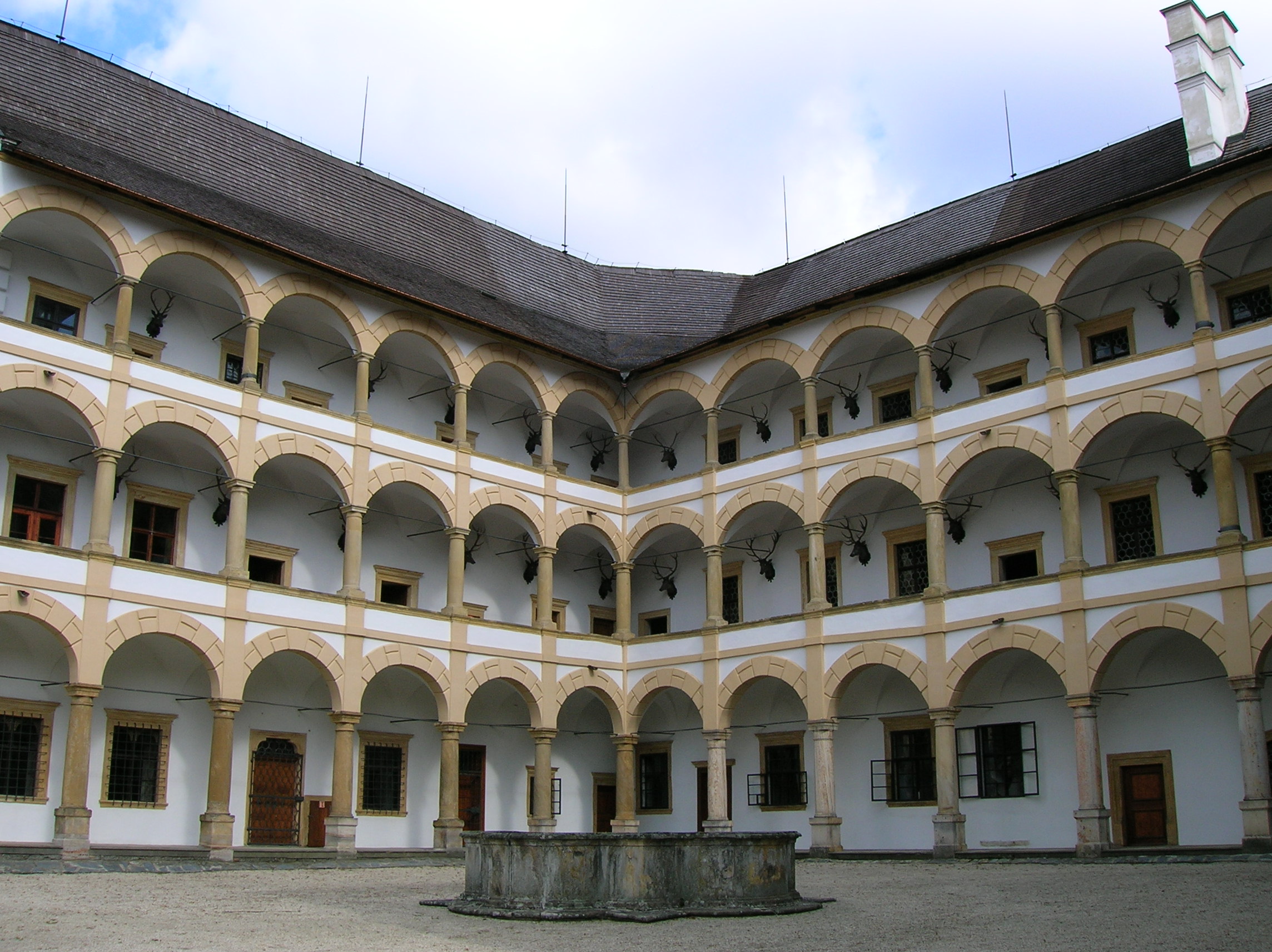
While I waited for the tour to begin on that freezing April morning, I familiarized myself with the history of the chateau as described in a booklet I had purchased. Žleby was first mentioned in writing during 1289. The Lichtemburks owned Žleby until 1356, when Holy Roman Emperor Charles IV gave it to Markvart from Vartenberk. During the Hussite wars, the castle was razed, sharing the same fate as many other places in Bohemia during that bloody era. Then Jiří from Dubé and Vizmburk restored the castle in Late Gothic style. It was changed into a four-winged Renaissance chateau with an arcaded courtyard at the end of the 16th century and the beginning of the 17th century under another owner. During the first part of the 18th century, Baroque renovations began.

Zleby2020ext9Zleby2020ext27

In 1746, while the Schönfelds owned the chateau, their daughter Kateřina married Jan Adam from Auersperg. When Kateřina died, the Auersberg line took over ownership of the chateau, and the family would retain Žleby for 200 years. Baroque restorations continued, and the Auersbergs also designed Rococo interiors. Some years later, owner Vincenc Karel Auersberg and his wife Princess Vilemína Colloredo-Mansfield would become responsible for many changes that gave the place a romantic makeover as they were influenced by English architecture from the first half of the 19th century.

Zleby2020ext12Zleby2020ext33Zleby2020ext34

Thus, from the 1840s Žleby took on a more romantic air. The Auersberg couple wanted to give the chateau more of a Gothic character and added a prison and bastions. They fitted the interior with leather wallpaper, wood furnishings, weapons and historic furniture, all of which can be seen in the chateau today. In 1849 Vincenc bought land for the future park. In 1942 the chateau changed hands, and after the war it was nationalized.

Zleby2020int68

zleby2020int69-e1594564857806.jpg

Zleby2020int70

The chapel was first on the list. Upon entering the tiny, quaint two-floor chapel, the narrow, high and oblong stained glass windows behind the altar of the Annunciation of the Virgin Mary caught my attention. The windows bewitched me with their dynamic, bright colors. I then studied the main altar and was drawn to the bright red of an angel’s cloak. The chapel was the youngest part of the chateau, in 19th century Neo-Gothic style, the guide – probably a university student – explained. It dated from 1853 to 1858. Still, there were a few items that went back farther than the 19th century. For instance, a side altar hailed from the 15th century. The triptych showed the Virgin Mary with a sculptural grouping of a Pieta in the middle of two statues. I noticed the trickles of blood on Jesus’ crossed hands. The oldest item in the entire chateau was here – a 15th century richly engraved baptismal font. Statues of saints were positioned high on the side walls of the chapel. I spotted the flapping drapery of Saint Elizabeth.

Zleby2020int35Zleby2020int37

Then we left the interior and walked through the courtyard with its breathtaking Renaissance arcades to another entrance. The inside hallway was dominated by a 16th century knight in armor on the model of a horse cloaked in red. The guide said that the knight weighed 40 kilograms, the horse 20 kilograms. On the walls were very wide moose antlers. I also noticed slits for eyes in some helmets, the shoulder boards and the neck guards of armor, a two-handed sword and a rapier.

Zleby2020int2Zleby2020int4

As we made our way up the Renaissance stairway, the young man leading our group pointed out that the chateau had the second most weapons after Konopiště, a popular chateau located about an hour from Prague. Indeed, on the walls leading up to the next floor I saw many weapons. Ancient rifles covered one wall, and in another place I spotted a white ivory horn with detailed engravings, once used by Polish King Jan III. Sobiesky, who liberated Vienna from a Turkish threat in 1683.

Zleby2020intKnightsHall2Zleby2020intKnightsHall3Zleby2020KnightsHall5Zleby2020KnightsHall11

We entered the Knights’ Hall, which was decorated with 14 knights’ armors from the 16th century, hunting trophies, pistols and swords –  one with red and green gem decoration in the hilt caught my eye –  as well as 188 painted glass pictures covering one wall. These glass paintings hailed from 1503 to 1749 and were decorated with allegorical figures, biblical scenes and coats-of-arms. I spotted the coat-of-arms of the Auersberg family above the doors. Three paintings from the beginning of the 16th century showed tournament and banqueting scenes. The ceiling featured stucco designs. An intarsia-designed credence was a delight, too.

Zleby2020int23Zleby2020int24Zleby2020int30Zleby2020int32

We went through the Emperor’s Room with its white swirls and flowers on brown wallpaper and dark brown table with white swirl decoration on the top. Then we moved on to the bedroom, where a brilliantly colored triptych from the 15th century entranced me. The gold and red colors complemented each other. A huge Baroque bed featured columns and a canopy. On the white tiled stove I saw scenes in nature. I noticed the sea, cliffs and a castle in the landscapes. A black and gold jewel chest was riveting as was an intarsia brown table. The golden wallpaper made an everlasting impression on me. Made with leather, it showed flowers with greenery and golden grapes. Little did I know that even more fascinating leather wallpaper awaited me in other rooms.

Zleby2020int78Zleby2020int82Zleby2020int90

The Prince’s Study was next on the agenda. The velvet leather wallpaper, colored dark blue and decorated with flowers, also heated the room. An intarsia closet was exquisite. In the Travel Room, silverware was packed in a box that fit into a portable chest that could be lugged around during journeys. The bed itself was enthralling – it could be packed up, appearing as a closet with intarsia design. A travel toilet in a box resembled a crate.

Zleby2020int14Zleby2020int16Zleby2020int20Zleby2020int21

The Rococo Salon was dominated by a tapestry featuring fountains, trees, apples, peacocks and well-dressed women taking a stroll through the idyllic scenery. Again, the wallpaper amazed me. This time it was decorated with flowers and birds. The leather wallpaper in this chateau brought to mind that fascinating leather wallpaper at Šternberk Castle in central Moravia.

Zleby2020int51Zleby2020int54

Soon we came to the Small Men’s Study with its daiquiri tiled stove that boasted coat-of-arms – just one of many tiled stoves that would bewitch me with its beauty. The leather wallpaper above the desk consisted of royal blue and brown swirls. I also peered at ancient books with delicate, brown and gold bindings.

Zleby2020int38Zleby2020int40


From there we entered the representative rooms. In the hallway the chairs had carved, wooden figures in their backs, and the bench also had a finely carved back displaying coats-of-arms. In the Thirty Years’ War Room the walls were covered in Late Gothic carved wood paneling with swirls cut into the wood. Elegant, dark chairs complemented ivory rifles and swords as well as helmets. There were two secret doors in the room – one led to a dry toilet and the other to the downstairs library.

Zleby2020int75Zleby2020int79Zleby2020int80Zleby2020int86

The upper floor library consisted of 6,000 books and 6,000 engravings. The big books had beautiful spines. Smaller books were set on shelves high on the walls. The Gallery enthralled as well. Engravings made up one display case. Paintings on the walls included those with animal scenes and a delicate still life of fruit. The leather wallpaper came from 72 deer. The walls were decorated with wood paneling featuring the geometric motif of the Auersberg “A”. There was also a Renaissance dagger that caught my attention. The coronation sword of Emperor Ferdinand I was compelling, too. A Baroque ebony bureau was made of ivory and tortoiseshell.

Zleby2020int91Zleby2020int94Zleby2020int97

The Red Room, though, had the most enticing wallpaper, with its gold and red ornamentation. A painting on the ceiling showed fluttering cherubs.  The Late Renaissance tiled stove from the 16th and 17th century featured Old Testament scenes in the upper part and New Testament scenes in the lower section. The green and brown colors made it attractive as well. The door with intarsia dated from the Renaissance, from 1573 to be exact, and used to be part of the Jihlava town hall. Above me was a beautiful, coffered ceiling.

Zleby2020int11Zleby2020int15Zleby2020int16

The Tyrol Room boasted a Baroque tiled stove from the Tyrol region that was just as captivating as the one in the Red Room. The brown stove showed scenes from mythology in white relief. The swirling, white columns on the stove were complemented by the swirling, pine wood columns in the wood paneling hailing from the Tyrol. A wooden Rococo sleigh for children looked precious. A Delft fajan vase was exquisite, and on the walls were impressive fajan plates.

The stunning Blue Salon was decorated with the biggest tiled stove in the chateau, a blue, white and mustard yellow piece hailing from Bavaria and featuring grape harvest scenes from that region. A rare black desk was complemented by gemstones. A Spanish-Moorish bureau from the 17th century graced the room as well. A  Baroque ebony cabinet hailed from 17th century Germany. The walls in the lower half of the space were decorated with light wood panels while the upper part included blue and gold leather wallpaper. I looked up at the wood, coffered ceiling. It was astounding.

Zleby2020int98Zleby2020int99Zleby2020int102Zleby2020int103

The Knights’ Dining Room did not disappoint, either. The biggest space in the chateau included an intarsia closet and rare hand-painted goblets with colorful figures. Swords and hunting trophies covered the walls. Another bureau in the room was decorated with an ivory engraving of a man on a horse, spearing a boar.

Zleby2020int100Zleby2020int101

Blue-and-white porcelain dominated the space where meals were prepared, and rare rose porcelain from Slavkov in Moravia was exhibited in the kitchen itself with its huge, astounding brickwork. Blue-and-white English porcelain was displayed on a table. A unique, 19th century, cylindrical grill stood out. The kitchen smelled like a bakery. Chateau employees in historic dress were baking bread. A boiling house and smoke house were attached, too. The stove dated from the 19th century.

Zleby2020int104Zleby2020int105Zleby2020int106

After the 10 of us on the tour sampled some homemade Easter bread, the eloquent and enthusiastic guide said goodbye. I took a few more photos of the romantic, fairy tale façade with elegant gate before heading to the park. Then I walked down the street to a pub for a fattening, yet tasty, lunch of beef and dumplings. From the pub window I gazed at the chateau. I felt as if I was a trance. I was so drawn to the chateau. I knew that soon I would have to wake up from my trance and get on the train to Čáslav, where I would switch to a Prague-bound train. Looking out the window at the chateau, I decided that I had had a great day. I just wished that more tourists would visit the chateau that was located only 18 kilometers from Kutná Hora, a major attraction.

Tracy A. Burns is a writer, proofreader and editor in Prague, Czech Republic.

Zleby2020int39Zleby2020int57Zleby2020int58Zleby2020int60Zleby2020int61Zleby2020int62

Velké Losiny Chateau Diary

ImageDuring an Easter vacation in Olomouc, I decided to pay a visit to the chateau in Velké Losiny, which was a two-hour bus ride away. I was enthusiastic about seeing the chateau as I had recently read Václav Kaplický’s Witch Hammer, based on the witch trials that took place in northern Moravia from 1678 to 1692. In both the book and real life, Deacon Kryštof Alois Lautner tried to protect those branded as witches from a cruel fate, but even he wound up on the stake. I thought it was interesting that the witch trails in what is now the Czech Republic had been confined to two regions of northern Moravia, where there was a mostly German-speaking population.

It terrified me that people could believe such terrible superstitions and that because of those superstitions they could torture and kill fellow human beings. For 15 years, when the emperor’s inquisitor Jindřich František Boblig from Edelstadt occupied the chateau, more than 100 people from the regions were killed, 56 of them from Velké Losiny. The opportunity to see a place where such religious intolerance was carried out sent a chill up my spine. The very idea of people being burned as witches terrified me; yet I just had to see this place with my own eyes.

It made me sad that, although there are no longer witch trials, religious intolerance in such extreme forms still exists today. There were so many examples of religious intolerance in the modern world that it frightened and disgusted me.

As the bus took me north, I saw more and more snow on the ground, even though it was spring. I was the only person on the bus without skis.  Many were even standing in the aisle because all the seats were taken. When the bus came to Velké Losiny, it passed the white three-winged Renaissance chateau with beautiful arcades but didn’t even slow down at the stop. The driver evidently thought he only had skiers on board, and no one was waiting at that particular stop. I spoke up frantically that I needed to get off the bus, and a skier quickly told the driver. Finally, the bus let me off. About 15 skiers had to disembark from the bus in order for me to get out. Luckily, even though the driver hadn’t stopped where he was supposed to, I still wasn’t far away from the chateau.

VelkeLosinycloseupWhen I approached the chateau, I noticed the exquisite sgraffito on one wall of the Renaissance wing from the 1680s and discovered that the chateau was really made of two parts: the Renaissance palace with arcaded courtyard and a Baroque two-storey building. The arcades in the courtyard gave the chateau a dignified look, I thought.  They dated from the 17th century, and the Baroque arcades were decorated with sculptures of dwarfs. It wasn’t until the tour that I realized the Renaissance windows were the oldest in Central Europe.

The guide explained that the Žerotín family had owned the chateau for more than 300 years, until 1802, and that Jan the Younger of Žerotín had built the Renaissance palace, a project that was finally finished in 1589. Also, this particular Žerotín, in 1596, founded the paper mill nearby, where paper was made by hand even today. It holds the distinction of being the only paper mill in Europe that makes paper by hand. During the Thirty Years’ War, the Žerotíns did not lose their property even though they did not convert to Catholicism. The Lichtenstein family took over the chateau from the Žerotíns in the 19th century because the Žerotíns were experiencing financial difficulties. The Žerotín portrait gallery in the chateau dates as far back as the 17th century, the guide pointed out.

Lake at Velke LosinyOn the tour, which consisted of only the guide and me, I stood on a parquet floor that was 400 years old. One 400-year old door was beautifully decorated with intarsia. In the Knights’ Hall I marveled at a majolica tiled stove, the third oldest in the Czech Republic, dating from 1585. The white, brown, blue and green colors intrigued me. The leather wallpaper also caught my attention. One of the two oldest leather wall coverings in the Czech Republic, it was decorated with floral ornament and a joint coat-of-arms of the Žerotín and Oppersdorf families. It dated from 1660. I especially liked the griffin with elaborate wings that stood for the Oppersdorfs. I looked up and thought I saw a panel ceiling, but it was only an illusion. The ceiling was, in fact, painted  in magnificent blue and gold colors. I also saw a Renaissance cupboard that was 400 years old, from the last quarter of the 16th century.

The guide informed me that above this space was a large room with a beamed ceiling where the witch craft trials took place in 1678, but the room was not open to the public. What a pity, I thought. That would be something to write home about! And to think I was standing in the room right below it!

In the library founded by Jan of Žerotín, the books ranged from the 15th to 19th century and were written in Latin, German and Czech, for example. They covered topics about horses, astrology and law, to name a few. In the center of the room, I saw a Renaissance reading pulpit made of ebony inlaid with ivory. I was especially intrigued with a leather wall covering that featured golden arabesques. Lions figured in some corners on the borders of the wallpaper.

In another room I saw the thrilling painting, “Night Festivity in Sienna,” which depicted firecrackers going off over a square. I liked the elements of fantasy in the picture that most likely dated from the 18th century.  I set my eyes on beautiful Baroque tapestries with motifs of a legend about Cupid and Psyche. They were woven around the middle of the 14th century. One tapestry illustrated a scene with Cupid and Psyche. A second tapestry showed Psyche and her two sisters. A third portrayed Mercury, Zeus and other gods at Cupid and Psyche’s wedding.  I saw even more tapestries in the chateau, and the guide proudly explained that this chateau had the second most tapestries in Moravia.

A set of four more tapestries decorated another room. The first showed Antony meeting Cleopatra; the second was titled, “A Torchlight Feast”; the third elaborated on the theme of Cleopatra’s and Antony’s love for each other; and the fourth, dating from 1560, dealt with Roman history as it portrayed the heroic young Roman Mucius Scaevola, who tried unsuccessfully to assassinate Etruscan king Lars Posenna. Because of his courage, he was not killed, though his right arm was badly burned. This particular tapestry dated from the second half of the 16th century.

In another room an early Baroque cabinet from Spain was inlaid with ivory. The drawers featured pictures made of tortoiseshell and ivory. I was enthralled by a small carved altar from Peru or Chile. It dated back to the 17th century, most likely. I saw even more leather wallpaper, this time from 1640, and a Baroque panel ceiling. I also took note of a Spanish bureau dating from the 17th century; it was called a vargueno. One particular painting fascinated me. It carried an inscription in an old form of the Czech language and showed a woman praying and Christ on the cross. Hailing from 1566, it was the funeral picture of Magdelene of Zástřizl, marked with the date of her death, the same year the painting was executed.

Then the guide and I came to a room where a copy of the official, thick book about the witch trials was displayed. She mentioned that among the 56 victims had been a Catholic priest. I imagined Boblig flipping through that fat volume, feeling pleased with himself, choosing which woman to torture next. Those thoughts both angered and terrified me. The atrocities of that period were too much for me to fathom.

In the two chapels, decorated by Jan Kryštof Handke and dating from the 1740s, I set my eyes on an astounding ceiling fresco featuring allegorical figures representing the four continents. A man with a parrot stood for America. Why Handke had chosen this particular symbol for America, I did not know.  Other figures included a kneeling woman with a crown to represent Europe, a man with a turban to denote Asia and a bowing black man as Africa.

The big chapel also featured a marble Rococo altar and a Renaissance altar of Madonna with child. The organ from 1723 still worked, the guide claimed. The fresco ceiling painting in the small chapel was the inspiration of Handke as well, and Baroque elements had been added to the late Renaissance altar. A copy of a Gothic statuette of Madonna of Altotting, from the Bavaria region of Germany, dated from the 14th century. Silk paintings also decorated the space.

The Empire Wing, where the Lichtensteins had lived, featured light wood Beidermeyer furniture. The porcelain was from Slavkov in the Czech Lands and from Vienna, Austria. The park, from 1802 in the English style, included eight sandstone sculptures of dwarves from the 1830s and a fountain decorated with a sculpture featuring fish and putti.

I left the chateau, astounded, unable to take in all I had seen, and set off for the paper mill nearby, where I went on a one-hour tour of the place. Founded in the 16th century, it was one of the oldest paper mills in Europe and was now the only existing one. Even the wife of a stationer who had worked here had been burned as a witch during Boblig’s reign. The handmade paper was made from cotton and flax. Some items in the museum included examples of Japanese handmade paper and a model of a paper crusher. I saw how paper was dried by hanging it on poles and learned about press compaction and the drainage of paper, among other things.

Then I found a restaurant in a hotel, ate a big meal of chicken, peaches and ham, wrote some postcards and soon left for the bus stop. This time, I hoped the bus would stop at the designated place.

It did.

Tracy A. Burns is a writer, proofreader and editor in Prague.

Arcades of Velke Losiny Chateau 2

Bouzov Castle Diary

BouzovAfter a one-hour ride from Olomouc, the bus left me off in the middle of nowhere. I knew that this bus would not take me to the main square, but I thought it must be near Bouzov Castle. The village of Bouzov, located in the highlands of Moravia, could not be so big, after all. Luckily, two women, a mother in her late forties or early fifties and her daughter, in her mid-twenties, got off with me. It turned off they were going to Bouzov Castle, too.


We climbed a short hill and walked along what could possibly be called a path, passing by some houses where big dogs barked ferociously in the front yards. The mother and daughter told me that they were from southern Bohemia and traveled for a week every year to a different part of the country to visit castles, chateaus and other sights. I began talking to the mother, as there was still no chateau in sight. She informed me that it was a two-kilometer trek.


While I was explaining to her the difference between a castle and a chateau, I thought I saw the daughter glare at me with a jealous look, as if I was intruding into her family by becoming friendly with the mother. She made me uncomfortable, and I felt like an intruder. I told the mother that while chateaus date from the 16th  to 19th  centuries, even sometimes into the beginning of the 20th  century, castles were built between the 12th  and 15th  century. Also, the purpose of construction differs: castles were made as fortresses for defense whereas chateaus were designed for comfortable lifestyles and usually were accompanied by parks and gardens.


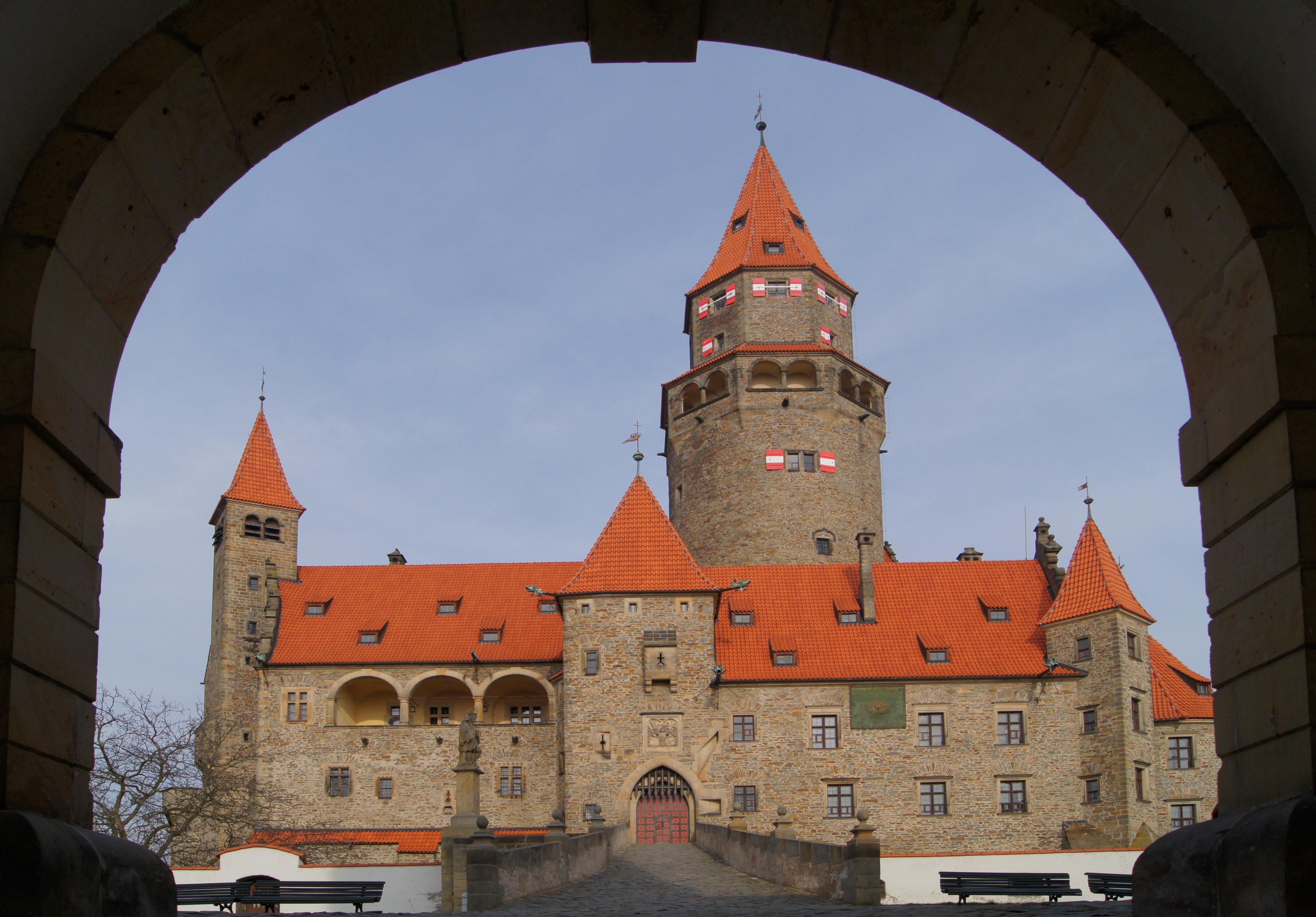
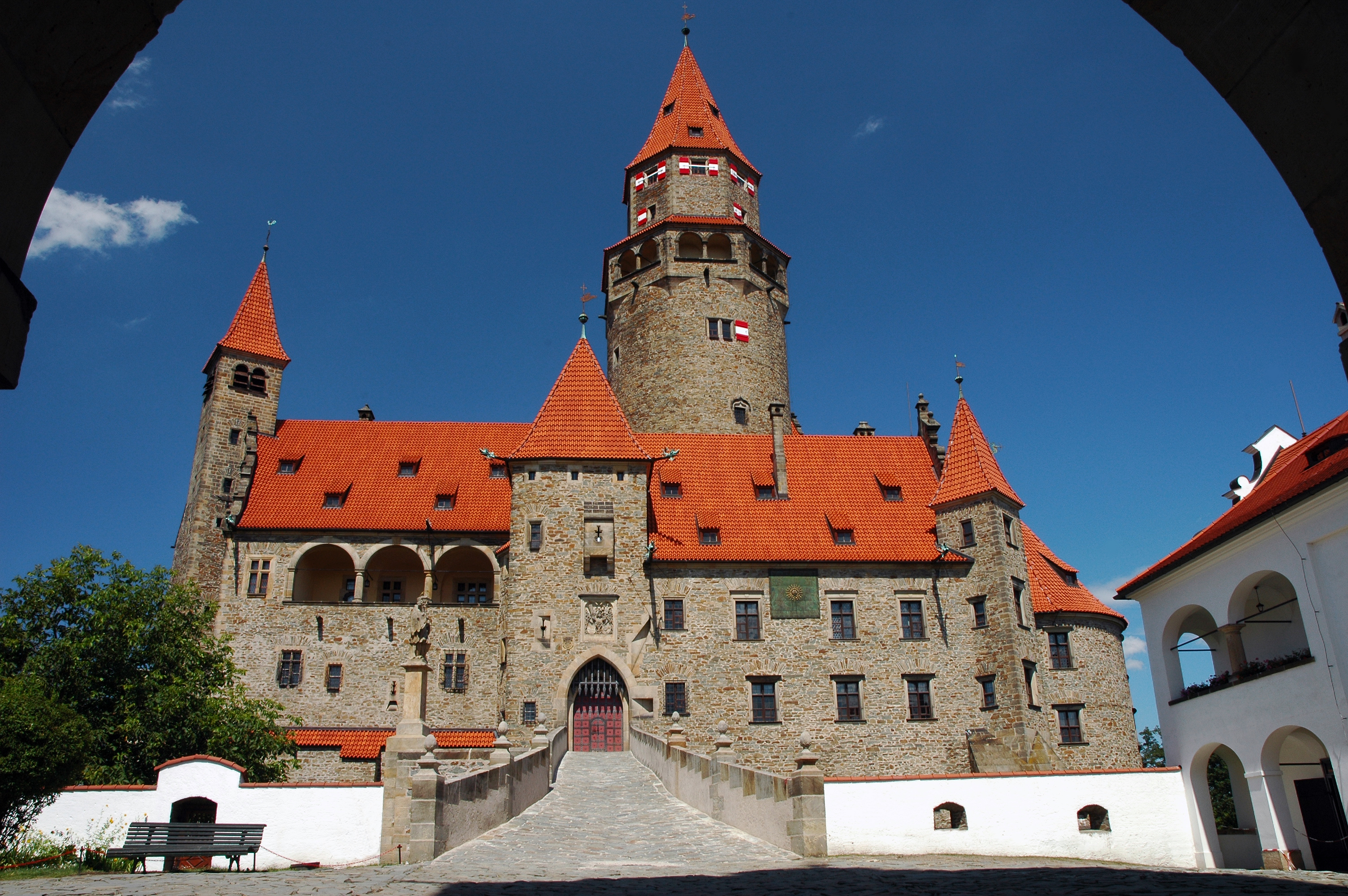
Finally, we came to the main square. I was stunned. Bouzov Castle had a fairy-tale appearance. I was so captivated that I was certain this would be one of my favorite chateaus even though I had yet to see the interior. While waiting for the tour to start, I read background material about the chateau in a brochure I had purchased at the souvenir shop.


Bouzov4Originally built in the early 13th century as a late Gothic stronghold, Bouzov was the property of the Order of the Teutonic Knights from the late 17th century until the end of World War I. (Founded at the end of the 12th  century by a group of German merchants, the Teutonic Knights first came to Bohemia in 1203.) Now it is owned by the National Monument Institution in Olomouc. The castle looked as it did at the end of its reconstruction at the turn of the 20th century, when Teutonic Knights’ Grand Master Eugene Habsburg, inspired by late Gothic and early Renaissance architecture in Germany and the Netherlands, had what was at the time practically a ruin remade into a residence with a romantic flair.


Indeed, I did find symbols of the Teutonic Knights’ order figuring prominently in the chateau; even the order’s crest adorns the second castle gate. I saw six tombstones of Grand Masters from 1395 to 1515 in the chapel. In the Knights’ Hall the coat-of-arms of all the Grand Masters of Bouzov decorated the walls.


It didn’t take me long to find a figure of Saint George, one of the order’s symbols. For example, a marble Renaissance statue, hailing from Venice, depicted this saint at the chapel’s entrance. Also an exquisite wall painting of St. George fighting the dragon adorned the Knights’ Hall.


I marveled at the walls of the Hunting Hall. They depict the ancient tale of Prince Aktaion and Goddess Diana: When Aktaion spotted the goddess naked, Diana got revenge by changing him into a deer. The Knights’ Hall was another gem. By that time, my head was spinning. I was so enthralled by everything I was seeing. That hall featured a Neo-Gothic fireplace, a Renaissance ceiling, exquisite wall paintings and stained glass pictures in the windows. The ravishing Baroque Grand Master’s Bedroom incorporated exquisitely woodcut sculptural carvings on two closets and chairs and a tiled stove decorated with figures of men and women clothed in Renaissance attire.


Bouzov3I had to watch my step at the grating and hatch on the floor of Court Hall; it led to the dungeon. Convicts were dropped through the hatch into the prison. The Nuremberg chandeliers that combined antlers with wooden figures impressed me in Eugene Habsburg’s private apartments. The guide told us that the biggest one weighed more than 300 kilograms (660 pounds) and held 48 candles.


In the chapel I took special notice of the late Gothic altar from 15th century Germany. The armory featured painted shooting targets of life-size figures. Other intriguing displays included gargoyles showing dragons’ heads. An executioner’s sword dating from 1677 boasted ornate decoration on both sides. There was a helical staircase inside an octagonal tower and a sundial on the courtyard façade, Gothic lattice windows, arcaded loggia and the 1929 signature of Tomáš Garrigue Masaryk (the first president of democratic Czechoslovakia) in the visitors’ book. I was especially excited about seeing Masaryk’s signature. I was a big fan of the Czechoslovak president and wondered how it must have been to live in the country during the 1920s, when he was in charge and democracy flourished here. That era fascinated me. It must have been exciting time to have been alive.


A theatrical performance featuring medieval-dressed performers and sword-fighting also entertained our group. There were four tours to choose from, and I went on two of them: the classic short tour which lasted 60 minutes and the long tour which lasted 100 minutes. A bit later I hopped on a bus that left from the main square and went back to Olomouc, enthusiastic about seeing one of the Czech wonders that had a magical touch and romantic air.


Yes, Bouzov Castle was definitely one of my all-time favorites.

Bouzov2