
Věra Jičínská – On the Terrace, 1934. Photo from webpages of Gallery of Modern Art, Hradec Králové.
What I like most about visiting Czech museums outside of Prague is that I often find an exhibition dedicated to an artist who is underrated and has been overlooked by the capital city’s art scene.I was in luck when I visited the Gallery of Modern Art in east Bohemia’s Hradec Králové because I came across an exhibition dedicated to the late artist and writer Věra Jičínská, who had made a name for herself in Europe during the interwar years. While she is best known as a painter, the thrilling show also emphasized her penchant for traveling and her talent as a journalist, photographer and designer. Back then, women were not expected to have careers but rather to dedicate their lives to raising a family. Jičínská demonstrated her independence by concentrating on an artistic career, smoking and sporting short hair.

Beach in Crimea (In a Small Bay), 1936.
Jičínská grew up near Brno and later studied in Prague at the School of Decorative Arts. She spent the following years living abroad, exhibiting her art during a seven-year sojourn in Paris after spending two years in Munich. In Paris she became steadfast friends with Czech painter Jan Zrzavý and composer Bohuslav Martinů. Her early career was influenced by Purism and Cubism, but during 1925 she developed a Neoclassical style. By the 1930s, her works were imbued with bright colors.

Parisian rooftops, 1923-24.
The exhibition’s display of paintings inspired by her travels was my favorite section. Jičínská’s paintings of Brittany’s landscape and fishing tradition captured my attention. That was one place I longed to see. Her romantic rendition of Paris’ rooftops and the Eiffel Tower brought back memories of my visits to the French capital. I went up the Eiffel Tower for the first time when I was a junior in college. As my friend and I enjoyed the sights from early morning until night every day, we drew energy from the electric atmosphere of the city and its many wonders. Her works showing places in Hungary and Czechoslovakia also captured my attention.
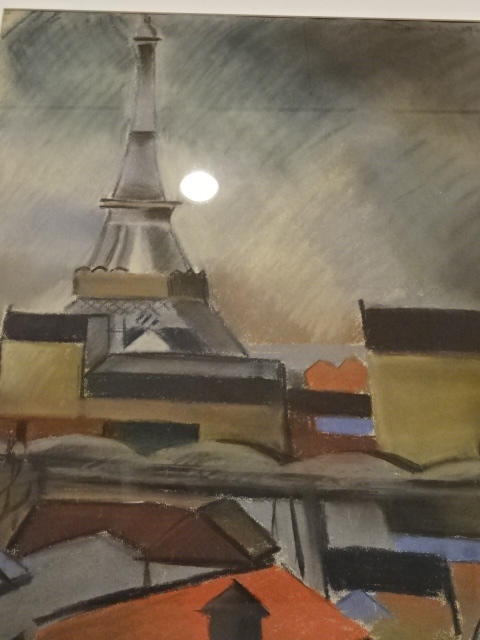
The Eiffel Tower, 1927.
Jičínská also became known for painting female nudes, a subject that, up until then, only had been taken up by male artists. She celebrated the female body in her works, even painting pregnant women. Dance was another theme she dealt with. The bright colors of her painting “Alexander Sakharov in a Fantastic Burlesque” captured the vibrancy of the dance. She was fascinated by folk culture. Her “Girl in Folk Costume” emphasized the beauty of the people, their costumes and folk traditions. Some of her art focused on Hindu dance themes, too.
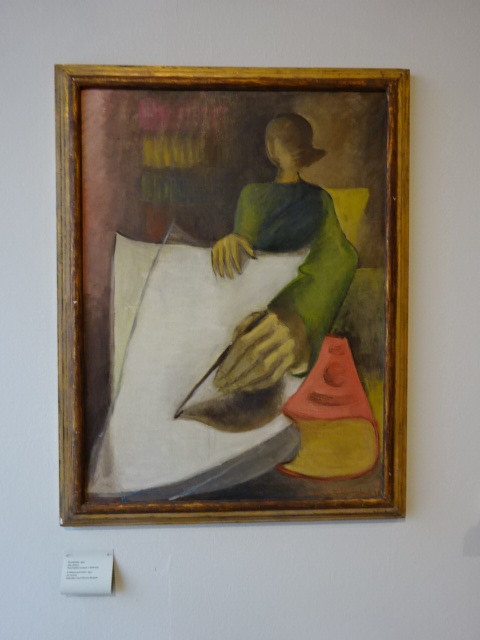
Journalism by Věra Jičínská
In the early 1930s, she took up journalism. Her articles examined modern culture – theatre, film and architecture, for instance. The profession of journalism was also the theme of some of her paintings. I had spent time as a culture writer for various publications, and her thirst for knowledge in the cultural sphere made me feel a certain kinship.
In 1930 she married a former classmate. The following year the couple moved to Prague, though her work was still exhibited throughout Europe. Together, the two trekked to Slovakia during 1933 and 1934, and she documented her trip with masterful photographs. Her pictures from Slovakia brought out the character of the people photographed. There was no exaggeration or embellishment to the photos. She emphasized everyday activities in her snapshots. This feature made me think of my favorite Czech writer, Bohumil Hrabal, who, in his fiction, stressed the beauty of everyday life. Ever since I read his books, I have become more appreciative of the little things in life that, up until that time, I would often take for granted, the small joys that take on so much meaning when they are gone.
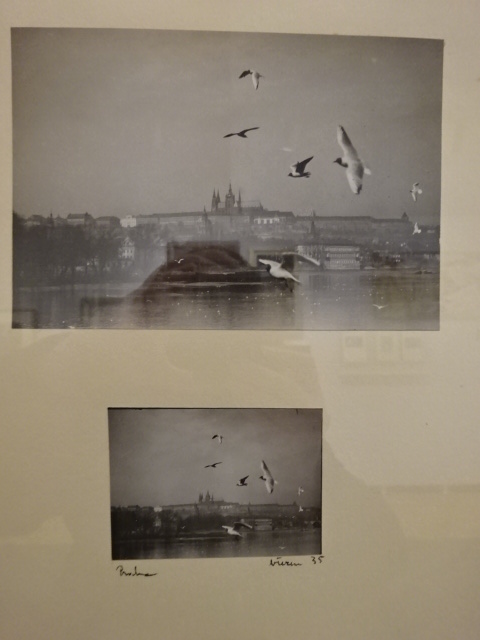
Gulls, 1933.
Still, the one photograph that impressed me the most featured gulls swooping around Prague Castle. I was reminded of one of the many views that had made me fall in love with the city – Prague Castle from several of the bridges, Prague Castle from the Vltava embankment, Prague Castle from the window of a flat I had rented long ago. After the attacks on September 11, 2001, I found great solace in that postcard perfect view from the apartment where I was living at the time. It helped me deal with the tragedy of that day, which would be forever etched in so many minds. Jičínská also took poignant photos during trips to Poland, Russia and Ukraine.

Brittany, 1928.
In 1937, her life changed again. Jičínská gave birth to a daughter whom she named Dana. While she devoted much time to motherhood, she did not give up her career. She even exhibited works during World War II. By 1941, she was concentrating on working with pastels to create a colorful dynamic and rendering many landscapes. In 1946, the couple bought a cottage in Říčky, a village nestled in the Orlické Mountains. Jičínská often painted there, and many Czech artists visited the couple during the 1950s.
The Communist coup of 1948 had had a devastating effect on Jičínská and her family. Her husband’s publishing house was nationalized, and he was no longer the boss but rather one of the employees. Her parents had lived in a villa in Brno, but the Communists only let them occupy several rooms. To make matters worse, her father saw his pension dwindle.
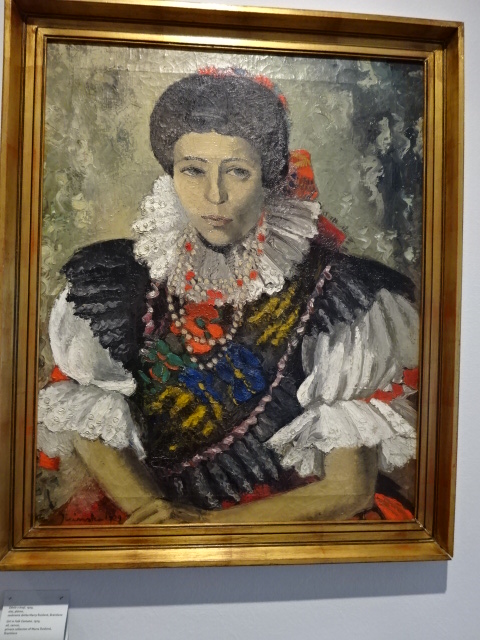
Girl in Folk Costume, 1929.
Due to the financial hardships, Jičínská branched out into more artistic fields. She designed postcards and became a designer who often worked with ceramics. In 1952 she was restoring a ceiling fresco at the Czechoslovak Academy of Arts and Sciences when the scaffolding collapsed. She was severely injured and could not continue as a painter. She focused on her work as a designer. On March 27, 1961, a year after her daughter married, Jičínská died in Prague.
Before this exhibition I had not even heard of Věra Jičínská. After seeing her works, I appreciated the obstacles she must have come across pursuing a career as a female artist, journalist and traveler during the interwar years. I grew up playing baseball and ice hockey with boys, and I often was the only girl in the baseball league. But that was nothing compared to what Jičínská had accomplished as a woman breaking down barriers and living an independent life the way she chose to live it, not allowing herself to be dictated by society’s norms.

Alexander Sakharov in a Fantastic Burlesque, 1932.
The Gallery of Modern Art’s permanent exhibitions were also fascinating, and I will write about that in a separate post. Twenty artists from the last century were featured in one section, and contemporary art played a role in the collections, too. But what stood out most for me was the exhibition of Věra Jičínská’s artistic accomplishments.
Tracy A. Burns is a writer, proofreader and editor in Prague.










 Tracy's Travels