
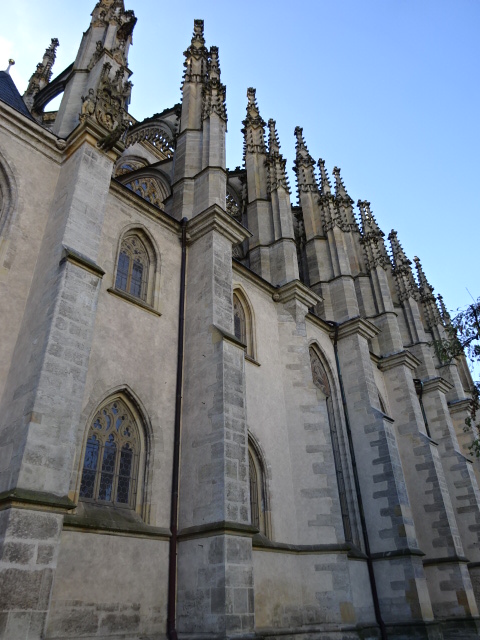
Whenever I visit Kutná Hora, the highlight of my trip there is the Late Gothic Church of Saint Barbara, a five-nave structure dedicated to the martyr representing the mining profession. During the Middle Ages, when the building of the church began, Kutná hora had been thriving thanks to its mining of silver and minting of groschen coins.

The exterior captures my undivided attention every time thanks to its double-arched flying buttresses and gargoyles. I loved the Late Gothic style that was preserved on the outside. While some of the interior had been transformed into Baroque and Neo-Gothic style, the church still retained many Gothic elements, including frescoes from the Middle Ages.

The construction on the church, initiated in the 14th century, was carried out by Jan Parler, son of Petr Parler. Jan’s father had been one of the most prominent architects and sculptors of the Holy Roman Empire under Emperor Charles IV’s reign, when Prague was the capital. Petr’s major accomplishments included work on Saint Vitus’ Cathedral at Prague Castle and the building of the Charles Bridge. Petr also planned the New Town part of Prague. His unique architectural style can be seen on Prague’s Old Bridge Tower, too. Jan took part in the construction of Saint Vitus’ Cathedral and was the main builder of the Church of Saint Barbara in Kutná Hora.

However, the Hussite wars of the 15th century got in the way, and work was halted as the church was pillaged. Construction was interrupted for 60 years. Then, at the end of the 15th century, Master Hanuš crafted much of the magnificent vaulting and part of the triforium.

After he died in 1489, a stonemason, sculptor and architect named Matyáš Rejsek took over. A master of the Late Gothic style, Rejsek had been inspired by Petr Parler’s creations. Rejsek made Prague’s statue-decorated Powder Tower, for instance. He also built Kutná Hora’s town hall, but that structure no longer stands. A large portion of the Church of Saint Barbara’s Gothic exterior was Rejsek’s work, including the gargoyles and upper triforium. He was responsible for interior décor as well, including the tabernacle, balustrades of the choir and the awe-inspiring choir vaulting adorned with emblems of countries and guilds. During his time, the church became a true Late Gothic gem. Construction did not stop until six years after his death, in 1506.

Then in the 16th century work started again with Benedikt Rejk (sometimes called Reid) in control. I knew him best as the architect of Prague Castle’s Vladislav Hall with its magnificent vaulting. He was responsible for the main nave and the Late Gothic large vaulting with helical ribs of the Church of Saint Barbara, for example.

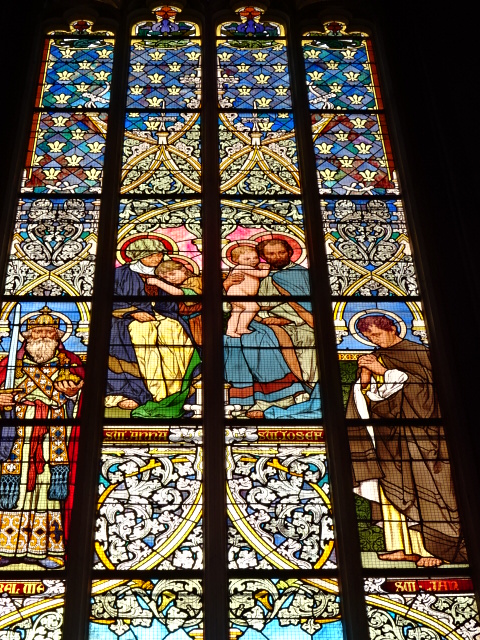
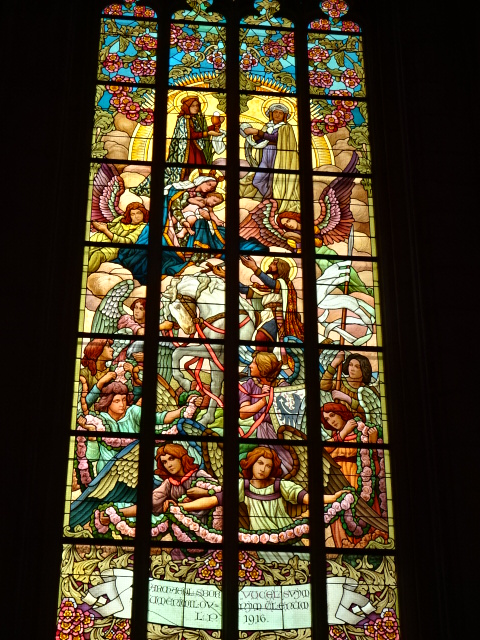
Baroque reconstruction took place when the Jesuits took charge. Then, from 1885 to 1905, remodeling was carried out. At this time the main altar and stained glass windows were formed. I was always particularly captivated with the windows dating from the end of the 19th century and beginning of the 20th century. The stained glass decoration portrays events in Kutná Hora and Czech history. Habsburg Emperor Franz Josef’s visit to Kutná Hora in the early 20th century makes up one scene.


One of my favorite works in the church is the statue of a miner, which hails from 1700. The miner is holding a lamp and tool in his hands as he seems ready to traverse the depths of the mines. Another gem, the statue of Our Lady Enthroned, dates from 1308.

The Minters’ Chapel is one of my favorites with 15th century frescoes that include a scene of two miners doing their job and a mallet-wielding minter making the groschen coins that Kutná Hora was famous for in the Middle Ages. In Smíšek’s Chapel visitors see the family gathered around an altar and other remarkable works. Baroque frescoes also dot the interior, including the altar of Ignatius of Loyola, which shows off the conversion of Ignatius.

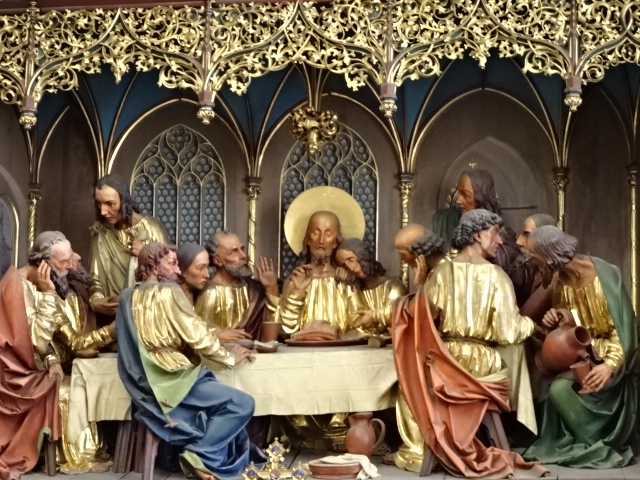
The intricate woodcarving of the choir benches hails from the late 15th century. The main altar is a Neo-Gothic replica of the original Late Gothic altar with the theme of the Last Supper. The Baroque altar of Saint Agatha is home to four Baroque paintings depicting the life of Saint Wenceslas, the patron saint of the Czech lands. The impressive stone pulpit dates from 1566.
I have never grown bored of visiting the Church of Saint Barbara, even though I have been there on numerous occasions. Both the exterior and interior are astounding as this church is the highlight of any trip to Kutná Hora.
Tracy A. Burns is a writer, proofreader and editor in Prague.




 Tracy's Travels