Petr Brandl Exhibition Diary

In October of 2023, I saw the comprehensive Prague exhibition “Petr Brandl: Story of a Bohemian” consisting of 64 altar paintings, portraits and genre works by Brandl (1668-1735), a masterful Czech artist during the Late Baroque period.

Self-portrait of Petr Brandl in a wig

I was well familiar with Brandl’s work. Many of the works shown at Wallenstein Palace were creations I had seen at chateaus, churches, cathedrals or monasteries throughout the Czech lands, such as at Břevnov monastery, The Cathedral of the Assumption of the Virgin Mary and Saint John in Sedlec as well as at Jindřichův Hradec Castle and Chateau. Another altar painting hailed from Church of St. John the Baptist near Manětín Chateau. Lnáře was home to another altar painting. I had visited the Baroque chateau and the cat museum in Lnáře a few years previously. The altar paintings on display had been restored over a period of two years.

Brandl was of Czech and German descent, baptized in October of 1668. At age 15, he served as an apprentice to painter Kristián Schroder, who later became custodian of Prague Castle. (Schroder’s work was also represented in this exhibition.) Brandl’s masterpieces showed a distinct influence of Karel Škréta’s dynamic and bold style, which was apparent because Škréta’s creations were displayed, too.

A friend of Brandl’s, legendary sculptor Matthias Bernard Braun utilized one of Brandl’s drawings for his design of the statue of Saint Luitgarda on the Charles Bridge. Coincidentally, Brandl had taken part in the competition to create the statues for the Charles Bridge, but Braun had been the victorious one. (I also saw examples of Braun’s work at this exhibition and couldn’t help thinking about the 24 allegorical statues of vices and virtues for former hospital Kuks in east Bohemia, rendered so masterfully by Braun.

Brandl had worked for some of the most prestigious noble families, including the Černíns, Lobkoviczes and Šporks. Brandl lived in Kuks, working under the guidance of František Antonín Špork, during 1731. The painter created a well-known portrait of his patron there.
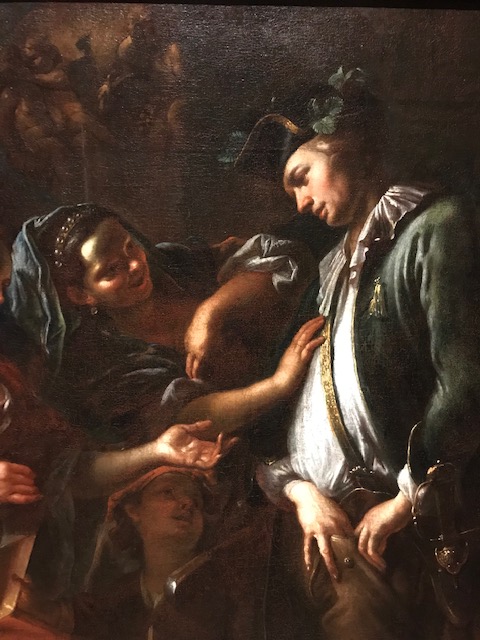
Coincidentally, Brandl’s brother had a claim to fame as well. Working as a goldsmith, Brandl’s brother contributed to the building of the Cathedral of Saint Vitus in Prague.

To be sure, Brandl was a prolific painter. In the Church of St. John the Baptist in Manětín, Brandl had designed the painting at the main altar. At the UNESCO-listed cathedral in Sedlec, Brandl was responsible for three paintings in the chapels. I also saw four of his paintings in Lnáře.  At Břevnov monastery his works dominated six side altars in the main nave. The themes of the paintings at the monastery, founded in 993 AD, included the dying Saint Benedict, Saint Vojtěch meeting with Prince Boleslav II at a spring, the murder of Saint Wenceslas and the crucified Christ.
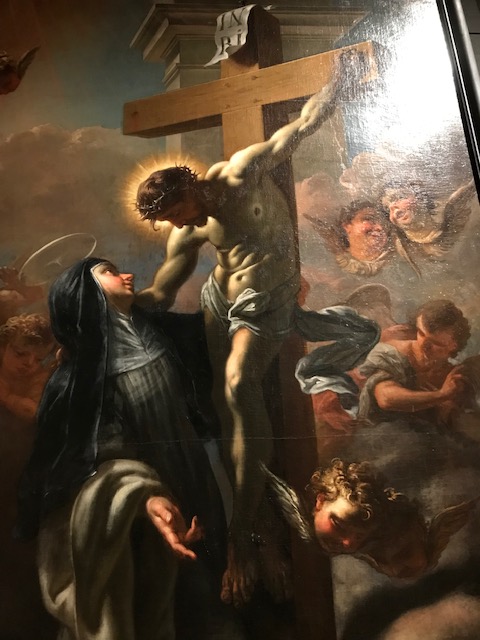
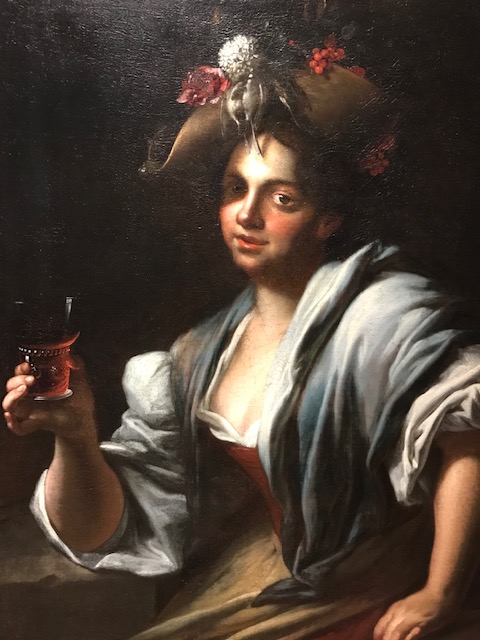
I had always been enamored by Brandl’s strong chiaroscuro and thick, energetic brushstrokes. His paintings, dynamic and vibrant in character, told distinct stories. His portraits brought the sitters to life. Those of elderly men, such as St. Jerome, were reminiscent of Rembrandt’s works in their expressive nature. His later works took on darker tones and utilized simpler modelling of shapes.

The exhibition also highlighted Brandl’s personal life, especially his monetary problems. I read descriptions of his troubles as I gazed at his monumental works. Brandl’s marriage was rocky in part due to financial problems. He also cheated on his wife, Helena. Wed to Petr Brandl during 1693, Helen often complained that he was a spendthrift and didn’t provide enough money for the care of his three children. He also owed money to the artist’s guild and was fined accordingly. Brandl was earning money but spent it all on an extravagant lifestyle. Brandl found himself in debt his entire life and even was imprisoned twice as a debtor.

His poor health was also highlighted in the exhibition. Brandl had trouble sleeping and took pills. He had pain in his joints and digestive problems, too. Those were just a few of his many ailments.

Saint Jerome

He was very poor when he died during 1735. Brandl was buried in a church in Kutná hora, a town about an hour from Prague, where he had spent time at the end of his life.

Fire of Troy

Despite his shortcomings as a person, Brandl was my favorite Czech Baroque painter and one of my favorite Baroque painters of all-time. I was enthralled by this exhibition and came away feeling joyous that I had been able to enter Brandl’s artistic worlds.

Tracy A. Burns is a writer, proofreader and editor in Prague.

Lnáře Chateau Diary

I hadn’t been to Lnáře for 13 years. This time a friend drove me there. We had lunch in a local restaurant, where three cats begged for food when not basking in the summer sun. I fed the black cat some macaroni. I love black cats. I’ve had two of them. I think they are good luck, and it is a shame they are least likely to be adopted.

The two-storey Baroque Lnáře Chateau hailed from the 17th century and has four wings as well as an elegant courtyard with arcades. It is situated in an area of south Bohemia dotted with numerous ponds. The chateau has had 17 owners. I found the 20th century information to be the most intriguing. In 1936 Prague lawyer Jindřich Vaníček bought it from Karel Bondy. During the Second World War, the Hitlerjugend occupied the chateau. At the end of the war, American troops stayed there. The first group of Americans to reside there was very well-behaved. However, when they left a second group of Americans came to Lnáře. These Americans were rambunctious, wild; bullet holes in the chateau walls attest to their despicable behavior. On the tour I would read information about the Americans’ time in Lnáře.

Information about the American troops arriving in the town

This chateau is also known as the place where Soviet General Andrey Andreyevich Vlasov capitulated. Vlasov’s military career was unique, to say the least. He made a name for himself fighting for the Soviets in the Battle of Moscow. Then, trying to thwart the siege of Leningrad, he was captured by the Nazis and switched sides, fighting for the Nazis. Thousands of bulletins showing his picture were circulated, as the Soviets were eager to capture him. With the Germans, he formed the Russian Liberation Army. At the end of the war, he changed his allegiance again, when the Russian Liberation Army was ordered to aid the Prague Uprising that pitted Czechs against Germans. The Soviets captured him while he was trying to escape to the West. He was hanged for treason.

After the war, the chateau was returned to Vaníček, but he didn’t have it for long. The Communists took it away from him, and in 1948 the chateau was nationalized. Lnáře was in decrepit condition until 1972, when repairs got underway. In 1985 it became a recreational center for high-ranking Communists. It was returned to Vaníček’s descendants in 1992 and remains family property.

Arriving at the chateau, we walked across a stone bridge with six statues of saints from the 18th century. In the courtyard, my friend took my picture in front of a 17th century fountain of Neptune.

Soon it was time for the tour. The stunning statues on the staircase of the main hall were the work of master Czech and Austrian sculptor Ignác František Platzer, who had been considered the best in his field during the second half of the 18th century. He created sculptures in late Baroque style and later worked with classicist forms. Whenever I thought of Ignác František Platzer, the two statues of the Battle of the Titans at the entrance gate of Prague Castle came to mind.

However, that was by no means his only claim to fame in Prague: the Archbishop’s Palace near Prague Castle and Kinský Palace in the Old Town were just two more examples of his many contributions to the Prague art scene. I knew his sculpture also graced Dobříš Chateau and Teplá Monastery, two sights I had visited years earlier. I also was a big fan of the Church of Saint James in the Old Town, another structure that featured his statues.

Two of my favorite artists had added to the decoration there – Baroque painter Petr Brandl and Czech Secession sculptor František Bílek. Statues of Greek gods and goddesses were the work of Ignác Michal Platzer, the son of Ignác František.

I was entranced by the many wall and ceiling frescoes as well as the stucco decoration. Many frescoes featured mythological themes. The Main Hall was one of the highlights of the interior with its frescoes and stucco adornment. Weddings often took place in the chateau. We saw a luxurious room for the bride and groom. Rooms for other guests were also available.

Another highlight was the early Baroque Chapel of Saint Joseph, which dated from 1654. The choir’s stucco and painting decoration hailed from around 1660 as did the main altar that was flanked by Saint Wenceslas and Saint Ludmila. In the nave I saw more frescoes – these portrayed scenes from the life of Saint Joseph and illustrated figures in the Old Testament.

We were excited to visit the Cat Museum, too. Figures of cats, paintings, drawings and coat-of-arms of towns symbolized by cats were some of the highlights. I especially liked the two-meter high copy of an Egyptian goddess represented by a cat and the cheerful painting of a cat by František Pon, a pseudonym for a married couple who designed books and paintings featuring felines. A shoe cleaner with a brush on the back of a cat figure was a unique item.

I liked the fact that my favorite Czech author, Bohumil Hrabal, was mentioned in the description about cats and literature. He had taken care of many cats and had written about them. I thought back to my visits to the U zlatého tygra pub in the 1990s. Hrabal would always order me fried schnitzel because that was what Bill Clinton ate when he had come to meet the legendary Czech writer. Then Hrabal would pour some of his beer over my schnitzel.

Overall, it was an excellent outing, and I was cheerful despite the pandemic riddling the world when I returned to Prague.

Tracy A. Burns is a writer, proofreader and editor in Prague.