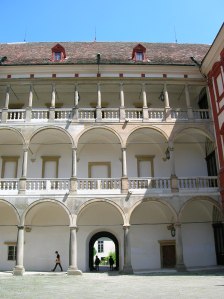
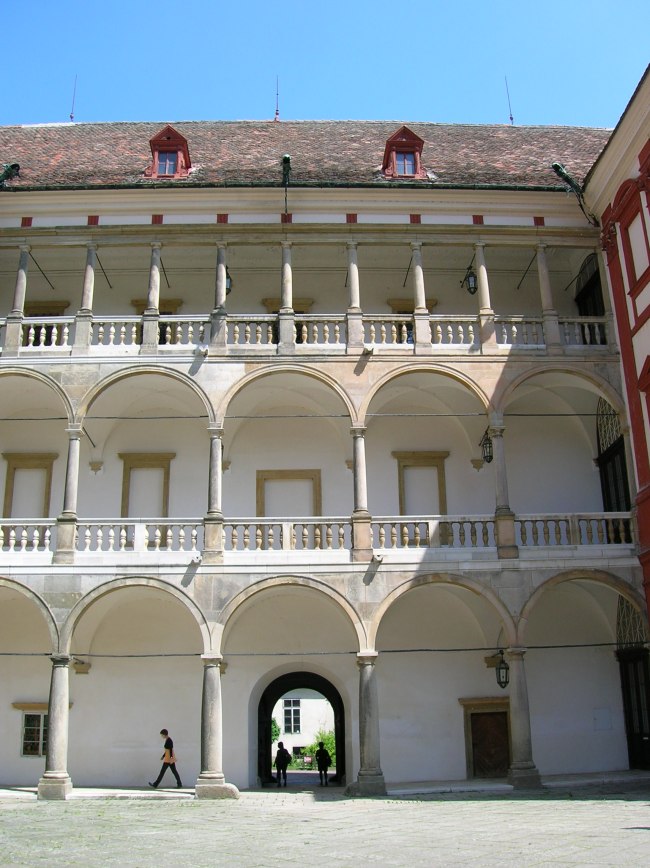
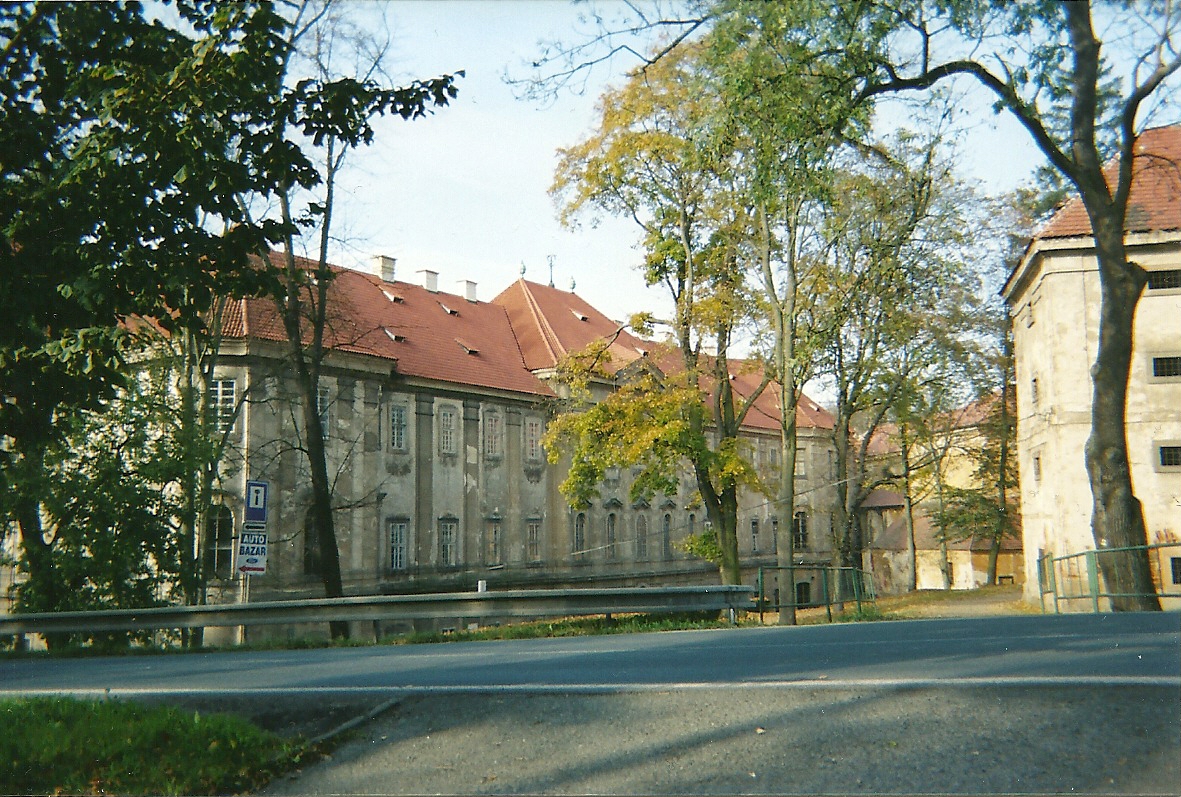
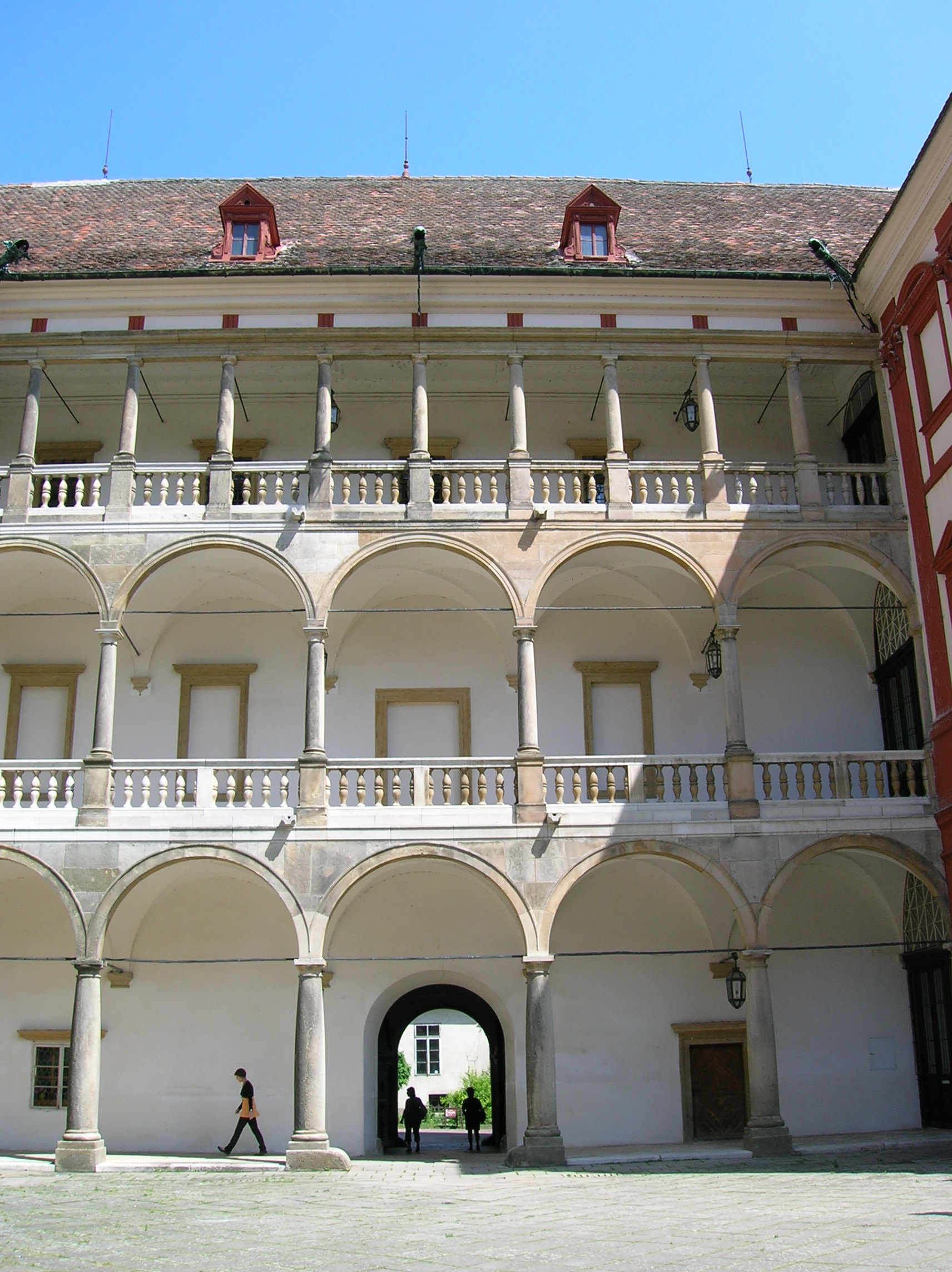
 The trip went well. I changed buses at Hradec Králové after a little over an hour’s ride and then took another bus for almost an hour to the main square of the small town in called Opočno, where there is a chateau of the same name. I was in northeast Bohemia, near Poland, not far from the Orlické Mountains. It didn’t take long to find the chateau as it was only 300 meters from the bus stop. After I bought my ticket, I walked through another courtyard and found myself staring at a façade with two-tiered light and airy arcades and a columned balcony on the third level. Flanking the arcaded façade were adjoining buildings of a pleasing red brick color complemented by white. Neatly trimmed circular hedges added color to the courtyard.
I had done enough reading about the chateau to know that the name Opočno conjures up a few intriguing stories connected with the chateau’s history. In the second half of the 15th century, the owner, Jan of Drslavic, protested against the legendary preacher and martyr Jan Hus being burned at the stake. Then he changed his mind and supported those who did Hus in. Jan Žižka, Hus’ successor with the Hussites, razed some of the surrounding villages and partially destroyed part of the chateau. Jan of Drslavic even hired a hitman to murder Žižka. He was unsuccessful.
When, during the 16th century, the Trčka family retained ownership of the chateau, Mikuláš Trčka Jr. not only reconstructed the chateau but also had his wife immured alive because she was unfaithful to him. Her lover was beheaded.
A significant historical event took place here as well. From June 16 to June 23, 1813 this was the setting for meetings dealing with the strategy to defeat French Emperor Napoleon Bonaparte. Austrian Chancellor Klemens Wenzel, Prince von Metternich; Russian Czar and Emperor Alexander I; and the King of Prussia, Friedrich Wilhelm III, were the main players in this historical drama.
Perhaps the 16th century is better known for the Trčka family’s work on the chateau. Jan Rudolph Trčka constructed a summerhouse and had built a garden and orangery with a Renaissance park and ponds. During the 18th century the façade took on a Baroque appearance.
The most significant changes, though, probably came about when Rudolph Joseph Colloredo-Mannsfeld became the owner in 1807. A greenhouse was built, and the English style park was filled with ponds and many types of plants, some of them exotic and rare. In 1896 the family moved their impressive picture gallery to the chateau. At the beginning of the 20th century, Joseph Colloredo-Mannsfeld transformed some interiors into Rococo style.
His successor, though, was not so lucky. The Nazis overtook the chateau and grounds in 1942. After the war the chateau became the property of newly independent Czechoslovakia. The chateau underwent much restoration during the late 1980s and early 1990s, but disaster hit in 1998, when floods ravaged the park. It took two years to clean the mud out of ponds, bridges had to be rebuilt, and rare species of plants had to grow anew.
Although the Colloredo-Mannsfeld family asked for the property back during 1992, they did not get their wish granted until 2003. Some legal disputes have yet to be settled, though.
 It was soon time for the tour. The first room I entered was the Ethnographic Hall, where I saw various objects from Sudan, Egypt, Central Africa, and South America. There was an Arabic sword and breastplate armor as well as a tonton drum. Arabic furniture and the apparel of the Sioux and Apache Indians were also on display. The Central American Indians were also represented.
Swords, shields and armor from the 16th to 19th century adorned the staircase as did paintings of the chateau as it had appeared at the beginning of the 18th century. Colloredo-Mannsfeld family portraits also hung here.
The Chapel of Saint Anne, dating back to the early 18th century, took up two floors. It was adorned with a fresco showing the coronation of the virgin, a painted ceiling showing swirling figures and also images of patrons of the Czech Lands. It boasted rich wooden décor. It was breathtaking to look up at all those swirling figures. I felt gripped by their beauty.
The Study boasted Italian commodes from the 16th to 17th century and a Neo-Renaissance wardrobe. One painting, called “The Twelve-Year Old Jesus in the Temple,” was executed by a follower of Hieronimus Bosch around 1550. The bright pink robe of one of the rather static figures caught my eye.
In the Smoking Room I was impressed with the glass – there was a collection of Venetian glass from the 16th century as well as Czech cut glass. German guild goblets, German pottery and Empire style Viennese porcelain also made the room intriguing. I spotted an ashtray shaped as a horn and made out of brown leather. I especially liked the hand painted vases and the glasses sporting coats of arms. I recognized pictures of Dobříš Chateau, near Prague, and Opočno Chateau on two glasses.
A Hapsburg dynasty portrait gallery called the Dining Room home. I spotted Empress Maria Theresa of Austria in a blue dress as well as Holy Roman Emperor and King of Bohemia Leopold I and his first wife, Margaret Theresa of Spain. I had visited enough chateaus to know that the pair was considered the ugliest and most faithful couple, according to legend. Somehow the curly, long black hair and moustache didn’t suit Leopold I’s disproportionate face, only making him more displeasing to the eye. Elaborate candlesticks were 200 years old, dating from the 18th and 19th century.

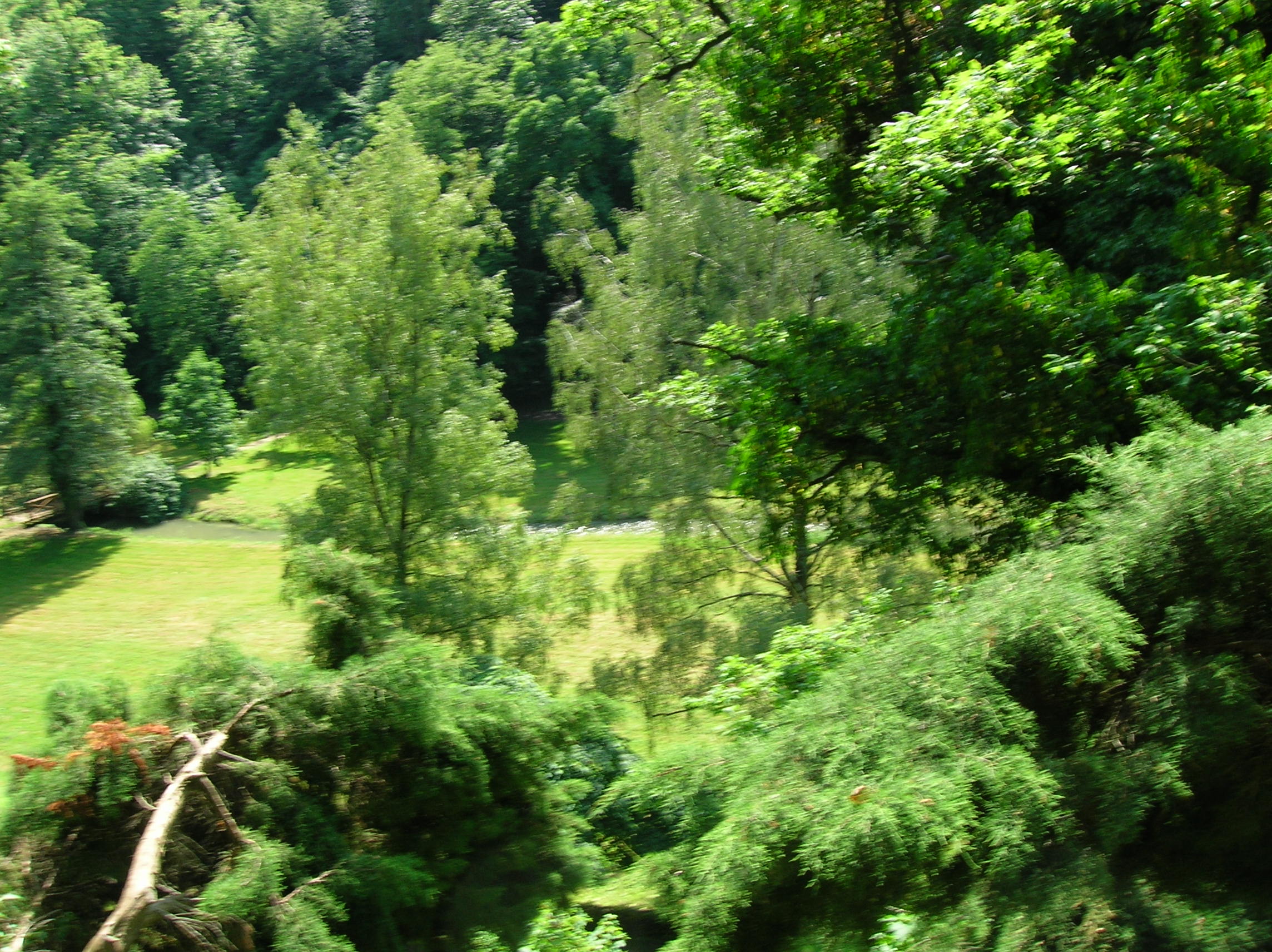
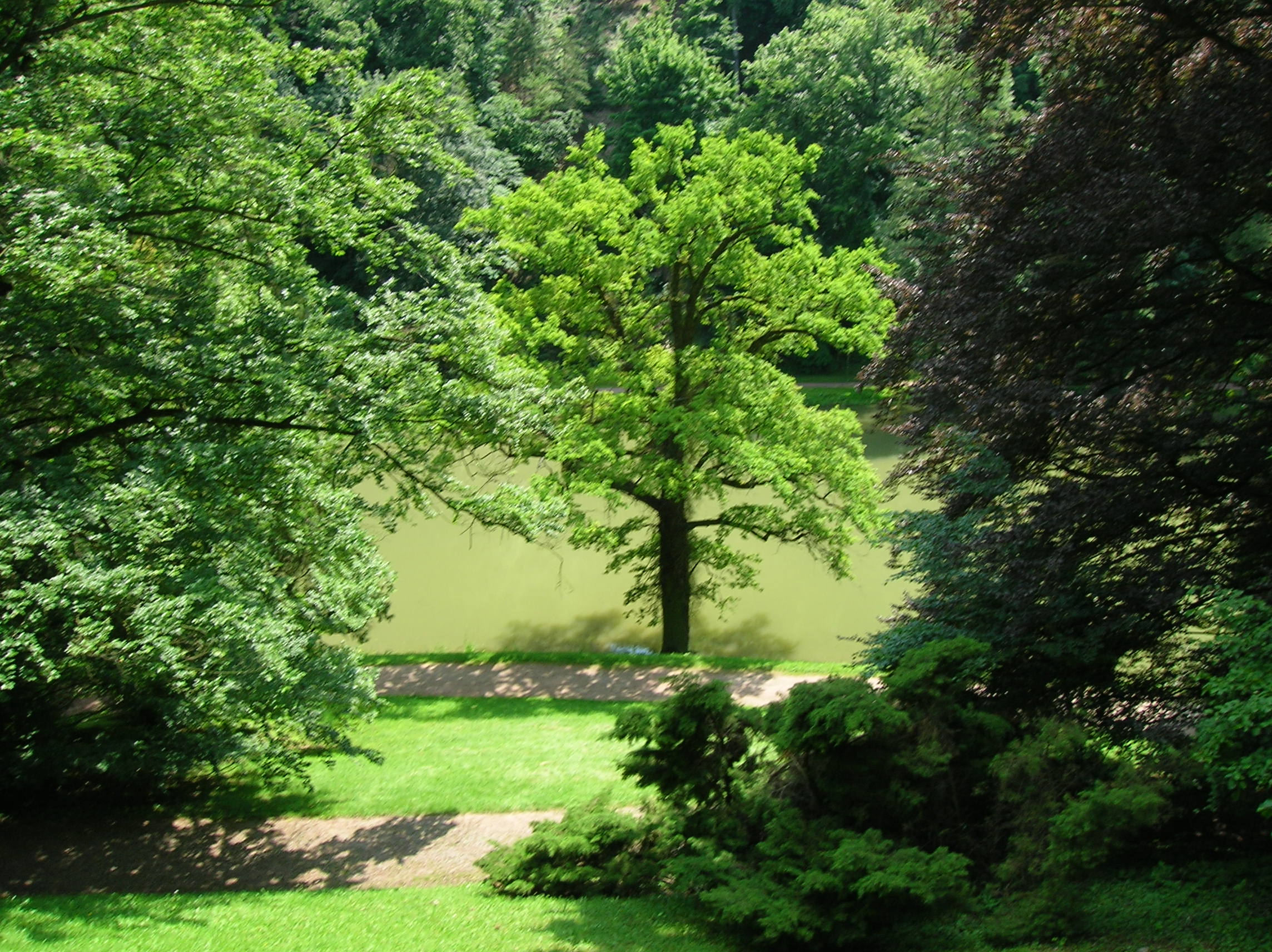
The chateau park
Flemish tapestries and hunting trophies from North America and Africa dotted the Game Room, which was also fit with a pool table. While I was always entranced by Flemish tapestries, I did not like hunting trophies, as I do not approve of killing animals for sport.
The Changing Room was distinguished by the 18th century Flemish tapestries with a hunting theme as well. Baroque still life paintings also adorned the walls. The guide told us that during the 18th century women could not show their ankles because it was considered the most erotic part of the body.
The Ladies Bedroom had a small bed because women remained in a sitting position while asleep so they wouldn’t mess up their elaborate hairdos. That was how the guide explained it. But I had also heard on many tours that people back then were afraid they would die if they lay down at night. I was particularly drawn to one black-and-white painting showing Empress Maria Theresa of Austria with 13 of her 16 children. Why only 13? Because three had already died before the painting was executed. The colorful chandelier made of Venetian glass will fall if an unfaithful man steps under it, the guide told us. I hoped there were no unfaithful men on the tour.
The Guest Rooms exhibited various styles of furniture, from Renaissance, Early Baroque and High Baroque to Classicist and Empire. In the Classicist room I noticed an intriguing stand for candles with three-tiers, one with figures of people, another with ravens and a third with what looked like cherubs.
Then we came to my favorite rooms, the small and large picture galleries. There were so many swirling Baroque figures in the paintings that it was overwhelming. I was dizzy with awe. The paintings were side-by-side, so close to each other. The small gallery featured Italian paintings of the Venetian and Ferraro Schools, to name a few, ranging from the 16th to 18th century while the large gallery was dominated by the work of the Neapolitan School and others during the 17th and 18th centuries. Three large paintings also depicted the history of the Italian town Mantova. I noticed a rendition of a hilly landscape, in calming blue and green, with a man in the foreground kneeling in front of some water. In the large gallery some seascapes caught my eye. One painting depicted a man with six toenails. On a hall there was a map of the area around Opočno with a legend of various places depicted on the painting. Yet another showed a battle scene with ruins in the background.
 I would like to point out some of the paintings that particularly enthralled me. In Luca Cambiaso’s “The Holy Family,” I took note of how Mary gazed so lovingly at the baby Jesus as she tickled his foot. The darkness contrasting with light caught my attention in Francesco Trevisani’s “The Assassination of St. Wenceslas.” While angels congregated in the light sky above, a helmeted man decked in blue gripped a dagger in the lower portion of the painting, almost complete darkness enclosing him as he was ready to strike an almost lifeless, chained Saint Wenceslas. Rays of light streamed into the darkness at a right angle. In “The Battle,” by a follower of Salvatore Rosa, one fighter on horseback shoved his sword into his foe, who began to slide off his horse. The wounded lifted up one hand toward Heaven as if asking God to stop time. I was moved by the helplessness of such a gesture. The atmosphere was totally different in Giacomo Po’s “Victor’s Apotheosis II,” as I saw a swirling figures and horses carried out in Baroque style. The clear, light blue sky melting into the horizon and the dark green color of the trees in the foreground had a calming effect on me in Jan Frans van Bloeman’s (known as Orizzonte) “Landscape in Campagna.”
The library became another of my favorite rooms as I was entranced by its rare books. Martin Luther’s German 16th century translation of The Bible was here, and I knew how much that book had influenced the evolution of the German language. There was a French encyclopedia dating from 1765, too. Altogether there were about 7,000 books, bound in what looked to be gold, written in languages such as Latin, French and Italian. The subjects ranged from religion to history to linguistics to philosophy. One manuscript was called The Czech Chronicle of the World – this was my favorite – and it had been printed before 1423 in Nuremburg. I loved old, fragile manuscripts. The ancient, crisp paper with the neat, careful, fancy script always caught my eye. Each page seemed to have a life of its own, to tell its own story. To me such manuscripts seemed magical.
I wasn’t keen on weapons, but the three rooms – the Asian Armory, the Hunting Hall and the Knights’ Hall – were impressive, no doubt about it. The Asian Armory featured weapons from the Near East and Far East, from countries such as Turkey, India and Japan. Perhaps the highlight of the room was the 2,000-year old small bronze drum from the Dongon culture of what is today North Vietnam. I took note of a sword from Thailand with beautifully carved handles. What intrigued me the most, though, was one object from Japan. It consisted of poles with spikes that had been used to catch the kimonos of thieves in the market.
The Knights’ Hall portrayed the development of weapons and armor from the 15th to 18th century, some pieces harkening back to the 15th century Hussite Wars and the 17th century Thirty Years’ War, for example. The guide showed us one sword that had no sharp point because it was used for executions. A Roman helmet was 2,000 years old and found in what is now Moravia. Another unique object that caught my attention was a painting of Opočno. It looked nothing like the chateau because the painter had never been there
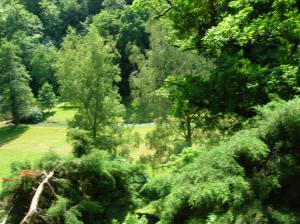
 After the tour I went to the park. It was a very hot, sunny day. I sat on a bench not far from the entrance, under a tree in the shade and stared at the pond and leafy trees that looked like enchanting scenery from a postcard. This was my favorite park, I was certain. I felt so at ease here. I couldn’t exactly explain why. I didn’t need to go to the sea to relax. I just needed to go to Opočno’s chateau park. When I first visited Opočno 10 years earlier, I had thought that I would like my wedding to be here, so I could walk with my new husband through this park, through this fairy tale of natural wonders. Ten years later, still with no husband, I sat on the bench and read The Death of the Beautiful Deer by Czech author Ota Pavel. I stayed there for about two hours, content, not wanting to leave. But I had to get something to eat before I caught the five o’clock bus back. The closest restaurant was reserved, so I found a pub with attractive seating on the main square and chose my favorite – chicken with peaches and cheese plus a diet Coke.
I got to the bus stop on the main square about 20 minutes before five o’clock. According to the schedule on the Internet, the bus was supposed to come a little after five. I wanted to check it on the schedule on the bus stop, but I couldn’t. It was June 12, and the bus schedule changed June 13. Tomorrow’s schedules were already posted; today’s had been taken down already. I could only hope my information from the Internet was right. Then two teenage girls showed up at the stop. The bus came about 10 minutes before five o’clock.
I had been lucky. In early August, when I looked up the times of buses from Hradec Králové to Opočno, according to the web site, no such connection existed.
Tracy A. Burns is a writer, proofreader and editor in Prague.
 After a one-hour ride from Olomouc, the bus left me off in the middle of nowhere. I knew that this bus would not take me to the main square, but I thought it must be near Bouzov Castle. The village of Bouzov, located in the highlands of Moravia, could not be so big, after all. Luckily, two women, a mother in her late forties or early fifties and her daughter, in her mid-twenties, got off with me. It turned off they were going to Bouzov Castle, too.
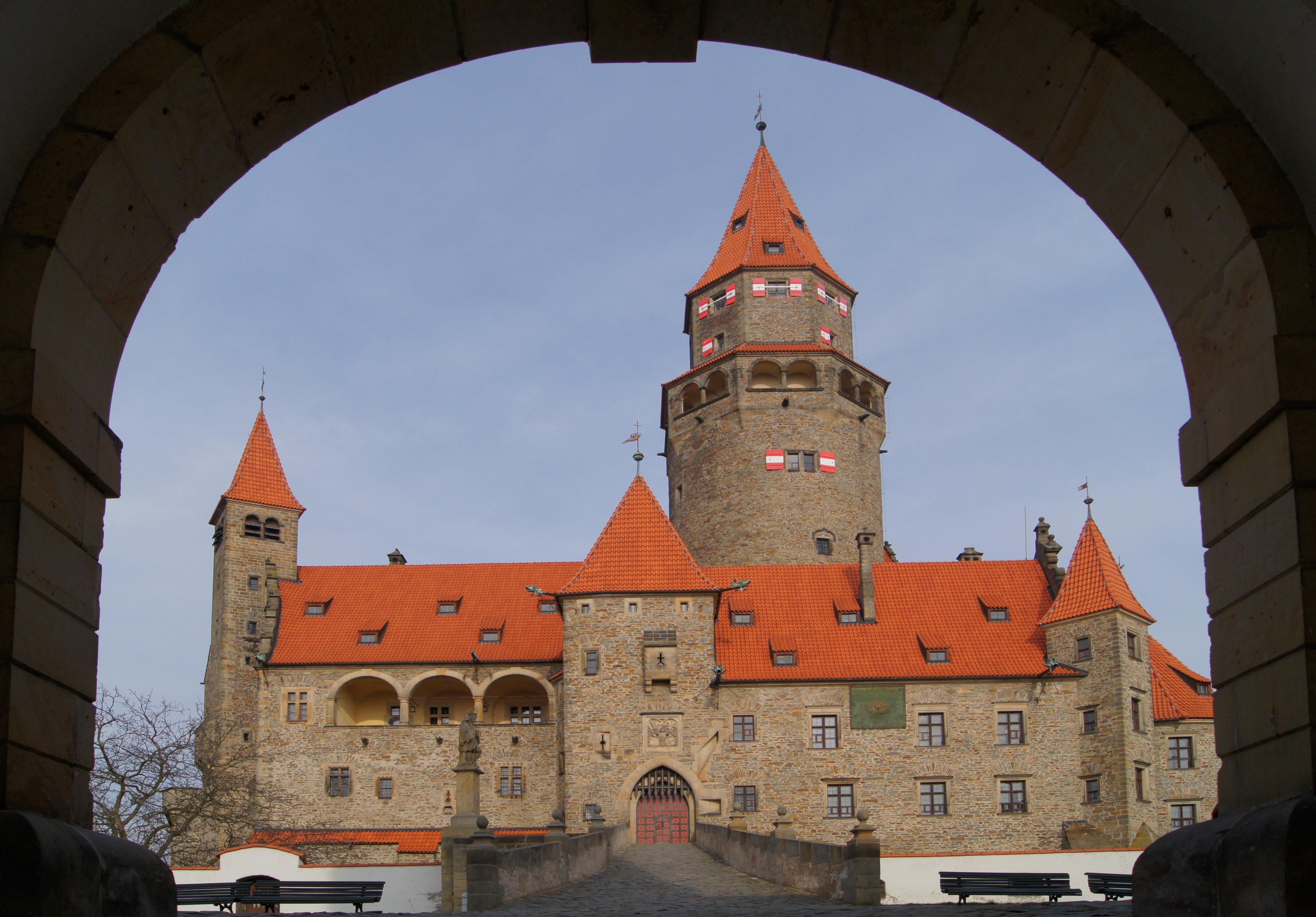 Originally built in the early 13th century as a late Gothic stronghold, Bouzov was the property of the Order of the Teutonic Knights from the late 17th century until the end of World War I. (Founded at the end of the 12th century by a group of German merchants, the Teutonic Knights first came to Bohemia in 1203.) Now it is owned by the National Monument Institution in Olomouc. The castle looked as it did at the end of its reconstruction at the turn of the 20th century, when Teutonic Knights’ Grand Master Eugene Habsburg, inspired by late Gothic and early Renaissance architecture in Germany and the Netherlands, had what was at the time practically a ruin remade into a residence with a romantic flair.
  I had to watch my step at the grating and hatch on the floor of Court Hall; it led to the dungeon. Convicts were dropped through the hatch into the prison. The Nuremberg chandeliers that combined antlers with wooden figures impressed me in Eugene Habsburg’s private apartments. The guide told us that the biggest one weighed more than 300 kilograms (660 pounds) and held 48 candles.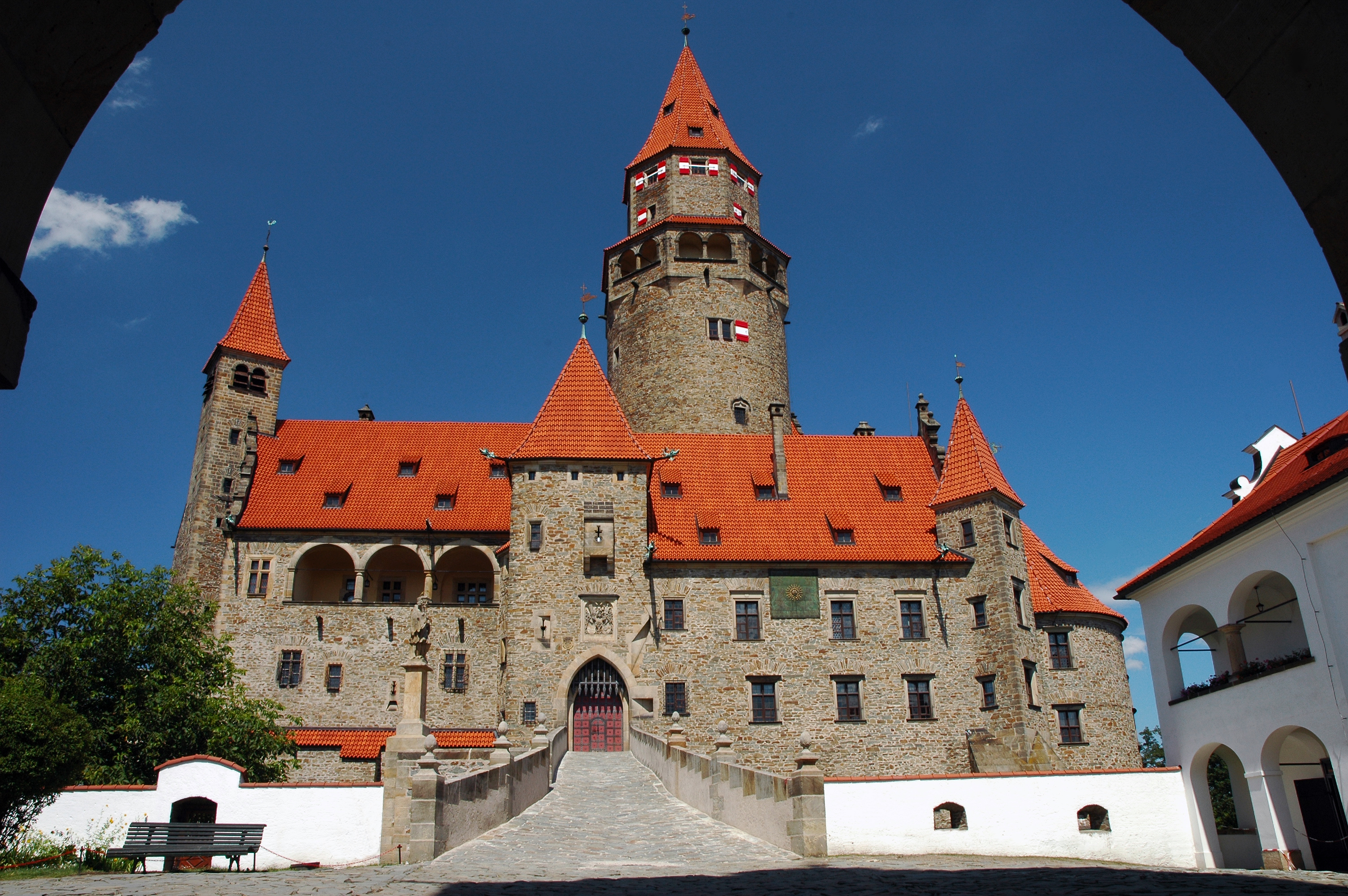




 Tracy's Travels