Bauer Villa and Czech Cubism Diary


Bauer Villa

Bauer Villa


I had traveled with Arsviva, a Czech tour company that specialized in trips that emphasized art and architecture, to Sicily for 11 days in May and had enjoyed a thrilling experience full of breathtaking sights, all made more fascinating thanks to a terrific guide. This time I was on a day trip to sample Cubist architecture in central Bohemia. As we started out at seven in the morning, I thought to myself how I had always been attracted to Cubism and to the way the style assembled shapes in abstract forms utilizing many perspectives. I had found the Pablo Picasso museums in Paris and Barcelona to be breathtaking. Georges Braque’s work also bewitched me, especially in the Centre Georges Pompidou. In terms of Czech Cubism, I was most drawn to the paintings of Josef Čapek, who had also, along with his exceptionally talented brother Karel, scribed some impressive plays.

First, we went to the Evangelist church in the village of Pečky. The monument to Jan Hus near the church reminded me of the first time I had seen the monument to the 15th century martyr on Prague’s Old Town Square, a place where I immediately felt a sense of belonging during my visit as a tourist in 1991. Hus had been a Czech priest, reformer, philosopher and teacher who was burned at the stake on July 6, 1415 for not preaching according to the doctrines of the Catholic Church; he stands out as a leading light of the Bohemian protestant reformation.

Evangelist church interior

Evangelist church interior

Designed by Oldřich Liška, the Cubist interior dated from 1914 to 1919. The church was adorned in new modern style with Cubist features. The pews, the pulpit and the organ all exhibit Cubist tendencies.  Inside the church I was especially captivated by the four Cubist chandeliers and the star patterns engraved on the sides of the wooden pews. The Cubist elements blended in with the relatively stark interior, not making a glaring, loud appearance but rather embracing the church in a subtle, sensitive style.

Cubist chandeliers

Cubist chandeliers

Next, the bus took me and the other 40-some passengers to another village called Libodřice, where, all of a sudden, a Cubist villa magically appeared.  No other Cubist villa was located in the Czech countryside, I would find out. I was instantly reminded of a Cubist villa in the Vyšehrad district of Prague. I had walked by it every day on my way home from the when I lived below Vyšehrad hill. Passing by such an architectural wonder every day made me feel calm, momentarily at peace with the world and all the wonders it brings.

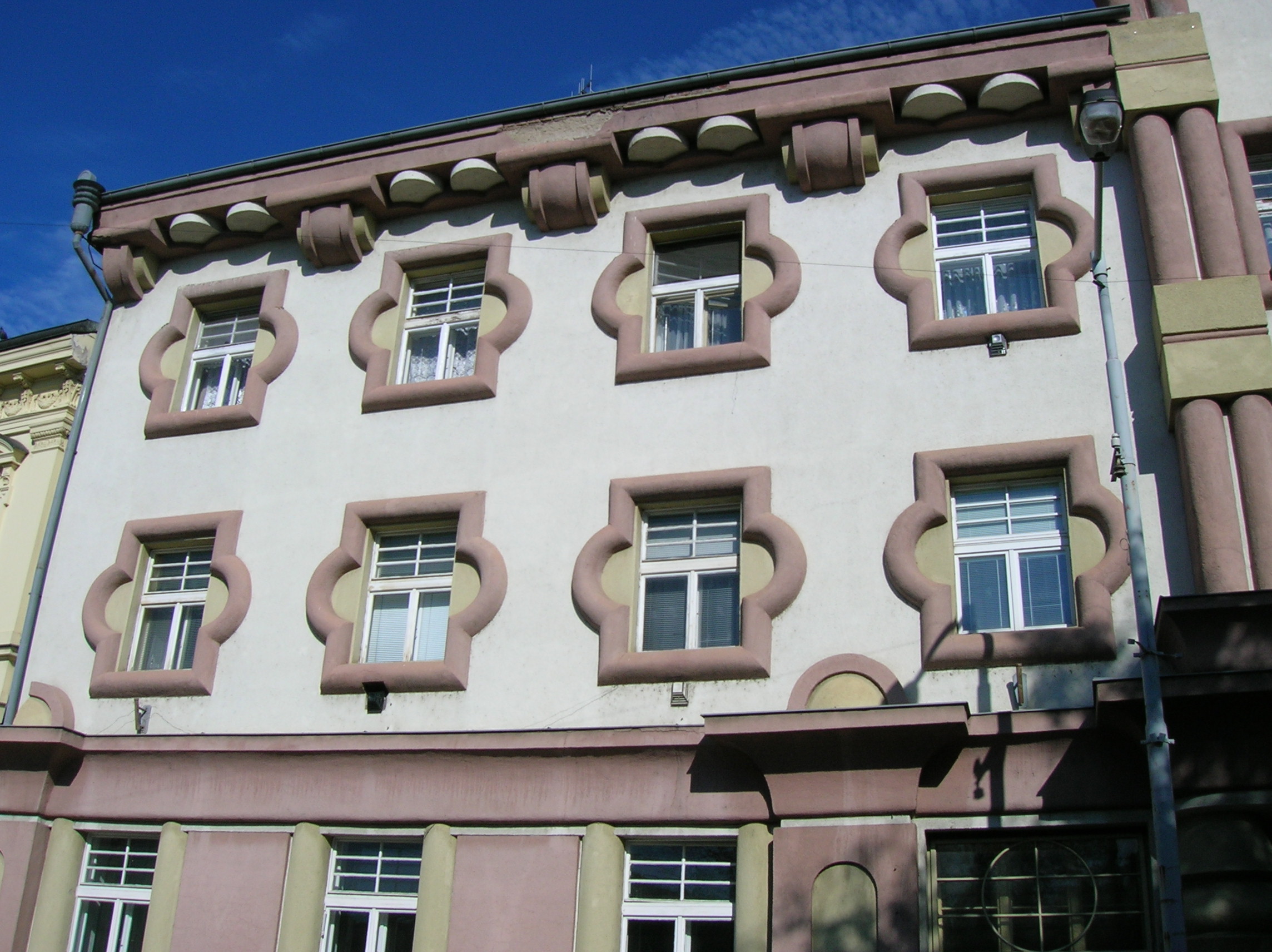
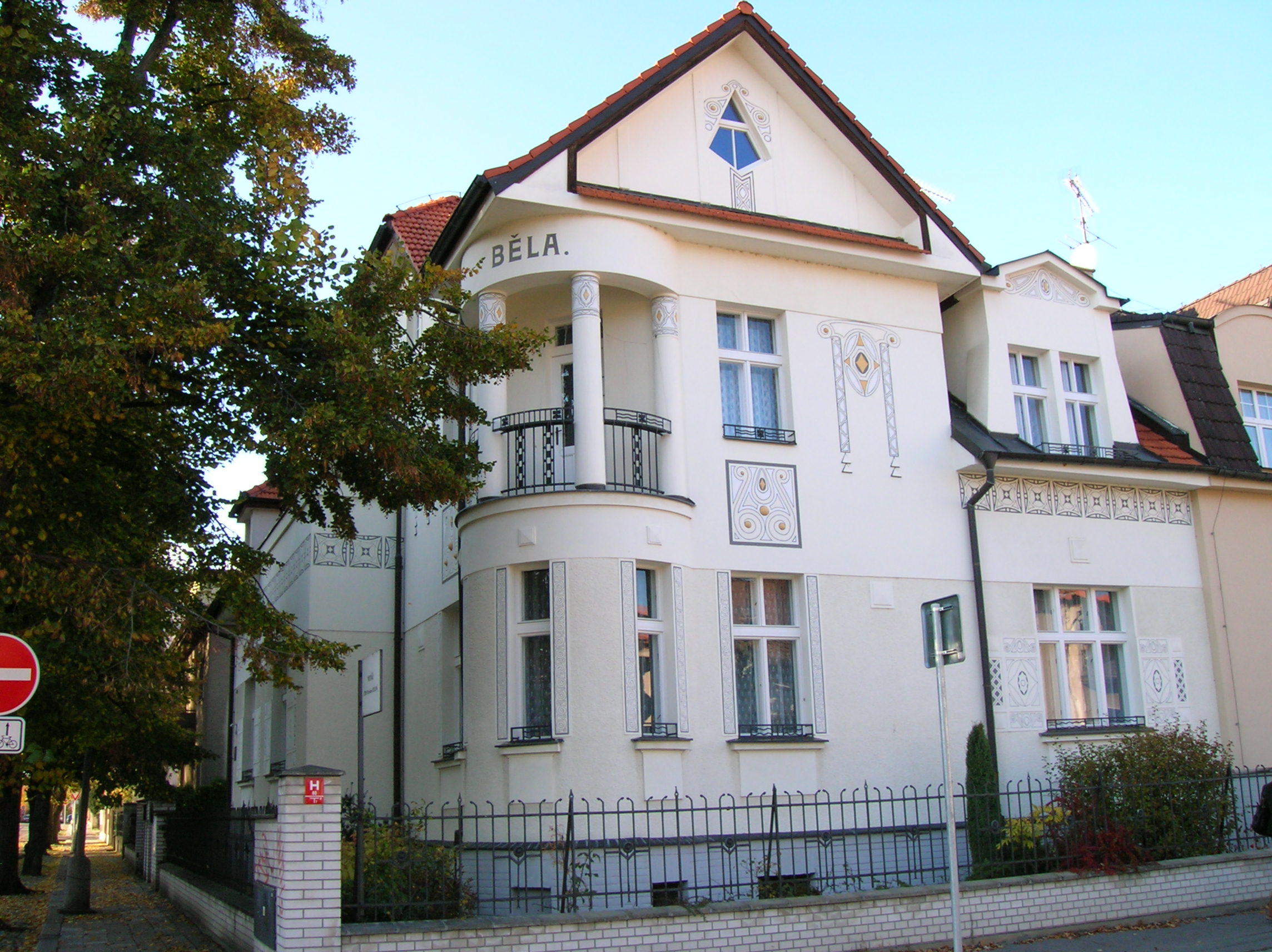
I was especially drawn to the framed windows of the Bauer Villa, decorated in star patterns. The large mansard roof blended into the design as well. The abstract, broken shapes appealed to me.  The villa boasted block stereometric articulation. Stereometric encompasses forms such as the cone, cube, pyramid and sphere – geometric shapes. Three polygonal buttresses were combined on one side of the villa. I was impressed with the slanted form of the main cornice, too. There were not just Cubist elements apparent inside and outside the villa; the entire building embraced the style in a form that did not disturb the tranquil landscape.

Windows of the Bauer VillaLegendary Czech architect Josef Gočár, who made a name for himself during the early 20th century in the Czech lands, designed the Bauer villa early in his career, between 1912 and 1914. Later, this pioneer of architecture would devote time to the styles of Rondocubism, Functionalism and Constructivism. His works are scattered throughout the Czech landscape, featured in Prague, Pardubice and Hradec Králové, for instance. Gočár had studied under the tutelage of famous Czech architect Jan Kotěra, who had was influenced by late 19th century styles along with Modernism. In 1911 Gočár chaired the Cubist Group of Visual Artists. Its members included Pavel Janák (who had also worked with Kotěra); the Čapek brothers; Otto Gutfreund, a renowned sculptor who also fought in the Foreign Legion during World War I; and Vlastislav Hofman, who was accomplished in architecture, painting, graphic art, furniture design and writing. Hofman even designed about 400 sets for plays, including 200 for Prague’s National Theatre.  A year later Gočár helped set up the Prague Art Workshops, designing Cubist furniture with Janák, who is best known for designing the Baba colony residential area in Prague’s sixth district.

Gazebo at Bauer Villa

Gazebo at Bauer Villa

Gočár’s first major projects included a staircase for the Church of the Virgin Mary on a square in Hradec Králové during 1909 and 1910. In 1910 he also designed the living quarters of a cavalry barracks in Bohdaneč. In Pardubice during 1909 to 1911 he designed the Winternitz automated mill and also concentrated on the Wenke department store in Jaroměř.  In 1912 he was one of many Czech artists to convert to Cubism, utilizing simple geometric shapes juxtaposed without illusions of classical perspective. He teamed up with Janák to build the first Czech Cubist building in Prague – the reinforced concrete House of the Black Madonna, which featured angular, bay windows, a Baroque double roof and Cubist ironwork on the balcony. Like the Bauer Villa, the House of the Black Madonna did not interfere with the atmosphere. Instead, it complemented the historic environment of downtown Prague.

The Bauer Villa was constructed for Jewish entrepreneur Adolf Bauer, who owned the manor farm estate. The investor and his family lived there from 1914 to 1929, when Bauer died of diabetes. Bauer’s widow remarried and moved to Prague with her two daughters, and from 1931 Antonín Illmann took care of the villa and the farm. The Jewish Bauer family was sent to their deaths during World War II. In 1941 Nazi Augustin Juppe moved in to what had been the Bauer family home. After the war the villa was occupied by administrative offices of the City Council. A hairdresser’s salon, a library and a few apartments also took up space in the villa.

The back of the Bauer Villa

The back of the Bauer Villa

Finally gaining recognition, the Bauer Villa was accorded the status of a cultural monument in 1987. Despite that, it became more and more dilapidated. Its poor condition finally led the municipality to sell it in 2002 to the Foundation of Czech Cubism. Extensive reconstruction costing approximately 25 million Czech crowns took place, and the Cubist creation was open to the public during 2008.

The expositions in the villa featured Cubist furniture, ceramics, paintings and sculptures as well as informative displays about the Bauer family, Gočár and about Czech Cubism in general. Today there is not much original furniture in the villa, though a few pieces had been salvaged – the fireplace, a wooden closet and the bathroom tiles.

The central staircase hall had been inspired by British villa architecture. I was reminded of the staircase hall in Dušan Jurkovič’s villa in Brno. At the beginning of the tour, I was impressed with a unique coat rack in Cubist style and two chandeliers, one made by Janák and another by Ladislav Machoň, who would become a prominent exponent of Art Deco and Functionalist styles. Machoň’s designs dot Prague. His interior of the Law Faculty of Charles University is probably his best known work. There was also a dark, gloomy painting of Faust on one wall of the Bauer Villa. I wondered how the theme of Faust fit in with the Cubist movement, if indeed it did.

 In the bedroom I noticed a still life painting with a goblet by František Volf and a bewitching, black Cubist chandelier. The bedroom was joined with a bathroom on the ground floor. Usually, during that period, the bedroom and bathroom would be situated on the first floor. The living room featured furniture made by Hofman in 1911 and 1912, a wall clock and chandelier. I was especially intrigued by the Cubist flower pot with its cover in the same style. Then, again in the hallway, I admired the linocuts by Václav Špála and Josef Čapek, two of my favorite Czech Cubist artists.

The Bauer Villa

The Bauer Villa

Then we went upstairs via a  beautiful staircase. Exhibition Room II featured furniture by Gočár and sculptures by Gotfreund. In his sculpture “Anxiety” I was aware of a certain tension permeating from the female’s drapery. This work, made between 1911 and 1912, was considered the first Cubist sculpture, though the one in the room was not the original. Other objects on the first floor included tea cups, metal and brass boxes and vases designed by Hofman and Janák. The bedroom was Hofman’s design from 1912 to 1914 with a black Cubist bed, more sculpture by Gotfreund and a chandelier hailing from that era. The study featured the style of Rondocubism, an offshoot on Cubism born after the creation of Czechoslovakia in 1918. Rondocubism featured folk and nationalistic themes with curls, circles and folkloristic elements. I was especially impressed with Janák’s green chair made of walnut.

Our guide had been informative and enthusiastic, and I was excited that I discovered another gem in the Czech Republic. I thought this would be a good half-day trip from Prague for foreigners visiting the capital city, but I doubted any tour agency offered such an excursion.  The arsviva tour company’s excursions were in Czech, so it would only appeal to foreigners who were fluent in the language. I understood why Karlštejn Castle and Konopiště Chateau drew so many crowds, but still it was, I felt, highly regrettable too that such an extraordinary Cubist villa in the countryside should remain relatively unknown.

Kotěra Chateau

Kotěra Chateau

Next on the itinerary was the Ratboř Chateau, also called the Chateau Kotěra, built between 1910 and 1913 for Bernard Mandelík, who owned a manor farm estate and sugar refinery. The new chateau (as opposed to the old chateau also on the estate) was designed in Czech modern style by Kotěra and served as a restaurant and hotel.  It is notable architecturally for its vestibule, staircase and entrance to the restaurant as well as for its guest rooms. The building is frequently used for weddings and conferences, too, and it had its own parkland.

A large, circular fountain stands in front of the façade. The cupola is decorated with two statues by legendary Czech sculptor Jan Štursa, who founded Czech modernist sculpture and was also an influential pedagogue. He began his career inspired by the symbolism of the Viennese Secession, and after World War I concentrated on depicting the horror and tragedies of wartime. He created a Cubist relief for the Mánes Bridge in Prague.

Fountain at the Chateau Kotěra

Fountain at the Chateau Kotěra

In the first guest room we saw a bookcase that had been designed by Adolf Loos, who was known for his lack of ornamentation. A severe critic of the Viennese Secession when the movement had been in full swing, the Brno-born architect who had spent much time in Austria had focused on purism and minimalistic design. The walls were decorated in green and blue with a lovely plant motif.

Cubist furniture

Cubist furniture

Another space featured original furniture, including a bed with canopy, table and bookcases. From the terrace there was an impressive view of the fountain and surrounding greenery with sculptures. It was also possible to see the statues on the cupola from a riveting, close perspective. A medallion sporting the letter “M” standing for the Mandelíks in green with dark brown wood decorated the railing. In another bedroom I was impressed with a Cubist bedframe and a Cubist chandelier that spoke of simplicity with a sense of style.

Cupola of Chateau Kotěra

Cupola of Chateau Kotěra

After lunch we visited Cubist creations in Kolín and Poděbrady. In Kolín I saw the main square for the first time, and the Neo-Renaissance town hall caught my attention as did the Baroque facades, plague column and fountain. We gazed at Rondocubist apartment buildings dating from 1921 to 1923, the former town savings bank from 1926, the municipal theatre dating from 1937 to 1939 and a high school with magnificent Cubist elements, especially the windows, designed in 1924. The bridge across the Labe River was architecturally impressive and had been built during the 1920s.

Cubism in Kolín

Cubism in Kolín

In the spa town of Poděbrady, we walked through a beautiful park and a neighborhood rich with villas with Cubist elements. At our second to last stop, in Poděbrady, we were able to admire the Amálka Villa from 1910, the Kouřimka Villa from 1909 to 1910 and the Obereigner Villa from 1898. We also took in the spa buildings on the promenade, fascinating structures designed by František Janda from 1907 to 1911. Previously, I had only changed trains or buses in Poděbrady, never realizing how much there is to see here.

Cubism in Poděbrady

Cubism in Poděbrady

While we were in Poděbrady, we had extra time to spend in a café famous for its desserts. Unfortunately, it was also famous for its poor service as it took the waiters an agonizingly long time to fetch coffees and cakes. I was joined by a friendly and interesting family, an adult son with his parents.  He had given his parents this trip as a Christmas present the previous year. I talked to them about my baseball and ice hockey careers growing up, attending Jaromír Jágr’s summer training camp in Slaný and sights I had seen in the Czech Republic.  The father and I reminisced about Czech and Slovak hockey players who had defected to the NHL some decades ago. For me the names Peter Šťastný and Milan Nový brought back childhood memories. In my opinion, the highlight of any tour was meeting nice people, no matter how exciting the particular excursion might be. I have had some negative experiences in the country over 21 years, but meeting kind Czechs always has always made the hardships worthwhile.

Cubist facade in Poděbrady

Cubist facade in Poděbrady

On the way back to Prague, we stopped at the Beniesova Villa in Lysá nad Labem. The villa, created by Emil Kralíček for the owner of a sugar refinery, is known for its big entrance hall with light roof window in the shape of the Star of David and crystal motives that denoted the process of manufacturing sugar. It was sad, though, to find the villa in such a dilapidated state.  The villa was fenced off; there was no possibility to see what sounded like a ravishing interior. If only someone had donated enough money to restore it to its original beauty. . . . If only. . . . It depressed me to think that people could let such architectural wonders fall into such poor condition, that there was not enough money to restore significant buildings to their former splendor.

My depression ceased by the time we returned to Prague around seven in the evening.  I felt grateful that I had had the opportunity to make new friends and to go on such a fascinating excursion.

Tracy A. Burns is a writer, proofreader and editor in Prague.


Beniesova Villa

Beniesova Villa


Holy Mountain (Svatá Hora) Diary

Image

The bus from Prague to the central Bohemian town of Příbram, 54 kilometers southwest of the capital, took about an hour. When it made a stop on the main square in Dobříš, I remembered visiting that lovely chateau with the quaint restaurant in its courtyard. I got off in Příbram and walked uphill for a while until I reached the Holy Mountain (Svatá Hora) pilgrimage site, a former Baroque monastery complex that included ambulatories, open altars, closed corner chapels and a basilica with three open altars on its loggia. On the bus I read some historical information about the place to which the devout had been flocking for centuries.

According to one legend, the original chapel was constructed courtesy of Knight Malovec in 1261 as his way of showing thanks to the Virgin Mary, who had protected him from robbers at the site. Another legend claims that the first Archbishop Arnošt of Pardubice, had the chapel erected during his tenure in that function from 1344 to 1364. (The first Archbishop also had been an active diplomat during Emperor Charles IV’s reign.) Some speculate that the original chapel may have been built in the 15th century or at the beginning of the 16th century.

ImageThe statuette of the Holy Virgin, now placed in front of the silver main altar of the basilica, is Bohemian, from the Gothic period, probably created in the 14th century. Pilgrims had begun traveling from afar to see the Madonna in the first half of the 16th century. The figurine was hidden in the tunnels of mines and other places during the Hussite wars of the 15th century and then returned to Holy Mountain, which witnessed dismal days again during the pillaging and destruction of the Thirty Years’ War in the 17th century. During those battle-ridden times, the statuette had been transported from place to place again. The chapel had even been used as a stable when the Emperor’s troops took over Holy Mountain.

The blind beggar Jan Procházka dreamed of regaining his sight at Holy Mountain in 1632, and his dream came true.  The popularity of Holy Mountain soared, major repairs were made and even Emperor Ferdinand II paid homage there on several occasions.

After the Jesuits took control of Holy Mountain in 1647, the Baroque complex was built. Chapels and ambulatories were erected, and the place was decorated with stucco and paintings. In 1732 the statuette was allowed to don a crown made of gold, as one of the Virgin’s titles is Regina Coeli, Queen of Heaven.

ImageIn 1773 the Jesuit Order was abolished because European leaders felt threatened it, and Pope Clement XIV succumbed to the secular demands. The Order only carried on in Prussia and Russia. In other countries it was suppressed for 40 years. In 1773 the state took over Holy Mountain. The site became dilapidated. The Redemptorists came into the picture during 1861. Extensive restoration was carried out in the early 20th century.  Pope Saint Pius X raised the status of the church to a basilica in 1905. After Czechoslovakia was created in 1918, Holy Mountain continued to be a favorite pilgrimage site.

But Holy Mountain once again faced difficult times during the Occupation and Communism.  Under the Nazi regime the Redemptorists had been allowed to carry out a limited number of activities, but in 1950, during the Communist era, the Redemptorists were expelled from the site. On April 13, 1950 the Communists closed down all the monasteries in the country and transported the monks and friars to internment camps or put them in prison. Still, that did not stop the devout from making the arduous journeys to the complex. Then, in April of 1978, a fire destroyed part of the site. The police claimed some mischievous children had accidently started the blaze. When the complex was returned to the Redemptorists in 1990, extensive reconstruction took place. Now there are six priests who take care of Holy Mountain.

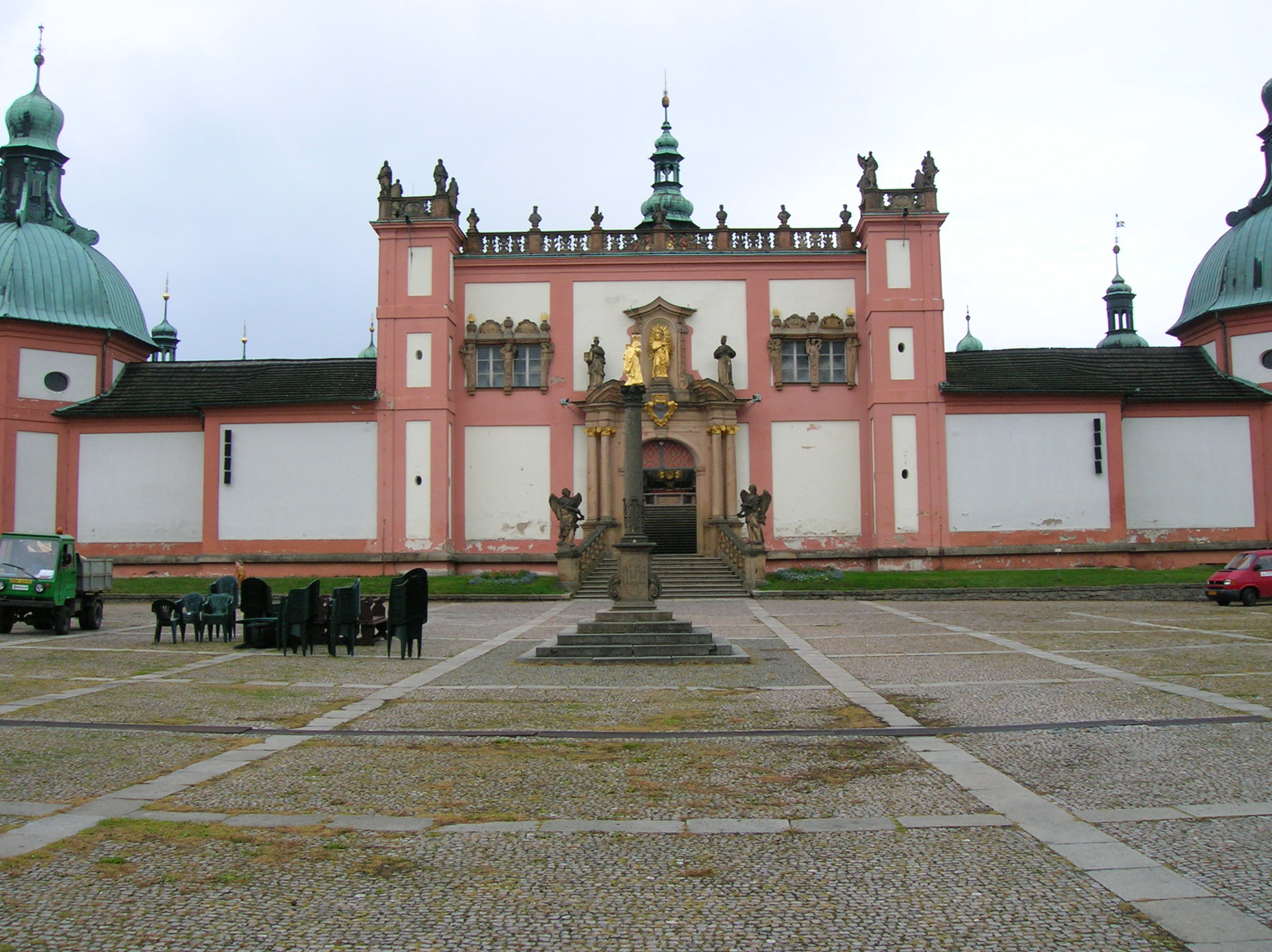
ImageAs I approached the Holy Mountain complex of buildings, I noticed how austere the exterior looked. I stopped in front of the main gate, called the Prague Gate, which was created in the early 18th century in collaboration with the legendary architect Kryštof Dientzenhofer.  The statuary adorning the gate was spectacular. Seven statues of prophets from the Old Testament and seven busts of saints decorated the balustrade. I spotted Saint Wenceslas, the Czech patron saint, and Saint George, among others.

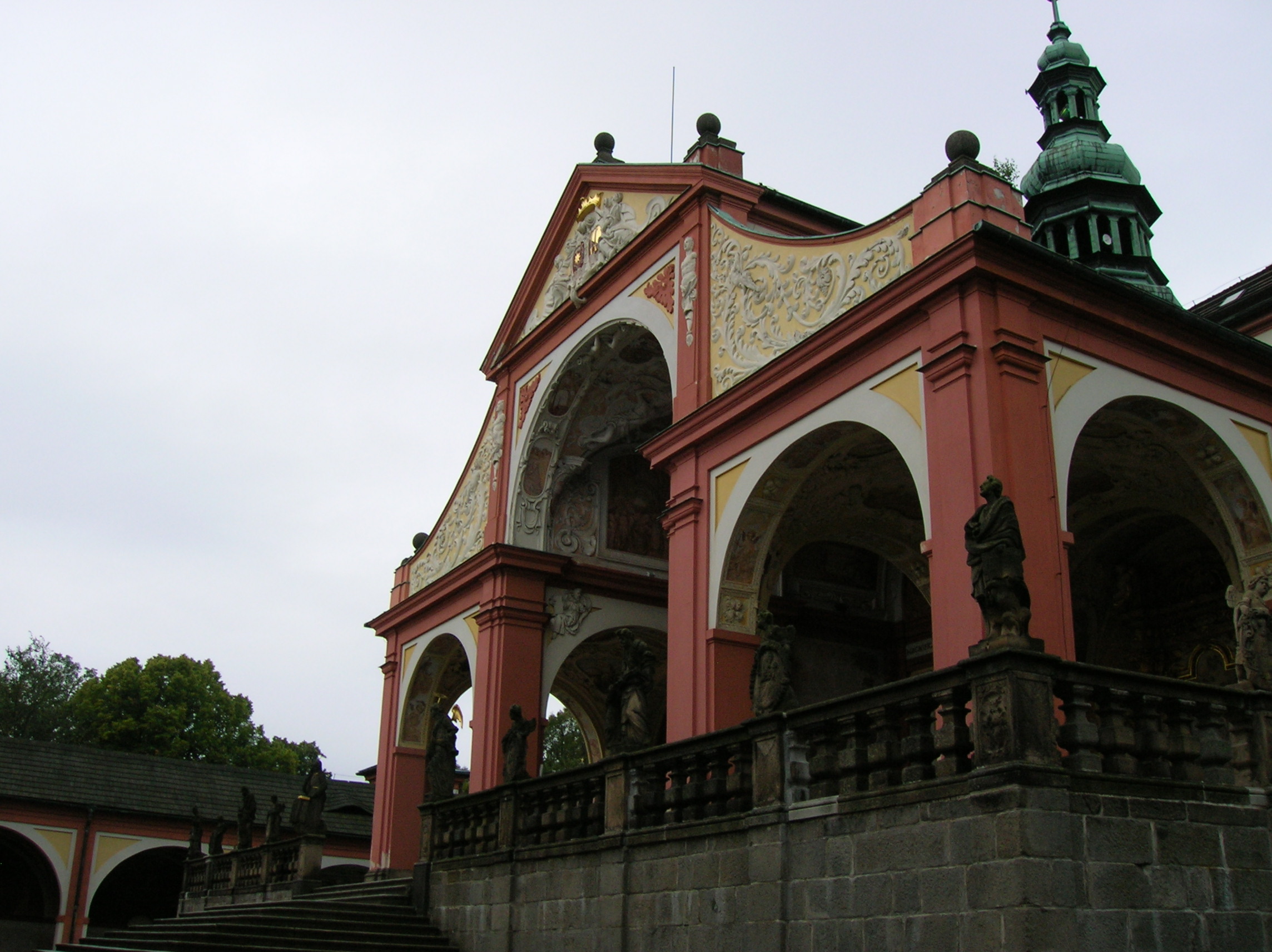
ImageThe basilica was situated on a terrace in the middle of the courtyard. The terrace was decorated with spectacular statuary. Surrounding the basilica were ambulatories with 16 arcades and four closed, corner chapels. Many open chapels adorned the ambulatories that also featured 21 lunette paintings focusing on the legends and history of Holy Mountain. The 100 paintings on the vaults of the ambulatories portrayed tragedies in which the Holy Virgin of Holy Mountain saved the believers in acts of miracles and grace. One ambulatory featured falling from a tower and falling from a horse, for instance. Other vault decoration portrayed the dangers of the plague, fire and lightning. Catastrophes triggered by water were also represented. The stucco work on the ambulatory chapels was original, though the altar paintings were redone by Jan Umlouf during the late 19th century.

The first closed chapel that we came to was the Prague Chapel, named after the capital city because the Old Town, the New Town and the Lesser Quarter of Prague had contributed funds to have it built. The coats-of-arms from these towns prominently decorated the chapel that harkened back to the late 17th century and early 18th century. The exquisite stucco decoration enthralled me as did the eight paintings of saints on the ceiling, but what really got my attention was the painting decorating the main altar.

ImageIt had been created by my favorite Czech Baroque artist, Petr Brandl. I loved the detail of the fluttering angel clad in dynamic drapery in Brandl’s energetic work, “The Annunciation of the Virgin Mary.” The angel’s gaze at the Virgin Mary appeared so protective, yet so fragile. The cupola featured portrayals of eight Czech saints with Saint Wenceslas and Saint Ludmila among them. On one wall I saw a painting of the Saints Cyril and Methodius, Byzantine Greek brothers, who, during the 9th century, introduced the Slavic language to the area that is now the Czech Republic and other regions. I also admired the stucco decoration with garlands and putti.

ImageI explored the open chapels. The Nativity of the Virgin Mary Chapel hailed from the 17th century, with a painting on that theme in the center of the altar.  Saint Catherine and Saint Wenceslas fIanked the main altar. I liked the appearance of the spiraling columns at the sides of the central panel and the white stucco on the ceiling adorned with exquisite, small paintings.

I also studied a painting of a pilgrimage from Prague to Příbram, a journey which had taken three days during the 17th century. I recognized Prague Castle and the Charles Bridge in the background. Those were two sights I rarely visited these days but adored despite the never-ending flow of tourists.

ImageThe Triumphant Virgin Mary Chapel from 1674 was certainly unique. General and Count Jan (Johann) von Sporck had it decorated with symbols of war, such as weaponry.  A general of the Habsburg armies famous for his successes during the Thirty Years’ War of the 17th century, Sporck had certainly proved himself as a military leader, but he was also known for his avarice and cruelty. Serfs disliked him so much that they were convinced he knew witchcraft and had ties with the Devil. His son Count Frantíšek Antonín von Sporck was well-respected for his patronage of the arts.

On the altar Jan von Sporck emphasized the theme of war to the extreme. The paintings featured battles showing the defeated Turks. The central panel featured a soldier wielding a sword and shield showing the head of a Turk.  White with gold stucco decoration included a child fighter armed with a sword in one hand and the head of a Turk in the other. I found the war themes appalling, especially the depiction of the child as a soldier holding a severed head. 

ImageSeeing the altar made me think about all the wars in which the United States had been embroiled during recent years. I have always been against the war with Iraq. I remember watching the beginning of the Iraq war unfold on CNN through the early morning hours, my gaze glued to the battles on the screen, horrified by what I saw, yet unable to turn away. It made me feel sick to my stomach. I did not think that the USA should get involved in Syria’s conflict, though the situation was far from simple. I wondered if there would ever be a time again when the USA would not be at war and if I would be alive to see America at peace.

The open chapel showing the engagement of the Virgin Mary to Saint Joseph portrayed the Holy Virgin receiving Saint Joseph’s ring in the central panel.  Landscapes adorned with stucco were featured on the walls. Landscape depictions during the Baroque period were rare, the guide told me. We also passed musical instruments made of stucco, the violins and trumpets getting most of my attention. Another painting showed a procession of pilgrims with children approaching Holy Mountain.

The closed Březnice Chapel hailed from 1665. The stucco work was impressive. I gazed at the ceiling paintings, showing the flight into Egypt, the burial of Christ, soldiers guarding Christ’s Tomb and other scenes. I wondered who had painted them – the artist was unknown.

I noticed skulls decorating a column of another open altar. Scenes from Hell and sudden death were depicted on the vaults of the ceiling and walls. Another chapel featured the death of the Virgin Mary surrounded by paintings of the 12 apostles on the wall and ceiling.

ImageThen we came to a closed, corner chapel named after the west Bohemian town of Pilsen. The main altar featured a painting of the patron saint of Pilsen, Saint Bartholomew, holding a book. The Virgin Mary of Pilsen and Saint Michael also made appearances. I noticed that Saint Nicholas was clad in elegant, golden robes. Angels accompanied the saints, playing various instruments. I also noticed the exquisite carvings on the benches.

Next we went outside the ambulatories and down to the Chapel of Mary Magdalene, which looked like a cave thanks to artificial stalactites, created in 1665. A statue of Saint Mary Magdalene, who, according to a medieval legend, had lived in a cave for 30 years after Christ’s resurrection, made up the main altar while scenes from her life were painted on the cupola. Figures of other saints surrounded her. The effect of the cave-like room was eerie and creepy, but stunning all the same.  I had never seen anything like it except for a church in a cave in Palermo, Sicily. Outside the guide pointed out one of the 12 crosses on the Stations of the Cross that the devout could follow, saying prayers at each station, symbolically following in the footsteps of Christ to the Cross.

Don’t let me forget the closed chapel called Mníšek. It dated from the late 17th century and early 18th century. Its altar painting showed Saint John of Nepomuk kneeling before the Virgin Mary and hailed from 1871. Statues on the balustrades of the chapel featured saints and angels.

ImageWe continued to the basilica in the middle of the courtyard. I admired its balustrade with impressive statues of Bohemian patron saints and angels. There were three open chapels in the loggia. I liked the Coronation Chapel the best. It hailed from 1667 with stucco adornment, paintings and a marble altar. Twelve paintings representing the 12 sections of the prayer “Ave Maria” caught my attention. Czech saints, apostles, prophets from the Old Testament and archangels were gathered on the ceiling vault. On one side a painting showed the 1732 coronation ceremony of the statuette of the Holy Virgin of Holy Mountain. I wondered what it would have felt like to be at such a formal, lavish celebration during the 18th century. It must have been enthralling to see the figurine decked in golden armor. The ceremony still takes place once a year.

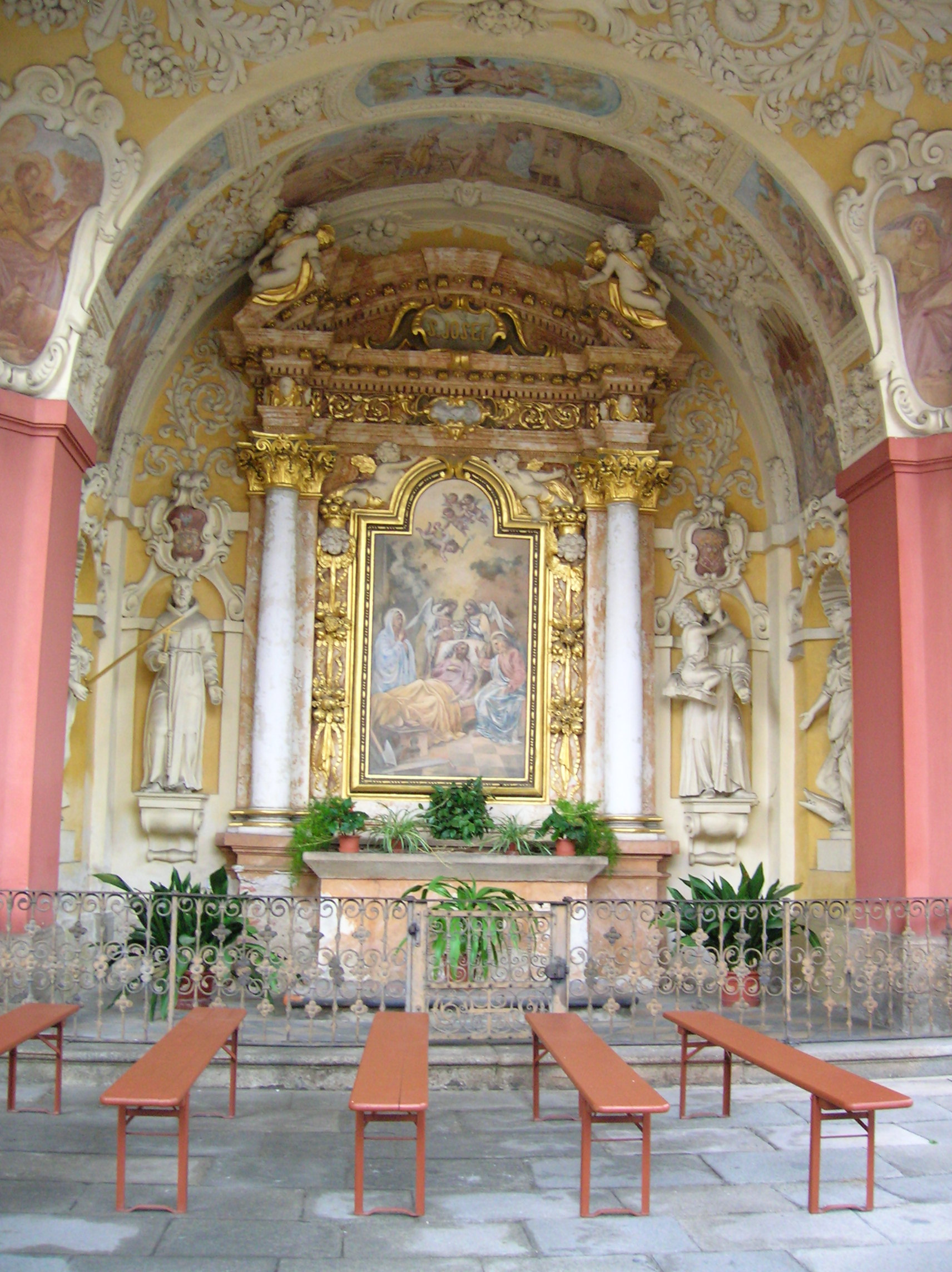
Impressive painting and stucco decorated the Chapel of Saint Joachim and Saint Ann. Paintings showed scenes from the life of the Holy Virgin’s parents. The Chapel of Saint Joseph, which hailed from 1667, featured the altar painting “The Death of Saint Joseph” from 1873.

ImageThe interior was amazing. The Chapel of Saint Ignatius featured 10 paintings of scenes from the life of Saint Ignatius of Loyola. I noticed a coat-of-arms with a star and eagle and knew it stood for the Šternberk clan, who owned Šternberk Castle not far from Prague. That family had helped finance the building of this altar. Another chapel called the Assumption of the Virgin or the Chapel of Saint Wenceslas featured exquisite stucco adornment and ceiling paintings from the life of Saint Wenceslas.  Silver statues of saints also decorated the space. The Chapel of Saint Elizabeth had exquisite stucco decoration, and the ceiling painting featured Saint John the Baptist with his parents.

The main altar was the big treat, though. Divided into tiers, it glittered silver. The statuette of the Holy Virgin looked so delicate inside the silver box. Silver figures of kneeling angels and Baroque reliefs added to the decoration. The antependium on the front of the altar could be traced back to 1686, and the tabernacle was constructed two years later.

I went to check out the other entrance, the south Březnice Gate. Above the portal was a stone replica of the Holy Virgin of Holy Mountain. Six stone busts from 1707 included Mary Magdalene. The sculptural adornment was undoubtedly impressive.

I said goodbye to the guide and descended the hidden staircase of more than 300 stairs that connected the complex with downtown Příbram. The Jesuits built it from 1727 to 1728 to protect pilgrims from bad weather. It was very austere, without decoration. After exiting the tunnel-like staircase, I walked down some picturesque, narrow streets with ceramic shops and small cafes. Then I came to the main square, where I found a restaurant that served my beloved chicken. After lunch I walked to the bus stop, and transportation to Prague came within five minutes.

 Tracy A. Burns is a writer, proofreader and editor in Prague.

Image

Dušan Jurkovič’s Villa Diary

Image

I was able to go by car to the villa where Slovak architect Dušan Jurkovič lived from 1907 to 1919. It was in a tranquil village near Brno, the capital of Moravia.  The architectural gem had opened in 2011. I did not know much about Jurkovič except that he was responsible for much of the stunning décor in the Coffer Room of the Nové Město nad Metují Chateau as well as the renovation of that chateau’s two-tiered garden.  While visiting the villa, it would become clear to me that Jurkovič was one of the leading architects in the Czech lands during the 19th century and that this house was his most prominent work.

This leading Slovak architect had been inspired by Austrian architects Josef Maria Olbrich and Josef Hoffmann, both of whom, along with artist Gustav Klimt and others, co-founded the Viennese Secession or Art Nouveau movement at the end of the 19th century.  Jurkovič had especially been influenced by Olbrich’s Secession style Darmstadt Artists’ Colony, where Art Nouveau artists lived and worked. One of the Secession features on the houses included the decoration at the entrance with its gold-plated floral motifs. Olbrich’s style mixed British tendencies with central European qualities. Hoffmann’s Hohe Warte Artists’ Colony, launched in Art Nouveau style, was another influence. Jurkovič had originally intended that his villa would become part of an artists’ colony, and he even opened the villa with an exhibition of 119 artworks, many his own, in 1906.

First, I walked through the garden, bursting with color and featuring pergolas and trelliswork. The view of the house from the garden confirmed that Jurkovič had created his own unique style by meshing several styles together. The house was a mixture of English Arts and Crafts, Art Nouveau and traditional Moravian folk architecture. During the 19th century, the Habsburgs of the Austro-Hungarian Empire supported European folk art because it united its regions. Folk art would play a major role in architecture during that century.

ImageAs I understood it, the English Arts and Crafts movement had emphasized simplicity and had employed romantic and folk styles. The materials used were also accented. Also British architects often featured a staircase hall, which dominated Jurkovič’s main achievement. The movement reached its peak from 1860 to 1910.

Jurkovič’s villa looked like it belonged in a fairy tale. I expected princes and maidens to stick their heads out its windows. I loved the playfulness of its design as if it had popped out of a story book. It was no wonder that it had been dubbed “the Fairy Tale House.” The villa was made of stone, wood and cork with lime-coating on the exterior and plaster on the interior. It resembled a country house or cottage in England.

At the entrance gate there was a mosaic of two peacocks standing opposite each other. There used to be a mosaic showing a scene from The Shephard and the Dragon fairy tale, but it was destroyed because it had been made on a cork rather than plastered base. The mosaic that replaced it lit up at night. The entrance loggia featured the statue, “The Thinker,” by sculptor Jan Štursa, who had helped define modern Czech sculpture. It was one of the few original pieces that were now in the villa. The house had been renovated to look as it had when Jurkovič and his family had lived there from 1907 to 1919, when the architect returned to Bratislava, Slovakia, where he died in 1947.

Soon it was time for my tour, which had to be booked in advance. My tour guide and I entered the main room of the villa, the Staircase Hall. It was dazzling. I especially loved the folk elements of traditional Moravian architecture, such as the red, white and blue abstract wallpaper on one side. The folk-oriented carpet featured reds and blues, too. The wine red and forest green colors represented in the room also symbolized Moravian folk art. I thought they complemented each other well and gave the place a cozy atmosphere. I recalled that in the Coffer Room at Nové Město nad Metují, reds, greens and browns played major roles.

Ceramics and tapestries also filled the room. The tiled stove was dark green, and the doors took on the same hue. The wallpaper was not the only part of the room to have blues in it. Even the exquisite, wooden table had a stunning, blue tone.  The chandelier, though, was pure Art Nouveau and had featured light bulbs, as the villa had utilized electric lighting.

ImageThe alcove, designed for Jurkovič’s wife Božena, was light and airy in contrast to the dark central section of the room.  I admired the tapestries in the alcove. One showed a log cabin with mountains in the background. The others shared the countryside theme, depicting fields and cross stations. The room was assembled like a gallery of Jurkovič’s work. He had also designed the furniture. I realized that the villa itself was an exhibit with smaller exhibits inside.

Jurkovič’s former study rooms featured a temporary show of furniture designed during the middle of the 20th century. Artists Zdeněk Plesník and Miroslav Navrátil used materials experimentally. Their armchairs were made from bent lamellas, which were fine sheets of material positioned in the shape of gills. The armchairs could be put into several positions. They could function as chairs or as a bed, if all three were placed together. I was surprised to find out that Navrátil had created the chairs on trams. Even now, trams 1, 3 and 11 in Brno were equipped with the style of chairs that he had created. I often took tram 1 to the center, so I had actually sat on a chair that he had designed!

Other spaces that used to serve as a bedroom, children’s bedroom and bathroom were now decorated with pictures of Jurkovič’s other designs, interactive materials and furniture from his other buildings. I found out that he had also designed the interior of the Vesna boarding house in the Czech lands. The bedroom there boasted vibrant hues of greens, yellows and reds. Jurkovič also incorporated a dovetail motif. I saw a stunning wooden chair with a dovetail masterfully carved on its back.

ImageJurkovič would also design a diner and hostel in Wallachian Pustevny in triumphant folk architectural style. The diner boasted an interior with a turquoise hue illuminated by side windows. The walls were covered with pictures of Czech figures, such as the country’s patron Saint Wenceslas and the Radegast pagan mountain god.

Jurkovič’s designs for the Luhačovice spa town were harshly criticized by Brno architect Karel Hugo Kepka and the editorial board of Architektonický obzor journal, which caused his commissions there to cease after 1914. Today, though, residents of Luhačovice are very proud of Jurkovič’s work there. He also designed a house in the Bubeneč district of Prague 6, using concrete instead of wood and constructing an elevated gable.

During World War I he designed about 40 cemeteries for fallen Austrian soldiers in what was then Galicia. After the war he concentrated on war memorials, and in the late 1920s he began to experiment with the functionalist style. Jurkovič moved out of this villa in 1919, after democratic Czechoslovakia was created because he wanted to help reshape his native, reborn Slovakia. So he moved back to Bratislava, where he died in 1947.

I loved the red color with floral pattern of the wooden beams on the ceiling. It had a log cabin appeal and gave the beams a vibrant folk architecture appearance. The entire villa exuded a warmth and coziness that I had also felt at Nové Město nad Metují’s Chateau. 

I was impressed with the tour, but disappointed that only the Staircase Hall looked as it had when Jurkovič had lived there. I understood that Jurkovič had sold a lot of the furniture. The Staircase Hall had such a dynamic quality. It was so vibrant, so cheerful, yet at the same time intimate. I wished that more than a few pieces of the original furniture and ornamentation had been preserved. While the temporary exhibition and spaces documenting Jurkovič’s works were intriguing, the Staircase Hall was definitely the highlight of the tour.

 Image

Tracy A. Burns is a writer, editor and proofreader living in Prague.

Kuks Diary

Kuks7It was almost 6:30 a.m., and the music on the bus was funereal – so depressing that I felt as if a heavy weight had descended upon my shoulders. It had taken me almost an hour to get to the Černý Most Metro and bus station, after leaving home on the 5:04 tram.

We made it to the Hradec Králové bus station in about an hour and 15 minutes. There, I had enough time to get the 8:20 to Kuks, a village where a former hospital, Baroque in style, was surrounded by 24 statues by legendary Czech sculptor Matyáš Braun. It also housed one of the oldest and most valuable pharmacies in the land.

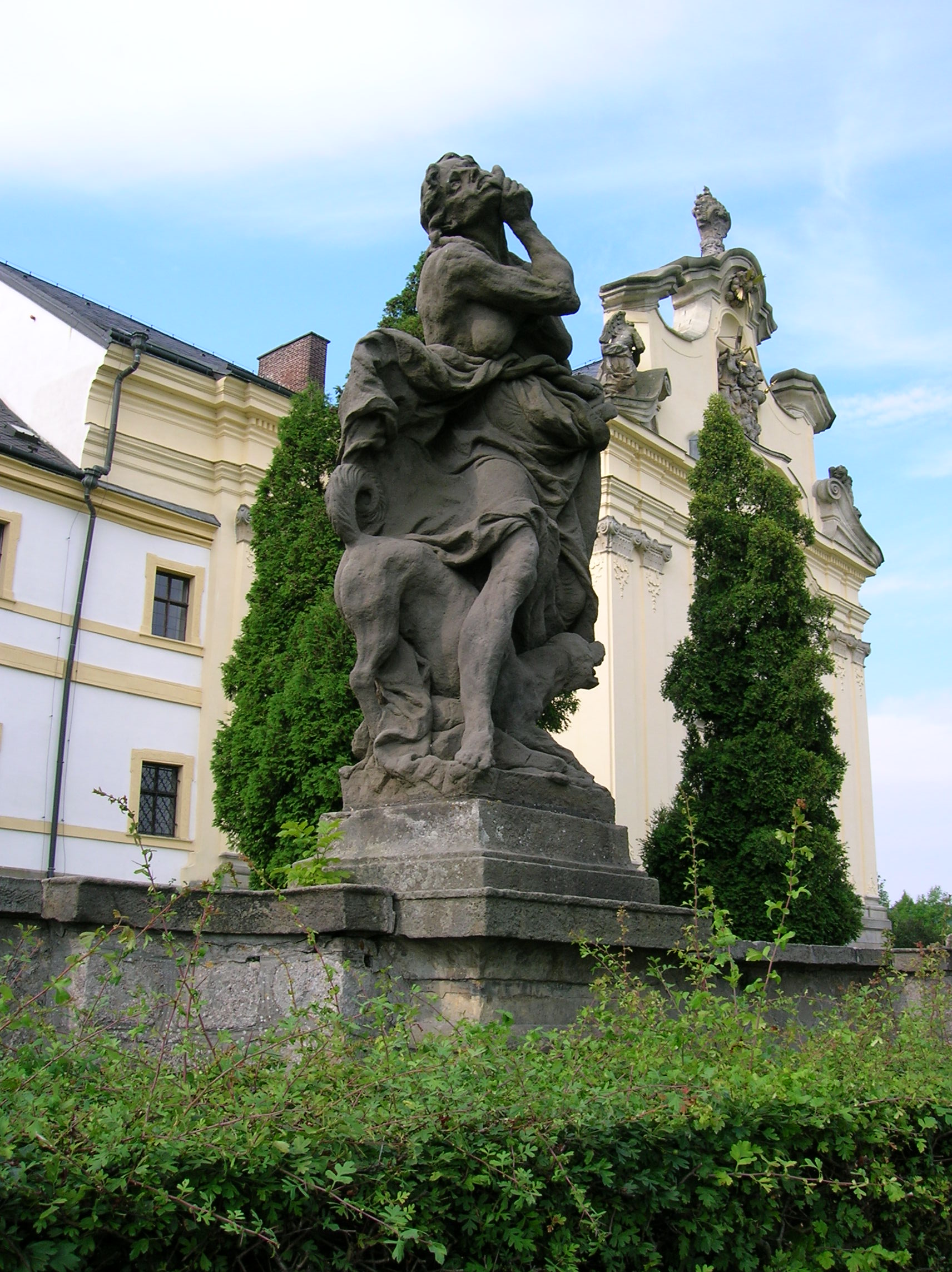
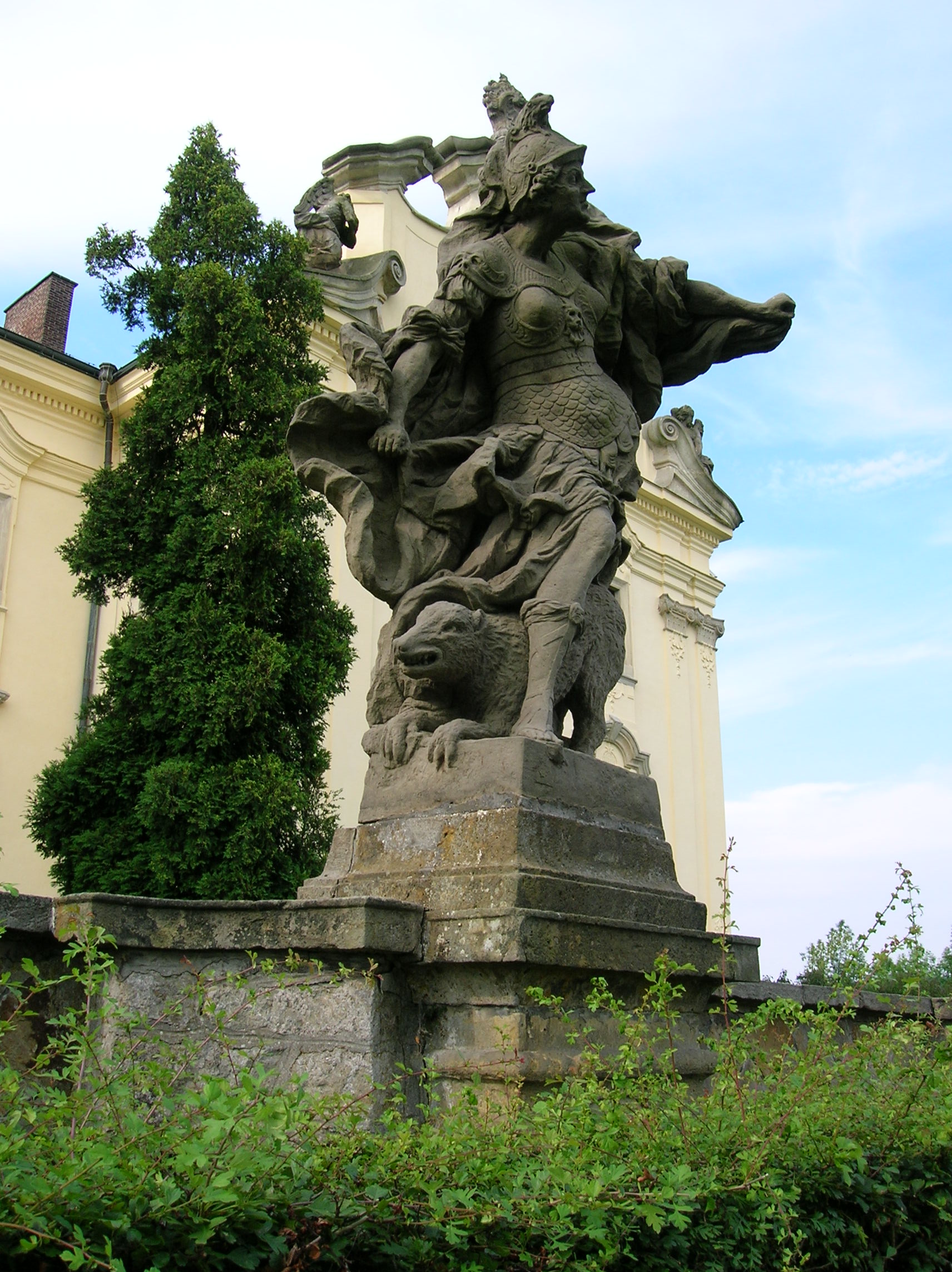
The bus to Kuks took half an hour. I only knew I was there because I saw a sign with the name of the village on a small wooden shack along the highway. I got off the bus and felt lost. I looked to my right: there was a large field, nobody in sight. To my left a building and a road. I reasoned that the village must be down the road; there must someone in the area to ask for directions.  I was right:  it only took only 15 minutes to come to the end of the big park in front of Kuks’ former hospital. I walked on the long path and up the stairs flanked by Matthias Bernard Braun’s 24 Late Baroque statues of Virtues and Vices.

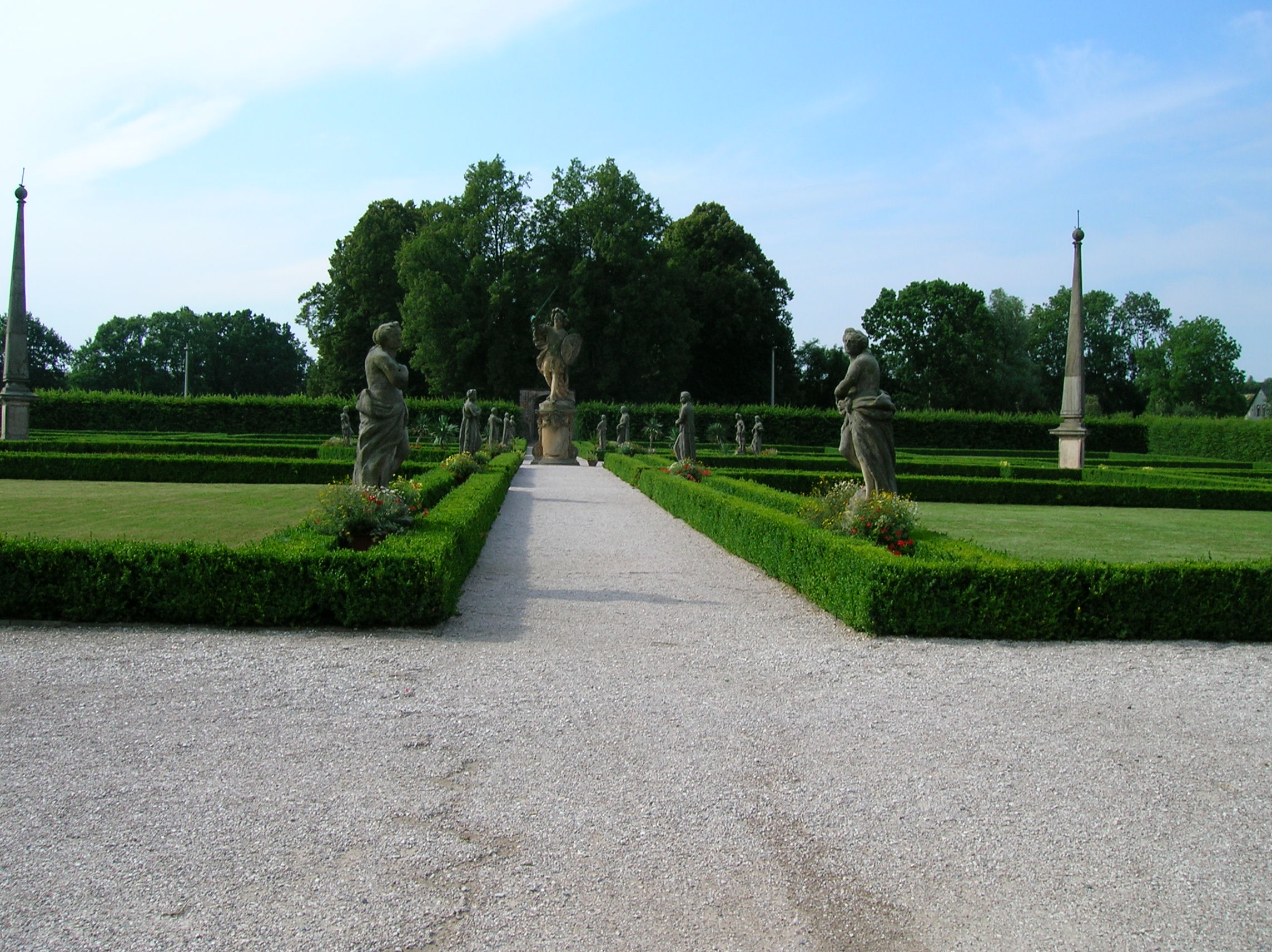
Kuks4I walked around Braun’s Baroque statues that seemed to be swirling and twisting and turning as I snapped photos of Love, Despair, Sloth, Sincerity, Faith, Virtue, Jealousy and Hope, to name a few. Then I went to the garden behind the hospital and took shots of the eight statues of the muses and the dominating statue, that of the Big Christian Fighter, wielding a sword and shield, with a godlike appearance as he defended Christianity against religious violence.

There were three tours. I took the one concentrating on the historical interior first. In the first room there were portraits on the walls.  An intriguing one showed a woman on her death bed, which was surrounded by candles. I could almost see them flickering.

Kuksgarden1The second room featured a model of the former Kuks hospital for veterans and the spa that used to be across from it, until it was destroyed by a flood in 1740. The model harkened back to 1725, when the spa was flourishing. The guide pointed out a church, a wooden theatre and astronomical clock that used to be part of the village as well as the pub, erected in 1699 and still operating on the other side of the village. She also pointed out the River Labe that separated the monastery hospital from the spa as well as the Philosophers’ House, a two-storey Baroque villa, where the founder of the hospital and spa, Count František Antonín Špork, had kept his library of 40,000 volumes.

Kuksgarden5Then we went out in the courtyard, where the guide pointed out the statue of the Small Christian Fighter gripping a sword that had turned green with age. From there we stepped into the lapidarium, where the original 24 sandstone statues by Braun were displayed. The swirling maelstrom of gigantic Baroque images left me in awe.  I always seem to feel overwhelmed when face-to-face with Baroque artworks. Dating from 1718-1720, the statues included Faith, who leaned against a cross, donning lush drapery. Hope had an anchor and was gazing upwards. Patience featured a girl with a ram as she held one hand to her bosom. Wisdom had faces on both sides of the head, one looking back and the other looking forward, one face gazing into a mirror. Sincerity, clad in fantastically swirling drapery, was portrayed as a girl with a heart in the palm of her hand, gripping it to her own heart.

The Annunciation of the Virgin Mary Chapel was next. Two exquisite reliquaries with Baroque golden frames were placed on either side of a wooden Christ on the cross. On one wall there was a huge tabular of Bethlehem, painted in the 19th century. A figure of a sheep was curled up, asleep, next to Jesus’ crib.

Kuksgarden10Next door was the church – The Holy Trinity. The altar featured the resurrection of Lazarus. Images of God the Father and the Holy Ghost sparkled in gold. On one side of the main columned altar stood a golden Saint Peter, holding a key. On the other side was a golden Saint Paul, armed with a sword. The Rococo pulpit glinted in gold as well. Four other altars took up space, two bigger ones and two smaller. The organ above was Baroque and the columns in the church Corinthian.

There was much to see in the hallway. From the old worn-away frescoes I could make out the figures in “Death with a Madman” that portrayed a dancing skeleton with the insane figure and “Death with a Cardinal,” in the other. I wondered how appealing This “Dance of Death” cycle must have been to the patients who may have strolled down the corridors.

Kuksstatue4The ancient pharmacy was next on the list. Called the Granat Apples, it featured various medicine jars on shelves behind the counter. The colorful display consisted of jars made from glass, ceramics and wood, for example. On the counter was a figure of a tree with golden apples and hanging scales. There were weighing scales on the counter as well as a bottle of Atropen, a poison that makes the user go blind if it is used for a lengthy period of time.

Kuksstatue5The pharmaceutical museum was the highlight of the second tour. A prescription for eye drops, written out for the first democratic president of Czechoslovakia, Tomáš Garrigue Masaryk, was displayed under glass on one counter. The paper was scribed in fancy, black lettering. The guide pointed out various poisons, which were marked in white letters on black labels. As I went through centuries of pharmaceutical history in the museum, I stopped to look at a cash register with paper numbers that came up. It hailed from the beginning of the 20th century. You could stir mixes for medicines in bowls yourself, if you so desired. Machines from various pharmacies were also featured in the museum. In a cabinet I saw a jar full of bones from an Egyptian mummy.

Kuksstatue6The guide was careful to point out the cabinet for poisons, such as Strychnitr. I was impressed with the traveling first aid kit from the 19th century. Small glass bottles had been placed in a wooden case that had a floral decoration on the underside of the lid. I didn’t understand why boxes of the contemporary medicine of Jox spray were there for viewing. They were situated next to a pale green box marked Vomitin. Then the guide demonstrated how to make tablets smaller by using a machine and also showed us how to mix tablets with another machine. It was quite intriguing. She also demonstrated how to prepare a tablet from powder with a hammer.

Kuksstatue16For the third tour I went into the crypt below the church. The group was ushered down a dark corridor toward the main altar, decorated with cherubs holding one hand over their eyes and holding skulls in their hands. In the center of the altar was a skull. Looming behind and above the altar was Braun’s masterpiece of Christ on the Cross.  In the darkness, thanks to the guide’s flashlight, we were able to make out coffins of the Špork family members. Only one coffin did not belong to a member of the clan. In a small coffin lay the midget Anežka Tarnovská, who died at age 90 and had worked as a cook on the estate. She saved František Špork’s life when she informed him about a plan to poison him. Finally, we were ushered out of the dark, damp space.

Kuksstatue28Famished at noon because I had eaten breakfast at 3 a.m., I walked to the Chateau Restaurant, only to find that it had been replaced by a small snack bar offering sausages and other fatty foods I did not like. I went for the ham and cheese sandwich, which wasn’t bad. Since it had started raining, I headed for the waiting room near the box office and wrote postcards there. I had wanted to trek the three kilometers to Braun’s outdoor Bethlehem statues called “The Nativity,” but I wasn’t about to venture into a forest when it was raining so hard. I had walked through a forest to get to and from Rožmberk Castle in the Šumava region during a severe thunderstorm some years ago; I didn’t care to repeat the experience. I had read that the biblical statues were carved directly into the sandstone rock. It certainly would have been an amazing sight to behold.

So, without seeing Braun’s Bethlehem, I wound my way back to the wooden shack on the highway, waiting for the bus that would take me back to Hradec Králové. It came on time, but the bus going to Prague didn’t. The 15:13 didn’t show up. Instead there was a 15:35. While it took an hour and 15 minutes to get to Hradec Králové from Prague, the return trip lasted at least two hours, a good half hour in Prague itself, going from the Černý Most Metro and bus station to the Florenc main bus station. There was a positive side to the ride back, though. During the trip home, before reaching Prague, I saw field after field of sunflowers, postcard perfect scenes of ravishing nature.Image

 Tracy A. Burns is a writer, proofreader and editor in Prague.