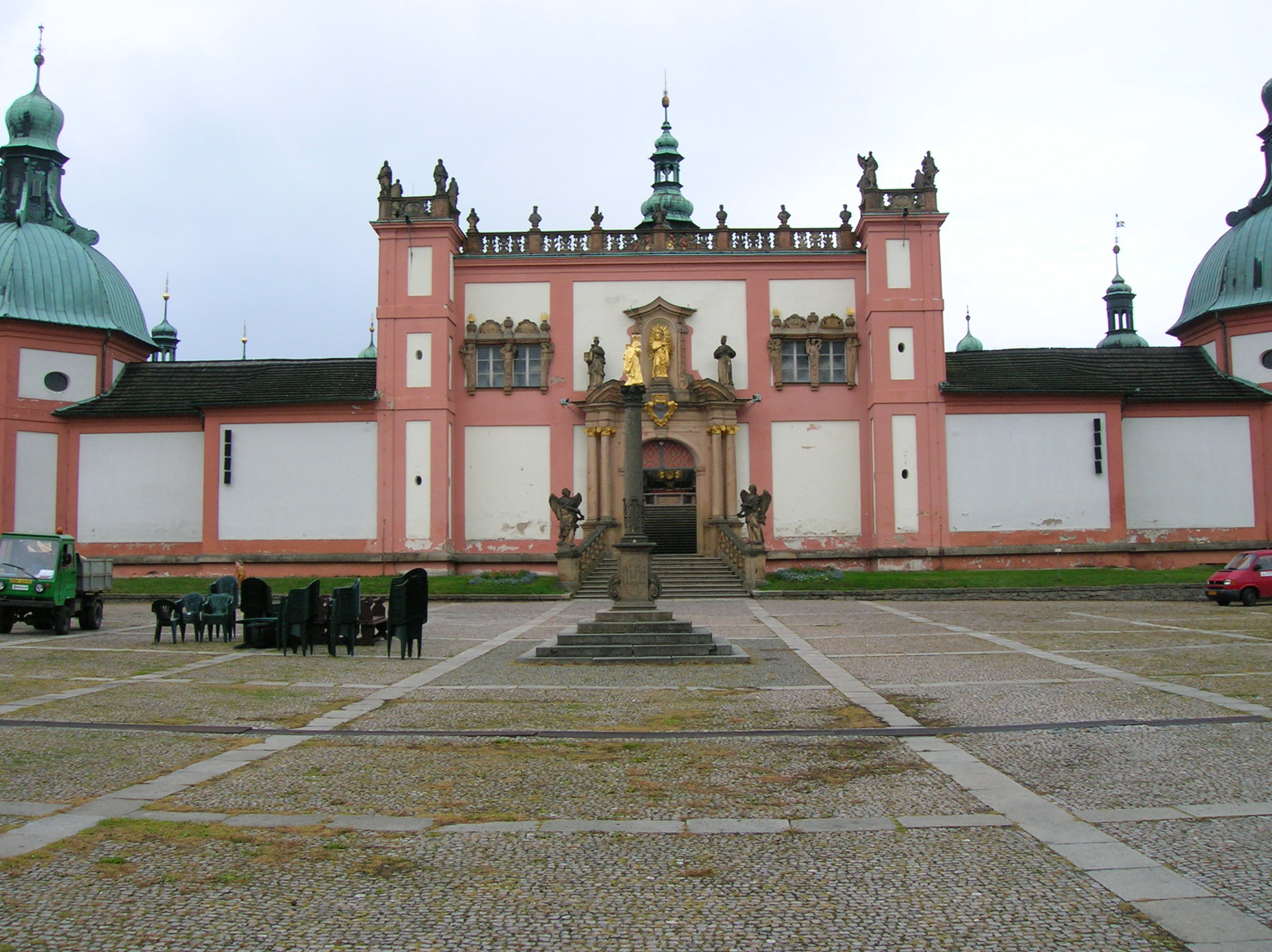
The bus from Prague to the central Bohemian town of Příbram, 54 kilometers southwest of the capital, took about an hour. When it made a stop on the main square in Dobříš, I remembered visiting that lovely chateau with the quaint restaurant in its courtyard. I got off in Příbram and walked uphill for a while until I reached the Holy Mountain (Svatá Hora) pilgrimage site, a former Baroque monastery complex that included ambulatories, open altars, closed corner chapels and a basilica with three open altars on its loggia. On the bus I read some historical information about the place to which the devout had been flocking for centuries.
According to one legend, the original chapel was constructed courtesy of Knight Malovec in 1261 as his way of showing thanks to the Virgin Mary, who had protected him from robbers at the site. Another legend claims that the first Archbishop Arnošt of Pardubice, had the chapel erected during his tenure in that function from 1344 to 1364. (The first Archbishop also had been an active diplomat during Emperor Charles IV’s reign.) Some speculate that the original chapel may have been built in the 15th century or at the beginning of the 16th century.
 The statuette of the Holy Virgin, now placed in front of the silver main altar of the basilica, is Bohemian, from the Gothic period, probably created in the 14th century. Pilgrims had begun traveling from afar to see the Madonna in the first half of the 16th century. The figurine was hidden in the tunnels of mines and other places during the Hussite wars of the 15th century and then returned to Holy Mountain, which witnessed dismal days again during the pillaging and destruction of the Thirty Years’ War in the 17th century. During those battle-ridden times, the statuette had been transported from place to place again. The chapel had even been used as a stable when the Emperor’s troops took over Holy Mountain.
The blind beggar Jan Procházka dreamed of regaining his sight at Holy Mountain in 1632, and his dream came true. The popularity of Holy Mountain soared, major repairs were made and even Emperor Ferdinand II paid homage there on several occasions.
After the Jesuits took control of Holy Mountain in 1647, the Baroque complex was built. Chapels and ambulatories were erected, and the place was decorated with stucco and paintings. In 1732 the statuette was allowed to don a crown made of gold, as one of the Virgin’s titles is Regina Coeli, Queen of Heaven.
 In 1773 the Jesuit Order was abolished because European leaders felt threatened it, and Pope Clement XIV succumbed to the secular demands. The Order only carried on in Prussia and Russia. In other countries it was suppressed for 40 years. In 1773 the state took over Holy Mountain. The site became dilapidated. The Redemptorists came into the picture during 1861. Extensive restoration was carried out in the early 20th century. Pope Saint Pius X raised the status of the church to a basilica in 1905. After Czechoslovakia was created in 1918, Holy Mountain continued to be a favorite pilgrimage site.
But Holy Mountain once again faced difficult times during the Occupation and Communism. Under the Nazi regime the Redemptorists had been allowed to carry out a limited number of activities, but in 1950, during the Communist era, the Redemptorists were expelled from the site. On April 13, 1950 the Communists closed down all the monasteries in the country and transported the monks and friars to internment camps or put them in prison. Still, that did not stop the devout from making the arduous journeys to the complex. Then, in April of 1978, a fire destroyed part of the site. The police claimed some mischievous children had accidently started the blaze. When the complex was returned to the Redemptorists in 1990, extensive reconstruction took place. Now there are six priests who take care of Holy Mountain.
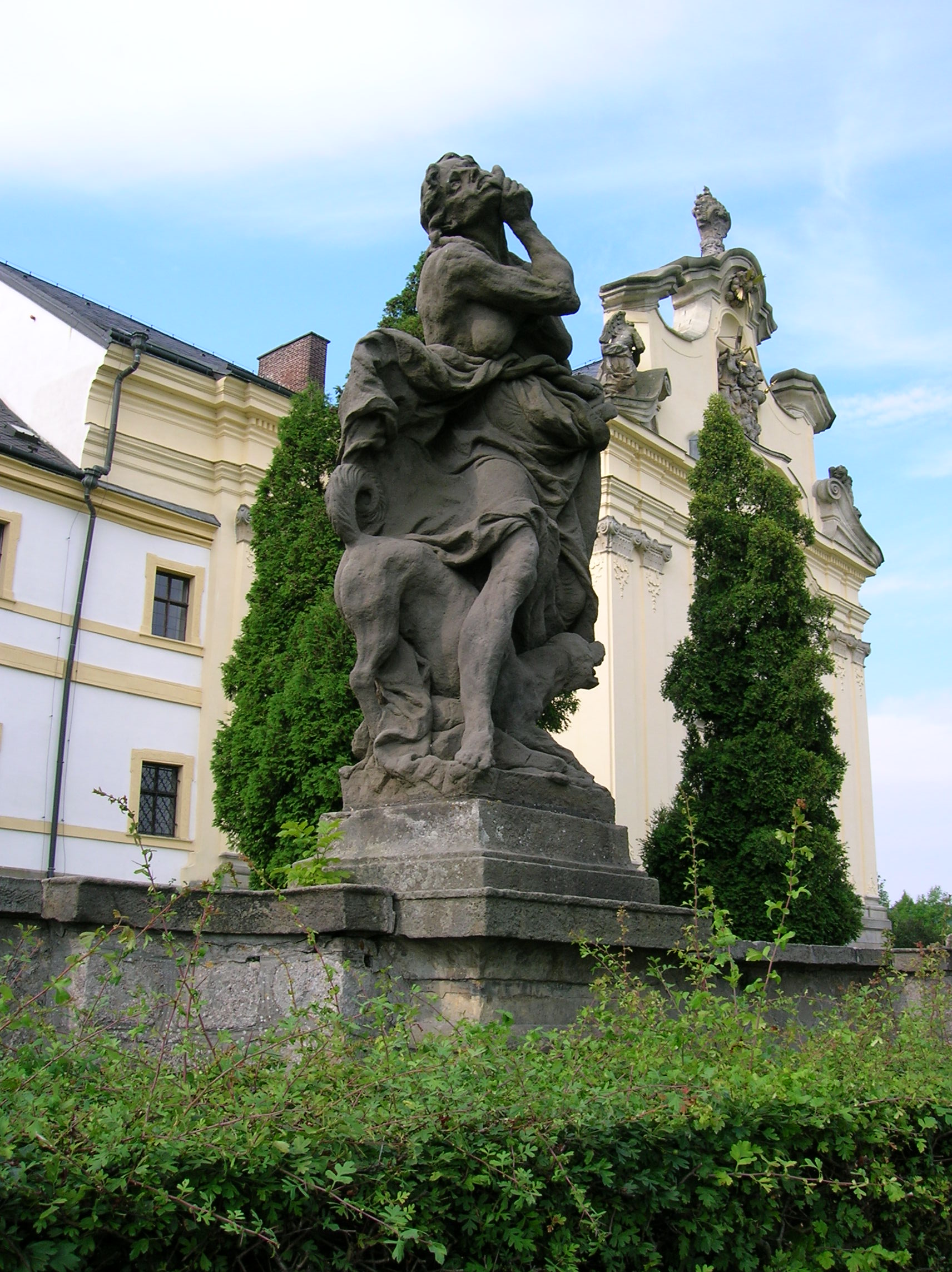
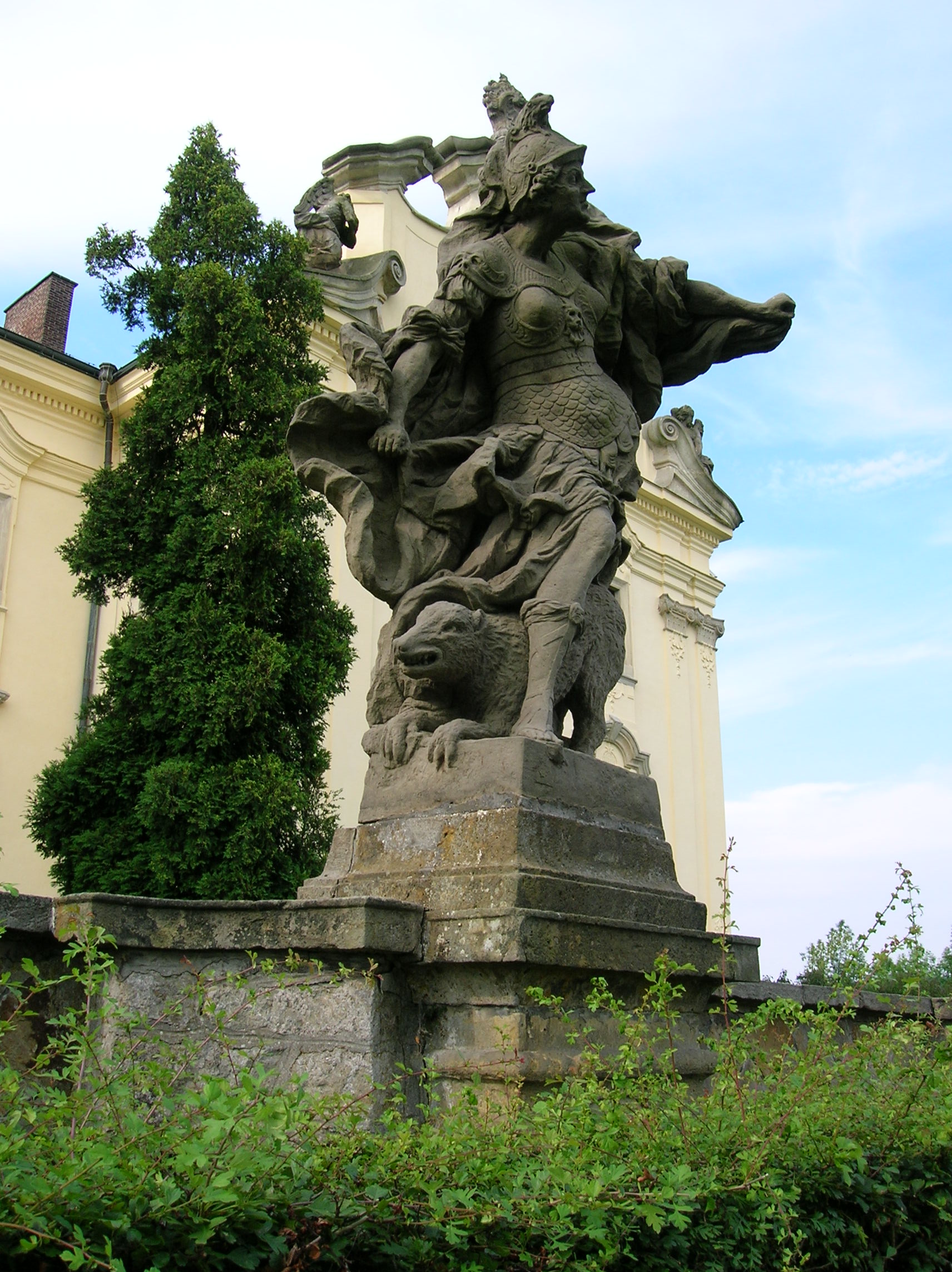
 As I approached the Holy Mountain complex of buildings, I noticed how austere the exterior looked. I stopped in front of the main gate, called the Prague Gate, which was created in the early 18th century in collaboration with the legendary architect Kryštof Dientzenhofer. The statuary adorning the gate was spectacular. Seven statues of prophets from the Old Testament and seven busts of saints decorated the balustrade. I spotted Saint Wenceslas, the Czech patron saint, and Saint George, among others.
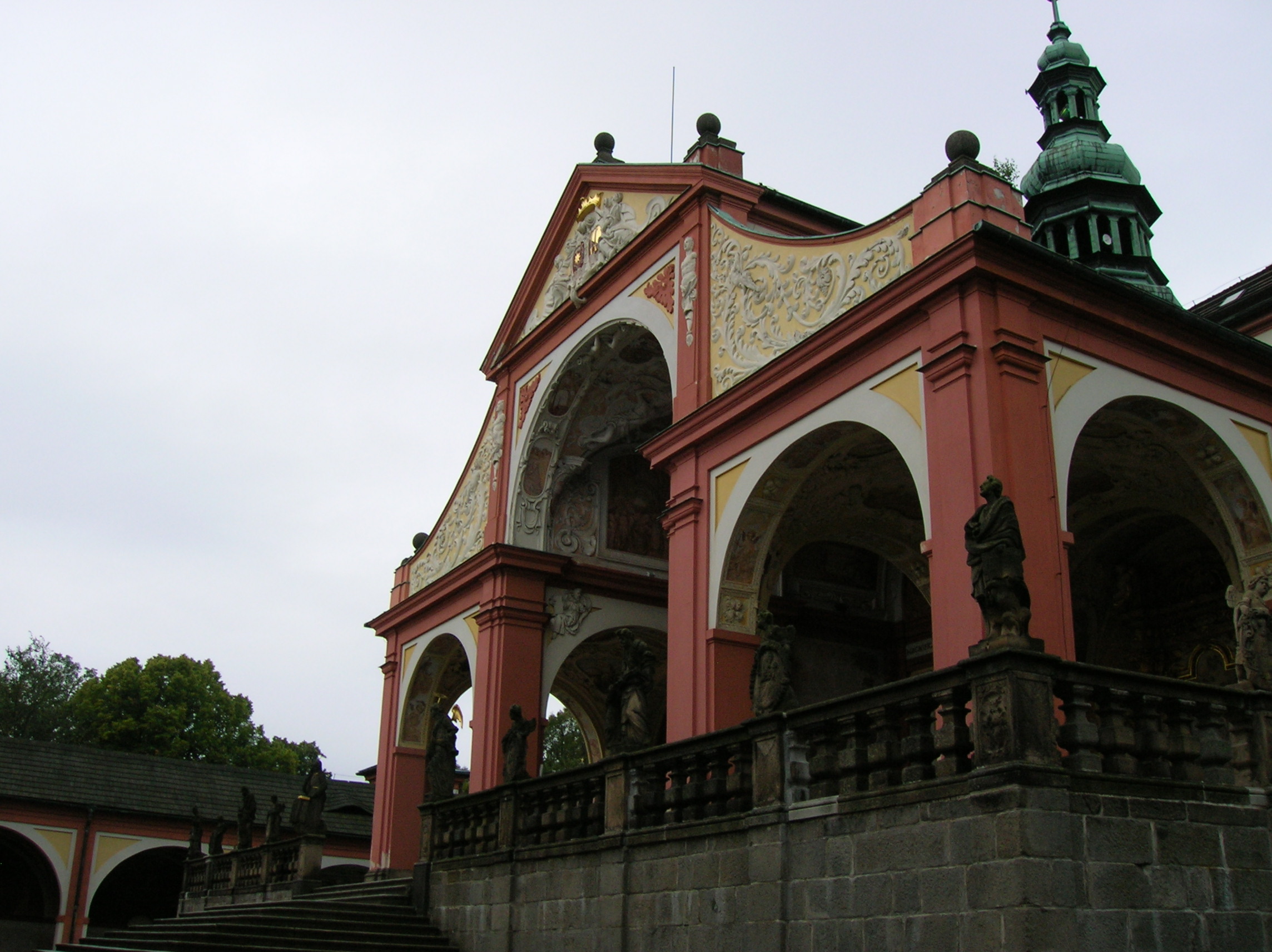 The basilica was situated on a terrace in the middle of the courtyard. The terrace was decorated with spectacular statuary. Surrounding the basilica were ambulatories with 16 arcades and four closed, corner chapels. Many open chapels adorned the ambulatories that also featured 21 lunette paintings focusing on the legends and history of Holy Mountain. The 100 paintings on the vaults of the ambulatories portrayed tragedies in which the Holy Virgin of Holy Mountain saved the believers in acts of miracles and grace. One ambulatory featured falling from a tower and falling from a horse, for instance. Other vault decoration portrayed the dangers of the plague, fire and lightning. Catastrophes triggered by water were also represented. The stucco work on the ambulatory chapels was original, though the altar paintings were redone by Jan Umlouf during the late 19th century.
The first closed chapel that we came to was the Prague Chapel, named after the capital city because the Old Town, the New Town and the Lesser Quarter of Prague had contributed funds to have it built. The coats-of-arms from these towns prominently decorated the chapel that harkened back to the late 17th century and early 18th century. The exquisite stucco decoration enthralled me as did the eight paintings of saints on the ceiling, but what really got my attention was the painting decorating the main altar.
 It had been created by my favorite Czech Baroque artist, Petr Brandl. I loved the detail of the fluttering angel clad in dynamic drapery in Brandl’s energetic work, “The Annunciation of the Virgin Mary.” The angel’s gaze at the Virgin Mary appeared so protective, yet so fragile. The cupola featured portrayals of eight Czech saints with Saint Wenceslas and Saint Ludmila among them. On one wall I saw a painting of the Saints Cyril and Methodius, Byzantine Greek brothers, who, during the 9th century, introduced the Slavic language to the area that is now the Czech Republic and other regions. I also admired the stucco decoration with garlands and putti.
 I explored the open chapels. The Nativity of the Virgin Mary Chapel hailed from the 17th century, with a painting on that theme in the center of the altar. Saint Catherine and Saint Wenceslas fIanked the main altar. I liked the appearance of the spiraling columns at the sides of the central panel and the white stucco on the ceiling adorned with exquisite, small paintings.
I also studied a painting of a pilgrimage from Prague to Příbram, a journey which had taken three days during the 17th century. I recognized Prague Castle and the Charles Bridge in the background. Those were two sights I rarely visited these days but adored despite the never-ending flow of tourists.
 The Triumphant Virgin Mary Chapel from 1674 was certainly unique. General and Count Jan (Johann) von Sporck had it decorated with symbols of war, such as weaponry. A general of the Habsburg armies famous for his successes during the Thirty Years’ War of the 17th century, Sporck had certainly proved himself as a military leader, but he was also known for his avarice and cruelty. Serfs disliked him so much that they were convinced he knew witchcraft and had ties with the Devil. His son Count Frantíšek Antonín von Sporck was well-respected for his patronage of the arts.
On the altar Jan von Sporck emphasized the theme of war to the extreme. The paintings featured battles showing the defeated Turks. The central panel featured a soldier wielding a sword and shield showing the head of a Turk. White with gold stucco decoration included a child fighter armed with a sword in one hand and the head of a Turk in the other. I found the war themes appalling, especially the depiction of the child as a soldier holding a severed head.
 Seeing the altar made me think about all the wars in which the United States had been embroiled during recent years. I have always been against the war with Iraq. I remember watching the beginning of the Iraq war unfold on CNN through the early morning hours, my gaze glued to the battles on the screen, horrified by what I saw, yet unable to turn away. It made me feel sick to my stomach. I did not think that the USA should get involved in Syria’s conflict, though the situation was far from simple. I wondered if there would ever be a time again when the USA would not be at war and if I would be alive to see America at peace.
The open chapel showing the engagement of the Virgin Mary to Saint Joseph portrayed the Holy Virgin receiving Saint Joseph’s ring in the central panel. Landscapes adorned with stucco were featured on the walls. Landscape depictions during the Baroque period were rare, the guide told me. We also passed musical instruments made of stucco, the violins and trumpets getting most of my attention. Another painting showed a procession of pilgrims with children approaching Holy Mountain.
The closed Březnice Chapel hailed from 1665. The stucco work was impressive. I gazed at the ceiling paintings, showing the flight into Egypt, the burial of Christ, soldiers guarding Christ’s Tomb and other scenes. I wondered who had painted them – the artist was unknown.
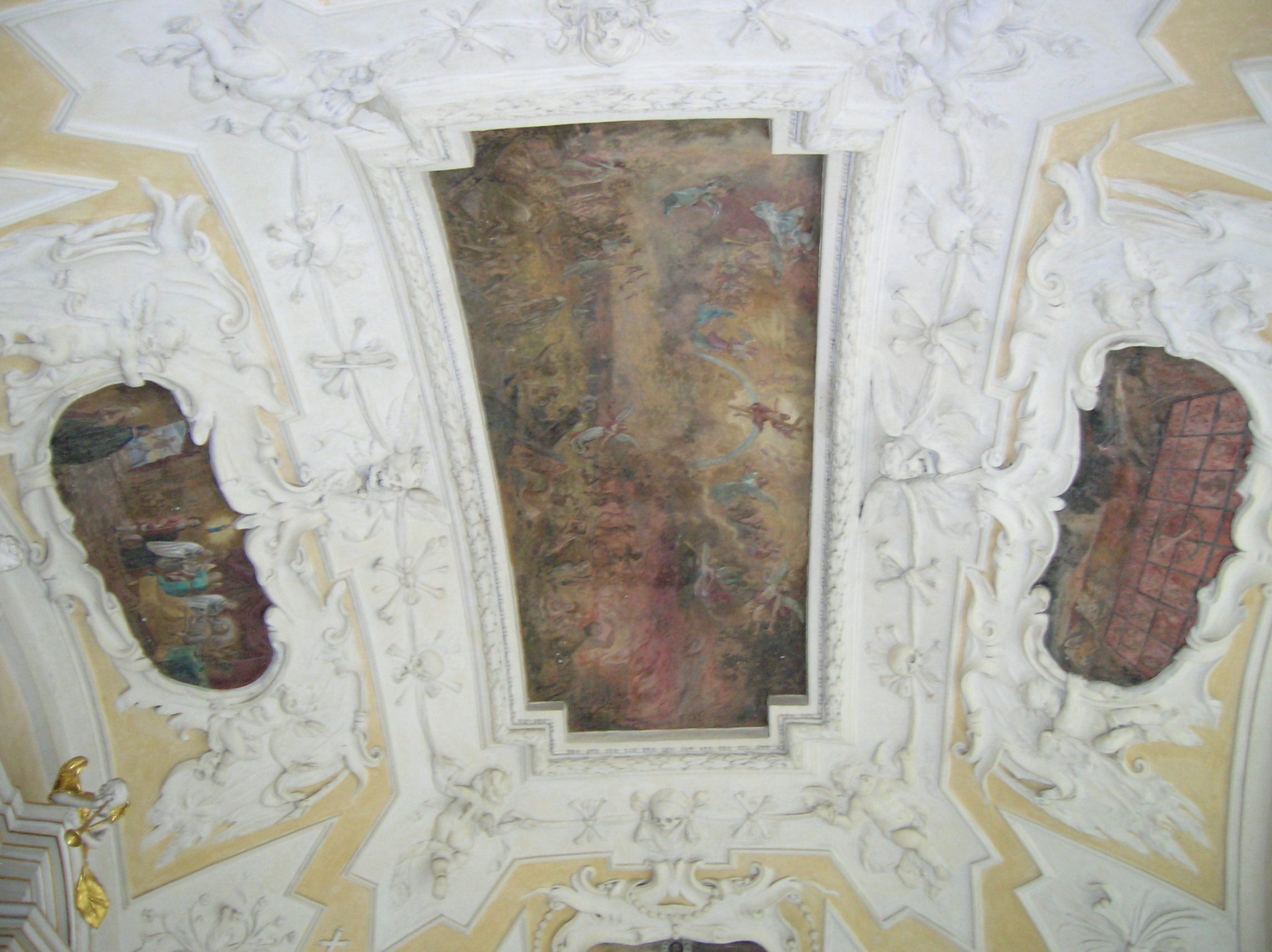
I noticed skulls decorating a column of another open altar. Scenes from Hell and sudden death were depicted on the vaults of the ceiling and walls. Another chapel featured the death of the Virgin Mary surrounded by paintings of the 12 apostles on the wall and ceiling.
 Then we came to a closed, corner chapel named after the west Bohemian town of Pilsen. The main altar featured a painting of the patron saint of Pilsen, Saint Bartholomew, holding a book. The Virgin Mary of Pilsen and Saint Michael also made appearances. I noticed that Saint Nicholas was clad in elegant, golden robes. Angels accompanied the saints, playing various instruments. I also noticed the exquisite carvings on the benches.
Next we went outside the ambulatories and down to the Chapel of Mary Magdalene, which looked like a cave thanks to artificial stalactites, created in 1665. A statue of Saint Mary Magdalene, who, according to a medieval legend, had lived in a cave for 30 years after Christ’s resurrection, made up the main altar while scenes from her life were painted on the cupola. Figures of other saints surrounded her. The effect of the cave-like room was eerie and creepy, but stunning all the same. I had never seen anything like it except for a church in a cave in Palermo, Sicily. Outside the guide pointed out one of the 12 crosses on the Stations of the Cross that the devout could follow, saying prayers at each station, symbolically following in the footsteps of Christ to the Cross.
Don’t let me forget the closed chapel called Mníšek. It dated from the late 17th century and early 18th century. Its altar painting showed Saint John of Nepomuk kneeling before the Virgin Mary and hailed from 1871. Statues on the balustrades of the chapel featured saints and angels.
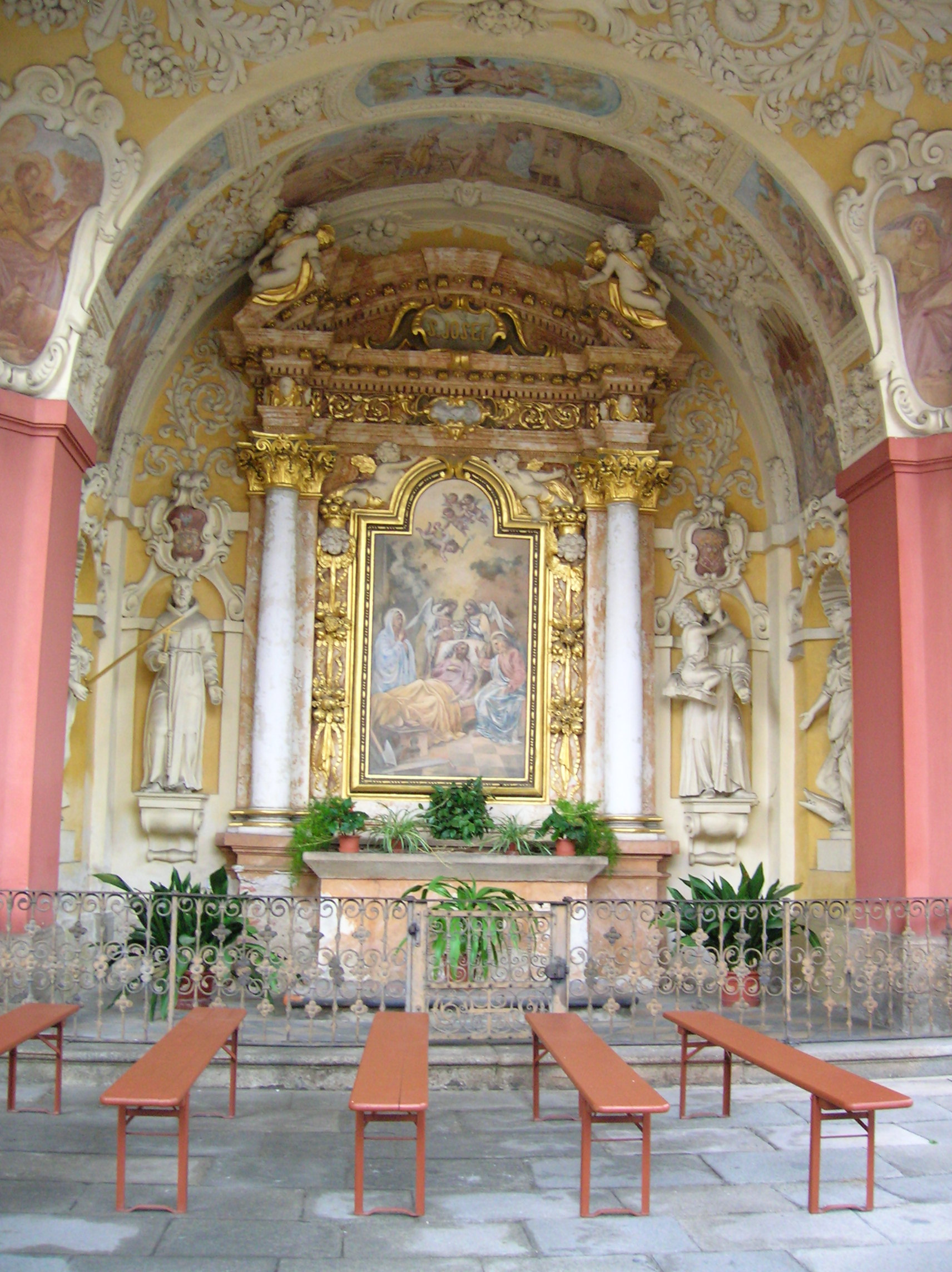 We continued to the basilica in the middle of the courtyard. I admired its balustrade with impressive statues of Bohemian patron saints and angels. There were three open chapels in the loggia. I liked the Coronation Chapel the best. It hailed from 1667 with stucco adornment, paintings and a marble altar. Twelve paintings representing the 12 sections of the prayer “Ave Maria” caught my attention. Czech saints, apostles, prophets from the Old Testament and archangels were gathered on the ceiling vault. On one side a painting showed the 1732 coronation ceremony of the statuette of the Holy Virgin of Holy Mountain. I wondered what it would have felt like to be at such a formal, lavish celebration during the 18th century. It must have been enthralling to see the figurine decked in golden armor. The ceremony still takes place once a year.
Impressive painting and stucco decorated the Chapel of Saint Joachim and Saint Ann. Paintings showed scenes from the life of the Holy Virgin’s parents. The Chapel of Saint Joseph, which hailed from 1667, featured the altar painting “The Death of Saint Joseph” from 1873.
 The interior was amazing. The Chapel of Saint Ignatius featured 10 paintings of scenes from the life of Saint Ignatius of Loyola. I noticed a coat-of-arms with a star and eagle and knew it stood for the Šternberk clan, who owned Šternberk Castle not far from Prague. That family had helped finance the building of this altar. Another chapel called the Assumption of the Virgin or the Chapel of Saint Wenceslas featured exquisite stucco adornment and ceiling paintings from the life of Saint Wenceslas. Silver statues of saints also decorated the space. The Chapel of Saint Elizabeth had exquisite stucco decoration, and the ceiling painting featured Saint John the Baptist with his parents.
The main altar was the big treat, though. Divided into tiers, it glittered silver. The statuette of the Holy Virgin looked so delicate inside the silver box. Silver figures of kneeling angels and Baroque reliefs added to the decoration. The antependium on the front of the altar could be traced back to 1686, and the tabernacle was constructed two years later.
I went to check out the other entrance, the south Březnice Gate. Above the portal was a stone replica of the Holy Virgin of Holy Mountain. Six stone busts from 1707 included Mary Magdalene. The sculptural adornment was undoubtedly impressive.
I said goodbye to the guide and descended the hidden staircase of more than 300 stairs that connected the complex with downtown Příbram. The Jesuits built it from 1727 to 1728 to protect pilgrims from bad weather. It was very austere, without decoration. After exiting the tunnel-like staircase, I walked down some picturesque, narrow streets with ceramic shops and small cafes. Then I came to the main square, where I found a restaurant that served my beloved chicken. After lunch I walked to the bus stop, and transportation to Prague came within five minutes.
Tracy A. Burns is a writer, proofreader and editor in Prague.








 Tracy's Travels