
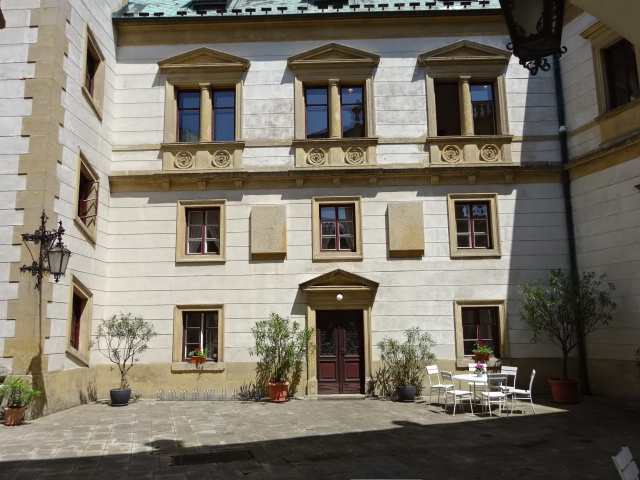
As I made my way from the grassy parking lot to the chateau, I wondered why I had only heard of Stránov that year, in 2025. After all, Stránov had been open to the public since 2004, even though reconstruction was in progress back then. The chateau looked impressive and romantic with a Neo-Renaissance appearance thanks to a 19th century transformation.
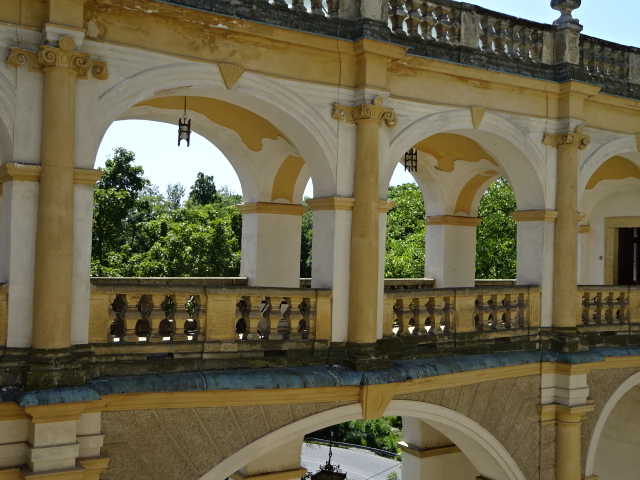
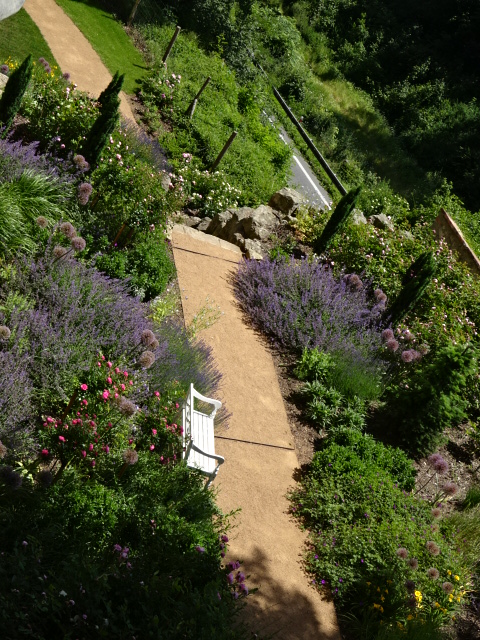
I walked into the café/box office to buy my ticket. The room was quaint with dark paneling. Then I walked into the courtyard dotted with white tables and chairs, and I gazed at the elegant Neo-Renaissance arcades. A distinctive sandstone fountain also caught my attention. From the courtyard I could see a narrow garden area below. People were seated at the white chairs and small tables in the garden. The plant species and flowers were colorful and enthralling.

The guide explained that a Gothic castle had been built on the site in the 15th century, replacing a fortress. Indeed, a Gothic tower still was a dominant feature of the chateau. It was even possible to climb it and take in the views. At the end of the 16th century, the castle got a Renaissance makeover and became a chateau for residential living. During the 18th century, more reconstruction was carried out – this time the chateau turned into a Baroque gem. The garden was also created during this period. The following century Stránov was made into the Neo-Renaissance structure that it is today.
However, the most important time in the chateau’s history began in 1917, when Josef Šimonek, a senator and entrepreneur with the Škoda auto manufacturer, purchased it. He had been so successful and well-respected in the business world that a noble title had been bestowed upon him.

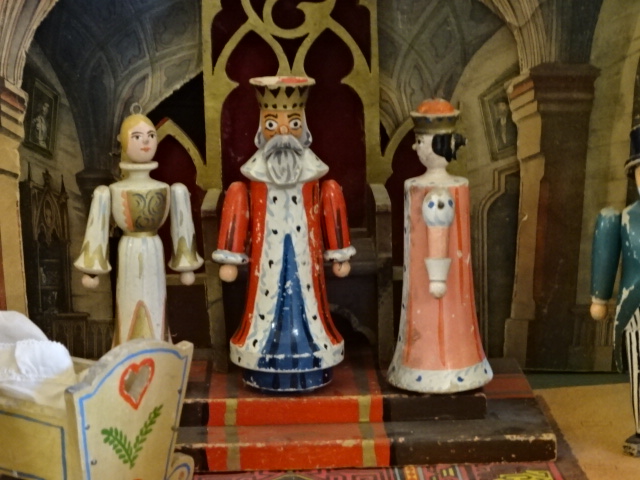
During the First Republic, when Czechoslovakia was a democratic country under the guidance of President Tomáš Garrigue Masaryk, Šimonek, his wife Božena and their two sons, Jaromír and Jiří, made the chateau their home. Black-and-white photographs of the family dotted the rooms as did a group photograph of a joyous acting ensemble that had shot a film there long ago. I saw artifacts from the sons’ childhood – a sled made in 1929 and well-worn miniature toy cars. A children’s theater stage with figures of a skeleton, king and queen caught my attention. The decoration on it was exquisitely hand-painted. The father even created a small zoo for the children.

Although Šimonek retired from Škoda Auto in 1918, he remained a senator in Parliament until he died in 1934. His son František resided there with his family until the Communists forced them to flee in 1950. František’s mother, Božena, left with her husband’s urn in a basket, never to return. She found shelter in a parish house without running water. She lived there until her death in 1976. I saw the suitcases members of the family had carried when they had to leave their home.
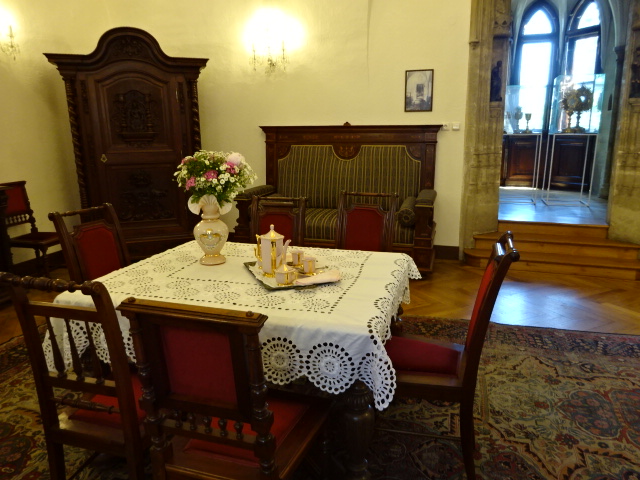
Once nationalized, the chateau became an orphanage. The Šimonek family didn’t get the chateau back until 2003. Before the arrival of the Communists in 1950, there had been 750 pieces of furnishings and objects. Returned to the family in the early 2000s were only 35 of those. Stránov was open it to the public during 2004 even though reconstruction was taking place.
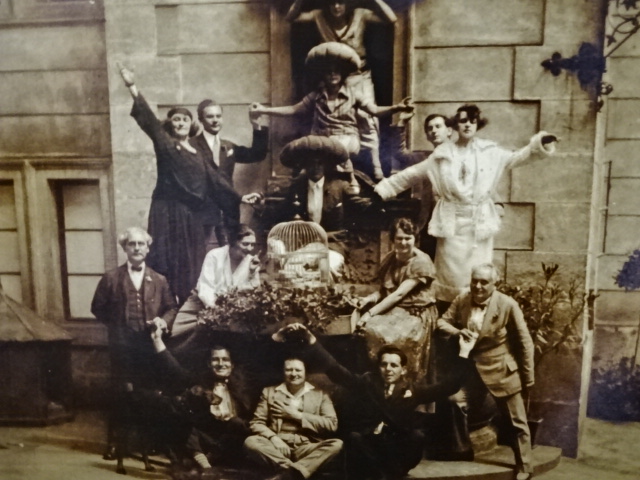
Photo of acting ensemble that shot a film at the chateau many decades ago
Another relative also named Jaromír Šimonek, born in 1945, had called the nearby chateau Lobeč home for five years before being forced out with his family by the Communists in 1950. Growing up, he had his hopes set on studying about machines in Mladá Boleslav, a nearby town. However, the Communists did not permit him to study for his desired profession. He did, though, wind up learning how to repair agricultural machines and took a serious interest in mechanics. Later, he followed in his family’s footsteps and went to work at Škoda Auto. Eventually, he became the mayor of Lobeč. He died in 2021.
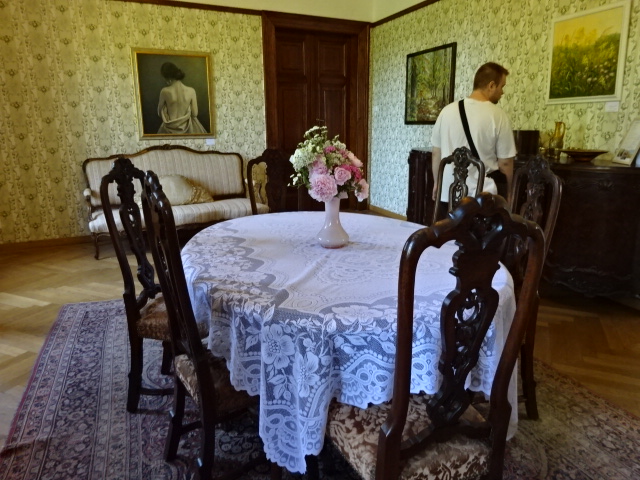
The interior of the chateau harkened back to the First Republic. The current owner had furnishings made to look like they had been created during that era, my favorite period of Czechoslovak history. There were a few original furnishings that had been preserved for use in the orphanage.
The interior was cozy with an atmosphere that made me want to open a good book and relax there. In one room with wine red-upholstered chairs and a table with a tea service, I could imagine having a cup of Earl Grey on a wintry evening while discussing the Čapeks’ latest play. I could imagine people seated in armchairs or at tables there, talking animatedly about what was new with Masaryk’s politics, Karel Čapek’s books and Josef Čapek’s artwork. While some of the paintings on the wall were for sale, others harkened back to past eras. The dining room chairs looked elegant with the family coat-of-arms decorating the backs. A beautiful piano also was on display.

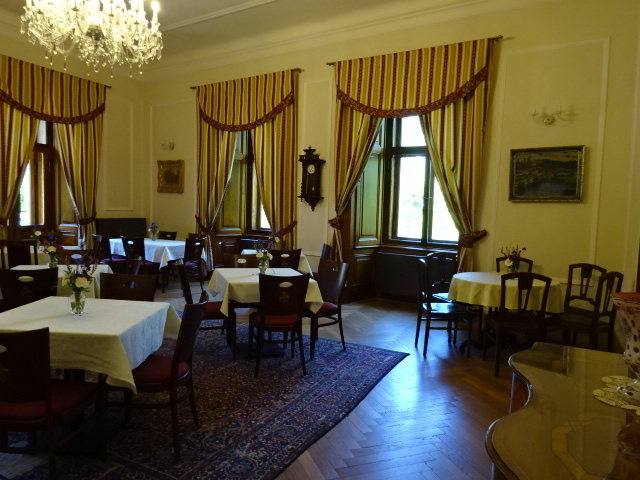
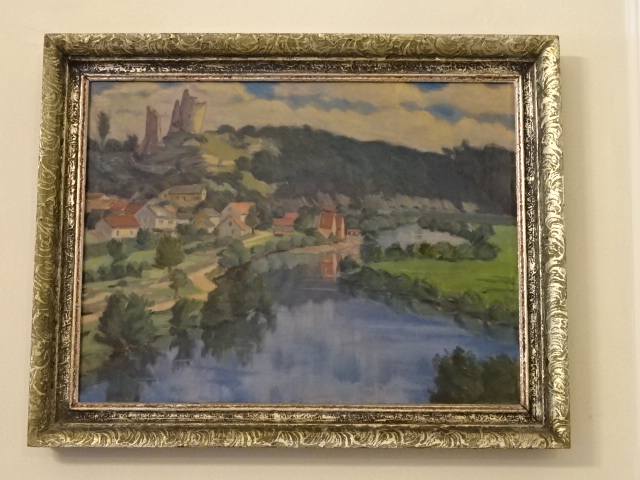
In the large space used for weddings, I saw red upholstered chairs with tables complementing the red and gold striped curtains that gave the place an elegant look. I wanted to fall into the quaint wine red leather couch. I noticed the beautiful Bohemian crystal chandelier. On the wall a painting caught my eye. The tranquil landscape featured a calm river with homes dotting the embankment.
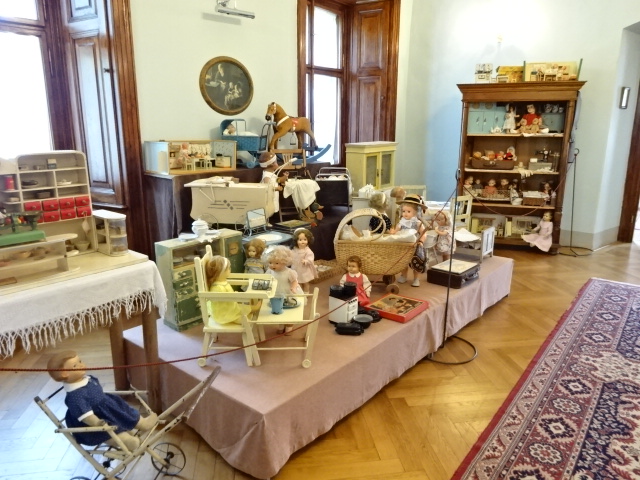
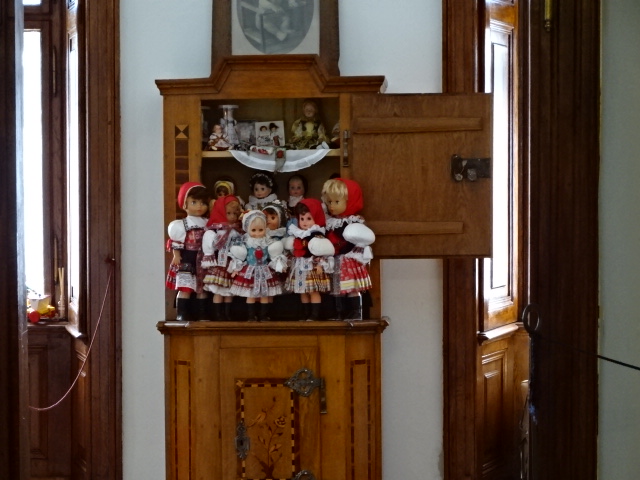
The chateau included a toy museum with old objects donated by a private collector. I saw early 20th century dolls of girls in folk costumes and once much loved teddy bears of various sizes. Children’s baby carriages and dolls of various sizes graced the exhibition room. A rocking horse was also on display. I loved the miniature furniture, such as a cabinet filled with plates and tea cups. I also peered in one hallway at original folk costumes, exquisitely made.
I came away from the tour with a warm feeling for my favorite period in Czechoslovak history. I imagined raucous boys playing with miniature cars in the rooms as their father told them to keep the noise down while he read Lidové noviny. The furnishings had brought the chateau to life, giving it a distinct family atmosphere.
Tracy A. Burns is a writer, proofreader and editor in Prague.


Original armchairs made for Josef Šimonek during the First Republic
 Tracy's Travels