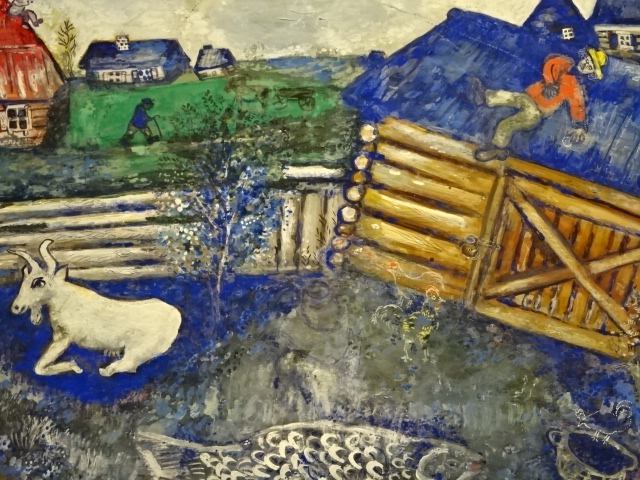
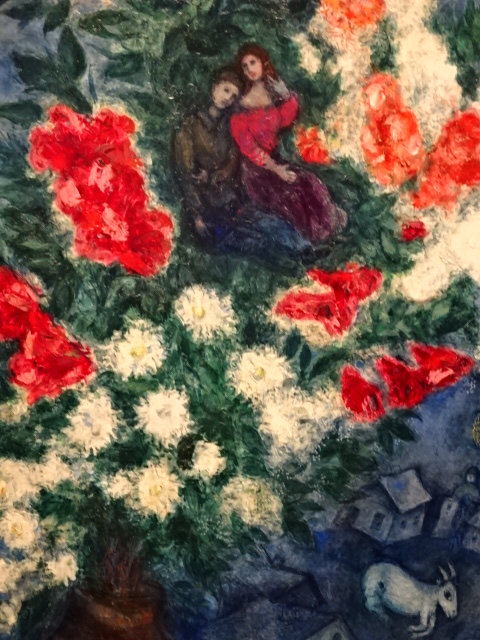
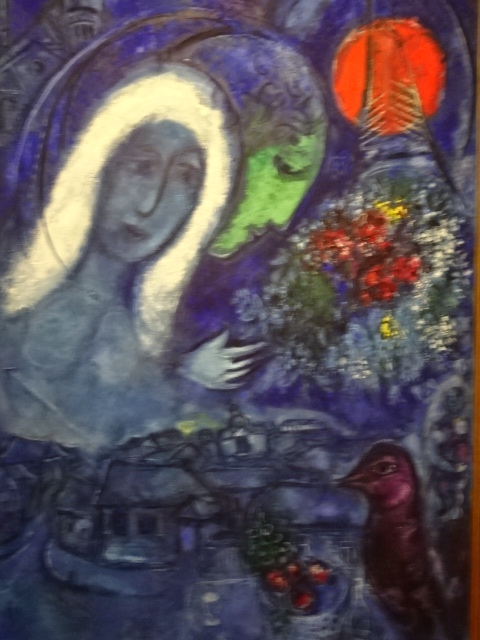
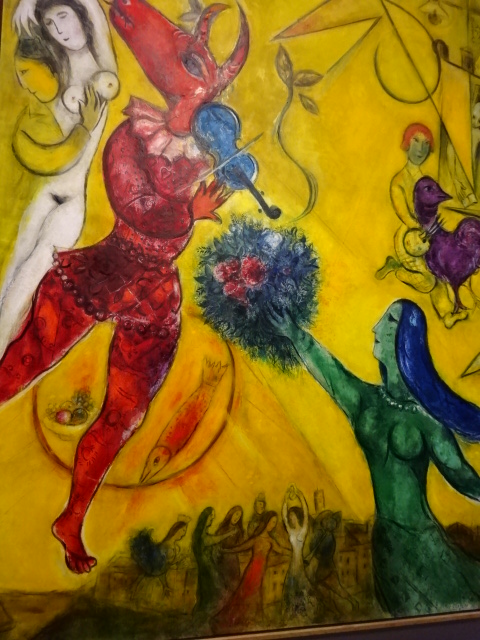
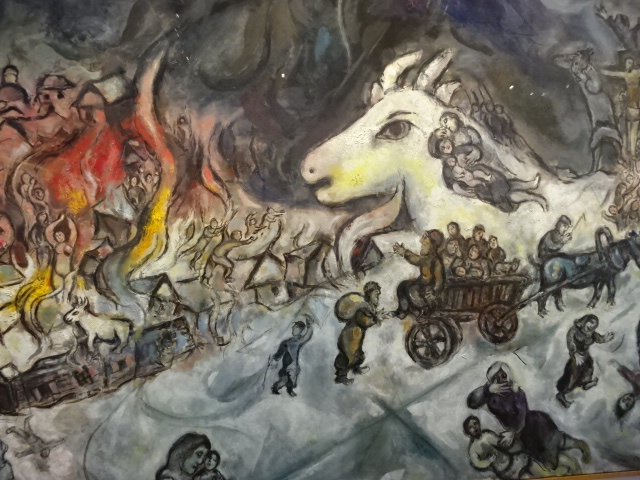
I admired Marc Chagall’s works at the Albertina venue in Vienna, Austria during late October of 2024. I have always loved going to exhibitions in the Albertina. I recalled a comprehensive show of works by Durer at that venue some years ago. A long-time fan of Chagall, I loved his use of bright colors and atmosphere of playfulness in his paintings that had a dreamy, fantasy-filled quality. I was enamored with his mastery of color to express various emotions and to create new worlds. I loved his renditions of Paris, the Eiffel Tower often dominating his creations.
Before this show I hadn’t realized how strongly his Jewish background had influenced his art. Chagall’s paintings were punctuated with Jewish folklore and motifs. I saw a painting of a synagogue and portraits of rabbis, for instance. Many paintings boasted biblical themes. I also hadn’t realized how often he had rendered his hometown, both sadness and joy intermingled in the memories. His yearning to return to his hometown was extremely visible in his art.
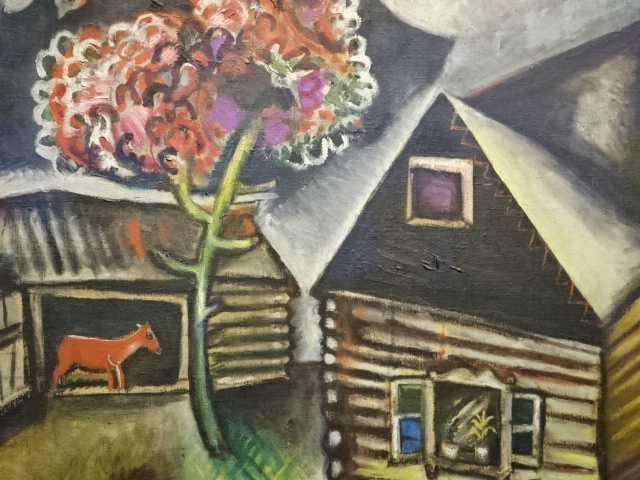
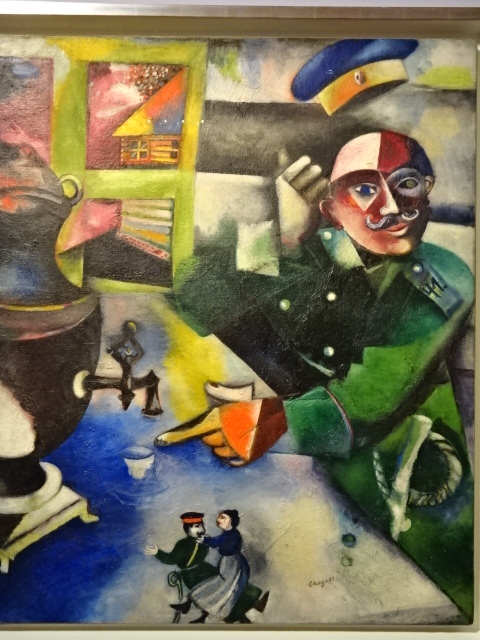
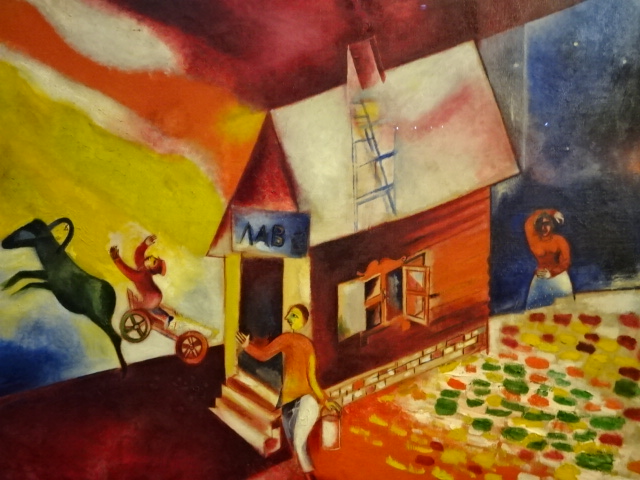
The symbolic nature of his artistic creations also enamored me as I noted the many violinists, animals, half-human creatures, wooden houses, circus characters, roosters and floating married couples as well as beautiful floral arrangements. Because I had visited an exhibition in Prague’s Wallenstein Riding Stables about the interwar years of the École de Paris movement, I knew he had been associated with that era during his Paris sojourn.
The exhibition allowed me to become better acquainted with the artist’s life. Marc Chagall (1887-1985)was born as Moishe Shagal on July 6, 1885 into a Hasidic Jewish family in Vitebsk, located in today’s Belarus. During the late 19th century the town was situated in the Russian Empire. His impressive, varied resume includes paintings, drawings, book illustrations, ceramics, prints, tapestries, stained glass and stage sets, but this vast exhibition focused solely on his paintings.
While he spent World War I in his hometown, he went to Paris before the war broke out, moving there in 1910 when he was 23 years old. In France he made friends with Guillaume Apollinaire, Ferdinand Léger and others creating avant-garde works. He often depicted Jewish themes and also evoked Paris in many paintings. During World War I, back in Vitebsk, he married Bella and held exhibitions in Russia as the war made it impossible for him to leave the empire. He founded an arts college in his hometown, too. However, he was in dire financial straits during the Russian Civil War. After World War I, much of his work was Moscow-based.
Following the Bolshevik Revolution, he moved to Paris for the second time, but fled during World War II after the Germans took control of France. The Nazis in occupied France took away Chagall’s French citizenship, and he and his wife were arrested. However, with the help of others, he and his wife found a way to escape to the USA. He felt like an outsider and didn’t speak English.
While he was in New York City, tragedy struck his hometown of Vitebsk, which was destroyed by the Nazis. Things would get even worse. Bela passed in1944 because it was not possible to get her any penicillin. It was no surprise then that Chagall’s late spouse appeared in many of his paintings. In 1948, though, he returned to Paris, and there his paintings focused on Jewish themes and his yearning for the existence of his hometown. Also, he would marry two more times.
He devoted much time to other fields as well. Some of his accomplishments included creating stained glass decoration in the cathedral in Reims and at the Art Institute in Chicago. He also made stained glass adornment for places in Switzerland and Israel. He became even better known for his ceiling painting of the Paris Opera. I remembered gazing in awe at this ceiling several decades ago. It was an experience I will never forget, even though I saw it so long ago. He also made sculpture and ceramics as well as tapestries.
Chagall died at the age of 97 on March 28, 1985 at the age of 97. He is buried with his third wife in a cemetery in Saint Paul-de-Vence, located in the Provence region.
Tracy A. Burns is a writer, proofreader and editor in Prague.
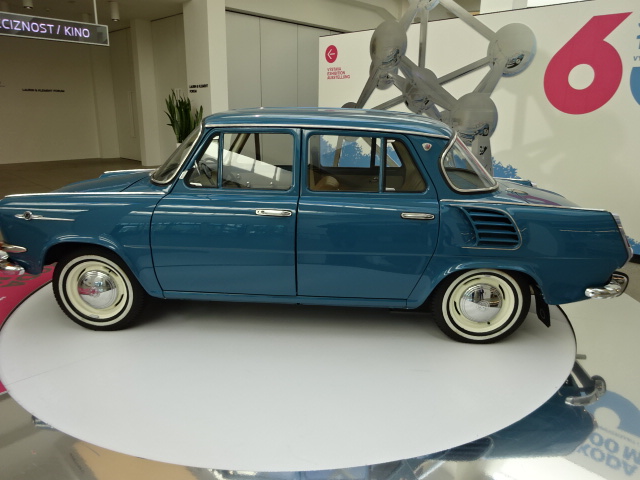
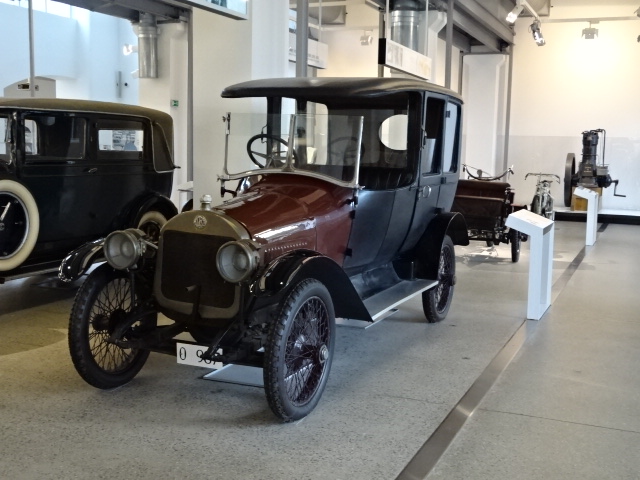
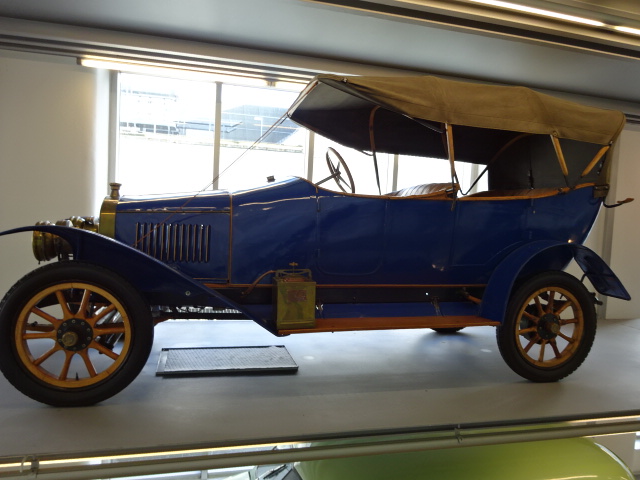
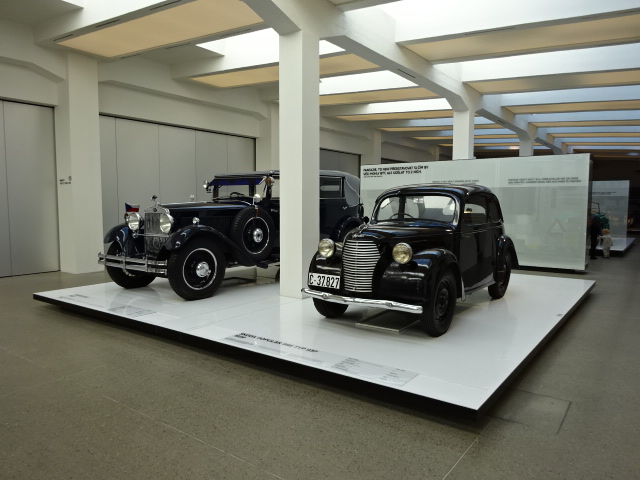
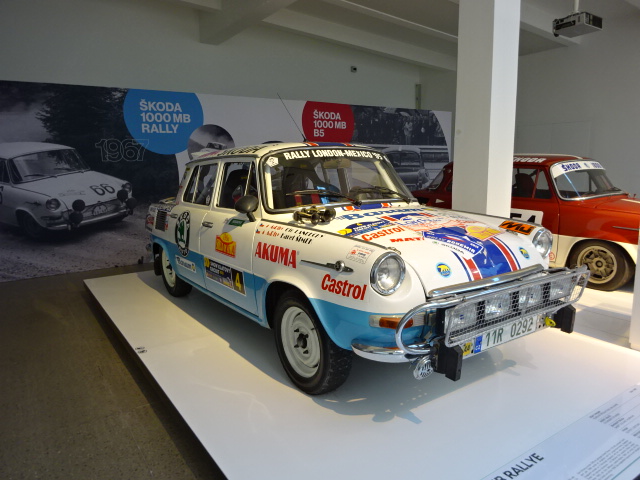
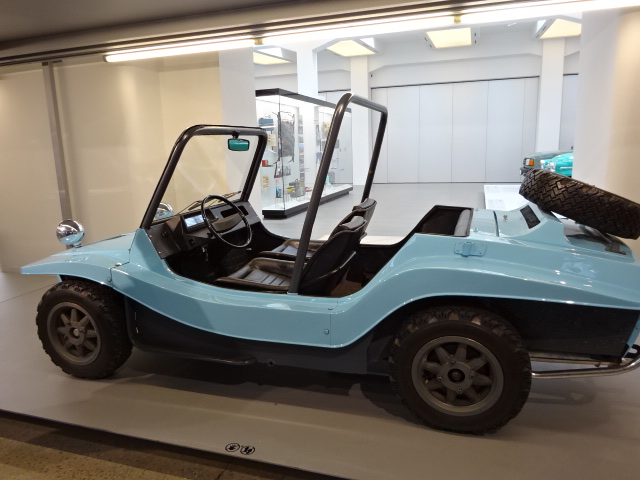
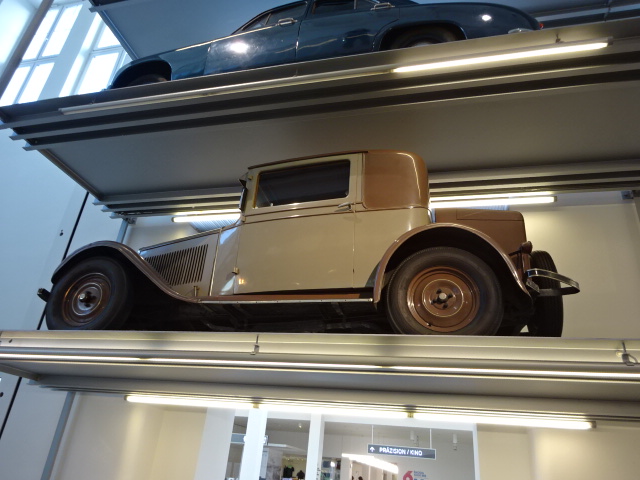
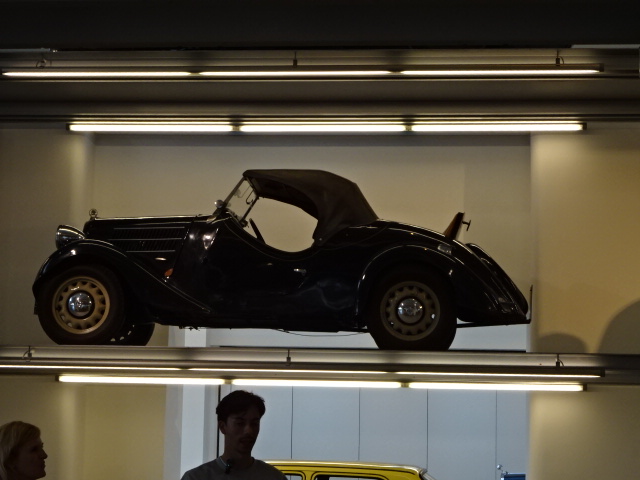
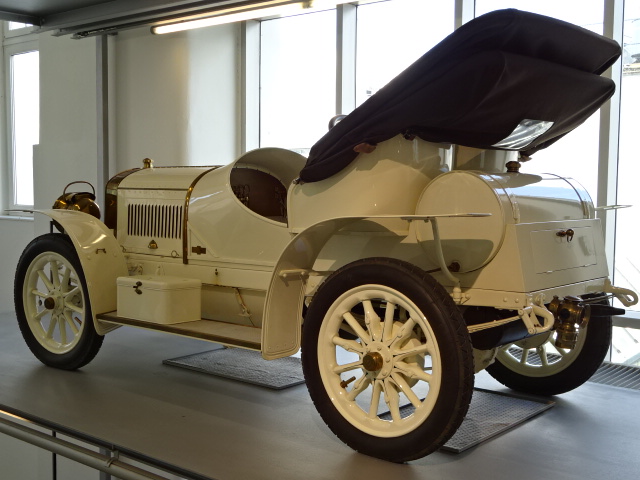
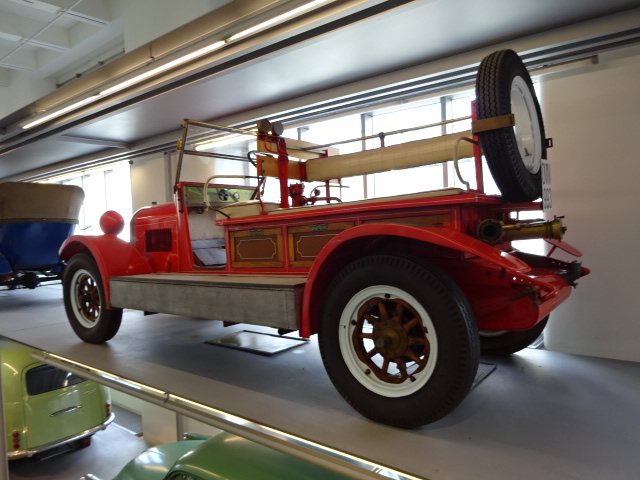
While visiting Mladá Boleslav, a town about 70 kilometers from Prague, I saw many automobiles from various eras in the Škoda Museum, named after a popular Czech car manufacturer that is renowned world-wide. When I walked into the former production halls of the automobile maker, I didn’t know what to expect. I had never been to a museum featuring cars – stagecoaches yes, but cars no. I didn’t have a car and hated driving.
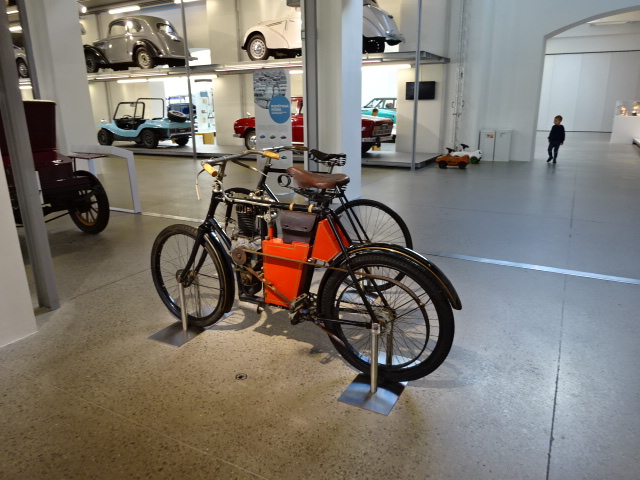
Still, the museum cast a spell on me as I peered at vehicles from the turn of the 19th and 20th century to the present day. The company was established as far back as 1895 by Václav Klement and Václav Laurin, when they focused on bicycles, a few of which were on display. I especially liked the two-seater for postal workers. The unicycle was another delight. I recalled how one Bagatti Valsecchi brother had mastered the unicycle in the early 20th century and how I came across a picture of him posing on one at the Bagatti Valsecchi House Museum in Milan, where Renaissance and Neo-Renaissance art took precedence.
The automobiles that most enamored me were those from the end of the 19th and beginning of the 20th century, although I enjoyed noting how the manufacturing of cars had developed over time. There are cars and bicycles on the ground floor, and after climbing many steps to a viewing platform, more cars are situated on vast shelves.
Here are some photos from bicycles and cars on display in the museum.
Tracy A. Burns is a writer, proofreader and editor in Prague.
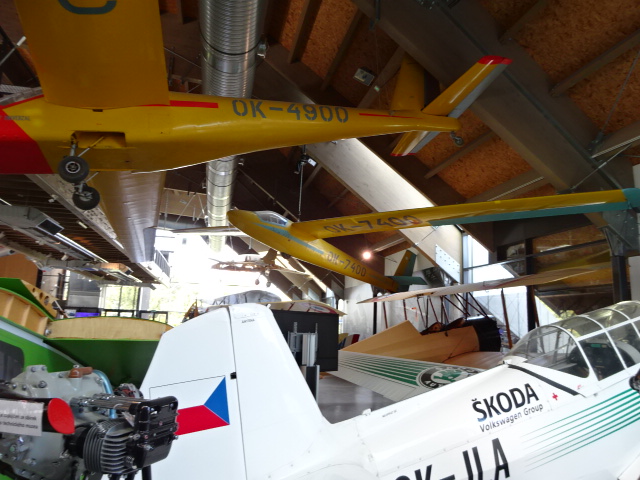
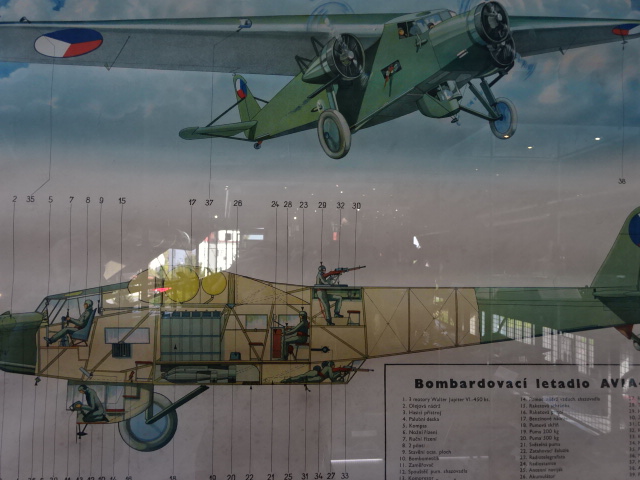
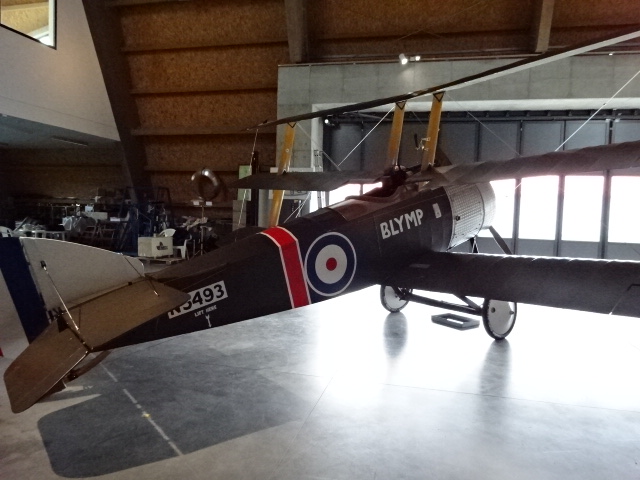
I hadn’t visited an aviation museum before fall of 2024 because, quite simply, I had never shown much interest in planes. That all changed when I went to Mladá Boleslav, about 70 kilometers from Prague. The 25 historic planes in this collection – mostly Czechoslovak, German and Soviet – had me hooked.
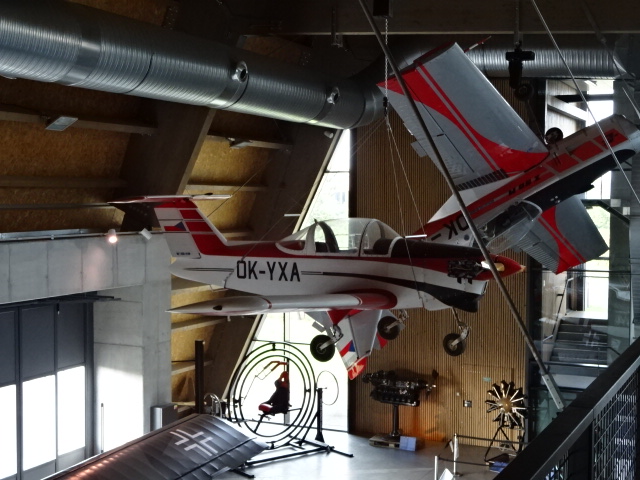
Construction on the museum in a hangar of the Mladá Boleslav airport finished in 2014, and it had been open to the public since 2015. The architecture received much acclaim as it was chosen one of five buildings in the country to be dubbed “Construction of the Year” for 2014. The museum also included two plane simulators and a gyroscope. I perused period uniforms, radio equipment, watches, photography, aviation trophies and posters. From an observation tower there were excellent views of the environs. After walking up steep stairs to the first floor of the museum, I got a good look at the planes hanging from the ceiling.
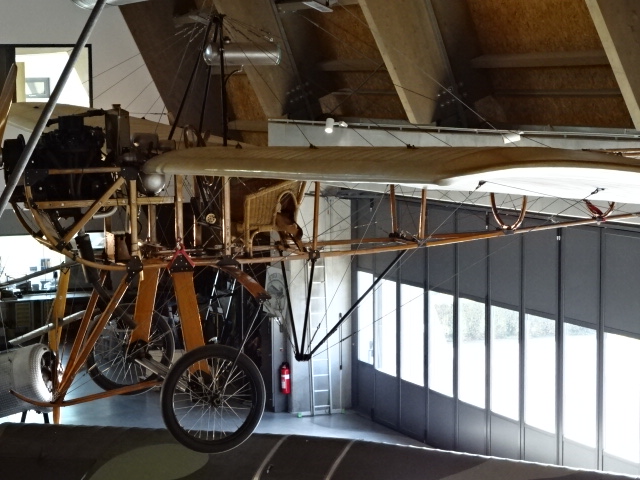
I had not heard of the name Metoděj Vlach before visiting this museum. Vlach had made a name for himself as the first Czech pilot. From 1908 he worked for Mladá Boleslav’s Laurin and Klement business, known for its bicycles and cars, an enterprise that would later become the world famous Škoda automobile manufacturer. He had to use his own money to finance his flying attempts. While his first try was not successful, the second plane he produced in 1909 managed short jumps between 30 and 50 meters. However, the third time was a charm as on November 8, 1912, his aircraft, constructed from 1910 to 1912, made the first flight – reaching 20 meters in the air. It flew a distance of 300 to 500 meters at 100 km/h. The plane weighed 720 kg, and the motor, the kind an automobile used, was 28 kW. The aircraft was successful during five attempts.
One of the aspects about museum-going that I like best is learning about important historical figures and events that I had not known anything about. Learning about Vlach was one of those lessons that certainly enriched my experience at the museum. I spent a lot of time peering at the various specimens, dating from World War I to the later years of the 20th century.
The Little Beetle
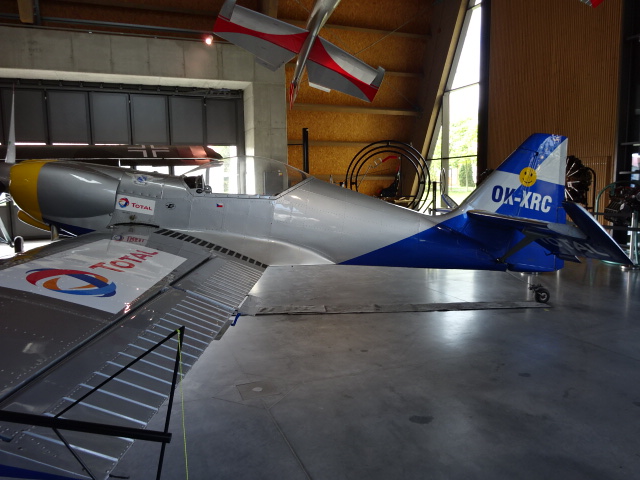
A plane called the Little Beetle captured my attention. The first modern Czechoslovak amateur aircraft, the W-01 Little Beatle was built at the owner’s home in Brandýs nad Labem during the 1960s. The public set eyes on the plane for the first time in 1970. With a wingspan of 6.08 meters and an empty weight of 280 kilograms, the Little Beetle was a frequent participant in Czechoslovak air shows. It was five meters long and could fly up to 180 kilometers per hour. During the mid-1970s, international audiences took notice of the Little Beetle as it was shown off in airshows that took place in the German Federal Republic, Holland and England. Sadly, an accident in 2003 ended the Little Beetle’s career. During 2015 the specimen was brought to this aviation museum.
German Bucker Bu 130 Jungmann
I also took notice of the German Bucker Bu 130 Jungmann, a two-seater designed for training and aerobatics. It took off for the first time in May of 1934 and became a popular training aircraft for the Luftwaffe. The Germans were not the only ones to use this model aircraft, though. It received worldwide acclaim in Czechoslovakia, Spain, Japan, Hungary, Switzerland and other countries.
PO-2, The Sewing Machine or The Maize Cutter
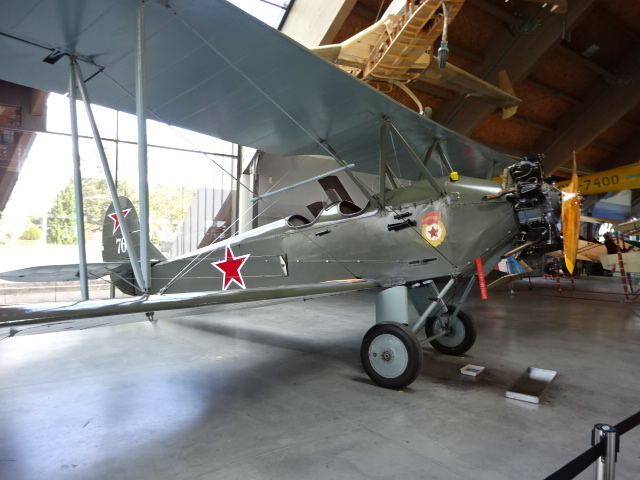
Another plane with an interesting history was the PO-2, a prototype of a U-2 biplane that was adopted by the Soviet Air Force. It was also used for civilian aviation. More than 40,000 PO-2 planes were produced. This popular two-seater came into existence during 1927, and production started the following year. During World War II the Germans called the plane “The Sewing Machine,” describing the distinctive sound of the engine. Soviets had a different nickname for the aircraft with an engine of 100 to 115 horsepower. They dubbed it the “Maize Cutter.” It was also historically significant because a regiment of female Soviet pilots conducted nighttime air raids on Germany using this aircraft. The Germans dubbed these female military personnel “Night Witches.” Production did not stop when the war came to a close. The PO-2 was manufactured in Poland post-wartime.
Klemm L 25
I took note of another German plane. The Klemm L 25 aircraft was designed by Dr. Ing. Hanns Klemm, created in 1926. It was possible to use various kinds of engines with these training, sports and aerobatic planes. About 600 planes were manufactured from 1928 to 1939. During the 1930s the Klemm L 25 participated in competitions in Germany.
Zlín Z-50L
I also saw the Zlín Z-50L aerobatic plane made in Moravia. In the 1970s and 1980s its pilots clinched first place in international competitions, both European and world championships, while flying this plane. The last world championship won by this aircraft was as recent as 1989.
Be-60 Bestiola
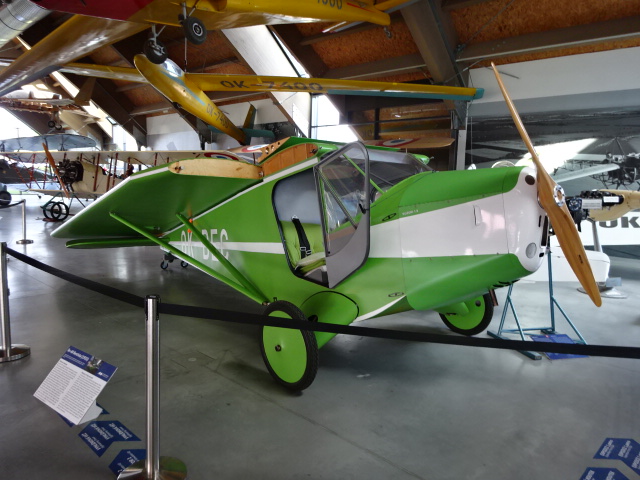
The two-seater, wooden aircraft called the Be-60 Bestiola was designed in 1935 as a Czechoslovak aircraft to be used for training and tourism purposes. Its life span was relatively short, though, as production was halted not long after the 1939 Nazi Occupation. Some of these planes were flown by the fascist-oriented Slovak State during World War II. Unfortunately, there are no longer any original planes of this type in existence. The replica in the museum is quite impressive, though.
Zlín Tréner
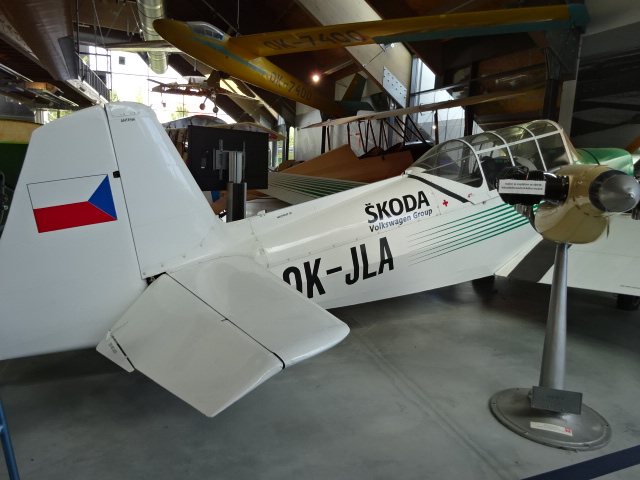
Used for training and aerobatics, the Zlín Tréner captured my attention. It was a two-seater monoplane with low wings and first took off in 1947. Later, it was powered by a four-cylinder engine and was composed of wings and tails made of metal. The career of that prototype began in 1953. The wingspan measured 10.26 meters while the take-off weight was 750 kilograms. The engine was 105 hp, and the maximum speed it could reach was 203 km/h. The aircraft has had a stellar career and is still used for training.
G – III plane
Brothers Gaston and Réné Caudron had been plane designers since 1909. Their G-III did a loop for the first time in December of 1913. In May of 1917 ,it hit another milestone by setting a new record: It flew non-stop for 16 hours and 28 minutes. About 150 planes of this type were produced. The aircraft had a wingspan of 13.4 meters with a take-off weight of 735 kg.
Fokker E.V.
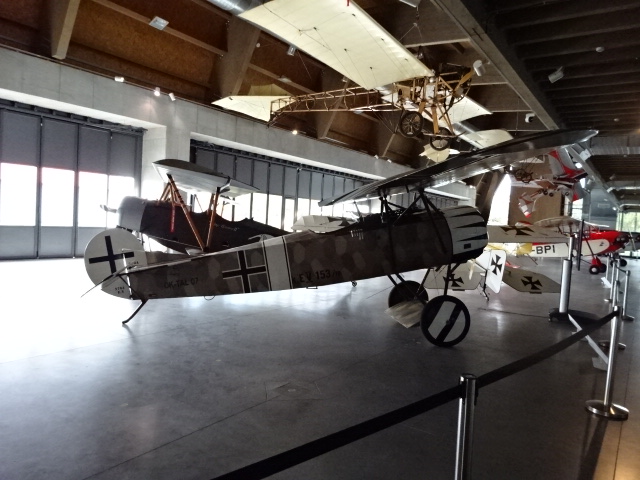
I also saw the Fokker E.V. German fighter plane from World War I. Some 289 aircraft of this model were manufactured. The planes were 5.85 meter long and utilized a 110 hp or 160 hp engine. The wingspan was 8.35 meters while the take-off weight was 605 kg. It could go as fast as 200 km/h.
ŠK – I Trempík
The two-seater ŠK – I Trempík was known for its stability. It was not difficult to take care of, either. Its wingspan measured 9.3 meters, and it was powered by an engine of 75 hp. The maximum take off weight was 578 kg, and it could fly 185 km/h.
1926 silent film with Alexander Hess as the pilot
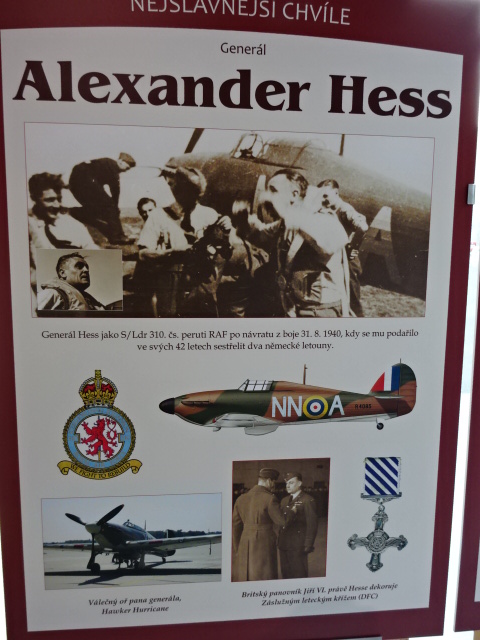
General Hess after returning from his service in the RAF when he shot down two German planes; British royal George VI awarding Hess a medal; War plane Hawker Hurricane used by the general
On the first floor there were panels about General Alexander Hess, a pilot I had not heard of before. He also had starred in a 1926 silent Czechoslovak film as well as working as a pilot. Hess was the organizer of the Czechoslovak aircraft for the 1936 Olympics. After the Nazi Occupation in 1939, he helped pilots escape, equipping them with false passports, and General Hess wound up fleeing from the Nazi Protectorate to France and then to the USA in January of 1940. After World War II, he returned to Czechoslovakia but fled again, this time from the Communist regime. General Hess settled in New York City, where he worked as a technical assistant with PAN AM.
So I became acquainted with the career of not only Metoděj Vlach but also that of Alexander Hessman. I found the exhibit most intriguing. In fact, the entire museum was engrossing with so many planes from various countries and eras, each unique with compelling attributes. While I still despised the eight-hour flights from Europe to the USA, I comprehended the historical importance of these aircraft. In Mladá Boleslav for the first time, the city made a good impression on me. After visiting this museum, I would take a look at the Škoda Museum of bicycles and automobiles, another delight.
Tracy A. Burns is a writer, proofreader and editor in Prague.






















 Tracy's Travels